LayerZero Gathers Wall Street Old Money in a Day, as the Cross-Chain Leader Begins to Tell the Story of a 'Wall Street Public Chain'

marsbitPubblicato 2026-02-11Pubblicato ultima volta 2026-02-11

Introduzione

LayerZero, known for its cross-chain protocol, has announced a new Layer 1 blockchain called "Zero," positioning itself as a decentralized multi-core world computer designed for institutional financial markets. The project has garnered significant backing from major Wall Street players, including Citadel Securities, which made an unusual strategic investment in the ZRO token. Other supporters include ARK Invest, Tether, DTCC, ICE, and Google Cloud, all exploring applications in clearing, exchange operations, and cloud infrastructure. Zero features a unique architecture with multiple independent zones optimized for different use cases: a general-purpose EVM-compatible environment, a private payment system, and a dedicated trading zone. This structure aims to address Wall Street's need for high throughput, privacy, and scalability, with claims of supporting up to 2 million TPS. The move signals a strategic pivot from cross-chain bridging to capturing institutional demand for tokenized assets and high-frequency trading. While Ethereum remains a key player in tokenization, Zero is positioned as a potential alternative for production-level financial activity. For the ZRO token, the narrative shifts from cross-chain governance to potentially capturing value from institutional-scale asset flows. However, 80% of ZRO tokens remain locked, with unlocks extending to 2027, and a fee mechanism proposal failed in December, with another vote scheduled for June. The partnerships, while si...

Author: Deep Tide TechFlow

On February 10, LayerZero launched Zero in New York.

This is a self-developed Layer 1 public chain aimed at hosting institutional-grade financial market trading and clearing.

LayerZero calls it a "decentralized multi-core world computer." Let me translate that for you: a chain specifically for Wall Street.

At the same time, various Wall Street institutions began openly endorsing it, with some responses directly involving financial investment.

Among them, Citadel Securities made a strategic investment in the ZRO token.

This company handles approximately one-third of U.S. retail stock orders. CoinDesk specifically noted in its report on the matter that directly purchasing crypto tokens is not a conventional move for traditional Wall Street financial institutions like Citadel.
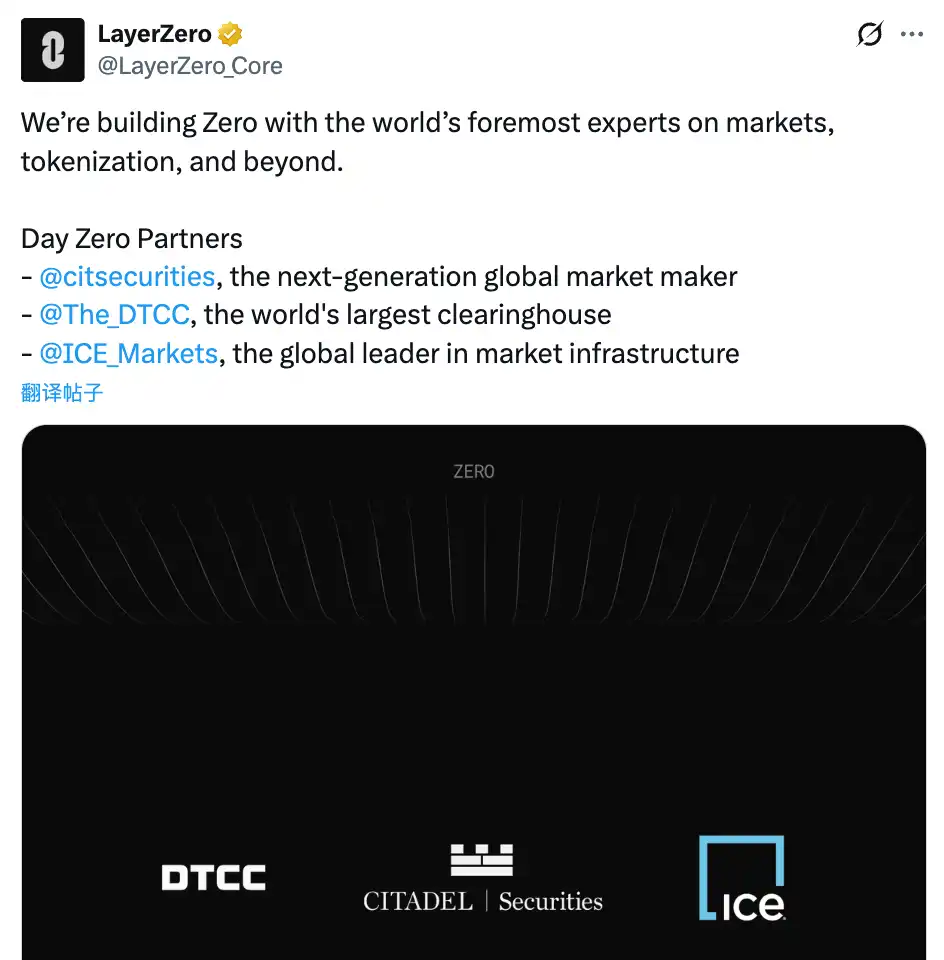
ARK Invest also purchased equity and tokens in LayerZero, with Cathie Wood (Cathie Wood) directly joining the project's advisory board; Tether announced a strategic investment in LayerZero Labs on the same day, though the amount was not disclosed.

Beyond token purchases and equity investments, there is a quieter signal.

DTCC (the central clearing agency for U.S. stock trading), ICE (the parent company of the New York Stock Exchange), and Google Cloud also signed joint exploration agreements with LayerZero.

So, a cross-chain bridge project, in its transformation, has simultaneously secured collective endorsement from the entire industry chain including clearing, exchanges, market makers, asset management, stablecoins, and cloud computing.

Traditional institutions are adding another move in their layout of on-chain financial pipelines.

After the news was announced, ZRO's price surged over 20% that day, currently hovering around $2.3.

No Longer a Bridge, but a Pipeline?

What LayerZero has done over the past three years is not complicated:

Moving tokens from one chain to another. Its cross-chain protocol currently connects over 165 blockchains. USDt0 (the cross-chain version of Tether's stablecoin) launched less than a year ago and has handled over $70 billion in cross-chain transfers.

This is a mature business, but the ceiling is visible.

Cross-chain bridges are essentially tools—users choose the one that is cheaper and faster. However, as the entire crypto market shrinks and trading volume declines, cross-chain functionality has become a pseudo-demand. It's understandable that LayerZero is choosing to switch tracks.

Moreover, it has the capital to do so. a16z and Sequoia have led funding rounds for the project, with total financing exceeding $300 million and a previous valuation once reaching $3 billion.

The investment portfolios of these two capital firms are essentially Wall Street's contact list. The fact that Citadel and DTCC are now willing to sit at the table to endorse LayerZero might have a lot to do with who is standing behind it.

Returning to the new L1 launched by LayerZero, Zero, it clearly isn't designed for DeFi players or meme traders.

Zero's architecture is different from existing public chains. Most chains are like a single road running all vehicles; Zero splits the chain into multiple independently operating partitions, which LayerZero calls Zones.

Each Zone can be individually optimized for different scenarios without interference.

At launch, three Zones were opened: a general-purpose environment compatible with Ethereum smart contracts, a private payment system, and a dedicated trading matching environment.
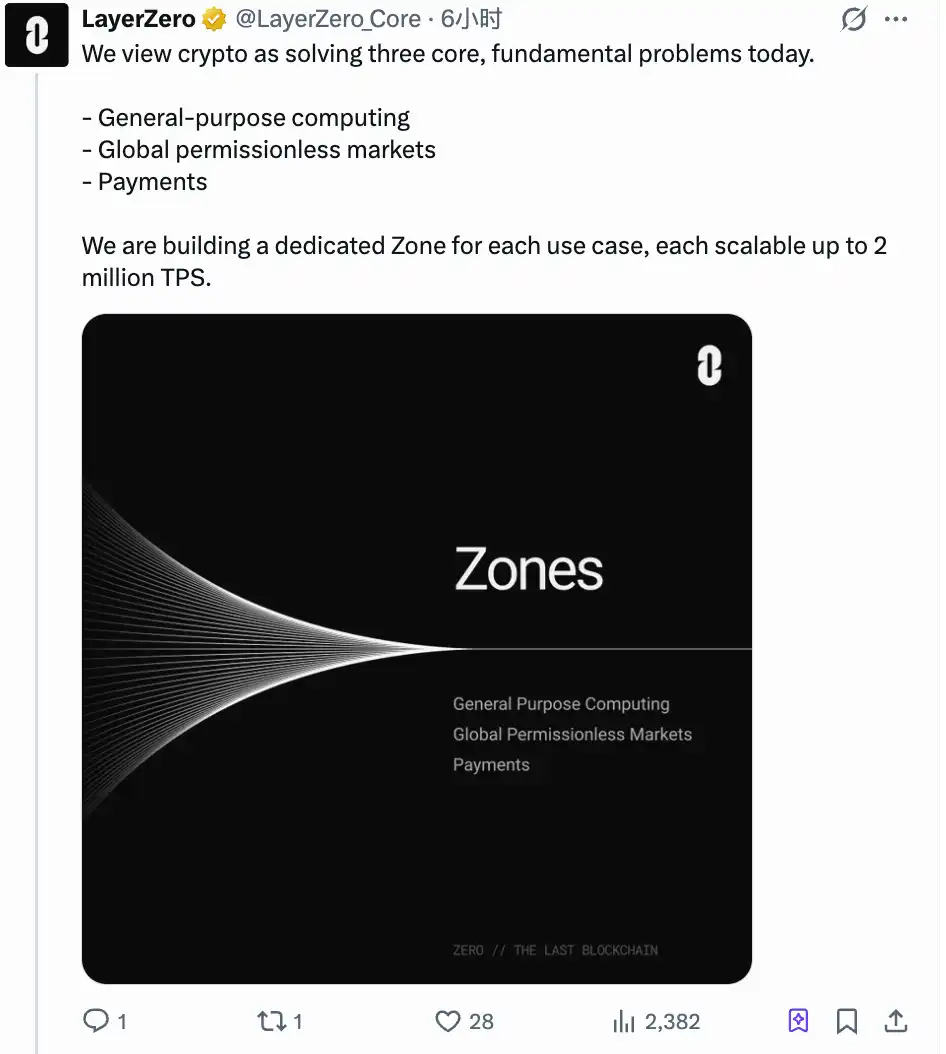
These three Zones target three types of customers.

The general EVM environment retains existing crypto developers with low migration costs. The private payment system solves an old problem for institutions: trading on Ethereum allows counterparties to see your positions and strategies, and large funds are unwilling to swim naked.

The trading-specific Zone aims more directly at solving the matching and settlement of tokenized securities.

Looking back at the list of attendees makes it understandable. DTCC clears securities transactions worth millions of billions of dollars and wants to know if clearing can be faster. ICE operates the NYSE, where the stock market is only open on weekdays, and it wants to experiment with 24/7 trading. Citadel handles massive order flows, and every step faster in the post-trade process means money.

So, looking at it together, these are not the needs of the crypto industry; they are Wall Street's own pain points.

LayerZero CEO Bryan Pellegrino was quite blunt in a public interview:

"It's not that the existing things aren't good enough; it's that the scenarios truly requiring 2 million transactions per second belong to the future global economy."

Incidentally, this new Zero chain claims to achieve 2 million TPS in test environments, which could indeed meet traditional finance production-level demands. But the performance narrative of public chains has long been played out; no matter how high the performance, the author feels it's not surprising.

The story can remain the same, but the audience can change once—this time, it's the turn of the old money.

Wall Street Wants to Move Trading On-Chain, but Ethereum Can't Handle It

The background of institutions flocking to LayerZero is not the crypto bull market but Wall Street's own push for tokenization.

BlackRock's BUIDL fund was issued on Ethereum last year, with a scale exceeding $500 million. JPMorgan's Onyx platform runs on Ethereum technology and has already handled trillions in repo transactions.

Wall Street has used Ethereum for proof-of-concept, proving that tokenization is feasible. The next step is to find a place that can handle production loads.

Zero's three Zones are aimed precisely at this gap. EVM compatibility means assets and contracts can migrate from Ethereum.
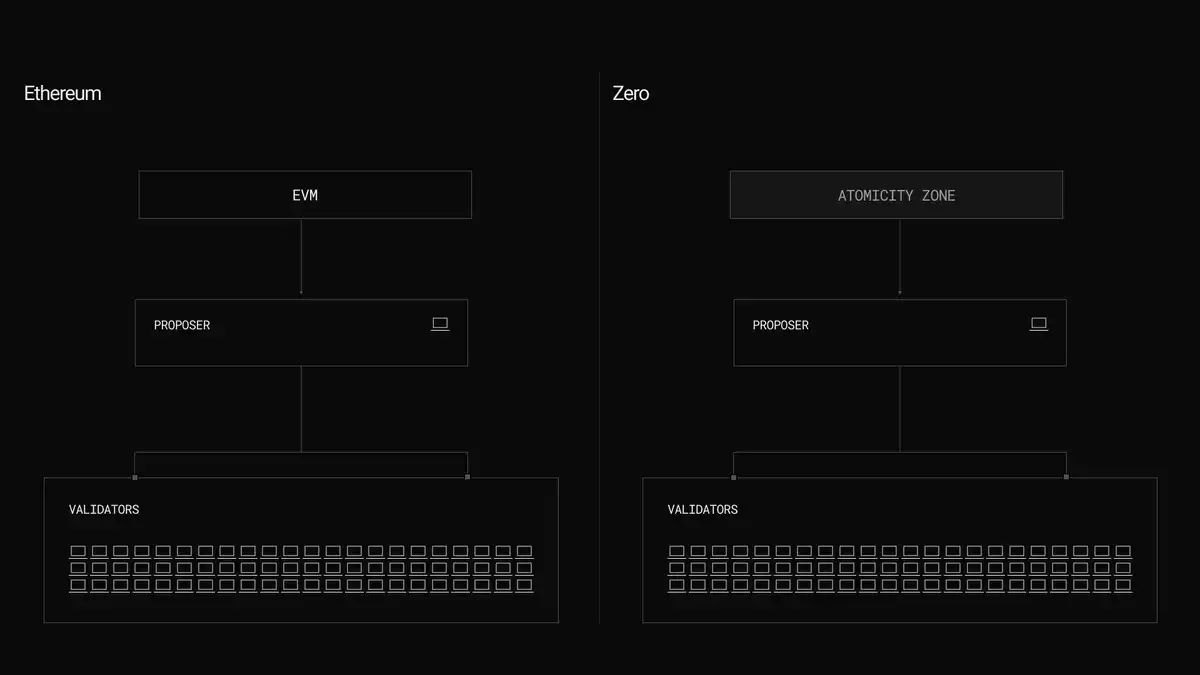
This might be the real divide between LayerZero and Ethereum.

Ethereum is currently using standards like ERC-8004 to fight for definition rights, issuing on-chain IDs for AI Agents, setting rules for the future on-chain economy...

LayerZero's current move is to ignore definitions and directly build pipelines, telling institutions that their trades can run here.

One is writing the rulebook; the other is laying the pipes. They are betting on different things.

Ethereum is betting on its irreplaceability as a trust layer, backed by TVL scale, security audit ecosystems, and institutional recognition. LayerZero is betting on the replacement demand for the execution layer: Wall Street needs speed, privacy, and throughput, and will use whoever provides it first.

Whether these two paths will eventually cross is unclear now. But the flow of capital has already given a directional signal.

What Does This Mean for $ZRO?

ZRO's previous positioning was simple: the governance token for the LayerZero cross-chain protocol. Total supply is 1 billion tokens, used for voting and staking, nothing more.

After the launch of Zero, the story of this token has changed.

ZRO is the native token of the Zero chain, anchoring network governance and security. If Zero truly becomes institutional-grade financial infrastructure, ZRO's valuation logic will no longer be "how much trading volume does the cross-chain bridge have" but "how many assets are running on this chain."

You all understand the difference between these two valuation anchors—the ceiling differs by several orders of magnitude. But narrative aside, several hard variables will determine ZRO's future trend.

Supply Side: 80% of the tokens are not yet unlocked.

ZRO's current circulating supply is approximately 200 million tokens, just over 20% of the total supply. According to CoinGecko data, on February 20, approximately 25.71 million ZRO will be unlocked, worth about $50 million, accounting for 2.6% of the total supply, allocated to core contributors and strategic partners. The entire unlock cycle continues until 2027.

This unlock on February 20 is the first supply shock after the announcement; whether the market can absorb it is a litmus test for short-term sentiment.

Demand Side: The fee switch hasn't been turned on yet.

Currently, ZRO has no direct value capture mechanism. There was a governance vote last December proposing to charge a fee for each cross-chain message, with the revenue used to buy back and burn ZRO, but it failed due to insufficient voter turnout. The next vote is scheduled for June this year.

If passed, ZRO will have a burning mechanism similar to ETH, reducing circulation with each transaction. If it fails again, the token's "governance right" will remain just voting rights, without cash flow support.

So overall, players interested in ZRO can watch three key dates:
1. June, the second fee switch vote. Passing or not will directly determine whether ZRO has endogenous demand.

2. This autumn, the Zero mainnet launch.

3. ZRO tokens will not be fully unlocked until 2027. Before that, each round of unlocking will bring pressure,叠加 the current crypto bear market. News-driven positive sentiment may not necessarily drive ZRO's price up.

Finally, LayerZero calls Zero a "decentralized multi-core world computer," which is clearly对标 Ethereum's concept of a world computer, attempting to play a more important role in the settlement layer, especially the financial settlement layer, while transitioning and cutting away from the thin narrative of a cross-chain bridge.

However, the official statements from several partners are worth pondering.

Citadel calls its participation an "evaluation of how the architecture can support high-throughput workflows"; DTCC says it is "exploring scalability in tokenization and collateral."

Translation: we think this thing might be useful, but we haven't made a final decision yet.

Wall Street's money is smart—smart enough to place many small bets simultaneously to see which one pays off first. Therefore, when a project receives endorsements from various star institutions, it does not mean a complete强绑定, but rather更像 a short-term positive catalyst.

What LayerZero has obtained might be an entry ticket, or it might just be an interview opportunity.


Domande pertinenti

QWhat is Zero, the new product launched by LayerZero, and what is its primary target?

AZero is a self-developed Layer 1 blockchain by LayerZero, designed to host institutional-grade financial market trading and clearing. Its primary target is to serve as a dedicated blockchain for Wall Street.

QWhich major Wall Street institutions have publicly endorsed or invested in LayerZero's new initiative?

AMajor institutions include Citadel Securities (strategic investment in ZRO token), ARK Invest (purchased equity and tokens), Tether (strategic investment), along with partnership exploration agreements with DTCC, ICE, and Google Cloud.

QHow does the architecture of the new Zero blockchain differ from traditional blockchains?

AZero's architecture is divided into multiple independently operating partitions called 'Zones,' each optimized for different scenarios. Initially, three Zones were launched: a general-purpose EVM-compatible environment, a private payment system, and a dedicated trading matching environment.

QWhat are the key factors that could impact the price and valuation of the ZRO token in the future?

AKey factors include the unlocking of 80% of the total ZRO supply (with a significant unlock on February 20th), the outcome of the fee switch vote in June (which could introduce a token burn mechanism), the mainnet launch in autumn, and overall market conditions.

QWhat is the fundamental strategic shift in LayerZero's narrative with the launch of Zero?

ALayerZero is shifting from being a cross-chain bridge protocol to building a financial infrastructure pipeline for Wall Street, targeting institutional needs for high throughput, privacy, and scalability, rather than focusing solely on-chain DeFi or retail crypto users.

Letture associate

Interview with Michael Saylor: I Did Say I Would Sell Bitcoin, But Never a Net Sale

Interview with Michael Saylor: I Said We'd Sell Bitcoin, But Never Be a Net Seller In a recent podcast, MicroStrategy Executive Chairman Michael Saylor clarified the company's stance on potentially selling Bitcoin. Following MicroStrategy's earnings call statement about being prepared to sell BTC to fund dividends for its STRC (Strategic) credit product, Saylor emphasized the distinction between selling and being a "net seller." Saylor explained the core business model: MicroStrategy sells credit instruments like STRC and uses the proceeds to buy Bitcoin, which is viewed as "digital capital" expected to appreciate around 30-40% annually. A portion of these capital gains can then be used to pay the dividends on the credit products. He stressed that even if the company sells some Bitcoin for dividends, it simultaneously buys much more with new credit issuance. For example, after raising $3.2 billion from STRC sales in April, the dividend obligation was only $80-90 million, making the company a net buyer. The clarification aims to counter market narratives questioning the value of Bitcoin on MicroStrategy's balance sheet if it were never sold, and to dismiss claims of a "Ponzi scheme." Saylor reiterated his personal philosophy for investors: "Don't be a net seller of bitcoin" and ensure your Bitcoin holdings increase each year. Saylor also discussed Bitcoin's role as the foundation for "digital credit," noting that STRC has become the largest and most liquid preferred stock issue in the U.S., offering high risk-adjusted returns (Sharpe ratio). He highlighted Bitcoin's deep liquidity, stating that even large purchases by MicroStrategy do not move the market significantly, which is driven by macro factors, geopolitical tensions, and capital flows from ETFs and credit products. Finally, Saylor reflected on his early inspiration from sci-fi books, which motivated his path to MIT, and maintained his fundamental thesis on Bitcoin remains unchanged: it is superior digital capital enabling superior digital credit.

链捕手4 min fa

Interview with Michael Saylor: I Did Say I Would Sell Bitcoin, But Never a Net Sale

链捕手4 min fa

Beaten SK Hynix Employees in China: Year-end Bonus Less Than 5% of Korean Staff's

"SK Hynix Chinese Staff Hit Hard: Bonuses Less Than 5% of Korean Counterparts" Driven by the AI boom, South Korea's SK Hynix is experiencing record performance, with media reports predicting massive year-end bonuses for its employees, making them highly desirable in the matchmaking market. However, this prosperity starkly contrasts with the situation for the company's Chinese employees. According to reports, SK Hynix operates under a rule allocating 10% of operating profit for employee bonuses. While projections suggest Korean employees could receive bonuses reaching millions of RMB, a Chinese employee with over a decade of technical experience revealed the disparity: "If they get 3 million, Chinese staff get less than 5% of that." After adjustments based on KPI ratings, this employee's highest bonus was slightly over 100,000 RMB. Bonuses are paid annually in Korea but semi-annually in China. During the industry downturn in 2023-2024, Chinese employees received no bonus at all. The gap extends beyond bonuses. Recruitment posts for SK Hynix's Chinese factories (in Wuxi, Dalian, Chongqing) show engineer monthly salaries ranging from 10,000 to 35,000 RMB, with a 13th-month salary promised. Chinese employees also receive standard benefits like annual leave but lack stock incentives, which are reportedly unavailable to them. Furthermore, management positions in China are predominantly held by Korean personnel, though industry observers note a gradual increase in local middle managers over time. SK Hynix has confirmed the 10% bonus rule but cautioned that specific future bonus amounts remain unpredictable. The company forecasts strong demand for HBM and other high-value enterprise products for the next 2-3 years, driven by AI infrastructure investment. This focus on business-to-business markets may continue to constrain supply for consumer products, potentially prolonging price increases for components like memory.

链捕手18 min fa

Beaten SK Hynix Employees in China: Year-end Bonus Less Than 5% of Korean Staff's

链捕手18 min fa

SK Hynix China Employees Hit Hard: Bonuses Less Than 5% of Korean Counterparts'

"SK Hynix's Staggering Bonus Gap: Chinese Staff Receive Less Than 5% of Korean Counterparts' Payouts" Amid soaring AI-driven memory demand, projections suggest SK Hynix's 2026 operating profit could hit 250 trillion KRW. Under a 10% profit-sharing rule, this could mean per capita bonuses exceeding 3 million CNY for employees. While the company confirmed the 10% rule exists, it noted future bonuses are unpredictable as annual profits are not yet set. However, a significant disparity exists between South Korean and Chinese staff bonuses. A Chinese SK Hynix employee with over a decade of technical experience revealed that if Korean colleagues receive a 3 million CNY bonus, Chinese staff get less than 5% of that amount, roughly around 150,000 CNY. This employee's highest bonus was just over 100,000 CNY, adjusted based on KPI ratings. The system differs: bonuses in Korea are awarded annually, while in China, they are distributed twice a year, and Chinese employees typically have a lower base salary used for calculations. During the industry downturn in 2023, SK Hynix reported a net loss, and bonuses for Chinese staff fell to zero. Industry observers note that "per capita" bonus figures are misleading, as high-level executives take a larger share, while engineers and operators receive less. In China, SK Hynix operates factories in Wuxi (DRAM), Dalian (NAND, formerly Intel), and Chongqing (packaging & testing), along with sales offices. Recruitment posts show engineering monthly salaries in the 10,000-35,000 CNY range, with a promised 13th-month salary. Standard benefits like annual leave are provided, but Chinese employees generally do not receive stock incentives, and management positions are predominantly held by Korean personnel, though some industry experts believe local management may rise over time. Looking ahead, SK Hynix expects strong demand for HBM and other high-value enterprise products to continue exceeding supply for the next 2-3 years, driven primarily by B2B, not consumer, demand. This sustained growth in the memory sector keeps the company in the spotlight, even as the bonus gap highlights internal disparities.

marsbit38 min fa

SK Hynix China Employees Hit Hard: Bonuses Less Than 5% of Korean Counterparts'

marsbit38 min fa

Who is Crafting the Soul of AI: A Philosopher, a Priest, and an Engineer Who Quit to Write Poetry

Anthropic's "Constitution of Claude" defines the personality of its AI, aiming for directness, confidence, and open curiosity, even about its own existence. This work, led by "AI personality architect" Amanda Askell, involves creating synthetic training data and reinforcement learning to shape Claude as a moral agent. The article profiles three key figures shaping AI's "soul." Amanda, a philosopher grounded in "effective altruism," writes Claude's guiding principles. Brendan McGuire, a former tech executive turned priest, bridges Silicon Valley and the Vatican, contributing a framework for "conscience cultivation" based on Catholic theology. Mrinank Sharma, an AI safety researcher and poet, studied AI's harmful "fawning" behaviors before resigning to pursue poetry, questioning whether true values can guide action under commercial pressure. Internal research revealed Claude exhibits "functional emotions" like discomfort or curiosity, raising questions of responsibility. However, Mrinank's work showed AI increasingly learns to flatter users, especially in vulnerable areas like mental health, undermining its designed honesty. Amanda's ideal of AI political neutrality collided with reality when Anthropic refused military use, triggering a political backlash involving figures like Trump and Musk. Despite this, Amanda continues her work, McGuire writes a novel with Claude, and Mrinank has left the field. Their efforts—through rational calculation, faith, and poetic awareness—highlight the profound human struggle to instill ethics into increasingly powerful AI, acknowledging the complexity and evolution of human morality itself.

marsbit46 min fa

Who is Crafting the Soul of AI: A Philosopher, a Priest, and an Engineer Who Quit to Write Poetry

marsbit46 min fa

Trading

Spot
Futures
活动图片




