Law Firm Behind FTX Legal Work Now Facing $525M Suit

bitcoinistPubblicato 2026-05-15Pubblicato ultima volta 2026-05-15

Introduzione

A federal lawsuit seeks $525 million from Silicon Valley law firm Fenwick & West for its alleged central role in facilitating FTX's fraud. A bankruptcy examiner found the firm "deeply intertwined" in FTX's wrongdoing, creating shell companies like North Dimension to funnel over $3 billion, drafting backdated agreements, and implementing FTX's auto-delete messaging policy on Signal. The suit, filed by 20 international victims, claims Fenwick's involvement lent FTX false legitimacy, preventing investors from withdrawing savings. It cites former FTX engineer Nishad Singh, who testified he directly told Fenwick attorneys about misuse of customer funds, after which the firm allegedly advised on concealment. The complaint includes claims of malpractice and fraud, targeting both the firm and two individual partners. This follows the recent rejection of Sam Bankman-Fried's bid for a new trial.

A court-appointed bankruptcy examiner found that Fenwick & West was “deeply intertwined in nearly every aspect of FTX Group’s wrongdoing” — and now that finding sits at the heart of a $525 million federal lawsuit filed against the Silicon Valley law firm.

Shell Companies And Deleted Messages

Twenty victims of the FTX collapse, coming from five countries, filed the complaint Wednesday in the US District Court for the District of Columbia.

They say they lost their life savings when the exchange went under in November 2022, and that Fenwick’s involvement gave FTX a false sense of legitimacy that kept them from pulling their money out in time. Six individual defendants are named alongside the firm.

The examiner’s conclusions came after a review of more than 200,000 documents in the federal bankruptcy proceedings.

According to the lawsuit, the examiner found that Fenwick created corporate structures for both FTX and its sister trading firm Alameda Research, formed shell entities to hide money movements, and drafted backdated agreements to cover up illicit transfers.
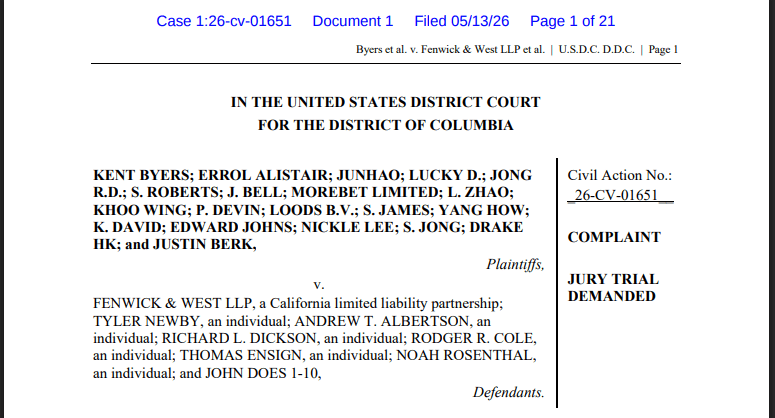
Source: Court Listener

Two specific acts are described in detail. Reports indicate Fenwick attorneys set up North Dimension Inc., a Delaware shell company that posed as an electronics retailer while allegedly funneling over $3 billion in stolen customer funds.

The firm also reportedly put in place FTX’s auto-delete messaging policy on the Signal app — the same system federal prosecutors say helped the fraud go undetected.

A Witness From Inside FTX

Nishad Singh, FTX’s former Director of Engineering, adds another layer to the case. Singh pleaded guilty to fraud charges and testified against Sam Bankman-Fried at his criminal trial.

According to the lawsuit, Singh told Fenwick attorneys directly that customer funds were being misused. Rather than walking away, the firm allegedly advised on how to conceal it.

BTCUSD now trading at $79,806. Chart: TradingView

After FTX filed for bankruptcy, Fenwick quietly scrubbed all references to the exchange from its website. The firm also retained defense lawyers from Gibson Dunn before any civil lawsuit had been filed against it.

Damages And Individual Defendants

The plaintiffs are bringing seven claims, including malpractice, fraud, and gross negligence. They are seeking compensatory damages above $525 million, a return of all legal fees Fenwick collected from FTX, and punitive damages against two named partners — Tyler Newby and Daniel Friedberg — for what the complaint calls deliberate and reckless individual professional conduct.

Meanwhile, Bankman-Fried’s own legal efforts have stalled. A federal judge last month rejected his bid for a new trial, dismissing his claims of new evidence as baseless.

Judge Lewis Kaplan, who sentenced Bankman-Fried to 25 years in prison in 2024, said his arguments were “wildly conspiratorial and entirely contradicted by the record.”

Featured image from WealthBuilders, chart from TradingView

Domande pertinenti

QAccording to the lawsuit, what specific actions did the court-appointed bankruptcy examiner find Fenwick & West to be involved in with FTX?

AThe examiner found that Fenwick & West was 'deeply intertwined in nearly every aspect of FTX Group’s wrongdoing,' including creating corporate structures for FTX and Alameda Research, forming shell entities to hide money movements, and drafting backdated agreements to cover up illicit transfers.

QWho is named as a key witness from inside FTX in the lawsuit against Fenwick & West, and what is the significance of his testimony?

ANishad Singh, FTX's former Director of Engineering, is named. He pleaded guilty to fraud and testified that he directly told Fenwick attorneys customer funds were being misused. The lawsuit alleges the firm then advised on how to conceal it rather than withdrawing.

QWhat are the plaintiffs in the lawsuit seeking from Fenwick & West and the named individual partners?

AThe plaintiffs are seeking compensatory damages above $525 million, a return of all legal fees Fenwick collected from FTX, and punitive damages against two named partners, Tyler Newby and Daniel Friedberg, for alleged deliberate and reckless professional conduct.

QWhat were two specific acts allegedly performed by Fenwick attorneys detailed in the complaint?

AFirst, they set up the Delaware shell company North Dimension Inc., which allegedly funneled over $3 billion in stolen customer funds while posing as an electronics retailer. Second, they reportedly implemented FTX’s auto-delete messaging policy on Signal, which helped conceal the fraud.

QWhat recent development is mentioned regarding Sam Bankman-Fried's legal situation?

AA federal judge, Lewis Kaplan, last month rejected Sam Bankman-Fried's bid for a new trial, dismissing his claims of new evidence as 'wildly conspiratorial and entirely contradicted by the record.' Judge Kaplan had sentenced him to 25 years in prison in 2024.

Letture associate

Sevenfold Oversubscription, Can SK Hynix Save the Semiconductor Industry This Time?

SK Hynix's planned US ADR listing is drawing intense interest, with its offering reportedly oversubscribed by over seven times, potentially making it the largest foreign listing in US history. The fundraising of approximately $24.5 billion is intended for expanding its Korean production capacity, including advanced packaging and EUV equipment. This massive demand from long-term funds and prominent institutions like Baillie Gifford and Situational Awareness Partners (led by noted investor Leopold Aschenbrenner) presents a stark contrast to the recent downturn in the broader semiconductor sector. The sector has faced a significant correction, with SK Hynix's own stock falling nearly 30% from its June high. This sell-off was triggered by concerns that major tech giants might slow their AI infrastructure spending, following signals like Meta's reported plan to sell surplus computing capacity. The strong ADR appetite suggests long-term investors still believe in the AI investment cycle's fundamentals, viewing the recent decline more as a valuation reset than a demand collapse. Some market speculation even suggests the pre-IPO price drop could be strategic, setting the stage for a stronger post-listing performance. While SK Hynix's successful listing may act as a short-term positive catalyst for market sentiment, the article argues the true signal for a sustained semiconductor recovery will come from upcoming earnings reports of tech giants like Microsoft, Google, Meta, and Amazon. Their future capital expenditure plans will be crucial in determining whether the AI-driven growth cycle can continue.

Odaily星球日报30 min fa

Sevenfold Oversubscription, Can SK Hynix Save the Semiconductor Industry This Time?

Odaily星球日报30 min fa

Breaking News: Musk Delivers the Most Powerful Grok 4.5, Slashes Price of Top-tier Opus Intelligence Drastically

**Elon Musk Launches Grok 4.5: A Cost-Effective, High-Performance AI Rival** SpaceXAI, in collaboration with Cursor, has released Grok 4.5, its new flagship AI model designed specifically for coding and agentic tasks. Trained on tens of thousands of NVIDIA GB300 GPUs using massive, high-quality data filtered from trillions of Cursor developer interactions, the model emphasizes "per-token intelligence." In benchmark performance, Grok 4.5 is highly competitive. It scores 64.7% on SWE Bench Pro (surpassing GPT-5.5's 58.6% and Opus 4.7's 64.3%), 83.3% on Terminal Bench 2.1 (nearly matching GPT-5.5), and 62.0% on DeepSWE 1.0 (beating Opus 4.8). Overall, it ranks fourth in AAAI official tests and first in the Harvey legal agent benchmark. The model's key advantage is its combination of speed, efficiency, and low cost. It generates responses at 80 tokens per second and, crucially, uses far fewer tokens to complete tasks—4.2 times fewer than Opus 4.8 on SWE Bench Pro. It is priced at $2 per million input tokens and $6 per million output tokens, significantly undercutting competitors. Musk stated it is "roughly equivalent to Opus 4.7, but much faster." Early user tests show Grok 4.5 can generate functional code for applications like 3D solar system simulators and basic games from simple prompts, though some note it still lags behind top models in certain creative tasks. Musk has hinted at a major update next month, leveraging real-world engineering data from his companies, with an even larger 2-trillion parameter version reportedly in development. Grok 4.5 positions itself not as the absolute strongest model, but as a highly efficient and affordable alternative in the top tier.

marsbit34 min fa

Breaking News: Musk Delivers the Most Powerful Grok 4.5, Slashes Price of Top-tier Opus Intelligence Drastically

marsbit34 min fa

Today, The Hong Kong Exchange Was Once Again Overwhelmed

Hong Kong's stock exchange witnessed an exceptionally busy day on July 9, with a record seven companies conducting initial public offerings (IPOs) simultaneously. The list included major firms such as Luxshare Precision, which launched the largest Hong Kong IPO of the year, and other notable names like Tri-Ring Group and Qiyunshan Food. However, the market reception was sharply divided on the first trading day. While Qiyunshan Food's shares surged over 110%, several other newcomers, including Luxshare Precision, Dingtai High-Tech, and Rigol Technologies, opened below their issue prices, with some falling nearly 20%. This event highlights a broader, bustling IPO scene in Hong Kong for 2024, with 82 Chinese companies listing in the first half alone—more than double the figure from the same period last year. A significant portion of this activity comes from dual "A+H" listings, where mainland China-listed firms seek secondary listings in Hong Kong. These larger companies have accounted for nearly 60% of total fundraising. Despite the high volume, recent trends show a cooling market sentiment for many new listings. Several IPOs in early July, including that of Tongrentang Healthcare, debuted with significant losses, indicating increased investor caution and selectivity. The market narrative is shifting, with capital increasingly concentrating on high-growth sectors like artificial intelligence, robotics, and semiconductors, while traditional manufacturing and consumer goods face greater pressure and volatility. This divergence underscores a market where success is no longer guaranteed by merely listing, but depends heavily on a company's growth prospects and sector appeal.

marsbit38 min fa

Today, The Hong Kong Exchange Was Once Again Overwhelmed

marsbit38 min fa

Glassnode: Crypto Market Enters Later Stages of Bottoming Phase

Glassnode: Crypto Market Enters Later Stages of Bottom Formation Bitcoin has traded below the true market average and the short-term holder cost basis for five consecutive months, indicating a deep undervaluation. On-chain data reveals a significant shift in selling pressure, with long-term holders now accounting for 43% of all realized losses. Daily realized losses for this group recently peaked at $280 million, the highest level since December 2022. While this large-scale capitulation is a hallmark of bear market bottoms, a sustained decline in this metric is a prerequisite for a sustained recovery. Institutional demand remains weak. US spot Bitcoin ETFs continue to see monthly net outflows, although the pace has moderated from June's peak. Furthermore, average daily ETF trading volumes have contracted by approximately 80% from their October 2025 peak, reflecting subdued institutional participation. Derivatives markets present a mixed picture. Overall positioning has shifted to cautiously bullish, with the put/call ratio dropping to a yearly low. However, the options volatility skew remains elevated, signaling that traders are still paying a premium for downside protection. The spot price also trades below the gamma "max pain" level. In summary, multiple indicators suggest the market is in the later phases of a bottoming process, characterized by long-term holder capitulation and weak institutional inflows. However, key confirmation signals for a durable trend reversal—a sustained drop in long-term holder selling pressure, stabilization of ETF flows, and a price recovery above key cost bases—are still pending.

Foresight News1 h fa

Glassnode: Crypto Market Enters Later Stages of Bottoming Phase

Foresight News1 h fa

Trading

Spot
活动图片