Author: Rita
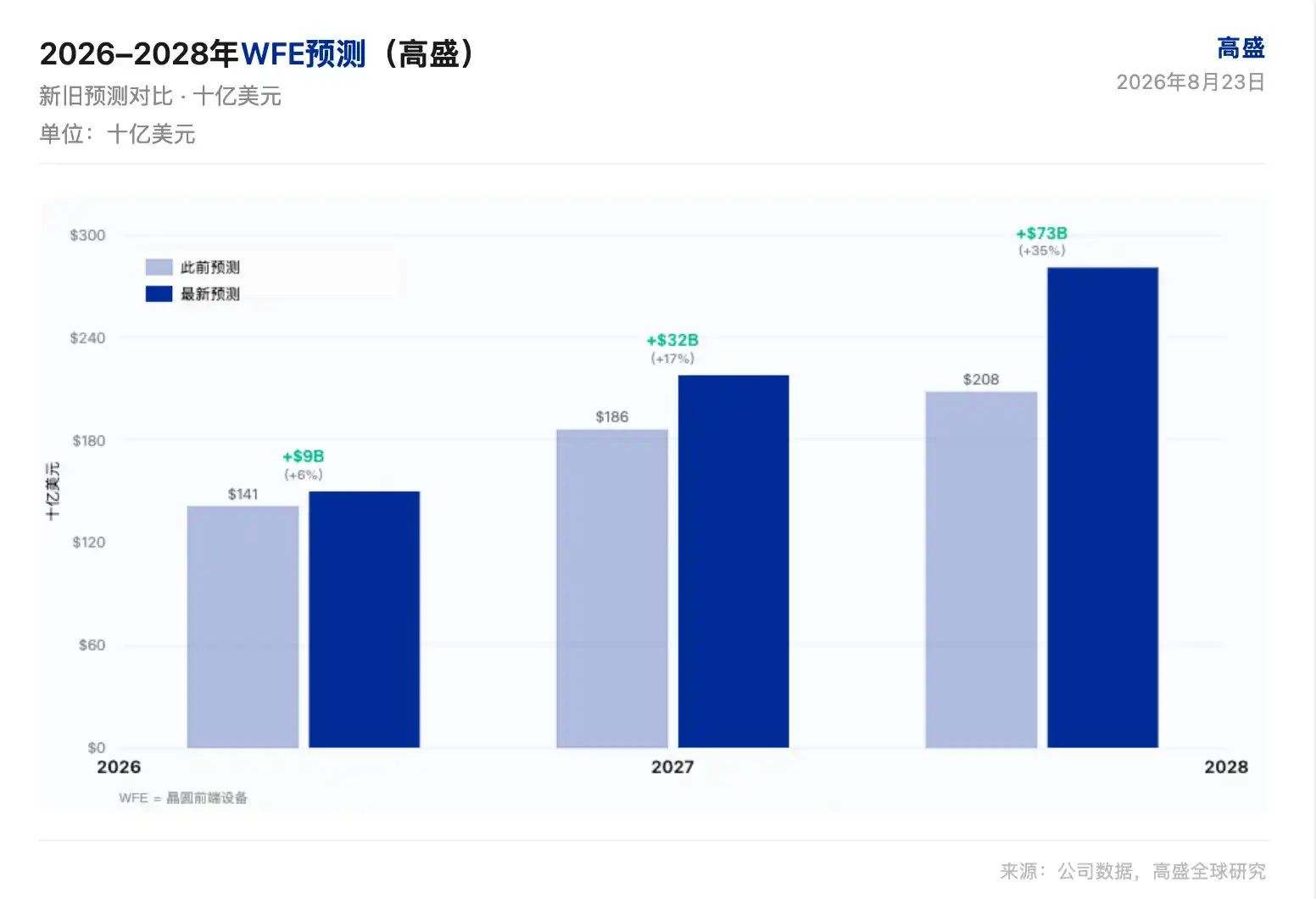
On August 23rd, Goldman Sachs released a global semiconductor capital equipment industry report, significantly revising its Wafer Front-end Equipment (WFE) forecast upward to $150 billion, $218 billion, and $281 billion for the years 2026 to 2028, representing increases of 6%, 17%, and 35% over previous projections. The revised year-over-year growth rates for the three-year period are 36%, 45%, and 29%, up from previous expectations of 28%, 32%, and 12%.
Goldman Sachs attributes this revision primarily to near-term demand driven by DRAM and advanced node foundry production, with NAND and logic/other (including Terafab) expected to sustain growth in the medium term. The simultaneous expansion of both memory and logic sectors indicates the demand base for the equipment industry is shifting from a singular structure to multi-faceted drivers.
DRAM Equipment Spending Accelerates, Capacity Constraints to Extend into 2028
DRAM represents the segment with the largest upward revision. Goldman Sachs raised its WFE forecast for 2026-2028 from $46 billion, $67 billion, and $74 billion to $48 billion, $72 billion, and $97 billion, with year-over-year growth rates revised from 45%, 45%, 10% to 50%, 50%, and 35%. Capital expenditure forecasts for Samsung and SK Hynix were raised by 22% and 19%, respectively.
HBM4 is the direct catalyst for the concentrated upward revision in DRAM capital expenditure. Compared to HBM3, HBM4 utilizes a more advanced packaging architecture, demanding higher Through-Silicon Via (TSV) density, finer micro-bump pitch, and superior thermal management capabilities. This implies significantly higher investment in etching, deposition, and inspection equipment per 10,000 wafers per month of capacity. Goldman Sachs expects DRAM industry capacity constraints to persist into 2028 even as capital expenditure remains elevated, extending order visibility for equipment suppliers.
Synchronous Expansion in Foundry and Logic, with Terafab Contributing Incrementally
In the foundry sector, Goldman Sachs raised its WFE forecast for 2026-2028 from $52 billion, $68 billion, and $78 billion to $58 billion, $84 billion, and $109 billion, with growth rates revised from 30%, 30%, 16% to 45%, 45%, and 30%. TSMC's annual capital expenditure was raised by $8 billion, primarily driven by increased intensity of the N2 process node and customer demand.
N2 is TSMC's first production node to adopt the Gate-All-Around (GAA) transistor architecture. Compared to N3, N2 has higher process complexity, leading to a notable increase in the use of equipment such as EUV lithography, Atomic Layer Deposition, and selective etching. Goldman Sachs expects N2 to continue ramping in the coming quarters, driving equipment procurement across the supply chain. The equipment intensity for advanced node foundries is significantly higher than for mature nodes, with each node transition demanding higher equipment investment per unit of capacity.
The upward revision for the logic/other sector's WFE is also substantial. The forecast for 2026-2028 was raised from $32 billion, $35 billion, and $37 billion to $34 billion, $47 billion, and $53 billion, with growth rates revised from 5%, 9%, 6% to 11%, 40%, and 12%. The incremental growth stems from two key areas: stronger-than-expected demand from Intel, and a recovery in mature nodes and analog markets.
Terafab emerges as a significant new variable in this forecast. Goldman Sachs has incorporated the initial phase equipment investment of approximately $16.8 billion committed by SpaceX and Tesla for Terafab into the logic/other WFE projection. Terafab's initial equipment procurement spans the full spectrum, including lithography, etching, deposition, and inspection, overlapping heavily with the equipment needs of logic chip foundries. Terafab contributes the majority of the incremental growth in the logic/other segment. Goldman Sachs views Terafab's impact as still in its early stages, suggesting further upside potential as subsequent phases materialize.
For NAND, Goldman Sachs maintained its 2026-2028 forecast at $11 billion, $15 billion, and $22 billion, while revising the 2027 projection down from $17 billion to $15 billion, mainly due to adjustments in the capital expenditure pace of certain manufacturers. The firm expects recent NAND equipment spending to focus on technology upgrades, with a tight supply-demand balance persisting into 2027.
Equipment Suppliers Poised to Benefit Broadly from WFE Upside
Goldman Sachs holds a bullish view on global semiconductor equipment stocks. Key recommendations include Applied Materials, Lam Research, ASML, Tokyo Electron, ASMI, BE Semiconductor Industries (Besi), Lasertec, and Ebara.
DRAM capacity expansion drives demand for etching and deposition equipment, with Applied Materials and Lam Research as primary beneficiaries. HBM4's extremely high precision requirements for TSV etching and copper fill deposition align with these companies' leading technology in relevant process steps, providing clear order visibility.
The ramp of the N2 foundry node fuels lithography equipment procurement. Demand for ASML's EUV and DUV lithography tools continues to rise. N2 requires approximately 20% more EUV layers compared to N3, with each layer needing a higher exposure dose, directly increasing lithography equipment consumption. Inspection equipment supplier Lasertec benefits from the expansion in both DRAM and logic segments. In advanced packaging and test equipment, Besi and Ebara benefit from the increased complexity of HBM packaging.
Goldman Sachs' revision extends beyond numbers to a revised view of the industry cycle. The synchronous expansion across the four major sectors—DRAM, foundry, NAND, and logic—coupled with the initial contributions from Terafab, suggests the growth foundation for the equipment industry is transitioning from singular structural recovery to diversified drivers. Order visibility and profit margins for equipment suppliers are on an upward trajectory.

Disclaimer
This article is a compilation and interpretation by Chaoxiang Research of a third-party brokerage research report (Goldman Sachs, August 23, 2026), combined with publicly available market information. The ratings, target prices, earnings forecasts, and related judgments cited herein represent the views of the respective analysts and their institutions and do not reflect the views of Chaoxiang Research, nor do they constitute any investment advice.
Markets involve risks, and investment decisions should be made independently. This article should not be used as the basis for trading any securities.