LAB’s 23% price crash meets bearish bets – Can bulls defend $13?

ambcryptoPubblicato 2026-06-29Pubblicato ultima volta 2026-06-29

Introduzione

LAB's price plummeted over 23% in 24 hours, trading near $13.53 as bearish sentiment dominated. Despite the sharp decline, on-chain data shows ongoing token accumulation, with negative spot exchange netflows indicating holders are moving LAB to private wallets rather than selling. However, this has not offset broader selling pressure. Technically, LAB is testing the lower support of its ascending channel near $13. A break below could target the $12 demand zone. Indicators like the MACD and Parabolic SAR remain bearish. In derivatives markets, a negative funding rate shows sustained short interest, though this creates potential for a short squeeze if buyers return. In summary, LAB faces heavy selling pressure with key channel support at risk. A successful defense of $13 could stabilize the price, while a breakdown would likely target $12 next.

LAB extended its decline after losing more than 23% of its value over the past 24 hours, reflecting persistent selling pressure across the market. Trading volume also declined by 35.01% to $32.2 million, showing that participation cooled even as the token registered another sharp decline.

The asset traded around $13.53 at the time of writing, leaving its market capitalization at $4.22 billion after another wave of losses. However, the decline arrived after LAB failed to sustain its earlier recovery within an ascending channel.

Why are traders still accumulating LAB?

Spot exchange activity continued reflecting accumulation rather than aggressive distribution despite the ongoing price decline.

CoinGlass data showed another $420.21K in negative spot netflows on the 29th of June, meaning more LAB left exchanges than entered them. That trend suggested holders still preferred moving tokens into private wallets instead of preparing them for immediate sale.

However, the relatively modest outflow failed to offset the broader bearish sentiment dominating the market. Buyers showed limited urgency despite declining exchange balances, leaving sellers with enough control to push prices lower.

As a result, exchange flows continued supporting reduced sell-side supply, yet price action remained largely dictated by weak demand across the broader market.
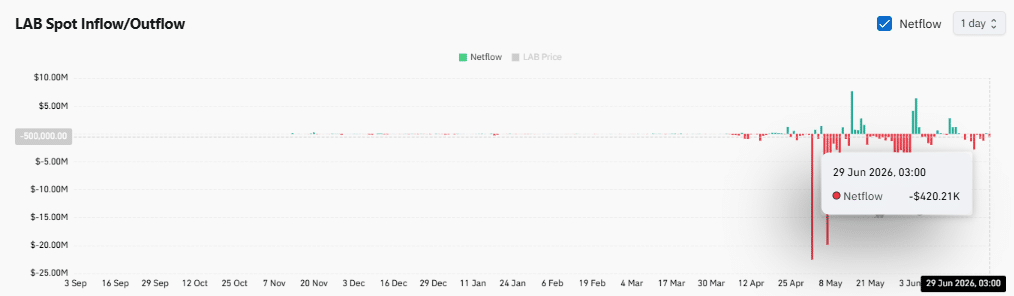
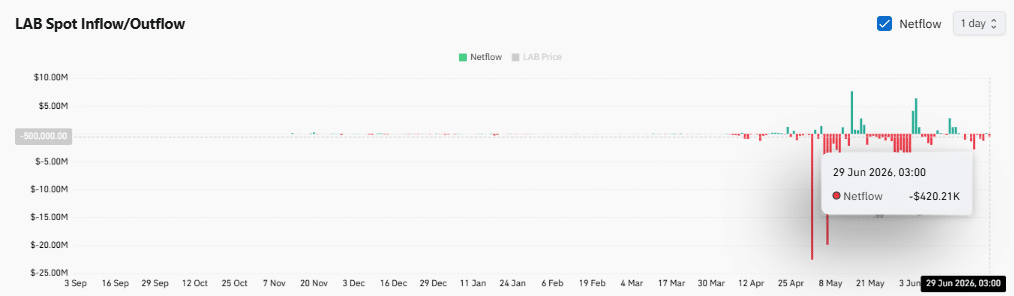
Source: CoinGlass

LAB edges closer to losing channel support

LAB approached the lower boundary of its ascending channel after several consecutive bearish candles erased much of the previous recovery. Price slipped toward the channel’s baseline near the $13 level, placing the entire structure under pressure.

A confirmed move below that trendline would expose the next major demand zone around $12, where buyers previously stepped in. Technical indicators continued favoring sellers as LAB weakened near channel support.

At press time, the MACD line crossed below the signal line while the histogram turned negative, showing that bullish strength had faded during the latest pullback. In addition, the Parabolic SAR remained above price, reinforcing the prevailing bearish trend after flipping earlier in the decline.

However, the channel remained technically intact during the latest session, leaving bulls with one final opportunity to defend the structure. The rejection from the upper half of the channel also showed that buyers struggled to sustain higher prices. Unless demand returns quickly, sellers could force a decisive break below the pattern.
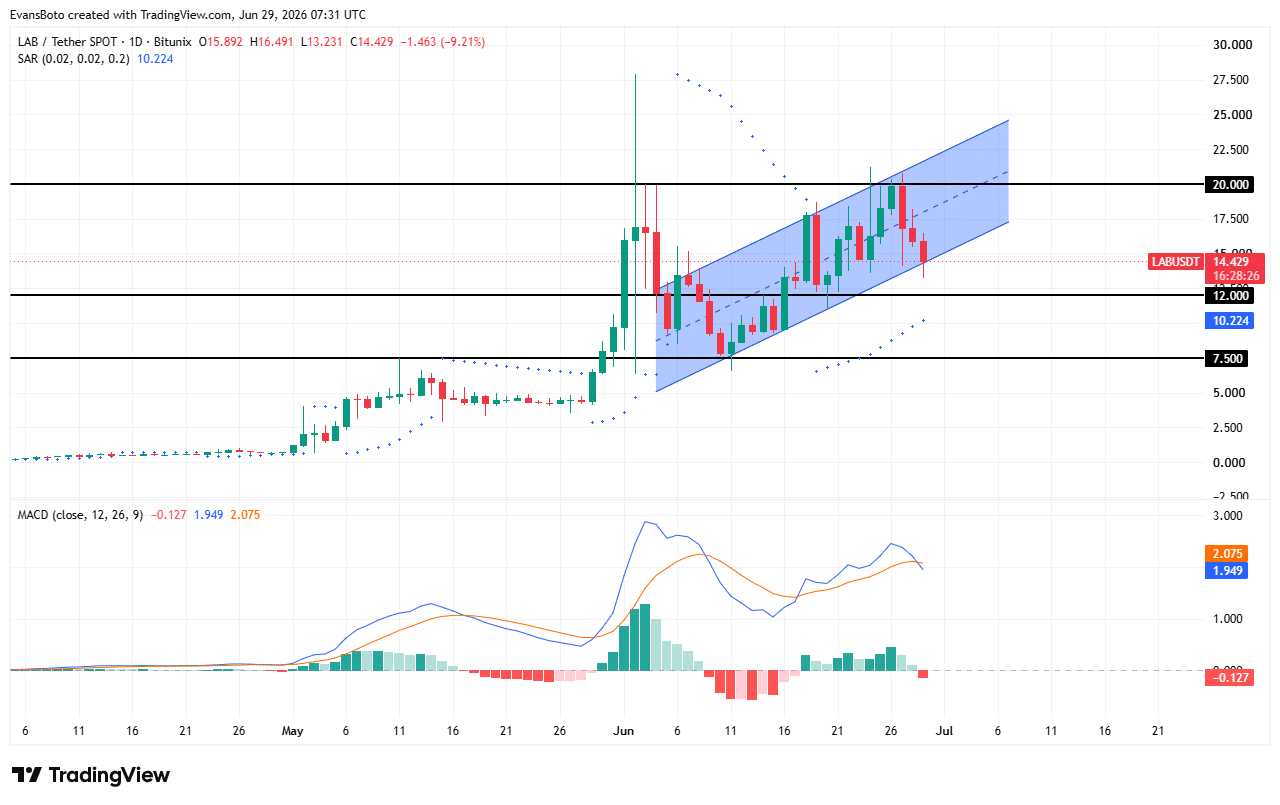
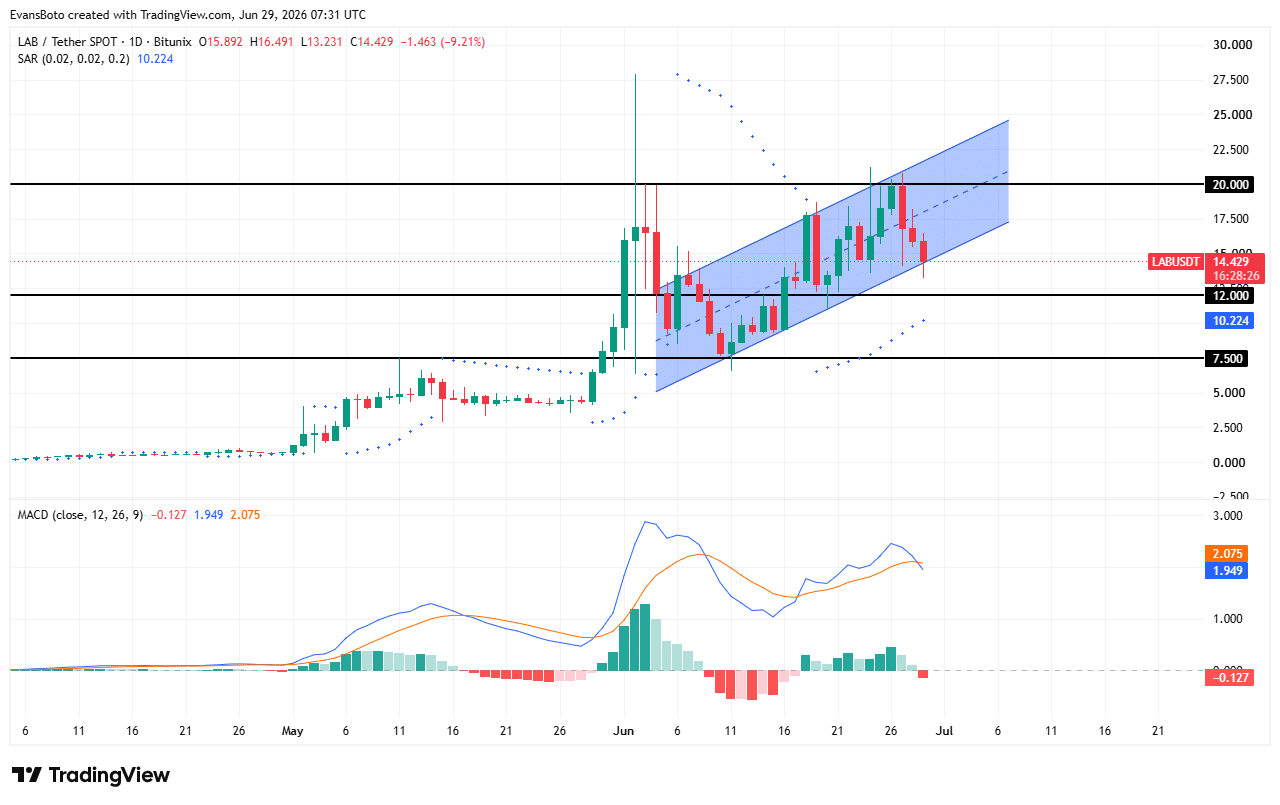
Source: TradingView

Why are short traders paying to stay?

Derivatives positioning continued to reflect bearish conviction across the futures market.

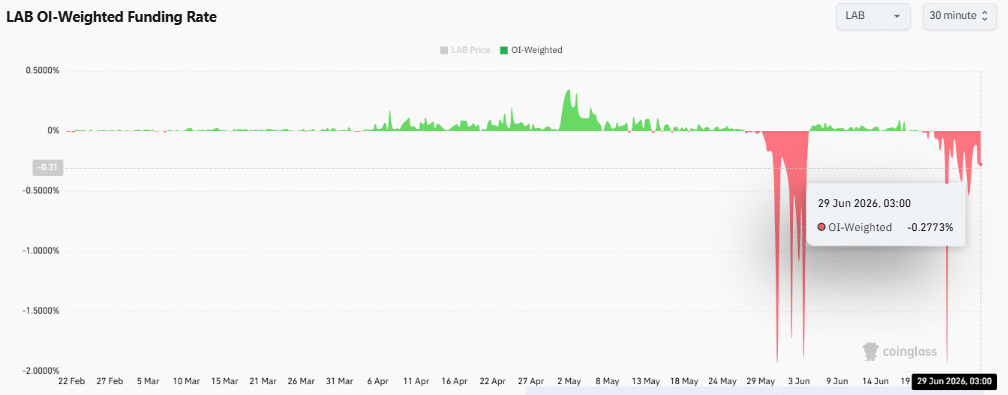
At the time of writing, LAB’s OI-Weighted Funding Rate stayed negative at -0.2773%, showing that short traders continued paying premiums to maintain their positions. That reading highlighted sustained confidence among bearish participants despite the extended decline.

However, deeply negative funding also suggested the market had become increasingly one-sided. If buyers reclaim channel support and force a rebound, overly crowded short positions could face pressure from a rapid squeeze.

For now, though, derivatives data continue supporting the prevailing bearish outlook as traders maintain defensive positioning against further downside.
Source: CoinGlass

Can LAB avoid a breakdown?

LAB remained under considerable pressure after losing more than 23% while technical indicators and derivatives positioning favored sellers.

However, the ascending channel had not broken down yet, and negative exchange netflows continued showing that holders still removed tokens from exchanges.

If buyers defend the lower channel boundary, LAB could stabilize before attempting another recovery. Otherwise, a confirmed break below support would likely expose the $12 demand zone as the next major downside target.


Final Summary

  • LAB remained under heavy selling pressure as bearish technical signals continued dominating market sentiment.
  • Negative exchange netflows contrasted with falling prices, while the $12 zone emerged as the next key test.


Domande pertinenti

QWhat is the current market price and 24-hour performance of LAB mentioned in the article?

AAt the time of writing, LAB was trading around $13.53, having lost more than 23% of its value over the past 24 hours.

QWhat does the negative spot netflow data from CoinGlass indicate about LAB holders' behavior?

AThe negative spot netflows indicate that more LAB tokens were withdrawn from exchanges than deposited, suggesting holders are moving tokens into private wallets rather than preparing them for immediate sale.

QWhat is the key technical support level for LAB within its ascending channel, according to the analysis?

AThe key technical support level is the lower boundary of the ascending channel, located near the $13 level. A break below this could expose the next major demand zone around $12.

QWhat does LAB's negative OI-Weighted Funding Rate suggest about market positioning?

AThe negative OI-Weighted Funding Rate of -0.2773% indicates that short traders are paying a premium to maintain their positions, reflecting sustained bearish conviction but also creating the risk of a short squeeze if prices rebound.

QWhat are the two main conflicting signals the article presents regarding LAB's future price direction?

AThe conflicting signals are: 1) Bearish technical indicators and derivatives positioning favoring sellers, and 2) Negative exchange netflows and an intact ascending channel suggesting some holders are accumulating and a potential defense of support by buyers.

Letture associate

In Such a Crowded Cross-border Payment Track, Where Does the Next Stop Lie in the Future?

The crowded cross-border payments industry faces a paradox: intense competition above water with financing and narratives, while beneath, price wars and shrinking margins in basic PSP services are common. The path forward lies not in simple "cross-border" solutions but in deep **localization**. Success requires mastering the fragmented and tightening regulations of fiat currencies in each market—the "last mile" of compliance, banking, and settlement. Many Chinese PSPs have succeeded by following Chinese merchants overseas but have not deeply penetrated mainstream local merchant ecosystems abroad. Their strong product capabilities need to be applied to new, complex markets. The future belongs to companies that evolve from single-channel providers to **cross-border capital network operators**. This means moving beyond competing on transaction fees to creating internal networks that optimize capital efficiency through multi-directional matching, netting, and position reuse across countries and currencies. For Web3 and stablecoins, the key is integration, not replacement. Stablecoins offer efficiency gains but cannot bypass the foundational trust, compliance, and legal frameworks of traditional finance. The realistic path is the gradual adoption and "taming" of Web3 technologies by established financial institutions. The ultimate solution is a **dual clearing infrastructure** combining deep local fiat capabilities (local accounts, compliance, banking) with lightweight stablecoin-native capabilities (on-chain settlement, wallets). The biggest opportunity lies not in oversaturated mainstream corridors but in complex, underserved regional corridors (e.g., specific CIS, Middle East-Southeast Asia, or Latin American trade pairs). The winners will be those who build hard-to-replicate, deep capabilities in these areas—acting as the essential "clearing shovels" or infrastructure providers. The future keywords are **more local, more networked, and more stablecoin-native**. High-profit opportunities remain in the non-standardized, difficult-to-replicate deep waters of the industry, requiring genuine on-the-ground presence and long-term patience.

链捕手3 h fa

In Such a Crowded Cross-border Payment Track, Where Does the Next Stop Lie in the Future?

链捕手3 h fa

Lightning Fast Five-Whip Combo! Strategy's Self-Rescue Plan Officially Released

Strategy, amidst the STRC de-pegging crisis, has unveiled its "Digital Credit Capital Framework" self-rescue plan. The five-part framework includes: 1) **Cash Reserves**: Management of ~$2.55B in USD reserves, dedicated solely to covering ~17.4 months of preferred stock dividends and debt interest, with a 12-month minimum coverage floor. 2) **Dividend Policy**: STRC's dividend yield rises to 12% from July 1st, with monthly reviews. Strategy clarifies de-pegging does not automatically trigger further hikes. 3) **Preferred Stock Buyback**: A $1B authorization, prioritizing STRC repurchases to support its price, reduce future dividend obligations, and signal commitment, using funds separate from dividend reserves. 4) **Common Stock Buyback**: A separate $1B authorization for MSTR stock, aimed at creating shareholder value when the stock is deemed undervalued, establishing a two-way capital management mechanism. 5) **Bitcoin Monetization**: Formal authorization to sell BTC (up to $1.25B earmarked) to build USD reserves, cover dividends/interest, or fund buybacks, marking a strategic shift where BTC becomes a managed asset rather than a strictly "hold-only" reserve. Market reaction saw MSTR and STRC shares rise pre-market, while BTC remained stable. The plan aims to restore confidence in STRC, ensure dividend sustainability, and reopen Strategy's funding channels.

Odaily星球日报4 h fa

Lightning Fast Five-Whip Combo! Strategy's Self-Rescue Plan Officially Released

Odaily星球日报4 h fa

Trading

Spot
活动图片