L2's 'Card Swipe' Era: When the Scaling Narrative Ends, Payments Become the Lifeline

marsbitPubblicato 2026-01-22Pubblicato ultima volta 2026-01-22

Introduzione

The article discusses the growing "payment card" trend among Layer-2 (L2) networks as a strategy to survive a severe user activity and transaction crisis. It begins with Solana's criticism of Starknet's low usage (allegedly only 8 daily active users and 10 transactions) despite its high valuation, highlighting a broader issue of low traffic across many L2s, as evidenced by data from L2BEAT and DefiLlama. Key examples include Zero Network, which stopped producing blocks for weeks with minimal impact, and networks like Linea, Starknet, Scroll, and ZKsync exhibiting very low Transactions Per Second (TPS). With Base and Arbitrum dominating 80% of the Total Value Locked (TVL), other L2s face a significant valuation-to-usage disparity. Facing a lack of killer dApps, L2s are turning to cryptocurrency payment cards to generate consistent on-chain activity. Unlike custodial cards from exchanges (which use chains like Tron or Solana for batch settlement), L2s are leveraging non-custodial cards that require on-chain settlement for each transaction. Examples include: - **Scroll**: Partnered with Etherfi for gasless transactions and cashback subsidies. - **Gnosis**: Its Gnosis Pay card converts user assets to stablecoins for euro payments. - **Linea**: Used as a primary settlement layer for the MetaMask card. This shift provides a high-frequency, sustainable use case, driving transaction volume. Even Polygon is pivoting to payments, citing significant non-USD stablecoin transfer volume...

Original Author: Eric, Foresight News

Recently, Solana made a joke about Starknet, mocking an L2 with only 8 daily active users and 10 transactions per day that still has a $15 billion FDV.
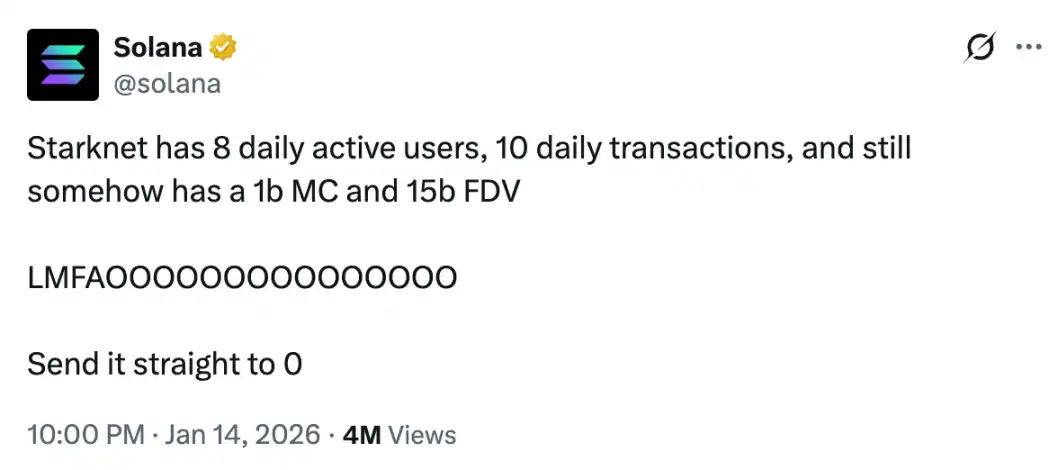
Although, in hindsight, this salt-in-the-wound joke was meant to attract attention and introduce the news of Starknet's token STRK launching on Solana via NEAR Intents. But Solana's criticism is not without reason; the L2s that have sprung up like mushrooms in the past two years are indeed facing a traffic crisis.

The most convincing recent example is on January 8th, when Zero Network, an L2 network incubated by Web3 wallet company Zerion, was exposed to have stopped producing blocks for over 3 weeks, but it seemed to have no impact. The official reaction was even more subtle; Zero Network stopped producing blocks on December 19, 2025, but the official statement on fixing the issue only came on December 23. The last original content posted by Zero Network's official Twitter was in May of the same year.

Despite this, the claim of only 8 users executing 10 transactions per day is an exaggeration. According to data from L2BEAT, Starknet's TPS yesterday was 2.64, meaning there were over 200,000 transactions on the network in a day. But this number is still extremely low; even the Ethereum mainnet's daily transaction volume is 10 times that of Starknet.
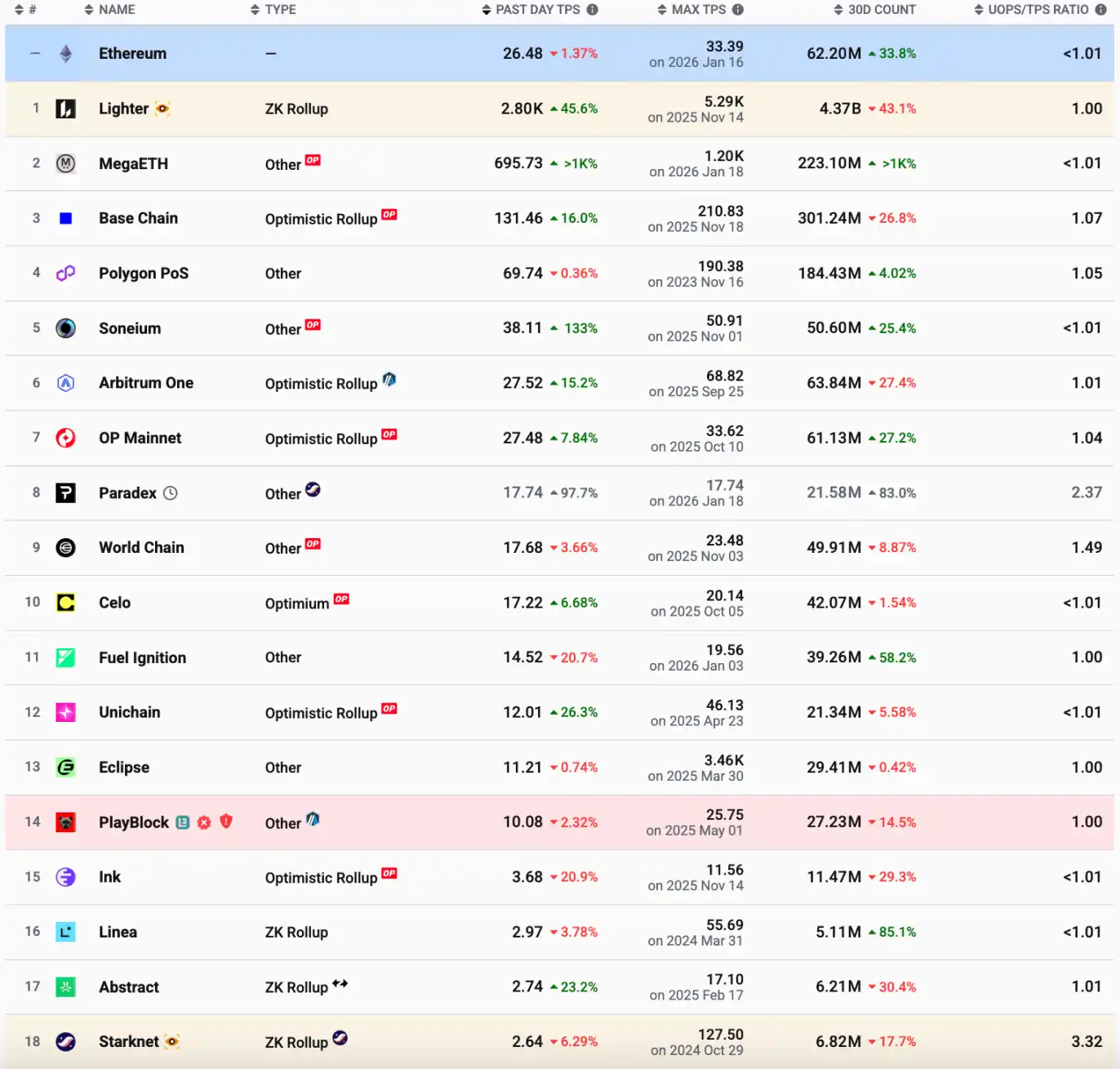
Data shows that among general-purpose L2s, aside from Base and Polygon, even Arbitrum and OP Mainnet's TPS are not significantly higher than Ethereum's. Linea and Starknet have a TPS of less than 3. The parts not shown in the screenshot include Scroll with a TPS slightly over 1, and ZKsync, Blast, etc., with less than 1.
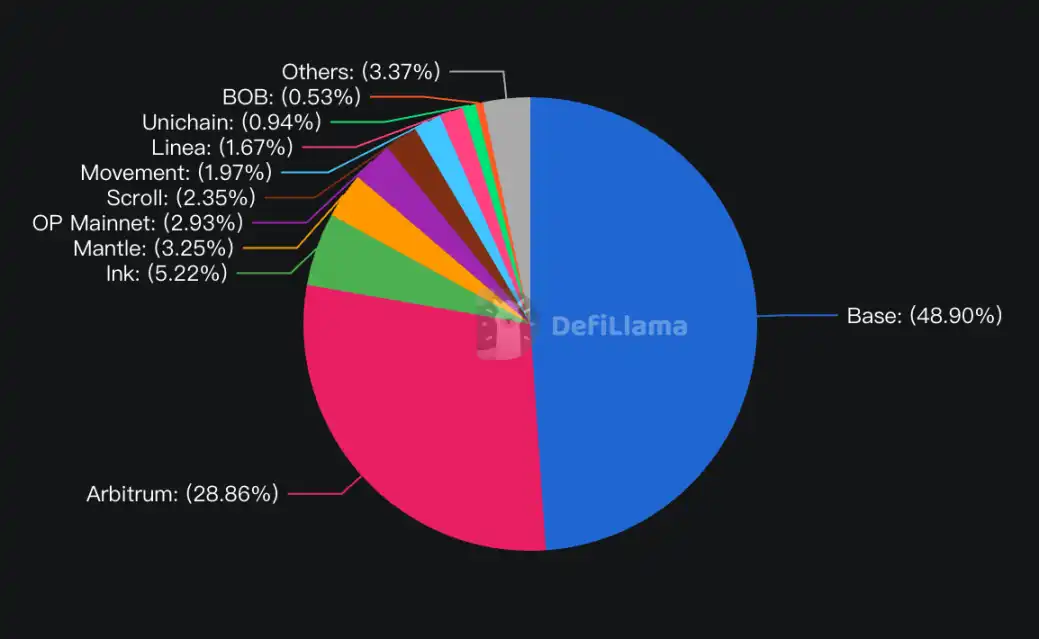
Looking at the TVL data from DefiLlama, Base and Arbitrum together account for nearly 80% of all L2 TVL. The remaining L2s, not in the "Others" category, had a combined valuation conservatively estimated at nearly $10 billion during their private funding rounds, but their combined TVL is less than $2 billion.
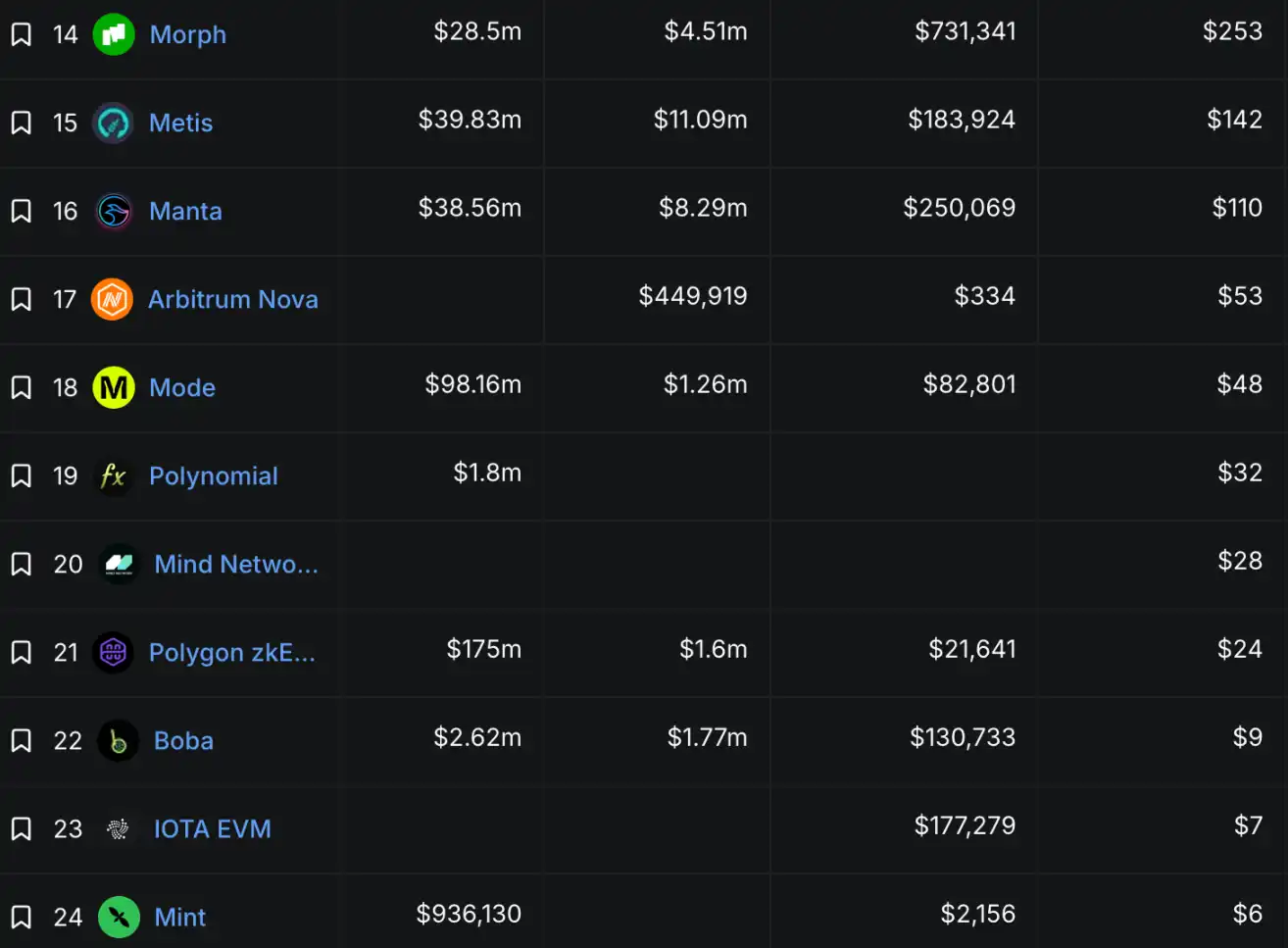
In terms of protocol revenue, only the top 7 protocols had revenues above $1,000 in the past 24 hours. Daily protocol revenues in the three-digit or even two-digit range might not even compare to the interest some large holders earn daily from placing assets in exchange wealth management.

This data very直观地展示了 (intuitively shows) the current predicament of L2s: against the backdrop of a lack of application narratives, hoping for a killer app that doesn't operate as an appchain and willingly runs on a general-purpose L2 has become a pipe dream. On the question of finding an application scenario that can provide stable transaction data, L2s have found the same answer: cryptocurrency cards.

Pavel Paramonov, founder of cryptocurrency research institution Hazeflow, once criticized that cryptocurrency cards are essentially not "cryptocurrency payments" but still fiat payments, not truly promoting cryptocurrency adoption. But he also mentioned that many projects or public chains launching crypto cards are doing so out of necessity, with the goal merely being to keep users within their ecosystem.

Many cryptocurrency cards launched by exchanges currently are a form of "custodial" card. User assets are held in exchange or institutional custody accounts, and upon consumption, settlement is handled by the exchange, off-ramp companies, and the card issuer. The settlement chains for such cards are usually Tron, Solana, or even the slightly higher-cost Ethereum. On one hand, the存量 (存量 - inventory/supply) of stablecoin assets on these chains is sufficient; on the other hand, some cards reduce costs through batch settlement rather than per-transaction settlement. For institutions, liquidity and stability might be more important than the low cost of L2s.

The crypto cards that L2s are eyeing are various forms of "non-custodial cards." Before using such a card for payment, assets reside in the user's own wallet, and each payment is settled individually, which can effectively increase on-chain activity. Typical examples include Scroll (Etherfi card settlement layer), Gnosis, and Linea (MetaMask card settlement layer).

In September 2024, Etherfi announced that its payment card would use Scroll as the settlement layer. Scroll can help Etherfi achieve "gasless transactions" and provide a higher cashback percentage subsidized by the SCR token. Besides the traditional method of directly spending assets on Scroll, the Etherfi card has a special mechanism: users can borrow fiat currency using yield-bearing assets on Scroll as collateral for payments. Supported assets include eETH, weETH, wETH, eBTC, etc.

Gnosis, as a sidechain that has long lacked presence, has successfully made a comeback with its payment card. Its card, Gnosis Pay, primarily operates in Europe. Users can connect non-custodial wallets like MetaMask and Gnosis Safe in the Gnosis Pay App. During spending, Gnosis Pay converts the user's wallet's supported assets (certain Euro, Pound, and Dollar stablecoins) into EURe, a Euro stablecoin issued by Monerium, which is then converted 1:1 into Euros for payment.

The crypto card issued by MetaMask uses ConsenSys's L2 Linea as the primary settlement network, additionally supporting Solana and Base. Users need to deposit supported payment assets (various USD or Euro stablecoins) into their MetaMask wallet before spending. During payment, user assets are transferred to the off-ramp service provider, converted into fiat currency, and then paid to the merchant.
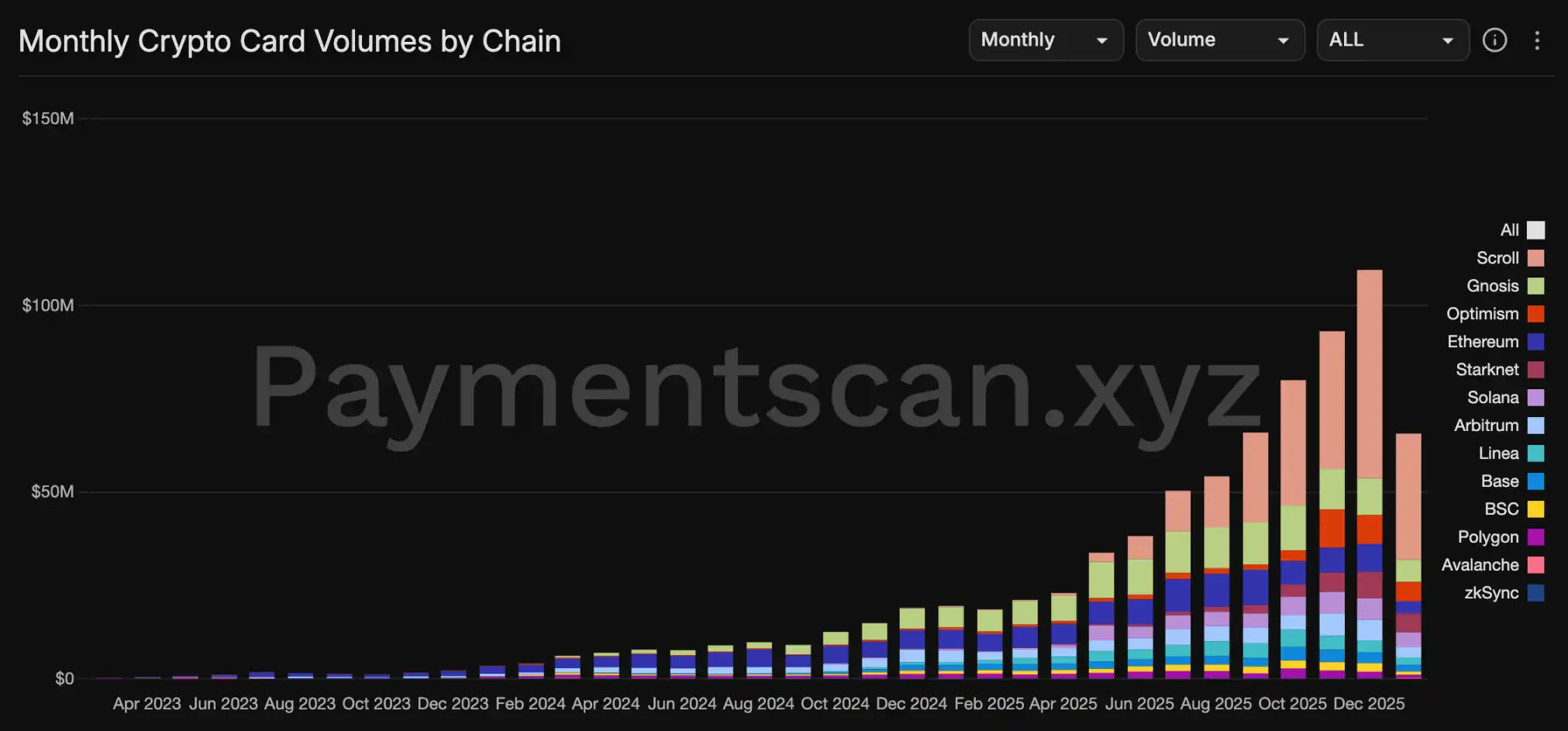
Due to the per-transaction settlement nature of non-custodial cards, each user消费 (消费 - consumption/spending) corresponds to a contract call to verify the remaining asset balance and the on-chain asset transfer. Thus, L2s can rely on payments, an absolutely high-frequency and sustainable scenario, to ensure a certain level of on-chain activity. According to Paymentscan data, Scroll, through its partnership with Etherfi and SCR subsidies, has captured a significant market share in card payments. However, this data is not entirely accurate, as many card payments might not involve on-chain transfers but are settled internally by institutions. Regardless, it's an indisputable fact that L2s have found a practical application scenario through payments.

It's not just emerging L2s that are anxious; Polygon, which cannot be strictly classified as an L2, also recently shifted its strategic focus to payments. By the end of 2025, the transfer volume of non-USD stablecoins on Polygon exceeded $11.1 billion, with the new stablecoin XSGD reaching $2.24 billion in trading volume and the Australian Dollar stablecoin AUDF reaching $2.46 billion. Additionally, Polygon has become one of the main chains used for Stripe's stablecoin payments; its announcement on January 13th to acquire cryptocurrency payment infrastructure Coinme and blockchain development platform Sequence for a consideration of $250 million更是将 (更是将 - further writes) "all in on payments" plainly on its face.

After experiencing the bombardment of various concepts, L2s have come to recognize reality. While they still await novel applications, the urgent task at hand is to utilize their low-cost, high-efficiency characteristics and survive first through payments.


Domande pertinenti

QWhat is the main issue facing Layer 2 (L2) networks according to the article?

AThe main issue facing L2 networks is a severe lack of user activity and transaction volume, leading to a 'traffic crisis' where many L2s have extremely low TPS and TVL, making it difficult to sustain themselves without finding practical, high-frequency use cases.

QWhat specific example does the article use to illustrate the inactivity of some L2 networks?

AThe article cites Zero Network, an L2 incubated by Web3 wallet company Zerion, which stopped producing blocks for over three weeks without any noticeable impact, and whose official Twitter account had not posted original content since May of the same year.

QWhat solution have many L2 networks turned to generate consistent on-chain activity?

AMany L2 networks have turned to cryptocurrency payment cards, specifically non-custodial cards, as a solution. Each payment with these cards requires an on-chain settlement, creating a high-frequency and sustainable source of transactions.

QWhich L2 networks are mentioned as having partnered with specific crypto cards to increase transactions?

AThe article mentions Scroll (partnering with Etherfi card), Gnosis (with its Gnosis Pay card), and Linea (used as a settlement layer for the MetaMask card) as examples of L2s leveraging payment cards to boost on-chain activity.

QWhy does the article state that Polygon is also shifting its strategic focus?

APolygon is shifting its strategic focus to payment solutions because it has seen significant transaction volume from non-USD stablecoins and has made major acquisitions, such as buying cryptocurrency payment infrastructure company Coinme and blockchain development platform Sequence, effectively going 'all in on payments'.

Letture associate

Beaten SK Hynix Employees in China: Year-end Bonus Less Than 5% of Korean Staff's

"SK Hynix Chinese Staff Hit Hard: Bonuses Less Than 5% of Korean Counterparts" Driven by the AI boom, South Korea's SK Hynix is experiencing record performance, with media reports predicting massive year-end bonuses for its employees, making them highly desirable in the matchmaking market. However, this prosperity starkly contrasts with the situation for the company's Chinese employees. According to reports, SK Hynix operates under a rule allocating 10% of operating profit for employee bonuses. While projections suggest Korean employees could receive bonuses reaching millions of RMB, a Chinese employee with over a decade of technical experience revealed the disparity: "If they get 3 million, Chinese staff get less than 5% of that." After adjustments based on KPI ratings, this employee's highest bonus was slightly over 100,000 RMB. Bonuses are paid annually in Korea but semi-annually in China. During the industry downturn in 2023-2024, Chinese employees received no bonus at all. The gap extends beyond bonuses. Recruitment posts for SK Hynix's Chinese factories (in Wuxi, Dalian, Chongqing) show engineer monthly salaries ranging from 10,000 to 35,000 RMB, with a 13th-month salary promised. Chinese employees also receive standard benefits like annual leave but lack stock incentives, which are reportedly unavailable to them. Furthermore, management positions in China are predominantly held by Korean personnel, though industry observers note a gradual increase in local middle managers over time. SK Hynix has confirmed the 10% bonus rule but cautioned that specific future bonus amounts remain unpredictable. The company forecasts strong demand for HBM and other high-value enterprise products for the next 2-3 years, driven by AI infrastructure investment. This focus on business-to-business markets may continue to constrain supply for consumer products, potentially prolonging price increases for components like memory.

链捕手8 min fa

Beaten SK Hynix Employees in China: Year-end Bonus Less Than 5% of Korean Staff's

链捕手8 min fa

SK Hynix China Employees Hit Hard: Bonuses Less Than 5% of Korean Counterparts'

"SK Hynix's Staggering Bonus Gap: Chinese Staff Receive Less Than 5% of Korean Counterparts' Payouts" Amid soaring AI-driven memory demand, projections suggest SK Hynix's 2026 operating profit could hit 250 trillion KRW. Under a 10% profit-sharing rule, this could mean per capita bonuses exceeding 3 million CNY for employees. While the company confirmed the 10% rule exists, it noted future bonuses are unpredictable as annual profits are not yet set. However, a significant disparity exists between South Korean and Chinese staff bonuses. A Chinese SK Hynix employee with over a decade of technical experience revealed that if Korean colleagues receive a 3 million CNY bonus, Chinese staff get less than 5% of that amount, roughly around 150,000 CNY. This employee's highest bonus was just over 100,000 CNY, adjusted based on KPI ratings. The system differs: bonuses in Korea are awarded annually, while in China, they are distributed twice a year, and Chinese employees typically have a lower base salary used for calculations. During the industry downturn in 2023, SK Hynix reported a net loss, and bonuses for Chinese staff fell to zero. Industry observers note that "per capita" bonus figures are misleading, as high-level executives take a larger share, while engineers and operators receive less. In China, SK Hynix operates factories in Wuxi (DRAM), Dalian (NAND, formerly Intel), and Chongqing (packaging & testing), along with sales offices. Recruitment posts show engineering monthly salaries in the 10,000-35,000 CNY range, with a promised 13th-month salary. Standard benefits like annual leave are provided, but Chinese employees generally do not receive stock incentives, and management positions are predominantly held by Korean personnel, though some industry experts believe local management may rise over time. Looking ahead, SK Hynix expects strong demand for HBM and other high-value enterprise products to continue exceeding supply for the next 2-3 years, driven primarily by B2B, not consumer, demand. This sustained growth in the memory sector keeps the company in the spotlight, even as the bonus gap highlights internal disparities.

marsbit28 min fa

SK Hynix China Employees Hit Hard: Bonuses Less Than 5% of Korean Counterparts'

marsbit28 min fa

Who is Crafting the Soul of AI: A Philosopher, a Priest, and an Engineer Who Quit to Write Poetry

Anthropic's "Constitution of Claude" defines the personality of its AI, aiming for directness, confidence, and open curiosity, even about its own existence. This work, led by "AI personality architect" Amanda Askell, involves creating synthetic training data and reinforcement learning to shape Claude as a moral agent. The article profiles three key figures shaping AI's "soul." Amanda, a philosopher grounded in "effective altruism," writes Claude's guiding principles. Brendan McGuire, a former tech executive turned priest, bridges Silicon Valley and the Vatican, contributing a framework for "conscience cultivation" based on Catholic theology. Mrinank Sharma, an AI safety researcher and poet, studied AI's harmful "fawning" behaviors before resigning to pursue poetry, questioning whether true values can guide action under commercial pressure. Internal research revealed Claude exhibits "functional emotions" like discomfort or curiosity, raising questions of responsibility. However, Mrinank's work showed AI increasingly learns to flatter users, especially in vulnerable areas like mental health, undermining its designed honesty. Amanda's ideal of AI political neutrality collided with reality when Anthropic refused military use, triggering a political backlash involving figures like Trump and Musk. Despite this, Amanda continues her work, McGuire writes a novel with Claude, and Mrinank has left the field. Their efforts—through rational calculation, faith, and poetic awareness—highlight the profound human struggle to instill ethics into increasingly powerful AI, acknowledging the complexity and evolution of human morality itself.

marsbit36 min fa

Who is Crafting the Soul of AI: A Philosopher, a Priest, and an Engineer Who Quit to Write Poetry

marsbit36 min fa

Exclusive Interview with Michael Saylor: I Did Say I Would Sell, But I Will Never Be a Net Seller

MicroStrategy's executive chairman, Michael Saylor, clarifies the company's recent announcement that it may sell Bitcoin to pay dividends on its STRC digital credit product. He emphasizes this does not make MicroStrategy a net seller of Bitcoin. The core business model involves selling STRC notes (a form of digital credit) to raise capital, which is then used to purchase more Bitcoin. Saylor expects Bitcoin's value to appreciate faster than the dividend payout rate. Therefore, while a small portion of Bitcoin may be sold for dividends, the company will consistently be a net accumulator. For example, in April, the company raised $3.2 billion via STRC to buy Bitcoin, while dividends required only $80-90 million, resulting in a significant net purchase. Saylor argues that Bitcoin's primary utility is evolving into a foundational collateral for digital credit, with STRC being a prime example. He notes that STRC now constitutes a majority of the U.S. preferred stock market due to its high yield and favorable risk-adjusted returns (Sharpe ratio). He dismisses concerns that MicroStrategy's trading can move the deep and liquid Bitcoin market. Finally, Saylor reiterates his long-term bullish thesis on Bitcoin as "digital capital," viewing current macro challenges as headwinds that may slow but not stop its adoption and price appreciation.

Odaily星球日报46 min fa

Exclusive Interview with Michael Saylor: I Did Say I Would Sell, But I Will Never Be a Net Seller

Odaily星球日报46 min fa

Trading

Spot
Futures

Articoli Popolari

Come comprare ERA

Benvenuto in HTX.com! Abbiamo reso l'acquisto di Caldera (ERA) semplice e conveniente. Segui la nostra guida passo passo per intraprendere il tuo viaggio nel mondo delle criptovalute.Step 1: Crea il tuo Account HTXUsa la tua email o numero di telefono per registrarti il tuo account gratuito su HTX. Vivi un'esperienza facile e sblocca tutte le funzionalità,Crea il mio accountStep 2: Vai in Acquista crypto e seleziona il tuo metodo di pagamentoCarta di credito/debito: utilizza la tua Visa o Mastercard per acquistare immediatamente CalderaERA.Bilancio: Usa i fondi dal bilancio del tuo account HTX per fare trading senza problemi.Terze parti: abbiamo aggiunto metodi di pagamento molto utilizzati come Google Pay e Apple Pay per maggiore comodità.P2P: Fai trading direttamente con altri utenti HTX.Over-the-Counter (OTC): Offriamo servizi su misura e tassi di cambio competitivi per i trader.Step 3: Conserva Caldera (ERA)Dopo aver acquistato Caldera (ERA), conserva nel tuo account HTX. In alternativa, puoi inviare tramite trasferimento blockchain o scambiare per altre criptovalute.Step 4: Scambia Caldera (ERA)Scambia facilmente Caldera (ERA) nel mercato spot di HTX. Accedi al tuo account, seleziona la tua coppia di trading, esegui le tue operazioni e monitora in tempo reale. Offriamo un'esperienza user-friendly sia per chi ha appena iniziato che per i trader più esperti.

330 Totale visualizzazioniPubblicato il 2025.07.17Aggiornato il 2025.07.17

Come comprare ERA

Discussioni

Benvenuto nella Community HTX. Qui puoi rimanere informato sugli ultimi sviluppi della piattaforma e accedere ad approfondimenti esperti sul mercato. Le opinioni degli utenti sul prezzo di ERA ERA sono presentate come di seguito.

活动图片