Krypto News: Coinbase and Crypto.com Launch Prediction Markets

bitcoinistPubblicato 2026-02-04Pubblicato ultima volta 2026-02-04

Introduzione

Major cryptocurrency exchanges Coinbase and Crypto.com have recently launched prediction market platforms, expanding their offerings beyond traditional crypto trading. Coinbase activated its "Coinbase Predict" feature across all 50 U.S. states in partnership with regulated provider Kalshi. This allows users to trade binary event contracts on real-world outcomes in sports, politics, and economics, settled in USD or USDC. The platform operates under CFTC oversight, creating a regulatory distinction from gambling. Simultaneously, Crypto.com introduced its standalone prediction market app, "OG," operated by its CFTC-registered derivatives division. A key differentiator is its planned offering of margined, leveraged positions on prediction contracts, alongside social features and user incentives. The article highlights the growing interest in event-based trading and questions which infrastructure can best support it. It points to Bitcoin Layer-2 solutions, like the project "Bitcoin Hyper," as a potential foundation for building scalable, decentralized prediction markets. The project's ongoing presale, having raised over $31 million, is cited as evidence of significant market interest in expanding Bitcoin's use cases beyond a store of value.

Since the beginning of the year, major crypto exchanges have been diving deep into the prediction and event trading market. In quick succession, both Coinbase and Crypto.com have announced and launched new platform offerings that allow private users to bet on the outcome of real-world events—from sports events to politics and cultural developments. This development is part of a broader trend where established trading platforms are expanding their product portfolios far beyond classic crypto trading.

Coinbase Expands Nationwide Prediction Markets

At the end of January, the US exchange Coinbase activated its prediction market offering across all 50 US states. The feature was introduced in collaboration with the regulated US provider Kalshi and enables customers to trade so-called event contracts directly via the Coinbase app. These are binary markets where the contract settles based on a yes/no outcome of an event, such as "Will Team X win the game?" or "Will US GDP exceed expectations?".

Pricing is determined by supply and demand in the market, not by odds set by the platform.

The full national release follows an earlier, limited availability in select regions. Coinbase itself describes the product as an opportunity to "hedge" on real-world events and convert predictions into tradable market prices, similar to established prediction markets like Polymarket or Kalshi itself. Wagers can be placed in US dollars or via stablecoin balances in USDC, which is already familiar to Coinbase customers.

Regulatorily, the offering is significant in the US as it falls under the supervision of the Commodity Futures Trading Commission (CFTC), which allows for a different classification than classic sports betting or gambling. This regulatory classification is not without controversy: in several states, there have already been disputes over whether prediction markets should instead fall under state gambling laws.

Crypto.com Launches Standalone Platform "OG"

Simultaneously, Crypto.com has launched its own prediction market platform called OG, which initially focuses on the US market and went live just before one of the biggest sporting events of the year. OG is operated by Crypto.com | Derivatives North America (CDNA), a registered CFTC clearing and trading venue, and also offers users the ability to trade event contracts on topics such as sports, politics, finance, and entertainment.

A key distinguishing feature of OG is the planned offering of margin or leveraged positions on prediction contracts, which is intended to set it apart from previous platform formats—an approach that, however, also implies higher risks for users. Additionally, OG integrates social elements such as leaderboards and rewards, including up to $500 for the first million registered users.

The launch as a standalone app rather than an integrated feature signals that Crypto.com views the prediction market as its own growth area that generates strong user interest. According to the company, demand for such contract types has increased significantly in recent months, which favored the decision to spin off a dedicated product.

Are Decentralized Prediction Markets Coming to Bitcoin?

The recent moves by major exchanges into regulated prediction markets highlight how much interest in event-based trading has grown. At the same time, this brings a fundamental question into focus: On which infrastructure can such applications be mapped in a scalable, transparent, and as neutral as possible manner in the long term?

While many of the platforms used today are built on existing smart contract networks, there is a parallel growing interest in solutions that enable these concepts on a Bitcoin basis as well. A prerequisite for this is powerful Layer-2 structures that open up new use cases beyond pure value storage.

Against this backdrop, one project is currently coming more into view that aims to address exactly this gap.

Bitcoin Hyper positions itself as a Layer-2 solution for the Bitcoin ecosystem, with the goal of enabling more complex applications directly at Bitcoin's security level. These explicitly include decentralized prediction markets, which have so far been implemented primarily on Ethereum- or Solana-based networks. The project pursues the approach of combining Bitcoin's liquidity and trust base with a high-performance execution layer to enable applications that were previously considered technically unfeasible.
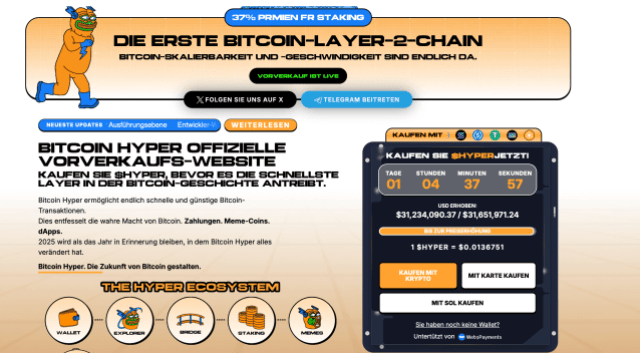
The current market interest is reflected primarily in the ongoing presale. According to project reports, over $31 million has already been raised, indicating unusually high attention in a phase where many investors are acting more selectively. Observers attribute this in part to the overarching narrative: Bitcoin not just as a passive store of value, but as a foundation for new financial and information markets. Prediction markets are considered a particularly sensitive use case, as they require both scalability and security.

Bitcoin Hyper attempts to differentiate itself in this environment through a clear focus on Bitcoin Layer-2 infrastructure. If the adoption of such Layer-2 networks continues to accelerate, applications like decentralized prediction markets on Bitcoin could also become realistic.

The presale is divided into several price tiers, allowing early participants to achieve book gains. Acquisition is done via the project website by connecting a compatible wallet and executing the token swap.

Go to the Bitcoin Hyper Presale

Domande pertinenti

QWhat new type of trading platforms have Coinbase and Crypto.com recently launched?

ACoinbase and Crypto.com have launched prediction market platforms, allowing users to trade on the outcome of real-world events such as sports, politics, and cultural developments.

QHow does Coinbase's prediction market, Coinbase Predict, function and what is it regulated under?

ACoinbase Predict functions as a binary market where contracts settle based on a yes/no outcome of an event. It is regulated under the oversight of the U.S. Commodity Futures Trading Commission (CFTC).

QWhat is the name of Crypto.com's new prediction market platform and what is one of its key differentiating features?

ACrypto.com's new platform is called OG. A key differentiating feature is its planned offering of margin or leveraged positions on prediction contracts.

QAccording to the article, which blockchain is being positioned as a potential new base for decentralized prediction markets through Layer-2 solutions?

ABitcoin is being positioned as a potential new base for decentralized prediction markets through Layer-2 solutions like Bitcoin Hyper, which aims to enable more complex applications on Bitcoin's security level.

QHow much funding has the Bitcoin Hyper project reportedly raised in its ongoing presale, according to the article?

AThe Bitcoin Hyper project has reportedly raised more than $31 million in its ongoing presale.

Letture associate

Has the 'Digital Gold' Narrative for BTC Failed?

**Title: Has the "Digital Gold" Narrative for Bitcoin Failed?** The article argues that Bitcoin's "digital gold" narrative remains valid despite a recent sharp price decline (from a peak near $126k in Oct 2025 to briefly under $61k in Feb 2026). It presents a long-term investment framework based on three core points: **1. Viewing Bitcoin as an Asset:** Bitcoin is presented as a superior potential store of value compared to gold. Key arguments are its absolute scarcity (21 million cap), superior portability, and transparent auditability via its public ledger. While acknowledging its current use in early, volatile stages (~3-4% global adoption), the author draws parallels to the early, disruptive phases of the internet and e-commerce. **2. Understanding the Recent Downturn:** The current ~50% correction is framed as a predictable, consensus-driven cycle following its post-halving peak (the 2024 halving preceded the Oct 2025 high). A crucial factor is a historic "changing of hands": the influx of new institutional buyers via ETFs allowed early, low-cost holders (miners, OG believers) to take profits. The author notes that while severe, Bitcoin's historical drawdowns (e.g., 93% in 2011, 77% in 2021-22) have been progressively smaller, suggesting maturing holder structure and decreasing volatility over time. **3. The Long-Term Perspective:** The long-term thesis hinges on Bitcoin capturing a portion of gold's market value. With Bitcoin's market cap at ~$1.4 trillion (at $70k) versus gold's ~$20 trillion, significant upside potential exists if the "digital gold" narrative is partially realized. However, the author strongly cautions that short-term risks remain, the bottom is unpredictable, and high volatility is inherent. The real risk is not Bitcoin failing but poor personal position management (over-leverage, wrong capital) and a lack of deep understanding, which can force investors out during severe downturns. The conclusion uses Amazon's 95% crash post-2000 dot-com bubble and subsequent 42x recovery as an analogy. The ultimate question is not if Bitcoin's price will rise, but if an investor's strategy and conviction can withstand the volatility to see the long-term play out. The recent divergence (gold up, Bitcoin down) is posed not as a narrative failure, but as potential evidence of this ongoing, painful transition from a speculative asset to a mainstream allocation.

marsbit5 h fa

Has the 'Digital Gold' Narrative for BTC Failed?

marsbit5 h fa

Has BTC's 'Digital Gold' Narrative Failed?

The article discusses Bitcoin's "digital gold" narrative, its recent price drop, and long-term outlook through the perspective of "Jason". It argues the narrative is not a failure but that Bitcoin represents a superior, new asset class due to its fixed supply (21 million), portability, and auditability. The piece compares its current ~3-4% global adoption rate to early internet/e-commerce, suggesting significant growth potential. Regarding the 2025-2026 price decline (from ~$126k to briefly under $61k), the author views it as a predictable, consensus-driven sell-off within Bitcoin's ~4-year cycle post-halving, exacerbated by a major "handover" from early, low-cost holders to new institutional buyers via ETFs. A key observation is that historical peak-to-trough drawdowns have lessened over time (e.g., 93% in 2011 to ~50% in 2026), indicating maturing volatility as holder structure changes. For the long term, the author uses a simple framework: Bitcoin's total market cap (~$1.4T at $70k) is only about 7% of gold's (~$20T). Even capturing 30-50% of gold's value would imply substantial upside. However, the article strongly cautions against viewing this as investment advice, emphasizing extreme volatility and the critical importance of risk management, position sizing, and deep fundamental understanding to survive severe drawdowns. It concludes by drawing a parallel to Amazon's 95% crash in 2000 and subsequent 42x recovery, stressing that the key is surviving market cycles to realize long-term potential.

链捕手5 h fa

Has BTC's 'Digital Gold' Narrative Failed?

链捕手5 h fa

From Code to Cognition: A Ten-Thousand-Word Guide to the Evolution of the Robot Brain

"From Code to Cognition: The Evolution of Robot Brains" The journey of robotic intelligence has shifted dramatically from manually coded systems to AI-driven brains. For decades, robots relied on layered software stacks—perception, state estimation, planning, control—each handcrafted. While predictable, they lacked adaptability. The 2010s saw deep learning revolutionize perception (e.g., object detection) and control (via reinforcement learning), but learned skills remained narrow. The arrival of Large Language Models (LLMs) marked a turning point. LLMs acted as high-level planners, interpreting natural language instructions and generating sequences of actions for traditional robotic systems to execute. However, true integration came with Visual-Language-Action (VLA) models, which fused vision, language, and motion prediction into a single network. Pioneered by models like RT-2 and open-source projects like OpenVLA, VLAs enable robots to reason and act directly from visual input and commands. The most advanced humanoid robots now employ a "dual-brain" architecture: a slow-thinking, large VLA (System 2) for reasoning and planning, and a fast-reacting, small network (System 1) for high-frequency motion control, sometimes with an even lower-level System 0 for balance. This split balances cognition with the physics of real-time movement. Computation is split between onboard hardware (e.g., NVIDIA Jetson) for safety-critical control loops and cloud/edge servers for non-critical tasks like learning and interfaces. A crucial driver is the open-source ecosystem—models like GR00T and OpenVLA allow startups to build upon pre-trained brains and fine-tune them with their own data, accelerating development. Despite progress, current systems struggle with recovery from errors, sample inefficiency, and long-horizon tasks. This has spurred the rise of **World Models**—neural networks that predict the consequences of actions. By simulating possible futures before acting (like NVIDIA Cosmos or Meta V-JEPA), robots can plan, recover, and generalize better. This represents the next frontier: shifting intelligence from learned reactions to an internal model of physics and cause-and-effect. The field is rapidly evolving. While not yet at its "ChatGPT moment," the convergence of cheaper hardware, scalable simulation, and world models points toward robots that are increasingly capable, adaptive, and useful. The question is shifting from "what can robots do?" to "what *should* they do?"

marsbit5 h fa

From Code to Cognition: A Ten-Thousand-Word Guide to the Evolution of the Robot Brain

marsbit5 h fa

Trading

Spot
Futures
活动图片