Show me 'The Lord of the Rings', Karpathy Recommends New Benchmark for Large Model Evaluation

marsbitPubblicato 2026-08-03Pubblicato ultima volta 2026-08-03

Introduzione

In a new benchmark for evaluating large language models, Andrej Karpathy proposes replacing the once-popular "pelican riding a bicycle" SVG test with a more complex challenge: generating a 3D scene from the opening text of *The Lord of the Rings*. Using Anthropic's Opus 5 model and the Three.js library, the task consumed approximately 1 million tokens, 2 hours, and 5,500 lines of code to produce a rudimentary, low-polygon animation of the Shire. While the output is visually crude with notable glitches like floating characters, it demonstrates the model's ability to parse narrative text and translate it into a functional, programmatic 3D world with defined objects, cameras, lighting, and basic animation. This "Lord of the Rings benchmark" is argued to test a model's capacity for long-horizon project planning, spatial reasoning, and maintaining consistency across thousands of code lines—capabilities not fully captured by simpler single-output tests. The initiative has sparked community experimentation, with users generating other 3D worlds like a low-poly San Francisco, a data-driven New York City model, and even a virtual Kanye West concert. Karpathy suggests a future pipeline where code-generated scenes provide the structural "bones" for video-to-video models to enhance visual fidelity. While some debate the computational cost and specificity to Three.js, proponents see it as a test of a model's general ability to structure its understanding of the world into an executable ...

Without further ado, let's start the daily slump (doge)!

Just moments ago, the great Karpathy announced that "we" at Anthropic have started using a brand new way to push large models to their limits—

"The Lord of the Rings."
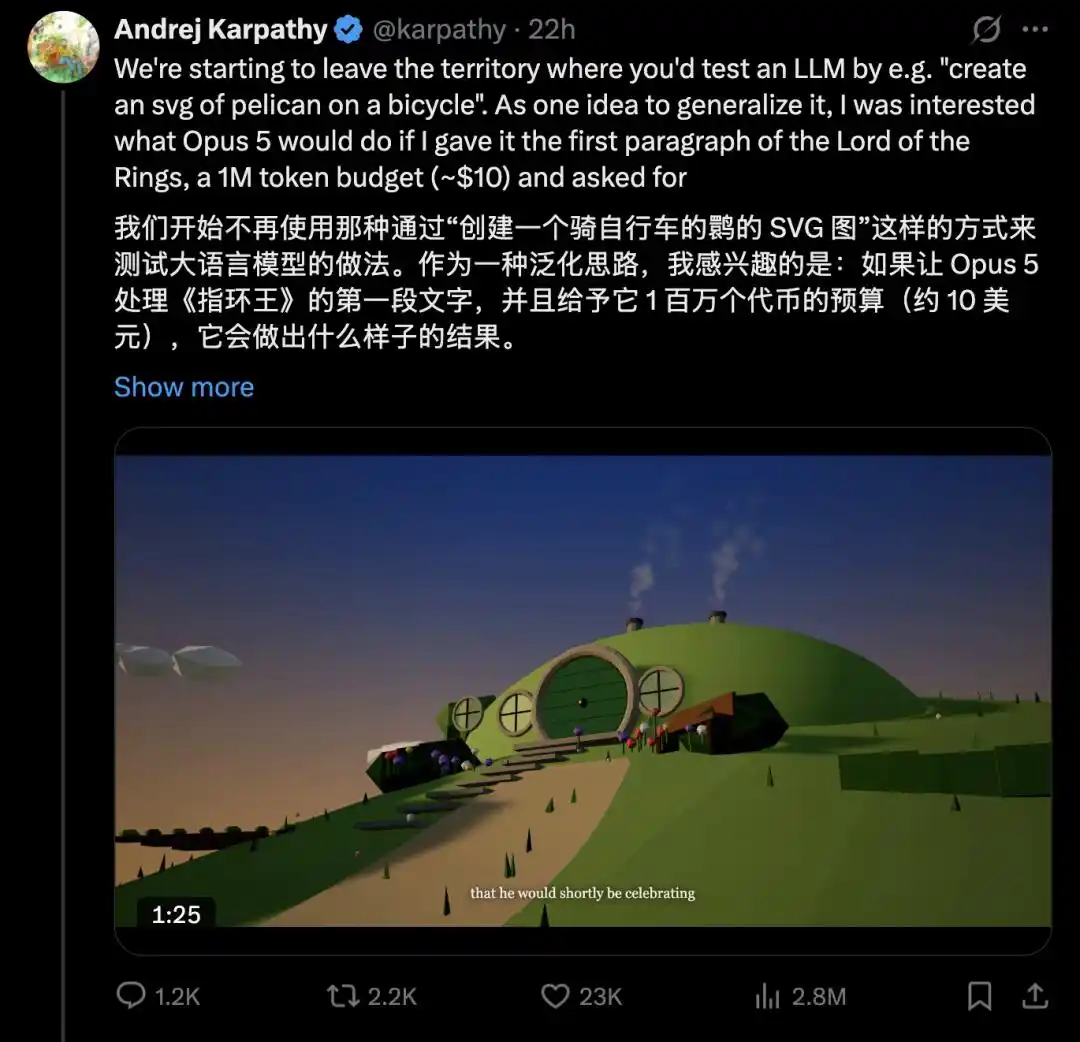
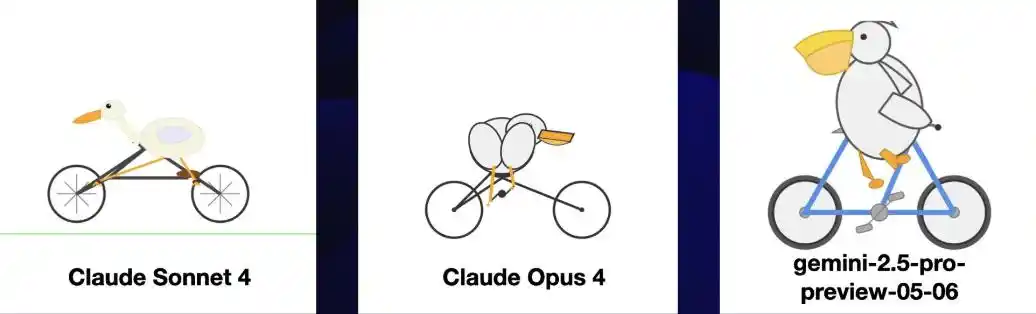
According to Karpathy, this "Lord of the Rings benchmark" is taking over from the once-popular "Pelican Riding a Bicycle" SVG test.
Specifically, Karpathy directly fed the beginning of "The Lord of the Rings" to Opus 5, instructing the model to use Three.js to craft an entire "Middle-earth" world on the spot.

As for the final effect... well, it somewhat resembles domestic 3D animations from the late 1990s and early 2000s: very rough and quite abstract.

But objectively speaking, if you look closely for a while and happen to be familiar with the "Lord of the Rings" filming location Hobbiton in New Zealand, you can indeed catch a hint of its flavor~

However, this seemingly unpolished creation genuinely cost Opus 5: 1 million tokens, 2 hours, and 5,500 lines of code.

Of course, it's not just the Claude model shining solo on this stage.

The most hilarious part is probably the new offering from netizens—a DeepSeek V4 Flash version.

It's a complete "Chinese people can fly" situation, with all characters floating in the air.

Faced with these currently obvious goofs, Karpathy was quite fair.

He pointed out that Opus 5 still cannot truly "enter" the world it generates; it can only continuously take screenshots at different time points and slowly check where things went wrong.

And this precisely exposes a significant shortcoming of current large models:

They can already write code, build scenes, and generate games, but they still cannot truly understand videos, nor can they actually play the games they create.

Two Hours, Crafting Middle-earth by Hand

Let's first look at how this "Lord of the Rings" test was conducted.

If taken literally from Karpathy's tweet, the main prompt input for Opus 5 should be the beginning of Chapter One, "A Long-expected Party," from "The Lord of the Rings" novel.

When Mr. Bilbo Baggins of Bag End announced that he would shortly be celebrating his eleventy-first birthday with a party of special magnificence, there was much talk and excitement in Hobbiton...

Interested folks can try it themselves.

In addition, Karpathy also specified Three.js in the prompt—a JavaScript library for building 3D scenes with code.

Thus, the task for Opus 5 was to first comprehend the text at the beginning of "The Lord of the Rings," and then translate it into a 3D world that could run in real-time in a browser.
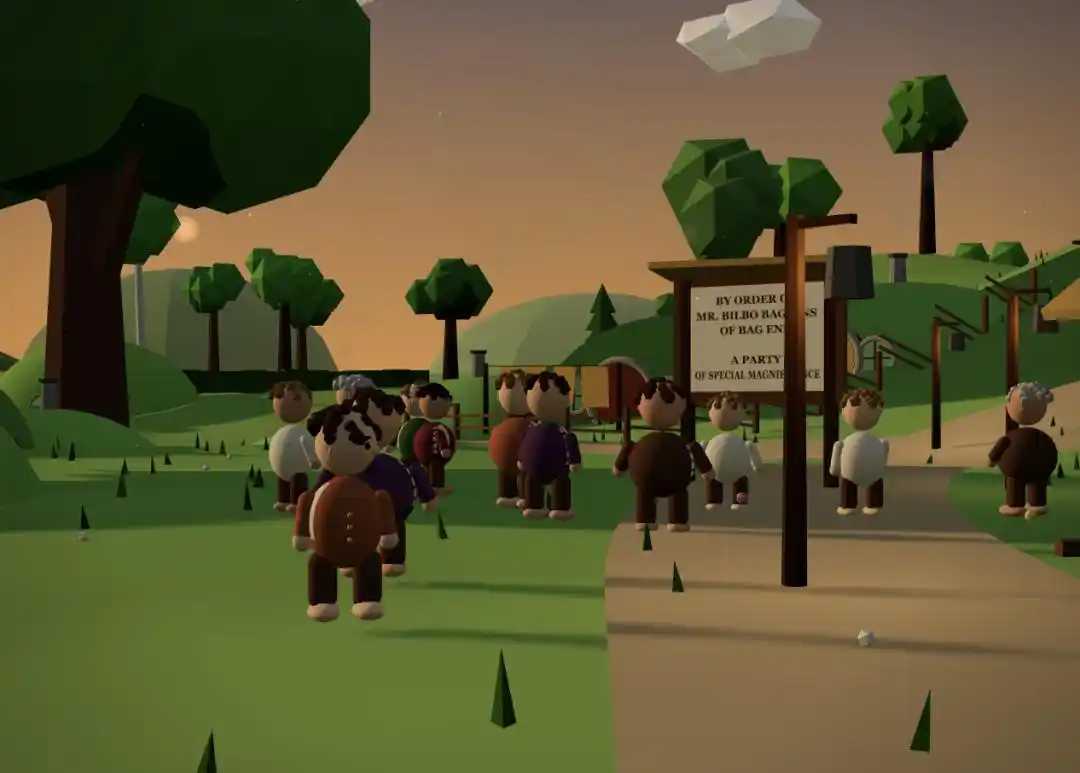
Throughout the process, Opus 5 needed to use polygons to piece together characters, buildings, and props, place them one by one into x, y, z coordinate systems, and then arrange cameras, lighting, and animations.

When characters should move, where the camera should turn, how lighting should change, and how objects in the scene should interact—all needed to be defined by the model using code.

Although the final visuals aren't exactly refined, and issues like clipping and floating frequently occur—for example, characters' bodies and heads separating... but at least the entire scene was genuinely built.
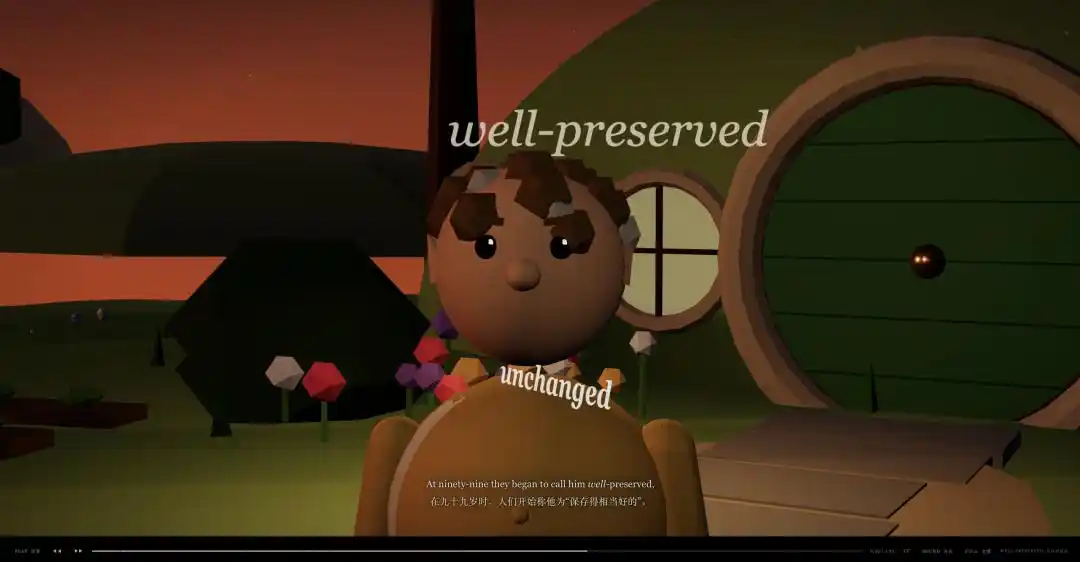
It's important to note that this is not the same as video models directly generating pixel frames.

Three.js first needs to build characters, objects, and scenes as 3D objects, then calculate their positions, angles, and motion states in real-time based on the code.

Therefore, the demo we see is not a regular AI-generated video, but a recording of a running 3D web scene.

However, Karpathy also mentioned in the comments that procedural 3D and video generation are not an either-or choice.

A netizen suggested that this rough Three.js recording could be fed to Sora as a reference video, letting the video model render it again with higher visual quality.
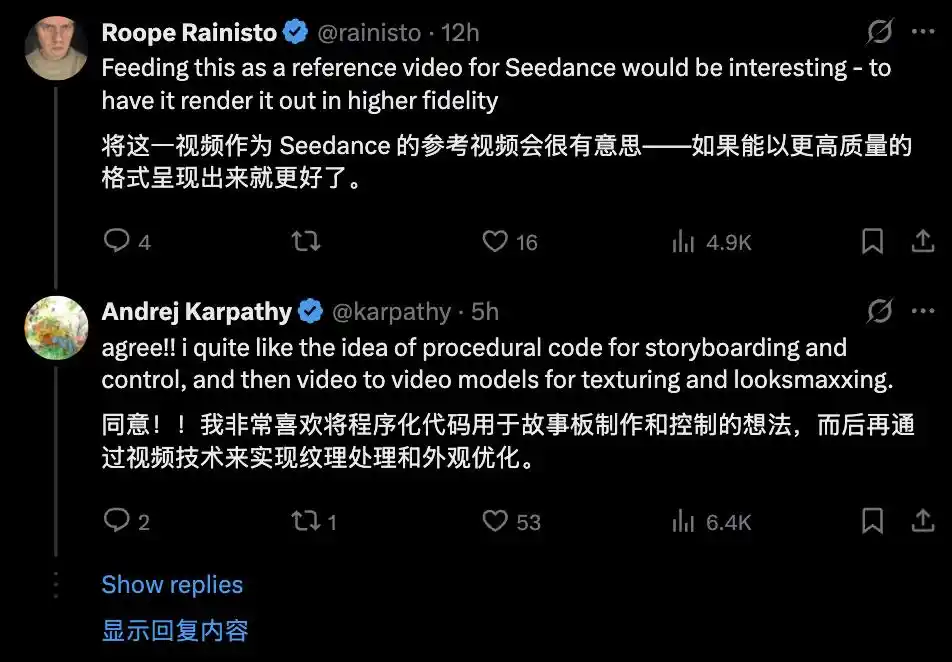
Karpathy quickly agreed.

According to his vision, procedural code could handle storyboarding and control, first finalizing the skeleton: where characters stand, how the camera moves, and how the plot progresses.

Then, the recording could be passed to a Video-to-Video model to add textures, lighting, shadows, and details, enhancing the overall "appeal" of the Middle-earth world.

As for audio, Opus 5 didn't handle it all this time.

Karpathy stated that, due to personal requirements for sound quality, he ultimately used ElevenLabs.
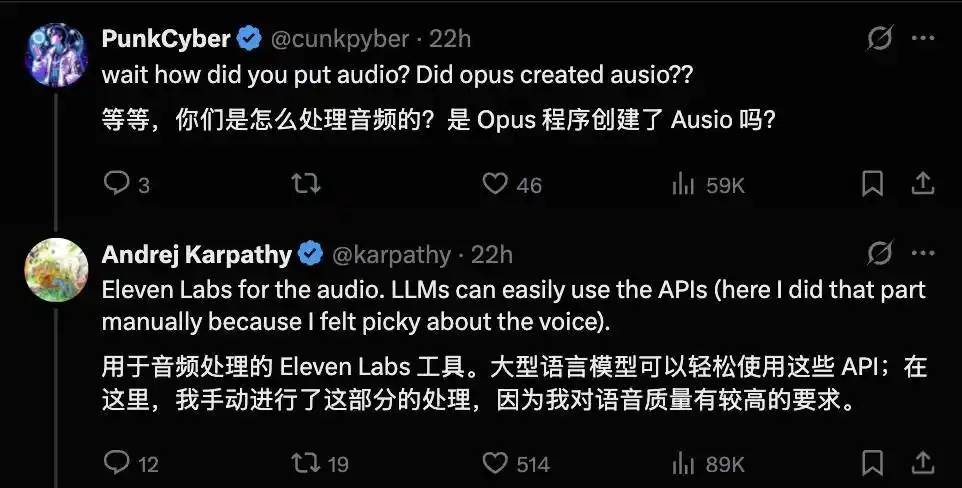
Thus, that "Lord of the Rings" demo with visuals, camera work, and narration at the beginning came into being.

Karpathy has also open-sourced the entire project; the specific link can be found at the end.
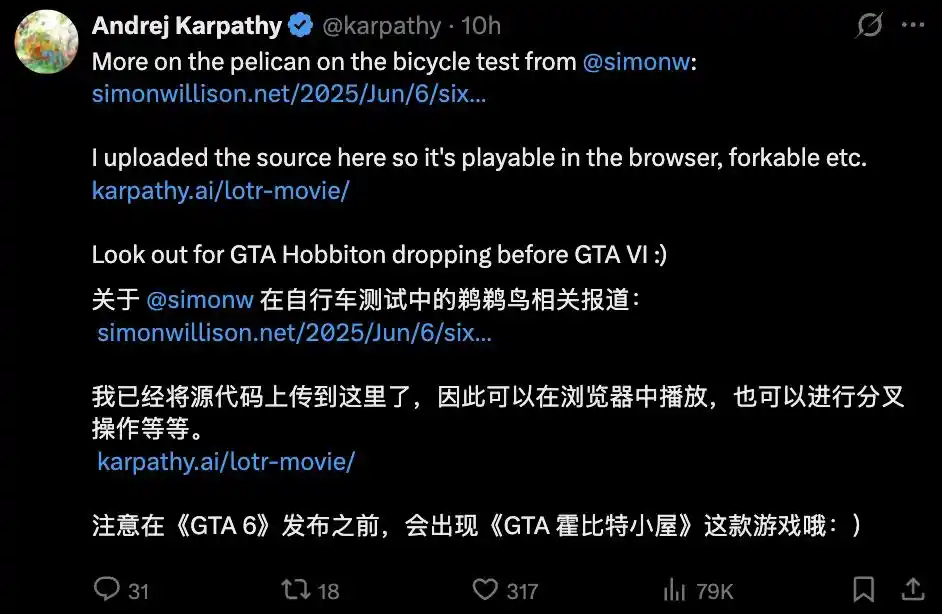
Netizens Are More Interesting Than Karpathy

After Karpathy released the demo, many netizens also rushed to test it out.

Looking at the overall response, one can only say:

This bunch of netizens is more imaginative than Karpathy.

Someone used Claude to launch an 'Earth Online' project, aiming to build the entire Earth bit by bit with a group of AI Agents.

Currently, the Agents haven't finished the whole Earth, having only built a low-poly-style San Francisco waterfront area. But from the available visuals, the building proportions, character scales, and overall style remain quite consistent.

This effect is somewhat like those Lego-world animations. The art style isn't complex, but characters, scenes, and actions can operate stably within the same world.

Continuing in this direction, simple-styled animations and lightweight games are already showing a hint of AI-native potential.

Another netizen used Fable 5 and GPT-5.6 Sol to build a 3D digital model of New York City, incorporating real-time data into it.

The model not only had to position New York's streets and buildings correctly but also maintain spatial relationships between different areas. The author thus proposed that this task of generating virtual worlds could perhaps become a new benchmark for spatial reasoning.

Even more exaggerated examples followed.

One netizen couldn't get tickets to Kanye West's concert, so they simply used AI to host a private concert for themselves in the browser.

The entire project was still built with Three.js. It consisted of a single HTML file, without calling any pre-made 3D models; the stage, characters, and lighting were all generated by code.

The concert prepared 14 songs in total, each with independent lighting design and a dedicated set of spherical stage visuals.

Regular users could listen to clips; after connecting a Spotify Premium account, they could play full songs and the entire show.

Couldn't get tickets? Just generate a private show for yourself. Incredible!

And there's more!!!

Karpathy also envisioned in the original post that gameplay could be added to these 3D worlds later, allowing players to enter as observers, NPCs, or even story characters.

Before Karpathy could arrange a game version, netizens had already made one.
This project also used Opus 5 and Three.js. It could not only run and be interactive but also had audio added.

More 3D design cases kept appearing. From building proportions and spatial layouts to scene style, Opus 5 could already maintain relatively stable consistency across fairly large-scale projects.

There are many similar examples; we won't showcase them all here.

Objectively speaking, these works still have some distance from truly mature games.

Whether the dazzling array of gameplay is fun, if it runs stably over long periods, and if players would genuinely stay for 15 minutes—all these questions currently lack answers.

But the barrier to creating real-time 3D content and playable prototypes has indeed been significantly lowered.

Moreover, having a new way to test model capabilities that is also sufficiently fun and interesting—isn't that a beautiful thing?

The Pelican Has Ridden Far Enough

So, why suddenly ask large models to generate "The Lord of the Rings"?

This goes back to the wildly popular "Pelican Riding a Bicycle" test from a few years ago.

This problem originated from developer Simon Willison, with only one sentence as the requirement:

Generate an SVG image of a pelican riding a bicycle.

Although this problem seems simple, it actually tests models quite significantly.

Because an SVG looks like an image, but its underlying structure is a string of code.

The model not only needs to know what a pelican and a bicycle look like separately but also must break them down into lines, circles, and polygons, then arrange the positional relationships of each component using coordinates.
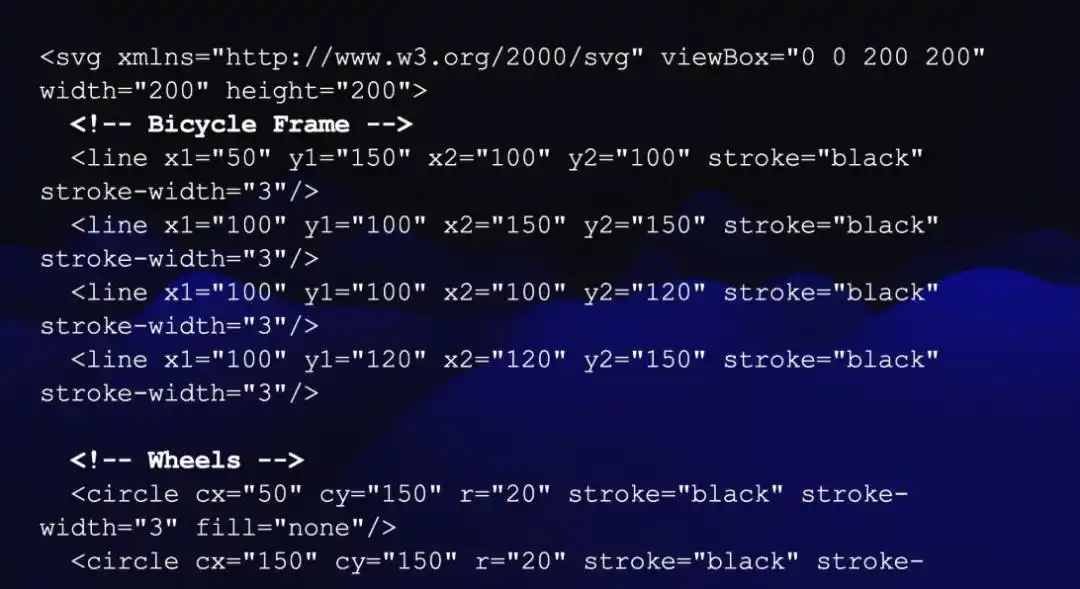
More crucially, pelicans and bicycles themselves are not a natural fit.

The bicycle's frame, tires, and pedals must maintain correct geometric structures; the pelican has a large beak, short legs, and a physique that doesn't look at all suited for pedaling.
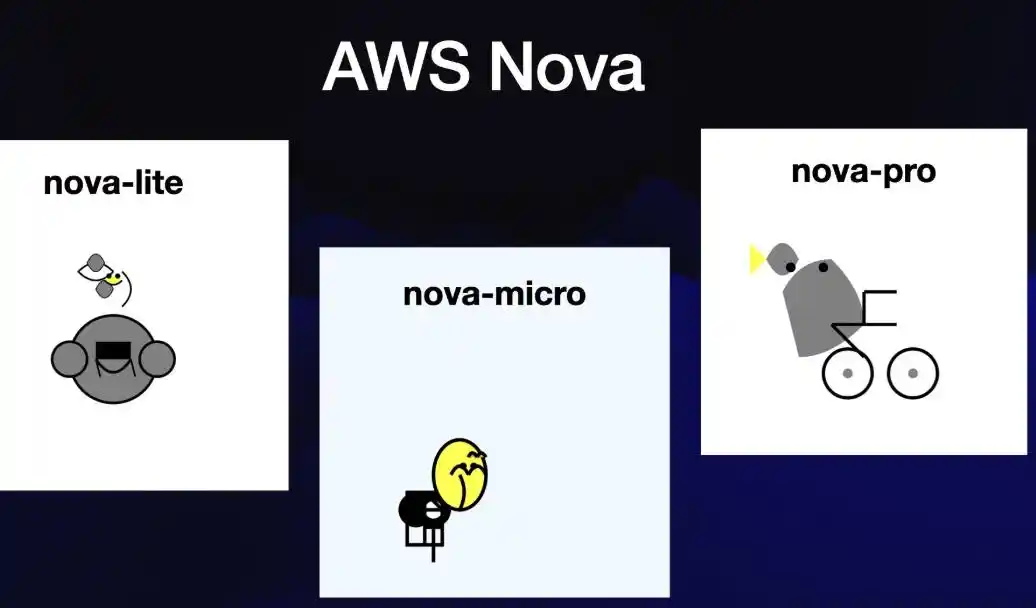
Combined, whether the model truly understands spatial relationships becomes almost immediately apparent:

Are the wheels crooked? Are the feet stepping on the pedals? Is the bird actually riding, or has it been dismembered by the bike frame?

Take a look at these demos from late 2024 above~

For this reason, "Pelican Riding a Bicycle" once became a classic folk test for observing large models' spatial understanding, object composition, and code generation abilities.
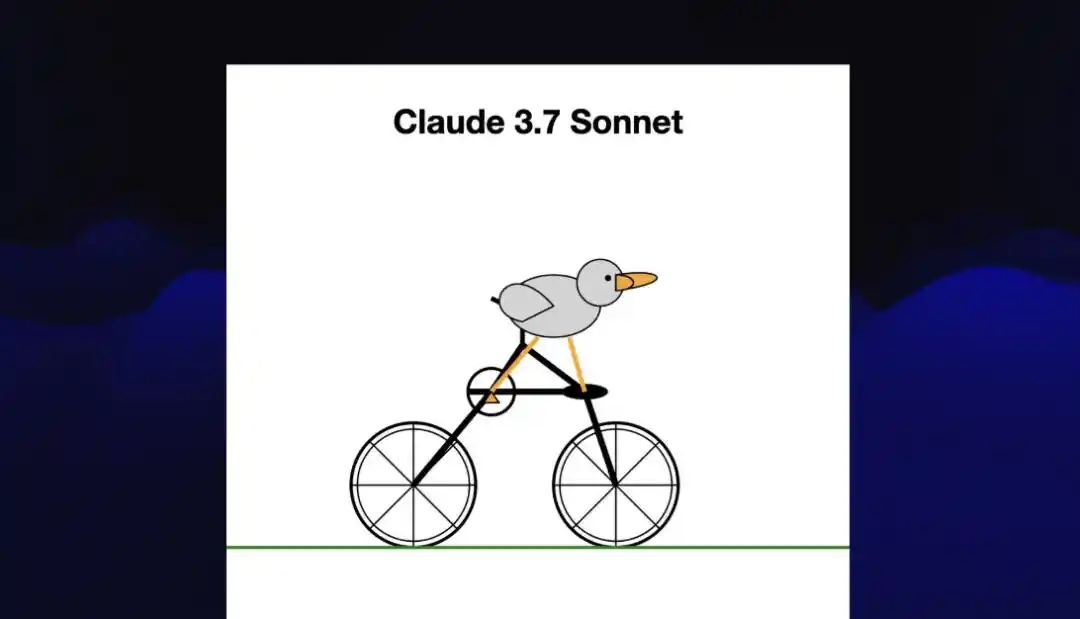
But as models grew stronger, this pelican's ride is nearing its end.

Just look at the performance of DeepSeek R1 and DeepSeek V4 below. Nowadays, models can handle this problem quite decently.
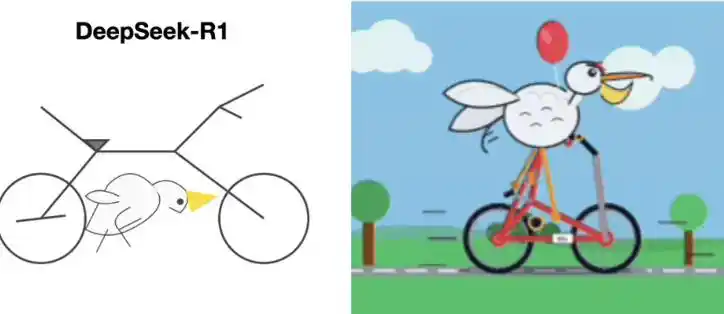
More importantly, a single SVG can only test a model's one-time output.

It cannot measure whether a model can plan a complex project, work continuously for hours, and repeatedly check and correct its own mistakes across thousands of lines of code.

Thus, Karpathy replaced a small "draw a picture" problem with a major "build a world" project—

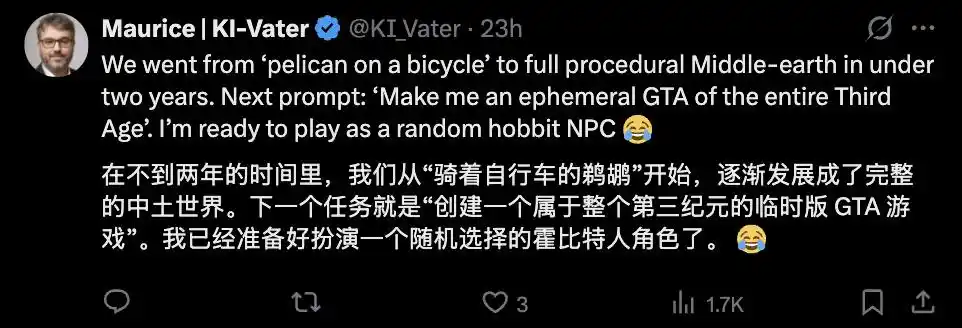
The pelican can dismount now; Middle-earth officially takes over.
Karpathy's Pelican

Soon, news that Karpathy was preparing to change the "Pelican test" problem also spread to various communities.

High-rated comments on Hacker News argued that although the visual quality of these demos is generally low, this precisely indicates we need a new test more challenging than generating a single image.

The new benchmark shouldn't just see if the model can draw the picture correctly; it should also examine whether it can comprehend a world.
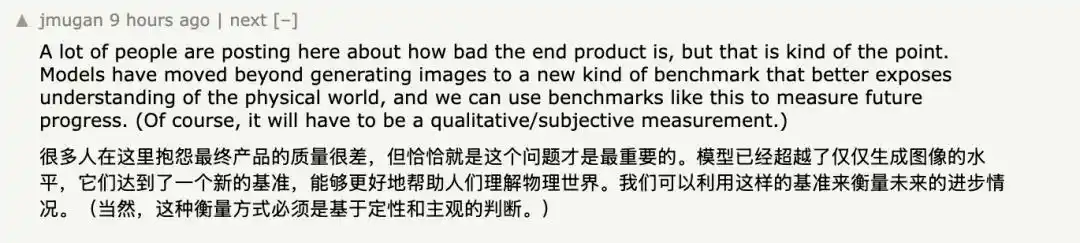
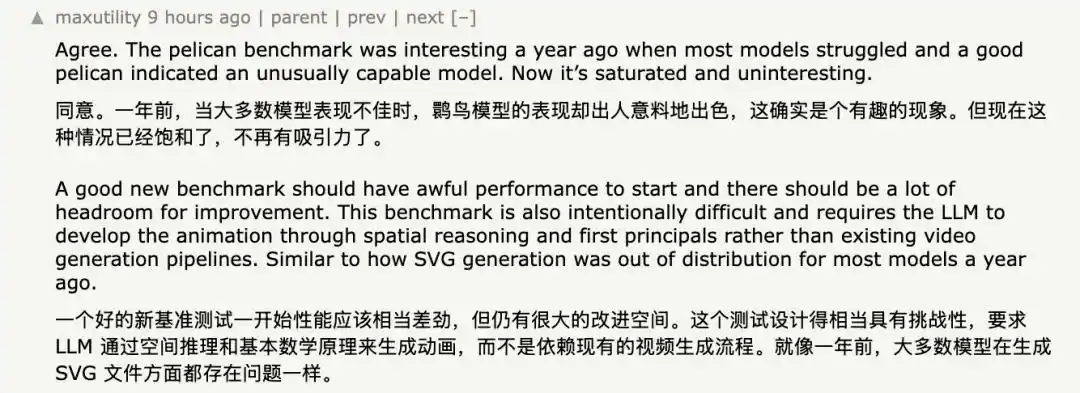
After all, "Pelican Riding a Bicycle" has been used for too long.

Models continuously optimize for this type of task on leaderboards, making the differences between them harder to discern.

In contrast, generating a complete 3D world requires the model to understand spatial relationships between characters and objects, handle camera, motion, and scene changes—not simply call a video generation model to spit out a sequence of frames.
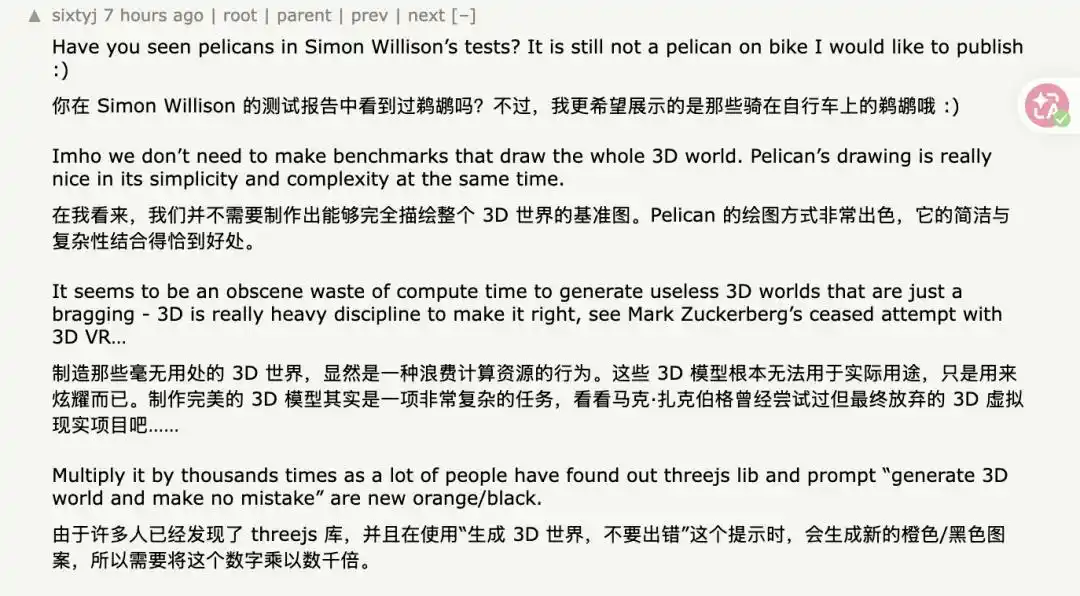
Of course, there were opposing opinions as well.

The Pelican test is sufficiently concise, low-cost, and its results are easy to compare.

Consuming so many Tokens to generate an entire 3D world just to test a model once seems a bit like setting off fireworks with computing power.
Simultaneously, whether Three.js itself can measure a large model's comprehensive abilities was also questioned.

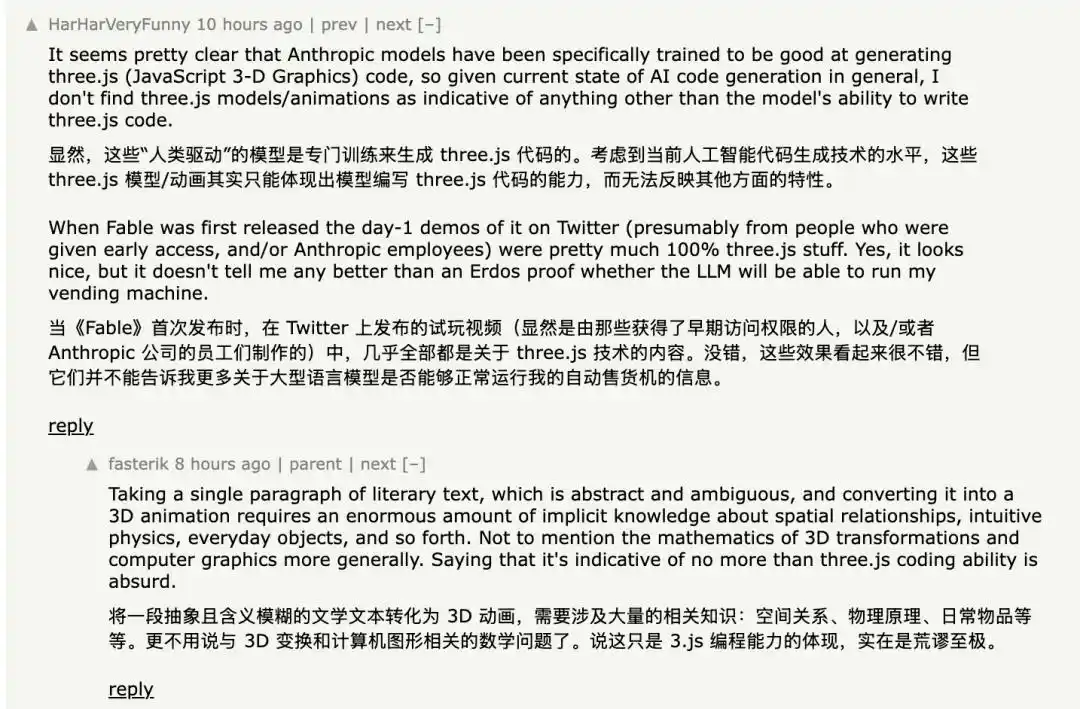
Some argued that such demos can at most prove that Anthropic has trained well on Three.js code, not that the model truly understands space and the physical world.

But soon, netizens rebutted:

Transforming an abstract, ambiguous literary text into a 3D animation requires the model to simultaneously handle spatial relationships, physical laws, everyday objects, as well as mathematical problems in 3D transformations and computer graphics.

If this is still considered merely "knowing how to write Three.js," that somewhat underestimates these 5,500 lines of code.
Another netizen raised an even more open question:

Is so-called "spatial reasoning" truly different from the reasoning large models typically perform when processing text and code?

One view holds that whether a scene holds up depends on whether the model understands spatial relationships like "front/back, inside/outside, near/far, occlusion," as well as the distance, angles, and relative sizes of objects from different viewpoints.
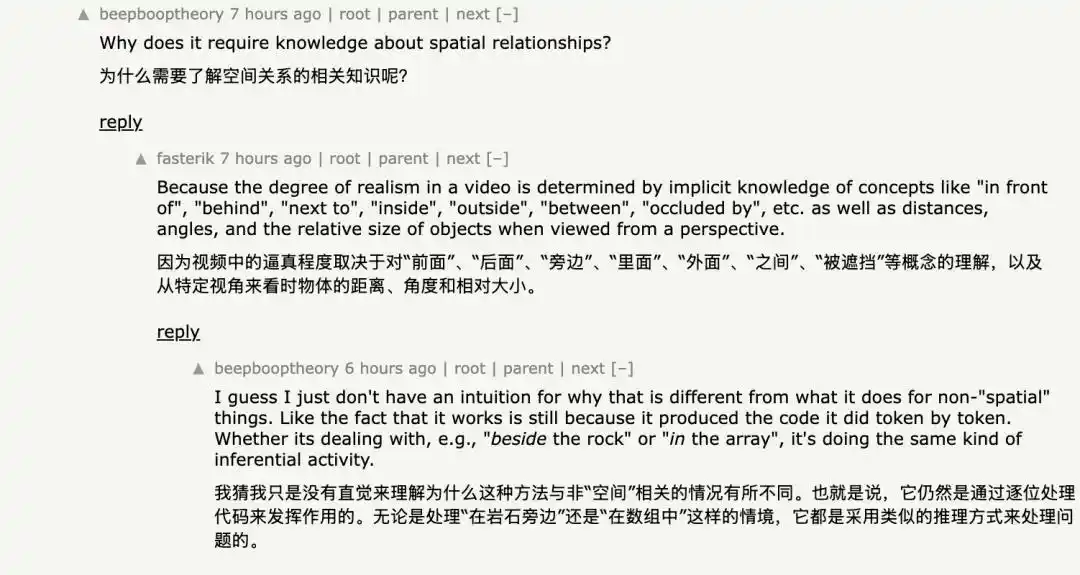
But another view argues that whether the model processes "beside a stone" or "inside an array," it might be doing the same thing: generating Tokens one by one based on context, completing reasoning in the process.

If so, then what Opus 5 demonstrates is not just a suddenly emerging "spatial ability."

A more likely scenario is that the general reasoning ability originally used by large language models to understand text and code has begun naturally extending into the three-dimensional world.

From drawing a pelican to building Middle-earth, the problem seems to have changed, but what's being tested behind the scenes might always be the same question:

Can the model transform its understanding of the world into a structure that can truly run.

And finally, perhaps there's an even more outrageous question—

If general large models can already write code to build 3D worlds themselves, then call APIs like Sora and ElevenLabs to complete visuals and audio, how much need is there left for users to personally open a specialized video generation product and input a Prompt?

Reference Links

[1]https://karpathy.ai/lotr-movie/

[2]https://simonwillison.net/2025/Jun/6/six-months-in-llms/

[3] https://x.com/wizardbrainz/status/2083012159341203708

[4]https://x.com/aniketjart/status/2083645765097033845

[5]https://x.com/davidfromkansas/status/2075691129899528254

[6]https://x.com/MindaugasLT/status/2083488027343470939

This article is from the WeChat public account "QbitAI," author: henry

Crypto di tendenza

Domande pertinenti

QWhat is the 'Lord of the Rings benchmark' proposed by Karpathy, and what does it test?

AThe 'Lord of the Rings benchmark' is a new test proposed by Andrej Karpathy for evaluating large language models. It involves giving a model, like Anthropic's Opus 5, the opening text from 'The Lord of the Rings' and instructing it to generate an interactive 3D scene using Three.js code. This benchmark tests a model's ability to comprehend complex narratives, understand and reason about spatial relationships, plan and execute large-scale projects (generating thousands of lines of code over hours), and translate abstract textual descriptions into a functional, multi-element digital world.

QHow does the 'Lord of the Rings' benchmark differ from the previous 'Pelican Riding a Bicycle' SVG test?

AThe 'Pelican Riding a Bicycle' test required models to generate a single SVG image, testing basic spatial understanding and object composition in a simple, static output. The new 'Lord of the Rings' benchmark is significantly more complex. It replaces a simple image generation task with the creation of a dynamic, multi-scene 3D world. It assesses a model's capability for long-term planning, multi-step reasoning, maintaining consistency across a large codebase, and managing interactive elements like camera angles, lighting, and character animations over time.

QWhat were some limitations or humorous failures observed when other models attempted the new benchmark?

AWhen other models attempted the task, notable failures included the DeepSeek V4 Flash version generating a scene where all characters were floating in the air, humorously described as 'Chinese people can fly.' Other common issues across demos included characters' bodies detaching from their heads, objects clipping through each other ('穿模'), and generally rough, abstract 3D graphics reminiscent of early 2000s animations. These highlight current model shortcomings in precise spatial reasoning and physical consistency.

QAccording to the article, what major shortcoming of current large models does this benchmark expose?

AThe benchmark exposes that while current large models can write code, build scenes, and generate game prototypes, they lack the ability to truly 'understand' or interact with the worlds they create. Karpathy pointed out that Opus 5 cannot 'enter' its generated world to playtest it; it can only inspect it by taking screenshots at different points in time. This reveals a gap in capabilities: models can create interactive content but cannot perceive it visually (understand video) or agency-based understanding (play the game) to debug or refine the experience autonomously.

QWhat future applications or possibilities does the article suggest based on the success of these 3D world-generation demos?

AThe article suggests several future possibilities: 1) Lowering the barrier for creating real-time 3D content and playable prototypes, enabling more AI-native simple animations and lightweight games. 2) A hybrid workflow where procedural code (from the LLM) handles scene composition and camera control, and a video-to-video model enhances the visual fidelity. 3) The potential for users to rely on general-purpose LLMs that can orchestrate multiple specialized APIs (for 3D, video, audio) to create complex media, reducing the need to use separate, specialized tools for each task. 4) The concept of AI agents collaboratively building large-scale virtual worlds like an 'Earth Online.'

Letture associate

Soaring 20% Then Dropping 5%: When Will the Bottom of the Korean Stock Market Be?

"South Korean stocks face a turbulent period as the KOSPI index, after a 20% surge, fell 5% to 6257 points. The market is grappling with severe issues: over 500,000 leveraged retail accounts have been liquidated, and more than 24 trillion won has flowed from stocks into bank deposits for safety. This reflects a significant loss of market liquidity and shaken investor confidence. In response, Korean financial regulators are taking action. They have tripled the minimum保证金 (margin) requirement for single-stock leveraged ETF trades to 30 million won and are considering granting themselves "emergency intervention" powers. These could include capping leverage ratios and setting investment limits on these ETFs, seen by many as amplifying market volatility. Initial results show a 75% drop in these products' trading volume post-regulation. The market downturn has political repercussions, pushing President Yoon Suk-yeol's approval rating to a new low. Meanwhile, foreign investors made a record net purchase of 7.18 trillion won during a recent rebound, while domestic retail investors sold off massively. Morgan Stanley has upgraded South Korean stocks to "overweight," citing the ongoing "leverage unwinding" and potential for a 36% upside, with giants like Samsung Electronics and SK Hynix providing valuation support. However, analysts caution that the market's structure remains vulnerable to foreign capital flows, and the current low may not be the bottom."

marsbit7 min fa

Soaring 20% Then Dropping 5%: When Will the Bottom of the Korean Stock Market Be?

marsbit7 min fa

Goldman Sachs Stakes a Clear Position: This Is the Largest Capital Demand Cycle in Human History, and the Fed Is Just an Observer

Goldman Sachs argues that the world is entering the most capital-intensive investment cycle in history, driven by concurrent massive demands from AI infrastructure, reindustrialization, defense reinvestment, power grid rebuilding, supply chain realignment, and sovereign debt financing. This structural competition for capital is pushing its cost higher, fundamentally altering investment paradigms. Goldman's Mark Wilson states that the Federal Reserve is merely a "passenger, not the driver" in this shift, with rising yields rooted in these real economy demands rather than just monetary policy. While major indices appeared calm in July, underlying market movements were historic, featuring extreme stock dispersion and a severe momentum factor crash, leading to significant de-risking by fund managers. Wilson cautions against expecting a quick reversal in August, citing ongoing digestion of higher rates, disrupted risk models, and typically muted market performance ahead of US midterm elections. Corporate fundamentals remain robust with strong earnings, though growth rates are peaking in the US while accelerating in Europe. Notably, hyperscale cloud companies like Amazon and Microsoft are announcing staggering capital expenditure projections for 2027-2028, justified by explosive AI-related revenue growth and high returns. Amazon revealed its AI revenue run-rate exceeds $25 billion, growing triple-digits annually, and expressed confidence that AWS could become a trillion-dollar revenue business. The report concludes that a transitional period is underway, marked by a growing tension between aggressively investing private tech giants and increasingly capital-constrained sovereign governments. The AI super-cycle continues, with August likely being a consolidation phase.

marsbit12 min fa

Goldman Sachs Stakes a Clear Position: This Is the Largest Capital Demand Cycle in Human History, and the Fed Is Just an Observer

marsbit12 min fa

Outflow of Stablecoins from South Korea Continues for 18 Consecutive Months, Exceeding $360 Million in June

In June 2026, South Korea experienced a net outflow of stablecoins to overseas crypto exchanges, amounting to 560.3 billion won ($367 million). This represents approximately 78% of the net value of foreign stocks purchased by Korean investors in the same period. According to the Financial Supervisory Service (FSS), this marks the 18th consecutive month of net outflows, a trend ongoing since January 2025. The FSS reported that 2.76 trillion won ($1.8+ billion) in stablecoins were withdrawn from the country's five major exchanges to foreign platforms in June, while 2.2 trillion won ($1.4 billion) flowed back in. The second quarter of 2026 saw a significant net outflow of 1.69 trillion won (~$1.1 billion), surpassing net sales of foreign stocks in the same period. Analysts cite access to unavailable domestic financial instruments as a primary driver. Foreign platforms offer crypto derivatives, spot and futures products tied to major Korean stocks like Samsung and Hyundai, along with RWA tokenization, DeFi, staking, and leveraged products. Lawmaker Lee Jong-wook warned that the stablecoin outflows constitute capital flight, exposing investors to risks on unregulated foreign platforms. He called for accelerated regulatory reform and enhanced investor protection measures. The government is reportedly working on a digital assets law to foster the blockchain sector.

cryptonews.ru17 min fa

Outflow of Stablecoins from South Korea Continues for 18 Consecutive Months, Exceeding $360 Million in June

cryptonews.ru17 min fa

Trading

Spot

Articoli Popolari

Cosa è G$

Comprendere GoodDollar ($G$): Un Progetto per il Reddito Universale di Base Decentralizzato Introduzione Nel panorama in continua evoluzione delle criptovalute e della tecnologia blockchain, le iniziative che cercano di affrontare questioni sociali urgenti hanno attirato crescente attenzione. Uno di questi progetti è GoodDollar ($G$), una soluzione di reddito universale di base (UBI) basata su Web3. GoodDollar si impegna a combattere le disuguaglianze e colmare il divario di ricchezza creando e distribuendo risorse economiche accessibili a coloro che ne hanno più bisogno. Attraverso il suo utilizzo innovativo della finanza decentralizzata (DeFi), GoodDollar propone un modello unico che potrebbe potenzialmente rimodellare il modo in cui l'assistenza finanziaria è percepita e fornita a livello globale. Che cos'è GoodDollar ($G$)? GoodDollar è un protocollo di criptovaluta che facilita l'emissione e la distribuzione di token digitali, denominati $G$, ai suoi utenti registrati su base giornaliera. Questi token funzionano come una forma di reddito universale di base, promuovendo l'empowerment finanziario per individui provenienti da vari contesti, specialmente quelli tradizionalmente esclusi dal sistema finanziario. Operando sulla blockchain, GoodDollar utilizza più catene, tra cui Ethereum, Celo e Fuse, garantendo ampia accessibilità e usabilità. L'obiettivo fondamentale di GoodDollar è rendere le criptovalute accessibili e vantaggiose per tutti, indipendentemente dal loro punto di partenza economico. Il Creatore di GoodDollar ($G$) I dettagli riguardanti il creatore di GoodDollar rimangono piuttosto oscuri. Tuttavia, è significativamente evidenziato che il progetto ha il forte sostegno di eToro, una piattaforma di investimento ampiamente riconosciuta che ha fornito il finanziamento iniziale e il supporto fondamentale per lo sviluppo di GoodDollar. La visione dietro il progetto non è esclusivamente orientata al profitto, ma tende fortemente verso l'imprenditorialità sociale, puntando a un cambiamento sistemico nell'accessibilità economica. Investitori di GoodDollar ($G$) GoodDollar gode del supporto finanziario e operativo di eToro. Questa partnership ha svolto un ruolo significativo nel lancio del protocollo e nei suoi sviluppi successivi. Sebbene eToro sia stato determinante nell'estableire le basi del progetto, GoodDollar prevede di passare a un modello finanziato dalla sua comunità a lungo termine. Questo spostamento verso il finanziamento comunitario è in linea con l'impegno di GoodDollar verso la decentralizzazione, consentendo ai suoi utenti di avere una partecipazione diretta nel futuro del progetto. Come Funziona GoodDollar ($G$)? Il framework operativo di GoodDollar si basa fortemente sui principi della DeFi per generare interessi dalle criptovalute staked. Questo meccanismo consente al progetto di coniare e distribuire token $G$ come reddito base digitale per utenti in tutto il mondo. Diverse caratteristiche chiave contribuiscono all'unicità e all'innovazione di GoodDollar: Reddito Universale di Base (UBI): Ogni giorno, gli utenti registrati ricevono token gratuiti, stabilendo un flusso di reddito automatico destinato ad alleviare le pressioni finanziarie. Modello Economico Sostenibile: La tokenomica del progetto mira a bilanciare domanda e offerta di token $G$, assicurando che il valore rimanga stabile nel tempo. Token Sostenuti da Riserva: Ogni token $G$ è sostenuto da una riserva di criptovalute, fornendogli un valore intrinseco e affidabilità, un aspetto cruciale per mantenere la fiducia degli utenti. Governance Decentralizzata: GoodDollar incorpora un approccio democratico al processo decisionale attraverso una governance decentralizzata alimentata dai token. Questo consente ai membri della comunità di partecipare attivamente alla definizione della traiettoria del progetto, rendendolo veramente guidato dalla comunità. Accessibilità Globale: GoodDollar ha stabilito un notevole footprint comunitario, vantando oltre 640.000 membri provenienti da 181 paesi. Tale portata diffusa è strumentale nel facilitare l'UBI su scala globale. Timeline di GoodDollar ($G$) L'evoluzione di GoodDollar è segnata da diversi traguardi significativi nella sua storia: 2019: Il lancio del portafoglio GoodDollar ha segnato il primo passo nella operativizzazione della sua visione di fornire UBI attraverso le criptovalute. 2020: Dopo il successo del portafoglio, il protocollo GoodDollar ha debuttato ufficialmente. Questo ha segnato una fase cruciale nella sua missione di fornire reddito distribuito giornalmente. 2021: Il progetto è avanzato ulteriormente con l'introduzione della sua Organizzazione Autonoma Decentralizzata (DAO), favorendo un maggiore livello di coinvolgimento e governance della comunità. 2022: GoodDollar ha svelato la sua versione DeFi-friendly 2 (V2), mirando a un coinvolgimento degli utenti e a un'efficienza operativa migliorata. Lo stesso anno ha visto anche la transizione a una struttura di governance decentralizzata tramite GoodDAO. 2022: È stata concettualizzata una nuova roadmap, focalizzata su iniziative come un programma di sovvenzioni progettato per promuovere iniziative imprenditoriali legate a $G$ e un mercato GoodDollar aggiornato. Caratteristiche Chiave di GoodDollar ($G$) Il progetto GoodDollar introduce numerose caratteristiche critiche tese a ridefinire il panorama del reddito di base: Reddito Universale di Base: La consegna diaria di token gratuiti ai suoi utenti sottolinea fondamentalmente la sua missione di eliminare la precarietà economica. Operazione Multi-Chain: Sfruttare più reti blockchain migliora l'accessibilità e la scalabilità, garantendo una partecipazione più ampia. Engagement con la Finanza Decentralizzata: L'uso della DeFi consente un finanziamento sostenibile del modello UBI, rafforzandone la fattibilità come soluzione economica. Coinvolgimento e Governance della Comunità: GoodDollar prevede un modello in cui la comunità influenza le operazioni attraverso la partecipazione democratica, promuovendo trasparenza e responsabilità. Comunità Globale: Vantare una comunità globale diversificata consente al progetto di implementare soluzioni UBI adattate a vari contesti culturali ed economici. Conclusione GoodDollar rappresenta un salto trasformativo verso l'integrazione dei principi del reddito universale di base attraverso l'innovativo obiettivo della tecnologia blockchain. Sfruttando la finanza decentralizzata, il progetto non solo fornisce una soluzione all'ineguaglianza finanziaria, ma coinvolge attivamente gli utenti nella sua governance e nelle sue operazioni. Con una comunità in crescita e una roadmap in evoluzione, GoodDollar si afferma come un attore significativo nell'intersezione tra criptovaluta e bene sociale, aprendo la strada a un futuro finanziario più equo. Continuando a evolversi, il percorso di GoodDollar potrebbe infine ispirare altre iniziative a considerare modelli simili, promuovendo ulteriormente la causa dell'empowerment economico per tutti.

142 Totale visualizzazioniPubblicato il 2024.04.05Aggiornato il 2024.12.03

Cosa è G$

Come comprare G

Benvenuto in HTX.com! Abbiamo reso l'acquisto di Gravity (G) semplice e conveniente. Segui la nostra guida passo passo per intraprendere il tuo viaggio nel mondo delle criptovalute.Step 1: Crea il tuo Account HTXUsa la tua email o numero di telefono per registrarti il tuo account gratuito su HTX. Vivi un'esperienza facile e sblocca tutte le funzionalità,Crea il mio accountStep 2: Vai in Acquista crypto e seleziona il tuo metodo di pagamentoCarta di credito/debito: utilizza la tua Visa o Mastercard per acquistare immediatamente GravityG.Bilancio: Usa i fondi dal bilancio del tuo account HTX per fare trading senza problemi.Terze parti: abbiamo aggiunto metodi di pagamento molto utilizzati come Google Pay e Apple Pay per maggiore comodità.P2P: Fai trading direttamente con altri utenti HTX.Over-the-Counter (OTC): Offriamo servizi su misura e tassi di cambio competitivi per i trader.Step 3: Conserva Gravity (G)Dopo aver acquistato Gravity (G), conserva nel tuo account HTX. In alternativa, puoi inviare tramite trasferimento blockchain o scambiare per altre criptovalute.Step 4: Scambia Gravity (G)Scambia facilmente Gravity (G) nel mercato spot di HTX. Accedi al tuo account, seleziona la tua coppia di trading, esegui le tue operazioni e monitora in tempo reale. Offriamo un'esperienza user-friendly sia per chi ha appena iniziato che per i trader più esperti.

514 Totale visualizzazioniPubblicato il 2024.12.10Aggiornato il 2026.06.02

Come comprare G

Cosa è @G

Rete Graphite, $@G: Colmare il divario tra TradFi e Web3 Introduzione alla Rete Graphite, $@G Nel vivace mondo delle criptovalute e dei progetti web3, la Rete Graphite emerge come un faro di innovazione. Con il suo token nativo, $@G, questa blockchain Layer-1, Proof-of-Authority (PoA) è progettata per colmare il divario tra la finanza tradizionale (TradFi) e l'ecosistema Web3 in rapida evoluzione. Mentre le valute digitali guadagnano terreno, la Rete Graphite si impegna a offrire una piattaforma blockchain che prioritizza sicurezza, conformità e velocità, presentandosi come un facilitatore di fiducia e responsabilità. Cos'è la Rete Graphite, $@G? La Rete Graphite non è semplicemente un altro progetto blockchain; mira a ridefinire come la decentralizzazione, la sicurezza e la responsabilità degli utenti siano percepite nel regno della finanza digitale. Il progetto vanta una serie di caratteristiche distintive: Blockchain Basata sulla Reputazione: Al suo interno, la Rete Graphite implementa una politica di uno-utente, uno-account, rafforzata con meccanismi integrati di Know Your Customer (KYC) e sistemi di punteggio. Questo design garantisce un equilibrio tra privacy degli utenti e trasparenza—un aspetto critico delle operazioni finanziarie nel mondo digitale odierno. Entrate dai Noduli di Accesso: La rete incentiva gli utenti a impostare noduli di accesso, consentendo agli operatori di guadagnare ricompense dalle transazioni di rete. Questo modello di generazione di reddito non solo aumenta il coinvolgimento degli utenti, ma rafforza anche la salute e la decentralizzazione della rete. Compatibilità EVM: Con una macchina virtuale (VM) compatibile con Ethereum, la Rete Graphite consente un'integrazione senza soluzione di continuità delle applicazioni decentralizzate (dApps) e dei contratti smart esistenti in Solidity, invitando così gli sviluppatori a sfruttare le sue capacità senza modifiche estensive. Integrazione KYC: In un'era in cui la conformità è fondamentale, il framework KYC integrato con più livelli di verifica migliora il controllo sulle operazioni finanziarie senza partecipazione obbligatoria, stabilendo un precedente per l'autonomia degli utenti. Chi è il Creatore della Rete Graphite, $@G? La Rete Graphite nasce dagli sforzi della Graphite Foundation, un'organizzazione non profit dedicata allo sviluppo, alla manutenzione e all'evoluzione della Rete Graphite. L'impegno della fondazione sottolinea la visione del progetto di creare un ambiente blockchain sicuro e sostenibile, focalizzato sul coinvolgimento autentico degli utenti e sulla conformità. Chi sono gli Investitori della Rete Graphite, $@G? Attualmente, ci sono informazioni limitate disponibili sugli investitori specifici che sostengono l'iniziativa della Rete Graphite. L'organizzazione fondatrice, la Graphite Foundation, opera in modo indipendente per promuovere la crescita del progetto, cercando al contempo partnership che risuonino con la sua visione di una piattaforma blockchain conforme e accessibile. Come Funziona la Rete Graphite, $@G? Il funzionamento della Rete Graphite si basa sul suo unico meccanismo di consenso Proof-of-Authority, che trova un impressionante equilibrio tra elevata capacità di elaborazione e decentralizzazione. Approfondiamo i vari componenti che definiscono il suo funzionamento: Nodi di Trasporto: Servendo come nodi di accesso, questi sono critici per l'ecosistema. Gli operatori possono guadagnare entrate dalle transazioni che attraversano la rete, il che non solo potenzia gli utenti individuali ma rafforza anche la decentralizzazione della rete. Nodi Autorizzati: Al centro della Rete Graphite ci sono i validatori principali che sottopongono a rigorosi test di conformità, comprendenti una robusta verifica KYC insieme a valutazioni tecniche. Questo strato di fiducia è essenziale per garantire che le transazioni all'interno della rete mantengano un elevato livello di integrità. Sistema di Ticker: La Rete Graphite impiega un sistema di ticker distintivo per i suoi token avvolti, denotati come @G. Questa caratteristica migliora la chiarezza nell'integrazione degli asset, rendendo le transazioni degli utenti comprensibili e dirette. L'approccio innovativo della Rete Graphite riflette un passo significativo nell'affrontare le questioni cruciali della finanza digitale, posizionandosi favorevolmente per il futuro mentre sempre più utenti transitano dalle forme tradizionali di finanza al mondo delle applicazioni decentralizzate. Cronologia della Rete Graphite, $@G Per comprendere la progressione e le tappe della Rete Graphite, è utile rivedere eventi chiave nella sua cronologia: 2021: L'inizio della Rete Graphite da parte della Graphite Foundation segna l'inizio di un nuovo capitolo nello sviluppo blockchain, focalizzandosi sulla conformità e sull'empowerment degli utenti. Sviluppi Chiave: Dopo il suo lancio, l'introduzione delle entrate dai nodi di accesso, l'istituzione di un modello basato sulla reputazione, la verifica KYC integrata e la fornitura di compatibilità EVM rappresentano progressi significativi nel progetto. Attività Recenti: I continui sforzi di sviluppo e cura della Graphite Foundation si sono concentrati sull'aumento delle funzionalità della rete, mentre si promuoveva la crescita dell'ecosistema, dimostrando un impegno a lungo termine per la sostenibilità e l'innovazione. Ulteriori Punti Chiave Oltre ai suoi componenti fondamentali, la Rete Graphite comprende diversi strumenti e funzionalità che ne rafforzano l'usabilità: Graphite Wallet: Un'estensione di Chrome user-friendly che facilita l'accesso a varie funzionalità e applicazioni della rete su catene compatibili con Ethereum, migliorando la comodità per gli utenti. Graphite Bridge: Questo strumento consente trasferimenti senza soluzione di continuità di asset Graphite tra diverse reti, promuovendo un ecosistema integrato e interoperabile. Graphite Explorer: Servendo come uno strumento essenziale all'interno dell'ecosistema, questa funzionalità consente agli utenti di visualizzare e verificare il codice sorgente dei contratti smart, tracciare le transazioni e esplorare altre informazioni vitali in tempo reale. Graphite Testnet: Il progetto fornisce un robusto ambiente di test per gli sviluppatori, consentendo loro di garantire stabilità e scalabilità prima del deployment sulla mainnet. Questa iniziativa non solo potenzia gli sviluppatori ma migliora anche l'affidabilità dell'intera rete. Conclusione La Rete Graphite, con il suo token nativo $@G, rappresenta un passo significativo verso il collegamento tra la finanza tradizionale e la tecnologia blockchain all'avanguardia. Concentrandosi su sicurezza, conformità e decentralizzazione, questa piattaforma innovativa è pronta a guidare la transizione nell'era Web3. Man mano che il coinvolgimento degli utenti cresce e sempre più progetti sfruttano le sue capacità, la Rete Graphite è destinata a dare contributi duraturi al panorama digitale in rapida evoluzione. In conclusione, la Rete Graphite è una testimonianza di ciò che può essere realizzato quando il pensiero innovativo incontra le crescenti esigenze della finanza e della tecnologia moderne. Mentre il mondo esplora il potenziale della finanza decentralizzata, la Rete Graphite rimarrà senza dubbio un attore notevole in questo campo.

41 Totale visualizzazioniPubblicato il 2025.01.06Aggiornato il 2025.01.06

Cosa è @G

Discussioni

Benvenuto nella Community HTX. Qui puoi rimanere informato sugli ultimi sviluppi della piattaforma e accedere ad approfondimenti esperti sul mercato. Le opinioni degli utenti sul prezzo di G G sono presentate come di seguito.

活动图片