"King of Pump Calls" Arthur Hayes Strikes Again, This Time Targeting Deribit

marsbitPubblicato 2026-06-29Pubblicato ultima volta 2026-06-29

Introduzione

On June 29, BitMEX co-founder Arthur Hayes purchased approximately 6.16 million SYN tokens via OTC platform Flowdesk for around $2.2 million. Hayes subsequently declared on X that SYN represents one of the most asymmetric investments he has seen since HYPE, stating it's time for an options DEX to challenge the dominant platform Deribit, and identifying Hypercall as that challenger. SYN's price surged over 40% following his comments, with a tenfold increase in June 2026 alone, bringing its FDV to roughly $110 million. The article details Synapse Protocol's evolution from a cross-chain messaging and liquidity network into the chain-based options trading protocol Hypercall. Hypercall, built on the Hyperliquid ecosystem's HyperEVM, aims to be a universal options exchange supporting any asset size with capped loss (limited to premium paid) and no forced liquidations. Deribit, established in 2016, remains the centralized leader in crypto options with an estimated 85% market share in BTC and ETH options and $3.588 billion in assets. Its strengths include deep liquidity and professional tools, but it faces criticisms over custody risk, KYC requirements, and regulatory uncertainty. The analysis positions Hypercall not as an immediate replacement for Deribit's entrenched network effects, but as a potential complementary and differentiated competitor, particularly for DeFi-native assets and new asset classes like RWA. The article concludes by noting Hayes's recent mixed "call" record...

Author: Ma He, Foresight News

On June 29, an address associated with BitMEX co-founder Arthur Hayes purchased approximately 6.16 million SYN tokens through the OTC platform Flowdesk, with a transaction value of about $2.2 million and an average purchase price of approximately $0.3573.
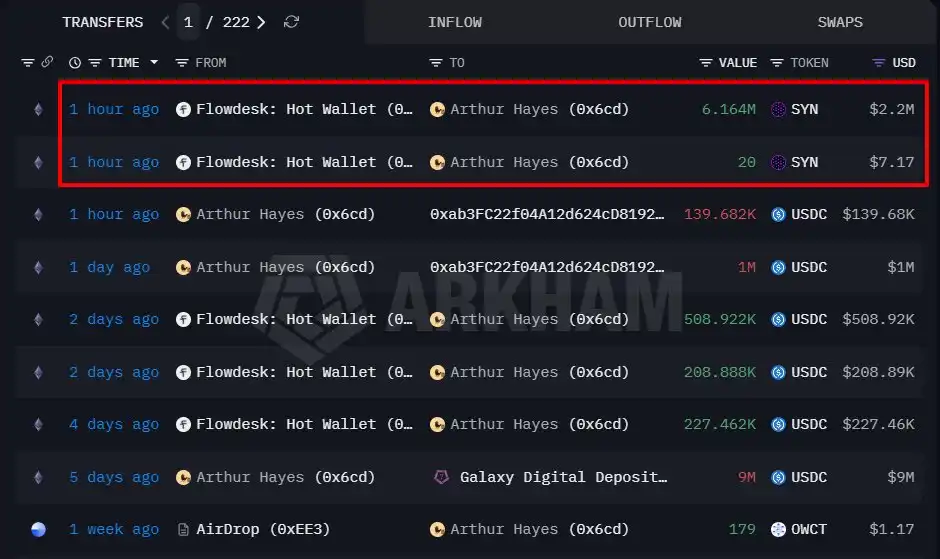
Subsequently, Arthur Hayes posted on X platform, stating that SYN is one of the most asymmetric investments he has seen since HYPE, and explicitly said: "The time has come for options DEX to formally challenge Deribit, and Hypercall is that challenger."

Currently, SYN is priced at $0.436, with a 24-hour increase of over 40%. Since June 2026, the price of SYN has experienced explosive growth, with a single-month increase exceeding 10 times, and an FDV of approximately $110 million.

Synapse: From Cross-Chain Infrastructure to On-Chain Options

Synapse Protocol was founded in 2021, initially positioned as a universal cross-chain messaging and liquidity network. It allows developers to transfer arbitrary data between different blockchains, including smart contract calls and NFTs, not limited to simple asset bridging.

Early on, Synapse secured a place in the multi-chain ecosystem with its cross-chain AMM liquidity pools and low-slippage stablecoin swaps. During the 2021-2022 bull market, its TVL once exceeded $1 billion, forming a mainstay in the cross-chain bridge sector alongside projects like Wormhole, LayerZero, and Axelar. However, the competition in the cross-chain bridging field is fierce, coupled with the impact of the bear market, the protocol's TVL has significantly declined.
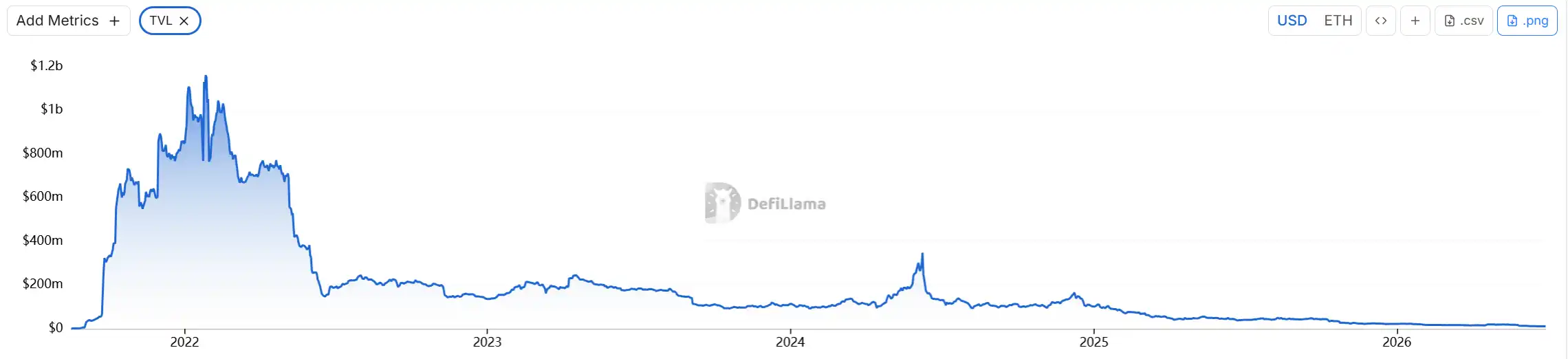
According to the latest data from DefiLlama, as of June 2026, Synapse's TVL is approximately $11.1 million, mainly concentrated on chains like Ethereum and Canto.

The SYN token, as a governance token, reached a high of about $5 in October 2021 and has remained low for a long time since.

Hypercall is an on-chain options trading protocol built by the Synapse team, deployed on the HyperEVM within the Hyperliquid ecosystem. Its core proposition is to build "an options exchange that can trade any asset."

Different from traditional centralized options platforms or early on-chain options protocols, Hypercall officially states that it supports trades of any size, with contracts divisible to dollar or million-dollar levels; additionally, the maximum loss on an option is only the premium paid, with no forced liquidation or cascading liquidation risks; it also supports 24/7 trading, among other features.

Currently, the Hypercall Mainnet Alpha is live. Users can directly connect their wallets to trade SpaceX (SPCX) options, and BTC put options, NVDA spreads, and other underlying assets have also appeared. The team previously claimed that their product's cumulative trading volume exceeds $55 billion.

Deribit: The Centralized Options Hegemon

Founded in 2016, Deribit has long held an absolute dominant position in the crypto options market. According to industry data, its market share in BTC and ETH options is about 85%, making it the preferred platform for institutional traders, market makers, and quant funds.

Currently, data from DeFiLlama shows its total asset value is $3.588 billion.
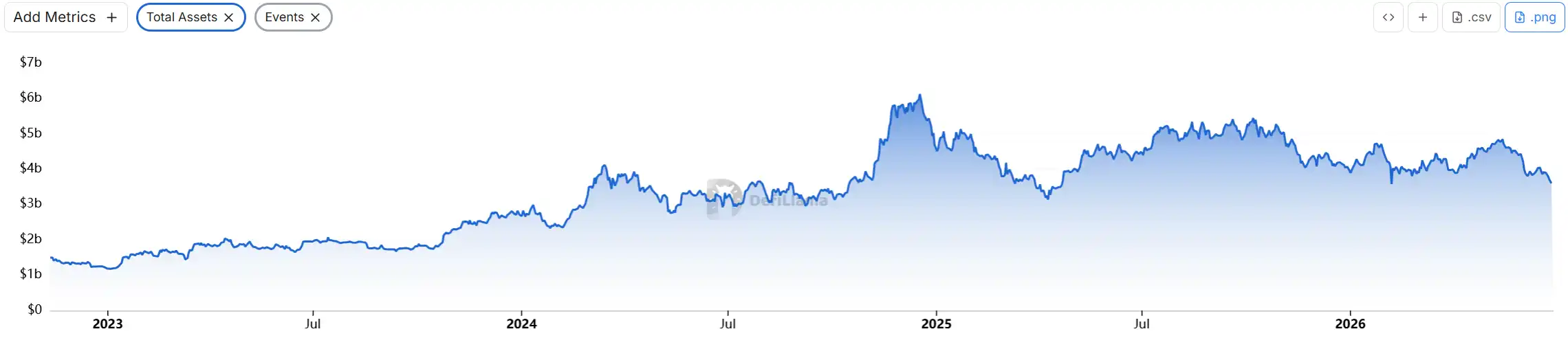
Deribit's advantages lie in its deep liquidity and professional tools: supporting portfolio margin, block trading, low-latency multicast data feeds; furthermore, it has maintained stable operation over the long term. However, centralization also brings inherent limitations: custody risks, KYC barriers, regulatory uncertainty, and relative unfriendliness to small retail users and DeFi natives. The complexity of options trading and margin mechanisms further amplify these pain points.

Arthur Hayes's call directly points to the industry's core logic—as on-chain perpetual DEXs like Hyperliquid demonstrate high performance, composability, and capital efficiency, the demand for the on-chainization of options, which serve as "precise tools for expressing volatility and direction," is accumulating.

Hypercall's potential advantages include: decentralization, permissionless access, no KYC, and transparency. Additionally, deep integration with the Hyperliquid settlement layer offers a trading experience close to centralized platforms while retaining on-chain transparency. However, the protocol is still in its early Mainnet Alpha stage, with liquidity depth far inferior to Deribit. Initial underlying assets are for testing, like SpaceX, and coverage of mainstream crypto options still requires time. Historically, on-chain options protocols (such as early versions of Hegic, Opyn) have also made significant attempts, but often struggled to scale due to insufficient liquidity.

Deribit's network effect is difficult to replace in the short term. Hypercall is more likely to be a "complement and differentiated competitor" rather than a direct replacement—especially in DeFi-native and emerging asset (like RWA, AI-related underlying) options fields.

What Game Is the "King of Pump Calls" Playing?

Arthur Hayes's recent "pump call" record shows clear divergence.

He previously strongly favored HYPE, predicting its price target as high as $150, but chose to liquidate all his HYPE holdings in early June. He also sold off NEAR and WLD, which he had previously promoted. On June 16 and 23, on-chain tracking data showed that he bought back a total of 91,000 HYPE tokens via exchanges.

On June 24, a deep research report on CARDS (Collector Crypt) released by Arthur Hayes's family office Maelstrom also sparked considerable controversy. The report set a target price of $4 by the end of summer.

Just 4 days later, the market capitalization of CARDS has fallen by about 22% since Maelstrom set the target price.

Currently, the price is $0.2437, with a market cap of $100 million and an FDV reported at $487 million.
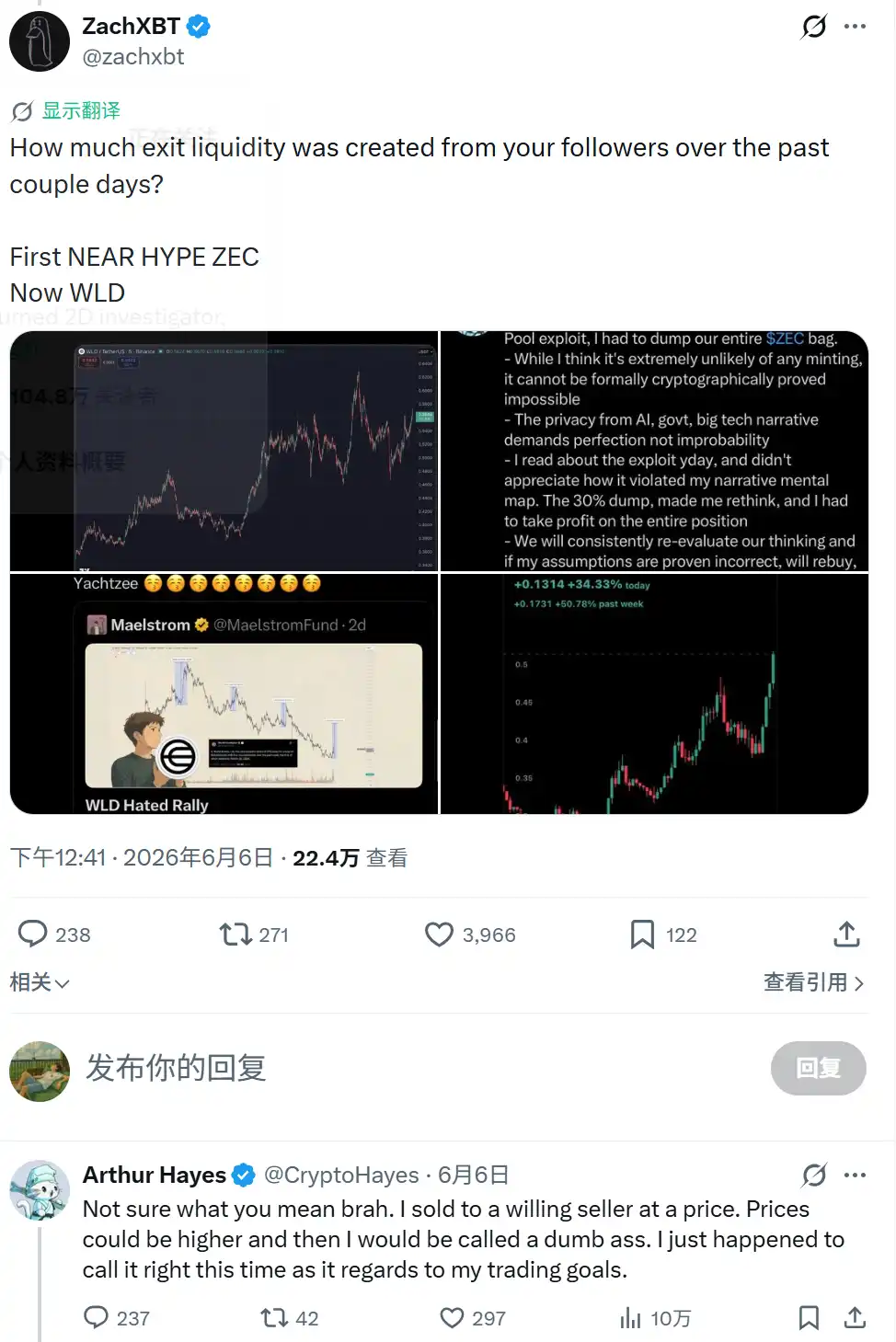
On-chain investigator ZachXBT previously criticized Arthur Hayes on X, noting his multiple public pump calls over the past few days, asking "How much exit liquidity have your followers generated in the past few days?" Arthur Hayes responded, saying he was just trading normally, prices can go up or down, and stated, "This time, the call just happened to be right."


Crypto di tendenza

Domande pertinenti

QWho is Arthur Hayes and what significant transaction did he make recently?

AArthur Hayes is the co-founder of BitMEX. On June 29, an address associated with him purchased approximately 6.16 million SYN tokens worth about $2.2 million via the OTC platform Flowdesk.

QWhat project is SYN associated with, and what is its new focus according to the article?

ASYN is the governance token of the Synapse Protocol. Originally a cross-chain messaging and liquidity network, its team has now developed Hypercall, an on-chain options trading protocol built on Hyperliquid's HyperEVM, aiming to challenge Deribit.

QWhat did Arthur Hayes state about SYN and its potential in his social media post?

AOn platform X, Arthur Hayes stated that SYN represents one of the most asymmetric investments he has seen since HYPE, declaring it is time for an options DEX to formally challenge Deribit and that 'Hypercall is that challenger.'

QWhat are the main advantages and challenges faced by Hypercall as an on-chain options protocol?

AHypercall's advantages include decentralization, no KYC, transparency, 24/7 trading, no forced liquidation risk, and integration with Hyperliquid's settlement layer. Its main challenges are limited liquidity in its early stages compared to Deribit, a lack of mainstream crypto options, and the historical difficulty of scaling on-chain options protocols.

QWhat criticism has Arthur Hayes faced regarding his recent public endorsements of tokens?

AChain analyst ZachXBT criticized Hayes, implying that his recent public endorsements may have created 'exit liquidity' for his followers. Hayes responded that he was simply trading normally and that prices can go up or down, adding that 'he happened to be right this time.'

Letture associate

Quantum Computing Approaches "Q-Day": How Encryption Policy, Investment Logic, and Risk Management Are Reshaping the Landscape

Quantum Computing Nears 'Q-Day': Shaping Encryption Policy, Investment Logic, and Risk Management Quantum technology is increasingly intersecting with cryptocurrency policy and cybersecurity discussions as the potential 'Q-Day'—when quantum computers could break current encryption—approaches. While summer brings fast-paced crypto market dynamics, new U.S. legislation, and AI debates, the emerging dimension is how quantum advancements will reshape the digital asset landscape. The next phase of crypto investment is being shaped by two converging forces: clearer regulatory frameworks and cryptographic evolution driven by quantum computing. Investors stand to benefit from reduced uncertainty, but must also recognize that quantum readiness is becoming a core risk factor. Public blockchains rely on cryptography for security, and sufficiently advanced quantum machines could undermine these foundations. This does not mean imminent network collapse, but investors can no longer dismiss the timeline as irrelevant. Key questions now include whether projects have identified their cryptographic dependencies, formulated migration plans to post-quantum cryptography, and established governance for upgrades. For policymakers, the link is clear. Effective crypto policy must look beyond token classification and disclosure to address the underlying infrastructure. As stablecoins, tokenized assets, and blockchain payments integrate deeper into finance, cryptographic resilience becomes a systemic issue. Failure to prepare could lead to investor losses, operational failures, and legal disputes. Policy should encourage risk disclosure, require major intermediaries to maintain upgrade and response plans, and foster coordination across the ecosystem—rather than impose a single technical fix. The sustainability of cryptocurrencies will increasingly depend on their security infrastructure's ability to adapt to these accelerating technological pressures.

Foresight News27 min fa

Quantum Computing Approaches "Q-Day": How Encryption Policy, Investment Logic, and Risk Management Are Reshaping the Landscape

Foresight News27 min fa

Bitcoin's Five-Wave Adjustment Nears End, Opportunities Emerge in HYPE Support Zone | Invited Analysis

**Bitcoin's Five-Wave Adjustment Nears End, HYPE Support Zone Presents Opportunity | Guest Analysis** This week, Bitcoin (BTC) is in the final stage of a five-wave corrective structure. The formation of 'Endpoint 44' is key: a level above $58,110 suggests a high probability of a technical rebound, leading likely to wide-range consolidation. A break below $58,110 without bullish divergence warrants caution for further downside. Mid-term bearish positions are maintained at 20%, with 30% of capital reserved for short-term scalping opportunities based on predefined support/resistance levels and three scenario-based plans (A/B/C). Simultaneously, HYPE has entered the 55-56 segment of its own five-wave correction from its $76.94 high. If 'Endpoint 56' forms above the prior low (Endpoint 54), creating a double-bottom pattern, a rebound is significantly likely. A light long position (under 30% allocation) can be considered upon stabilization in the support zone. Last week's BTC short-term strategy, guided by proprietary quantitative models, successfully executed two short trades (1x leverage), yielding a total return of approximately 6.21%. The market move validated the prior weekly forecast of a retest towards the $59,100 support. **Core Trading Views Summary:** * **BTC:** Focus on the formation of 'Endpoint 44'. A scenario above $58,110 allows for tentative longs. Key resistances: $60,900-$62,300, ~$65,500, $67,300-$69,500. Key supports: ~$58,100, ~$55,000. * **HYPE:** Monitor the final position of 'Endpoint 56'. Key resistances: ~$65.5, ~$71.5. Key supports: ~$58.5, $52-$54 zone. Strategy favors buying on dips upon stabilization in support areas with confirmed model signals, with strict position control. **Risk Disclaimer:** Financial markets are volatile. All analysis, models, and strategies herein are based on personal technical analysis for journaling purposes only, not investment advice. Trade at your own risk.

Odaily星球日报41 min fa

Bitcoin's Five-Wave Adjustment Nears End, Opportunities Emerge in HYPE Support Zone | Invited Analysis

Odaily星球日报41 min fa

AI Sweeps the Globe, So Why Is Crypto + AI Facing Gloom?

The article "AI Sweeps the Globe, But Why Is Crypto + AI So Bleak?" analyzes the disconnect between the booming AI industry and the struggling crypto+AI sector. It argues the issue is not flawed logic but severe demand-supply mismatch across four key sub-sectors. Decentralized compute and storage projects offer theoretical benefits like cost savings and data sovereignty but lack a decisive technical edge over entrenched cloud providers (AWS, GCP). Enterprises are unwilling to risk migration for unproven infrastructure that can't guarantee the performance and reliability needed for critical AI workloads. ZKML and privacy solutions address important issues like model verification but solve non-urgent, long-term concerns for most businesses currently focused on core performance and ROI. Demand here is likely to be regulation-driven (e.g., EU AI Act) rather than organic. AI agent infrastructure is developing foundational tech for a future multi-agent economy. However, the current market phase is dominated by internal process automation within single companies, making this technology premature. AI agent payments is highlighted as the only sub-sector where blockchain competes on a level playing field with traditional finance, as neither has adequately solved the challenges of machine-to-machine micropayments and real-time settlement. Overall, crypto+AI projects are building for future needs (data ownership, decentralization, transparency) that don't align with the industry's immediate priorities (performance, cost, stability). The absence of a flagship, large-scale use case further hinders mainstream adoption and capital inflow. The path forward requires either adapting to current market demands or patiently building the foundational infrastructure for the next phase of AI.

marsbit53 min fa

AI Sweeps the Globe, So Why Is Crypto + AI Facing Gloom?

marsbit53 min fa

AI is Sweeping the Globe, So Why is Crypto + AI in a Slump?

AI Booms, But Crypto + AI Remains Sluggish: A Demand-Side Analysis Despite the AI industry's explosive growth and massive investment, the convergence of blockchain and AI (Crypto + AI) has seen limited traction. The core issue is a severe supply-demand mismatch, not a flawed premise. Analyzing four key sub-sectors reveals specific gaps: 1. **Decentralized Compute/Storage:** Offer logical benefits like data sovereignty and cost savings but lack a decisive technical advantage over entrenched cloud giants (AWS, GCP). Enterprises prioritize performance and stability and are unwilling to bear the switching risk and uncertainty of decentralized networks. 2. **Model Verification/Privacy (e.g., ZKML):** Address important long-term issues like auditability and data privacy, but these are not urgent operational pain points for most businesses today. Widespread demand will likely follow regulatory mandates (like the EU AI Act), not precede them. 3. **AI Agent Infrastructure:** Projects are building infrastructure for a future of autonomous, interacting agents. However, the current market focus is on internal process automation within corporate firewalls. The technology is ahead of market readiness. 4. **AI Agent Payments:** This is the only sub-sector where blockchain is on a level playing field with traditional finance. Both are trying to solve the unsolved problem of real-time, micro-transactions for machines, making it the most immediately competitive area. The overarching problem is that the AI industry invests heavily in solutions that solve immediate bottlenecks (e.g., faster memory, more power). Most Crypto + AI solutions target secondary, longer-term concerns (decentralization, transparency) and often come with performance trade-offs. The lack of a flagship, large-scale commercial success case further hinders mainstream capital inflow. The path forward requires either aligning more closely with the current industry's performance demands or patiently building the foundational infrastructure for the next phase of AI.

Foresight News1 h fa

AI is Sweeping the Globe, So Why is Crypto + AI in a Slump?

Foresight News1 h fa

Trading

Spot

Articoli Popolari

Come comprare PUMP

Benvenuto in HTX.com! Abbiamo reso l'acquisto di Pump.fun (PUMP) semplice e conveniente. Segui la nostra guida passo passo per intraprendere il tuo viaggio nel mondo delle criptovalute.Step 1: Crea il tuo Account HTXUsa la tua email o numero di telefono per registrarti il tuo account gratuito su HTX. Vivi un'esperienza facile e sblocca tutte le funzionalità,Crea il mio accountStep 2: Vai in Acquista crypto e seleziona il tuo metodo di pagamentoCarta di credito/debito: utilizza la tua Visa o Mastercard per acquistare immediatamente Pump.funPUMP.Bilancio: Usa i fondi dal bilancio del tuo account HTX per fare trading senza problemi.Terze parti: abbiamo aggiunto metodi di pagamento molto utilizzati come Google Pay e Apple Pay per maggiore comodità.P2P: Fai trading direttamente con altri utenti HTX.Over-the-Counter (OTC): Offriamo servizi su misura e tassi di cambio competitivi per i trader.Step 3: Conserva Pump.fun (PUMP)Dopo aver acquistato Pump.fun (PUMP), conserva nel tuo account HTX. In alternativa, puoi inviare tramite trasferimento blockchain o scambiare per altre criptovalute.Step 4: Scambia Pump.fun (PUMP)Scambia facilmente Pump.fun (PUMP) nel mercato spot di HTX. Accedi al tuo account, seleziona la tua coppia di trading, esegui le tue operazioni e monitora in tempo reale. Offriamo un'esperienza user-friendly sia per chi ha appena iniziato che per i trader più esperti.

327 Totale visualizzazioniPubblicato il 2024.12.12Aggiornato il 2026.06.02

Come comprare PUMP

Discussioni

Benvenuto nella Community HTX. Qui puoi rimanere informato sugli ultimi sviluppi della piattaforma e accedere ad approfondimenti esperti sul mercato. Le opinioni degli utenti sul prezzo di PUMP PUMP sono presentate come di seguito.

活动图片