Kelp DAO Hack: Aave DAO Proposes To Contribute 25,000 ETH To Recovery Efforts

bitcoinistPubblicato 2026-04-25Pubblicato ultima volta 2026-04-25

Introduzione

Aave DAO has proposed contributing 25,000 ETH from its treasury to a coordinated recovery effort following a major exploit on Kelp DAO. The attack, which occurred on April 18, targeted Kelp's rsETH Ethereum LayerZero adapter, resulting in a loss of approximately 163,183 ETH. Through frozen assets, recovered funds, and expected liquidations, over half the deficit has been covered, but a gap of roughly 75,081 ETH remains. A coalition named "DeFi United," including pledges from EtherFi, Lido, Ethena, and a credit line from Mantle, is mobilizing to restore the system. Aave's anchored contribution is a key part of this effort to reintroduce liquidity and fully back the affected tokens.

Aave DAO has unveiled a proposal to deploy 25,000 ETH from its treasury to support a coordinated recovery effort following the recent Kelp DAO exploit. The move forms part of a broader “DeFi United” initiative aimed at restoring user funds and stabilizing affected lending markets.

On April 18, KelpDAO suffered a major attack targeted at its rsETH Ethereum LayerZero adapter, allowing a hacker to drain assets and break the backing relationship between locked ETH collateral and minted tokens across chains. The breach triggered a cascading liquidity and solvency challenge across DeFi platforms that integrated rsETH and its wrapped variant.

Over $160,000 ETH Gap Remains As Exploit Recovery Efforts Gain Traction

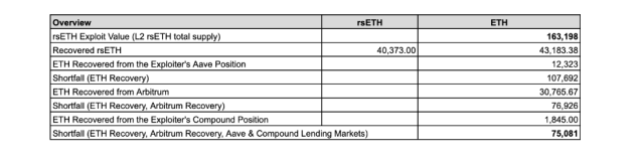
According to the Aave DAO governance proposal, the attacker stole 152,577 rsETH, which is approximately 163,183 ETH based on prevailing conversion rates. Since then, coordinated intervention by ecosystem participants has substantially reduced the gap. Kelp DAO managed to freeze 40,373 rsETH, equivalent to roughly 43,168 ETH. Additionally, the Arbitrum Security Council recovered 30,766 ETH that the attacker still held on its platform.
Source: Aave DAO

Notably, further recoveries are expected through liquidation processes on lending platforms. The attacker’s positions on Aave could yield up to 12,323 ETH, while an additional 1,845 ETH may be recovered from positions on Compound. In total, these efforts account for approximately 87,955 ETH, i.e, just over half of the original deficit. Despite this progress, a funding gap of roughly 75,081 ETH remains, resulting in a further coordinated capital injection to fully restore backing.

Aave DAO Steps In With 25,000 ETH Commitment As Coalition Mobilizes

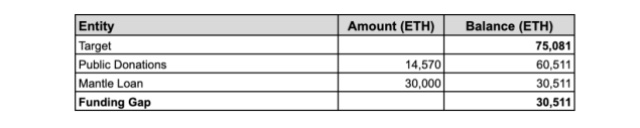
To bridge the remaining deficit, the DeFi United coalition is combining donations, credit facilities, and treasury support. So far, ecosystem contributors including EtherFi, Lido, and Ethena have pledged 14,570 ETH, while Mantle has extended a credit facility of up to 30,000 ETH.
Source: Aave DAO

Aave DAO’s proposal to contribute 25,000 ETH represents a cornerstone of this recovery stack. Notably, the contribution is “anchored,” meaning it will not be reduced by future donations. Instead, any additional funds raised will be used to repay borrowed capital, thereby limiting Aave’s long-term exposure.

The plan requires approximately 120,015 ETH (excluding 43,168 ETH immediately frozen by Kelp DAO) to be reintroduced into the LayerZero lockbox to fully restore system integrity. However, a portion of expected recoveries remains illiquid, prompting the need for short-term loan financing from ecosystem partners.

Total crypto market cap valued at $2.57 trillion on the daily chart | Source: TOTAL chart on Tradingview.com

Domande pertinenti

QWhat is the total amount of ETH that was stolen in the Kelp DAO exploit, and what is the remaining funding gap after recovery efforts?

AThe attacker stole 152,577 rsETH, which is approximately 163,183 ETH. After recovery efforts, including frozen funds and liquidations, a funding gap of roughly 75,081 ETH remains.

QWhat is the role of the 'DeFi United' initiative mentioned in the proposal?

AThe 'DeFi United' initiative is a coordinated effort aimed at restoring user funds and stabilizing affected lending markets by combining donations, credit facilities, and treasury support from various ecosystem participants.

QHow much ETH has Aave DAO specifically proposed to contribute, and what is the nature of this contribution?

AAave DAO has proposed to contribute 25,000 ETH from its treasury. This contribution is 'anchored,' meaning it will not be reduced by future donations and any additional funds raised will be used to repay borrowed capital to limit Aave's long-term exposure.

QWhich other major ecosystem participants have pledged support, and what are their contributions?

AEcosystem contributors including EtherFi, Lido, and Ethena have collectively pledged 14,570 ETH. Additionally, Mantle has extended a credit facility of up to 30,000 ETH.

QWhat specific mechanism of the KelpDAO protocol was targeted in the attack on April 18?

AThe attack targeted KelpDAO's rsETH Ethereum LayerZero adapter, which allowed the hacker to drain assets and break the backing relationship between locked ETH collateral and minted tokens across chains.

Letture associate

Has Hook Summer Really Arrived? sato, Lo0p, FLOOD Ignite the New Narrative of Uniswap v4

"Hook Summer" Arrives? Sato, Lo0p, FLOOD Ignite Uniswap v4 Narrative Amidst a slight market recovery, attention within the Ethereum ecosystem has shifted to Meme coins built on Uniswap v4's Hook protocol. Following ASTEROID, tokens like sato, sat1, Lo0p, and FLOOD have become market focal points, with market caps ranging from millions to tens of millions, bringing concentrated liquidity to a narrative-dry market. Uniswap v4 Hooks are "plugin smart contracts" that allow developers to inject custom logic at key points in a liquidity pool's lifecycle (initialization, adding/removing liquidity, swaps, etc.), making the AMM programmable. Recent representative projects include: * **sato**: Market cap peaked over $38M; uses a v4 curve mechanism for minting/burning, locking ETH as reserve. * **sat1**: Market cap briefly exceeded $10M, positioning as an "optimized sato," but later declined significantly. * **Lo0p**: Market cap neared $6.6M; a "lending AMM protocol" allowing users to borrow ETH against deposited LO0P tokens without immediate selling pressure. * **FLOOD**: Market cap approached $6M; channels trading reserves into Aave v3 to generate yield, which is retained in the pool. The emergence of these Hook-based tokens could drive long-term growth for the Uniswap ecosystem by attracting users and liquidity to v4 pools. Combined with Uniswap's activated fee switch (partially used to burn UNI), the long-term outlook for UNI appears positive. However, short-term UNI price appreciation is not directly guaranteed. Factors include the sustainability and lifecycle of these new tokens, their price volatility, overall market conditions, and regulatory pressures. Currently, Uniswap v4's TVL ($595M) lags behind v3 and v2, indicating Hook adoption still requires time to mature. In summary, the Hook ecosystem serves as "long-term nourishment" for UNI, but acts more as a "catalyst" than a direct "booster" in the short term. Note: These are early-stage experimental tokens and may carry unknown risks.

marsbit21 min fa

Has Hook Summer Really Arrived? sato, Lo0p, FLOOD Ignite the New Narrative of Uniswap v4

marsbit21 min fa

Has Hook Summer Truly Arrived? sato, Lo0p, FLOOD Ignite the New Uniswap v4 Narrative

With the broader market showing signs of recovery, a new wave of interest has emerged around Ethereum-based meme coins. Following ASTEROID, tokens like sato, sat1, Lo0p, and FLOOD, built upon the Uniswap v4 Hook protocol, are capturing market attention. Their market capitalizations range from millions to tens of millions of dollars, injecting much-needed focused liquidity into a market lacking narratives. This article explores whether this trend signifies an incoming "Hook Summer" and its potential impact on UNI's price. Hooks are essentially plug-in smart contracts for Uniswap v4 liquidity pools, allowing developers to inject custom logic at key points in a pool's lifecycle (like initialization, adding/removing liquidity, swaps). This transforms the AMM into programmable building blocks. Key highlighted projects include: * **sato**: Peaked over $38M market cap. It utilizes a v4 curve for minting/burning; buying locks ETH as reserve to mint new tokens, while selling redeems ETH from the reserve and burns tokens. * **sat1**: Market cap briefly exceeded $10M, promoted as an "optimized sato," but later declined significantly. * **Lo0p**: Reached nearly $6.6M. It's a lending AMM protocol where buying LO0P tokens locks them as collateral, allowing users to borrow ETH from the pool reserve at 40% LTV, aiming to improve capital efficiency for idle ETH in LPs. * **FLOOD**: Peaked near $6M. Its mechanism directs asset reserves from buys into Aave v3 to generate yield, with fees and interest retained in the pool to potentially influence the token's price long-term. In the long term, the development of the Hook ecosystem can attract users and liquidity to Uniswap v4, benefiting UNI's fundamentals—especially combined with the recent activation of the protocol fee switch, where a portion of fees is used to burn UNI. However, in the short term, these Hook-based tokens are unlikely to directly drive significant UNI price appreciation. Their impact is moderated by factors like token sustainability, price volatility, and broader market and regulatory conditions. Currently, Uniswap v4's TVL ($595M) still trails behind v2 and v3, indicating adoption and growth will take time. The article concludes that while the Hook ecosystem provides long-term "nourishment" for UNI, its short-term role is more of a "catalyst" than a "booster." Readers are cautioned that these are early-stage experimental tokens and may carry unknown risks.

Odaily星球日报34 min fa

Has Hook Summer Truly Arrived? sato, Lo0p, FLOOD Ignite the New Uniswap v4 Narrative

Odaily星球日报34 min fa

Interview with Michael Saylor: I Did Say I Would Sell Bitcoin, But Never a Net Sale

Interview with Michael Saylor: I Said We'd Sell Bitcoin, But Never Be a Net Seller In a recent podcast, MicroStrategy Executive Chairman Michael Saylor clarified the company's stance on potentially selling Bitcoin. Following MicroStrategy's earnings call statement about being prepared to sell BTC to fund dividends for its STRC (Strategic) credit product, Saylor emphasized the distinction between selling and being a "net seller." Saylor explained the core business model: MicroStrategy sells credit instruments like STRC and uses the proceeds to buy Bitcoin, which is viewed as "digital capital" expected to appreciate around 30-40% annually. A portion of these capital gains can then be used to pay the dividends on the credit products. He stressed that even if the company sells some Bitcoin for dividends, it simultaneously buys much more with new credit issuance. For example, after raising $3.2 billion from STRC sales in April, the dividend obligation was only $80-90 million, making the company a net buyer. The clarification aims to counter market narratives questioning the value of Bitcoin on MicroStrategy's balance sheet if it were never sold, and to dismiss claims of a "Ponzi scheme." Saylor reiterated his personal philosophy for investors: "Don't be a net seller of bitcoin" and ensure your Bitcoin holdings increase each year. Saylor also discussed Bitcoin's role as the foundation for "digital credit," noting that STRC has become the largest and most liquid preferred stock issue in the U.S., offering high risk-adjusted returns (Sharpe ratio). He highlighted Bitcoin's deep liquidity, stating that even large purchases by MicroStrategy do not move the market significantly, which is driven by macro factors, geopolitical tensions, and capital flows from ETFs and credit products. Finally, Saylor reflected on his early inspiration from sci-fi books, which motivated his path to MIT, and maintained his fundamental thesis on Bitcoin remains unchanged: it is superior digital capital enabling superior digital credit.

链捕手38 min fa

Interview with Michael Saylor: I Did Say I Would Sell Bitcoin, But Never a Net Sale

链捕手38 min fa

Trading

Spot
Futures

Articoli Popolari

Come comprare DAO

Benvenuto in HTX.com! Abbiamo reso l'acquisto di DAO Maker (DAO) semplice e conveniente. Segui la nostra guida passo passo per intraprendere il tuo viaggio nel mondo delle criptovalute.Step 1: Crea il tuo Account HTXUsa la tua email o numero di telefono per registrarti il tuo account gratuito su HTX. Vivi un'esperienza facile e sblocca tutte le funzionalità,Crea il mio accountStep 2: Vai in Acquista crypto e seleziona il tuo metodo di pagamentoCarta di credito/debito: utilizza la tua Visa o Mastercard per acquistare immediatamente DAO MakerDAO.Bilancio: Usa i fondi dal bilancio del tuo account HTX per fare trading senza problemi.Terze parti: abbiamo aggiunto metodi di pagamento molto utilizzati come Google Pay e Apple Pay per maggiore comodità.P2P: Fai trading direttamente con altri utenti HTX.Over-the-Counter (OTC): Offriamo servizi su misura e tassi di cambio competitivi per i trader.Step 3: Conserva DAO Maker (DAO)Dopo aver acquistato DAO Maker (DAO), conserva nel tuo account HTX. In alternativa, puoi inviare tramite trasferimento blockchain o scambiare per altre criptovalute.Step 4: Scambia DAO Maker (DAO)Scambia facilmente DAO Maker (DAO) nel mercato spot di HTX. Accedi al tuo account, seleziona la tua coppia di trading, esegui le tue operazioni e monitora in tempo reale. Offriamo un'esperienza user-friendly sia per chi ha appena iniziato che per i trader più esperti.

147 Totale visualizzazioniPubblicato il 2024.12.11Aggiornato il 2025.03.21

Come comprare DAO

Discussioni

Benvenuto nella Community HTX. Qui puoi rimanere informato sugli ultimi sviluppi della piattaforma e accedere ad approfondimenti esperti sul mercato. Le opinioni degli utenti sul prezzo di DAO DAO sono presentate come di seguito.

活动图片