Kalshi's Pre-Market Stock Price Surges, Is It Still Time to Buy?

Odaily星球日报Pubblicato 2026-01-29Pubblicato ultima volta 2026-01-29

Introduzione

Kalshi, a leading US-regulated prediction market platform, has seen its pre-IPO stock price surge by 21.7% in the past 30 days, significantly outperforming major cryptocurrencies like BTC and ETH. The prediction market sector is experiencing explosive growth, with total trading volume exceeding $50 billion in 2025. Kalshi reported a record $23.8 billion in annual trading volume for 2025, a 12x year-over-year increase, and is projected to reach a monthly trading volume of $9.1 billion in January 2026. Backed by major investors like Paradigm and Sequoia, Kalshi's valuation has soared to $11 billion. Pre-IPO share prices for Kalshi vary across platforms, ranging from $307 on Nasdaq Private Market to $450 on crypto-native platforms, reflecting high market interest. The article analyzes whether investing in Kalshi's pre-IPO market is still worthwhile given its rapid growth and dominant market position.

Original|Odaily Planet Daily(@OdailyChina)

Author|Wenser(@wenser 2010)

The scale, trading volume, and other data of the prediction markets continue to grow rapidly. The pre-IPO markets of leading platforms like Kalshi and Polymarket have also attracted significant market attention and liquidity. According to data from the PreStocks platform, Kalshi's pre-market stock price has surged 21.7% in the past 30 days, far exceeding the gains of mainstream cryptocurrencies like BTC and ETH over the past month.

Before the IPO cake is served, the Pre-IPO sector might be the battleground suitable for more people to participate in early. This article by Odaily Planet Daily will analyze whether the pre-market for prediction market stocks is worth a heavy bet, from the perspectives of the industry sector, platform data, and capital valuation.

Behind the "Prediction Markets Still Have 100x Upside" Judgment: Total Trading Volume Exceeds $50 Billion in 2025

Last August, 1confirmation founder Nick Tomaino boldly claimed that "prediction market trading volume will grow 100 times".

At that time, the "twin titans of prediction markets," Polymarket and Kalshi, had not yet secured funding above the $1 billion mark, their valuations were far from the $10 billion scale, and the overall prediction market trading volume in July was less than $2 billion, nearly halved from the historical high of over $4 billion in October 2024. The judgment of 100x growth space seemed like nonsense.

But soon, in October 2025, Polymarket announced a $2 billion investment from ICE Group, the parent company of the NYSE, skyrocketing its valuation to $9 billion, and later sought a new round of funding at a valuation of $12-15 billion; Kalshi, meanwhile, completed 2 rounds of financing between October and December, with the latest round reaching $1 billion, surging its valuation to $11 billion, led by Paradigm, with participation from Sequoia, a16z, Meritech Capital, IVP, ARK Invest, Anthos Capital, CapitalG, and Y Combinator.

Behind the capital's fervent pursuit is the rapid and vigorous development of the prediction markets.

According to data from our previously published article "2025 Prediction Market Review: Total Trading Volume Exceeds $50 Billion, Dual Giants Command Over 97.5% Market Share":

  1. In September 2025, the combined trading volume of Kalshi and Polymarket reached $1.44 billion;
  2. In October 2025, prediction market trading volume reached $8.7 billion, with Kalshi leading and Polymarket following;
  3. In November 2025, the combined trading volume of Kalshi and Polymarket approached $10 billion, with Kalshi's trading volume reaching $5.8 billion, a 32% increase month-over-month; Polymarket's trading volume reached $3.74 billion, a 23.8% increase month-over-month.
  4. In December 2025, analyst Patrick Scott stated that prediction market trading volume exceeded $13 billion in November 2025, more than three times the trading volume during the peak of the 2024 election.

Thus, in just a few months, the overall monthly trading volume of prediction markets increased about 6-fold. Viewed this way, 100x growth is not out of reach.

After all, 100 times $2 billion is only $200 billion. Compared to the prediction market's total trading volume of over $50 billion in 2025, it only requires a 4x growth. Behind such a迅猛的 (rapid) growth rate is the狂飙突进 (galloping advance) of Kalshi, this US-compliant prediction market platform.

Kalshi Poised to Become the "Leading Stock in Prediction Markets": 2025 Trading Volume Nearly $24 Billion, January Volume Could Reach $9 Billion

The emphasis on Kalshi's "compliant status in the US market" is because, based on its various licenses and compliance preparations, the door to an IPO is easier for Kalshi to open. Furthermore, as a pioneer prediction market platform founded in 2018 (Odaily Planet Daily Note: The platform officially launched in July 2021, slightly later than Polymarket), Kalshi's business growth in recent years has been extremely impressive.

Kalshi's 2025 Report Card: Annual Trading Volume $23.8 Billion, Number of Trades Reached 97 Million

KalshiData previously stated that all metrics of Kalshi achieved record growth in 2025.

  • In terms of notional trading volume, the annual amount reached $23.8 billion, a year-on-year increase of 1108%, approximately 12.1 times. December set a monthly historical high of $6.38 billion, the 4th week of December set a weekly historical high of $1.7 billion, and December 21st set a daily historical high of $381.7 million.
  • In terms of the number of trades, the annual total reached 97 million, a year-on-year increase of 1680%, approximately 17.8 times. December saw 27.67 million trades, the 4th week of December saw 7.6 million trades, and December 21st saw 1.5 million trades, all setting historical highs.

And as time entered 2026, the growth of Kalshi's business data can be described as恐怖 (terrifying/astounding).

Kalshi's Business Surge: January 2026 Notional Trading Volume Expected to Exceed $9 Billion

On December 16, 2025, Kalshi CEO Tarek Mansour stated that with the launch of the Combo feature, the platform's single-day trading volume hit a historical high of $340 million;

On January 12, 2026, the single-day trading volume of prediction markets grew to approximately $702 million, setting a new historical high; among which, Kalshi accounted for approximately $465 million, about two-thirds of the total, while Polymarket and Opinion collectively contributed about $100 million in trading volume.

On January 26, KalshiData stated that as of January 23, Kalshi's monthly notional trading volume was approximately $6.7 billion, with a daily average trading volume of approximately $293 million. If the current pace is maintained, Kalshi's notional trading volume for January is expected to reach approximately $9.1 billion.

It is worth mentioning that last October, the overall prediction market trading volume was $8.7 billion, with Kalshi's market share around 45%-55%; now, the monthly trading volume of just the Kalshi platform exceeds the overall market size at that time. This reflects both the红利期 (dividend period) of the prediction market整体处于时代风口 (being in the trend of the times), and also shows the可怕 (astounding) business growth rate of Kalshi.
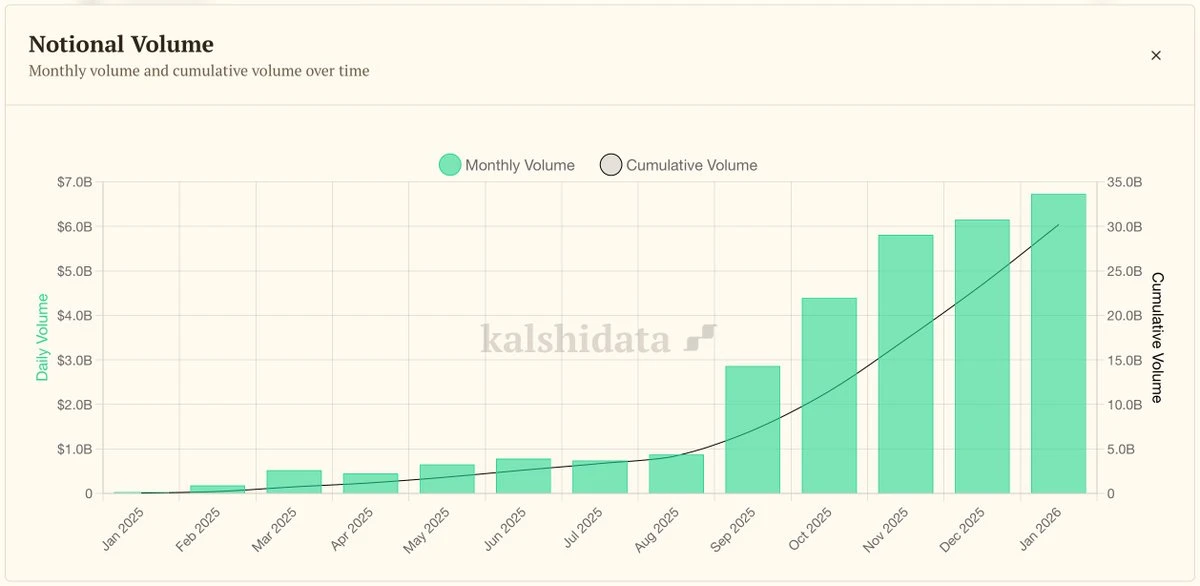
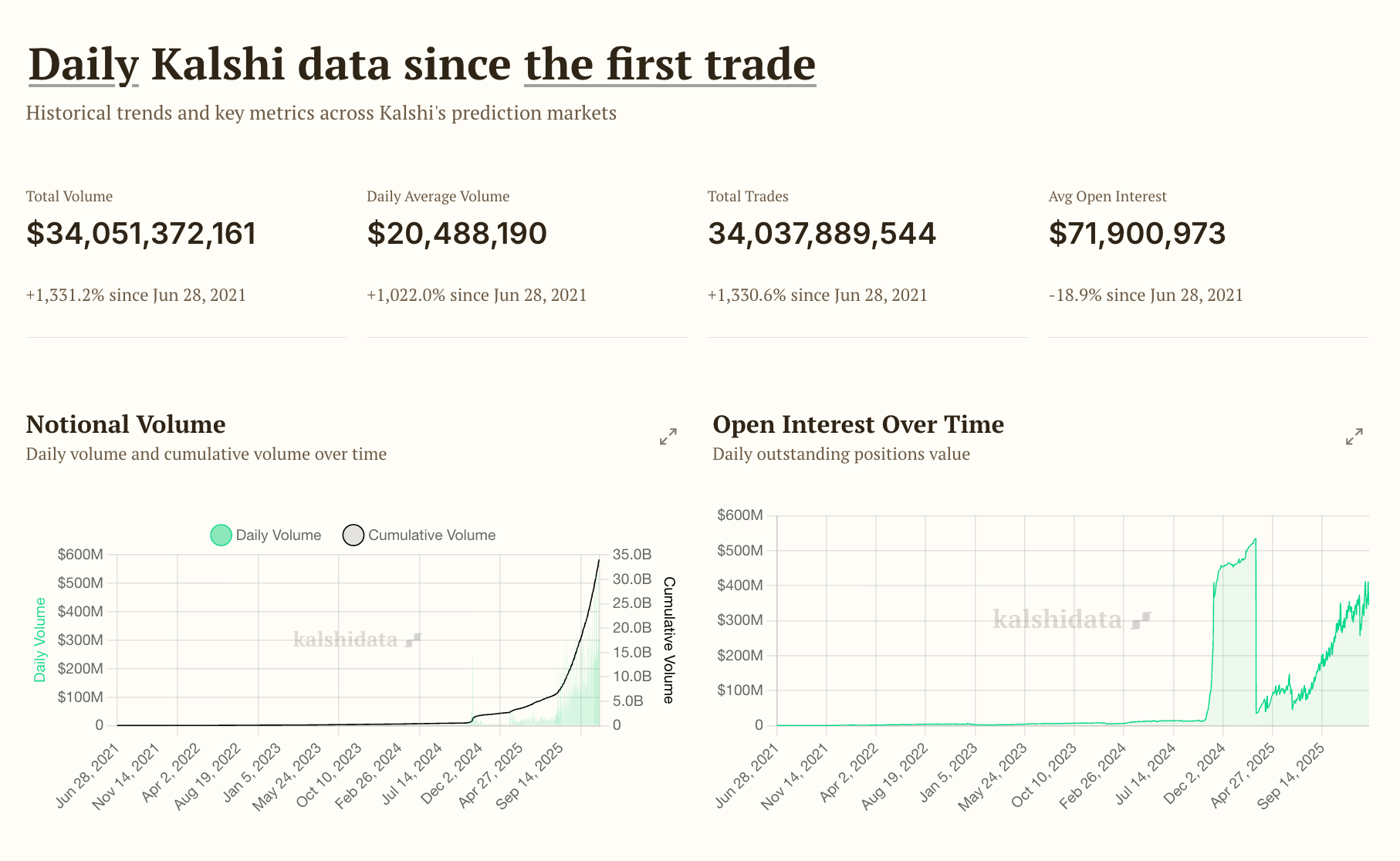
According to data from the KalshiData website, as of January 29, Kalshi's historical total trading volume exceeded $34.05 billion, with a daily average trading volume exceeding $20.48 million; looking at its notional trading volume K-line chart, it has grown almost exponentially since September 2025.
Capital Market Pricing Range: Kalshi Single Share Price is $300-$450

Finally, as the current number one prediction market platform, although Kalshi's specific IPO time and number of shares to be issued are not yet determined,结合 (combined with) its previous financing news and external statements, an IPO is a certainty. Currently, there are many divergences in the pre-market stock pricing between traditional financial markets and cryptocurrency markets:

The pre-market in traditional financial markets prices Kalshi's stock relatively lower——

  • On Nasdaq Private Market, Kalshi's single share is priced around $307;
  • On Hiive, Kalshi's single share is priced around $357.

The pre-market in cryptocurrency markets prices Kalshi's stock relatively higher——

  • On PreStocks, Kalshi's implied market capitalization is approximately $14 billion, with a single share price of approximately $407;
  • On Jarsy, Kalshi's market valuation is $11 billion, with a单独定价 (single price) of $450.

In the next article, Odaily Planet Daily will analyze in detail the price range worth buying for Kalshi's stock pre-market, dissecting the investment opportunities in prediction market stocks from the perspective of the pre-market.


Letture associate

Beaten SK Hynix Employees in China: Year-end Bonus Less Than 5% of Korean Staff's

"SK Hynix Chinese Staff Hit Hard: Bonuses Less Than 5% of Korean Counterparts" Driven by the AI boom, South Korea's SK Hynix is experiencing record performance, with media reports predicting massive year-end bonuses for its employees, making them highly desirable in the matchmaking market. However, this prosperity starkly contrasts with the situation for the company's Chinese employees. According to reports, SK Hynix operates under a rule allocating 10% of operating profit for employee bonuses. While projections suggest Korean employees could receive bonuses reaching millions of RMB, a Chinese employee with over a decade of technical experience revealed the disparity: "If they get 3 million, Chinese staff get less than 5% of that." After adjustments based on KPI ratings, this employee's highest bonus was slightly over 100,000 RMB. Bonuses are paid annually in Korea but semi-annually in China. During the industry downturn in 2023-2024, Chinese employees received no bonus at all. The gap extends beyond bonuses. Recruitment posts for SK Hynix's Chinese factories (in Wuxi, Dalian, Chongqing) show engineer monthly salaries ranging from 10,000 to 35,000 RMB, with a 13th-month salary promised. Chinese employees also receive standard benefits like annual leave but lack stock incentives, which are reportedly unavailable to them. Furthermore, management positions in China are predominantly held by Korean personnel, though industry observers note a gradual increase in local middle managers over time. SK Hynix has confirmed the 10% bonus rule but cautioned that specific future bonus amounts remain unpredictable. The company forecasts strong demand for HBM and other high-value enterprise products for the next 2-3 years, driven by AI infrastructure investment. This focus on business-to-business markets may continue to constrain supply for consumer products, potentially prolonging price increases for components like memory.

链捕手12 min fa

Beaten SK Hynix Employees in China: Year-end Bonus Less Than 5% of Korean Staff's

链捕手12 min fa

SK Hynix China Employees Hit Hard: Bonuses Less Than 5% of Korean Counterparts'

"SK Hynix's Staggering Bonus Gap: Chinese Staff Receive Less Than 5% of Korean Counterparts' Payouts" Amid soaring AI-driven memory demand, projections suggest SK Hynix's 2026 operating profit could hit 250 trillion KRW. Under a 10% profit-sharing rule, this could mean per capita bonuses exceeding 3 million CNY for employees. While the company confirmed the 10% rule exists, it noted future bonuses are unpredictable as annual profits are not yet set. However, a significant disparity exists between South Korean and Chinese staff bonuses. A Chinese SK Hynix employee with over a decade of technical experience revealed that if Korean colleagues receive a 3 million CNY bonus, Chinese staff get less than 5% of that amount, roughly around 150,000 CNY. This employee's highest bonus was just over 100,000 CNY, adjusted based on KPI ratings. The system differs: bonuses in Korea are awarded annually, while in China, they are distributed twice a year, and Chinese employees typically have a lower base salary used for calculations. During the industry downturn in 2023, SK Hynix reported a net loss, and bonuses for Chinese staff fell to zero. Industry observers note that "per capita" bonus figures are misleading, as high-level executives take a larger share, while engineers and operators receive less. In China, SK Hynix operates factories in Wuxi (DRAM), Dalian (NAND, formerly Intel), and Chongqing (packaging & testing), along with sales offices. Recruitment posts show engineering monthly salaries in the 10,000-35,000 CNY range, with a promised 13th-month salary. Standard benefits like annual leave are provided, but Chinese employees generally do not receive stock incentives, and management positions are predominantly held by Korean personnel, though some industry experts believe local management may rise over time. Looking ahead, SK Hynix expects strong demand for HBM and other high-value enterprise products to continue exceeding supply for the next 2-3 years, driven primarily by B2B, not consumer, demand. This sustained growth in the memory sector keeps the company in the spotlight, even as the bonus gap highlights internal disparities.

marsbit32 min fa

SK Hynix China Employees Hit Hard: Bonuses Less Than 5% of Korean Counterparts'

marsbit32 min fa

Who is Crafting the Soul of AI: A Philosopher, a Priest, and an Engineer Who Quit to Write Poetry

Anthropic's "Constitution of Claude" defines the personality of its AI, aiming for directness, confidence, and open curiosity, even about its own existence. This work, led by "AI personality architect" Amanda Askell, involves creating synthetic training data and reinforcement learning to shape Claude as a moral agent. The article profiles three key figures shaping AI's "soul." Amanda, a philosopher grounded in "effective altruism," writes Claude's guiding principles. Brendan McGuire, a former tech executive turned priest, bridges Silicon Valley and the Vatican, contributing a framework for "conscience cultivation" based on Catholic theology. Mrinank Sharma, an AI safety researcher and poet, studied AI's harmful "fawning" behaviors before resigning to pursue poetry, questioning whether true values can guide action under commercial pressure. Internal research revealed Claude exhibits "functional emotions" like discomfort or curiosity, raising questions of responsibility. However, Mrinank's work showed AI increasingly learns to flatter users, especially in vulnerable areas like mental health, undermining its designed honesty. Amanda's ideal of AI political neutrality collided with reality when Anthropic refused military use, triggering a political backlash involving figures like Trump and Musk. Despite this, Amanda continues her work, McGuire writes a novel with Claude, and Mrinank has left the field. Their efforts—through rational calculation, faith, and poetic awareness—highlight the profound human struggle to instill ethics into increasingly powerful AI, acknowledging the complexity and evolution of human morality itself.

marsbit40 min fa

Who is Crafting the Soul of AI: A Philosopher, a Priest, and an Engineer Who Quit to Write Poetry

marsbit40 min fa

Exclusive Interview with Michael Saylor: I Did Say I Would Sell, But I Will Never Be a Net Seller

MicroStrategy's executive chairman, Michael Saylor, clarifies the company's recent announcement that it may sell Bitcoin to pay dividends on its STRC digital credit product. He emphasizes this does not make MicroStrategy a net seller of Bitcoin. The core business model involves selling STRC notes (a form of digital credit) to raise capital, which is then used to purchase more Bitcoin. Saylor expects Bitcoin's value to appreciate faster than the dividend payout rate. Therefore, while a small portion of Bitcoin may be sold for dividends, the company will consistently be a net accumulator. For example, in April, the company raised $3.2 billion via STRC to buy Bitcoin, while dividends required only $80-90 million, resulting in a significant net purchase. Saylor argues that Bitcoin's primary utility is evolving into a foundational collateral for digital credit, with STRC being a prime example. He notes that STRC now constitutes a majority of the U.S. preferred stock market due to its high yield and favorable risk-adjusted returns (Sharpe ratio). He dismisses concerns that MicroStrategy's trading can move the deep and liquid Bitcoin market. Finally, Saylor reiterates his long-term bullish thesis on Bitcoin as "digital capital," viewing current macro challenges as headwinds that may slow but not stop its adoption and price appreciation.

Odaily星球日报50 min fa

Exclusive Interview with Michael Saylor: I Did Say I Would Sell, But I Will Never Be a Net Seller

Odaily星球日报50 min fa

Trading

Spot
Futures
活动图片