
Kalshi's First Research Report Released: How Collective Intelligence Outperforms Wall Street Think Tanks in Predicting CPI

Odaily星球日报Pubblicato 2025-12-24Pubblicato ultima volta 2025-12-24

Introduzione

Kalshi Research's inaugural report demonstrates that prediction markets consistently outperform Wall Street consensus forecasts in predicting the U.S. year-over-year CPI inflation rate. The study, covering over 25 monthly CPI releases from February 2023 to mid-2025, shows Kalshi’s market-implied forecasts had a 40.1% lower mean absolute error (MAE) than consensus predictions across all environments. The advantage was most pronounced during economic "shocks." For large surprises (over 0.2 percentage points), Kalshi's forecasts were 50% more accurate a week before the data release, improving to 60% more accurate the day before. For medium surprises (0.1-0.2 percentage points), the advantage was similarly 50%, rising to 56.2% closer to the release. Crucially, a divergence of over 0.1 percentage points between the market forecast and consensus served as a strong signal, with an 81.2% probability that a shock would occur. When the two forecasts disagreed, the market prediction was more accurate 75% of the time. The report attributes this "Shock Alpha" to three factors: the "wisdom of crowds" aggregating diverse information, superior incentive structures that reward accuracy over conformity, and more efficient information synthesis, even with the same public data. This suggests prediction markets provide a valuable, differentiated signal for investors and policymakers, especially during periods of high uncertainty.

This article is from:Kalshi Research

Compiled by | Odaily Planet Daily (@OdailyChina); Translator | Azuma (@azuma_eth)

Editor's Note: Leading prediction market platform Kalshi yesterday announced the launch of a new research report series, Kalshi Research, aimed at providing Kalshi's internal data to scholars and researchers interested in topics related to prediction markets. The inaugural research report for this series has been released. The original title is "Kalshi Outperforms Wall Street in Predicting Inflation" (Beyond Consensus: Prediction Markets and the Forecasting of Inflation Shocks).

Below is the content of the original report, compiled by Odaily Planet Daily.

Overview

Typically, in the week leading up to the release of important economic statistics, analysts and senior economists from large financial institutions provide their estimates of the expected figures. These forecasts, when aggregated, are referred to as the "consensus expectation" and are widely regarded as a crucial reference for gaining insights into market changes and adjusting position layouts.

In this research report, we compare the performance of the consensus expectation versus the implied pricing from Kalshi's prediction markets (sometimes referred to herein as "market prediction") in forecasting the actual value of a key macroeconomic signal—the year-over-year headline inflation rate (YOY CPI).
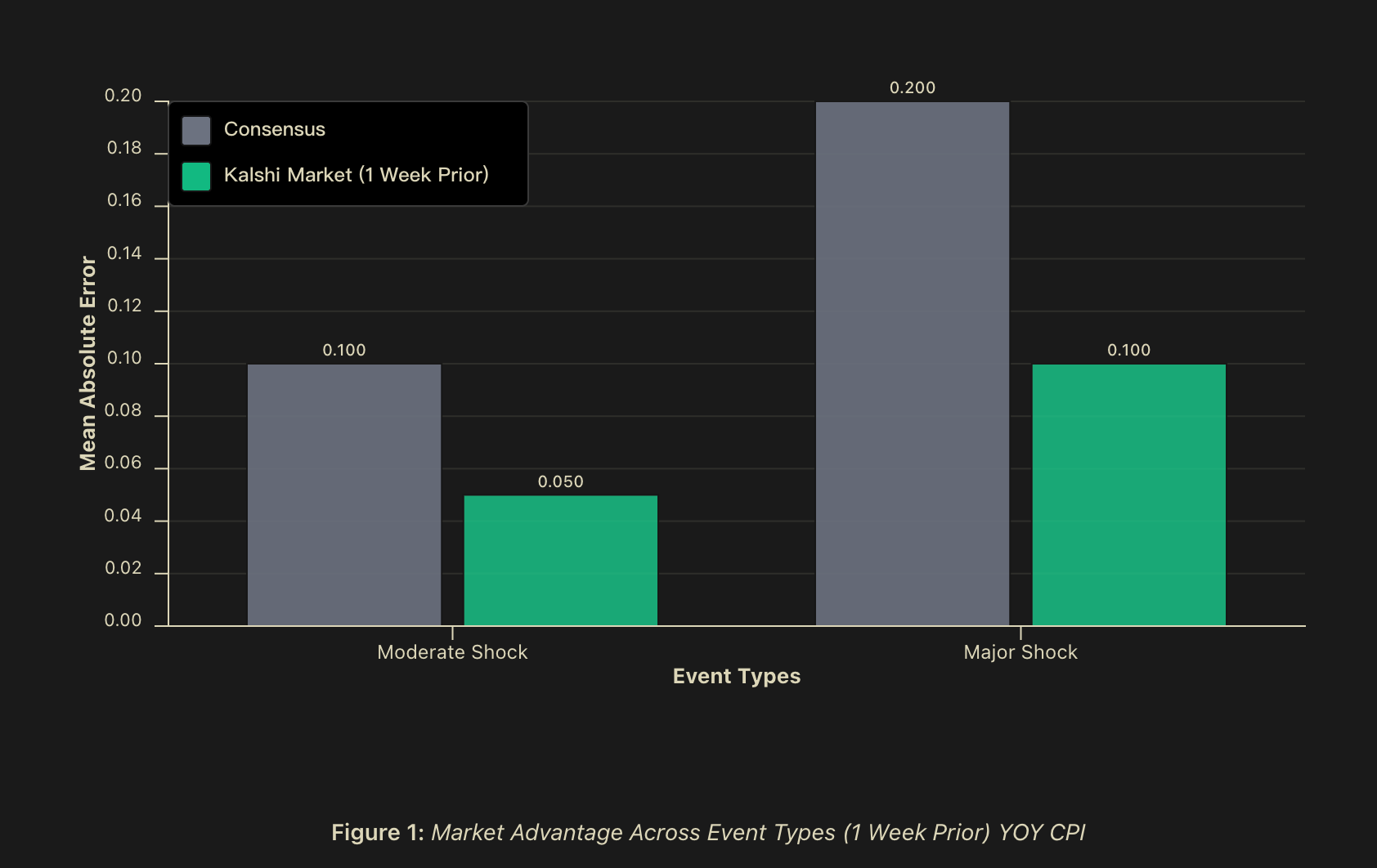
Key Highlights

  • Overall Superior Accuracy: Across all market environments (including normal and shock periods), Kalshi's predictions had a Mean Absolute Error (MAE) that was 40.1% lower than the consensus expectation.
  • "Shock Alpha": During periods of major shocks (greater than 0.2 percentage points), Kalshi's predictions one week ahead had an MAE 50% lower than the consensus expectation; this advantage expanded to 60% on the day before the data release. During periods of moderate shocks (between 0.1 - 0.2 percentage points), Kalshi's predictions one week ahead also had an MAE 50% lower than the consensus expectation, expanding to 56.2% on the day before the data release.
  • Predictive Signal: When the deviation between the market prediction and the consensus expectation exceeded 0.1 percentage points, the probability of a shock occurring was approximately 81.2%, rising to about 82.4% on the day before the data release. In cases where the market prediction differed from the consensus expectation, the market prediction was more accurate in 75% of instances.

Background

Macroeconomic forecasters face an inherent challenge: the times when forecasting is most critical—namely, during market dislocations, policy shifts, and structural breaks—are precisely the periods when historical models are most likely to fail. Financial market participants typically release consensus forecasts days before key economic data announcements, aggregating expert opinions into market expectations. However, these consensus views, while valuable, often share similar methodological approaches and information sources.

For institutional investors, risk managers, and policymakers, the stakes of forecasting accuracy are asymmetric. During uncontroversial periods, slightly better predictions offer limited value; but during periods of market turmoil—when volatility spikes, correlations break down, or historical relationships fail—superior accuracy can yield significant Alpha returns and limit drawdowns.

Therefore, understanding how parameters behave during market volatility is crucial. We focus on a key macroeconomic indicator—the year-over-year headline inflation rate (YOY CPI)—a core reference for future interest rate decisions and an important signal of economic health.

We compared and evaluated forecasting accuracy across multiple time windows before the official data release. Our core finding is that so-called "Shock Alpha" indeed exists—during tail events, market-based predictions can achieve additional predictive precision compared to the consensus benchmark. This outperformance is not merely of academic interest; it significantly enhances signal quality at critical moments when forecasting errors carry the highest economic cost. In this context, the truly important question is not whether prediction markets are "always correct," but whether they provide a differentiated signal worthy of inclusion in traditional decision-making frameworks.

Methodology

Data

We analyzed the daily implied predictions of traders on the Kalshi platform at three time points: one week before the data release (matching the consensus release timing), one day before release, and the morning of the release. Each market used was (or had been) a real, tradable, active market, reflecting real-money positions at varying liquidity levels. For the consensus expectation, we collected institution-level YoY CPI consensus forecasts, typically published about a week before the U.S. Bureau of Labor Statistics official data release.

The sample period spans from February 2023 to mid-2025, covering over 25 monthly CPI release cycles across various macroeconomic environments.

Shock Classification

We categorized events into three types based on the "magnitude of surprise" relative to historical levels. A "shock" was defined as the absolute difference between the consensus expectation and the actual published data:

  • Normal Events: YoY CPI forecast error below 0.1 percentage points;
  • Moderate Shocks: YoY CPI forecast error between 0.1 and 0.2 percentage points;
  • Major Shocks: YoY CPI forecast error exceeding 0.2 percentage points.

This classification allows us to examine whether predictive advantages vary systematically with the difficulty of the forecast.

Performance Metrics

To evaluate forecasting performance, we employed the following metrics:

  • Mean Absolute Error (MAE): The primary accuracy metric, calculated as the average of the absolute differences between predicted and actual values.
  • Win Rate: When the difference between the consensus expectation and the market prediction reached or exceeded 0.1 percentage points (rounded to one decimal place), we recorded which forecast was closer to the final actual result.
  • Forecast Timeframe Analysis: We tracked how the accuracy of market valuations evolved from one week before release to the release day, revealing the value of continuously incorporating information.

Results: CPI Forecasting Performance

Overall Superior Accuracy

Across all market environments, the market-based CPI predictions had a Mean Absolute Error (MAE) that was 40.1% lower than the consensus forecasts. Across all timeframes, the MAE for market-based CPI predictions was lower than the consensus expectation by 40.1% (one week ahead) to 42.3% (one day ahead).

Furthermore, in cases where the consensus expectation and the market-implied value diverged, Kalshi's market-based predictions demonstrated a statistically significant win rate, ranging from 75.0% one week ahead to 81.2% on release day. If ties with the consensus expectation (accurate to one decimal place) are included, the market-based prediction was tied or better than consensus in approximately 85% of cases one week ahead.

Such a high directional accuracy rate indicates: when market predictions diverge from the consensus expectation, this divergence itself carries significant informational value regarding the likelihood of a shock event occurring.

"Shock Alpha" Exists

The difference in forecasting accuracy was particularly pronounced during shock events. During moderate shock events, the MAE of market predictions was 50% lower than the consensus expectation at the release time, and this advantage expanded to 56.2% or more on the day before the data release; during major shock events, the MAE of market predictions was also 50% lower than the consensus expectation at the release time, and could reach 60% or more on the day before the data release; whereas in normal environments without shocks, market predictions and consensus expectations performed roughly equally.

Although the sample size for shock events is small (reasonable in a world where shocks are inherently highly unpredictable), the overall pattern is clear: when the forecasting environment is most challenging, the information aggregation advantages of markets are most valuable.

However, more importantly, it's not just that Kalshi's predictions perform better during shock periods, but also that the divergence between market predictions and the consensus expectation itself may be a signal of an impending shock. In cases of divergence, the win rate of market predictions relative to the consensus expectation reached 75% (within comparable time windows). Furthermore, threshold analysis indicates: when the deviation between the market and consensus exceeds 0.1 percentage points, the probability of predicting a shock is approximately 81.2%, and on the day before the data release, this probability further increases to about 84.2%.

This practically significant difference suggests that prediction markets can serve not only as a competitive forecasting tool alongside consensus expectations but also as a "meta-signal" regarding forecasting uncertainty, transforming market-consensus divergence into a quantifiable early warning indicator for potential unexpected outcomes.

Further Discussion

An obvious question follows: Why do market predictions outperform consensus forecasts during shocks? We propose three complementary mechanisms to explain this phenomenon.

Market Participant Heterogeneity and "Wisdom of the Crowd"

Traditional consensus expectations, while integrating views from multiple institutions, often share similar methodological assumptions and information sources. Econometric models, Wall Street research reports, and government data releases form a highly overlapping common knowledge base.

In contrast, prediction markets aggregate positions held by participants with diverse information bases: including proprietary models, industry-level insights, alternative data sources, and experience-based intuition. This participant diversity has a solid theoretical foundation in the "wisdom of crowds" theory. This theory suggests that when participants possess relevant information and their prediction errors are not perfectly correlated, aggregating independent predictions from diverse sources often yields superior estimates.

The value of this informational diversity is particularly pronounced during "state shifts" in the macro environment—individuals with scattered, local information interact in the market, and their informational fragments combine to form a collective signal.

Differences in Participant Incentive Structures

Institution-level consensus forecasters often operate within complex organizational and reputational systems that systematically deviate from the goal of "purely pursuing predictive accuracy." The career risks faced by professional forecasters create an asymmetric payoff structure—significant forecasting errors incur substantial reputational costs, while even extreme accuracy, especially achieved by deviating substantially from peer consensus, may not yield proportional career rewards.

This asymmetry induces "herding behavior," where forecasters tend to cluster their predictions near the consensus value, even if their private information or model outputs suggest different results. The reason is that within the career system, the cost of "being wrong alone" is often higher than the reward for "being right alone."

In stark contrast, the incentive mechanism faced by prediction market participants directly aligns forecasting accuracy with economic outcomes—accurate predictions mean profits, incorrect predictions mean losses. In this system, reputational factors are almost non-existent; the only cost of deviating from market consensus is economic loss, entirely dependent on the prediction's correctness. This structure imposes stronger selection pressure for predictive accuracy—participants who can systematically identify consensus forecast errors continuously accumulate capital and amplify their influence in the market through larger position sizes;而那些 mechanically follow consensus suffer continuous losses when consensus proves wrong.

During periods of significantly heightened uncertainty, when the career cost for institutional forecasters to deviate from expert consensus is at its peak, this divergence in incentive structures is often most pronounced and economically most significant.

Information Aggregation Efficiency

A noteworthy empirical fact is: even one week before the data release—a timeframe matching the typical window for consensus expectation releases—market predictions still exhibit significant accuracy advantages. This suggests that the market advantage does not stem solely from the often-cited "information speed advantage" of prediction market participants.

Instead, market predictions may more efficiently aggregate information fragments that are too dispersed, too industry-specific, or too ambiguous to be formally incorporated into traditional econometric forecasting frameworks. The relative advantage of prediction markets may lie not in earlier access to public information, but in their ability to synthesize heterogeneous information more effectively within the same timeframe—information that survey-based consensus mechanisms, even with the same time window, often struggle to process efficiently.

Limitations and Caveats

Our findings require an important qualification. Since the overall sample covers only about 30 months, and major shock events are by definition rare, this means statistical power remains limited for larger tail events. A longer time series will enhance future inferential ability, although the current results strongly suggest the superiority and differentiated signal of market predictions.

Conclusion

We document systematic and economically significant outperformance of prediction markets relative to expert consensus expectations, particularly during shock periods when forecasting accuracy is most critical. Market-based CPI predictions exhibited approximately 40% lower error overall, and this error reduction reached about 60% during periods of major structural change.

Based on these findings, several future research directions become particularly important: First, investigating whether "Shock Alpha" events themselves can be predicted using volatility and forecast divergence indicators, across a larger sample size and multiple macroeconomic indicators; Second, determining the liquidity threshold above which prediction markets can stably outperform traditional forecasting methods; Third, exploring the relationship between prediction market forecasts and those implied by high-frequency trading financial instruments.

In an environment where consensus forecasts heavily rely on correlated model assumptions and shared information sets, prediction markets offer an alternative information aggregation mechanism capable of capturing state switches earlier and processing heterogeneous information more efficiently. For entities needing to make decisions in an economic environment characterized by rising structural uncertainty and tail event frequency, "Shock Alpha" may represent not just an incremental improvement in predictive capability, but a fundamental component of a robust risk management infrastructure.


Domande pertinenti

QWhat is the main finding of Kalshi Research's first report regarding CPI prediction accuracy?

AKalshi's prediction market had a 40.1% lower Mean Absolute Error (MAE) than Wall Street consensus forecasts across all market conditions.

QWhat is 'Shock Alpha' as defined in the Kalshi report?

A'Shock Alpha' refers to the significant additional predictive accuracy of Kalshi's market-based forecasts over consensus during shock events, with MAE reductions of 50% to 60%.

QWhat probability does a divergence of over 0.1 percentage points between market and consensus forecasts signal a potential shock event?

AA divergence of over 0.1 percentage points signals an approximately 81.2% probability of a shock event occurring, rising to about 84.2% the day before the data release.

QWhat are the three mechanisms proposed in the report to explain why market predictions outperform consensus during shocks?

AThe three mechanisms are: 1. Participant heterogeneity and the 'wisdom of crowds'. 2. Differences in incentive structures (direct financial alignment in markets vs. career risks in institutions). 3. Superior information aggregation efficiency in markets.

QWhat key macroeconomic indicator was the focus of the performance comparison in this study?

AThe study focused on comparing the prediction performance for the year-over-year headline inflation rate (YoY CPI).

Letture associate

Trading

Spot
Futures

Articoli Popolari

Cosa è $S$

Comprendere SPERO: Una Panoramica Completa Introduzione a SPERO Mentre il panorama dell'innovazione continua a evolversi, l'emergere delle tecnologie web3 e dei progetti di criptovaluta gioca un ruolo fondamentale nel plasmare il futuro digitale. Un progetto che ha attirato l'attenzione in questo campo dinamico è SPERO, denotato come SPERO,$$s$. Questo articolo mira a raccogliere e presentare informazioni dettagliate su SPERO, per aiutare gli appassionati e gli investitori a comprendere le sue basi, obiettivi e innovazioni nei domini web3 e crypto. Che cos'è SPERO,$$s$? SPERO,$$s$ è un progetto unico all'interno dello spazio crypto che cerca di sfruttare i principi della decentralizzazione e della tecnologia blockchain per creare un ecosistema che promuove l'impegno, l'utilità e l'inclusione finanziaria. Il progetto è progettato per facilitare interazioni peer-to-peer in modi nuovi, fornendo agli utenti soluzioni e servizi finanziari innovativi. Al suo interno, SPERO,$$s$ mira a responsabilizzare gli individui fornendo strumenti e piattaforme che migliorano l'esperienza dell'utente nello spazio delle criptovalute. Questo include la possibilità di metodi di transazione più flessibili, la promozione di iniziative guidate dalla comunità e la creazione di percorsi per opportunità finanziarie attraverso applicazioni decentralizzate (dApps). La visione sottostante di SPERO,$$s$ ruota attorno all'inclusività, cercando di colmare le lacune all'interno della finanza tradizionale mentre sfrutta i vantaggi della tecnologia blockchain. Chi è il Creatore di SPERO,$$s$? L'identità del creatore di SPERO,$$s$ rimane piuttosto oscura, poiché ci sono risorse pubblicamente disponibili limitate che forniscono informazioni dettagliate sul suo fondatore o fondatori. Questa mancanza di trasparenza può derivare dall'impegno del progetto per la decentralizzazione—un ethos che molti progetti web3 condividono, dando priorità ai contributi collettivi rispetto al riconoscimento individuale. Centrando le discussioni attorno alla comunità e ai suoi obiettivi collettivi, SPERO,$$s$ incarna l'essenza dell'empowerment senza mettere in evidenza individui specifici. Pertanto, comprendere l'etica e la missione di SPERO rimane più importante che identificare un creatore singolo. Chi sono gli Investitori di SPERO,$$s$? SPERO,$$s$ è supportato da una varietà di investitori che vanno dai capitalisti di rischio agli investitori angelici dedicati a promuovere l'innovazione nel settore crypto. Il focus di questi investitori generalmente si allinea con la missione di SPERO—dando priorità a progetti che promettono avanzamenti tecnologici sociali, inclusività finanziaria e governance decentralizzata. Queste fondazioni di investitori sono tipicamente interessate a progetti che non solo offrono prodotti innovativi, ma contribuiscono anche positivamente alla comunità blockchain e ai suoi ecosistemi. Il supporto di questi investitori rafforza SPERO,$$s$ come un concorrente degno di nota nel dominio in rapida evoluzione dei progetti crypto. Come Funziona SPERO,$$s$? SPERO,$$s$ impiega un framework multifunzionale che lo distingue dai progetti di criptovaluta convenzionali. Ecco alcune delle caratteristiche chiave che sottolineano la sua unicità e innovazione: Governance Decentralizzata: SPERO,$$s$ integra modelli di governance decentralizzati, responsabilizzando gli utenti a partecipare attivamente ai processi decisionali riguardanti il futuro del progetto. Questo approccio favorisce un senso di proprietà e responsabilità tra i membri della comunità. Utilità del Token: SPERO,$$s$ utilizza il proprio token di criptovaluta, progettato per servire varie funzioni all'interno dell'ecosistema. Questi token abilitano transazioni, premi e la facilitazione dei servizi offerti sulla piattaforma, migliorando l'impegno e l'utilità complessivi. Architettura Stratificata: L'architettura tecnica di SPERO,$$s$ supporta la modularità e la scalabilità, consentendo un'integrazione fluida di funzionalità e applicazioni aggiuntive man mano che il progetto evolve. Questa adattabilità è fondamentale per mantenere la rilevanza nel panorama crypto in continua evoluzione. Coinvolgimento della Comunità: Il progetto enfatizza iniziative guidate dalla comunità, impiegando meccanismi che incentivano la collaborazione e il feedback. Nutrendo una comunità forte, SPERO,$$s$ può affrontare meglio le esigenze degli utenti e adattarsi alle tendenze di mercato. Focus sull'Inclusione: Offrendo basse commissioni di transazione e interfacce user-friendly, SPERO,$$s$ mira ad attrarre una base utenti diversificata, inclusi individui che potrebbero non aver precedentemente interagito nello spazio crypto. Questo impegno per l'inclusione si allinea con la sua missione generale di empowerment attraverso l'accessibilità. Cronologia di SPERO,$$s$ Comprendere la storia di un progetto fornisce preziose intuizioni sulla sua traiettoria di sviluppo e sui traguardi. Di seguito è riportata una cronologia suggerita che mappa eventi significativi nell'evoluzione di SPERO,$$s$: Fase di Concettualizzazione e Ideazione: Le idee iniziali che formano la base di SPERO,$$s$ sono state concepite, allineandosi strettamente con i principi di decentralizzazione e focus sulla comunità all'interno dell'industria blockchain. Lancio del Whitepaper del Progetto: Dopo la fase concettuale, è stato rilasciato un whitepaper completo che dettaglia la visione, gli obiettivi e l'infrastruttura tecnologica di SPERO,$$s$ per suscitare interesse e feedback dalla comunità. Costruzione della Comunità e Prime Interazioni: Sono stati effettuati sforzi attivi di outreach per costruire una comunità di early adopters e potenziali investitori, facilitando discussioni attorno agli obiettivi del progetto e ottenendo supporto. Evento di Generazione del Token: SPERO,$$s$ ha condotto un evento di generazione del token (TGE) per distribuire i propri token nativi ai primi sostenitori e stabilire una liquidità iniziale all'interno dell'ecosistema. Lancio della Prima dApp: La prima applicazione decentralizzata (dApp) associata a SPERO,$$s$ è stata attivata, consentendo agli utenti di interagire con le funzionalità principali della piattaforma. Sviluppo Continuo e Partnership: Aggiornamenti e miglioramenti continui alle offerte del progetto, inclusi partnership strategiche con altri attori nello spazio blockchain, hanno plasmato SPERO,$$s$ in un concorrente competitivo e in evoluzione nel mercato crypto. Conclusione SPERO,$$s$ rappresenta una testimonianza del potenziale del web3 e delle criptovalute di rivoluzionare i sistemi finanziari e responsabilizzare gli individui. Con un impegno per la governance decentralizzata, il coinvolgimento della comunità e funzionalità progettate in modo innovativo, apre la strada verso un panorama finanziario più inclusivo. Come per qualsiasi investimento nello spazio crypto in rapida evoluzione, si incoraggiano potenziali investitori e utenti a ricercare approfonditamente e a impegnarsi in modo riflessivo con gli sviluppi in corso all'interno di SPERO,$$s$. Il progetto mostra lo spirito innovativo dell'industria crypto, invitando a ulteriori esplorazioni delle sue innumerevoli possibilità. Mentre il percorso di SPERO,$$s$ è ancora in fase di sviluppo, i suoi principi fondamentali potrebbero effettivamente influenzare il futuro di come interagiamo con la tecnologia, la finanza e tra di noi in ecosistemi digitali interconnessi.

75 Totale visualizzazioniPubblicato il 2024.12.17Aggiornato il 2024.12.17

Cosa è $S$

Cosa è AGENT S

Agent S: Il Futuro dell'Interazione Autonoma in Web3 Introduzione Nel panorama in continua evoluzione di Web3 e criptovalute, le innovazioni stanno costantemente ridefinendo il modo in cui gli individui interagiscono con le piattaforme digitali. Uno di questi progetti pionieristici, Agent S, promette di rivoluzionare l'interazione uomo-computer attraverso il suo framework agentico aperto. Aprendo la strada a interazioni autonome, Agent S mira a semplificare compiti complessi, offrendo applicazioni trasformative nell'intelligenza artificiale (AI). Questa esplorazione dettagliata approfondirà le complessità del progetto, le sue caratteristiche uniche e le implicazioni per il dominio delle criptovalute. Cos'è Agent S? Agent S si presenta come un innovativo framework agentico aperto, progettato specificamente per affrontare tre sfide fondamentali nell'automazione dei compiti informatici: Acquisizione di Conoscenze Specifiche del Dominio: Il framework apprende in modo intelligente da varie fonti di conoscenza esterne ed esperienze interne. Questo approccio duale gli consente di costruire un ricco repository di conoscenze specifiche del dominio, migliorando le sue prestazioni nell'esecuzione dei compiti. Pianificazione su Lungo Orizzonte di Compiti: Agent S impiega una pianificazione gerarchica potenziata dall'esperienza, un approccio strategico che facilita la suddivisione e l'esecuzione efficiente di compiti complessi. Questa caratteristica migliora significativamente la sua capacità di gestire più sottocompiti in modo efficiente ed efficace. Gestione di Interfacce Dinamiche e Non Uniformi: Il progetto introduce l'Interfaccia Agente-Computer (ACI), una soluzione innovativa che migliora l'interazione tra agenti e utenti. Utilizzando Modelli Linguistici Multimodali di Grandi Dimensioni (MLLM), Agent S può navigare e manipolare senza sforzo diverse interfacce grafiche utente. Attraverso queste caratteristiche pionieristiche, Agent S fornisce un framework robusto che affronta le complessità coinvolte nell'automazione dell'interazione umana con le macchine, preparando il terreno per innumerevoli applicazioni nell'AI e oltre. Chi è il Creatore di Agent S? Sebbene il concetto di Agent S sia fondamentalmente innovativo, informazioni specifiche sul suo creatore rimangono elusive. Il creatore è attualmente sconosciuto, il che evidenzia sia la fase embrionale del progetto sia la scelta strategica di mantenere i membri fondatori sotto anonimato. Indipendentemente dall'anonimato, l'attenzione rimane sulle capacità e sul potenziale del framework. Chi sono gli Investitori di Agent S? Poiché Agent S è relativamente nuovo nell'ecosistema crittografico, informazioni dettagliate riguardanti i suoi investitori e sostenitori finanziari non sono documentate esplicitamente. La mancanza di approfondimenti pubblicamente disponibili sulle fondazioni di investimento o sulle organizzazioni che supportano il progetto solleva interrogativi sulla sua struttura di finanziamento e sulla roadmap di sviluppo. Comprendere il supporto è cruciale per valutare la sostenibilità del progetto e il suo potenziale impatto sul mercato. Come Funziona Agent S? Al centro di Agent S si trova una tecnologia all'avanguardia che gli consente di funzionare efficacemente in contesti diversi. Il suo modello operativo è costruito attorno a diverse caratteristiche chiave: Interazione Uomo-Computer Simile a Quella Umana: Il framework offre una pianificazione AI avanzata, cercando di rendere le interazioni con i computer più intuitive. Mimando il comportamento umano nell'esecuzione dei compiti, promette di elevare le esperienze degli utenti. Memoria Narrativa: Utilizzata per sfruttare esperienze di alto livello, Agent S utilizza la memoria narrativa per tenere traccia delle storie dei compiti, migliorando così i suoi processi decisionali. Memoria Episodica: Questa caratteristica fornisce agli utenti una guida passo-passo, consentendo al framework di offrire supporto contestuale mentre i compiti si sviluppano. Supporto per OpenACI: Con la capacità di funzionare localmente, Agent S consente agli utenti di mantenere il controllo sulle proprie interazioni e flussi di lavoro, allineandosi con l'etica decentralizzata di Web3. Facile Integrazione con API Esterne: La sua versatilità e compatibilità con varie piattaforme AI garantiscono che Agent S possa adattarsi senza problemi agli ecosistemi tecnologici esistenti, rendendolo una scelta attraente per sviluppatori e organizzazioni. Queste funzionalità contribuiscono collettivamente alla posizione unica di Agent S all'interno dello spazio crittografico, poiché automatizza compiti complessi e multi-fase con un intervento umano minimo. Man mano che il progetto evolve, le sue potenziali applicazioni in Web3 potrebbero ridefinire il modo in cui si svolgono le interazioni digitali. Cronologia di Agent S Lo sviluppo e le tappe di Agent S possono essere riassunti in una cronologia che evidenzia i suoi eventi significativi: 27 Settembre 2024: Il concetto di Agent S è stato lanciato in un documento di ricerca completo intitolato “Un Framework Agentico Aperto che Usa i Computer Come un Umano”, mostrando le basi per il progetto. 10 Ottobre 2024: Il documento di ricerca è stato reso pubblicamente disponibile su arXiv, offrendo un'esplorazione approfondita del framework e della sua valutazione delle prestazioni basata sul benchmark OSWorld. 12 Ottobre 2024: È stata rilasciata una presentazione video, fornendo un'idea visiva delle capacità e delle caratteristiche di Agent S, coinvolgendo ulteriormente potenziali utenti e investitori. Questi indicatori nella cronologia non solo illustrano i progressi di Agent S, ma indicano anche il suo impegno per la trasparenza e il coinvolgimento della comunità. Punti Chiave su Agent S Man mano che il framework Agent S continua a evolversi, diversi attributi chiave si distinguono, sottolineando la sua natura innovativa e il potenziale: Framework Innovativo: Progettato per fornire un uso intuitivo dei computer simile all'interazione umana, Agent S porta un approccio nuovo all'automazione dei compiti. Interazione Autonoma: La capacità di interagire autonomamente con i computer attraverso GUI segna un passo avanti verso soluzioni informatiche più intelligenti ed efficienti. Automazione di Compiti Complessi: Con la sua metodologia robusta, può automatizzare compiti complessi e multi-fase, rendendo i processi più veloci e meno soggetti a errori. Miglioramento Continuo: I meccanismi di apprendimento consentono ad Agent S di migliorare dalle esperienze passate, migliorando continuamente le sue prestazioni e la sua efficacia. Versatilità: La sua adattabilità attraverso diversi ambienti operativi come OSWorld e WindowsAgentArena garantisce che possa servire un'ampia gamma di applicazioni. Man mano che Agent S si posiziona nel panorama di Web3 e delle criptovalute, il suo potenziale per migliorare le capacità di interazione e automatizzare i processi segna un significativo avanzamento nelle tecnologie AI. Attraverso il suo framework innovativo, Agent S esemplifica il futuro delle interazioni digitali, promettendo un'esperienza più fluida ed efficiente per gli utenti in vari settori. Conclusione Agent S rappresenta un audace passo avanti nell'unione tra AI e Web3, con la capacità di ridefinire il modo in cui interagiamo con la tecnologia. Sebbene sia ancora nelle sue fasi iniziali, le possibilità per la sua applicazione sono vaste e coinvolgenti. Attraverso il suo framework completo che affronta sfide critiche, Agent S mira a portare le interazioni autonome al centro dell'esperienza digitale. Man mano che ci addentriamo nei regni delle criptovalute e della decentralizzazione, progetti come Agent S giocheranno senza dubbio un ruolo cruciale nel plasmare il futuro della tecnologia e della collaborazione uomo-computer.

401 Totale visualizzazioniPubblicato il 2025.01.14Aggiornato il 2025.01.14

Cosa è AGENT S

Come comprare S

Benvenuto in HTX.com! Abbiamo reso l'acquisto di Sonic (S) semplice e conveniente. Segui la nostra guida passo passo per intraprendere il tuo viaggio nel mondo delle criptovalute.Step 1: Crea il tuo Account HTXUsa la tua email o numero di telefono per registrarti il tuo account gratuito su HTX. Vivi un'esperienza facile e sblocca tutte le funzionalità,Crea il mio accountStep 2: Vai in Acquista crypto e seleziona il tuo metodo di pagamentoCarta di credito/debito: utilizza la tua Visa o Mastercard per acquistare immediatamente SonicS.Bilancio: Usa i fondi dal bilancio del tuo account HTX per fare trading senza problemi.Terze parti: abbiamo aggiunto metodi di pagamento molto utilizzati come Google Pay e Apple Pay per maggiore comodità.P2P: Fai trading direttamente con altri utenti HTX.Over-the-Counter (OTC): Offriamo servizi su misura e tassi di cambio competitivi per i trader.Step 3: Conserva Sonic (S)Dopo aver acquistato Sonic (S), conserva nel tuo account HTX. In alternativa, puoi inviare tramite trasferimento blockchain o scambiare per altre criptovalute.Step 4: Scambia Sonic (S)Scambia facilmente Sonic (S) nel mercato spot di HTX. Accedi al tuo account, seleziona la tua coppia di trading, esegui le tue operazioni e monitora in tempo reale. Offriamo un'esperienza user-friendly sia per chi ha appena iniziato che per i trader più esperti.

826 Totale visualizzazioniPubblicato il 2025.01.15Aggiornato il 2025.03.21

Come comprare S

Discussioni

Benvenuto nella Community HTX. Qui puoi rimanere informato sugli ultimi sviluppi della piattaforma e accedere ad approfondimenti esperti sul mercato. Le opinioni degli utenti sul prezzo di S S sono presentate come di seguito.

活动图片