June Transaction Volume Doubles: x402 Ecosystem Continues to Expand, Content Monetization Narrative Faces Crucial Test

Foresight NewsPubblicato 2026-07-10Pubblicato ultima volta 2026-07-10

Introduzione

X402, a protocol for AI and data services, experienced significant growth in June. Its transaction volume doubled compared to May, primarily driven by the AI inference routing service BlockRun. The ecosystem expanded with new integrations: Apify enabled data scraping services, Exa extended its AI search to Solana, and Seal launched 'Hacks', a marketplace for automated AI agents. The protocol itself received crucial upgrades, including 'Builder Codes' for tracking and affiliate systems and 'Batch Settlement' to enable practical micropayments for high-frequency AI tasks. Major external validation came from tech giants. Amazon Web Services (AWS) launched a solution for AI traffic metering at its edge nodes. More significantly, Cloudflare opened its waitlist for a Content Monetization Gateway. This gateway allows websites to charge AI bots and other automated agents for accessing content, using x402 for stablecoin payments. This addresses a core internet monetization problem and represents x402's most promising path to mass adoption, though Cloudflare's CEO noted current blockchain scalability remains a critical hurdle. Current leading use cases are AI inference routing and paid data feeds. However, the large-scale real-world test with Cloudflare's gateway will be decisive in determining if x402 can transition from a useful tool to a fundamental infrastructure component for a new web economy where AI agents pay for the content they consume.


Author: David Christopher

Compiled by: Saoirse, Foresight News


x402 experienced rapid business development in June.


Protocol transaction volume surged significantly, stabilizing at roughly double the level seen in May. A clear use case has emerged: the vast majority of transaction activity is concentrated with a single service provider—the inference routing project BlockRun. Enterprise adoption continues to materialize: Amazon completed integration with the protocol, and Cloudflare officially announced the launch of its content monetization gateway. A series of technical upgrades have substantially improved the stability and transaction traceability of x402 as it enters the summer months. These very features are essential prerequisites for x402 to face the practical test that Cloudflare is poised to bring.


Next, we will review the latest developments, the directions already validated as viable, and the hypotheses yet to be proven.
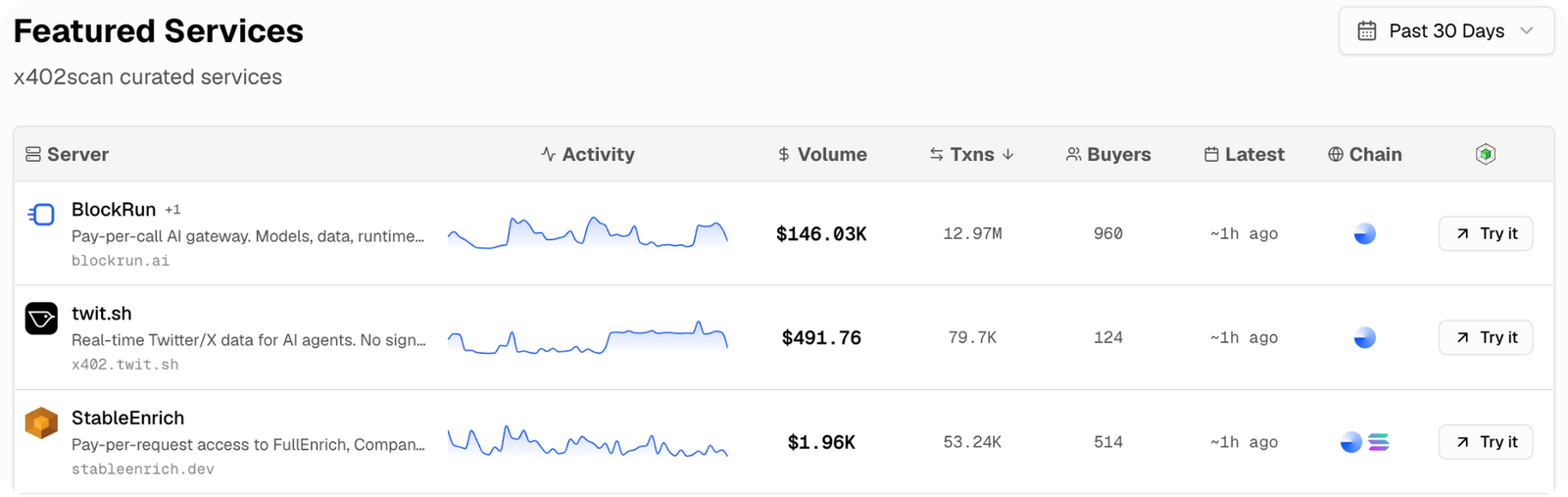

x402scan platform's featured services rankings (based on 30-day data), showcasing the activity, transaction amount, transaction count, number of buyers, and hosting blockchain for three AI data/gateway service providers charging by call: BlockRun, twit.sh, and StableEnrich.


More Service Providers Continuously Joining the Ecosystem


If you are using x402, this section is worth special attention.


In June, Apify announced its integration with x402. Developers can now use the USDC stablecoin on the Base blockchain (which remains the protocol's primary operating network) to call its web automation and data scraping toolkit. Users can now leverage stablecoins to scrape data from platforms like Twitter (X), Reddit, TikTok, and Facebook, although the quality of various automated scripts (which Apify calls Actors) within the platform is uneven.


Following closely, the AI search engine Exa expanded x402 payment support to the Solana blockchain, allowing users on this public chain to pay for web retrieval and content search services. This is particularly suitable for in-depth information research, especially for due diligence on new projects.


The personal AI assistant platform Seal launched a feature module called Hacks: a customizable agent capability that bundles multiple API requests into a single automated task. This product's underlying marketplace is built using x402, which aligns perfectly with a key application scenario I previously described in my article "My Wishlist for x402's Development." I'm delighted to see the product officially launched and plan to try it myself.


Additionally, the Merit Systems team continues to roll out new data streams, accessible for its conversational application Poncho, which is equipped with the x402 protocol.
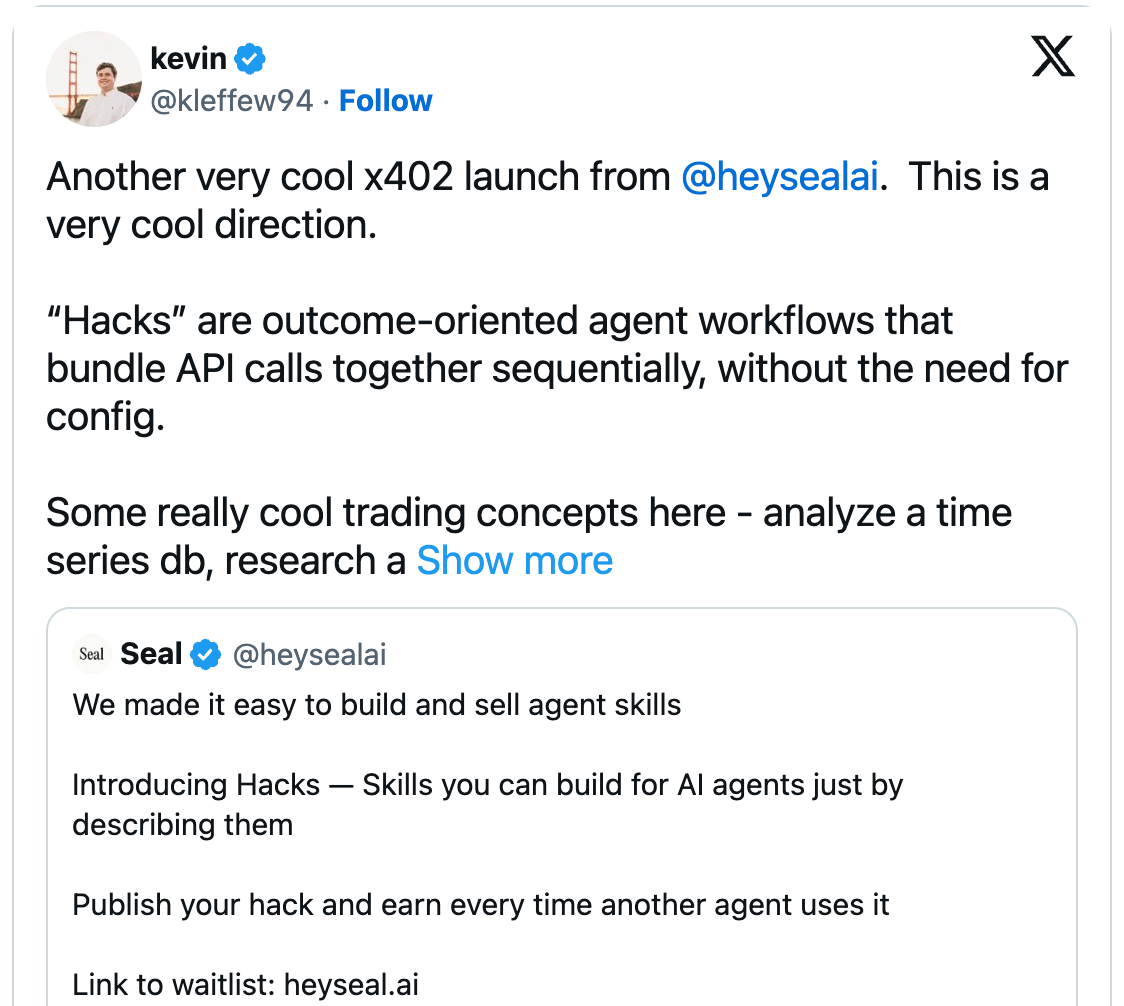

Kevin Leffew, co-author of the x402 whitepaper, commented on Seal's Hacks feature built on x402: users can create and sell AI agent automation skills described simply in text, earning revenue per call. Kevin believes this direction has broad prospects.


Significant Enhancement in Practicality of Payment Infrastructure


Two major protocol-level updates are particularly crucial:


  • Builder Codes (Developer Identifier Codes): x402 payment transactions can now be tagged with the application, client, or service intermediary that initiated the payment. This feature enables the construction of distribution affiliate and revenue-sharing systems, clearing obstacles for various marketplace ecosystems.
  • Batch Settlement: Eliminates the need for separate on-chain settlement for every small payment request. Buyers only need to pre-fund their accounts and authorize a series of consecutive purchases, with service providers later aggregating funds in batches. For high-frequency, small-amount payment scenarios like AI inference and information retrieval, where per-transaction on-chain costs and latency are infeasible, batch settlement makes the high-frequency micro-payment model a reality.


Furthermore, x402 has added support for more programming languages and compatibility with multiple blockchains, essentially lowering the integration barrier for various service providers.
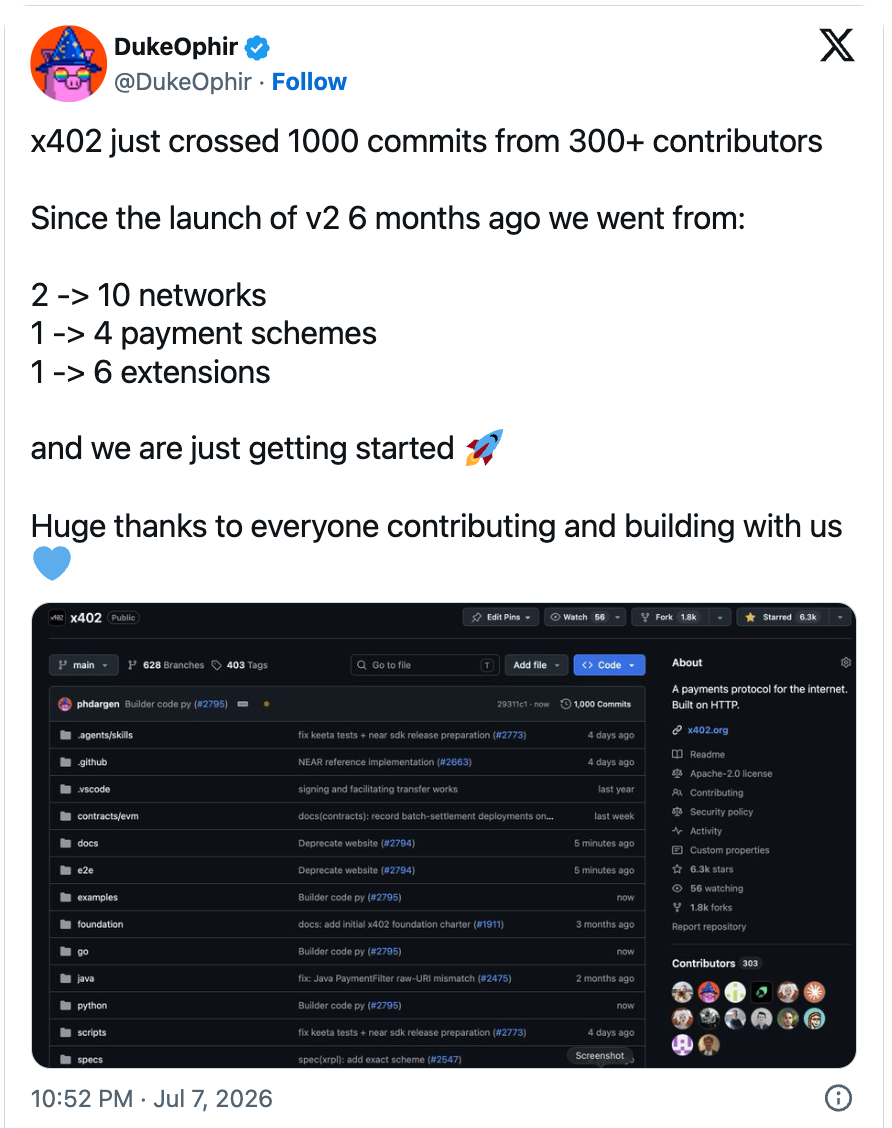

DukeOphir, a core member and de facto maintainer of the x402 ecosystem, announced project development progress: code commits exceeded 1,000, developers surpassed 300, and various technical components have expanded multiple times within half a year of v2's launch.


Channel Boost from External Mainstream Internet Giants


The most impactful developments did not originate from the crypto-native industry.


AWS launched an edge node AI traffic billing solution. When a user requests a protected resource, an AWS edge node can return pricing and payment terms, verify payment credentials, and then grant access to the resource. Any content site or API deployed on AWS can now treat AI agents as paying customers.


The main event, however, comes from Cloudflare. On July 1st, its Content Monetization Gateway officially opened for waitlist applications. Using this gateway, customers can charge for any resource hosted on Cloudflare: web content, datasets, various APIs, and tool services can all be monetized. Transactions are settled using stablecoins via x402, with payment validation occurring at the edge nodes.


Content monetization is precisely the core application scenario that initially made outsiders optimistic about x402. The current internet business model is fundamentally imbalanced: various crawler bots account for the vast majority of traffic. These bots scrape content without generating ad clicks, forcing website operators to bear bandwidth costs without revenue compensation. Cloudflare handles approximately 20% of global website traffic. Therefore, this gateway represents the first large-scale, real-world test for the model where bots pay to scrape internet content.


The biggest question at this stage is performance scaling. Cloudflare's CEO publicly endorsed x402 as the solution in a podcast but also pinpointed the core bottleneck: current blockchain throughput is temporarily insufficient to handle the required transaction volume. Even monetizing just a small fraction of Cloudflare's traffic would require millions of transactions per second, far exceeding the performance of any public chain he has tested. This performance gap must be bridged first.
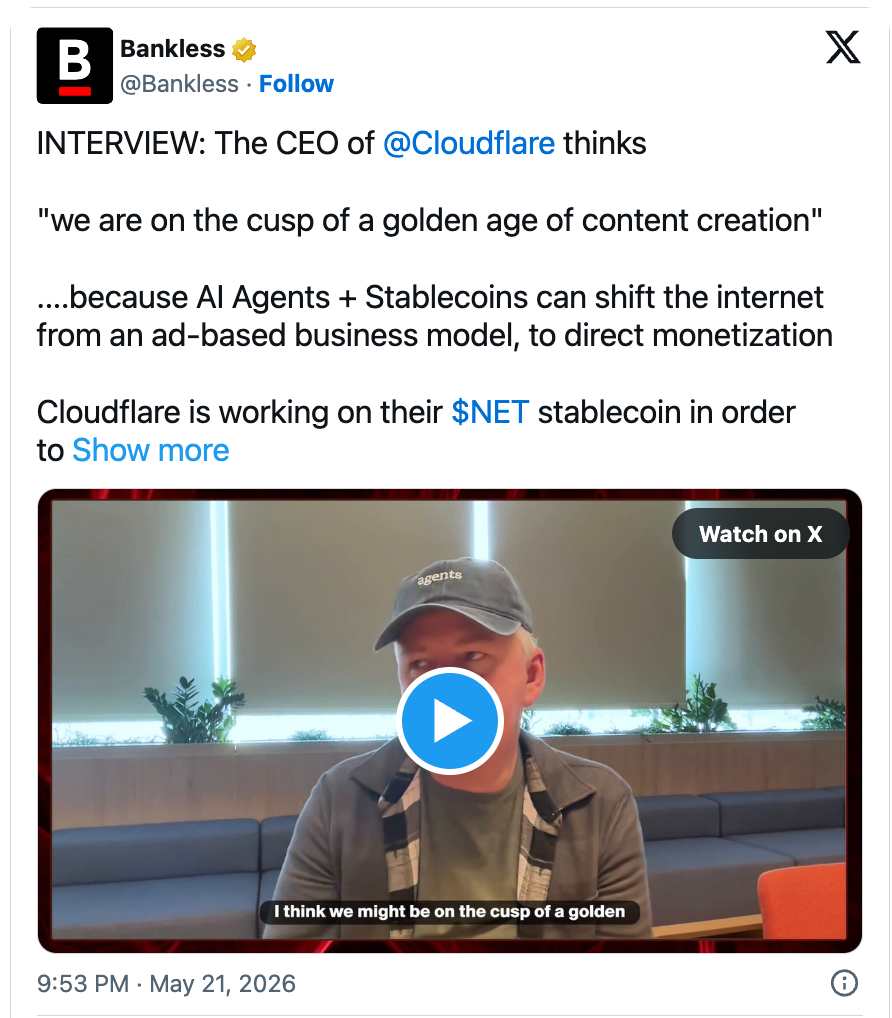

Source: Bankless interview with Matthew Prince, Co-founder and CEO of Cloudflare.


Which Application Track Will Ultimately Prevail?


Several viable application tracks have already emerged within the x402 ecosystem.


AI inference routing appears to be leading in scale, with BlockRun having validated market demand: users want to access various inference services through a single interface without managing multiple individual subscriptions. The paid high-quality data track follows closely, as developers are willing to pay for superior input data, which significantly enhances large language model output quality.


Both tracks represent real and sustainable demand. However, by themselves, they are unlikely to make x402 an indispensable foundational component of the next-generation internet. In contrast, the content monetization track possesses this potential. If various AI agents need to pay for the web content they scrape, this scenario could propel x402 from being a useful tool to achieving mass adoption. The practical implementation of the Cloudflare gateway will test whether this path is viable.


Domande pertinenti

QWhat are the two key protocol-level updates for x402 mentioned in the article, and why are they significant?

AThe two key updates are Builder Codes and Batch Settlement. Builder Codes allow payments to be tagged with the identifier of the originating application, enabling affiliate/commission systems. Batch Settlement allows for many small purchases to be authorized upfront and settled in aggregate later, making high-frequency, micro-payments for services like AI inference or data retrieval economically viable without on-chain latency and cost for every single transaction.

QWhich major non-crypto companies have recently integrated or announced support for the x402 protocol, and what are their respective contributions?

ATwo major non-crypto companies are involved: Amazon Web Services (AWS) and Cloudflare. AWS introduced an edge node AI traffic billing solution that allows resources to return pricing and validate x402 payments before granting access. Cloudflare has opened a waitlist for its Content Monetization Gateway, which will allow any resource hosted on its network (websites, APIs, data) to charge AI agents for access, settling payments via x402 at the edge.

QAccording to the article, what is currently the primary driver of transaction volume on the x402 protocol?

AThe primary driver of transaction volume is a single service provider: the inference routing project called BlockRun. The vast majority of transaction activity in June was concentrated on this platform, which provides a one-stop-shop for accessing various AI inference services.

QWhat does the article identify as the 'core bottleneck' for the success of the content monetization narrative via Cloudflare's gateway?

AThe core bottleneck is blockchain scalability/throughput. Cloudflare's CEO stated that even monetizing a small fraction of Cloudflare's traffic would require processing millions of transactions per second, a scale that far exceeds the current capacity of any blockchain he has tested. This performance gap must be bridged first.

QName at least two other application sectors or specific services (besides BlockRun) that are gaining traction within the x402 ecosystem as mentioned in the June updates.

AOther gaining sectors/services include: 1) Apify, which provides web automation and data scraping tools (e.g., for Twitter, TikTok). 2) Exa, an AI search engine that expanded x402 payment support to Solana. 3) Seal's 'Hacks' feature, which lets users create and sell custom AI agent automations. 4) Merit Systems' new data streams for its Poncho chat application.

Letture associate

Weekly Editor's Picks (0725-0731)

Weekly Editor's Picks (0725-0731) provides a curated selection of deep analysis, filtering out market noise. Key themes from this week include: **Macro & Policy:** The Federal Reserve's upcoming meeting is marked by high uncertainty, balancing cooling inflation data against persistent price pressures. Meanwhile, the U.S. crypto regulatory Clarity Act faces critical political hurdles, with its 2026 passage probability seen as low. **Investing & Crypto:** Analysis suggests long-term crypto success depends on conviction through volatile cycles, focusing on assets like Bitcoin and core smart contract platforms. A trend noted is the increasing similarity between global equity markets (especially tech) and crypto, driven by narrative and leverage. Several major crypto protocols show strong revenue growth, but this isn't always translating to token price appreciation due to sell pressure and structural factors. **AI & Semiconductors:** Nvidia's rising credit default swap rates signal market concern over AI infrastructure financing risks. The storage sector experienced volatility as markets began pricing in potential 2027 oversupply. Despite a record profitable quarter, SK Hynix's results were deemed "below expectations," reflecting heightened investor demands for future growth visibility. **Markets & DeFi:** TradeXYZ demonstrated remarkable accuracy in pre-market pricing for a major A股 listing. The token ONDO saw gains, linked to its growing role in the on-chain tokenized stock ecosystem. **Ethereum:** Post-Pectra upgrade, a major structural shift is underway as Lido begins migrating millions of ETH to new validator architectures designed for capital efficiency. **Also Highlighted:** Butian's bullish stock market move; OpenAI's Altman promising major advances; Samsung and SK Hynix securing large AI chip deals; Apple reaching a $5T market cap; and ongoing discussions around exchange security following Poolin's bankruptcy case.

marsbit4 min fa

Weekly Editor's Picks (0725-0731)

marsbit4 min fa

Low Investment Isn't Apple's Immunity Pass

While Meta and Google face investor scrutiny over ballooning AI capital expenditures, Apple's minimal AI investment has paradoxically become a strength. Its market cap recently reclaimed the global top spot, surpassing $5 trillion. The irony is deep: Apple's own AI efforts have lagged, with "Apple Intelligence" delayed and core talent lost, forcing reliance on partners like Google Gemini and Alibaba's Qianwen. Its Q3 FY2026 (Q2 CY) earnings initially seemed stellar. Revenue hit $109.4B (up 16% YoY), with iPhone and Mac sales, growing 22% and 29% respectively, driving most of the growth. However, the stock fell over 8% post-earnings. The primary concern was a weaker Q4 revenue growth forecast of 9-11%, below expectations, due to looming supply chain constraints. Apple is feeling the indirect cost of the AI boom. Soaring memory and chip prices, fueled by massive data center investments from Microsoft, Amazon, and others, are forcing Apple to raise Mac and iPad prices significantly. The upcoming iPhone launch is also expected to see substantial price hikes. Despite avoiding heavy AI infrastructure spending—its capital expenditures are actually down 28%—Apple cannot escape the industry-wide supply and cost pressures. While Apple's operating cash flow remains robust, its substantial R&D spending (up 32% YoY) has yet to yield major AI breakthroughs. As Tim Cook prepares to step down as CEO, Apple faces a challenging transition: balancing its premium hardware success against the strategic and cost pressures of the AI era it has so far cautiously navigated.

marsbit55 min fa

Low Investment Isn't Apple's Immunity Pass

marsbit55 min fa

PA Graphics Explanation | One Chart to Understand the Major Web3 Events in August 2026

**PANews Crypto Calendar: Key Web3 Events in August 2026** PANews introduces its revamped crypto calendar, featuring comprehensive coverage, flexible filtering, and easy export options. The market in August will be shaped by multiple key events across macroeconomics, regulation, tokenomics, and project developments: * **Macro & Policy:** Key US economic data releases (July Non-Farm Payrolls, CPI), the Federal Reserve meeting minutes, and the Jackson Hole Economic Symposium will be in focus. On the regulatory front, the US Senate plans to release a new draft of the *CLARITY Act*, while the EU's expanded crypto ban against Belarus comes into effect. * **Token Unlocks:** Significant token unlocks are scheduled for assets including ENA, AVAX, CONX, ZRO, and KAITO, which may influence market volatility. * **Project Updates & Shutdowns:** Several services, including Exchange Art, Ctrl Wallet, Zapper, NFTfi, and Summer.fi, are set to cease operations or undergo major adjustments. Users are advised to manage their assets accordingly. * **Corporate Activity:** Q2 earnings reports from companies like SpaceX, Circle, and Nvidia are due. Unitree Robotics will initiate its IPO subscription on the STAR Market, and Moonshot AI plans to begin a Pre-IPO financing round. * **Industry Events:** Major conferences such as Bitcoin Asia 2026 and the 2026 Digital Expo will take place. The overarching market narrative for August will revolve around macroeconomic expectations, regulatory developments, token unlock schedules, and ongoing industry consolidation.

marsbit1 h fa

PA Graphics Explanation | One Chart to Understand the Major Web3 Events in August 2026

marsbit1 h fa

Wall Street's Most Famous 'Cassandra' Now Has His Sights Set on Nvidia

Michael Burry, the famed "Big Short" investor, has once again captured Wall Street's attention with a series of short positions against major tech and semiconductor stocks, most notably Nvidia. In late June and July, through his "Cassandra Unchained" newsletter, Burry disclosed short bets against Nvidia, Tesla, Applied Materials, Caterpillar, the SOXX semiconductor ETF, and later, Micron Technology. His core thesis revolves around potential distortions in the AI infrastructure boom, specifically questioning whether extended depreciation schedules (e.g., 6 years vs. a realistic 2-3 years for AI chips) by cloud giants like Microsoft and Google artificially inflate profits. He also raises concerns about possible "off-balance-sheet circular financing," where chip demand might be propped up by vendor-backed funding to clients. Nvidia's stock experienced volatility following these disclosures, briefly dipping but largely holding near Burry's reported entry points, leaving his positions roughly flat or slightly underwater as of late July. This move is part of a pattern for Burry, whose track record since his legendary 2008 bet is mixed. He has faced notable losses, such as on Tesla in 2021, while scoring on broader market turns like the 2020 pandemic crash. His methodology focuses intensely on free cash flow and scrutinizing original financial documents to spot overvaluation and structural risks, but it often struggles with timing the market. The article contrasts Burry's stance with other prominent investors. Steve Eisman, another "Big Short" figure, is not shorting Nvidia, citing strong fundamentals but expressing nervousness about sustainability. Jim Chanos agrees with the broad "accounting mismatch" concern—comparing it to the dot-com bubble—but targets financial leverage in private equity firms rather than the chip stocks themselves. While Nvidia's short interest remains relatively low at 1.3-1.4% of float, the massive stock size means absolute short losses have been significant, exceeding $5 billion earlier this year. The piece concludes that for ordinary investors, the key takeaway is not replicating specific short bets but learning from the critical frameworks these investors use: questioning rosy accounting, identifying structural vulnerabilities, and maintaining skepticism during market euphoria, even if pinpointing the exact catalyst for a downturn remains elusive.

marsbit1 h fa

Wall Street's Most Famous 'Cassandra' Now Has His Sights Set on Nvidia

marsbit1 h fa

Weekly Selection丨Epic Stock Market Volatility, Changxin Tech's IPO Reshapes Storage Landscape, Saylor Aims to Re-Anchor STRC Around September 8th

PANews Weekly Digest: Market Turmoil, Tech Breakthroughs, and Crypto Developments. The week saw significant volatility across global markets. South Korea's KOSPI index experienced extreme turbulence, including multiple trading halts, largely driven by sharp declines in AI hardware stocks like SK Hynix. In contrast, China's Changxin Xinqiao (CXC) achieved a landmark IPO with a market cap surpassing 4 trillion yuan, marking a major success for the domestic DRAM industry after a decade of losses. In the crypto and Web3 space, several key narratives emerged. AI is driving demand for new infrastructure, with projects like AI agent wallets and programmable payments gaining traction, attracting interest from firms like Coinbase. The Bitcoin mining sector is pivoting, with companies like MARA focusing on energy management as electricity becomes a core AI-era asset. Meanwhile, the RWA (Real World Assets) sector faces a "utilization puzzle," with hundreds of billions in on-chain assets remaining dormant. Notable market movements included a historic single-day surge of over 17% for the KOSPI index and a significant migration of $16.5 billion in staked ETH within the Lido ecosystem. Michael Saylor announced a target to re-peg the STRC stablecoin around September 8th. Other highlights include discussions on Ethereum's ambitious 2030 roadmap for scaling and privacy, analysis showing high protocol revenues not always translating to token price gains, and warnings from Citi about potential extreme commodity price shocks by late 2026.

marsbit1 h fa

Weekly Selection丨Epic Stock Market Volatility, Changxin Tech's IPO Reshapes Storage Landscape, Saylor Aims to Re-Anchor STRC Around September 8th

marsbit1 h fa

Trading

Spot
活动图片