Is the Plunge Just Beginning? Three 'Macro Bombs' for BTC About to Detonate

Odaily星球日报Pubblicato 2025-12-16Pubblicato ultima volta 2025-12-16

Introduzione

Bitcoin experienced a sharp drop on December 15, falling from $89,000 to around $85,000, nearing its December 1 low. The market fear and greed index has fallen to 21, indicating extreme fear. Three major macroeconomic events are expected to further impact Bitcoin's price: First, the U.S. November non-farm payroll data will be released on December 16. Due to the previous government shutdown, October data was incomplete, which may lead to market volatility. Weak data could reinforce expectations of a Fed rate cut in January 2026, but could also increase selling pressure on Bitcoin. Second, the Bank of Japan is widely expected to raise interest rates by 25 basis points on December 19, marking its highest rate in 30 years. This could end the long-standing yen carry trade, reducing liquidity in risk assets like Bitcoin. Historical data shows Bitcoin often drops over 20% following BoJ rate hikes. Third, uncertainty over the next Fed Chair is growing. Kevin Warsh, considered more hawkish, has gained traction as a potential nominee over Kevin Hassett. A Warsh appointment could mean tighter monetary policy, further suppressing Bitcoin’s upward momentum. These factors materialize, Bitcoin may face continued downward pressure, with some analysts predicting a fall toward $70,000.

Original | Odaily Planet Daily (@OdailyChina)

Author | Golem (@web 3_golem)
On the evening of December 15th, Bitcoin experienced another flash crash, plummeting from $89,000 to around $85,000, approaching the low of December 1st ($83,822). Accompanying the sharp drop, the market fear and greed index fell to 21 (extreme fear).

"Be fearful when others are greedy"? The temptation to buy the dip or engage in swing trading is immense right now, but it's also extremely easy to step on a landmine. Monday's flash crash was not an isolated incident. The "three hidden macro risks" planted in December are severely suppressing Bitcoin's upward momentum. A larger storm of decline may have just begun.

Tuesday's Non-Farm Payrolls Night

On Tuesday, December 16th, at 21:30 (UTC+8), the U.S. Department of Labor will release the November Non-Farm Payrolls (NFP) data. Due to the previous U.S. government shutdown, the household survey data for October was not collected, resulting in a blank unemployment rate for October. Consequently, the standalone October NFP data was canceled, but the Labor Department will incorporate the October establishment survey (NFP) data into the November release.

While the NFP data based on the establishment survey remains useful, the lack of contrasting household survey data for October might amplify the contradictions between the non-farm payroll numbers and the unemployment rate, leading to an incomplete and potentially misleading market interpretation. This combined report, missing some key indicators, could increase speculative trading or market volatility, putting pressure on Bitcoin's price. Institutions will also treat this report as an "important but require caution" information.

Citigroup economists also pointed out that the latest employment report to be released on the evening of December 16th might release more conflicting signals. The bank expects October job losses of about 45,000, but an increase of 80,000 jobs in November. They also predict the unemployment rate will rise from 4.4% to 4.52%, while a Reuters survey of economists shows an unemployment rate of 4.4%. The Fed's own quarterly projections indicate a median unemployment rate of about 4.5% by the end of this year.

Coupled with this being the first NFP report since the Fed announced a 25 basis point rate cut on December 10th, market reactions to wages, sector changes, and total employment numbers might be amplified due to expectations for the Fed's January 2026 rate decision.

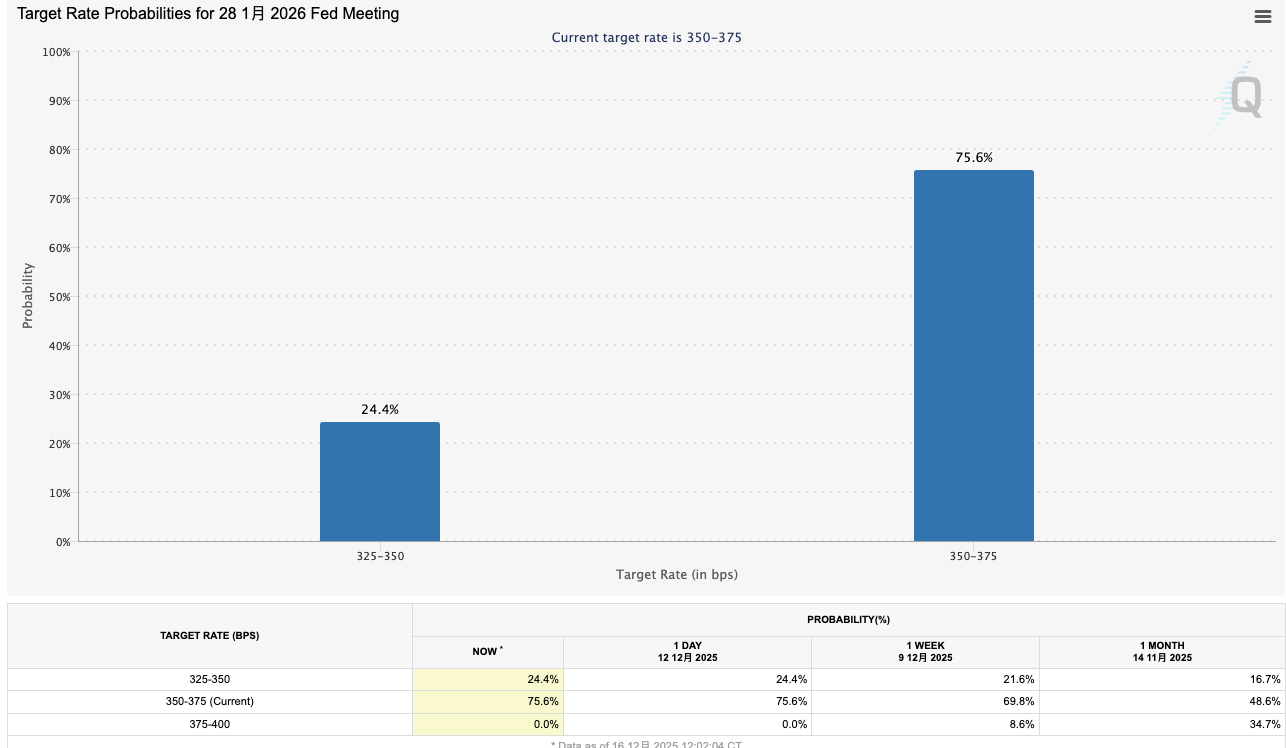
The NFP report's biggest impact is on market expectations for a Fed rate cut in January 2026. According to CME's "FedWatch Tool," the probability of a 25 basis point rate cut in January 2026 is only 24.4%, while the probability of maintaining the current rate is 75.6%.
Morgan Stanley strategist Michael Wilson analyzed that if tonight's NFP report shows moderate weakness, it could intensify market expectations for the Fed to cut rates again at least in the first quarter of next year.

However, the Financial Times believes that tonight's U.S. NFP report will provide policymakers and investors with a more complete picture of the U.S. labor market, ending months of partial "flying blind." Although the Fed cut rates to a three-year low on December 10th amid serious divisions, the current debate still centers on whether to prioritize fighting high inflation or a weakening labor market.

Therefore, in an already消极 (bearish) market, if the NFP data fails to provide a positive signal again, Bitcoin will likely face another downward crisis.

Friday's Bank of Japan Interest Rate Decision

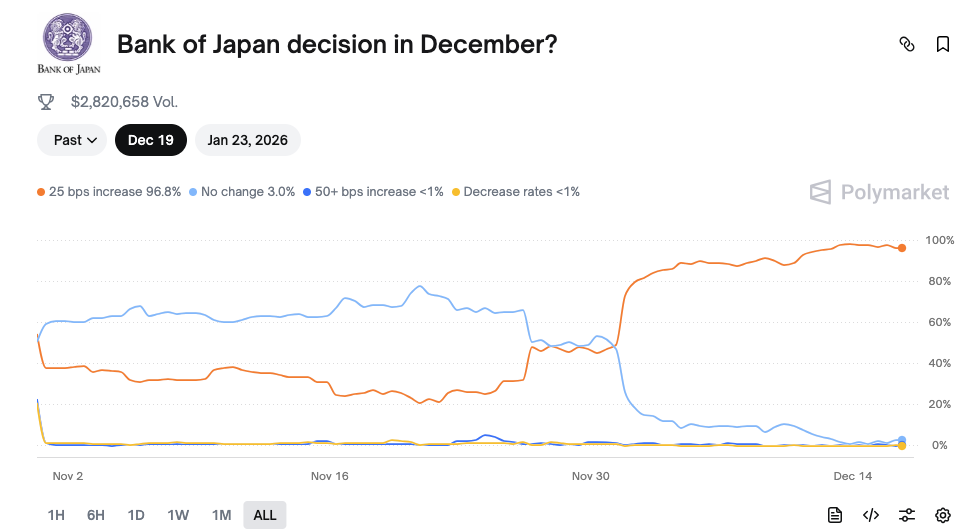
On Friday, December 19th, the Bank of Japan (BOJ) will announce its interest rate decision. The market widely believes a 25 basis point rate hike (to 0.75%) is a "done deal." According to Polymarket data, the probability of a 25 basis point hike on December 19th has reached 97%, which would bring Japanese interest rates to their highest level in 30 years since 1995.
Investors are closely watching the BOJ's rate hike because the Yen carry trade has injected massive amounts of funds into global financial markets over the past decade, including the crypto market. For over a decade, the BOJ's interest rates have basically remained in an ultra-loose range of "close to 0% or slightly negative," allowing numerous institutions and investors to borrow ultra-low-interest Yen and invest in U.S. Treasuries, U.S. stocks, or Bitcoin, "easily earning" the interest rate differential or risk premium.

But a BOJ rate hike will shatter this illusion. Investors will no longer get "free Yen" to conduct carry trades in global financial markets. Stock and crypto markets will face pressure, while the Yen strengthens, and yields on Japanese 10-year and 30-year government bonds rise successively.

Some macro analysts believe that if the BOJ hikes rates as expected on December 19th, Bitcoin could correct further to the $70,000 level. Analyst AndrewBTC tracked historical data, stating that every BOJ rate hike since 2024 has been accompanied by a Bitcoin price drop of over 20%: approximately 23% in March 2024, ~26% in July 2024, and ~31% in January 2025. If the BOJ hikes rates next week, similar downside risks could reappear.

In fact, the market has been shrouded in the shadow of a BOJ rate hike throughout December. To some extent, the market has almost priced in the possibility of Japan raising rates from 0.5% to 0.75% in December. But the key issue is that a December hike by the BOJ is not a one-off action; it's the start of a new rate hike cycle.

Multiple sources透露 (revealed) that after Friday's hike, Japan could see more rate hikes. These sources stated that Japanese officials believe even after hiking to 0.75%, the BOJ仍未达到 (has still not reached) the neutral interest rate level. Some officials already consider 1% to be below the neutral rate. Informed sources indicated that even if the BOJ updates its neutral rate estimate based on the latest data, the range is not expected to narrow significantly at present. The BOJ's current estimate for the nominal neutral rate range is approximately 1% to 2.5%.

In this scenario, not only will Bitcoin's price be under pressure this week, but it also has the potential to continue trending lower for some time. Crypto investors need to prepare themselves psychologically in advance.

Uncertainty Over Next Fed Chair Nomination Intensifies

Hassett has long been a frontrunner to succeed Powell as the next Fed Chair. Even as the candidate list narrowed to 5 people in early December, Hassett's winning probability on Polymarket remained far ahead (Related reading:Fed "Changing of the Guard" Countdown: 5 Major Candidates Revealed, Who is the Final Winner?). The reason is that Hassett is inherently a "Trump-aligned figure" and agrees with Trump on interest rate cut policy (Trump has consistently advocated for rapid rate cuts).

But on December 13th, the situation began to change. Trump said in an Oval Office interview that day: "Both Kevins (Warsh and Hassett) are excellent, and the other candidates are outstanding too."

Simultaneously, according to informed sources, Trump previously met with Warsh in the Oval Office for 45 minutes, during which he pressured Warsh, asking if he could guarantee support for rate cuts if elected Fed Chair. Trump confirmed this in the interview: "He thinks rates must be cut, everyone I've spoken to thinks so too." Trump said he believes the next Fed Chair should seek his opinion when setting interest rate policy.

After the news broke, the probability of Warsh being nominated as the next Fed Chair on Polymarket rose to 38%, while Hassett's probability dropped from 75% to 50%.

On December 15th, according to informed sources, some senior figures close to Trump are opposing Hassett becoming the next Fed Chair due to concerns that Hassett is too close to the president. Since then, Hassett's advantage on Polymarket has disappeared. As of now, the probability of Warsh being nominated is 47%, while Hassett is at 41%, slightly behind Warsh.
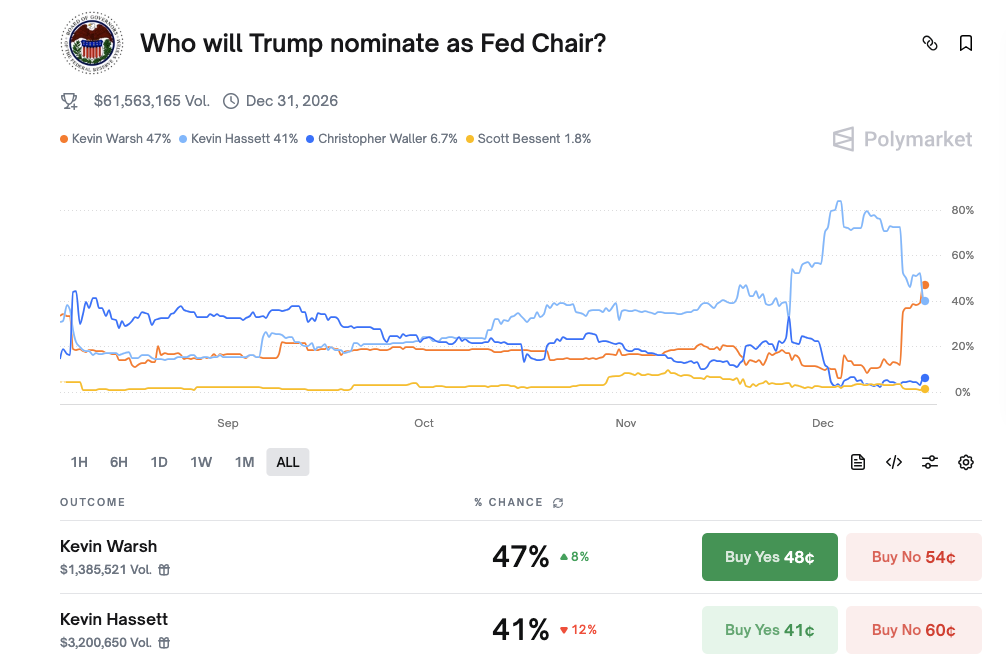
This is not good news for crypto investors. Crypto investors, of course, are not interested in U.S. political struggles, but rather because Warsh is not part of the "rate cut camp." Warsh has long been considered a "hawk," with policies leaning towards tightening interest rates and combating inflation, and advocating for reducing the central bank's balance sheet. If he takes office, it would clearly suppress the crypto market from a macro perspective.

The Bitcoin plunge on the evening of December 15th was also influenced, in the short term, by the sentiment surrounding Warsh's potential nomination. But if Trump ultimately confirms Warsh's nomination by the end of December, then the Christmas rally anticipated by crypto investors might also fail to materialize.


Crypto di tendenza

Domande pertinenti

QWhat are the three major macroeconomic events mentioned in the article that could trigger a further decline in Bitcoin's price?

AThe three major macroeconomic events are: 1) The release of the November U.S. Non-Farm Payrolls (NFP) data on December 16th, which could create market volatility and uncertainty. 2) The Bank of Japan's (BoJ) interest rate decision on December 19th, which is widely expected to result in a 25 basis point hike. 3) The uncertainty surrounding the nomination of the next Federal Reserve Chair, with potential candidates' differing stances on monetary policy affecting market.

QHow did the market's 'Fear and Greed Index' react to Bitcoin's drop to near $85,000 on December 15th?

AThe market's 'Fear and Greed Index' dropped to 21, indicating a state of 'Extreme Fear' among investors following the price decline.

QWhy is the Bank of Japan's potential interest rate hike significant for the Bitcoin and global financial markets?

AA BoJ rate hike is significant because it would end over a decade of ultra-low interest rates that fueled the 'yen carry trade.' Investors borrowed cheap yen to invest in higher-yielding assets like U.S. stocks, bonds, and Bitcoin. Higher Japanese rates would make this trade less profitable, potentially leading to capital outflows from these markets and putting downward pressure on assets like Bitcoin.

QAccording to the article, what impact could the nomination of Kevin Warsh as Fed Chair have on the crypto market?

AThe nomination of Kevin Warsh, who is perceived as a 'hawkish' candidate favoring tighter monetary policy and inflation control, could be negative for the crypto market. His potential policies would be less supportive of lower interest rates, creating a macro environment that could suppress the crypto market's growth and potentially eliminate any expected 'Santa rally'.

QWhat does the article suggest about the nature of the potential Bank of Japan rate hike on December 19th? Is it seen as a one-time event?

AThe article suggests that the potential rate hike is not seen as a one-time event but rather as the beginning of a new cycle of interest rate increases. Sources indicate that Japanese officials believe even a hike to 0.75% has not reached the neutral rate level, implying that further hikes could follow, creating sustained downward pressure on Bitcoin.

Letture associate

Only 153 Venture Capital Firms Invested in July: Is the Crypto VC Industry Experiencing a 'Mass Extinction'?

In July 2026, only 153 unique venture capital firms participated in disclosed crypto funding rounds, marking the lowest monthly count since November 2020. This figure represents an 87% decline from the peak of 1,177 firms in 2022. Overall, the first seven months of 2026 saw crypto projects raise approximately $11.78 billion across 481 rounds. This crypto VC contraction contrasts sharply with the broader venture capital landscape, where global VC investment reached a record $560.4 billion in H1 2026, heavily fueled by major AI company financings. This shift in capital allocation has drawn funds away from the crypto sector. Within crypto, funding is highly concentrated. Trading platforms, prediction markets, and payment sectors absorbed 53% of the total capital. While early-stage deals remain frequent, the largest sums flow to a few late-stage rounds and mergers & acquisitions, which surged to $7.23 billion in Q2 2026. The market is consolidating around top funds like a16z crypto and Dragonfly, which successfully raised new multi-billion dollar funds, while many smaller firms have retreated. Analysts describe this as a "great extinction" for crypto VCs, where capital is becoming more selective, favoring proven business models and assets over early-stage speculation. This raises the bar for project quality, funding efficiency, and viable exit paths.

marsbit12 min fa

Only 153 Venture Capital Firms Invested in July: Is the Crypto VC Industry Experiencing a 'Mass Extinction'?

marsbit12 min fa

Strategy's Loss in the Second Quarter Reaches $8.22 Billion Amid Bitcoin Decline

Strategy, the largest corporate holder of Bitcoin, reported a net loss of $8.22 billion for the second quarter. This loss was primarily driven by an $8.32 billion unrealized loss on its Bitcoin holdings due to a decline in the asset's price during the period. Despite these paper losses, the company increased its Bitcoin holdings to 843,775 BTC, a 25% growth since the start of the year. As part of a new monetization strategy, Strategy sold approximately $218.4 million worth of Bitcoin, mainly to fund dividends for preferred shareholders, with $216 million of that sold after Q2 ended. The company also built a $3.75 billion cash reserve, which it claims is sufficient to cover over two years of dividend and interest payments, aiming to insulate itself from Bitcoin's volatility while meeting obligations. Following the earnings release, Strategy's stock (MSTR) rose 4.7% in regular trading but corrected slightly after-hours. This pattern reflects how the company's accounting results are heavily tied to Bitcoin's price swings, even as its long-term strategy remains unchanged. The report indicates that Strategy is maintaining its core strategy of accumulating Bitcoin while building a financial buffer. This quarterly loss follows a recognizable pattern, with the company posting significant unrealized losses in previous quarters (e.g., $12.4 billion in Q4 2025 and ~$12.5 billion in Q1 2026) due to fair-value accounting. A key technical shift is its new monetization program, which introduces periodic selling pressure on the market, transitioning Strategy from a pure accumulator to a participant that occasionally adds supply. A critical question remains: how long can the cash reserve cover dividend obligations if a Bitcoin price downturn persists beyond two years?

cryptonews.ru32 min fa

Strategy's Loss in the Second Quarter Reaches $8.22 Billion Amid Bitcoin Decline

cryptonews.ru32 min fa

Will Terrorist Durov Ban Russian Officials?

Telegram founder Pavel Durov publicly reacted to being labeled a "terrorist" by Russian authorities, stating the designation came after he refused demands for mass surveillance and censorship on the platform. In a Telegram post, he highlighted that this status formally bans him from "publishing information online." Durov concluded with a statement widely circulated: Russian officials "clearly don't understand who can ban whom on the internet." This remark suggests Durov could potentially restrict official Russian government and officials' channels on Telegram, which continue to operate on the platform despite its formal blocking in Russia. The situation parallels previous, slow-moving state directives, like switching officials to domestic cars, contrasted with the current push to migrate all government communication to the Russian-made messenger MAX by 2030. However, reports indicate many officials still use Telegram via workarounds, fearing surveillance on MAX, while alternatives like BiP and KakaoTalk recently became inaccessible in Russia without a VPN. Durov has not specified any immediate actions against state channels. His statement is an initial response, with further developments depending on the authorities' reaction. The dynamic differs from 2020 when Russian regulators lifted a block on Telegram; now, Durov implies control from within the platform itself over the official accounts that persisted through that earlier blockade.

cryptonews.ru32 min fa

Will Terrorist Durov Ban Russian Officials?

cryptonews.ru32 min fa

DeepSeek V4 Official Version Arrives, New Capabilities Emerge, Value-for-Money King Enters the Fray

On July 31st, DeepSeek officially launched the public API beta for its DeepSeek-V4-Flash model. A key highlight is its performance on multiple Agent benchmark tests, reportedly nearing or even surpassing the level of the V4-Pro preview version from three months ago. Notably, the Flash model achieves this with significantly smaller scale (130B active parameters vs. Pro's 490B), suggesting that post-training optimization and data quality may be as crucial as raw model size. DeepSeek emphasized that the V4-Flash-0731 uses the same model architecture and size as its preview version, with improvements attributed solely to "re-trained post-training." The update also marks the official debut of DeepSeek's self-developed Agent framework, "Harness." The move signals DeepSeek's strategic push to position its cost-effective Flash model as a competitive base for Agent applications—scenarios requiring autonomous planning, tool usage, and complex task execution—where inference speed and cost are critical. By natively supporting OpenAI's Responses API format and adapting for code-generation scenarios, DeepSeek aims not just to be a cheaper alternative but to establish its own ecosystem in the Agent era. This release follows DeepSeek's record-breaking ~$50 billion fundraising round roughly two months prior, underscoring market confidence in its technology and commercialization prospects. The company is reportedly preparing for another funding round at a valuation of approximately $71 billion. The Flash model's advancement represents a step in fulfilling the high expectations that come with this valuation, setting the stage for the impending release of the V4-Pro official version and intensifying competition in the global Agent landscape.

marsbit36 min fa

DeepSeek V4 Official Version Arrives, New Capabilities Emerge, Value-for-Money King Enters the Fray

marsbit36 min fa

Trading

Spot

Articoli Popolari

Cosa è BITCOIN

Comprendere HarryPotterObamaSonic10Inu (ERC-20) e la sua posizione nel mondo delle criptovalute Negli ultimi anni, il mercato delle criptovalute ha assistito a un aumento della popolarità delle meme coin, catturando l'interesse non solo dei trader, ma anche di coloro che cercano coinvolgimento comunitario e valore di intrattenimento. Tra questi token unici c'è HarryPotterObamaSonic10Inu (ERC-20), un progetto intrigante che mescola riferimenti culturali nel tessuto delle criptovalute. Questo articolo esplora gli aspetti chiave di HarryPotterObamaSonic10Inu, analizzando i suoi meccanismi, l'etica guidata dalla comunità e il suo coinvolgimento con il panorama crittografico più ampio. Che cos'è HarryPotterObamaSonic10Inu (ERC-20)? Come suggerisce il suo nome, HarryPotterObamaSonic10Inu è una meme coin costruita sulla blockchain di Ethereum, classificata secondo lo standard ERC-20. A differenza delle criptovalute tradizionali che possono enfatizzare l'utilità pratica o il potenziale investimento, questo token prospera grazie al valore di intrattenimento e alla forza della sua comunità. Il progetto mira a creare un ambiente in cui gli utenti coinvolti possono riunirsi, condividere idee e partecipare ad attività ispirate a diversi fenomeni culturali. Una caratteristica notevole di HarryPotterObamaSonic10Inu è la zero tassa sulle transazioni. Questo elemento allettante tende a incoraggiare il trading e il coinvolgimento della comunità, privo di costi aggiuntivi che possono scoraggiare i trader di piccole dimensioni. L'offerta totale della moneta è fissata a un miliardo di token, un numero che segna la sua intenzione di mantenere una circolazione sostanziale all'interno della comunità. Creatore di HarryPotterObamaSonic10Inu (ERC-20) Le origini di HarryPotterObamaSonic10Inu sono avvolte in un certo mistero; i dettagli sul creatore rimangono sconosciuti. Lo sviluppo di questo token non presenta un team identificabile o un piano esplicito, cosa non rara nel settore delle meme coin. Invece, il progetto è emerso organicamente, con il suo progresso fortemente dipendente dall'entusiasmo e dalla partecipazione della sua comunità. Investitori di HarryPotterObamaSonic10Inu (ERC-20) Per quanto riguarda investimenti esterni e finanziamenti, HarryPotterObamaSonic10Inu rimane ambiguo. Il token non elenca alcuna fondazione di investimento conosciuta o un sostegno organizzativo significativo. Invece, la linfa vitale del progetto è la sua comunità di base, che informa la sua crescita e sostenibilità attraverso azioni collettive e coinvolgimento nello spazio crittografico. Come funziona HarryPotterObamaSonic10Inu (ERC-20)? In quanto meme coin, HarryPotterObamaSonic10Inu opera principalmente al di fuori delle strutture tradizionali che governano spesso il valore degli asset. Ci sono diversi aspetti distintivi che definiscono il funzionamento del progetto: Transazioni senza tasse: Senza costi fiscali sulle transazioni, gli utenti possono comprare e vendere liberamente il token senza preoccuparsi di costi nascosti. Coinvolgimento della comunità: Il progetto prospera sull'interazione della comunità, sfruttando le piattaforme social per creare entusiasmo e facilitare il coinvolgimento. Discussioni, condivisione di contenuti e coinvolgimento sono elementi cruciali che aiutano ad espandere la sua portata e a favorire la lealtà tra i sostenitori. Nessuna utilità pratica: Va notato che HarryPotterObamaSonic10Inu non offre un'utilità concreta all'interno dell'ecosistema finanziario. Piuttosto, è classificato come un token principalmente per attività di intrattenimento e comunitarie. Riferimento culturale: Il token incorpora astutamente elementi della cultura pop per attirare interesse, collegandosi a appassionati di meme e seguaci delle criptovalute. HarryPotterObamaSonic10Inu esemplifica come le meme coin operino in modo diverso rispetto ai progetti di criptovalute più tradizionali, entrando nel mercato come costrutti sociali innovativi piuttosto che come asset utilitari. Cronologia di HarryPotterObamaSonic10Inu (ERC-20) La storia di HarryPotterObamaSonic10Inu è segnata da diversi traguardi notevoli: Creazione: Il token è emerso da un meme virale, catturando l'immaginazione di molti appassionati di criptovalute. Le date di creazione specifiche non sono disponibili, sottolineando la sua crescita organica. Inserimento negli scambi: HarryPotterObamaSonic10Inu ha fatto il suo ingresso in vari scambi, consentendo un accesso e un trading più facili da parte della comunità. Iniziative di coinvolgimento della comunità: Attività in corso volte a migliorare l'interazione della comunità, comprese gare, campagne sui social media e generazione di contenuti da parte di fan e sostenitori. Piani di espansione futura: La tabella di marcia del progetto include il lancio di una collezione NFT, merchandising e un sito di eCommerce relativo ai suoi temi culturali, coinvolgendo ulteriormente la comunità e cercando di aggiungere più dimensioni al suo ecosistema. Punti chiave su HarryPotterObamaSonic10Inu (ERC-20) Natura guidata dalla comunità: Il progetto dà priorità al contributo collettivo e alla creatività, garantendo che il coinvolgimento degli utenti sia al centro del suo sviluppo. Classificazione come meme coin: Rappresenta l'epitome delle criptovalute basate sull'intrattenimento, distinguendosi dai veicoli d'investimento tradizionali. Nessuna affiliazione diretta con Bitcoin: Nonostante la somiglianza nel nome del ticker, HarryPotterObamaSonic10Inu è distintivo e non ha alcuna relazione con Bitcoin o altre criptovalute consolidate. Focus sulla collaborazione: HarryPotterObamaSonic10Inu è progettato per creare uno spazio per la collaborazione e la condivisione di storie tra i suoi detentori, fornendo un canale per la creatività e il legame comunitario. Prospettive future: L'ambizione di espandersi oltre il suo presupposto iniziale verso NFT e merchandising delinea un percorso per il progetto per potenzialmente entrare in strade più mainstream all'interno della cultura digitale. Poiché le meme coin continuano a catturare l'immaginazione della comunità crittografica, HarryPotterObamaSonic10Inu (ERC-20) si distingue per i suoi legami culturali e il suo approccio centrato sulla comunità. Anche se potrebbe non adattarsi al modello tipico di un token orientato all'utilità, la sua essenza risiede nella gioia e nella camaraderia coltivate tra i suoi sostenitori, evidenziando la natura in evoluzione delle criptovalute in un'epoca sempre più digitale. Con la continuazione dello sviluppo del progetto, sarà importante osservare come le dinamiche della comunità influenzano la sua traiettoria nel panorama in continuo cambiamento della tecnologia blockchain.

1.9k Totale visualizzazioniPubblicato il 2024.04.01Aggiornato il 2024.12.03

Cosa è BITCOIN

Come comprare BTC

Benvenuto in HTX.com! Abbiamo reso l'acquisto di Bitcoin (BTC) semplice e conveniente. Segui la nostra guida passo passo per intraprendere il tuo viaggio nel mondo delle criptovalute.Step 1: Crea il tuo Account HTXUsa la tua email o numero di telefono per registrarti il tuo account gratuito su HTX. Vivi un'esperienza facile e sblocca tutte le funzionalità,Crea il mio accountStep 2: Vai in Acquista crypto e seleziona il tuo metodo di pagamentoCarta di credito/debito: utilizza la tua Visa o Mastercard per acquistare immediatamente BitcoinBTC.Bilancio: Usa i fondi dal bilancio del tuo account HTX per fare trading senza problemi.Terze parti: abbiamo aggiunto metodi di pagamento molto utilizzati come Google Pay e Apple Pay per maggiore comodità.P2P: Fai trading direttamente con altri utenti HTX.Over-the-Counter (OTC): Offriamo servizi su misura e tassi di cambio competitivi per i trader.Step 3: Conserva Bitcoin (BTC)Dopo aver acquistato Bitcoin (BTC), conserva nel tuo account HTX. In alternativa, puoi inviare tramite trasferimento blockchain o scambiare per altre criptovalute.Step 4: Scambia Bitcoin (BTC)Scambia facilmente Bitcoin (BTC) nel mercato spot di HTX. Accedi al tuo account, seleziona la tua coppia di trading, esegui le tue operazioni e monitora in tempo reale. Offriamo un'esperienza user-friendly sia per chi ha appena iniziato che per i trader più esperti.

4.3k Totale visualizzazioniPubblicato il 2024.12.12Aggiornato il 2026.06.02

Come comprare BTC

Cosa è $BITCOIN

ORO DIGITALE ($BITCOIN): Un'Analisi Completa Introduzione all'ORO DIGITALE ($BITCOIN) L'ORO DIGITALE ($BITCOIN) è un progetto basato su blockchain che opera sulla rete Solana, con l'obiettivo di combinare le caratteristiche dei metalli preziosi tradizionali con l'innovazione delle tecnologie decentralizzate. Sebbene condivida un nome con Bitcoin, spesso definito “oro digitale” a causa della sua percezione come riserva di valore, l'ORO DIGITALE è un token separato progettato per creare un ecosistema unico all'interno del panorama Web3. Il suo obiettivo è posizionarsi come un asset digitale alternativo valido, anche se i dettagli riguardanti le sue applicazioni e funzionalità sono ancora in fase di sviluppo. Cos'è l'ORO DIGITALE ($BITCOIN)? L'ORO DIGITALE ($BITCOIN) è un token di criptovaluta esplicitamente progettato per l'uso sulla blockchain di Solana. A differenza di Bitcoin, che fornisce un ruolo di stoccaggio di valore ampiamente riconosciuto, questo token sembra concentrarsi su applicazioni e caratteristiche più ampie. Aspetti notevoli includono: Infrastruttura Blockchain: Il token è costruito sulla blockchain di Solana, nota per la sua capacità di gestire transazioni ad alta velocità e a basso costo. Dinamiche di Offerta: L'ORO DIGITALE ha un'offerta massima fissata a 100 quadrilioni di token (100P $BITCOIN), sebbene i dettagli riguardanti la sua offerta circolante siano attualmente non divulgati. Utilità: Sebbene le funzionalità precise non siano esplicitamente delineate, ci sono indicazioni che il token potrebbe essere utilizzato per varie applicazioni, potenzialmente coinvolgendo applicazioni decentralizzate (dApp) o strategie di tokenizzazione degli asset. Chi è il Creatore dell'ORO DIGITALE ($BITCOIN)? Attualmente, l'identità dei creatori e del team di sviluppo dietro l'ORO DIGITALE ($BITCOIN) rimane sconosciuta. Questa situazione è tipica tra molti progetti innovativi nel settore blockchain, in particolare quelli allineati con la finanza decentralizzata e i fenomeni delle meme coin. Sebbene tale anonimato possa favorire una cultura guidata dalla comunità, intensifica le preoccupazioni riguardo alla governance e alla responsabilità. Chi sono gli Investitori dell'ORO DIGITALE ($BITCOIN)? Le informazioni disponibili indicano che l'ORO DIGITALE ($BITCOIN) non ha alcun sostenitore istituzionale noto o investimenti di venture capital prominenti. Il progetto sembra operare su un modello peer-to-peer incentrato sul supporto e sull'adozione della comunità piuttosto che su percorsi di finanziamento tradizionali. La sua attività e liquidità si trovano principalmente su exchange decentralizzati (DEX), come PumpSwap, piuttosto che su piattaforme di trading centralizzate consolidate, evidenziando ulteriormente il suo approccio di base. Come Funziona l'ORO DIGITALE ($BITCOIN) Le meccaniche operative dell'ORO DIGITALE ($BITCOIN) possono essere elaborate in base al suo design blockchain e alle caratteristiche della rete: Meccanismo di Consenso: Sfruttando il proof-of-history (PoH) unico di Solana combinato con un modello di proof-of-stake (PoS), il progetto garantisce una validazione efficiente delle transazioni contribuendo all'alta performance della rete. Tokenomics: Sebbene meccanismi deflazionistici specifici non siano stati dettagliati ampiamente, l'ampia offerta massima di token implica che potrebbe soddisfare microtransazioni o casi d'uso di nicchia che devono ancora essere definiti. Interoperabilità: Esiste il potenziale per l'integrazione con l'ecosistema più ampio di Solana, inclusi vari piattaforme di finanza decentralizzata (DeFi). Tuttavia, i dettagli riguardanti integrazioni specifiche rimangono non specificati. Cronologia degli Eventi Chiave Ecco una cronologia che evidenzia traguardi significativi riguardanti l'ORO DIGITALE ($BITCOIN): 2023: Il dispiegamento iniziale del token avviene sulla blockchain di Solana, contrassegnato dal suo indirizzo di contratto. 2024: L'ORO DIGITALE guadagna visibilità poiché diventa disponibile per il trading su exchange decentralizzati come PumpSwap, consentendo agli utenti di scambiarlo contro SOL. 2025: Il progetto assiste a un'attività di trading sporadica e a un potenziale interesse per impegni guidati dalla comunità, sebbene non siano state documentate partnership significative o avanzamenti tecnici fino ad ora. Analisi Critica Punti di Forza Scalabilità: L'infrastruttura sottostante di Solana supporta alti volumi di transazioni, il che potrebbe migliorare l'utilità di $BITCOIN in vari scenari di transazione. Accessibilità: Il potenziale basso prezzo di trading per token potrebbe attrarre investitori al dettaglio, facilitando una partecipazione più ampia grazie a opportunità di proprietà frazionata. Rischi Mancanza di Trasparenza: L'assenza di sostenitori, sviluppatori o di un processo di audit pubblicamente noti potrebbe generare scetticismo riguardo alla sostenibilità e all'affidabilità del progetto. Volatilità del Mercato: L'attività di trading è fortemente dipendente dal comportamento speculativo, il che può comportare una significativa volatilità dei prezzi e incertezze per gli investitori. Conclusione L'ORO DIGITALE ($BITCOIN) emerge come un progetto intrigante ma ambiguo all'interno dell'evolvente ecosistema di Solana. Sebbene tenti di sfruttare la narrativa dell'“oro digitale”, la sua partenza dal ruolo consolidato di Bitcoin come riserva di valore sottolinea la necessità di una chiara differenziazione della sua utilità e struttura di governance. L'accettazione e l'adozione future dipenderanno probabilmente dall'affrontare l'attuale opacità e dalla definizione più esplicita delle sue strategie operative ed economiche. Nota: Questo rapporto comprende informazioni sintetizzate disponibili a ottobre 2023, e potrebbero essersi verificati sviluppi oltre il periodo di ricerca.

200 Totale visualizzazioniPubblicato il 2025.05.13Aggiornato il 2025.05.13

Cosa è $BITCOIN

Discussioni

Benvenuto nella Community HTX. Qui puoi rimanere informato sugli ultimi sviluppi della piattaforma e accedere ad approfondimenti esperti sul mercato. Le opinioni degli utenti sul prezzo di BTC BTC sono presentate come di seguito.

活动图片