Is Quantum Computing A Threat To Bitcoin? ARK Invest Breaks It Down

bitcoinistPubblicato 2026-03-12Pubblicato ultima volta 2026-03-12

Introduzione

ARK Invest and Unchained's research paper examines the potential threat quantum computing poses to Bitcoin's cryptography. The authors conclude it is a legitimate long-term concern but not an imminent threat. Current quantum systems are in the "NISQ era" with limited qubits and high error rates, far from the estimated requirement of at least 2,330 logical qubits to break Bitcoin's encryption. The report describes quantum development as a gradual progression, not a sudden event, providing ample warning and time for the market and network to adapt. It estimates that roughly 35% of Bitcoin's supply could theoretically be exposed, but many of these coins are either lost or can be migrated to safer address formats. The paper highlights that meaningful quantum breakthroughs would disrupt broader internet security first, triggering a coordinated response. While the technical risk is distant, it raises future governance challenges, as upgrading Bitcoin's cryptography would require community consensus. The authors frame the issue as a manageable long-term engineering problem rather than an abrupt point of failure.

A new research paper from ARK Invest and Unchained examines one of the most persistent questions in Bitcoin: whether advances in quantum computing could eventually break it’s cryptography.

The authors conclude that while the technology represents a legitimate long-term concern, it does not pose an immediate threat to the network. Published March 11 and authored by Dhruv Bansal, Tom Honzik and David Puell, the report argues that current quantum systems remain far from the capabilities required to compromise Bitcoin’s cryptographic foundations.

Bitcoin Quantum Threat Is Distant, Not Immediate

The paper’s central thesis is straightforward: quantum computing represents a real but gradual risk.

“Our two central arguments are as follows,” the authors write. “Quantum is a long-term risk but not an imminent threat. The community must continue to research and make plans for protecting the network as quantum computers improve.”

They add that even if breakthroughs occur, exploiting them against Bitcoin would be costly and slow. “If quantum computing were to affect Bitcoin’s cryptography, the process would be protracted and undertaken at meaningful cost to the attacker.”

In practical terms, the report notes that today’s machines fall well short of the scale needed to attack the elliptic-curve cryptography used by Bitcoin keys. Current devices operate in what researchers call the “NISQ era,” characterized by limited logical qubits and high error rates.

Breaking Bitcoin’s cryptography would require significantly more advanced systems. “To do so would require at least 2,330 logical qubits and tens of millions to billions of quantum gates,” the authors write, far beyond the roughly hundred-qubit systems typical today.

Rather than a sudden technological shock, the paper outlines a staged progression toward any meaningful threat. The authors describe a series of milestones in quantum development. Early stages involve experimental systems with limited commercial usefulness. Later phases would see applications in fields like chemistry or materials science long before cryptographic attacks become viable.

Only in more advanced stages would quantum computers become capable of breaking elliptic-curve cryptography — and even then the process could take longer than Bitcoin’s roughly 10-minute block interval.
The researchers emphasize that this gradual progression would create numerous warning signals. “In our view, quantum development will be a gradual technological progression—not a sudden ‘Q-day’ event—giving markets and the Bitcoin network time to adapt.”

The implication is that the broader internet security ecosystem would likely face disruption before Bitcoin specifically becomes vulnerable. “Meaningful breakthroughs would disrupt internet security first,” the paper states, “triggering coordinated responses well beyond Bitcoin.”

The report also estimates how much bitcoin could theoretically be vulnerable if large-scale quantum attacks became feasible. According to the analysis, roughly 1.7 million BTC stored in older P2PK address types are considered exposed but likely lost. Another 5.2 million BTC sit in address formats that could be migrated if necessary.

Combined, the authors estimate that roughly 35% of the total outstanding supply could theoretically face quantum exposure in its current form. However, because many of those coins are inactive or capable of being moved to safer address types, the researchers frame the issue as manageable rather than catastrophic.

Governance And Upgrades Remain Open Questions

While the technical threat may be distant, the report highlights governance challenges that could emerge if the ecosystem eventually needs to adopt post-quantum cryptography. Upgrading Bitcoin’s cryptographic primitives would require consensus changes, meaning coordination across developers, miners, node operators, and the broader community.

The authors also raise unresolved questions around coins whose public keys are already exposed on-chain. “There is no consensus about protecting coins that remain vulnerable to quantum,” the report notes, pointing to ongoing debates about whether such coins should be migrated, restricted, or treated as recoverable by quantum attackers.

The researchers ultimately frame the issue as a long-range engineering problem rather than a near-term existential risk. “Quantum risk will evolve over an extended period of time, with many intermediate warning signals and decision points,” the authors conclude. “An abrupt single point of failure is unlikely.”

At press time, Bitcoin traded at $69,496.
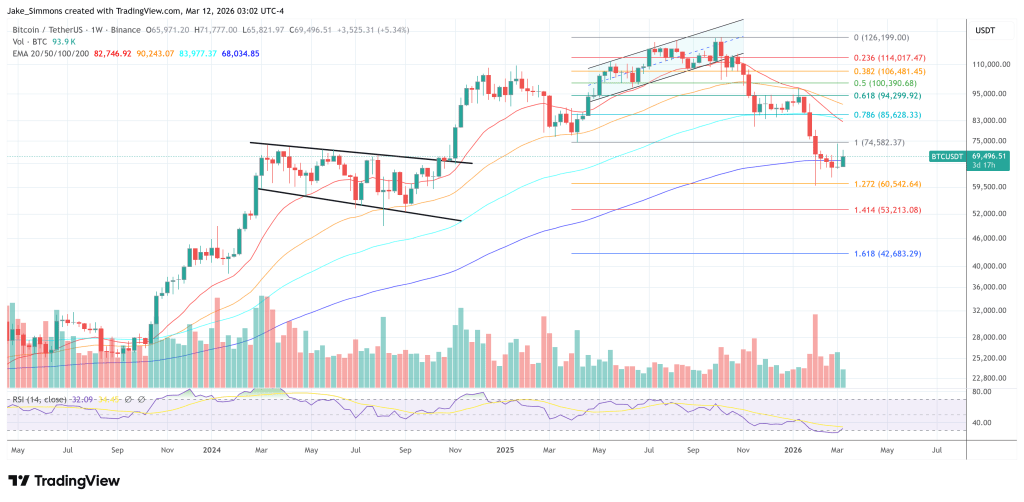
Bitcoin must break above the 1.0 Fib level, 1-week chart | Source: BTCUSDT on TradingView.com

Domande pertinenti

QWhat is the main conclusion of the ARK Invest and Unchained research paper regarding quantum computing and Bitcoin?

AThe paper concludes that while quantum computing represents a legitimate long-term concern, it does not pose an immediate threat to the Bitcoin network, as current systems are far from the capabilities required to break its cryptography.

QHow many logical qubits would be required to break Bitcoin's elliptic-curve cryptography according to the report?

AThe report states that breaking Bitcoin's cryptography would require at least 2,330 logical qubits, which is beyond the roughly hundred-qubit systems typical today.

QWhat percentage of Bitcoin's total outstanding supply is estimated to be theoretically vulnerable to quantum exposure?

AThe authors estimate that roughly 35% of the total outstanding Bitcoin supply could theoretically face quantum exposure in its current form.

QWhat does the report say about the nature of the quantum threat to Bitcoin? Is it a sudden event or a gradual progression?

AThe report describes the quantum threat as a gradual technological progression, not a sudden 'Q-day' event, which would provide markets and the Bitcoin network time to adapt.

QWhat governance challenge does the report highlight in relation to a potential quantum threat?

AThe report highlights that upgrading Bitcoin's cryptographic primitives to post-quantum cryptography would require consensus changes, meaning coordination across developers, miners, node operators, and the broader community.

Letture associate

You Bet on the News, the Pros Read the Rules: The True Cognitive Gap in Losing Money on Polymarket

The article explains that the key to profiting on Polymarket, a prediction market platform, lies not just predicting real-world events correctly, but in meticulously understanding the specific rules that govern how each market will be resolved. It illustrates this with examples, such as a market on Venezuela's 2026 leader, where the official rules defining "officially holds" the office overruled the intuitive answer of who was in practical control. Other examples include debates over the definition of a "token" or what constitutes an "agreement." The core argument is that a "reality vs. rules" gap creates pricing discrepancies that savvy traders ("车头" or "whales") exploit. The platform has a formal dispute resolution process managed by UMA token holders to settle ambiguous outcomes. This process involves proposal submission, a challenge window, a discussion period, and a final vote. However, the article highlights a critical flaw in this system compared to a traditional court: the lack of separation between the arbiters (UMA voters) and the interested parties (traders with financial stakes in the outcome). This conflict of interest undermines the discussion phase, leads to herd mentality, and results in opaque final decisions without explanatory rulings. Consequently, the system lacks a body of precedent, making it difficult for users to learn from past disputes. The ultimate takeaway is that success on Polymarket requires a lawyer-like scrutiny of the rules to identify and capitalize on the cognitive gap between how events appear and how they are contractually defined for settlement.

marsbit59 min fa

You Bet on the News, the Pros Read the Rules: The True Cognitive Gap in Losing Money on Polymarket

marsbit59 min fa

Trading

Spot
Futures

Articoli Popolari

Come comprare ONE

Benvenuto in HTX.com! Abbiamo reso l'acquisto di Harmony (ONE) semplice e conveniente. Segui la nostra guida passo passo per intraprendere il tuo viaggio nel mondo delle criptovalute.Step 1: Crea il tuo Account HTXUsa la tua email o numero di telefono per registrarti il tuo account gratuito su HTX. Vivi un'esperienza facile e sblocca tutte le funzionalità,Crea il mio accountStep 2: Vai in Acquista crypto e seleziona il tuo metodo di pagamentoCarta di credito/debito: utilizza la tua Visa o Mastercard per acquistare immediatamente HarmonyONE.Bilancio: Usa i fondi dal bilancio del tuo account HTX per fare trading senza problemi.Terze parti: abbiamo aggiunto metodi di pagamento molto utilizzati come Google Pay e Apple Pay per maggiore comodità.P2P: Fai trading direttamente con altri utenti HTX.Over-the-Counter (OTC): Offriamo servizi su misura e tassi di cambio competitivi per i trader.Step 3: Conserva Harmony (ONE)Dopo aver acquistato Harmony (ONE), conserva nel tuo account HTX. In alternativa, puoi inviare tramite trasferimento blockchain o scambiare per altre criptovalute.Step 4: Scambia Harmony (ONE)Scambia facilmente Harmony (ONE) nel mercato spot di HTX. Accedi al tuo account, seleziona la tua coppia di trading, esegui le tue operazioni e monitora in tempo reale. Offriamo un'esperienza user-friendly sia per chi ha appena iniziato che per i trader più esperti.

265 Totale visualizzazioniPubblicato il 2024.12.12Aggiornato il 2025.03.21

Come comprare ONE

Discussioni

Benvenuto nella Community HTX. Qui puoi rimanere informato sugli ultimi sviluppi della piattaforma e accedere ad approfondimenti esperti sul mercato. Le opinioni degli utenti sul prezzo di ONE ONE sono presentate come di seguito.

活动图片