Institutions Are Taking Over the Crypto Market: Is This the End of Decentralization, or the Prelude to a New Cycle?

比推Pubblicato 2025-12-11Pubblicato ultima volta 2025-12-11

Introduzione

The cryptocurrency market is undergoing a structural shift in 2025, with institutional investors now accounting for approximately 95% of capital inflows, while retail participation has declined to 5–6%. According to Aishwary Gupta of Polygon Labs, this transition is driven by maturing infrastructure rather than market sentiment. Major asset managers like BlackRock, Apollo, and Hamilton Lane are allocating portions of their portfolios to digital assets via ETFs and on-chain tokenized products, leveraging public blockchains that meet traditional finance compliance standards. Key drivers include yield generation through tokenized treasuries and institutional staking, followed by efficiency gains from faster settlements, shared liquidity, and programmable assets. While retail investors retreated due to losses from meme coin cycles, Gupta believes they will return as more regulated and transparent products emerge. He argues that institutional involvement does not undermine decentralization; instead, it enhances legitimacy and fosters a hybrid financial ecosystem where DeFi, NFTs, and traditional assets coexist on public chains. Although increased compliance may limit some experimentation, it promotes more sustainable innovation. Looking ahead, institutional liquidity is expected to reduce market volatility and accelerate the growth of real-world asset tokenization and cross-chain interoperability infrastructure. This evolution signals crypto’s transition from a speculative asset...

Author: Centreless

Original Title: Institutional Dominance in the Crypto Market: The End of Decentralization or the Beginning of a New Era?


In 2025, the cryptocurrency market has reached a structural turning point: institutional investors have become the absolute main force, while retail investors have noticeably cooled off. Aishwary Gupta, Global Head of Payments and Real-World Assets at Polygon Labs, recently stated in an interview that institutional capital now accounts for approximately 95% of the total inflows into cryptocurrency, with the retail proportion dropping to just 5%-6%, indicating a significant shift in market dominance.

He explained that the shift towards institutions is not driven by sentiment, but is a natural result of maturing infrastructure. Major asset management giants, including BlackRock, Apollo, and Hamilton Lane, are allocating 1%-2% of their investment portfolios to digital assets, accelerating their deployment through ETFs and on-chain tokenized products. Citing Polygon's collaboration cases as examples—such as JPMorgan testing DeFi transactions under the supervision of the Monetary Authority of Singapore, Ondo's tokenized treasury project, and AMINA Bank's regulated staking—Gupta demonstrated that public chains are now capable of meeting the compliance and audit requirements of traditional finance.

The two main drivers for institutional entry are yield demand and operational efficiency. The first phase primarily focuses on obtaining stable returns through methods like tokenized treasuries and bank-grade staking; the second phase is driven by the efficiency improvements brought by blockchain, such as faster settlement speeds, shared liquidity, and programmable assets, which are prompting large financial institutions to experiment with on-chain fund structures and settlement models.

In contrast, the exit of retail investors is mainly due to losses and a loss of trust caused by the previous Meme coin cycle. However, Gupta emphasized that this is not a permanent loss; as more regulated and risk-transparent products emerge, retail investors will gradually return.

Addressing concerns that institutional entry might weaken the decentralized ethos of cryptocurrency, Gupta argued that as long as the infrastructure remains open, institutional participation will not centralize the blockchain but will instead enhance its legitimacy. He pointed out that the future financial network will be a fused system where DeFi, NFTs, treasuries, ETFs, and various other assets coexist on the same public chain.

Regarding whether institutional dominance might stifle innovation, he acknowledged that some experimentation would be limited in a more compliance-focused environment. However, in the long run, this will help the industry build a more robust and scalable path for innovation, rather than relying on high-speed trial-and-error that "breaks the rules."

Looking ahead, he stated that institutional liquidity will continue to enhance market stability, with reduced speculation leading to lower volatility. The tokenization of real-world assets (RWA) and institutional-grade staking networks will develop rapidly. Interoperability will also become crucial, as institutions require infrastructure capable of seamlessly transferring assets across chains and across rollup layers.

Gupta emphasized that institutional entry is not a "takeover" of crypto by traditional finance, but a process of jointly building new financial infrastructure. Cryptocurrency is gradually evolving from a speculative asset into a core underlying technology of the global financial system.


Twitter:https://twitter.com/BitpushNewsCN

Bitpush TG Discussion Group:https://t.me/BitPushCommunity

Bitpush TG Subscription: https://t.me/bitpush

Original article link:https://www.bitpush.news/articles/7594862

Crypto di tendenza

Domande pertinenti

QWhat is the current proportion of institutional inflows in the cryptocurrency market according to Aishwary Gupta?

AInstitutional investors currently account for approximately 95% of the total inflows in the cryptocurrency market, with retail investors making up only 5-6%.

QWhat are the two main drivers for institutional entry into the crypto market as mentioned in the article?

AThe two main drivers are yield generation (through tokenized treasuries and bank-grade staking) and operational efficiency (faster settlement, shared liquidity, and programmable assets).

QHow does Gupta respond to concerns that institutional participation might undermine decentralization in crypto?

AGupta argues that as long as the infrastructure remains open, institutional participation will not centralize blockchains but instead enhance their legitimacy and contribute to a hybrid financial network.

QWhat impact does institutional dominance have on market stability and volatility according to the article?

AInstitutional liquidity is expected to increase market stability and reduce volatility, as speculative activities decrease.

QWhat key area of development does Gupta highlight as critical for institutional adoption in the future?

AInteroperability is emphasized as crucial, enabling institutions to seamlessly transfer assets across chains and rollup layers.

Letture associate

ECB's Schnabel says central bank money 'should move to blockchain'

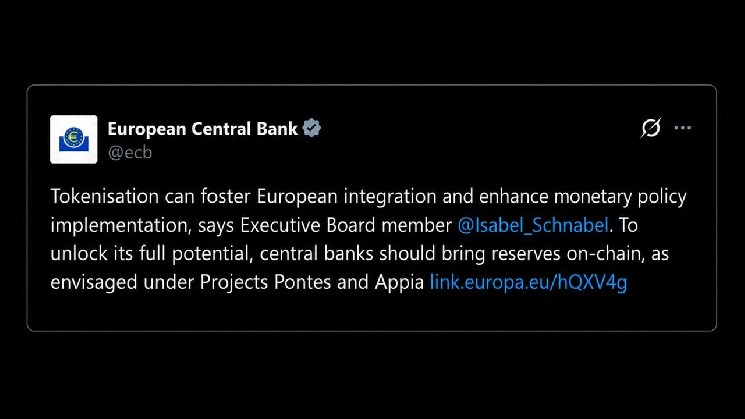
ECB Executive Board member Isabel Schnabel stated that central bank money "must move onto the blockchain." She argued that stablecoins lack the independent ability to scale liquidity during financial stress—a gap only a central bank can fill. Her proposed solution involves tokenization, which she says can make transactions faster, safer, and more programmable, but only if the safest asset (central bank money) is on the same "rails" as other tokenized assets. This marks a notable shift for the Eurosystem, which had previously viewed Distributed Ledger Technology (DLT) mainly as a tool for regulating stablecoins and crypto, not as infrastructure to adopt directly. The first step is Project Pontes, launching in September. It will initially synchronize the ECB’s existing TARGET services with private DLT platforms. Eventually, it aims to enable settlement finality on a Eurosystem-managed DLT platform with smart contract functionality and 24/7 operation. The long-term strategy is Project Appia, tasked with developing the architecture, standards, and legal framework for a genuine European tokenized asset market by 2028. Trials have already processed around €1.6 billion, and since March 2026, the ECB accepts DLT-based assets as collateral. While not directly impacting Bitcoin's price, these developments signal that a major G7 central bank is preparing to settle transactions on-chain, lending legitimacy to the underlying infrastructure of crypto markets. The ECB's move to avoid "disintermediation" by private tokenization shows that debates in central bank boardrooms are now aligning with discussions long followed in the crypto space.

cryptonews.ru1 h fa

ECB's Schnabel says central bank money 'should move to blockchain'

cryptonews.ru1 h fa

Ripple Labs Warns of a New Challenge for Blockchains

Ripple Labs is preparing the XRP Ledger for quantum threats but now emphasizes a broader challenge: ensuring financial infrastructure can adapt simultaneously to quantum computing and artificial intelligence. Senior Director of Engineering Ayo Akinyele states the goal is not merely anticipating a "Q-Day" but building infrastructure capable of preemptively adopting new security mechanisms without network disruption. The shift to post-quantum cryptography involves more than swapping algorithms; it requires flexible infrastructure, improved key management, and clear upgrade paths. Financial systems were not designed with quantum computers in mind, necessitating a rethink of transaction, identity, asset, and data protection. This is underscored by significant investments, such as the $2 billion U.S.-IBM quantum factory initiative and a 2030 U.S. government mandate for post-quantum cryptography adoption. AI introduces distinct risks by driving automation and autonomous economic activity, increasing demand for an always-on, internet-oriented payment infrastructure. AI agents could soon conduct transactions independently, creating new security requirements. Ripple Labs advocates for proactive, orderly preparation rather than a crisis-driven transition, having outlined a four-phase strategy aiming for a full XRP Ledger transition by 2028, now expanded to address both quantum and AI-driven challenges.

cryptonews.ru1 h fa

Ripple Labs Warns of a New Challenge for Blockchains

cryptonews.ru1 h fa

Trading

Spot

Articoli Popolari

Come comprare DJT

Benvenuto in HTX.com! Abbiamo reso l'acquisto di Trump Media and Technology Group Corp. (DJT) semplice e conveniente. Segui la nostra guida passo passo per intraprendere il tuo viaggio nel mondo delle criptovalute.Step 1: Crea il tuo Account HTXUsa la tua email o numero di telefono per registrarti il tuo account gratuito su HTX. Vivi un'esperienza facile e sblocca tutte le funzionalità,Crea il mio accountStep 2: Vai in Acquista crypto e seleziona il tuo metodo di pagamentoCarta di credito/debito: utilizza la tua Visa o Mastercard per acquistare immediatamente Trump Media and Technology Group Corp.DJT.Bilancio: Usa i fondi dal bilancio del tuo account HTX per fare trading senza problemi.Terze parti: abbiamo aggiunto metodi di pagamento molto utilizzati come Google Pay e Apple Pay per maggiore comodità.P2P: Fai trading direttamente con altri utenti HTX.Over-the-Counter (OTC): Offriamo servizi su misura e tassi di cambio competitivi per i trader.Step 3: Conserva Trump Media and Technology Group Corp. (DJT)Dopo aver acquistato Trump Media and Technology Group Corp. (DJT), conserva nel tuo account HTX. In alternativa, puoi inviare tramite trasferimento blockchain o scambiare per altre criptovalute.Step 4: Scambia Trump Media and Technology Group Corp. (DJT)Scambia facilmente Trump Media and Technology Group Corp. (DJT) nel mercato spot di HTX. Accedi al tuo account, seleziona la tua coppia di trading, esegui le tue operazioni e monitora in tempo reale. Offriamo un'esperienza user-friendly sia per chi ha appena iniziato che per i trader più esperti.

173 Totale visualizzazioniPubblicato il 2026.08.26Aggiornato il 2026.08.26

Come comprare DJT

Cosa è MRK

Un'azienda farmaceutica leader a livello globale focalizzata sulla ricerca e sviluppo di farmaci innovativi con prescrizione, vaccini e biologici. I suoi prodotti principali includono la terapia immuno-oncologica Keytruda e il vaccino HPV Gardasil, tra gli altri, espandendosi anche nel settore della salute animale. L'azienda opera con il marchio "Merck" negli Stati Uniti e in Canada, e come "MSD" (Merck Sharp and Dohme) in altre regioni del mondo.

282 Totale visualizzazioniPubblicato il 2026.08.26Aggiornato il 2026.08.26

Cosa è MRK

Come comprare MRK

Benvenuto in HTX.com! Abbiamo reso l'acquisto di Merck Co., Inc. (MRK) semplice e conveniente. Segui la nostra guida passo passo per intraprendere il tuo viaggio nel mondo delle criptovalute.Step 1: Crea il tuo Account HTXUsa la tua email o numero di telefono per registrarti il tuo account gratuito su HTX. Vivi un'esperienza facile e sblocca tutte le funzionalità,Crea il mio accountStep 2: Vai in Acquista crypto e seleziona il tuo metodo di pagamentoCarta di credito/debito: utilizza la tua Visa o Mastercard per acquistare immediatamente Merck Co., Inc.MRK.Bilancio: Usa i fondi dal bilancio del tuo account HTX per fare trading senza problemi.Terze parti: abbiamo aggiunto metodi di pagamento molto utilizzati come Google Pay e Apple Pay per maggiore comodità.P2P: Fai trading direttamente con altri utenti HTX.Over-the-Counter (OTC): Offriamo servizi su misura e tassi di cambio competitivi per i trader.Step 3: Conserva Merck Co., Inc. (MRK)Dopo aver acquistato Merck Co., Inc. (MRK), conserva nel tuo account HTX. In alternativa, puoi inviare tramite trasferimento blockchain o scambiare per altre criptovalute.Step 4: Scambia Merck Co., Inc. (MRK)Scambia facilmente Merck Co., Inc. (MRK) nel mercato spot di HTX. Accedi al tuo account, seleziona la tua coppia di trading, esegui le tue operazioni e monitora in tempo reale. Offriamo un'esperienza user-friendly sia per chi ha appena iniziato che per i trader più esperti.

171 Totale visualizzazioniPubblicato il 2026.08.26Aggiornato il 2026.08.26

Come comprare MRK

Discussioni

Benvenuto nella Community HTX. Qui puoi rimanere informato sugli ultimi sviluppi della piattaforma e accedere ad approfondimenti esperti sul mercato. Le opinioni degli utenti sul prezzo di A A sono presentate come di seguito.

活动图片