Institutional Adoption of Prediction Markets Stuck at the Third Stage

Odaily星球日报Pubblicato 2026-04-17Pubblicato ultima volta 2026-04-17

Introduzione

Prediction markets are transitioning from niche platforms focused on elections and sports to mainstream tools for information and risk management. While events like the Super Bowl still dominate trading volume, non-sports categories—such as macroeconomics, politics, and entertainment—are growing faster and attracting institutional interest. Key drivers include the need for real-time benchmarks on uncertain events (e.g., election outcomes or policy changes), which traditional markets lack. Institutions like Goldman Sachs and CNBC are already using prediction market data for decision-making, though most remain in the early stages of adoption. The path to full institutional integration involves three phases: data integration, system compliance, and active trading. The current barrier to large-scale trading is the lack of margin trading, requiring full collateral for positions—a limitation platforms like Kalshi are working to address. Experts compare prediction markets to the early days of options trading, anticipating they will become a standard, if mundane, financial infrastructure. Political leaders and institutions are increasingly referencing these markets, signaling their growing credibility. The future lies in their evolution from speculative arenas to essential tools for hedging and pricing uncertainty.

Original Title:Prediction Markets: They Grow Up So Fast, Author: Alex Immerman(@aleximm)

Compiled by | Odaily Planet Daily(@OdailyChina); Translator | Asher(@Asher_ 0210)
Editor's Note: At the end of March this year, prediction markets, once considered a niche area, reached a critical moment. Kalshi Research, the research arm of Kalshi, hosted its inaugural research conference in New York, bringing together academics, Wall Street executives, former politicians, and frontline traders. The composition of attendees sent a clear signal—prediction markets are moving from the fringe to the mainstream.

The conference opened with a dialogue between Kalshi co-founders Tarek Mansour and Luana Lopes Lara, moderated by Bloomberg reporter Katherine Doherty. This article excerpts and summarizes key insights from the conference.

Prediction Markets Are More Than Just Elections and Sports

For a long time, prediction markets have been defined by certain "highlight moments"—U.S. elections, the Super Bowl, March Madness. These events dominate news cycles and naturally consume most of the trading volume, leading outsiders to mistakenly believe that the value of prediction markets ends there.
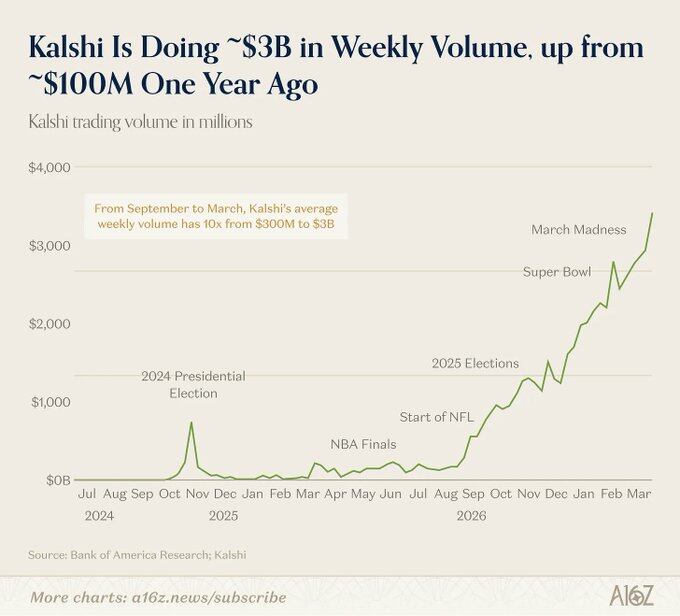
But this impression is being shattered. Just as the conference was held, weekly trading volume for sports predictions had nearly reached $3 billion, accounting for about 80% of Kalshi's total trading volume. While this seems dominant, it hides a more critical trend: sports' share is actually at a historical low.

In other words, all other categories are growing faster. Entertainment, crypto, politics, culture, and other areas are driving stronger user growth and more stable retention. Sports act more like an entry product—intuitive, emotionally driven, and rhythmically clear, suitable for attracting mass participation. Meanwhile, long-tail markets, which make up over 20% of total trading volume, are growing rapidly. These markets will play an important role in institutional hedging and information pricing in the future.
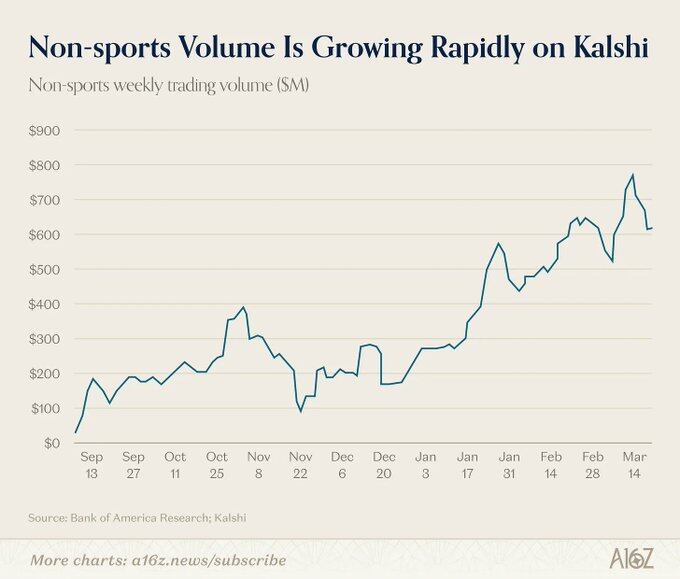
This point is also confirmed on the institutional side. Cyril Goddeeris, Global Co-Head of Equity Business at Goldman Sachs, stated that predictions related to macro events and CPI are the categories Wall Street is most focused on currently; Sally Shin, Head of Growth Platforms at CNBC, mentioned that she already uses predictions related to the Fed Chair and non-farm payroll data as narrative tools; Troy Dixon, Global Co-Head of Markets at Tradeweb, envisioned a future where large investment banks will establish dedicated prediction market trading desks, with financial contracts as core products.

Prediction markets are shifting from "recreational trading" to "information and risk tools."

Why Kalshi Has Attracted Wall Street's Attention

Traditional financial markets operate efficiently largely because various assets have recognized benchmarks—the S&P 500 represents the average performance of 500 stocks, and crude oil has the ICE benchmark price. But for political and economic events (such as who will win an election, whether a certain tariff will pass, or the outcome of a Supreme Court case), there was almost no widely recognized and dynamically updated "benchmark" before.

Prediction markets change this. Now, almost any future event can have a real-time, liquid price benchmark. When the market can provide credible pricing for "the probability of a 30% tariff passing," institutions can trade around this price or hedge other risks in their portfolios. This makes the event itself a directly tradable object.

As Tradeweb's Troy Dixon said: "If you go back to when Trump was first elected, many people were hedging in the stock market, such as shorting the S&P, because they thought his election would cause the market to fall. But this was the wrong trade. The question is, how should these events be priced? Where is the benchmark?"

Tarek also mentioned that one motivation for founding Kalshi came from his previous work at Goldman Sachs, where he provided trading advice around the 2024 election and Brexit. Without prediction markets, when institutions hedge political or macro events through related assets, they actually need to make two layers of judgment—they must judge both the outcome of the event itself and the relationship between the event and the traded asset, with the latter carrying a separate risk of failure.

When the event itself has a direct price benchmark, the originally dispersed dual risks are merged into a single judgment. As Tarek said, the market has already begun pricing various events.

The Three Stages Towards Institutional Adoption

It is still too early to say that Wall Street institutions are participating in Kalshi trading on a large scale. Currently, most institutions' usage is still primarily for reference data rather than actual trading.

However, Luana pointed out that the path to institutional adoption is already clear and can be divided into three stages:

  • The first stage is data access: Integrating prediction market prices into institutions' daily workflows, such as having Goldman Sachs investment managers view Kalshi odds like they view the VIX index. This stage has already been achieved to some extent. Professor Jonathan Wright from Johns Hopkins University, a former Fed official, stated that for Fed decisions, unemployment rates, and GDP, Kalshi is almost the only reference source;
  • The second stage is system integration: Including compliance approval, legal confirmation, technical access, and internal education, i.e., incorporating prediction markets into the usable financial tool system;
  • The third stage is actual trading: Institutions begin hedging risks on the platform, trading volume and liquidity gradually accumulate, forming a positive feedback loop. More hedgers attract more speculators, tighter spreads attract more hedgers, and benchmark prices continuously strengthen.

Currently, most institutions are still in the first stage, some have entered the second stage, and only a few have reached the third stage.

A major obstacle preventing institutions from entering the third stage is that current prediction market trading requires full margin—a $100 position requires depositing $100. This is acceptable for retail investors but is a significant limitation for hedge funds or banks that rely on leverage and capital efficiency. As Tarek said, if you want to hedge $100, you must put in $100, which is too costly for institutions; firms like Citadel or Millennium would not adopt this method. Kalshi has already received permission from the National Futures Association and is working with the Commodity Futures Trading Commission to introduce margin trading mechanisms.

What Happens Next?

Michael McDonough, Head of Market Innovation at Bloomberg, gave the most direct judgment: the sign of success is when these things become boring. He compared prediction markets to the options market in the 1970s, which also faced controversies over manipulation and regulatory uncertainty, but these issues were eventually digested and evolved into an almost taken-for-granted infrastructure.

Toby Moskowitz, Partner at AQR, stated that he is willing to bet on the development of prediction markets. Within five years, or even sooner, it will become a viable tool at the institutional level.

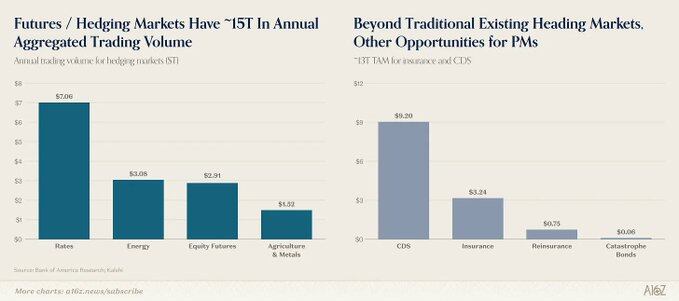
Garrett Herren from Vote Hub described the final form: the question is no longer whether to use prediction markets, but how to use them. Once the discussion shifts to this level, it means they have become indispensable. In fact, although prediction markets are still relatively small, the hedging market itself is extremely large.
The normalization of prediction markets is already happening.

In discussions on political issues, former Congressman Mondaire Jones mentioned that senior figures from both parties, including Trump, House Minority Leader Jeffries, and Senate Minority Leader Schumer, have begun publicly citing Kalshi odds. Scott Tranter from DDHQ also confirmed that prediction market data has now become an important input for intra-party decision-making. Meanwhile, Vote Hub announced that it has directly integrated Kalshi data into its midterm election prediction models.

All of this was almost non-existent two years ago. Back then, the most successful traders on Kalshi were still seen as amateurs. But now, the situation has changed, and it's even hard to define them with that term anymore.

In a roundtable, four traders shared their paths—one spent eleven years studying the Billboard charts, another has been participating in prediction markets since 2006, when it was still a cashless, somewhat geeky interest area. They did not come from the finance industry but from backgrounds in music, politics, and poker. But they unanimously agreed that the platform truly rewards deep domain knowledge, not resumes.

Summary

Prediction markets have come a long way. They were once seen as academic experiments, later became brief highlights during election cycles, and were also viewed as an extension of sports betting.

The message from this conference is clear: prediction markets are gradually evolving into an infrastructure for pricing uncertainty, serving a wide range of participants from retail investors to large institutions and diverse application scenarios.


Domande pertinenti

QWhat are the three stages of institutional adoption of prediction markets as described in the article?

AThe three stages are: 1) Data Access - integrating prediction market prices into daily workflows; 2) System Integration - compliance approval, legal confirmation, technical access, and internal education; 3) Actual Trading - institutions begin hedging risks on the platform, with trading volume and liquidity gradually accumulating.

QWhat is identified as a major barrier preventing institutions from entering the third stage of adoption on Kalshi?

AThe requirement for full margin trading is the major barrier. A $100 position requires depositing $100, which is cost-prohibitive and inefficient for leverage-dependent institutions like hedge funds or banks.

QAccording to the article, what significant shift is occurring in the perception of prediction markets' primary value?

APrediction markets are shifting from being seen as 'entertainment trading' towards becoming 'information and risk tools,' serving as real-time, liquid price benchmarks for future events.

QWhich event category currently dominates trading volume on Kalshi, and what underlying trend does this mask?

ASports currently dominates with about 80% of weekly trading volume. However, this masks the key trend that sports is at a historical low percentage, meaning all other categories (entertainment, crypto, politics, culture) are growing much faster.

QHow do high-level political figures in the U.S. demonstrate the normalization of prediction markets, according to the article?

AHigh-level figures from both parties, including Trump, House Minority Leader Jeffries, and Senate Minority Leader Schumer, have begun publicly citing Kalshi's odds, integrating this data into political discourse and decision-making.

Letture associate

The AI Agent Era Accelerates Its Arrival: Questflow Defines a New Paradigm of Financial Intelligence with On-Chain AI Brokerage

The AI Agent era is accelerating, with the CB Insights AI 100 list highlighting global investment confidence. The focus has shifted from whether AI works to its speed of deployment and ability to manage complex workflows, with autonomous AI Agents driving this transformation. At the forefront is Questflow, a Singapore-based startup redefining financial intelligence through its on-chain AI brokerage. Unlike tools that merely provide data dashboards, Questflow deploys AI Agents that proactively scan markets, form judgments, and execute trades via a conversational interface—operating 24/7 without requiring manual confirmation for each decision. This embodies the new AI paradigm of agents capable of executing multi-step workflows autonomously. Questflow's mission is to democratize institutional-grade trading intelligence. Historically reserved for the ultra-wealthy, this capability is now accessible starting from just $1 through Questflow's "AI Clone + Copy Trade" model. The platform charges only a 1% execution fee, aligning its incentives directly with users and eliminating traditional management or performance fees. The timing is opportune, aligning with key trends identified by CB Insights: the scalable deployment of AI Agents, accelerated AI adoption in financial services, and the maturation of on-chain infrastructure. With robust liquidity on platforms like Hyperliquid and Polymarket, alongside advancements in AI reasoning and non-custodial wallet security, Questflow is positioned to merge the roles of broker, fund, and exchange into a single, accessible platform for millions.

链捕手7 min fa

The AI Agent Era Accelerates Its Arrival: Questflow Defines a New Paradigm of Financial Intelligence with On-Chain AI Brokerage

链捕手7 min fa

Why Pricing Social Interactions is Doomed to Fail?

Titled "Why Putting a Price on Social Interaction Is Doomed to Fail," this article critiques attempts to monetize social networks directly through SocialFi models, arguing their inevitable failure stems from a fundamental misunderstanding of media dynamics. Using Marshall McLuhan's theory of "hot" and "cold" media, the author posits that social networks are inherently "cold" media. Their value isn't contained in individual posts but is co-created through user participation, interpretation, and fragmented, ongoing interaction (e.g., replies, shares). This ambiguity and need for user involvement are core to their function. The article asserts that SocialFi projects like Friend.tech failed because introducing real-time, tradable financial pricing (a definitive "hot" signal) into this "cold" environment doesn't add a layer—it replaces the medium's essence. The unambiguous price signal overshadows and nullifies the nuanced, participatory social signal. Users become traders, not participants, and when speculative profits vanish, the underlying social ecosystem—never genuinely cultivated—collapses entirely. This principle extends beyond crypto. The author argues platforms like Twitter have gradually "heated up" through metrics (likes, retweets counts, algorithmically defined value), shifting users from participants to performers and eroding organic engagement. The solution isn't to abandon capital but to manage its entry point. Successful models like Substack, Patreon, or Bandcamp allow capital to "condense" at specific, isolated nodes (e.g., subscriptions, one-time payments) without permeating and "heating" every social interaction. They preserve the core "cold," participatory medium while enabling monetization at designated boundaries. The NFT boom and bust serves as a stark parallel: the ancient "cold" medium of collecting (valued for story, community, gradual accumulation) was rapidly destroyed by platforms that introduced real-time floor prices, rarity scores, and trading dashboards, transforming collectors into speculators and vaporizing cultural value when prices fell. The core lesson: "Liquidity equals heat." Injecting high liquidity and definitive pricing into a "cold" participatory medium doesn't optimize it; it fundamentally alters and destroys its value-creating mechanism. The future lies not in pricing every social gesture but in finding precise, non-invasive points for capital to condense without overheating the entire ecosystem.

marsbit15 min fa

Why Pricing Social Interactions is Doomed to Fail?

marsbit15 min fa

Jensen Huang's CMU Speech: In the AI Era, Don't Just Watch, Build

Jensen Huang, CEO of NVIDIA and a first-generation immigrant, delivered the commencement address to Carnegie Mellon University's class of 2026. He shared his personal journey from a humble background to founding NVIDIA, emphasizing resilience, learning from failure, and the responsibility that comes with leadership. Huang framed the present moment as the dawn of the AI revolution, a shift he believes is more profound than previous computing waves. He described AI as fundamentally resetting computing—moving from human-written software to machines that understand, reason, and use tools. This will create a new industry for generating intelligence and transform every sector. While acknowledging AI's potential to automate tasks and displace some jobs, Huang distinguished between the *tasks* of a job and its core *purpose*. He argued AI will augment human capability, not replace humans. The real risk, he stated, is not AI itself, but people being left behind by those who effectively use AI. He presented AI as a generational opportunity for massive infrastructure investment—in chip factories, data centers, energy grids, and advanced manufacturing—that could re-industrialize nations like the U.S. and bridge the digital divide by making computing and intelligent tools accessible to all. Huang called for a balanced approach: advancing AI safely and responsibly, establishing prudent policies, ensuring broad access, and encouraging universal participation. He urged the graduates not to fear the future but to engage with optimism and ambition, reminding them of CMU's motto, "My heart is in the work." His core message was clear: this is their moment to actively build and shape the AI-powered future, not merely observe it.

marsbit1 h fa

Jensen Huang's CMU Speech: In the AI Era, Don't Just Watch, Build

marsbit1 h fa

Trading

Spot
Futures
活动图片




