Insider Trading Might Be the Most Valuable Part of Prediction Markets

marsbitPubblicato 2026-01-07Pubblicato ultima volta 2026-01-07

Introduzione

The article "Insider Trading Might Be the Most Valuable Part of Prediction Markets" examines a controversial case on Polymarket where an account achieved a 1242% return by accurately predicting the arrest of Venezuelan leader Maduro before mainstream media coverage. This event sparked debates about insider trading in decentralized prediction markets and led U.S. Representative Ritchie Torres to propose the "2026 Financial Prediction Markets Public Integrity Act," aiming to regulate such activities. The piece argues that while traditional finance bans insider trading to protect retail investors, prediction markets fundamentally serve as "truth discovery" mechanisms. Their core value lies in aggregating fragmented information into accurate price signals, even if it involves informed participants. Preventing insiders from trading could render markets less accurate, as prices would reflect public speculation rather than genuine probabilities. The article concludes that prediction markets should be viewed as tools for uncovering truth through decentralized information aggregation, not as fair trading venues. Blockchain transparency allows hidden information to become public signals through market activity, enabling rapid price correction and collective intelligence. Regulatory attempts to enforce fairness might undermine the predictive efficiency that makes these markets valuable.

Author: Chloe, ChainCatcher

Recently, Venezuelan leader Maduro was arrested. Before mainstream media released the news, a Polymarket account created in late December had already exited the market with a 1242% return. This incident prompted U.S. Representative Ritchie Torres to propose the "Public Integrity in Financial Prediction Markets Act of 2026," attempting to introduce traditional financial "insider trading" regulations into the crypto market.

This article will use the Maduro incident as a core case study to delve into the controversial issue of insider trading in prediction markets, re-examining whether we need an absolutely level playing field or a precise truth engine in decentralized prediction platforms.

Polymarket's "Prophet" Moment: Accurately Predicting Maduro's Downfall

In January 2026, Venezuelan leader Maduro was confirmed to have been arrested. While global mainstream media was still verifying sources, the data on the decentralized prediction market Polymarket had already provided the answer.

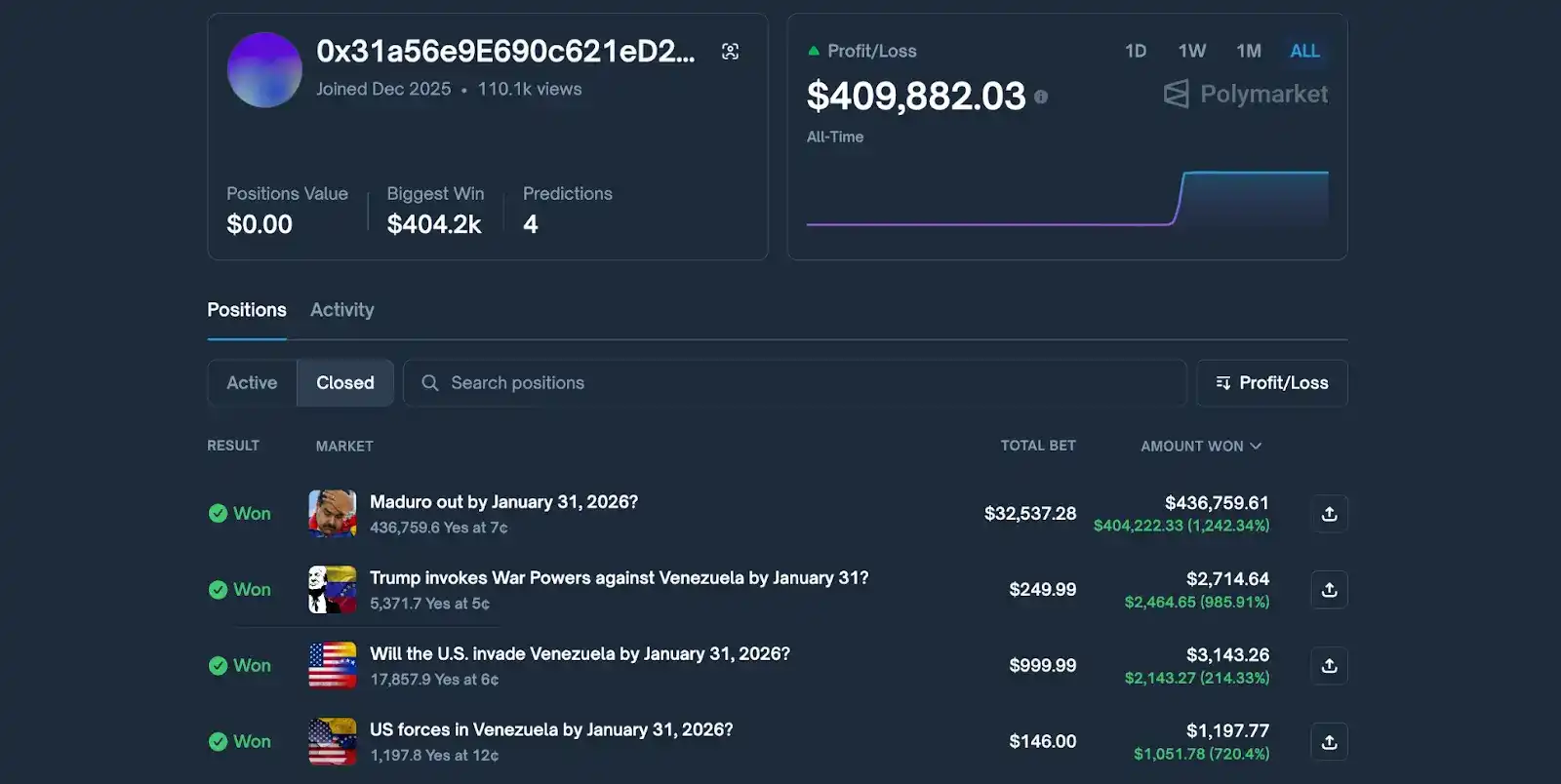
A new account created on Polymarket in late December 2025 seemed to have a god's-eye view, accurately predicting the event. The account made four predictions, all related to whether the U.S. would intervene in Venezuela, with the largest being a bet of $32,537 that "Maduro will step down by January 31." At the time, the market's expected probability for such an extreme event was in the single digits, and the account swept up contracts at the extremely low price of 7 cents.

As news of Trump confirming military action emerged early Saturday morning, these contracts instantly surged to near the $1 settlement price. The account profited over $400,000 in less than 24 hours, with a return rate of 1242%. This was not ordinary speculation but a precise snipe.
Mysterious Prophet or Insider Trading?

This god's-eye view of massive profits quickly became a focal point in the community. As discussions heated up, accusations of insider trading followed:

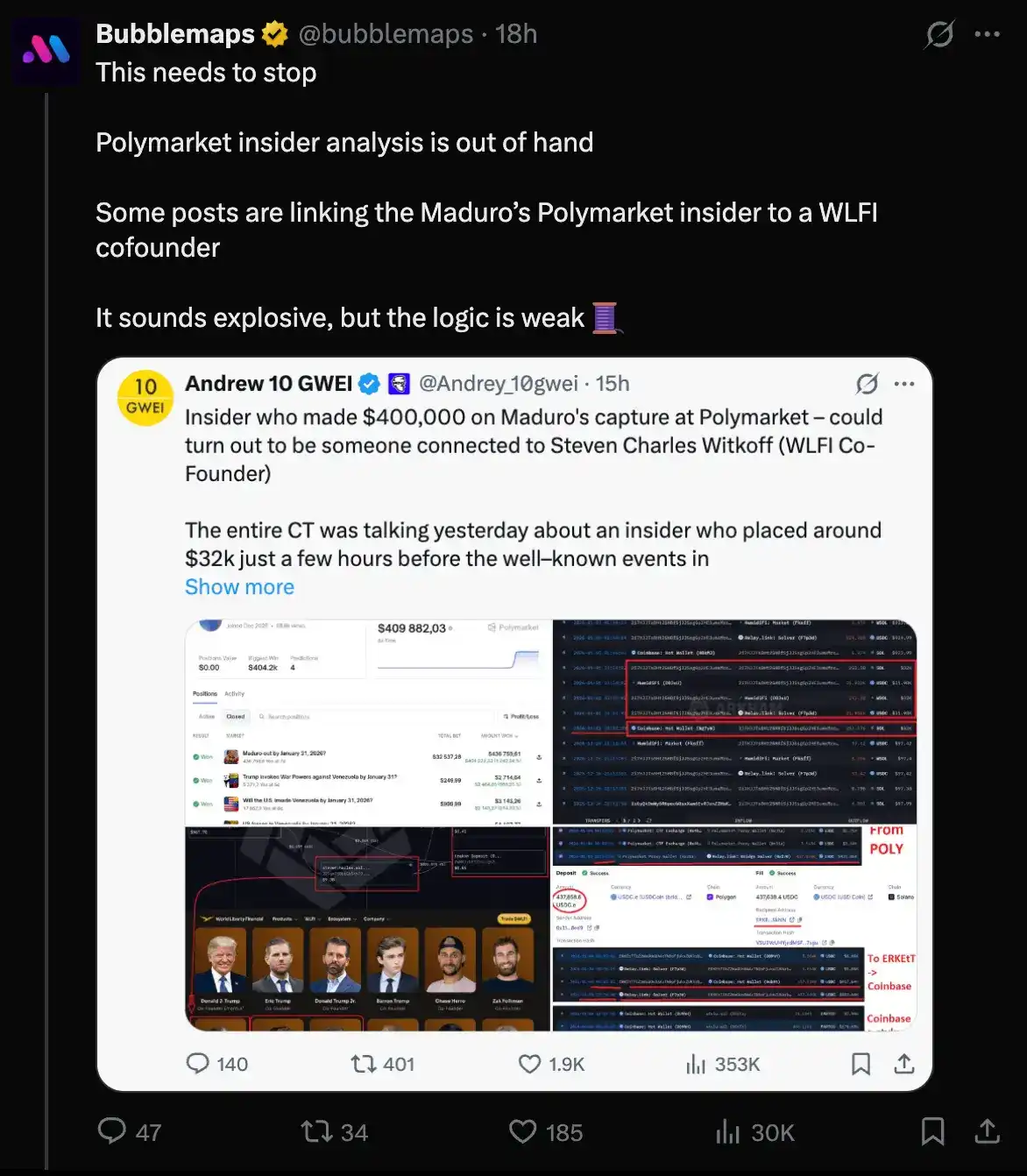
On-chain analyst Andrew 10 GWEI pointed out that the account's funding path showed high similarity: 252.39 SOL withdrawn from Coinbase on January 1 closely matched 252.91 SOL deposited by another wallet the previous day (23 hours apart),疑似通过交易所进行中转断链. More controversially, the associated wallet registered domains like StCharles.sol and had significant interactions with an address疑似 belonging to Steven Charles Witkoff, co-founder of World Liberty Finance (WLFI). Given WLFI's close ties to the Trump family, this raised strong suspicions: Was this insider trading using information from inside the White House?

On-chain analysis platform BubbleMaps later offered a different perspective. They argued that the "time and amount similarity" inference was too superficial, noting that there were at least 20 wallets on-chain that fit this pattern. They also pointed out that Andrew's argument lacked direct on-chain evidence of fund movement, so there was no reliable evidence linking the Polymarket account to the WLFI co-founder.
Congressman Proposes Integrity Act: Aiming to Regulate Insider Trading in Prediction Markets

This incident also led U.S. Representative Ritchie Torres to propose the "Public Integrity in Financial Prediction Markets Act of 2026." The core of the bill is to prohibit federally elected officials, politically appointed officials, and executive branch employees from trading in government policy-related prediction markets using "material non-public information" obtained through their official positions.

However, this bill faces a dual challenge in reality. First, the lengthy and uncertain legislative process; in the complex power dynamics of U.S. politics, such bills often undergo lengthy hearings and interest negotiations, ultimately easily becoming texts with more political posturing than substantive impact.

Second, there is an enforcement blind spot in the decentralized environment, where fund flows on-chain can easily be obscured through various privacy protocols or complex transfer mechanisms. Although the bill symbolizes the formal entry of traditional financial values into prediction markets, attempting to protect retail investors from information harvesting and maintain fair participation rights, we must consider: Will this regulatory logic, directly applied to decentralized prediction markets, conflict with core values and even cause prediction markets to fail?

The Core Value of Prediction Markets and the Paradox of Insider Trading

Returning to first principles, what is the purpose of prediction markets? Is it to give everyone a fair chance to profit, or to obtain the most accurate prediction results?

Traditional finance prohibits insider trading to protect retail investors' confidence and prevent capital markets from becoming a cash machine for the powerful. But in prediction markets, the core value may be "truth discovery."

Prediction markets are machines that aggregate fragmented information into price signals. If a market about "whether Maduro will step down" prohibits informed participants, then the market's price reflection will always be "outsiders' guesses" rather than "real probability," which would render prediction markets inaccurate.

In the Maduro incident,假设 the profiteer was not an insider but a top information analysis expert. He might have tracked abnormal radio signals at the Venezuelan border, private jet takeoffs and landings, or even the U.S. Department of Defense's public procurement lists, piecing together through model inference that military action would occur. This behavior might be highly controversial in the eyes of traditional regulation, but in the logic of prediction markets, it is an extremely valuable "information pricing behavior."

One mission of prediction markets is to break information monopolies. While各方 are interpreting ambiguous, delayed government diplomatic rhetoric, price fluctuations on prediction markets are already sending early warnings of the truth to the world. Therefore, rather than calling this insider trading, it is more accurate to say it is a博弈 that rewards hidden information surfacing through trading, thereby providing real-time risk guidance to the public.

Prediction Markets Are Tools Born from the Pursuit of Truth, Not Fair Trading Venues

The emergence of the "Public Integrity in Financial Prediction Markets Act of 2026" may reflect regulators' cognitive bias towards decentralized prediction platforms. If we pursue a "completely fair" prediction market, we will ultimately get a "completely ineffective" prediction market.

The Maduro incident profoundly reveals the true value of prediction markets: they allow hidden truths to be transformed into on-chain signals visible to all through the traces of fund flow. Blockchain transparency breaks the black box; even if we cannot immediately identify the幕后推手, when mysterious accounts heavily build positions and probabilities fluctuate剧烈, the market is actually sending a signal. This can attract smart money to quickly follow, rapidly leveling the originally unequal information gap, thereby transforming "insider information" into "public probability."

Prediction markets are not stock markets; they are essentially radars of collective human intelligence. To keep this radar accurate, it is necessary to allow the friction cost brought by information arbitrage to a certain extent. Therefore, rather than trying to block signals with bans, should we not position prediction markets as tools born from the pursuit of truth, rather than fair trading venues?


Domande pertinenti

QWhat was the core event that sparked the debate around insider trading in prediction markets, as described in the article?

AThe core event was a Polymarket user who, in late December 2025, made a highly profitable bet predicting the arrest of Venezuelan leader Maduro before it was publicly reported, earning a 1242% return.

QWhat was the name of the bill proposed by U.S. Representative Ritchie Torres in response to the incident, and what was its primary goal?

AThe bill was called the 'Financial Prediction Market Public Integrity Act of 2026'. Its primary goal was to prohibit federal officials and employees from using 'material non-public information' obtained through their positions to trade in prediction markets related to government policy.

QAccording to the article, what is the fundamental paradox or conflict regarding insider trading in prediction markets?

AThe paradox is the conflict between the goal of a 'fair' market that protects all participants and the goal of an 'accurate' market that serves as a 'truth discovery' engine. Banning insiders could make the market fairer but less accurate, while allowing their information to be incorporated through trading makes the market more accurate but less fair.

QHow does the article argue that the transparency of blockchain technology changes the nature of so-called 'insider trading' in prediction markets?

AThe article argues that blockchain transparency turns hidden information into a public signal. Even if the identity of a trader is unknown, their large bets and the resulting market probability shifts act as an early warning system, allowing 'smart money' to follow and quickly incorporate the 'inside' information into a public price, thus flattening the information asymmetry.

QWhat is the article's concluding stance on the primary purpose of a prediction market?

AThe article concludes that the primary purpose of a prediction market is to be a tool for pursuing truth and accurate collective forecasting ('a radar for collective human wisdom'), rather than a perfectly fair trading venue. It argues that some level of information arbitrage is a necessary cost for maintaining the market's accuracy.

Letture associate

Morning Post | Trump Media Group Releases Q1 Financial Report; Top Three DeFi Applications Return Nearly $100 Million in Revenue to Token Holders in 30 Days; Michael Saylor Shares Bitcoin Tracker Info Again

**Title: Daily Briefing | Trump Media Group Releases Q1 Report; Top 3 DeFi Apps Return Nearly $100M to Token Holders; Michael Saylor Signals Potential Bitcoin Buy** **Summary:** Key developments in the past 24 hours include: * **Economic Outlook:** Goldman Sachs has pushed back its forecast for the next two Federal Reserve interest rate cuts to December 2026 and March 2027, citing persistent inflationary pressures from energy costs. This delayed timeline is expected to tighten liquidity flow into risk assets, including cryptocurrencies. * **DeFi & Revenue:** Data from DefiLlama shows that three leading DeFi applications—Hyperliquid, Pump.fun, and EdgeX—collectively distributed $96.3 million in revenue to their token holders over the last 30 days. This trend highlights a shift in the crypto community's focus towards real protocol earnings and sustainable economic models. * **Corporate Bitcoin Moves:** Michael Saylor, founder of MicroStrategy (note: referred to as 'Strategy' in the text, likely a typographical error), has signaled potential upcoming Bitcoin purchases by posting a "Bitcoin Tracker" update, following a pattern that typically precedes the company's official disclosure of new acquisitions. * **Market Integrity:** Prediction market platform Polymarket announced updates to address platform issues, including identifying and banning clusters of accounts involved in "ghost-fill" activities and implementing measures to prevent bulk account creation. * **Regulation:** The Bank of England Governor warned that stablecoin regulation could lead to tensions between US and international regulators. In South Korea, the National Tax Service has launched a pilot program to entrust seized virtual assets to private custody firms for management. * **Meme Token Trends:** GMGN data lists the top trending meme tokens on Ethereum (e.g., HEX, SHIB), Solana (e.g., FWOG, TROLL), and Base (e.g., SKITTEN, PEPE) over the past day. **Financial Note:** Trump Media & Technology Group reported a Q1 loss of approximately $4 billion, primarily attributed to unrealized losses on its Bitcoin and other digital asset holdings.

链捕手29 min fa

Morning Post | Trump Media Group Releases Q1 Financial Report; Top Three DeFi Applications Return Nearly $100 Million in Revenue to Token Holders in 30 Days; Michael Saylor Shares Bitcoin Tracker Info Again

链捕手29 min fa

Telegram Takes Direct Control of TON, Social Traffic Rewrites the Public Chain Narrative

Telegram founder Pavel Durov announced that Telegram will replace the TON Foundation as the core driver and largest validator of The Open Network (TON). Key initiatives include a sixfold reduction in transaction fees, performance upgrades, and improved developer tools within the next few weeks. This marks a strategic shift from Telegram merely providing user access to deeply integrating TON into its platform's core infrastructure. The goal is to transform Telegram's massive social traffic into sustainable on-chain activity. While viral mini-apps like Notcoin have demonstrated Telegram's ability to drive user adoption, TON aims to support frequent, low-value transactions inherent to social platforms—such as tipping, in-app payments, and game rewards. Ultra-low fees and sub-second finality (0.6 seconds) are crucial to making blockchain interactions seamless and nearly invisible within the Telegram user experience. However, Telegram's increased central role raises questions about network decentralization. Durov argues that Telegram's participation will attract more large validators, thereby enhancing decentralization. TON also offers high annual staking rewards (18.8%), aiming to retain capital within its ecosystem. The fundamental challenge for TON is no longer leveraging Telegram's user base, but becoming an indispensable, seamless infrastructure layer for Telegram's everyday applications—moving from an adjacent chain to an embedded utility.

marsbit31 min fa

Telegram Takes Direct Control of TON, Social Traffic Rewrites the Public Chain Narrative

marsbit31 min fa

Telegram Takes Direct Control of TON, Social Traffic Reshapes Public Chain Narrative

Telegram's founder, Pavel Durov, has announced a major shift in the development of The Open Network (TON). Telegram will now become the core driver of TON, replacing the TON Foundation and becoming its largest validator. The focus will be on technical upgrades over the next few weeks, including slashing network fees by six times to near-zero and improving finality time to 0.6 seconds. This move signifies a deeper integration between Telegram and TON, moving beyond just providing a user base. The goal is to transform Telegram's vast social traffic and built-in features—like Mini Apps, payments, and bots—into sustainable, on-chain usage scenarios. The reduced fees and faster speeds are crucial for enabling the small, frequent transactions typical of social interactions. While this promises stronger execution and product alignment, it raises questions about centralization. Durov argues Telegram's involvement will attract more validators, enhancing decentralization, but the outcome remains to be seen. Additionally, TON's high annual staking reward of 18.8% aims to retain capital within the ecosystem. The key challenge for TON is no longer just leveraging Telegram's entry point, but becoming an invisible, seamless infrastructure layer within Telegram's daily use. Its success hinges on converting viral attention into lasting, embedded utility.

Odaily星球日报40 min fa

Telegram Takes Direct Control of TON, Social Traffic Reshapes Public Chain Narrative

Odaily星球日报40 min fa

OpenAI Post-Training Engineer Weng Jiayi Proposes a New Paradigm Hypothesis for Agentic AI

OpenAI engineer Weng Jiayi's "Heuristic Learning" experiments propose a new paradigm for Agentic AI, suggesting that intelligent agents can improve not just by training neural networks, but also by autonomously writing and refining code based on environmental feedback. In the experiment, a coding agent (powered by Codex) was tasked with developing and maintaining a programmatic strategy for the Atari game Breakout. Starting from a basic prompt, the agent iteratively wrote code, ran the game, analyzed logs and video replays to identify failures, and then modified the code. Through this engineering loop of "code-run-debug-update," it evolved a pure Python heuristic strategy that achieved a perfect score of 864 in Breakout and performed competitively with deep reinforcement learning (RL) algorithms in MuJoCo control tasks like Ant and HalfCheetah. This approach, termed Heuristic Learning (HL), contrasts with Deep RL. In HL, experience is captured in readable, modifiable code, tests, logs, and configurations—a software system—rather than being encoded solely into opaque neural network weights. This offers potential advantages in explainability, auditability for safety-critical applications, easier integration of regression tests to combat catastrophic forgetting, and more efficient sample use in early learning stages, as demonstrated in broader tests on 57 Atari games. However, the blog acknowledges clear limitations. Programmatic strategies struggle with tasks requiring long-horizon planning or complex perception (e.g., Montezuma's Revenge), areas where neural networks excel. The future vision is a hybrid architecture: specialized neural networks for fast perception (System 1), HL systems for rules, safety, and local recovery (also System 1), and LLM agents providing high-level feedback and learning from the HL system's data (System 2). The core proposition is that in the era of capable coding agents, a significant portion of an AI's learned experience could be maintained as an auditable, evolving software system.

marsbit1 h fa

OpenAI Post-Training Engineer Weng Jiayi Proposes a New Paradigm Hypothesis for Agentic AI

marsbit1 h fa

Your Claude Will Dream Tonight, Don't Disturb It

This article explores the recent phenomenon of AI companies increasingly using anthropomorphic language—like "thinking," "memory," "hallucination," and now "dreaming"—to describe machine learning processes. Focusing on Anthropic's newly announced "Dreaming" feature for its Claude Agent platform, the piece explains that this function is essentially an automated, offline batch processing of an agent's operational logs. It analyzes past task sessions to identify patterns, optimize future actions, and consolidate learnings into a persistent memory system, akin to a form of reinforcement learning and self-correction. The article draws parallels to similar features in other AI agent systems like Hermes Agent and OpenClaw, which also implement mechanisms for reviewing historical data, extracting reusable "skills," and strengthening long-term memory. It notes a key difference from human dreaming: these AI "dreams" still consume computational resources and user tokens. Further context is provided by discussing the technical challenges of managing AI "memory" or context, highlighting the computational expense of large context windows and innovations like Subquadratic's new model claiming drastically longer contexts. The core critique argues that this strategic use of human-centric vocabulary does more than market products; it subtly reshapes user perception. By framing algorithms with terms associated with consciousness, companies blur the line between tool and autonomous entity. This linguistic shift can influence user expectations, tolerance for errors, and even perceptions of responsibility when systems fail, potentially diverting scrutiny from the companies and engineers behind the technology. The article concludes by speculating that terms like "daydreaming" for predictive task simulation might be next, continuing this trend of embedding the idea of an "inner life" into computational processes.

marsbit1 h fa

Your Claude Will Dream Tonight, Don't Disturb It

marsbit1 h fa

Trading

Spot
Futures
活动图片




