Hyperliquid's Monthly Trading Volume of $225 Billion: How Will HIP-4 Ignite the Prediction Market?

marsbitPubblicato 2026-02-05Pubblicato ultima volta 2026-02-05

Introduzione

Hyperliquid processed over $225 billion in monthly trading volume in January 2026, while the entire prediction market sector handled around $23 billion. The introduction of HIP-4 aims to integrate outcome contracts—binary event-based derivatives—into the same margin framework as perpetual futures, enabling shared collateral and unified risk management. This integration allows traders to manage event exposure alongside perpetual positions within a single portfolio, improving capital efficiency and enabling sophisticated strategies like hedging and volatility trading. As a result, prediction markets could see significant volume growth: conservative estimates project $28 billion in monthly trading, with medium and strong adoption scenarios reaching $33 billion and over $40 billion, respectively. By merging event-driven contracts with core derivatives infrastructure, HIP-4 transforms prediction markets from isolated betting platforms into integral components of broader crypto trading strategies, potentially unlocking billions in new activity.

Author: Predictefy

Compiled by: Deep Tide TechFlow

Deep Tide Guide: In January 2026, prediction markets processed over $23 billion in nominal trading volume. In the same month, Hyperliquid alone processed over $225 billion. Outcome trading could bring tens of billions of dollars in new trading volume to prediction markets.

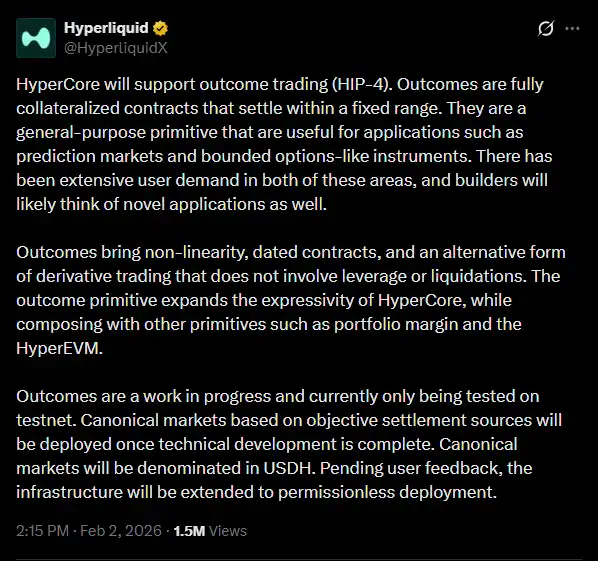
Predictefy analysis indicates that the key to HIP-4 lies in integrating outcome contracts into the same margin framework as perpetual futures, bringing event trading into the same environment as other crypto derivatives.

This could bring tens of billions of dollars in new trading volume and open interest to prediction markets in a short period. Conservative estimates suggest partial adoption could reach $28 billion in monthly trading volume, moderate adoption $33 billion, and strong integration over $40 billion.

Full text below:

Prediction markets processed over $23 billion in nominal trading volume in January 2026. Hyperliquid alone processed over $225 billion in the same month. Outcome trading could bring tens of billions of dollars in new trading volume to prediction markets.

Prediction markets are growing rapidly, but they primarily operate in isolation. You can trade event outcomes, but these positions are not within the same systems traders use to manage broader market risks.

HIP-4 changes this. On Hyperliquid, outcome contracts share the same margin framework with perpetual futures, bringing event trading into the same environment as other crypto derivatives.

This could bring tens of billions of dollars in new trading volume and open interest to prediction markets in a short time. Here’s how it works.
Prediction Markets Are Already Substantial

Over the past year, prediction markets have moved beyond niche activity.

  • Weekly trading volume on major platforms has repeatedly exceeded $6 billion
  • A recent month recorded approximately $23.8 billion in nominal trading volume
  • Market share remains concentrated, with platforms like Polymarket, Opinion, and Kalshi dominating most activity

Despite this growth, prediction markets still primarily function as standalone venues. Event exposure, directional crypto exposure, and volatility exposure typically require separate platforms, collateral pools, and risk systems. This fragmentation limits capital efficiency and constrains the types of strategies traders can implement.

Outcome Contracts Bring Risk into Core Infrastructure

Outcome contracts introduced via HIP-4 have several defining characteristics:

  • Positions are fully collateralized
  • Settlement occurs within a fixed and bounded payment range
  • No liquidation mechanism
  • Contracts are event-based or time-based
  • Positions are integrated into the same margin framework as perpetual futures

Binary contracts themselves are not new. The structural change lies in their integration into a unified derivatives engine. Event exposure can now share collateral with perpetual positions, allowing risk to be managed at the portfolio level rather than the individual market level.

Improvements in Capital Efficiency

Previously, implementing event-driven strategies typically required traders to:

  • Deposit collateral on a prediction market platform
  • Deposit separate collateral on a perpetual futures venue for hedging
  • Manage risk and margin independently across venues

This setup increased capital requirements and operational complexity.

With outcome contracts in a shared trading environment, event exposure and directional hedging can be managed together. Portfolio margin systems can recognize offsetting risks, reducing total margin usage. This aligns event trading with established derivatives risk management practices.

Current Market Size and Trading Volume Growth Potential

Prediction markets processed approximately $20-25 billion in monthly trading volume in January 2026 under today's isolated structure, with event trading located outside the broader derivatives stack.

In contrast, Hyperliquid recorded over $225 billion in perpetual futures volume in the same month, with daily perpetual trading volumes reaching the multi-billion dollar range. The pool of derivatives liquidity is already much deeper than standalone prediction market activity.

If HIP-4 improves capital efficiency and makes event positions easier to hedge within the same system, trading activity could expand through structural churn—more strategies running on the same capital.

Conservative scenario suggests:

  • Partial adoption → $28 billion monthly prediction market trading volume
  • Moderate adoption → $33 billion
  • Strong integration → Over $40 billion

These estimates reflect strategy integration, not hype cycles, and do not include the ongoing monthly growth already seen in prediction market volume, which could push total volumes even higher.

Prediction Markets Begin to Resemble Options Infrastructure

Outcome contracts introduce:

  • Non-linear payouts
  • Event-driven settlement
  • Bounded risk profiles

These characteristics overlap with options-like exposure. This creates a foundation for:

  • Event volatility strategies
  • Structured products incorporating outcome positions
  • Systematic portfolios combining event and market risks
  • Protocols building new products on top of outcome primitives

Prediction markets shift from being primarily narrative-driven to becoming available components in broader financial strategies.

Competitive Landscape

Standalone prediction market platforms retain advantages in brand recognition, liquidity depth, and simplicity. However, platforms integrating event risk with perpetual contracts and other derivatives offer:

  • Shared collateral pools
  • Instant hedging within the same environment
  • Portfolio-level risk netting

Even partial migration of more advanced trading flows could affect where capital-efficient and hedge-intensive activities concentrate.

Signals of Adoption

Structural adoption will be reflected in trading behavior, not just headline volume:

  • Pairing of outcome positions with perpetual hedges
  • Growth in open interest around macro and policy events
  • Emergence of vaults or structured strategies built on outcome exposure
  • Narrowing spreads relative to standalone prediction market venues

These signals indicate outcomes are being used as financial instruments, not isolated event trades.

Conclusion

Prediction markets have achieved scale but have until now been structurally separated from the broader derivatives stack.

HIP-4 introduces a framework where event risk can coexist with perpetual futures within shared trading infrastructure. As this model evolves, prediction markets may increasingly function as components of diversified risk portfolios, rather than standalone betting venues.


Domande pertinenti

QWhat is the key innovation of HIP-4 on Hyperliquid, and how does it impact prediction markets?

AHIP-4 introduces outcome contracts integrated into the same margin framework as perpetual futures, allowing event trading to occur within the same environment as other crypto derivatives. This integration enhances capital efficiency and enables portfolio-level risk management, potentially bringing billions in new trading volume to prediction markets.

QHow does the trading volume of prediction markets compare to Hyperliquid's perpetual futures volume in January 2026?

AIn January 2026, prediction markets processed over $23 billion in nominal trading volume, while Hyperliquid alone handled over $225 billion in perpetual futures volume during the same month.

QWhat are the potential trading volume scenarios for prediction markets with the adoption of HIP-4?

AConservative adoption could reach $28 billion monthly trading volume, medium adoption $33 billion, and strong integration could exceed $40 billion, reflecting strategic integration rather than hype cycles.

QHow do outcome contracts on Hyperliquid improve capital efficiency for traders?

AOutcome contracts allow event exposure and directional hedges to be managed together within a shared trading environment. The portfolio margin system recognizes offsetting risks, reducing total margin usage and aligning event trading with established derivatives risk management practices.

QWhat competitive advantages do platforms with integrated event risk and perpetual contracts offer compared to standalone prediction markets?

AThey provide shared collateral pools, instant hedging within the same environment, and portfolio-level risk netting, which may attract capital-efficient and hedge-intensive activities even if standalone platforms retain advantages in brand recognition and simplicity.

Letture associate

Kicked Out of PayPal, Musk Aims for a Comeback in the Crypto Market

Elon Musk's X (formerly Twitter) has launched its "Smart Cashtags" feature, generating approximately $1 billion in trading volume within days of its April 2026 pilot launch. The feature allows users to click on stock or crypto tickers (or even full Solana token contract addresses) in posts to view real-time price charts and discussions without leaving the app. Initially available to iPhone users in the US and Canada, with a partnership in Canada enabling direct trading via the Wealthsimple app. This move is part of Musk's broader "Everything App" vision, spearheaded by the upcoming X Money platform. Analysts, such as Mizuho's Dan Dolev, see this as a potential disruptor to the US payments market, even prompting a downgrade of PayPal's stock. X Money's beta offers services like 6% APY on deposits, cashback, and P2P transfers, with speculation it may later incorporate crypto trading and stablecoin settlements for faster transactions. However, the ambitious plan faces significant regulatory scrutiny. Senator Elizabeth Warren has questioned the sustainability of the high 6% yield and raised concerns over X's banking partner, Cross River Bank, which has a history of regulatory violations. Additional risks involve the "GENIUS Act," which may create loopholes for stablecoin issuance without full FDIC insurance coverage, potentially leaving users unprotected. The integration of social trading on a platform with over 500 million users could inject new liquidity and retail interest into the crypto market. Yet, it also amplifies risks like herd mentality and the blurring of lines between entertainment and financial speculation. Musk's return to finance, after his ouster from PayPal, hinges on balancing innovation with regulatory compliance.

marsbit2 h fa

Kicked Out of PayPal, Musk Aims for a Comeback in the Crypto Market

marsbit2 h fa

Trading

Spot
Futures

Articoli Popolari

Come comprare 4

Benvenuto in HTX.com! Abbiamo reso l'acquisto di 4 (4) semplice e conveniente. Segui la nostra guida passo passo per intraprendere il tuo viaggio nel mondo delle criptovalute.Step 1: Crea il tuo Account HTXUsa la tua email o numero di telefono per registrarti il tuo account gratuito su HTX. Vivi un'esperienza facile e sblocca tutte le funzionalità,Crea il mio accountStep 2: Vai in Acquista crypto e seleziona il tuo metodo di pagamentoCarta di credito/debito: utilizza la tua Visa o Mastercard per acquistare immediatamente 44.Bilancio: Usa i fondi dal bilancio del tuo account HTX per fare trading senza problemi.Terze parti: abbiamo aggiunto metodi di pagamento molto utilizzati come Google Pay e Apple Pay per maggiore comodità.P2P: Fai trading direttamente con altri utenti HTX.Over-the-Counter (OTC): Offriamo servizi su misura e tassi di cambio competitivi per i trader.Step 3: Conserva 4 (4)Dopo aver acquistato 4 (4), conserva nel tuo account HTX. In alternativa, puoi inviare tramite trasferimento blockchain o scambiare per altre criptovalute.Step 4: Scambia 4 (4)Scambia facilmente 4 (4) nel mercato spot di HTX. Accedi al tuo account, seleziona la tua coppia di trading, esegui le tue operazioni e monitora in tempo reale. Offriamo un'esperienza user-friendly sia per chi ha appena iniziato che per i trader più esperti.

312 Totale visualizzazioniPubblicato il 2025.10.20Aggiornato il 2025.10.20

Come comprare 4

Discussioni

Benvenuto nella Community HTX. Qui puoi rimanere informato sugli ultimi sviluppi della piattaforma e accedere ad approfondimenti esperti sul mercato. Le opinioni degli utenti sul prezzo di 4 4 sono presentate come di seguito.

活动图片