Hyperliquid Infringement Dispute: Technological Rights Protection or Opportunistic Marketing?

marsbitPubblicato 2026-02-04Pubblicato ultima volta 2026-02-04

Introduzione

Hyperliquid, a high-performance decentralized exchange (DEX), faces patent infringement allegations from Cypherium, a competing RWA blockchain project. The dispute centers on US Patent 11,411,721 B2, held by Cypherium, which covers systems for dynamically selecting and reconfiguring validator committees using mechanisms like aggregated signatures and two-phase reconfiguration in a Proof-of-Stake (PoS) environment. Cypherium’s founder, Sky Guo, claims Hyperliquid’s core consensus engine, HyperCore—a custom variant of the HotStuff algorithm—illegally uses this patented technology to achieve its high throughput and sub-second finality. The controversy arises as Hyperliquid’s native token, HYPE, surged over 40% amid a broader market downturn and the launch of its new prediction market proposal, HIP-4. Critics question the timing of the allegations, noting coinciding promotions for Cypherium’s upcoming project, "G-Exchange," suggesting potential "clickbait marketing." Hyperliquid has not yet publicly responded to the legal claims. With Hyperliquid’s code remaining closed-source, external verification of the infringement is challenging. The situation highlights tensions between protecting proprietary tech and maintaining decentralization trust. Additionally, HYPE is set to unlock 9.92 million tokens (2.79% of supply) on February 6, worth approximately $357 million at current prices.

Original Author: Sanqing, Foresight News

On February 2, Hyperliquid announced that the HIP-4 proposal had gone live on the testnet on February 2. This proposal aims to build a prediction market infrastructure by introducing "Outcome Trading." Additionally, from late January to early February 2026, the cryptocurrency market showed weakness, with Bitcoin's price falling below the $75,000 mark, leading to a broad market correction. However, Hyperliquid's native token HYPE bucked the trend, rising over 40% in the past week.
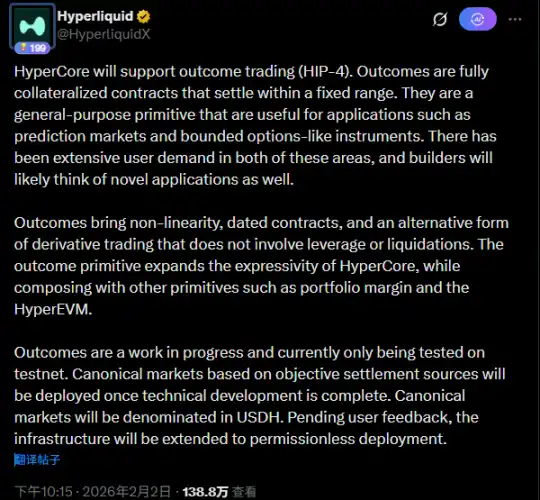
Image Source: Hyperliquid Tweet

However, as Hyperliquid expands its business, it has encountered allegations of technological infringement from a peer. On February 2, Sky Guo, founder of the RWA public chain project Cypherium, publicly accused Hyperliquid of infringing on its patented technology on social media. Sky Guo claimed that Hyperliquid's underlying consensus engine, HyperCore, uses a patented optimized version of the PoS-based HotStuff algorithm and demanded that Hyperliquid cease the infringement.
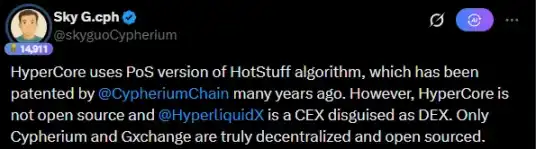
Image Source: Sky Guo Tweet


Core Dispute: The Technical Boundaries of Patent US 11,411,721 B2

The core of this dispute revolves around a formal patent issued by the United States Patent and Trademark Office (USPTO) on August 9, 2022, with the number US 11,411,721 B2. The assignee of this patent is Cypherium Blockchain Inc., and its title is "Systems and methods for selecting and utilizing a committee of validator nodes in a distributed system."

The patent details a mechanism for dynamically selecting and reconfiguring a validator committee, supporting node election through PoW, PoS, or PoA, and emphasizes the use of Aggregate Signatures to enhance consensus efficiency and fault tolerance. The patent also proposes specific implementation paths such as Two-phase Reconfiguration and Tree-structured Hierarchy.

Cypherium believes that these technologies are key to implementing HotStuff in large-scale, high-performance networks (such as Hyperliquid's 200,000 TPS), and this constitutes the core barrier of the patent rights.
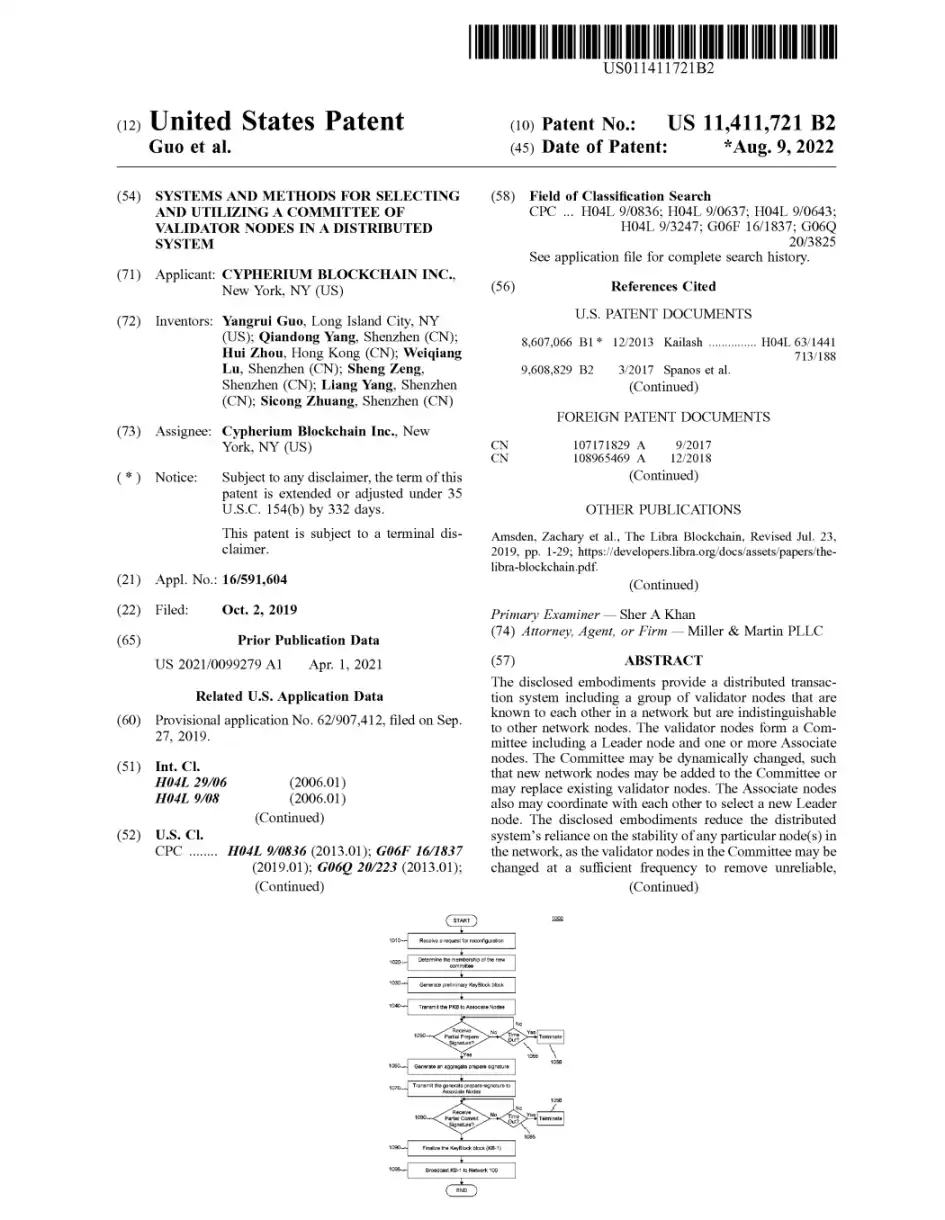
First Page of Cypherium Patent US 11,411,721 B2 | Image Source: Google Patents

The technical dispute centers on both parties' improvements and applications of the consensus algorithm HotStuff, but HotStuff itself is an open-source consensus protocol published in academia between 2018 and 2019.

Cypherium's CypherBFT combines HotStuff with PoW to achieve permissionless operation, while Hyperliquid's HyperBFT is a custom variant optimized for low-latency transactions.

However, Cypherium claims that its patent covers specific enhancement logic for HotStuff in a PoS environment. Hyperliquid has not yet responded regarding whether HyperBFT uses the unique claims covered by the patent.

Escalation of Accusations: From Questioning Transparency to Alleging Infringement

Prior to this infringement allegation, Sky Guo's criticism of Hyperliquid primarily focused on code transparency.

Image Source: Sky Guo Tweet

This lack of transparency, on one hand, protects Hyperliquid's commercial advantage in high-concurrency processing; on the other hand, it makes it difficult for the project to prove its innocence through public audits when facing external technical质疑 (questioning/doubt).

Sky Guo believes that it is precisely because HyperCore borrowed the dynamic committee selection logic described in his patent that it achieved its sub-second finality.

Sky Guo claims to have sent a legal letter to the Hyperliquid team and relevant responsible persons, accusing them of using the patented technology without permission. He stated that the Hyperliquid side is currently avoiding the issue and has not responded to the legal correspondence.

Solid Evidence or Ambush Marketing?

From a superficial legal and technical logic perspective, the US patent US 11,411,721 B2 held by Cypherium is indeed a formally issued legal document. Its scope of protection确实涵盖 (does indeed cover) key aspects of consensus mechanisms such as dynamic committee selection, signature aggregation, and two-phase reconfiguration.

According to Hyperliquid's publicly available technical documentation, the underlying HyperCore engine确实运行 (does indeed run) on a custom variant of the HotStuff algorithm called HyperBFT. HotStuff is precisely the technology改良对象 (improvement target) heavily involved in the claims of this patent.
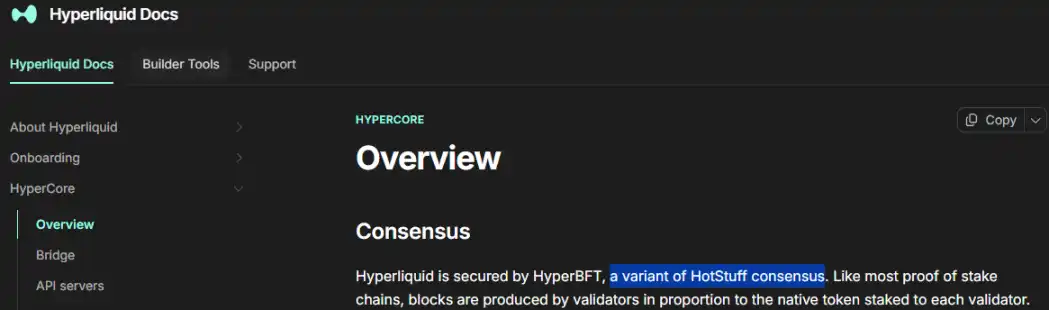
Image Source:Hyperliquid Docs

Furthermore, since Hyperliquid's core codebase is currently closed-source, this black-box属性 (attribute) makes it difficult for the outside world to determine whether its specific implementation path avoids the relevant patent through public code audits.

However, in reality, HotStuff and its variants are hardly new in the high-performance Layer 1 race. From Meta's (formerly Facebook) aborted Libra/Diem, to the currently prominent Aptos (AptosBFT), Monad (MonadBFT), and even early research iterations of Sui's core consensus, all have been significantly influenced by HotStuff's linear communication complexity and responsive design.

Additionally, the timing and context of the accusation are thought-provoking. Sky Guo published the infringement allegation at 12:00 on February 3, coinciding with strong market performance of the HYPE token and the热度 (heat/buzz) surrounding the HIP-4 proposal for the prediction market.

On social platforms, some KOLs expressed support for this rights protection action, but the comment sections of related posts featured疑似推广内容 (suspected promotional content) about "G-Exchange." "G-Exchange" is an upcoming new project within the Cypherium ecosystem. The coincidence in the timeline between this technical accusation and the预热 (pre-launch warm-up) of a new project makes this series of维权动作 (rights protection actions)疑似 (suspected of being) ambush marketing to generate buzz for the new business.
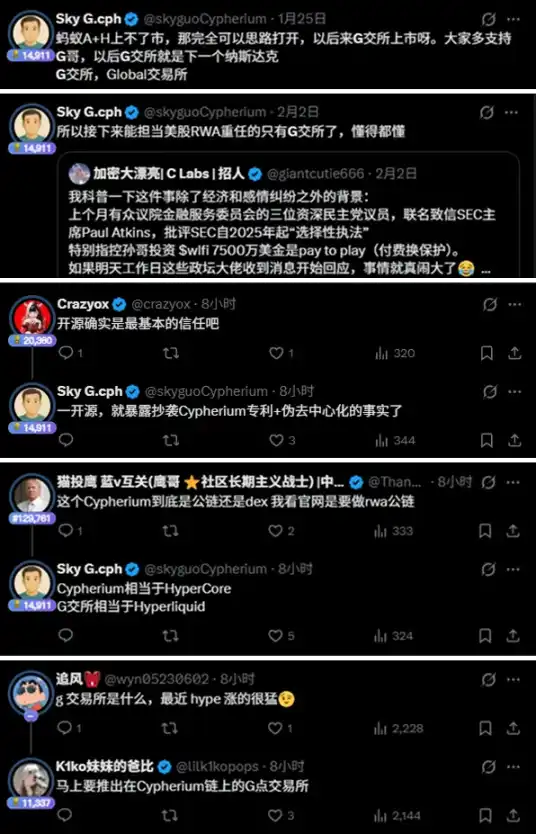
Image Source: Sky Guo and other X account tweets

Whether the accusation is a "real hammer" (solid evidence) or "ambush marketing," Hyperliquid seems to have reached a crossroads. As its business expands, community calls for increased transparency are growing. Faced with infringement质疑 (doubts/questions), will Hyperliquid insist on its black-box advantage, or will it prove its innocence through partial open-sourcing or third-party audits? This concerns the trust foundation of its decentralization narrative.

Note: 9.92 million HYPE tokens are scheduled to be unlocked on February 6, accounting for 2.79% of the circulating supply, with a value of approximately $357 million (based on a price of $36).


Domande pertinenti

QWhat is the core patent technology that Cypherium accuses Hyperliquid of infringing upon?

ACypherium accuses Hyperliquid of infringing upon US Patent No. 11,411,721 B2, which covers systems and methods for dynamically selecting and reconfiguring a committee of validator nodes in a distributed system, utilizing mechanisms like aggregate signatures and two-phase reconfiguration to enhance consensus efficiency and fault tolerance.

QHow did Hyperliquid's native token HYPE perform in the market amidst the broader cryptocurrency downturn mentioned?

ADespite a broader market correction where Bitcoin fell below $75,000, Hyperliquid's native token HYPE experienced significant growth, rising over 40% in the past week.

QWhat specific technical feature does Sky Guo claim Hyperliquid's HyperCore engine borrowed from Cypherium's patent?

ASky Guo claims that Hyperliquid's HyperCore engine borrowed the dynamic committee selection logic from Cypherium's patent, which is key to achieving its sub-second finality.

QWhy is it difficult to verify the patent infringement claims against Hyperliquid through public code audit?

AIt is difficult to verify the infringement claims because Hyperliquid's core codebase is currently closed-source and non-transparent, making it impossible for external parties to conduct a public code audit to determine if the implementation avoids the patented technology.

QWhat coincidental timing suggests that Cypherium's infringement accusation might be a form of 'clickbait marketing'?

AThe accusation was made just as HYPE token was performing strongly and the HIP-4 proposal was generating prediction market hype. Additionally, promotional content for Cypherium's new project 'G-Exchange' appeared in related social media discussions, suggesting the timing may be strategic for marketing purposes.

Letture associate

In Conversation with Ray Dalio: We Are Currently in an AI Bubble, with 1% of My Portfolio in Bitcoin

Ray Dalio, founder of Bridgewater Associates, warns in an interview that the current AI boom shows classic bubble characteristics, which could lead to significant economic downturns as seen in past cycles like 1929 or 2000. He explains that speculative enthusiasm, fueled by debt and overvaluation, often precedes a crash when rising rates or taxation force asset sales, causing widespread losses and recession. Dalio also outlines his "Big Cycle" theory, describing an approximate 80-year pattern where widening wealth gaps, massive government deficits, and shifting geopolitical power (like China's rise) create internal conflict and global instability. He emphasizes that we are in a late-cycle, transitional phase where traditional powers like the US and UK face decline. For personal wealth protection, Dalio advises diversification beyond cash into assets like stocks, bonds, real estate, and particularly gold, which he prefers over Bitcoin. While he holds about 1% of his portfolio in Bitcoin as a non-printable hard asset, he views gold as more secure from technological or governmental threats. Regarding AI's impact, Dalio believes it will disproportionately benefit capital owners, worsening inequality by replacing both physical and cognitive labor. He suggests that human intuition and emotional intelligence, combined with AI, will be key for future workers. On taxation, Dalio argues that wealth taxes are impractical and risk triggering asset sell-offs, reducing productive investment. He points to the UK as a cautionary example of debt, low productivity, and political strife. Geopolitically, Dalio foresees a more regionalized world, with the US showing weakness in prolonged conflicts like with Iran, akin to past imperial declines. The ideal outcome, he suggests, is coexisting powerful blocs (e.g., Americas, China-Asia Pacific) without major war.

marsbit55 min fa

In Conversation with Ray Dalio: We Are Currently in an AI Bubble, with 1% of My Portfolio in Bitcoin

marsbit55 min fa

Daily 7.2 Trillion KRW: Foreign Capital's Record Net Buying on Friday! Wall Street Says Headwinds for Korean Stock Fund Flows Have Subsided

South Korean stock market sees a dramatic shift in fund flows. On July 31, foreign investors made a record net purchase of approximately KRW 7.2 trillion in KOSPI stocks, marking a fundamental reversal from the persistent large-scale net outflows seen in previous months. This contributed to a significant narrowing of foreign net selling in July to KRW 9.8 trillion, down sharply from KRW 48.4 trillion in June and KRW 44.5 trillion in May. Simultaneously, domestic institutional pressure eased. South Korean pension funds and asset managers turned to a net buying position in July, purchasing KRW 1.0 trillion worth of KOSPI shares, contrasting with net sales in May and June. Market volatility is expected to be dampened by new financial regulations. Effective July 31, the Financial Services Commission tightened access for retail investors to single-stock leveraged ETFs by raising the minimum cash deposit requirement. Trading volumes for these products subsequently dropped to about 50% of their monthly average. Citigroup Research maintains its year-end KOSPI target of 10,000 points. The firm cites several supportive factors: the substantial easing of headwinds from capital outflows, a robust fundamental outlook for the semiconductor sector, historically low market valuations, strong economic fundamentals, and the potential for policy support from financial authorities if needed.

marsbit55 min fa

Daily 7.2 Trillion KRW: Foreign Capital's Record Net Buying on Friday! Wall Street Says Headwinds for Korean Stock Fund Flows Have Subsided

marsbit55 min fa

Thanks to Dice Rolls, Bitcoin Keys Are Stored Offline, But Not Everyone Will Do It

The article discusses using dice rolls to generate secure Bitcoin wallet seeds, providing entropy independent of potentially flawed hardware random number generators. It explains that each fair dice roll offers about 2.585 bits of entropy, with around 50 rolls needed for a standard 12-word seed phrase and 99+ recommended for higher security. This method gained attention after a vulnerability was revealed in some Coldcard hardware wallets, where a faulty firmware RNG (dating back to 2021) compromised generated keys. The analysis notes that while a dice-generated main seed was safe from this specific flaw, other Coldcard functions (like creating paper wallets, backup keys, or passwords) could still be vulnerable if they used the defective RNG. The piece argues that while dice-based entropy is technically robust, the manual process is error-prone, tedious, and unrealistic for most new users, who might make mistakes in recording or inputting rolls. It concludes that while manual entropy generation should remain an option for advanced users, the long-term goal is to develop reliable, user-friendly hardware and software that securely generates randomness without requiring specialized knowledge. Coldcard users are advised to check their firmware version and replace any secondary secrets (like paper wallet keys) created with vulnerable devices, while also considering multi-signature setups with devices from different manufacturers for added security.

cryptonews.ru6 h fa

Thanks to Dice Rolls, Bitcoin Keys Are Stored Offline, But Not Everyone Will Do It

cryptonews.ru6 h fa

Trading

Spot
活动图片




