HYPE (briefly) hits $10 billion, flips ADA to enter crypto’s top 10 – Details

ambcryptoPubblicato 2026-03-20Pubblicato ultima volta 2026-03-20

Introduzione

Hyperliquid (HYPE) briefly entered the top 10 cryptocurrencies by market cap, reaching a valuation of approximately $10.06 billion and overtaking Cardano (ADA). This surge was supported by a strong weekly performance, with HYPE gaining over 4% compared to ADA's 1.4%. Year-to-date, HYPE has climbed nearly 57%, while ADA declined over 23%. The rally is attributed to Hyperliquid's partnership with S&P Dow Jones Indices to introduce an on-chain perpetual contract for the S&P 500, offering traders continuous access to the index with official data backing. This innovation is seen as a major credibility boost, attracting significant market interest.

Hyperliquid [HYPE] has been making waves in crypto lately, and it’s starting to show. What was once a niche platform is now getting mainstream attention, thanks to new developments that are pulling in more traders.

At the center of it all... is something that could change how people trade altogether.

HYPE breaks into Top 10!

HYPE, temporarily, pushed its way into the top 10 cryptocurrencies by market cap, overtaking Cardano [ADA] in the process. While it had retraced at press time, HYPE was valued at around $39 a few hours prior, giving it a market cap of roughly $10.06 billion; just ahead of Cardano’s $9.64 billion.


Source: Coinmarketcap

This, after a strong weekly performance from HYPE, which gained by over 4% over the past week compared to Cardano’s 1.4% hike. While both assets saw some dips in the last 24 hours, HYPE’s relative strength helped it push past ADA. Again, briefly.

2026 – The year of HYPE?

The gap between both tokens becomes even clearer when looking at their YTD performance. HYPE has climbed over the past few months, posting gains of nearly 57% and consistently putting up higher highs along the way.
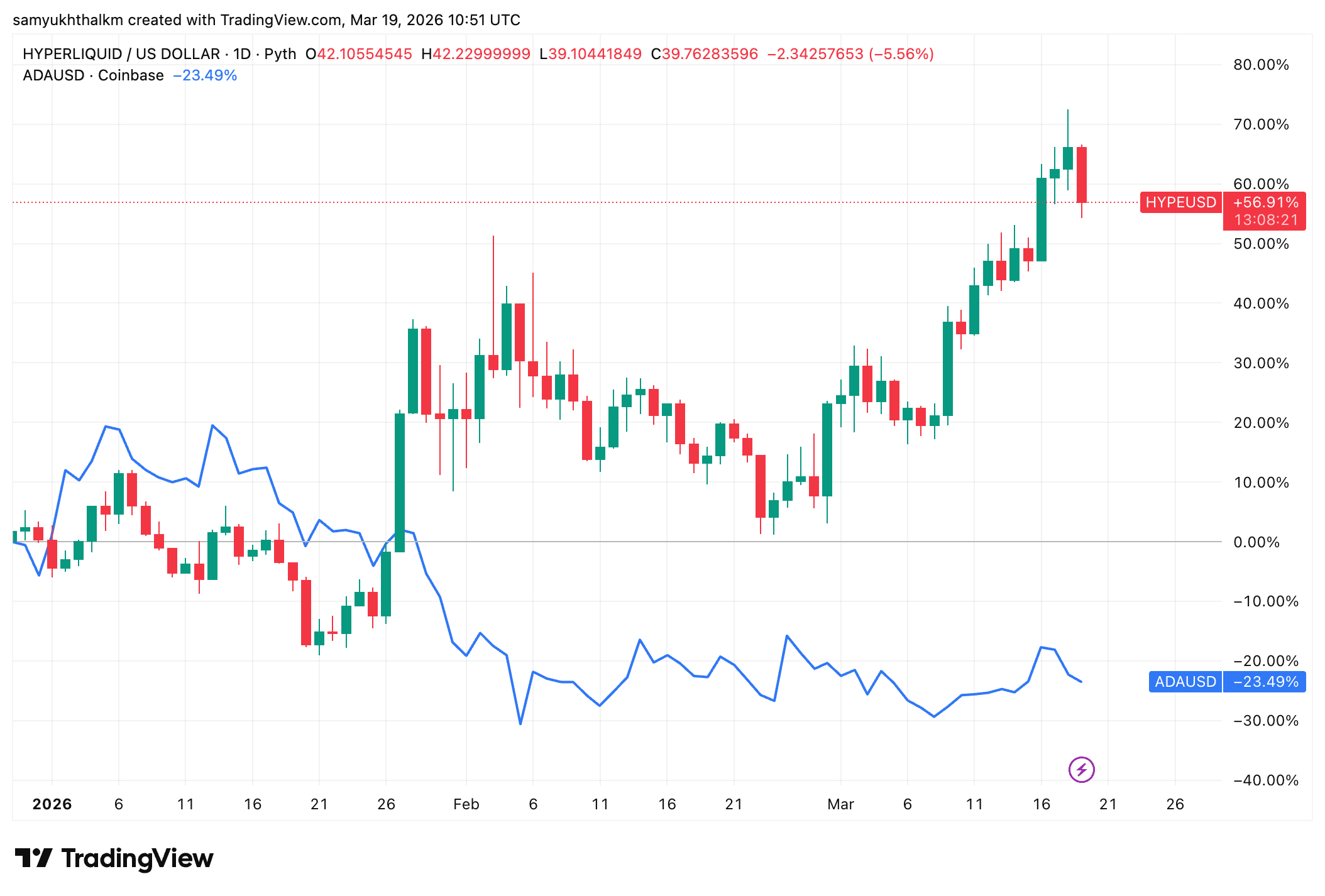
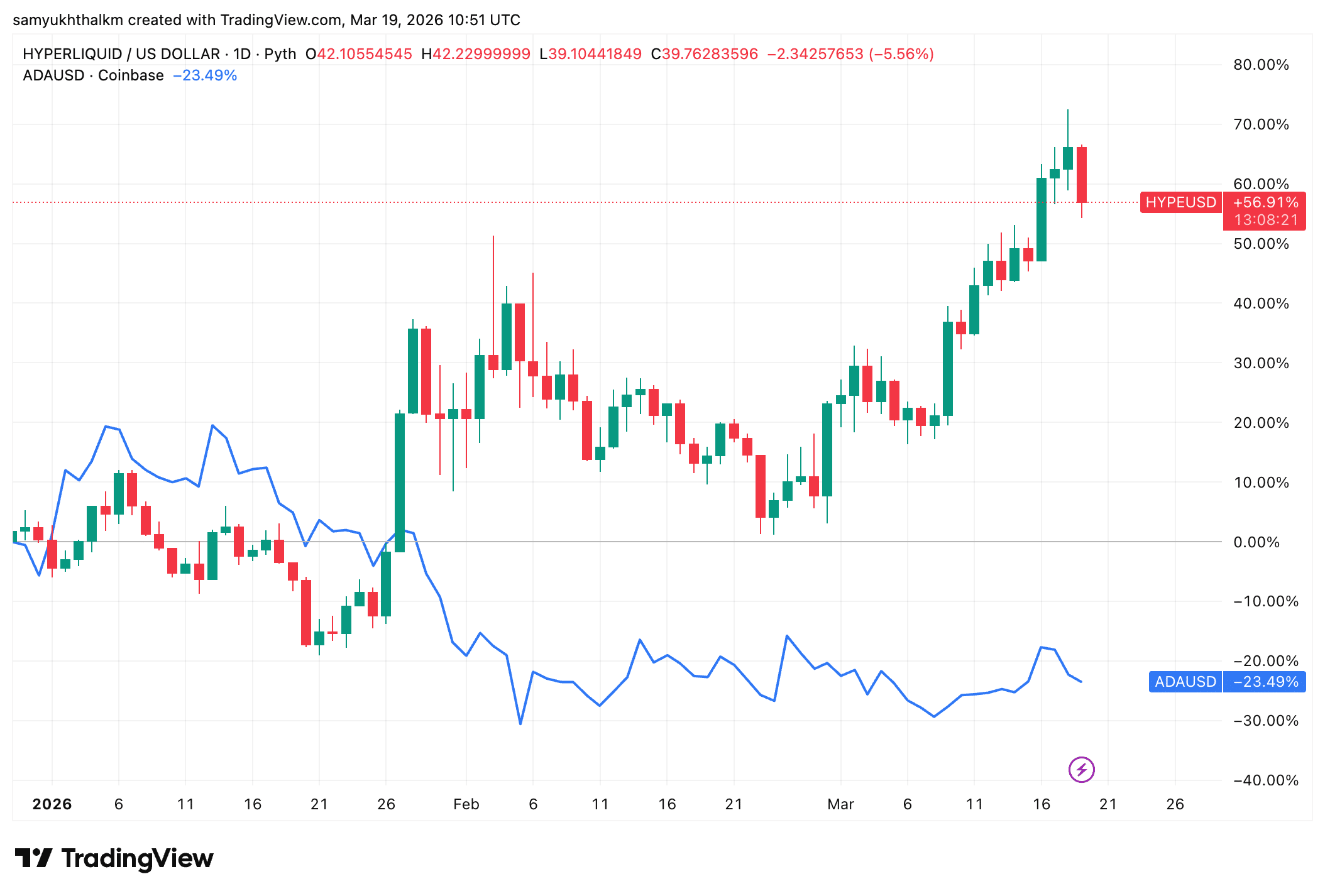
Source: Tradingview

Cardano, on the other hand, has struggled. The daily chart revealed that ADA was down over 23% in the same period, with weak price action despite brief recoveries.

While ADA has seen slower, uneven movement, HYPE benefited from better pace and buying interest.

A whole new league

In partnership with S&P Dow Jones Indices and Trade [XYZ], Hyperliquid is all set to bring the S&P 500 on-chain through a perpetual contract. This is something that hasn’t existed in this form before.
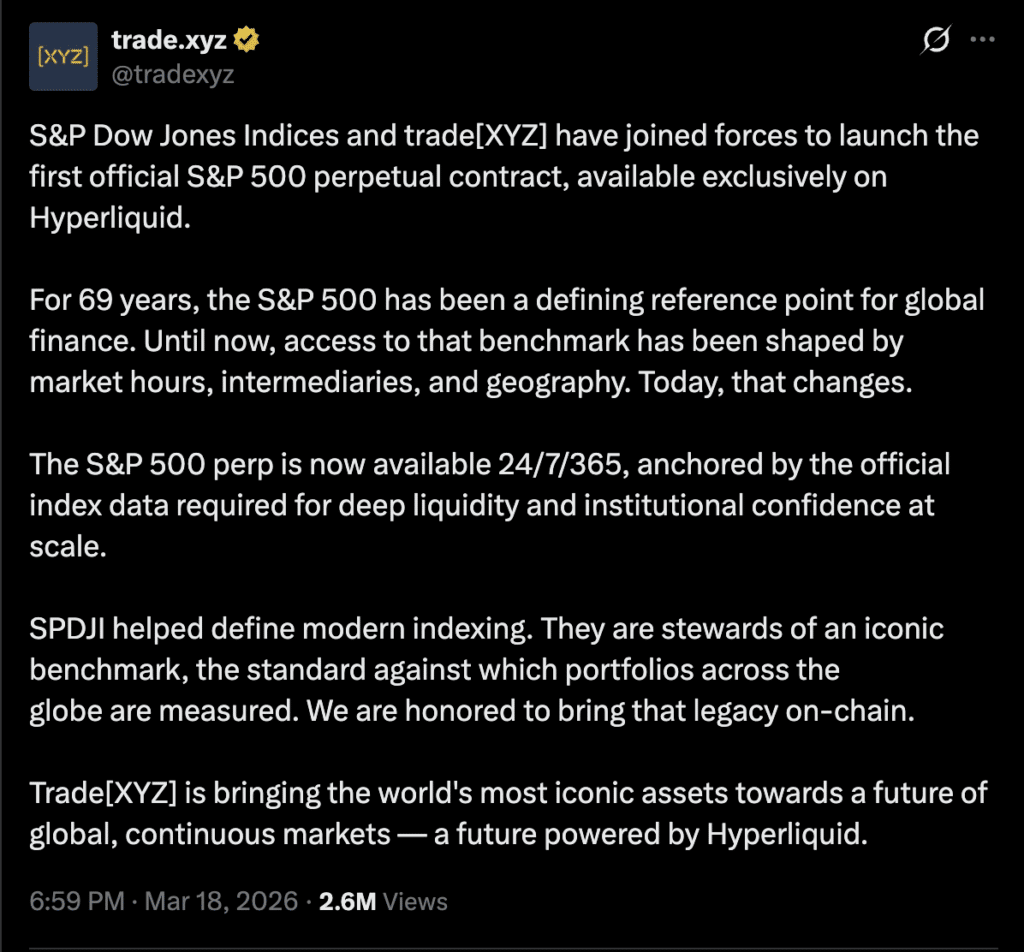
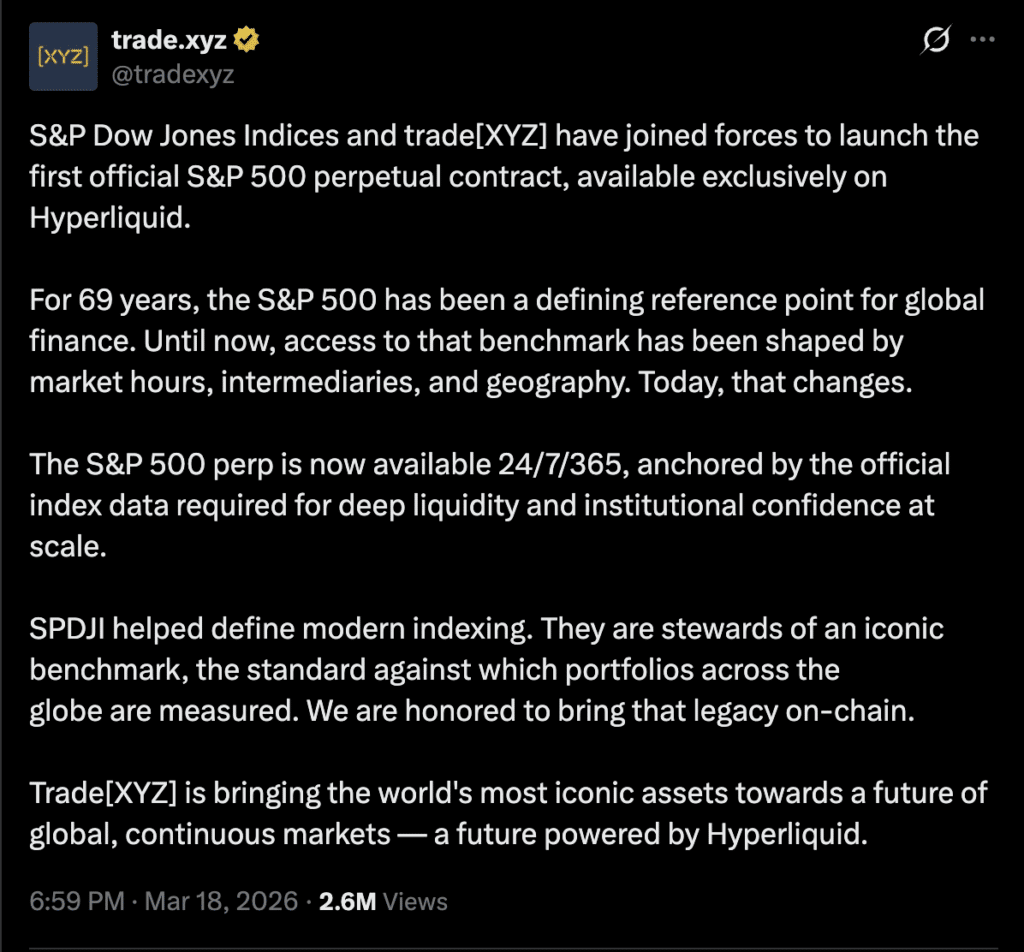
Source: X

The accessibility is notable. Instead of being limited by market hours or intermediaries, traders can now gain exposure to one of the world’s most tracked indices at any time. With official index data backing it, the product also carries the kind of credibility that could attract more money.



Crypto di tendenza

Domande pertinenti

QWhat was Hyperliquid's (HYPE) market cap when it briefly entered the top 10, and which cryptocurrency did it overtake?

AHyperliquid (HYPE) reached a market cap of roughly $10.06 billion, briefly overtaking Cardano (ADA), which had a market cap of $9.64 billion.

QWhat key partnership is mentioned as a major development for Hyperliquid?

AHyperliquid partnered with S&P Dow Jones Indices and Trade [XYZ] to bring the S&P 500 on-chain through a perpetual contract.

QHow did HYPE's weekly performance compare to ADA's in the article?

AHYPE gained over 4% in the past week, while Cardano (ADA) saw a 1.4% hike.

QWhat was the Year-to-Date (YTD) performance difference between HYPE and ADA as highlighted in the article?

AHYPE posted gains of nearly 57% YTD, while ADA was down over 23% in the same period.

QWhat is the main advantage of Hyperliquid's new perpetual contract product for the S&P 500?

AIt provides 24/7 accessibility, allowing traders to gain exposure to the S&P 500 index at any time, without being limited by traditional market hours or intermediaries, and is backed by official index data for credibility.

Letture associate

Global Stock Market's Storm Center: South Korea's Stock Market De-leveraging Is Largely Complete

Storm's Eye: South Korean Market De-leveraging Nears Completion The recent sharp correction in South Korean equities, with the KOSPI index dropping 32% from its June high, has been a key trigger for global tech stock volatility. The core driver was not a fundamental shift but a forced de-leveraging process within the market's unique structure, which is now largely complete. Two main leverage channels amplified the sell-off: 1. **Leveraged ETFs:** Their size, proportionally four times larger than in the U.S., peaked near $50 billion. Their mandatory daily rebalancing mechanism created a vicious cycle of "price drop → forced selling → further drop." Approximately 75% of this excess has been unwound, shrinking to $26 billion, with regulatory curbs now blocking new inflows. 2. **Hedge Fund Leverage:** Using swaps to magnify exposure, hedge funds saw their net long positioning fall by over 50% from peak levels. The most intense phase of this institutional de-leveraging is over. In contrast, **retail margin debt** poses minimal systemic risk. At 0.5% of market cap, it is far lower than in the U.S. or China, lacks automatic triggers, and is concentrated in smaller stocks. The conclusion: the high-leverage structures most prone to "chain-reaction selling" have been substantially cleared. The market is transitioning from a liquidity-driven crash to one priced more on fundamentals. The article argues that the AI trend—centered on Korean memory chips—remains intact. This episode represents a painful but necessary clearing of crowded trades, not the end of the AI revolution. For investors, the key question is conviction in the long-term AI direction; if the trend is real, current volatility is a cost of entry, not a terminal risk.

链捕手52 min fa

Global Stock Market's Storm Center: South Korea's Stock Market De-leveraging Is Largely Complete

链捕手52 min fa

The Eternal Fragments of Money: Third-Party Payment Has No First Principle

"The Enduring Fragments of Money: Third-Party Payments Lack a First Principle" Stripe is reportedly attempting to acquire PayPal, marking a significant shift reminiscent of PayPal's merger with the original X.com 30 years ago. The article analyzes Stripe's strategic challenges and the broader payments industry landscape. Despite its initial success with a developer-friendly API model, Stripe missed its optimal IPO window during the pandemic and has since seen its valuation decline. Its attempts to expand through acquisitions and new ventures, particularly in stablecoins (like its OUSD project) and Agent-focused payments (ACP/MPP protocols), have faced headwinds. The author argues that the payment industry remains highly fragmented and is ultimately an adjunct to the traditional banking system. This structure limits the potential for any single player, including Stripe, to achieve complete dominance. While stablecoins and the future rise of autonomous Agent economies present potential growth avenues, they are not yet mainstream and still require integration with the existing financial system. For now, Agent-based transactions are largely used for speculative "volume boosting" rather than substantive business applications. Stripe's current move to acquire PayPal is seen as an attempt to bolster its weak consumer-facing (C-side) business after its stablecoin-focused strategies faltered. Meanwhile, PayPal is described as structurally outdated, unable to revive itself through new products like Venmo or PYUSD. The future of payments may lie not in payments themselves but in value-added services like more efficient settlement networks. The author suggests that companies like Stripe and Circle, which are building their own blockchains (Tempo, Arc) and stablecoins, are positioning themselves to eventually profit from high-efficiency settlement systems. These new networks could potentially bypass some traditional banking layers. In conclusion, the article posits that third-party payment is a perpetually fragmented battlefield where scale alone cannot ensure victory. Players must find new models, focusing on efficiency to compete with the entrenched banking system. Stripe's acquisition of PayPal represents a bet on this uncertain future.

链捕手1 h fa

The Eternal Fragments of Money: Third-Party Payment Has No First Principle

链捕手1 h fa

Trading

Spot

Articoli Popolari

Come comprare HYPE

Benvenuto in HTX.com! Abbiamo reso l'acquisto di Hyperliquid (HYPE) semplice e conveniente. Segui la nostra guida passo passo per intraprendere il tuo viaggio nel mondo delle criptovalute.Step 1: Crea il tuo Account HTXUsa la tua email o numero di telefono per registrarti il tuo account gratuito su HTX. Vivi un'esperienza facile e sblocca tutte le funzionalità,Crea il mio accountStep 2: Vai in Acquista crypto e seleziona il tuo metodo di pagamentoCarta di credito/debito: utilizza la tua Visa o Mastercard per acquistare immediatamente HyperliquidHYPE.Bilancio: Usa i fondi dal bilancio del tuo account HTX per fare trading senza problemi.Terze parti: abbiamo aggiunto metodi di pagamento molto utilizzati come Google Pay e Apple Pay per maggiore comodità.P2P: Fai trading direttamente con altri utenti HTX.Over-the-Counter (OTC): Offriamo servizi su misura e tassi di cambio competitivi per i trader.Step 3: Conserva Hyperliquid (HYPE)Dopo aver acquistato Hyperliquid (HYPE), conserva nel tuo account HTX. In alternativa, puoi inviare tramite trasferimento blockchain o scambiare per altre criptovalute.Step 4: Scambia Hyperliquid (HYPE)Scambia facilmente Hyperliquid (HYPE) nel mercato spot di HTX. Accedi al tuo account, seleziona la tua coppia di trading, esegui le tue operazioni e monitora in tempo reale. Offriamo un'esperienza user-friendly sia per chi ha appena iniziato che per i trader più esperti.

330 Totale visualizzazioniPubblicato il 2024.12.11Aggiornato il 2026.06.02

Come comprare HYPE

Discussioni

Benvenuto nella Community HTX. Qui puoi rimanere informato sugli ultimi sviluppi della piattaforma e accedere ad approfondimenti esperti sul mercato. Le opinioni degli utenti sul prezzo di HYPE HYPE sono presentate come di seguito.

活动图片