Humanity Loses $31 Million, a Private Key Causes Token Price to Plunge 90%

Foresight NewsPubblicato 2026-06-09Pubblicato ultima volta 2026-06-09

Introduzione

On June 9th, the digital identity project Humanity Protocol suffered a major security breach resulting in over $31 million stolen from hundreds of wallets holding its H token. The attack was caused by the compromise of a private key belonging to a foundation member, leading the team to advise users against interacting with its bridge or liquidity pools. Following the incident, the price of the H token plummeted by over 90%, from around $0.70 to a low of $0.052, wiping out a significant portion of its market capitalization. The attacker allegedly minted 100 million new H tokens and began selling them for BNB. Humanity Protocol, founded in 2024, aimed to verify human users through palm-print biometrics and zero-knowledge proofs on Polygon CDK. Despite raising $50 million across two funding rounds and achieving a unicorn valuation, the project faced prior controversies. Shortly after its June 2025 token launch, reports emerged that only about 1 million of its 9 million registered IDs had completed biometric verification, suggesting 88% might be bots. Furthermore, allegations surfaced that the project might be a rebranded "shell" of a Chinese access control company, raising concerns about data privacy and authenticity. The project's founder, Terence Kwok, has a controversial business history. His previous venture, Tink Labs, burned through $170 million in funding before collapsing in 2020. The breach highlights the persistent critical risk of private key management in crypto....


Author: ChandlerZ, Foresight News


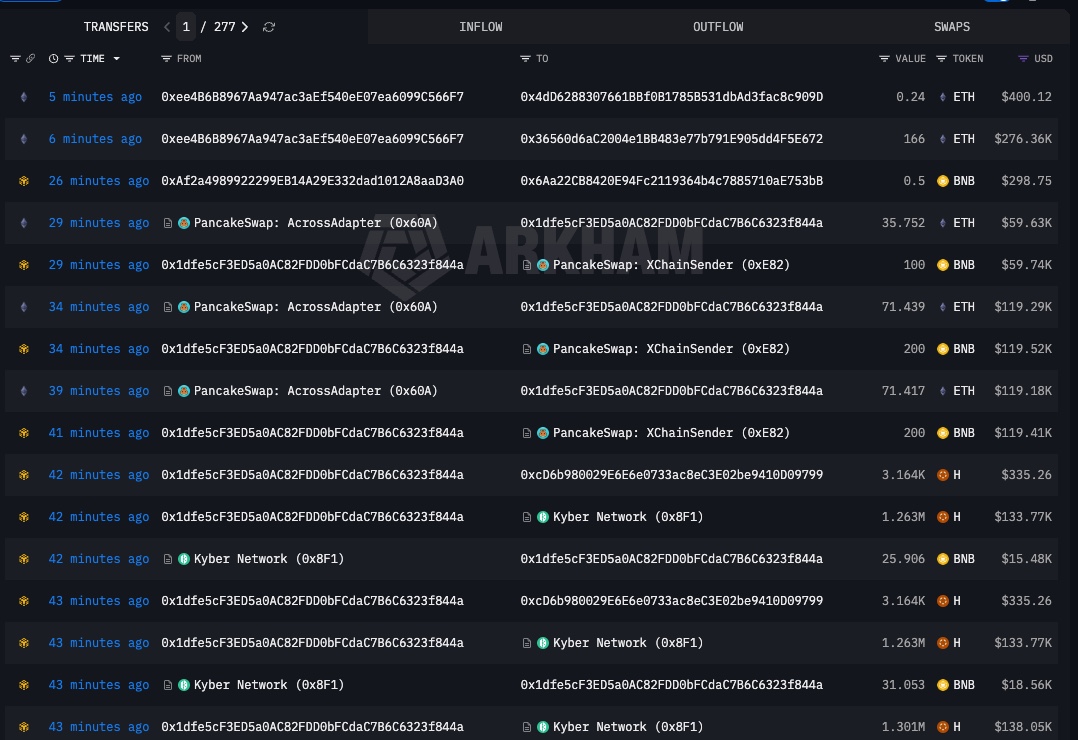
On June 9, according to on-chain analyst Specter's monitoring, wallets that have interacted with the digital identity project Humanity are under sustained attack. Hundreds of addresses holding H tokens have been compromised so far, with total losses exceeding $31 million. Approximately $9 million has been swapped for ETH, with another $9.9 million still held in the form of H tokens.


Humanity founder Terence Kwok subsequently confirmed the security incident, involving the leakage of a private key belonging to a foundation member. As a precaution, he advised users to temporarily refrain from interacting with the Humanity cross-chain bridge or any liquidity pools until further safety confirmation. The team is working with security experts and exchange partners to handle the situation and will continue to update the community on the progress.
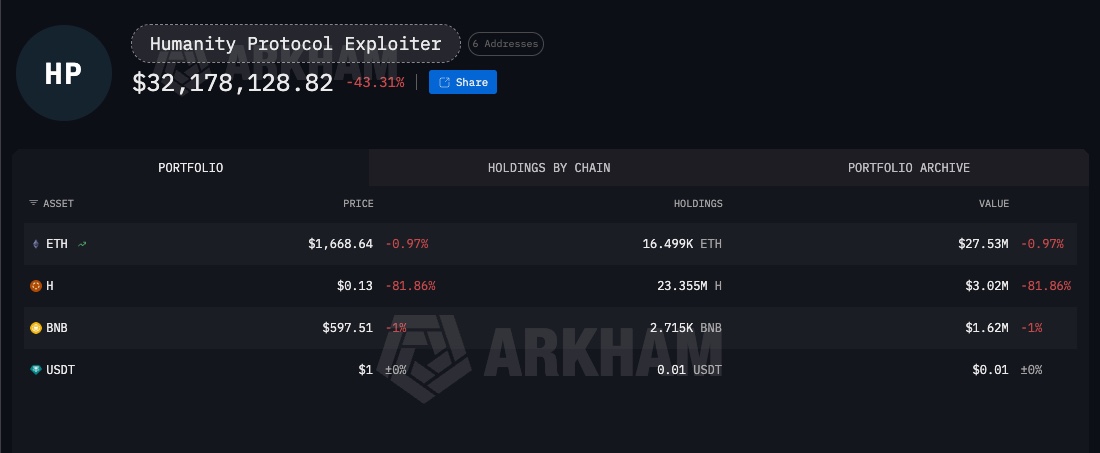


The price of the H token plummeted from around 0.7 USDT to a low of 0.052 USDT, a drop of over 90% within 24 hours. At the time of writing, H is trading at 0.1368301 USDT, with its market capitalization falling from around $2 billion to approximately $35.7 million.


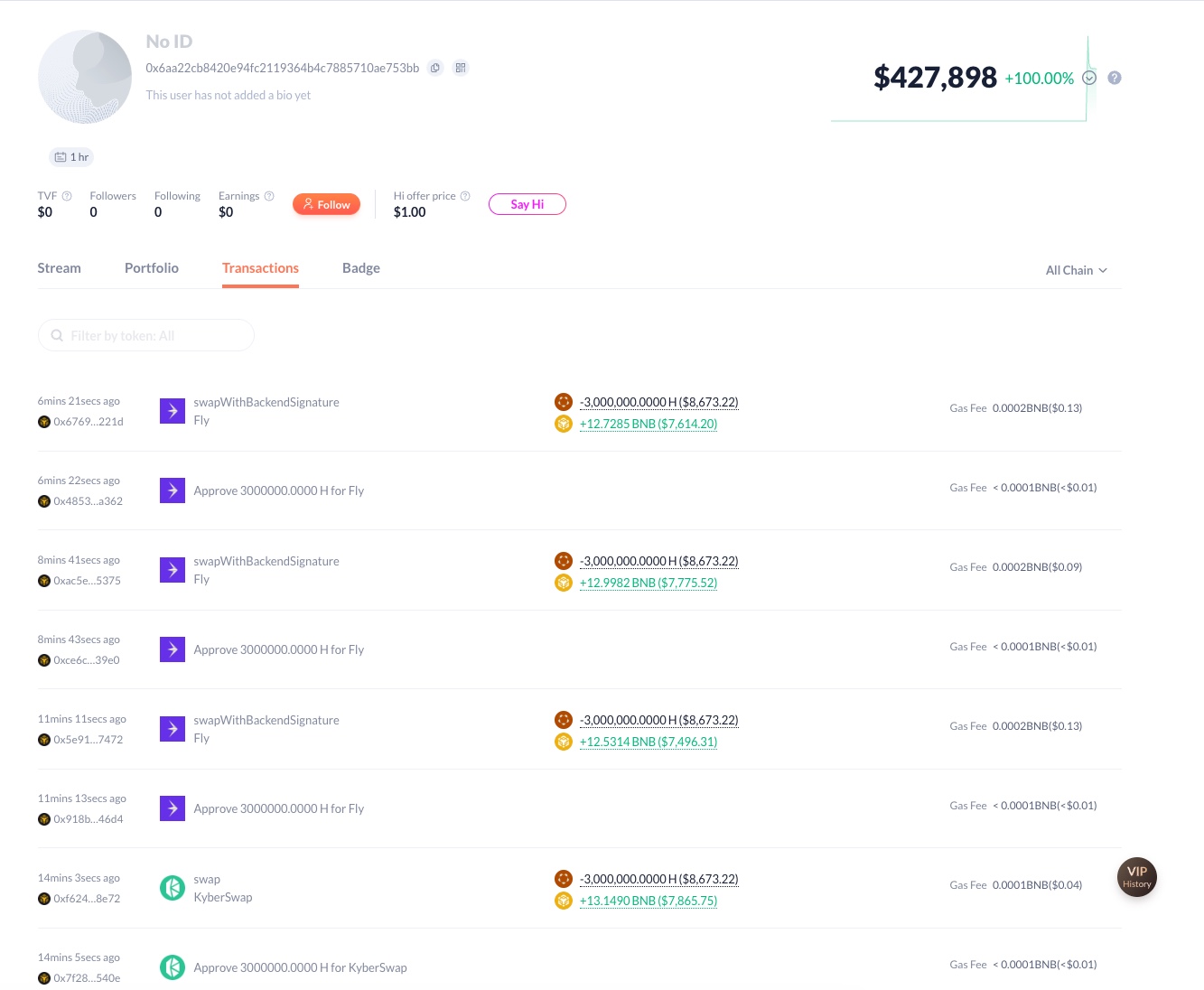
As of 11:00 AM on June 9, the attacker is suspected of minting 100 million new Humanity Protocol H tokens and is currently selling them off for BNB.


A Project That Never Truly 'Proved Humanity'


Humanity Protocol was founded in 2024, positioning itself as a decentralized digital identity network. Its core selling point was using palm print biometrics and zero-knowledge proofs to verify whether a user is a real human. Built on Polygon CDK (zkEVM), the project claimed to solve issues like Sybil attacks, fake accounts, and AI-generated identities without exposing personal information.


This narrative attracted significant capital attention in 2024. Humanity Protocol completed two rounds of funding totaling $50 million. A $30 million seed round at a $1 billion valuation included investors like Kingsway Capital, Animoca Brands, Blockchain.com, and Shima Capital. In January 2025, another $20 million round led by Pantera Capital and Jump Crypto raised the valuation to $1.1 billion.


The Humanity Foundation also assembled numerous well-known figures, led by Animoca Brands Chairman Yat Siu. Co-founders included Mario Nawfal, founder of the international blockchain consulting firm, and Yeewai Chong, a senior investment expert from Morgan Stanley and Ortus Capital.


On June 25, 2025, the H token launched via a Fairdrop mechanism, touted as the first-ever token distribution in Web3 history exclusively to verified humans. However, two days after launch, DL News reported leaked conversations from the founder. In the dialogue, Kwok admitted that out of the 9 million Human IDs created on the network, only about 1 million had completed biometric verification, implying that up to 88% of users might be bots.


Furthermore, according to revelations from X platform users SCoin (@ LianFang _) and AB Kuai . Dong (@_FOR AB ), Humanity Protocol (H) might be a "repackaged domestic project," with APP code material libraries still containing images from Shenzhen access control manufacturer Zhangteng Information, raising doubts about its authenticity. Netizens claimed much of its social media hype was self-generated by project-side accounts, with actual user participation questionable.
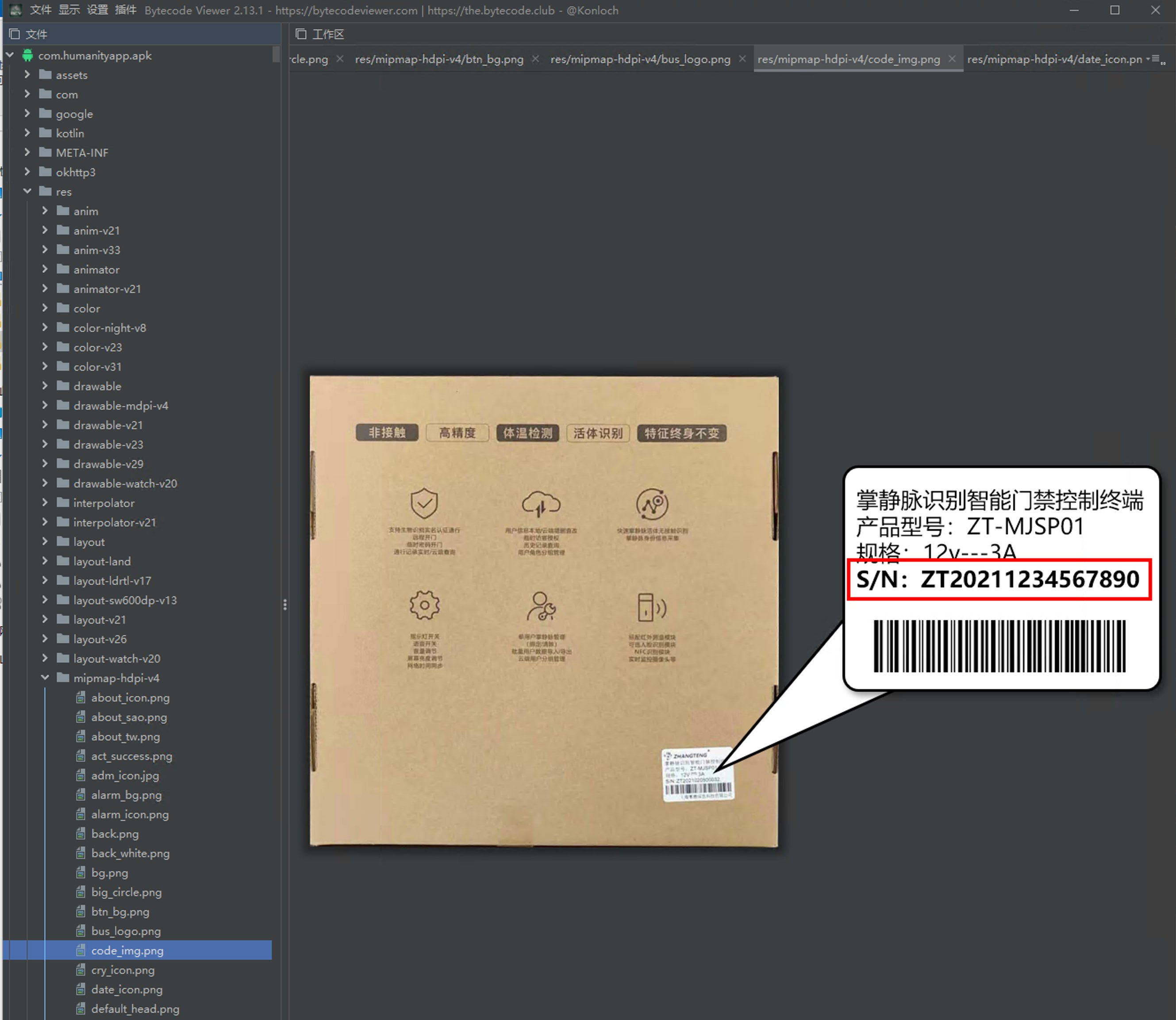


AB Kuai.Dong stated that those who previously completed verification with Humanity should be cautious. Zhangteng Information is allegedly backed by a Shanghai-based outsourcing company specializing in full identity recognition outsourcing. Additionally, whistleblower SCoin claimed the project collected large amounts of users' palm print data, raising privacy and security concerns.


This was fatal for a project whose core value proposition was "proving humanity." The H token fell over 61% within two days of launch, from around $0.05 to a low of $0.018.


The Founder's Previous Unicorn Burned Through $170 Million


Terence Kwok's personal resume added a footnote of risk to the project. In 2012, 20-year-old Terence Kwok dropped out of the University of Chicago and, inspired by a $900 roaming bill received during a trip, founded Tink Labs. The company provided free smartphones (branded Handy) to hotel rooms for guests to use abroad, replacing expensive roaming fees. This concept once captivated the capital market. Tink Labs raised $170 million successively from Foxconn, SoftBank, Innovation Works, and the founder of Meitu, reaching a valuation of $1.5 billion and becoming Hong Kong's first unicorn. At its peak, Handy devices covered 600,000 hotel rooms across 82 countries.


However, Kwok's aggressive expansion strategy soon met reality. Global roaming fees continued to decline, hotels were unwilling to pay for Handy devices, and the company began losing money from 2017. According to the Financial Times, SoftBank cut off funding for a key project after discovering that Tink Labs might have diverted funds from its Japanese joint venture to other loss-making markets. In July 2019, over 100 employees from its European, Middle Eastern, and African offices did not receive their salaries. Laid-off employees smeared cake on the walls and floors as they left the Oxford office. On August 1, Tink Labs officially shut down, entering bankruptcy proceedings in January 2020. A former HR director told the FT that Kwok only cared about "making money," and the entire $170 million investment evaporated.


Six years later, Kwok returned to the market with Humanity Protocol, once again securing a unicorn valuation from Pantera Capital and Jump Crypto.


Private Key Management: An Old Problem, a New Cost


Based on current information, this attack does not involve smart contract vulnerabilities or protocol-level security flaws. The attacker obtained a private key belonging to a foundation member, representing a failure in the most traditional security management.


The security landscape for the crypto industry in 2026 was already severe. According to CCN statistics, losses from DeFi hacks in the first four months of 2026 exceeded $1 billion, with most stolen funds still unrecovered. The $286 million attack on Drift Protocol on April 1 was the largest single incident of the year. Attackers are increasingly targeting validators, RPC nodes, and governance systems, not just smart contract vulnerabilities. However, private key leaks remain one of the most devastating attack types because they bypass all on-chain security mechanisms, directly granting control of assets.


For a project already burdened with the controversy of 88% bot users and a token down over 90% from its peak, a $31 million private key leak could be the final blow to trust. As of the time of writing, Kwok stated in his declaration that the team is working with security experts and exchange partners to handle the situation but did not mention any user compensation plan or explain why the foundation member's private key lacked basic protections like multi-signature or hardware isolation.


Domande pertinenti

QWhat was the total estimated loss in the Humanity Protocol security incident, and what were the main assets stolen?

AThe total estimated loss exceeded $31 million. Approximately $9 million was converted to ETH, and about $9.9 million remained in the form of H tokens.

QAccording to the article, what was the specific cause of the Humanity Protocol security breach?

AThe security breach was caused by the private key of a foundation member being compromised.

QWhat was a major controversy regarding Humanity Protocol's user verification process that was reported before the hack?

AA leaked conversation revealed that out of 9 million created Human IDs, only about 1 million had completed biometric verification, suggesting around 88% of users might be bots.

QWhat previous venture of Humanity Protocol's founder, Terence Kwok, failed after burning through $170 million in funding?

ATerence Kwok's previous venture was Tink Labs (branded Handy), which provided free smartphones to hotel rooms and failed after reportedly burning through $170 million in funding.

QHow did the article characterize the nature of the attack on Humanity Protocol in relation to common DeFi security failures?

AThe article characterized the attack not as a smart contract vulnerability, but as a traditional security management failure involving private key compromise, bypassing all on-chain security mechanisms.

Letture associate

Weekly Editor's Picks (0725-0731)

Weekly Editor's Picks (0725-0731) provides a curated selection of deep analysis, filtering out market noise. Key themes from this week include: **Macro & Policy:** The Federal Reserve's upcoming meeting is marked by high uncertainty, balancing cooling inflation data against persistent price pressures. Meanwhile, the U.S. crypto regulatory Clarity Act faces critical political hurdles, with its 2026 passage probability seen as low. **Investing & Crypto:** Analysis suggests long-term crypto success depends on conviction through volatile cycles, focusing on assets like Bitcoin and core smart contract platforms. A trend noted is the increasing similarity between global equity markets (especially tech) and crypto, driven by narrative and leverage. Several major crypto protocols show strong revenue growth, but this isn't always translating to token price appreciation due to sell pressure and structural factors. **AI & Semiconductors:** Nvidia's rising credit default swap rates signal market concern over AI infrastructure financing risks. The storage sector experienced volatility as markets began pricing in potential 2027 oversupply. Despite a record profitable quarter, SK Hynix's results were deemed "below expectations," reflecting heightened investor demands for future growth visibility. **Markets & DeFi:** TradeXYZ demonstrated remarkable accuracy in pre-market pricing for a major A股 listing. The token ONDO saw gains, linked to its growing role in the on-chain tokenized stock ecosystem. **Ethereum:** Post-Pectra upgrade, a major structural shift is underway as Lido begins migrating millions of ETH to new validator architectures designed for capital efficiency. **Also Highlighted:** Butian's bullish stock market move; OpenAI's Altman promising major advances; Samsung and SK Hynix securing large AI chip deals; Apple reaching a $5T market cap; and ongoing discussions around exchange security following Poolin's bankruptcy case.

marsbit28 min fa

Weekly Editor's Picks (0725-0731)

marsbit28 min fa

Low Investment Isn't Apple's Immunity Pass

While Meta and Google face investor scrutiny over ballooning AI capital expenditures, Apple's minimal AI investment has paradoxically become a strength. Its market cap recently reclaimed the global top spot, surpassing $5 trillion. The irony is deep: Apple's own AI efforts have lagged, with "Apple Intelligence" delayed and core talent lost, forcing reliance on partners like Google Gemini and Alibaba's Qianwen. Its Q3 FY2026 (Q2 CY) earnings initially seemed stellar. Revenue hit $109.4B (up 16% YoY), with iPhone and Mac sales, growing 22% and 29% respectively, driving most of the growth. However, the stock fell over 8% post-earnings. The primary concern was a weaker Q4 revenue growth forecast of 9-11%, below expectations, due to looming supply chain constraints. Apple is feeling the indirect cost of the AI boom. Soaring memory and chip prices, fueled by massive data center investments from Microsoft, Amazon, and others, are forcing Apple to raise Mac and iPad prices significantly. The upcoming iPhone launch is also expected to see substantial price hikes. Despite avoiding heavy AI infrastructure spending—its capital expenditures are actually down 28%—Apple cannot escape the industry-wide supply and cost pressures. While Apple's operating cash flow remains robust, its substantial R&D spending (up 32% YoY) has yet to yield major AI breakthroughs. As Tim Cook prepares to step down as CEO, Apple faces a challenging transition: balancing its premium hardware success against the strategic and cost pressures of the AI era it has so far cautiously navigated.

marsbit1 h fa

Low Investment Isn't Apple's Immunity Pass

marsbit1 h fa

PA Graphics Explanation | One Chart to Understand the Major Web3 Events in August 2026

**PANews Crypto Calendar: Key Web3 Events in August 2026** PANews introduces its revamped crypto calendar, featuring comprehensive coverage, flexible filtering, and easy export options. The market in August will be shaped by multiple key events across macroeconomics, regulation, tokenomics, and project developments: * **Macro & Policy:** Key US economic data releases (July Non-Farm Payrolls, CPI), the Federal Reserve meeting minutes, and the Jackson Hole Economic Symposium will be in focus. On the regulatory front, the US Senate plans to release a new draft of the *CLARITY Act*, while the EU's expanded crypto ban against Belarus comes into effect. * **Token Unlocks:** Significant token unlocks are scheduled for assets including ENA, AVAX, CONX, ZRO, and KAITO, which may influence market volatility. * **Project Updates & Shutdowns:** Several services, including Exchange Art, Ctrl Wallet, Zapper, NFTfi, and Summer.fi, are set to cease operations or undergo major adjustments. Users are advised to manage their assets accordingly. * **Corporate Activity:** Q2 earnings reports from companies like SpaceX, Circle, and Nvidia are due. Unitree Robotics will initiate its IPO subscription on the STAR Market, and Moonshot AI plans to begin a Pre-IPO financing round. * **Industry Events:** Major conferences such as Bitcoin Asia 2026 and the 2026 Digital Expo will take place. The overarching market narrative for August will revolve around macroeconomic expectations, regulatory developments, token unlock schedules, and ongoing industry consolidation.

marsbit1 h fa

PA Graphics Explanation | One Chart to Understand the Major Web3 Events in August 2026

marsbit1 h fa

Wall Street's Most Famous 'Cassandra' Now Has His Sights Set on Nvidia

Michael Burry, the famed "Big Short" investor, has once again captured Wall Street's attention with a series of short positions against major tech and semiconductor stocks, most notably Nvidia. In late June and July, through his "Cassandra Unchained" newsletter, Burry disclosed short bets against Nvidia, Tesla, Applied Materials, Caterpillar, the SOXX semiconductor ETF, and later, Micron Technology. His core thesis revolves around potential distortions in the AI infrastructure boom, specifically questioning whether extended depreciation schedules (e.g., 6 years vs. a realistic 2-3 years for AI chips) by cloud giants like Microsoft and Google artificially inflate profits. He also raises concerns about possible "off-balance-sheet circular financing," where chip demand might be propped up by vendor-backed funding to clients. Nvidia's stock experienced volatility following these disclosures, briefly dipping but largely holding near Burry's reported entry points, leaving his positions roughly flat or slightly underwater as of late July. This move is part of a pattern for Burry, whose track record since his legendary 2008 bet is mixed. He has faced notable losses, such as on Tesla in 2021, while scoring on broader market turns like the 2020 pandemic crash. His methodology focuses intensely on free cash flow and scrutinizing original financial documents to spot overvaluation and structural risks, but it often struggles with timing the market. The article contrasts Burry's stance with other prominent investors. Steve Eisman, another "Big Short" figure, is not shorting Nvidia, citing strong fundamentals but expressing nervousness about sustainability. Jim Chanos agrees with the broad "accounting mismatch" concern—comparing it to the dot-com bubble—but targets financial leverage in private equity firms rather than the chip stocks themselves. While Nvidia's short interest remains relatively low at 1.3-1.4% of float, the massive stock size means absolute short losses have been significant, exceeding $5 billion earlier this year. The piece concludes that for ordinary investors, the key takeaway is not replicating specific short bets but learning from the critical frameworks these investors use: questioning rosy accounting, identifying structural vulnerabilities, and maintaining skepticism during market euphoria, even if pinpointing the exact catalyst for a downturn remains elusive.

marsbit1 h fa

Wall Street's Most Famous 'Cassandra' Now Has His Sights Set on Nvidia

marsbit1 h fa

Trading

Spot
活动图片