How to View the Divergence Between Gold and Oil Prices?

marsbitPubblicato 2026-03-23Pubblicato ultima volta 2026-03-23

Introduzione

The article analyzes the divergence between gold and oil prices following the outbreak of the U.S.-Iran war. While oil prices surged significantly, gold experienced a decline, contrary to expectations given its traditional role as a safe-haven asset during geopolitical crises. Gold serves three primary hedging functions: against geopolitical risk, inflation risk, and U.S. dollar risk. Since late 2023, gold had been in a strong bull market, rising from $1,800 to over $5,000, driven by simultaneous geopolitical tensions (e.g., Russia-Ukraine war, Middle East conflicts), inflationary pressures, and a weakening dollar due to the Fed's premature rate cuts. However, after the U.S. "decapitation" strike on Iran, gold prices fell sharply. This was attributed to two main factors: a shift of capital from gold to oil, as investors repositioned portfolios to capitalize on rising oil prices, and a liquidity crisis in U.S. financial markets that forced large-scale sell-offs of gold—a highly liquid asset—to meet redemption demands. More critically, growing pessimism about a prolonged U.S.-Iran conflict raised fears of sustained high oil prices, potential global economic disruption, and a possible reversal of Fed monetary policy (delayed cuts or even renewed hikes). This expectation of tighter policy caused gold’s dollar-related hedging function to reverse, overwhelming its geopolitical and inflation hedging roles and leading to a severe correction. Oil prices also experienced volatility...

Since the outbreak of the US-Iran war, as two commodities highly correlated with geopolitics, crude oil and gold have shown completely different trends: the former has risen sharply, while the latter has fallen slightly. Why is this?

As a natural currency, gold has three major hedging functions: hedging against geopolitical risks, inflation risks, and US dollar risks. The price of gold is simultaneously influenced by these three forces, thus playing varying degrees of hedging roles at different stages.
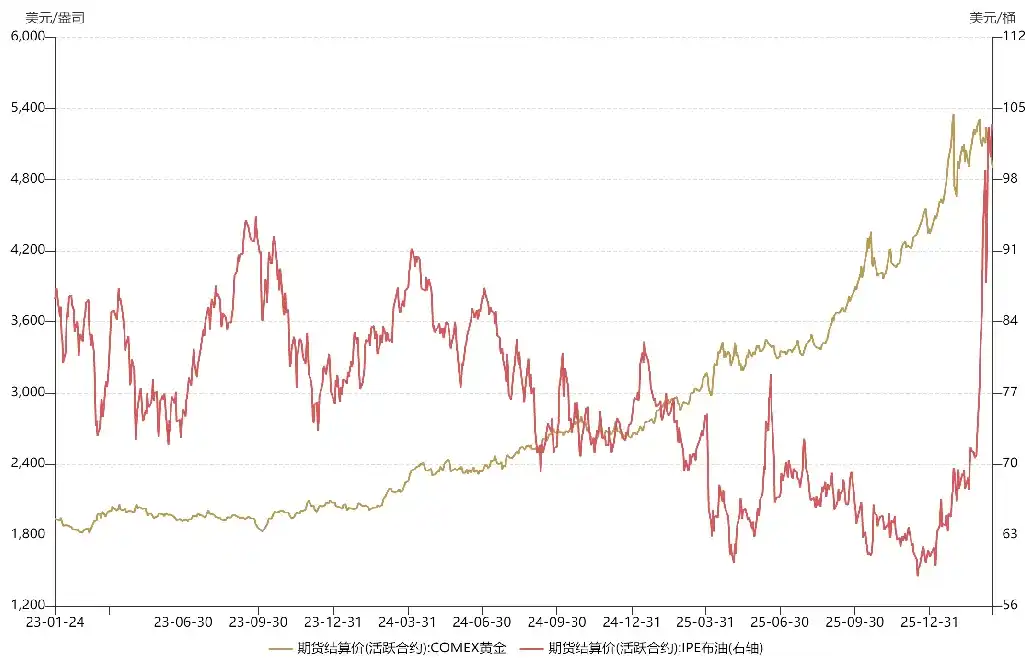
Since the end of 2023, precious metals have experienced a super bull market, with the price of gold soaring from $1,800 to over $5,000. The reason for such strong upward momentum is that gold simultaneously served as a hedge against geopolitical risks, inflation risks, and US dollar risks.

In October 2023, on top of the Russia-Ukraine war, large-scale conflicts broke out between Israel and Palestine, plunging the Middle East into turmoil. In 2024, the Red Sea crisis erupted, and the Bab el-Mandeb Strait was blockaded. In 2025, Trump took office, and the international order became precarious. These are all manifestations of chaotic geopolitical situations, providing strong support for the price of gold.

On the other hand, in 2023, the US economy shifted from overheating to stagflation. By 2024, influenced by political factors, the Federal Reserve boldly initiated an interest rate-cutting cycle before inflation issue was fully resolved, leading to a resurgence of US dollar liquidity. On one hand, there was mid-cycle easing, and on the other, the risk of secondary inflation. Gold simultaneously served as a hedge against US dollar risks and inflation risks, fueling the takeoff of gold prices.

With all three hedging functions in place, how could the price of gold not rise? In addition, benefiting from the Federal Reserve's easing cycle, both emerging and developed markets, whether in A-shares or US stocks, experienced a bull market.

Now, regarding oil prices, last year's average oil price was significantly lower than the previous year. This was because after Trump took office, he persuaded OPEC to significantly increase crude oil production in an attempt to force Russia to make concessions at the negotiating table. This strategy initially worked, with Putin repeatedly softening his stance on peace talks. If not for the US-Iran war, it was expected that Russia and Ukraine would sign a ceasefire agreement in the first half of this year.

Since the outbreak of the Middle East war, the prices of gold and oil have experienced multiple fluctuations, with their trends diverging due to different causes.

For gold, in mid-to-late January (half a month before the war), as the probability of a US-Iran conflict continued to rise, the price of gold increased, reflecting its geopolitical hedging attribute. According to the market's mainstream expectations at the time, this conflict might be similar to last year's "Midnight Hammer" operation, with a short duration, making it more of a temporary trend.

After the US carried out a "decapitation" strike on Iran, the price of gold rebounded briefly but soon plummeted. This was because the main force shifted from gold to crude oil. Due to the excessive concentration of gold holdings earlier, the main funds chose to sell gold to obtain liquidity for going long on crude oil. In other words, the "position switching" from gold to crude oil led to a fall in gold and a rise in oil.

On the other hand, as overseas markets began to price in a prolonged US-Iran war, risk assets such as US stocks came under pressure, triggering a wave of redemptions. The US financial market faced a liquidity crisis, and as an asset with liquidity second only to cash, gold was heavily sold. In other words, the selling pressure on gold in early March was not because international investors were bearish on gold but rather a self-preservation strategy amid the liquidity crisis.

If it were just a liquidity crisis, the price of gold would often form a "deep V" trend, providing buying opportunities. However, the more troublesome part came later. Since mid-March, overseas expectations for the US-Iran conflict have become more pessimistic, with concerns not only about the potential long-term blockade of the strait but also about the possibility of warring parties launching large-scale attacks on each other's energy facilities. This would keep oil prices at relatively high levels for an extended period, dealing a devastating blow to the global economy and even causing the collapse of the international order. In such a scenario, the Federal Reserve might delay its interest rate-cutting pace or even restart a rate-hiking cycle as it did in 2022. Based on this expectation, the price of gold plummeted, with the extent of the correction breaking the highest record in recent years.

In other words, gold's geopolitical hedging function is still at play, but the current sharp decline in gold prices is driven by expectations of a reversal in the Federal Reserve's monetary policy. The US dollar anti-hedging attribute of gold has overshadowed its geopolitical and inflation hedging attributes, becoming its main driver. Compared to previous declines, the fundamentals of gold have changed. It is no longer a liquidity crisis or profit-taking but rather overseas concerns about the tightening of the Federal Reserve's monetary policy. These concerns are also reflected in risk assets such as A-shares and US stocks, as no one is spared when disaster strikes.

Since the outbreak of the US-Iran war, oil prices have also experienced twists and turns. The reason for this volatility is that overseas investors' perception of geopolitics has deviated. After the "decapitation" strike, oil prices continued to rise, reaching nearly $120 per barrel. However, in early March, as Trump hinted that "the war will end soon," the market began executing "TACO" trades, believing that the Iran situation might ease, and oil prices once plummeted by 30%. However, unlike tariff issues, the initiative in a geopolitical crisis does not lie with Trump. He cannot extricate himself easily while the strait is blockaded. Eventually, the market corrected its expectations for oil, and prices returned to an upward trend.

On geopolitical issues, the market sometimes makes misjudgments, but such pricing deviations are not necessarily bad. A drop in oil prices can反而 provide opportunities to add positions, making it easier for latecomers to enter the market.

Looking ahead, the trends of gold and oil prices will depend on the pace of the US-Iran conflict. If it evolves into a prolonged war like the Russia-Ukraine conflict, gold may lack配置 value in the first half of the year, and in the short term, one might focus on the energy chain. However, the situation could still reverse. The US-Iran war may reach a critical turning point, which will determine whether the Strait of Hormuz can be unblocked in the short term. It all depends on Trump's choice.


Domande pertinenti

QAccording to the article, what are the three main safe-haven functions of gold?

AThe three main safe-haven functions of gold are: hedging against geopolitical risks, hedging against inflation risks, and hedging against U.S. dollar risks.

QWhat event in 2025 is mentioned as a factor contributing to the chaotic geopolitical situation that supported gold prices?

ADonald Trump taking office in 2025 is mentioned as a factor that made the international order precarious, contributing to the chaotic geopolitical situation.

QWhy did the price of gold fall sharply after the U.S. 'decapitation' strike on Iran, as explained in the article?

AThe price fell because major funds switched from gold to crude oil, selling gold to obtain liquidity for oil positions. Additionally, a liquidity crisis in U.S. financial markets led to large-scale selling as gold is a highly liquid asset.

QWhat was the main reason for the significant drop in gold prices from mid-March onwards, according to the analysis?

AThe main reason was the market's expectation that the Federal Reserve might delay interest rate cuts or even restart a rate hike cycle due to concerns that the U.S.-Iran conflict could keep oil prices high and severely impact the global economy.

QWhat does the article suggest is the key factor that will determine the future trends of gold and oil prices?

AThe future trends of gold and oil prices will depend on the pace and development of the U.S.-Iran conflict, specifically whether it becomes a protracted war like in Ukraine and the critical issue of whether the Strait of Hormuz can be unblocked in the short term.

Letture associate

The Gold Buy-on-the-Dip Guide: Watch Interest Rates, Not Just War

"Gold Buying Guide: Focus on Interest Rates, Not Just War" Four months ago, gold buyers likely didn't anticipate buying at a peak that even a war couldn't sustain. After hitting a record high of $5,596 on January 29, gold entered a bear market just 91 days later, its fastest decline since 2008. A key trigger was the Fed's hawkish shift, highlighting that monetary policy, not geopolitics, is the primary driver. The article argues that the traditional "buy gold in turmoil" script has changed. While the US-Iran conflict initially boosted prices, the sustained rally in oil prices heightened inflation fears, forcing central banks to maintain or consider tighter policy. Since gold yields no interest, higher rates increase its opportunity cost, eroding its appeal. This dynamic was evident when gold fell sharply on May 18 despite positive peace talks, as lower oil prices eased inflation and thus rate hike pressures. The recent sell-off is also part of a broader market deleveraging. Correlations between gold, Nasdaq, and Bitcoin spiked as leveraged investors sold liquid assets to cover losses, creating a synchronized downturn. Historically, gold bottoms align with policy shifts, not conflict resolutions. The 2008 and 2022 bear markets ended with shifts to extreme easing and peak inflation expectations, respectively. For potential buyers, the author suggests monitoring three signals: 1) Peak interest rate hike expectations, 2) Reopening of the Strait of Hormuz (to ease oil/inflation pressure), and 3) A return to net inflows for Gold ETFs, indicating the end of forced selling. While predicting the exact bottom is impossible, the author's personal strategy involves scaling into a position across price levels like $4000, $3700, and $3500, committing no more than 30% of the intended total allocation initially, and adding the remainder only if key signals emerge. The core conclusion: In turbulent times, watching interest rates is more crucial than watching wars.

marsbit7 min fa

The Gold Buy-on-the-Dip Guide: Watch Interest Rates, Not Just War

marsbit7 min fa

Recent On-Chain Review: No Clear Narrative Under U.S. Stock Market Pressure, Just Hype

This article analyzes the current state of the Solana meme coin and community token ecosystem, highlighting a market caught between two dominant forces: attention-based PvP and a gradual return to community-centric projects. The first part explores the "Attention PvP" dynamic, where success is driven by celebrity endorsements, viral events, and speed. Examples include $JOTCHUA, which surged after its meme creator's social media activity, and $WORLDCUP, which outperformed a similar Base chain project ($PITCH) largely due to influencer support. The recent "pump.fun GO" feature, allowing bounty tasks for token promotion, is critiqued for fostering sensationalist and often negative stunts—like people getting token tickers tattooed on their bodies for rewards—reminiscent of old internet shock content. In contrast, the article points to a resurgence of organic, community-driven tokens that survive market volatility through strong holder bases and shared ideology, not just hype. Influencer Ansem is cited, arguing that durable meme coins rely on communities willing to endure losses and promote their core message daily. Examples given are older tokens like $neet (anti-work ethos), $troll, $buttcoin, and $triplet, which have maintained relative price stability. A prime example of this community-build model is the new project $KINS, the token for the browser-based MMORPG Kintara. Its success stems not from advanced graphics but from consistently delivering updates, fostering player trust, and creating genuine engagement (e.g., in-game economies, events, property auctions). It has attracted a growing player base and even notable KOLs as participants, demonstrating that sustainable growth can come from building trust rather than orchestrating pumps. The article concludes by questioning whether the market is ultimately a game of mutual trust or mutual deception, expressing hope that such reflection might lead to a healthier ecosystem.

marsbit7 min fa

Recent On-Chain Review: No Clear Narrative Under U.S. Stock Market Pressure, Just Hype

marsbit7 min fa

On-Chain Scene on Opening Day: $20 Billion Already Staked, How Do On-Chain Contracts Know Who Wins?

On the opening day of the 2026 World Cup, over $2 billion had already been wagered on just the "tournament winner" contracts on platforms like Polymarket and Kalshi. This article explores how these blockchain-based prediction markets actually function once the games begin. It breaks down the massive volume and explains how single-game and tournament-long contracts are priced, with values moving between 1-99 cents to reflect implied probabilities. A key mechanism highlighted is "elimination zeroing," where a team's "champion yes" contract immediately settles to zero once they are mathematically eliminated. The core technical question answered is: how does a smart contract "know" who won a real-world match? The answer lies in oracles. The article details two primary paradigms: UMA's "optimistic oracle" (used by most of Polymarket), which allows a challenge period after a proposed result, and Chainlink's multi-source data aggregation (used by FIFA partners like ADI Predictstreet), which automates settlement with minimal dispute windows. Finally, the article injects a note of caution, citing research estimating that a significant portion of historical trading volume on these platforms might be "wash trading" to inflate numbers. It concludes by contrasting the legal status of these "event contracts" under CFTC rules in the U.S. versus traditional, state-regulated sports betting. As the tournament progresses, the real-time operation of this multi-billion dollar machine—its settlements, eliminations, and underlying mechanisms—becomes a story as compelling as the football itself.

marsbit22 min fa

On-Chain Scene on Opening Day: $20 Billion Already Staked, How Do On-Chain Contracts Know Who Wins?

marsbit22 min fa

Sequoia Dialogue with Jensen Huang: Computing Model Undergoes a 60-Year Transformation; You Won't Be Replaced by AI, But You Will Be Dimensionality-Reduced by 'Those Who Master AI'

NVIDIA founder and CEO Jensen Huang, in a conversation with Sequoia Capital's Konstantine Buhler, argues that we are witnessing the most significant computing shift in 60 years—from retrieval-based to generative computing. Instead of just storing and retrieving data, future systems will generate highly personalized content (text, images, video) on demand, powered by massive "AI factories." Huang envisions a global "intelligence network" that will envelop the planet, following the historical patterns of energy and communication grids. He outlines a five-layer investment framework: 1) Energy, 2) Chips/Computers, 3) Infrastructure (data centers), 4) AI Models, and 5) Applications. He predicts this ecosystem will reach a scale of $20 trillion annually. Crucially, Huang pushes back against fears of AI-driven job loss. He distinguishes between specific "tasks" (e.g., typing, analyzing images) and overall "jobs" (e.g., CEO, radiologist). While AI automates tasks, it increases efficiency and demand for the higher-value problem-solving aspects of professions, thus creating more jobs and "up-leveling" careers. The real risk, he asserts, is not being replaced by AI, but being outperformed by someone who effectively leverages it. He urges everyone to embrace AI as a tool for augmented capability and innovation.

marsbit1 h fa

Sequoia Dialogue with Jensen Huang: Computing Model Undergoes a 60-Year Transformation; You Won't Be Replaced by AI, But You Will Be Dimensionality-Reduced by 'Those Who Master AI'

marsbit1 h fa

Trading

Spot
Futures

Articoli Popolari

Come comprare WAR

Benvenuto in HTX.com! Abbiamo reso l'acquisto di WAR (WAR) semplice e conveniente. Segui la nostra guida passo passo per intraprendere il tuo viaggio nel mondo delle criptovalute.Step 1: Crea il tuo Account HTXUsa la tua email o numero di telefono per registrarti il tuo account gratuito su HTX. Vivi un'esperienza facile e sblocca tutte le funzionalità,Crea il mio accountStep 2: Vai in Acquista crypto e seleziona il tuo metodo di pagamentoCarta di credito/debito: utilizza la tua Visa o Mastercard per acquistare immediatamente WARWAR.Bilancio: Usa i fondi dal bilancio del tuo account HTX per fare trading senza problemi.Terze parti: abbiamo aggiunto metodi di pagamento molto utilizzati come Google Pay e Apple Pay per maggiore comodità.P2P: Fai trading direttamente con altri utenti HTX.Over-the-Counter (OTC): Offriamo servizi su misura e tassi di cambio competitivi per i trader.Step 3: Conserva WAR (WAR)Dopo aver acquistato WAR (WAR), conserva nel tuo account HTX. In alternativa, puoi inviare tramite trasferimento blockchain o scambiare per altre criptovalute.Step 4: Scambia WAR (WAR)Scambia facilmente WAR (WAR) nel mercato spot di HTX. Accedi al tuo account, seleziona la tua coppia di trading, esegui le tue operazioni e monitora in tempo reale. Offriamo un'esperienza user-friendly sia per chi ha appena iniziato che per i trader più esperti.

200 Totale visualizzazioniPubblicato il 2024.12.11Aggiornato il 2026.06.02

Come comprare WAR

Discussioni

Benvenuto nella Community HTX. Qui puoi rimanere informato sugli ultimi sviluppi della piattaforma e accedere ad approfondimenti esperti sul mercato. Le opinioni degli utenti sul prezzo di WAR WAR sono presentate come di seguito.

活动图片












