How to Use Premium Rate to See Through ETF Fund Flows 24 Hours in Advance?

比推Pubblicato 2026-01-30Pubblicato ultima volta 2026-01-30

Introduzione

This article explains how to use the ETF premium/discount rate as a leading indicator to predict fund flows into and out of Bitcoin and Ethereum ETFs up to 24 hours before official data is released. The premium rate reflects the difference between an ETF's market price and the net asset value (NAV) of its underlying assets. A positive premium indicates bullish sentiment and high demand, often leading to net inflows as authorized participants (APs) create new shares to arbitrage the price difference. Conversely, a negative premium (discount) signals bearish sentiment and selling pressure, typically resulting in net outflows as APs redeem shares. Historical data from 2025-2026 shows a strong correlation: a positive premium predicted net inflows with 84% accuracy, while a negative premium predicted net outflows with 81% accuracy. Key practical applications include: - Monitoring the persistence of premiums/discounts over multiple days, not just single readings. - Watching for extreme values beyond ±0.5%, which indicate strong sentiment shifts. - Combining the indicator with price action (e.g., sustained discounts at market tops can signal early distribution). The article cautions that this is not a standalone tool. For higher conviction, it should be combined with other metrics like changes in ETF holdings, futures basis and funding rates, options put/call ratios, and on-chain exchange flows to confirm trends and potential turning points.

Author: Umbrella, Deep Tide TechFlow

Original Title: Understanding Premium Rate Lets You Be 24 Hours Faster Than ETF Data


Since the approval of BTC and ETH spot ETFs, daily ETF fund inflows and outflows have become a core indicator for many traders' market analysis.

The logic is simple: net inflows indicate institutional buying and bullish sentiment; net outflows indicate institutional selling and bearish sentiment.

However, the problem is that the ETF data we see daily is always from the previous day.

By the time the data is released, the price has often already reflected it.

So, is there any way to predict whether today's ETF will have net inflows or net outflows in advance?

Yes, the answer is the ETF premium rate.

It's not difficult to verify this pattern; looking back at the recently concluded January 2026 is the best sample.

As of January 28, there were 18 trading days in the U.S. stock market.

Statistics show that the premium index on Coinbase remained in positive territory for only two days, while the other 16 days were all in negative premium territory.

Corresponding ETF fund flows show that 11 of these 16 days ultimately recorded net outflows.

Particularly from January 16 to 23, the negative premium rate continuously fell below -0.15%, corresponding to a weekly net outflow of over $1.3 billion from the ETF market, with BTC's price dropping from a high of $97,000 to around $88,000.
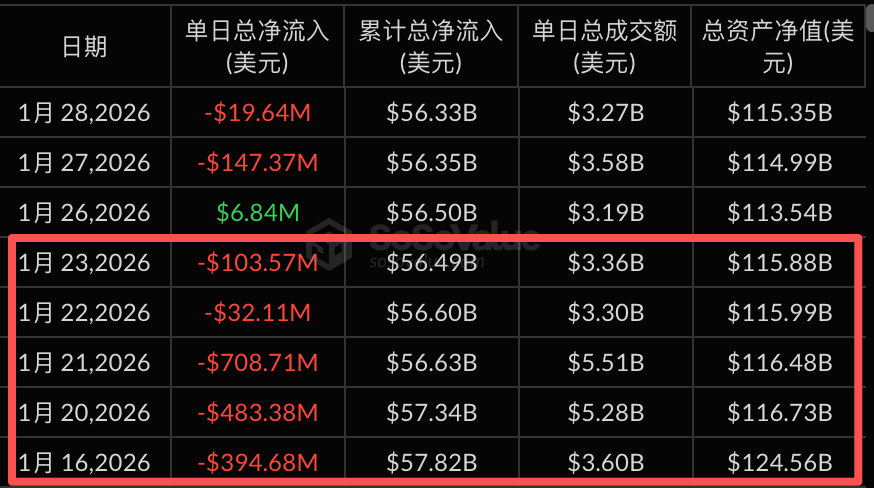
Data source: sosovalue

Let's take a broader view.

From July 1, 2025, to January 28, 2026, there were a total of 146 trading days.

· Negative premium rate occurred for 48 days, corresponding to net outflows for 39 days, with an accuracy rate of 81%.

· Positive premium rate occurred for 98 days, corresponding to net inflows for 82 days, with an accuracy rate of 84%.

This is the value of the premium rate—it allows you to see where the funds are flowing earlier than most.

What Is Premium Rate?

We've been talking about the premium rate, but what exactly is it?

Here's an analogy.

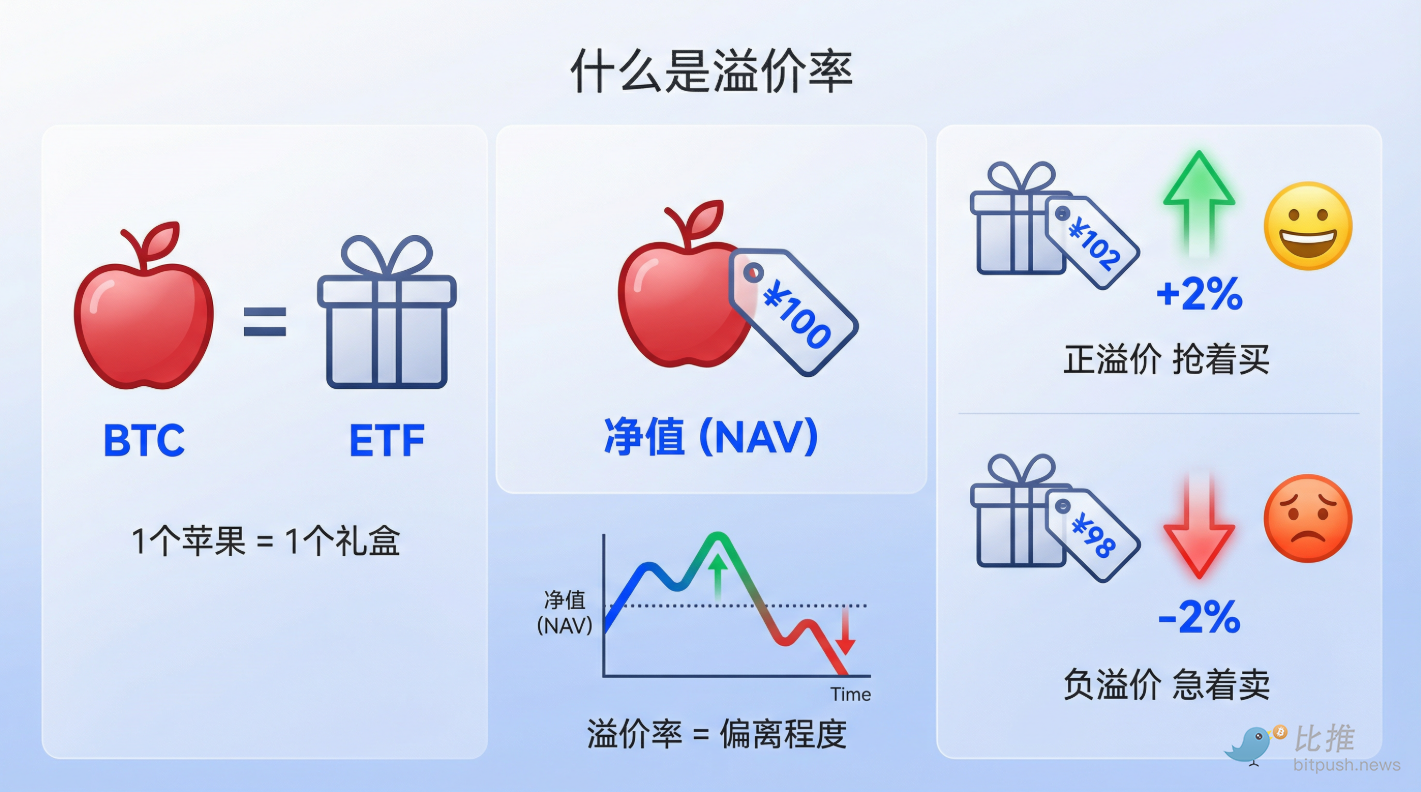
BTC is like loose apples in a grocery market, while BTC spot ETFs are like packaged apple gift boxes in a supermarket, each containing one apple.

An apple sells for $100 in the grocery market—this is the net asset value (NAV).

How much the apple gift box sells for in the supermarket depends on supply and demand.

If many people buy it, the box is bid up to $102—this is a positive premium rate, with a premium of +2%.

If many people sell it, the box drops to $98—this is a negative premium rate, with a premium of -2%.

The premium rate reflects the degree to which the ETF market price deviates from the real price of BTC.

A positive premium indicates optimistic market sentiment, with everyone rushing to buy.

A negative premium indicates pessimistic market sentiment, with everyone rushing to sell.
The Relationship Between Premium Rate and ETF Inflows/Outflows

The premium rate is not just a market sentiment indicator; it also becomes a key driver of fund flows.

The key players here are APs, or Authorized Participants, whom you can think of as privileged arbitrageurs.

The core logic for APs is risk-free arbitrage: they can subscribe to and redeem ETF shares in the primary market and also buy and sell in the secondary market.

As long as there is a price difference, they will arbitrage.

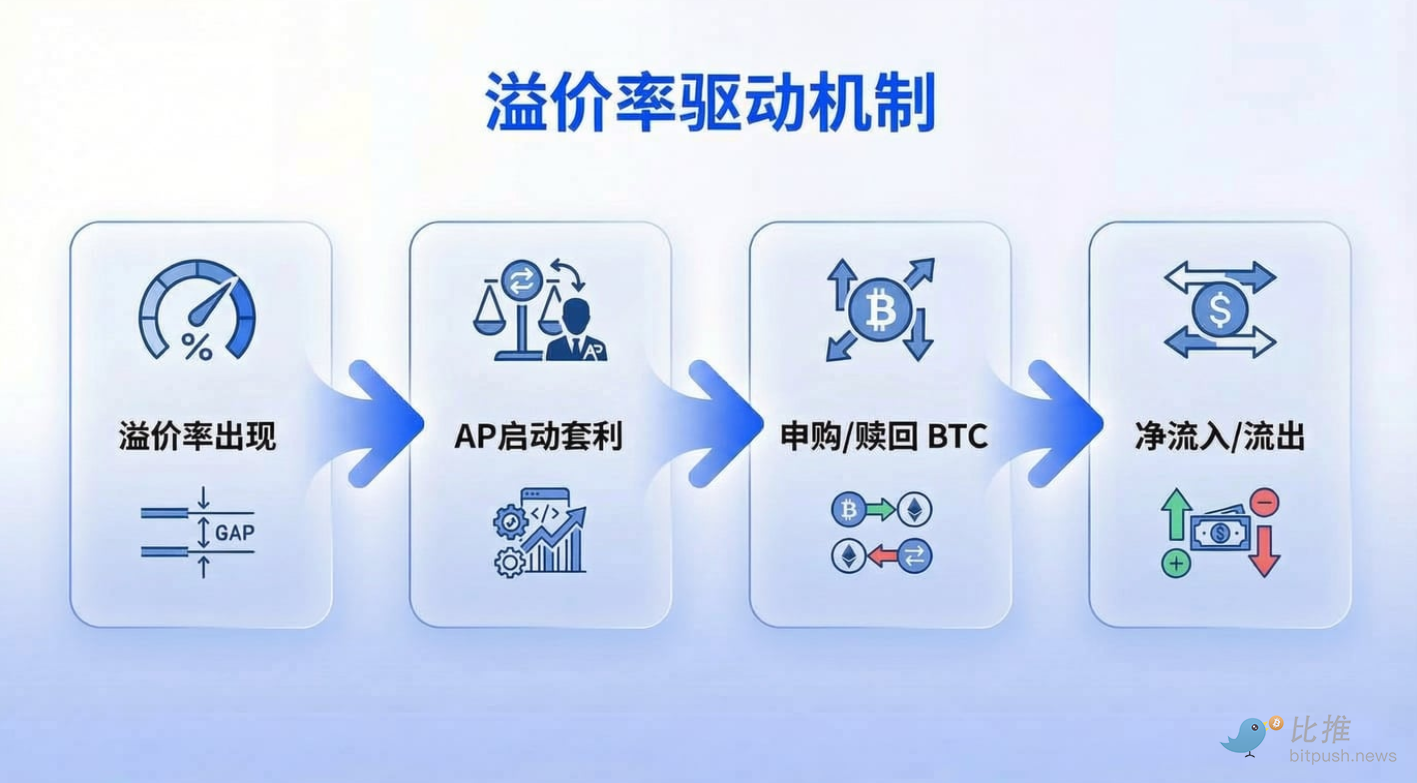
When a positive premium rate appears, the gift box is more expensive than the apple. APs will go to the primary market to buy BTC, package it into ETF shares, and then sell it in the secondary market to profit from the difference. In this process, BTC is bought, resulting in net inflows.

Conversely, when a negative premium rate appears, the gift box is cheaper than the apple. APs will buy ETFs in the secondary market, unbundle them to redeem BTC, and then sell the BTC to profit from the difference. In this process, BTC is sold, resulting in net outflows.

So the logical chain is as follows:

Premium rate appears → APs initiate arbitrage → Subscription or redemption occurs → Net inflows or outflows are generated.
And the ETF fund data we see daily is published the next day after settlement.

The premium rate is real-time; the fund data is lagging.

This is why the premium rate can give you an edge over the market.

How to Apply the Premium Rate

Now that we understand the principle of the premium rate and its relationship with ETF net inflows and outflows, how can we apply it to our trading plans?

First, the premium rate is not an indicator to be used in isolation.

It can tell us the direction of funds but not the magnitude or sustainability.

Here, I suggest combining it with the following dimensions.

1. The Sustainability of the Premium Rate Is More Important Than a Single-Day Value

A single day of negative premium rate may just be short-term volatility.

However, if negative premium rates occur for multiple consecutive days, it is highly likely to correspond to continuous net outflows, which is worth noting.

Looking back at the five consecutive trading days of negative premium rates from January 16 to 23 this year, they corresponded to five days of net outflows, with BTC falling nearly 10%.

2. Pay Attention to Extreme Values of the Premium Rate

Generally, premium rates fluctuate within ±0.5% as the norm.

Once it breaks through ±1%, it indicates a significant deviation in market sentiment, and AP arbitrage activity intensifies, accelerating fund flows.

3. Combine with Price Levels for Judgment

Sustained negative premium rates at high prices may be an early signal of capital flight.

Sustained positive premium rates at low prices may indicate bottom-fishing capital entering the market.

The premium rate itself does not constitute a basis for buying or selling, but it can help you confirm the current trend or detect turning points in advance.

Final Thoughts

Finally, a few reminders are necessary.

No indicator is a holy grail; the effectiveness of the premium rate is based on the normal operation of the AP arbitrage mechanism.

In extreme market conditions, such as the 10.11 crash, where market liquidity dries up, the arbitrage mechanism may fail, and the correlation between the premium rate and fund flows may decrease.

Additionally, the premium rate is just one window into observing ETF fund movements.

For mature investors, the premium rate is just one piece of the puzzle.

It is recommended to combine it with the following indicators for multi-dimensional cross-verification:

  1. ETF Holdings Changes: An increase in holdings indicates institutions are accumulating positions; a decrease indicates they are reducing positions. More direct than the premium rate, but data updates are delayed.

  2. Futures Basis and Funding Rate: A positive basis and continuously rising funding rate indicate overheated bullish sentiment and excessive market optimism. The opposite indicates bearish dominance.

  3. Put/Call Ratio in the Options Market: Puts are put options; Calls are call options. A rising ratio indicates increased market risk aversion; a falling ratio indicates dominant optimism.

  4. On-Chain Large Transfers and Exchange Net Inflows: Large BTC transfers into exchanges usually signal impending selling pressure. Large transfers out of exchanges indicate accumulation.

For example.

When you observe: a continuous negative premium rate, declining ETF holdings, and rising exchange net inflows.

Three signals point in the same direction: funds are withdrawing, and selling pressure is accumulating.

At this point, you should at least be alert and control your positions rather than buying the dip.

A single indicator cannot reveal the full picture; multi-dimensional cross-verification is needed to improve judgment accuracy.

In this market, the more dimensions you observe, the smaller the information gap, but the time gap will always exist.

Whoever sees the direction of funds first gains an extra edge.


Twitter:https://twitter.com/BitpushNewsCN

BitPush TG Discussion Group:https://t.me/BitPushCommunity

BitPush TG Subscription: https://t.me/bitpush

Original link:https://www.bitpush.news/articles/7607387

Domande pertinenti

QWhat is the ETF premium rate and how can it be used to predict fund flows 24 hours in advance?

AThe ETF premium rate is the percentage difference between the market price of an ETF share and its net asset value (NAV). A positive premium rate indicates market optimism and potential net inflows, while a negative rate suggests pessimism and potential net outflows. By monitoring real-time premium rates, traders can anticipate the next day's official ETF flow data, as the rate reflects immediate market sentiment and authorized participants' (APs) arbitrage activities that drive fund flows.

QHow do authorized participants (APs) use the premium rate for arbitrage, and how does this affect ETF fund flows?

AAuthorized participants (APs) engage in arbitrage based on the ETF premium rate. When there is a positive premium (ETF price > NAV), APs buy the underlying assets (e.g., BTC), create ETF shares, and sell them on the secondary market for a profit, leading to net inflows. Conversely, during a negative premium (ETF price

QWhat was the accuracy of the premium rate in predicting ETF fund flows from July 1, 2025, to January 28, 2026, according to the article?

AFrom July 1, 2025, to January 28, 2026, covering 146 trading days, the premium rate had an 81% accuracy for predicting net outflows during negative premium days (48 days, with 39 days of net outflows) and an 84% accuracy for predicting net inflows during positive premium days (98 days, with 82 days of net inflows).

QWhat additional indicators does the article recommend combining with the premium rate for better validation of market trends?

AThe article recommends combining the premium rate with: 1) ETF holdings changes (indirect but delayed data), 2) futures basis and funding rates (indicate market sentiment), 3) Put/Call ratios in options markets (reflect risk sentiment), and 4) on-chain large transfers and exchange net flows (show accumulation or selling pressure). Multi-dimensional cross-verification improves judgment accuracy.

QWhy might the premium rate's effectiveness decrease in extreme market conditions, such as during a crash?

AIn extreme market conditions, like a severe crash (e.g., the referenced 10.11 crash), market liquidity can dry up, causing the arbitrage mechanism for authorized participants (APs) to fail. When APs cannot efficiently execute arbitrage due to illiquidity or high volatility, the correlation between the premium rate and ETF fund flows weakens, reducing the indicator's reliability.

Letture associate

Former CFTC Chairman, Circle President Tarbert: Preaching Long-Termism While Cashing Out $30 Million Himself

Former CFTC Chairman and Circle President Heath Tarbert has consistently advocated for a long-term vision in public, urging patience from investors as Circle’s stock price has fallen significantly from its peak. However, it has been revealed that since Circle’s IPO, Tarbert has continuously sold his CRCL shares through pre-arranged trading plans, cashing out approximately $30 million, without making any public market purchases. This contrast between his public messaging and personal actions has drawn criticism. Tarbert joined Circle in July 2023 as Chief Legal Officer, leveraging his regulatory experience to help guide the company through its IPO and expansion. Despite promoting stablecoins as long-term infrastructure, he established a 10b5-1 trading plan just before Circle went public, leading to substantial stock sales over the following year. In March 2026, he initiated another plan to sell more shares. His career trajectory highlights a pattern of moving between high-level regulatory roles and influential positions in the financial sector. After resigning as CFTC Chairman in early 2021, he joined Citadel Securities as Chief Legal Officer just 27 days later, during a period of intense regulatory scrutiny for the firm. He later joined Circle, aiding its efforts to navigate regulatory challenges for its public listing. While Tarbert's expertise in policy and compliance is valuable to companies like Circle, his actions—advocating long-term confidence while personally divesting—raise questions about the alignment between his public statements and his private financial decisions, leaving investors who followed his advice to bear the market risks.

marsbit8 min fa

Former CFTC Chairman, Circle President Tarbert: Preaching Long-Termism While Cashing Out $30 Million Himself

marsbit8 min fa

Gate Research Institute: The 'Wall Street-ization' Wave of Crypto Financial Products – Competition or Integration?

The article titled "Gate Research Institute: Are Crypto Financial Products Sparking a 'Wall Street' Wave—Competition or Convergence?" explores the evolving relationship between the crypto ecosystem and traditional finance (TradFi). The piece begins by reflecting on Bitcoin's original 2009 vision of decentralization, disintermediation, and moving away from banks. It then contrasts this with the 2024 landscape, where key crypto assets like Bitcoin are increasingly held through Wall Street products like ETFs issued by giants like BlackRock. The article questions whether this signifies that TradFi is systematically taking over the rights to issue, price, custody, and distribute crypto financial assets. The core argument is that this is not a zero-sum takeover but rather a bidirectional convergence where each side addresses the other's weaknesses. Crypto offers 24/7 global markets, programmable settlement, and open access but lacks compliant channels, institutional-grade custody, deep fiat liquidity, and mainstream distribution. TradFi possesses these but is constrained by legacy systems, limited operating hours, and slow settlement. Two primary convergence paths are highlighted: * **Path A (CEX to TradFi):** Exemplified by Gate, which has progressed from offering tokenized stocks and CFDs to providing direct, real stock trading (US, Hong Kong, South Korea) within its platform, using USDT. * **Path B (TradFi to Crypto):** Exemplified by Robinhood, which has integrated crypto trading, acquired exchanges like Bitstamp, and is moving traditional assets like stocks onto the blockchain via tokenization and its own Layer 2. Both paths are ultimately competing to become the next-generation, unified financial account—a "super account" where users can seamlessly trade cryptocurrencies, stocks, ETFs, RWA (Real World Assets), and tokenized treasury products in one interface. The growth of RWA and tokenized treasuries (e.g., BlackRock's BUIDL) is presented as the asset-layer fusion, providing stable, yield-bearing assets on-chain and acting as a bridge between the two worlds. In conclusion, the "Wall Street-ization" of crypto is framed as a mutual transformation. Decentralized ideals persist in the protocol layer, while at the application layer, a more efficient, global, and accessible unified capital market is emerging from this convergence. The future competition lies not between crypto exchanges and stockbrokers, but between platforms vying to offer the most comprehensive asset coverage, liquidity, and user experience within a single account.

marsbit12 min fa

Gate Research Institute: The 'Wall Street-ization' Wave of Crypto Financial Products – Competition or Integration?

marsbit12 min fa

Claude's Major New Feature: Screen Recording + Voice, Distilling Your Skills into AI Tasks in One Click

Claude has introduced a major new feature called "Record a Skill," available for Pro, Max, and Team users. This function, found in the Claude desktop app's CoWork menu, allows users to create reusable AI skills simply by recording their screen and providing voice narration while performing a task. Claude then automatically analyzes the recording and generates a functional Skill. A hands-on test confirmed the feature works seamlessly. Users start recording via the Skills manager, perform their workflow while verbally explaining the steps and logic, and avoid including sensitive information. After recording, Claude processes the content and creates the Skill, which can be saved and later invoked with a slash command (/). This eliminates the need for manual adjustments or writing complex instruction files. The innovation goes beyond mere efficiency. Previously, creating a Skill required writing a detailed SKILL.md file in Markdown—a significant barrier for non-technical users. "Record a Skill" bypasses this by directly capturing both actions and the implicit reasoning shared in the narration. This lowers the barrier to knowledge transfer and automation, addressing a core challenge in corporate knowledge management: the difficulty of getting experts to write and maintain documentation. However, the feature also highlights a shift in the nature of work. A case study from March 2026 showed a freelancer whose five-year client relationship was effectively replaced by a hand-coded Claude Skill automating their content workflow. With the even lower barrier of screen recording, the ability to distill personal expertise into automatable skills accelerates this trend. The "moat" for work is moving from simply knowing how to do a task to mastering tasks that are difficult or impossible to automate.

marsbit17 min fa

Claude's Major New Feature: Screen Recording + Voice, Distilling Your Skills into AI Tasks in One Click

marsbit17 min fa

Feeding AI "Noise" Can Also Boost Scores, This Work Enables Positive Transfer with Noise

Feeding "Noise" to AI Can Improve Performance: A Method Enables Positive Transfer from Noise This work, Semi-Supervised Noise Adaptation (SSNA), introduces a Noise Adaptation Framework (NAF) that challenges traditional transfer learning. Instead of requiring a labeled source domain of real data (e.g., images, text), NAF uses randomly generated Gaussian noise as the source. For a target task with C classes, it constructs C noise clusters by sampling from Gaussian distributions. Although this synthetic noise contains no semantic meaning, NAF trains it to form a discriminative class structure in a shared representation space—clustering same-class noise and separating different classes. The key is aligning this learned structure from the noise domain to the real, sparsely labeled target domain. A small number of target labels are still essential to establish the correspondence between noise clusters and actual classes. The training objective combines: 1) supervised loss on the few labeled target samples, 2) classification loss for the noise to build its structure, and 3) a distribution alignment loss (using Negative Domain Similarity) to minimize the gap between the noise and target domains in the shared space. Experiments show significant gains in few-label settings. With just 4 labels per class, NAF with a ResNet-18 backbone improves accuracy over a standard supervised baseline (ERM) by +12.35% on CIFAR-10, +7.61% on CIFAR-100, +4.38% on DTD-47, and +2.74% on Caltech-101. It also benefits fine-grained datasets and scales to ImageNet-1K (with 100 labels/class) and text classification (AG News). NAF can be integrated into existing semi-supervised methods like FixMatch for further gains. Ablation studies confirm the transferred benefit comes from the discriminative structure of the noise, not randomness itself. Collapsing all noise into a single point causes negative transfer, while increasing separation between noise cluster centers improves performance. The amount of noise per class is less critical once a basic structure forms. In conclusion, this work demonstrates that for positive transfer, the semantic content of source data may not be necessary. What can be effectively transferred is the *organizational structure* of categories within a representation space. This offers a promising alternative for scenarios where real source data is unavailable due to privacy, copyright, or procurement constraints.

marsbit18 min fa

Feeding AI "Noise" Can Also Boost Scores, This Work Enables Positive Transfer with Noise

marsbit18 min fa

Trading

Spot
活动图片