How prediction markets raise insider trading and credit risks

cointelegraphPubblicato 2025-12-09Pubblicato ultima volta 2025-12-09

Introduzione

Prediction markets like Kalshi and Polymarket are experiencing significant growth, with billions in trading volume, but face scrutiny over ethical and financial risks. Concerns include insider trading, as seen in a manipulated map edit during the Russo-Ukrainian War that influenced a Polymarket bet resolution, and wash trading, which comprised up to 60% of volume on Polymarket. Regulators, including the CFTC, have granted some approvals, but states are challenging these platforms over gambling classifications. Analysts warn that easy access and gamified interfaces could lead to credit overextension and loan defaults, introducing new risks for lenders and consumers.

Prediction markets like Kalshi and Polymarket are growing, generating billions of dollars in volume. But some observers are concerned about the ethical problems and potential credit risks posed by major prediction betting platforms.

Last week, Polymarket saw a notional volume of over $1.2 billion, according to Dune Analytics. Media giant CNBC has entered into a partnership with prediction market Kalshi to integrate prediction data in its TV, digital and subscription platforms.

On the back of this success, Kalshi co-founder Tarek Mansour has mentioned creating “a tradable asset out of any difference in opinion,” stating that prediction markets could soon surpass the stock market in size.

Regulators in some jurisdictions are taking efforts to curb their activities. Concerns over wash and insider trading have surfaced in recent weeks, and some analysts believe it’s making credit risks worse.
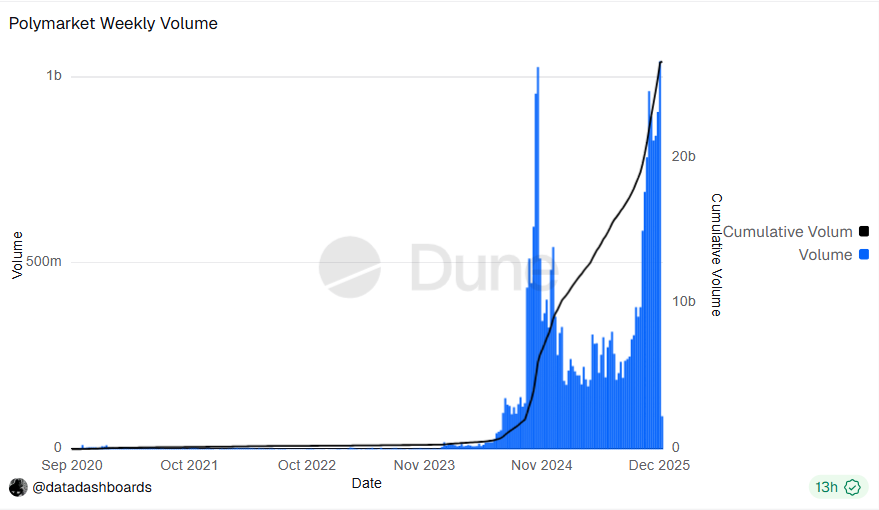
Weekly volumes on Polymarket are frequently over $1 billion. Source: Dune

Russo-Ukrainian War map altered, prediction market bet resolved

Prediction markets have opened up a range of possibilities for setting wagers on events. These can range from a specific element of a sports match to the outcome of a war. In some instances, this has led to insider manipulation to resolve a market in a certain way.

This is what may have happened in November, when the Institute for the Study of War (ISW) announced an unauthorized edit to its map of the Russo-Ukrainian War. The map is used by media organizations worldwide to track changes to frontline positions.

The edit concerned the ISW’s map of Myrnohrad, where Ukrainian troops have been defending the city against the Russian Pokrovsk offensive since July 2024. The unauthorized change to the map of the city coincided with the resolution of a bet on Polymarket, “Will Russia capture Myrnohrad by...” and then a series of dates.

The market resolution was triggered if Russia held an intersection between two streets, Vatutina Vulytsya and Puhachova Vulytsya. According to 404 Media, on Nov. 15, someone edited the map to show Russian troops had taken the intersection. Just minutes after the market resolved, the edit disappeared.
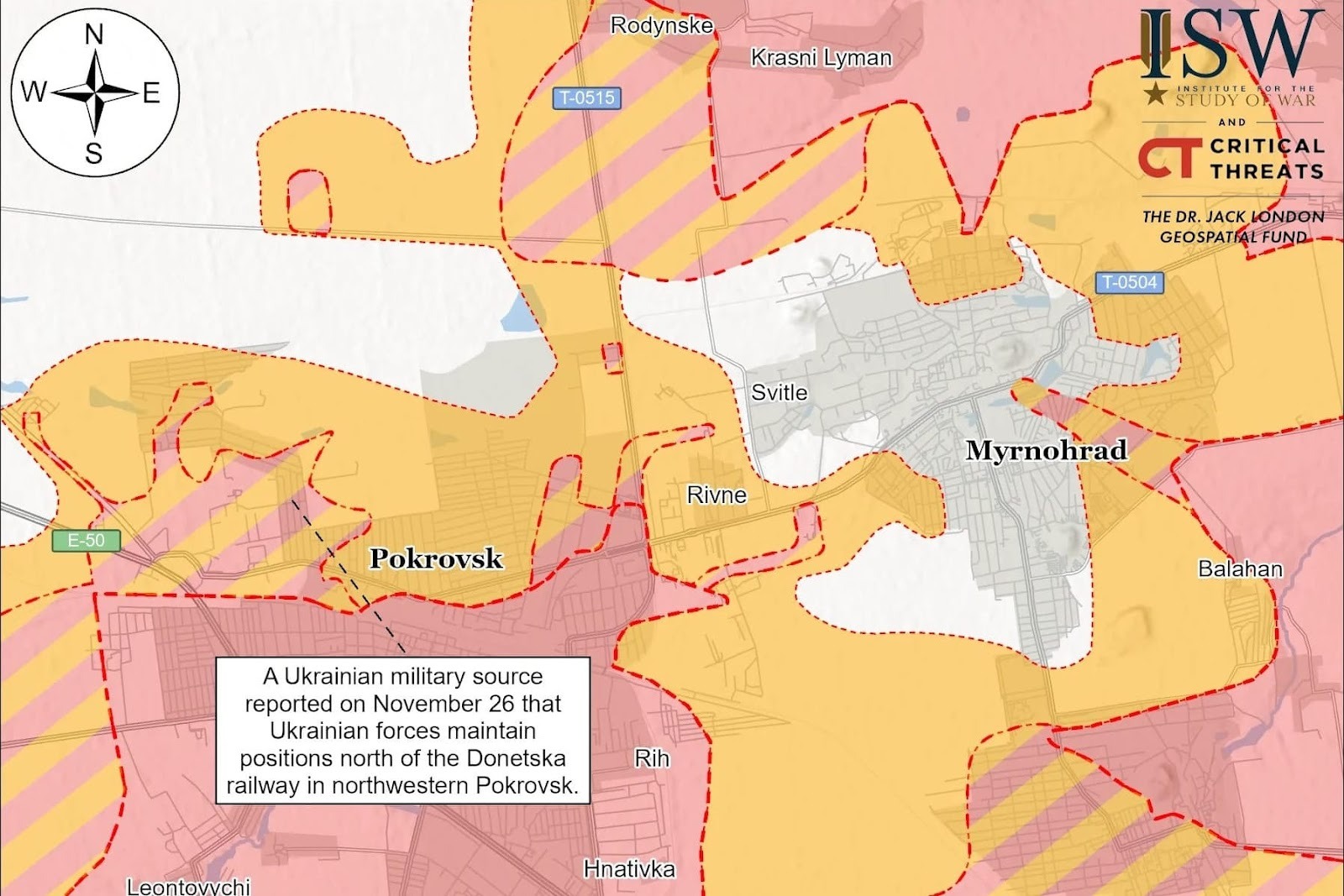

The updated Nov. 17 ISW map did not show that Russian forces controlled the intersection. Source: ISW, 404

The ISW announced the unapproved edit on Nov. 17. It noted that, “The map does not represent battlefield changes in real-time, and all adjustments made during our workday are subject to review and change over the course of the day.”

In this instance, not only was insider knowledge allegedly used to manipulate data, but that manipulation could have affected the public perception of an ongoing violent conflict.

Other examples have also surfaced. Pseudonymous trader AlphaRaccoo netted over $1 million in bets relating to Google search result rankings. He also reportedly made $150,000 by predicting the exact day Google would launch a new version of its Gemini AI model.

Jeong Haeju, a senior software engineer at Meta, said, “He’s a Google insider milking Polymarket for quick money. It’s one of the wildest things I’ve seen on the platform.”
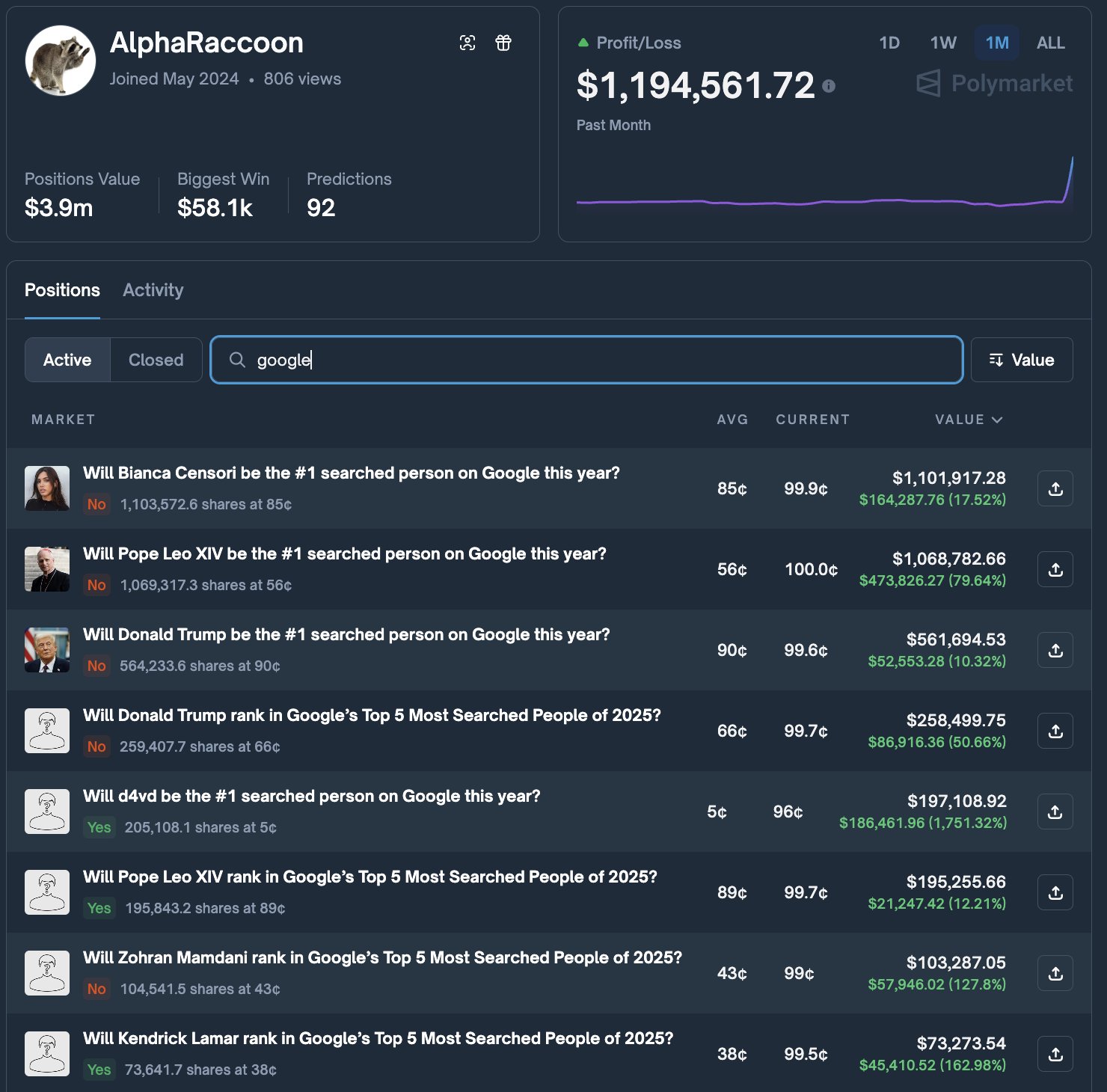
AlphaRaccoon’s betting history. Source: Jeong Haeju

Allegations of manipulation aren’t limited to insider trading. A November report from researchers at the Columbia Business School found that wash trading — i.e., “buying and selling securities without taking a net position, for the purpose of artificially inflating recorded volume” — accounted for 60% of volume on Polymarket in December 2024.

Related: Polymarket rife with ‘artificial trading,’ Columbia University researchers find

This fell substantially but rose to nearly 20% of total volume by October 2025 and has comprised an average of 25% of all trading on Polymarket.

Wash trading “doesn’t add liquidity or information to the market,” said Yash Kanoria, a professor at Columbia University’s business school. This is especially important, given claims that prediction markets provide more accurate and dynamic analyses of a situation.

Jason Wingard, a distinguished visiting professor at Harvard University and executive chairman of the Education Board, wrote that prediction markets create a “‘truth signal’ that moves faster than polls, pundits, or official reports. When thousands of people are willing to lose money on what they think will happen, the result is a dynamic forecast of political outcomes, corporate decisions, economic trends, and cultural shifts.”

Regulation battles as prediction markets ponder new assets

Prediction platforms have won important regulatory approvals this year. In November, Polymarket secured regulatory approval from the US Commodity Futures Trading Commission (CFTC) to operate an intermediated trading platform.

Polymarket founder and CEO Shayne Coplan said, “This approval allows us to operate in a way that reflects the maturity and transparency that the US regulatory framework demands.”

Kalshi is also regulated by the CFTC, meaning that, on paper, it should be allowed to operate in all 50 states.

However, state regulators have taken issue with these platforms. Kalshi is currently facing legal battles with gaming regulators in Nevada, New Jersey, New York, Massachusetts, Maryland and Ohio over whether its platform constitutes a gambling enterprise.

Others see the potential for risks to the financial and credit systems. Bank of America analysts wrote, “Easy access and gamified interfaces encourage frequent and impulsive wagers, which can lead to overextension of credit and rising loan defaults.”

“For investors this convergence of entertainment and speculative finance signals heightened behavioral risk that could pressure credit quality, increase delinquencies, and impact earnings for issuers and subprime lenders.”

They said these risks could pressure credit quality and that online betting markets “introduce a new risk for lenders, one that they have not had to deal with historically and underwriting models may need to be adapted.”

The Connecticut Department of Consumer Protection has served cease-and-desist orders to Robinhood, Kalshi and Crypto.com. It stated that, in addition to lacking proper gambling licenses, the platforms pose “a serious risk to consumers who may not realize that wagers placed on these illegal platforms offer no protections for their money or information.”

Mansour’s plan to turn “any difference in opinion” into a tradable asset may sound novel, but betting platforms will first have to face regulatory scrutiny and a host of ethical issues.

Magazine: 6 reasons Jack Dorsey is definitely Satoshi... and 5 reasons he’s not


Letture associate

Has Hook Summer Really Arrived? sato, Lo0p, FLOOD Ignite the New Narrative of Uniswap v4

"Hook Summer" Arrives? Sato, Lo0p, FLOOD Ignite Uniswap v4 Narrative Amidst a slight market recovery, attention within the Ethereum ecosystem has shifted to Meme coins built on Uniswap v4's Hook protocol. Following ASTEROID, tokens like sato, sat1, Lo0p, and FLOOD have become market focal points, with market caps ranging from millions to tens of millions, bringing concentrated liquidity to a narrative-dry market. Uniswap v4 Hooks are "plugin smart contracts" that allow developers to inject custom logic at key points in a liquidity pool's lifecycle (initialization, adding/removing liquidity, swaps, etc.), making the AMM programmable. Recent representative projects include: * **sato**: Market cap peaked over $38M; uses a v4 curve mechanism for minting/burning, locking ETH as reserve. * **sat1**: Market cap briefly exceeded $10M, positioning as an "optimized sato," but later declined significantly. * **Lo0p**: Market cap neared $6.6M; a "lending AMM protocol" allowing users to borrow ETH against deposited LO0P tokens without immediate selling pressure. * **FLOOD**: Market cap approached $6M; channels trading reserves into Aave v3 to generate yield, which is retained in the pool. The emergence of these Hook-based tokens could drive long-term growth for the Uniswap ecosystem by attracting users and liquidity to v4 pools. Combined with Uniswap's activated fee switch (partially used to burn UNI), the long-term outlook for UNI appears positive. However, short-term UNI price appreciation is not directly guaranteed. Factors include the sustainability and lifecycle of these new tokens, their price volatility, overall market conditions, and regulatory pressures. Currently, Uniswap v4's TVL ($595M) lags behind v3 and v2, indicating Hook adoption still requires time to mature. In summary, the Hook ecosystem serves as "long-term nourishment" for UNI, but acts more as a "catalyst" than a direct "booster" in the short term. Note: These are early-stage experimental tokens and may carry unknown risks.

marsbit23 min fa

Has Hook Summer Really Arrived? sato, Lo0p, FLOOD Ignite the New Narrative of Uniswap v4

marsbit23 min fa

Has Hook Summer Truly Arrived? sato, Lo0p, FLOOD Ignite the New Uniswap v4 Narrative

With the broader market showing signs of recovery, a new wave of interest has emerged around Ethereum-based meme coins. Following ASTEROID, tokens like sato, sat1, Lo0p, and FLOOD, built upon the Uniswap v4 Hook protocol, are capturing market attention. Their market capitalizations range from millions to tens of millions of dollars, injecting much-needed focused liquidity into a market lacking narratives. This article explores whether this trend signifies an incoming "Hook Summer" and its potential impact on UNI's price. Hooks are essentially plug-in smart contracts for Uniswap v4 liquidity pools, allowing developers to inject custom logic at key points in a pool's lifecycle (like initialization, adding/removing liquidity, swaps). This transforms the AMM into programmable building blocks. Key highlighted projects include: * **sato**: Peaked over $38M market cap. It utilizes a v4 curve for minting/burning; buying locks ETH as reserve to mint new tokens, while selling redeems ETH from the reserve and burns tokens. * **sat1**: Market cap briefly exceeded $10M, promoted as an "optimized sato," but later declined significantly. * **Lo0p**: Reached nearly $6.6M. It's a lending AMM protocol where buying LO0P tokens locks them as collateral, allowing users to borrow ETH from the pool reserve at 40% LTV, aiming to improve capital efficiency for idle ETH in LPs. * **FLOOD**: Peaked near $6M. Its mechanism directs asset reserves from buys into Aave v3 to generate yield, with fees and interest retained in the pool to potentially influence the token's price long-term. In the long term, the development of the Hook ecosystem can attract users and liquidity to Uniswap v4, benefiting UNI's fundamentals—especially combined with the recent activation of the protocol fee switch, where a portion of fees is used to burn UNI. However, in the short term, these Hook-based tokens are unlikely to directly drive significant UNI price appreciation. Their impact is moderated by factors like token sustainability, price volatility, and broader market and regulatory conditions. Currently, Uniswap v4's TVL ($595M) still trails behind v2 and v3, indicating adoption and growth will take time. The article concludes that while the Hook ecosystem provides long-term "nourishment" for UNI, its short-term role is more of a "catalyst" than a "booster." Readers are cautioned that these are early-stage experimental tokens and may carry unknown risks.

Odaily星球日报35 min fa

Has Hook Summer Truly Arrived? sato, Lo0p, FLOOD Ignite the New Uniswap v4 Narrative

Odaily星球日报35 min fa

Interview with Michael Saylor: I Did Say I Would Sell Bitcoin, But Never a Net Sale

Interview with Michael Saylor: I Said We'd Sell Bitcoin, But Never Be a Net Seller In a recent podcast, MicroStrategy Executive Chairman Michael Saylor clarified the company's stance on potentially selling Bitcoin. Following MicroStrategy's earnings call statement about being prepared to sell BTC to fund dividends for its STRC (Strategic) credit product, Saylor emphasized the distinction between selling and being a "net seller." Saylor explained the core business model: MicroStrategy sells credit instruments like STRC and uses the proceeds to buy Bitcoin, which is viewed as "digital capital" expected to appreciate around 30-40% annually. A portion of these capital gains can then be used to pay the dividends on the credit products. He stressed that even if the company sells some Bitcoin for dividends, it simultaneously buys much more with new credit issuance. For example, after raising $3.2 billion from STRC sales in April, the dividend obligation was only $80-90 million, making the company a net buyer. The clarification aims to counter market narratives questioning the value of Bitcoin on MicroStrategy's balance sheet if it were never sold, and to dismiss claims of a "Ponzi scheme." Saylor reiterated his personal philosophy for investors: "Don't be a net seller of bitcoin" and ensure your Bitcoin holdings increase each year. Saylor also discussed Bitcoin's role as the foundation for "digital credit," noting that STRC has become the largest and most liquid preferred stock issue in the U.S., offering high risk-adjusted returns (Sharpe ratio). He highlighted Bitcoin's deep liquidity, stating that even large purchases by MicroStrategy do not move the market significantly, which is driven by macro factors, geopolitical tensions, and capital flows from ETFs and credit products. Finally, Saylor reflected on his early inspiration from sci-fi books, which motivated his path to MIT, and maintained his fundamental thesis on Bitcoin remains unchanged: it is superior digital capital enabling superior digital credit.

链捕手40 min fa

Interview with Michael Saylor: I Did Say I Would Sell Bitcoin, But Never a Net Sale

链捕手40 min fa

Trading

Spot
Futures
活动图片