How Did Cardano Token NIGHT Ignite Nearly $10 Billion in Daily Trading Volume?

比推Pubblicato 2025-12-24Pubblicato ultima volta 2025-12-24

Introduzione

The Cardano-based privacy token NIGHT, associated with the Midnight sidechain, recently recorded nearly $10 billion in daily trading volume across major exchanges like Binance, OKX, and Bybit. Its price surged over 300% in less than two weeks after launch, reaching a fully diluted valuation of over $2.5 billion before settling around $0.08. Midnight, developed by Cardano’s parent company IOG, focuses on programmable data protection using zero-knowledge proofs (ZKPs) packaged into developer-friendly TypeScript APIs. It employs a dual-token model: NIGHT for governance and generating DUST, the utility token used for transaction and privacy fees. This design aims to meet regulatory requirements by separating governance from transactional assets. The token’s rapid growth is attributed to a massive airdrop campaign targeting 37 million addresses across multiple blockchains, alongside distribution partnerships with top exchanges. With Cardano planning major upgrades in 2025—including scaling solutions, Midnight’s mainnet launch, native stablecoin integration, and enhanced interoperability—NIGHT’s rise may signal renewed momentum for the ecosystem.

Author: Eric, Foresight News

Original Title: A Token with Nearly $10 Billion in Daily Trading Volume, Actually from Cardano?


Recently, a token named NIGHT, which was listed for spot or contract trading on Bitget, Binance, OKX, and Bybit earlier this month, saw its 24-hour global trading volume exceed $9 billion, approaching $10 billion. Bybit even surpassed Binance in 24-hour spot trading volume thanks to NIGHT.

NIGHT was officially launched on December 9. According to CoinGecko data, the token's price rose from around $0.025 to nearly $0.114 in less than two weeks, a increase of over 3 times. Its FDV once exceeded $2.5 billion, which would place it within the top 50 by market capitalization. At the time of writing, NIGHT price has retraced to around $0.08.
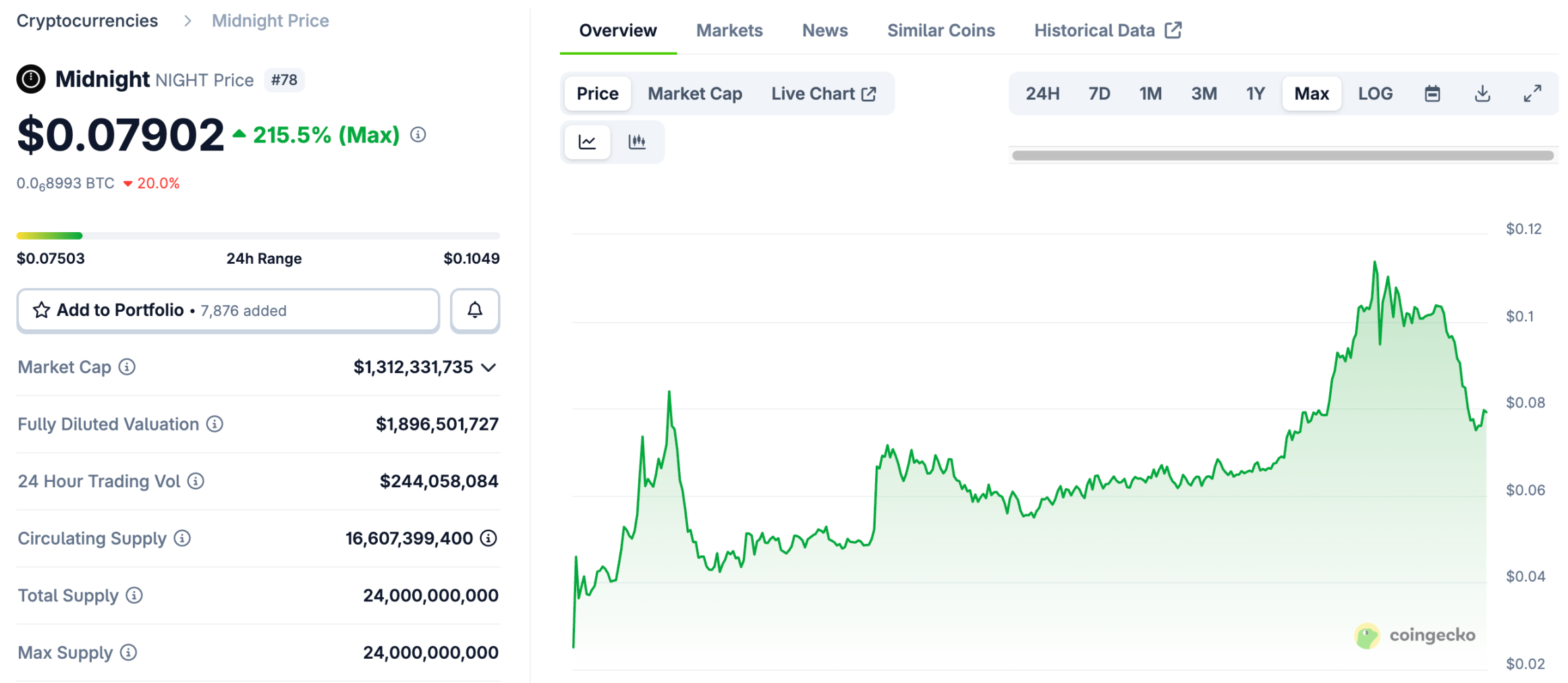
Such performance from a token listed on several major exchanges simultaneously is not entirely unexpected. However, the interesting part is that NIGHT is the token of Midnight, a privacy-focused sidechain of Cardano. The explosive power of a project bearing both the "Cardano" and "privacy" labels truly surprised most people.

What Makes Midnight "Valuable"?

Midnight is a sidechain developed by Input Output Global (IOG, the parent company of Cardano) with "programmable data protection" as its core selling point. It packages zero-knowledge proofs (ZKP) into a ready-to-use TypeScript API, allowing Web2 developers to implement "selective disclosure" on-chain without needing to learn cryptography. The entire network uses Cardano as its consensus layer and Halo2 as its ZK backend, employing a dual-token model (NIGHT+DUST). The goal is first to land the "data availability without visibility" that enterprises care about most, and then gradually expand to scenarios like DeFi, RWA, and on-chain compliant identity.

Overall, it doesn't seem particularly unique. It adopts ZKP privacy technology but doesn't natively protect privacy; instead, it makes privacy features optional to address practical needs.

IOG first publicly announced the plan to develop Midnight in November 2022, but the testnet wasn't launched until nearly two years later, in October 2024. This is indeed IOG's style—it took almost 5 years from announcing smart contracts for Cardano to actual implementation, which wasn't achieved until September 2021, long after the bull market had passed.

In May of this year, Midnight established a foundation, with Fahmi Syed, former CFO of Polkadot development team Parity, as chairman, signaling the first step towards TGE (Token Generation Event). Just two days after announcing the foundation's establishment, Cardano founder Charles Hoskinson revealed plans to airdrop tokens to 37 million addresses on 8 major blockchains, stating that the airdrop would target only retail users, with no VC participation in the project.

Perhaps what truly ignited market sentiment was Midnight's "massive airdrop." In addition to the airdrop, Midnight also distributed nearly 3 billion NIGHT tokens in collaboration with Binance, OKX, and Bybit. This large-scale approach, which contrasts sharply with the recent popular ICO models, garnered a positive market response.
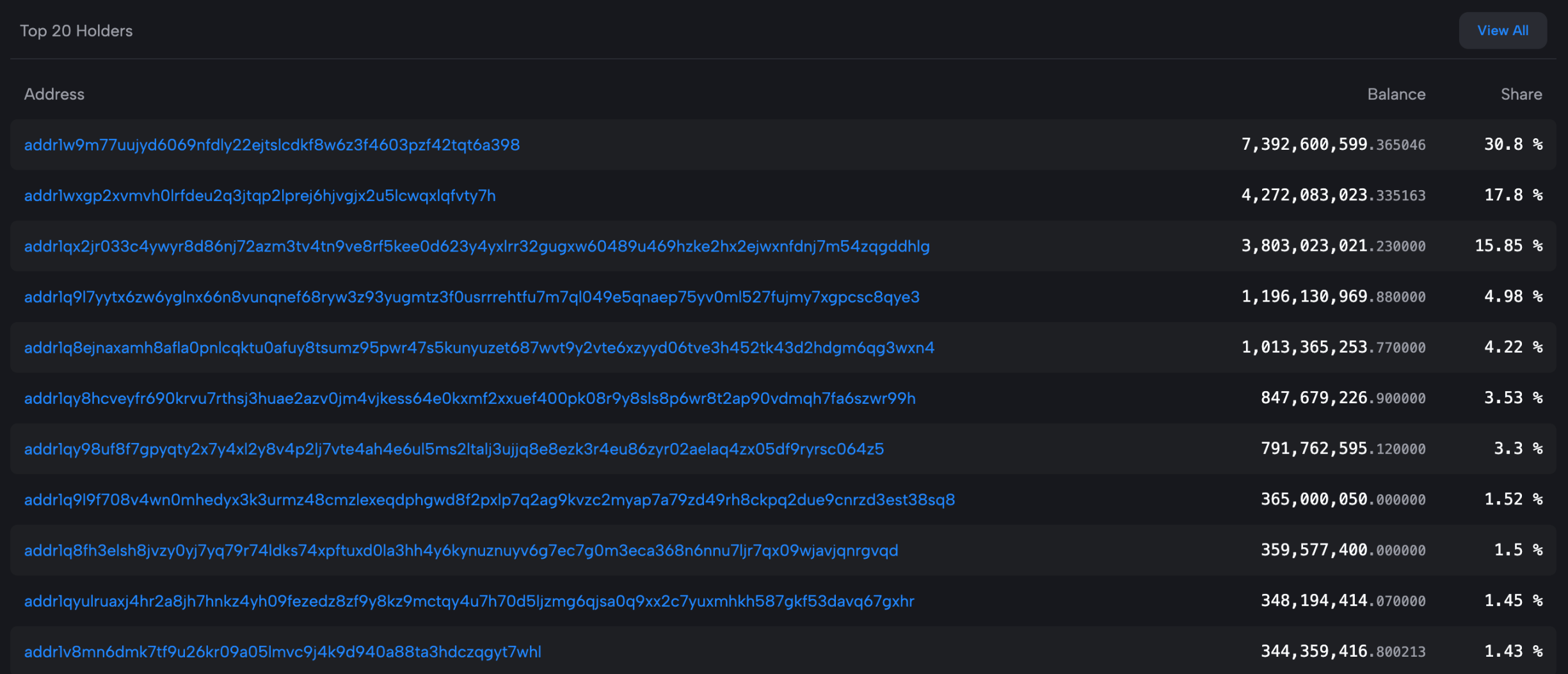
Looking at the block explorer, aside from the top three addresses which likely belong to IOG or the Midnight Foundation, the holdings of the remaining addresses are relatively decentralized. According to data provided on the official website, the author estimates that the airdrop itself, combined with exchange collaboration events, distributed nearly one-third of the total supply (24 billion tokens), which indeed qualifies as a massive effort.

Midnight's tokenomics feature not just NIGHT, but a "NIGHT+DUST" dual-token model. This rare design isn't based on some "whimsical idea" but rather aims to ensure regulatory compliance. NIGHT can be used for network governance, incentives, and generating the other token, DUST. NIGHT itself is not related to privacy and supports on-chain auditing.

DUST, generated by holding NIGHT, is used to pay for transaction fees, similar to Gas. Additionally, DUST will be used to pay for privacy fees—if one wants to add optional privacy features to on-chain transactions, they must pay DUST. DUST is automatically distributed to NIGHT holders' accounts with each block produced and "decays" over time to prevent malicious hoarding and network attacks.

Thus, Midnight's "equity" token, NIGHT, does not participate in paying on-chain transaction fees but exists solely as a governance token and a generator for the actual on-chain fuel, DUST. DUST itself, as a "renewable resource" generated by NIGHT and constantly decreasing over time, would be considered a resource rather than an asset from a regulatory perspective, potentially satisfying regulatory requirements in various jurisdictions.

Cardano to Heavily Invest in On-Chain Ecosystem Next Year

According to Cardano's roadmap, next year will be focused on comprehensively boosting on-chain activity.

First and foremost, Cardano will undergo a network upgrade to increase throughput to 1000-10,000 TPS through parallel block processing and a layered structure for vertical scaling, while maintaining security and decentralization. Following this will be the mainnet launch of the protagonist of this article, Midnight. Cardano believes Midnight's launch will bring more DeFi activity and TVL through its optional privacy features. Additionally, the Cardano Treasury will allocate funds to support the native issuance of major stablecoins like USDT and USDC on Cardano.

The last point, which the author finds most important, is Cardano's plan to focus on interoperability—not simple cross-chain functionality, but enabling users from other chains to interact directly with DApps on Cardano by paying gas fees on their source chain.

Last week, Cardano achieved atomic swaps between BTC and ADA through Fluid, not via cross-chain bridges, wrapped tokens, or centralized custody, but directly through underlying script-to-script transactions, which is somewhat facilitated by Cardano's own UTXO ledger model. Two days ago, interactions between Cardano stake pool operators and Solana's co-founder on X also confirmed this development direction.

Accompanying the strategic and product plans is capital investment. The Cardano Foundation plans to increase its marketing budget by 12% and "make an appearance" at events like TOKEN2049 and Consensus. Venture Hub will also invest 2 million ADA to support startups and ecosystem projects. Furthermore, the Cardano Foundation plans to inject tens of millions of ADA into on-chain DeFi to improve liquidity and attract institutional participation.

From this perspective, driving up the price of NIGHT might just be the appetizer Cardano is serving for a series of plans. Perhaps 2026 is really the year to keep an eye on this project, which launched its mainnet back in 2017 and has been almost forgotten by the mainstream Web3 market.


Twitter:https://twitter.com/BitpushNewsCN

Bitpush TG Discussion Group:https://t.me/BitPushCommunity

Bitpush TG Subscription: https://t.me/bitpush

Original link:https://www.bitpush.news/articles/7598128

Domande pertinenti

QWhat is NIGHT and which blockchain is it from?

ANIGHT is the native token of Midnight, a privacy-focused sidechain developed by Input Output Global (IOG), the parent company of Cardano.

QWhat was the 24-hour trading volume of NIGHT that sparked significant attention?

ANIGHT achieved a 24-hour trading volume of nearly $9 billion, approaching $10 billion, which was a major point of discussion.

QWhat is the core technological feature of the Midnight blockchain?

AMidnight's core feature is 'programmable data protection,' offering TypeScript APIs for zero-knowledge proofs (ZKPs) to enable 'selective disclosure' without requiring developers to learn cryptography.

QHow does Midnight's dual-token model (NIGHT and DUST) work and why was it designed this way?

ANIGHT is used for governance and generating DUST, while DUST acts as gas for transaction fees and privacy features. This design helps comply with regulatory requirements by separating the governance token from the transactional resource.

QWhat are some of Cardano's key plans for its ecosystem in the coming year as mentioned in the article?

ACardano plans to upgrade network throughput to 1000-10,000 TPS, launch the Midnight mainnet, support native issuance of stablecoins like USDT and USDC, focus on interoperability allowing users to interact with DApps using their native chain's gas tokens, and invest in marketing and liquidity.

Letture associate

Where the AI Bubble Really Is: Which Layer of Players Are Naked

AI Bubble: Where It Really Is and Who's Swimming Naked This analysis dissects the AI industry not as a single entity but as a five-layer pyramid, arguing that bubbles are concentrated in specific tiers, not uniformly distributed. **Key Distinction from the 2000 Dot-com Bubble:** Unlike 2000, where companies had stock prices before revenue, today's leading AI players have massive, contract-backed revenue driving their valuations. Core infrastructure demand is real, with every GPU running at full capacity for paying customers. **The Five-Layer Pyramid & Bubble Assessment:** * **L0 (Fab/Manufacturing) & Top L4 (Leading AI Apps): NO BUBBLE.** Companies like TSMC, NVIDIA, major cloud providers (Microsoft, Google, Meta, Amazon), and top AI labs have real revenues and orders. Supply is tightly constrained by TSMC's disciplined capacity control and physical limits like power/land for data centers, preventing a supply glut. * **L1 (Memory): BATTLEGROUND.** Sky-high HBM margins could signal a new structural cycle or a classic "boom before bust." The oligopoly of three major players may enforce supply discipline, making this a high-stakes bet. * **L2 (Interconnect/Optical Modules): BUBBLE TERRITORY.** Companies like Lumentum and AAOI have seen stock surges (4-10x) far outpacing revenue growth. This hardware segment has lower physical barriers to expansion than fabs, allowing speculation. It mirrors the 2000 bubble's epicenter—optics. * **L3 (Infrastructure/"GPU Landlords"): VULNERABLE.** GPU leasing companies profit from the current compute shortage but own no long-term moat. Their business model relies on a temporary bottleneck that will ease as big tech expands and new tech (e.g., potential space-based data centers) emerges. * **L4 Long Tail (VC-backed Startups): STRONG BUBBLE SIGNALS.** VC funding concentration in AI is twice that of the 1999 peak. Many startups with little revenue use the valuation logic of successful giants to justify their own, creating high risk of a "valuation crunch" when funding dries up. **Critical Risks to Monitor:** 1. **GPU Depreciation & Accounting:** Companies extending the assumed useful life of GPUs artificially boost profits. The true economic life depends on future generational leaps from NVIDIA. 2. **"GPU Credit" & Off-Balance-Sheet Leverage:** Emerging structures where shell companies borrow to buy GPUs and lease them out (with chipmakers sometimes investing) move debt off major balance sheets. This echoes the "vendor financing" of 2000 and the securitization risks of 2008, though currently small-scale. 3. **TSMC Abandoning Caution:** If the primary supply bottleneck (TSMC's conservative capacity planning) breaks, runaway supply could trigger a bust. 4. **Algorithmic Efficiency Breakthrough:** A major leap in software efficiency could drastically reduce the need for raw compute hardware, undermining the investment thesis. **Conclusion:** The AI boom is expensive and has frothy areas, but its core is underpinned by real demand and physical supply constraints. The bubble risk is layered: most present in optical components, GPU leasing, and the long-tail startup ecosystem, while the foundational chip manufacturing and leading application layers remain relatively solid—for now.

marsbit15 min fa

Where the AI Bubble Really Is: Which Layer of Players Are Naked

marsbit15 min fa

Standing in the Light: A Comprehensive Guide to the Optical Module and CPO Supply Chain

"Standing in the Light: Understanding the Optical Module and CPO Industry Chain" This article analyzes the critical role of optical communication technology, specifically optical modules and Co-Packaged Optics (CPO), as the "nervous system" for modern AI data centers. With exponential growth in AI computational demands (e.g., NVIDIA's Vera Rubin architecture), traditional electrical interconnects using copper cables face severe bottlenecks in bandwidth, power consumption, and signal integrity over distance. The core function of an optical module is to act as a "translator," converting electrical signals from chips into optical signals for transmission over fiber (and vice-versa). Key internal components include lasers, modulators, photodetectors, drivers, and DSP chips. The industry is currently transitioning from 800G to 1.6T modules. However, the future lies in CPO. This next-generation technology integrates the optical engine directly with the switch ASIC/XPU on the same package substrate, drastically reducing power consumption (by ~3.5x according to NVIDIA), overcoming bandwidth density limits, and minimizing signal attenuation compared to traditional pluggable modules. Key challenges for CPO include advanced packaging capacity (dominated by TSMC), thermal management, repairability, and standardization. The article details the broader technology landscape, including Near-Packaged Optics (NPO, a pragmatic intermediate step), Linear-drive Pluggable Optics (LPO), Optical I/O (OIO for chip-level integration), and Optical Circuit Switches (OCS). A comprehensive CPO industry chain is mapped, highlighting shifting power dynamics: * **Architecture Definers:** NVIDIA, Broadcom, and Marvell now hold greater influence. * **Advanced Packaging & Manufacturing:** TSMC is central; Fabrinet is a key EMS player. * **Lasers ("The Heart"):** A strategic bottleneck. EML lasers are led by Lumentum and Coherent (both receiving major NVIDIA investments). CW lasers, favored for CPO/silicon photonics, see strong Chinese players like Source Photonics and Sicoya. * **Silicon Photonics Chips:** The mainstream path for CPO engines, with key players like Broadcom, Intel, Marvell, and China's Accelink. * **Fiber Connectivity Components:** A major new, high-growth market created by CPO, including Fiber Array Units (FAU), Polarization-Maintaining Fiber (PMF), and MPO connectors. Companies like Tianfu Communication and US Conec are leaders. * **Fiber & Cable:** Experiencing a super-cycle (e.g., Corning, Yangtze Optical Fiber). * **PCB/Substrates:** Requiring advanced materials (e.g., Shengyi Tech). * **DSP & SerDes:** Functions are integrated into switch ASICs in the CPO era (e.g., Broadcom, Astera Labs). * **Optical Module Makers:** Transitioning from standalone module suppliers to providers of optical engines and NPO/LPO solutions while riding the current pluggable boom (e.g., Zhongji Innolight, Eoptolink). The investment timeline is segmented: Short-term (2026-2027) features the "last feast" for pluggable modules and CPO's initial rollout. Medium-term (2027-2029) will see CPO expand and NPO peak. Long-term (2029-2032+) involves CPO/OIO penetration into intra-rack scaling. In conclusion, optical interconnects are fundamental to AI infrastructure. The competitive landscape sees US firms leading in architecture and high-end chips, TSMC in advanced packaging, and Chinese firms holding strong positions in modules, connectivity components, CW lasers, and fiber/cable. The future belongs to companies that can navigate the technological shift from "selling shovels" (modules) to "building highways" (CPO/OIO infrastructure).

marsbit25 min fa

Standing in the Light: A Comprehensive Guide to the Optical Module and CPO Supply Chain

marsbit25 min fa

Trading

Spot
Futures

Articoli Popolari

Come comprare ADA

Benvenuto in HTX.com! Abbiamo reso l'acquisto di Cardano (ADA) semplice e conveniente. Segui la nostra guida passo passo per intraprendere il tuo viaggio nel mondo delle criptovalute.Step 1: Crea il tuo Account HTXUsa la tua email o numero di telefono per registrarti il tuo account gratuito su HTX. Vivi un'esperienza facile e sblocca tutte le funzionalità,Crea il mio accountStep 2: Vai in Acquista crypto e seleziona il tuo metodo di pagamentoCarta di credito/debito: utilizza la tua Visa o Mastercard per acquistare immediatamente CardanoADA.Bilancio: Usa i fondi dal bilancio del tuo account HTX per fare trading senza problemi.Terze parti: abbiamo aggiunto metodi di pagamento molto utilizzati come Google Pay e Apple Pay per maggiore comodità.P2P: Fai trading direttamente con altri utenti HTX.Over-the-Counter (OTC): Offriamo servizi su misura e tassi di cambio competitivi per i trader.Step 3: Conserva Cardano (ADA)Dopo aver acquistato Cardano (ADA), conserva nel tuo account HTX. In alternativa, puoi inviare tramite trasferimento blockchain o scambiare per altre criptovalute.Step 4: Scambia Cardano (ADA)Scambia facilmente Cardano (ADA) nel mercato spot di HTX. Accedi al tuo account, seleziona la tua coppia di trading, esegui le tue operazioni e monitora in tempo reale. Offriamo un'esperienza user-friendly sia per chi ha appena iniziato che per i trader più esperti.

1.3k Totale visualizzazioniPubblicato il 2024.12.10Aggiornato il 2026.06.02

Come comprare ADA

Discussioni

Benvenuto nella Community HTX. Qui puoi rimanere informato sugli ultimi sviluppi della piattaforma e accedere ad approfondimenti esperti sul mercato. Le opinioni degli utenti sul prezzo di ADA ADA sono presentate come di seguito.

活动图片