Hot Track, New Interaction Opportunities: Three Prediction Markets Backed by YZi Labs

Odaily星球日报Pubblicato 2025-12-23Pubblicato ultima volta 2025-12-23

Introduzione

Prediction markets are a hot topic in the crypto community, with significant activity on BNB Chain. According to Dune data, three platforms dominate: Opinion leads with 75% market share and $125M in daily volume, followed by PancakeSwap's Probable at 14.5% ($24M), and predict.fun, founded by dingaling, at 10.5% ($17M). All three are backed by YZi Labs. **Opinion**, a Binance Labs MVB alum, raised a $5M seed round. It runs a points program with weekly rewards. A special Christmas/New Year event offers 100k points for activities like daily trading, high volume, and using Binance Wallet. **predict.fun**, founded by NFT influencer dingaling, allows users to earn yield on capital locked in predictions. It airdropped initial points to active BNB Chain users. Its first weekly points event concludes soon, with a second starting immediately after. **Probable**, incubated by PancakeSwap, focuses on a zero-fee, fully on-chain experience using UMA's Oracle for dispute resolution. It supports predictions on various events and allows deposits in any token, auto-swapped to USDT. A points system based on trading volume is imminent and is already tracking user activity.

Original | Odaily Planet Daily (@OdailyChina)

Author | Asher (@Asher_ 0210)
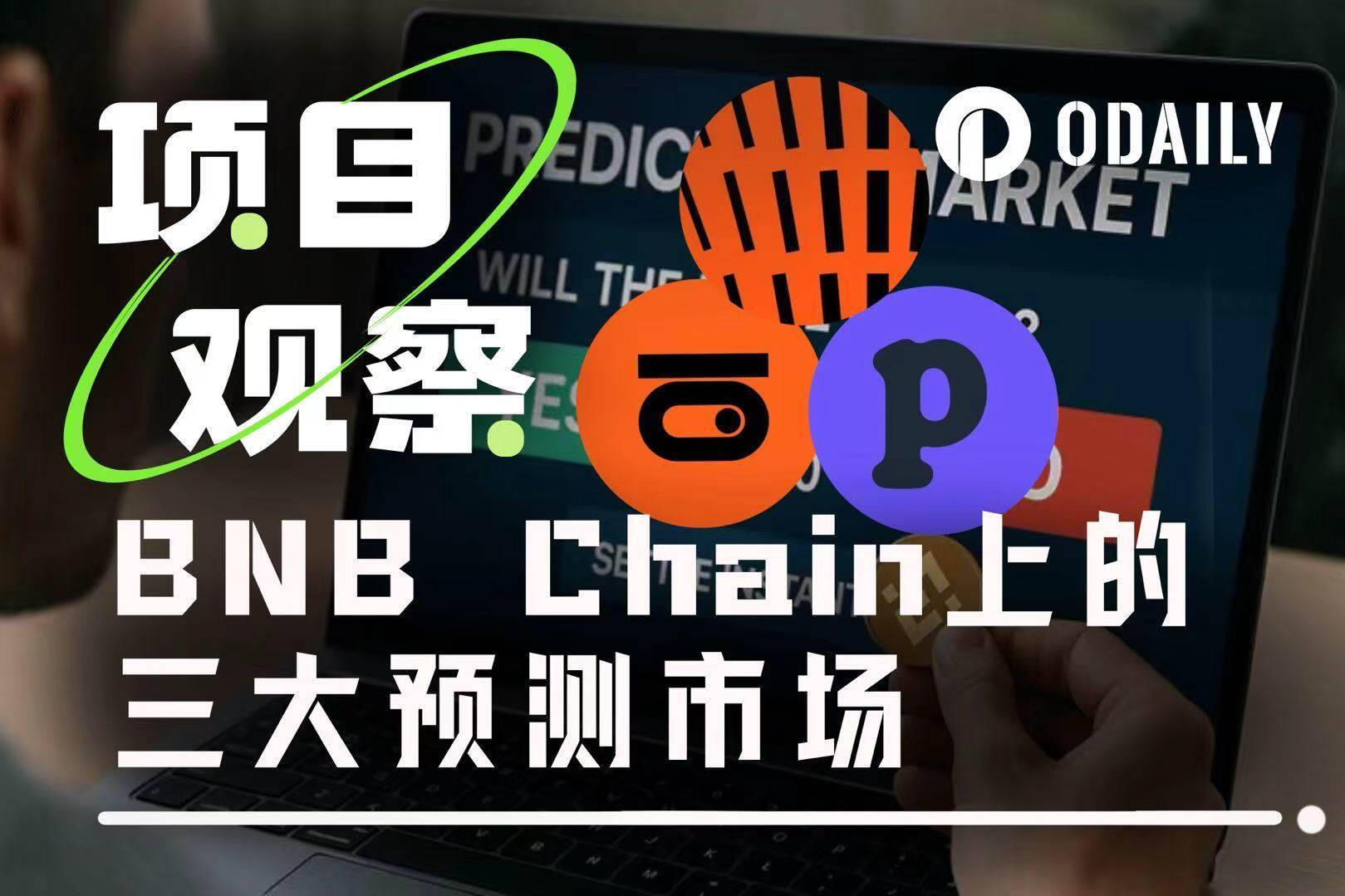
Prediction markets are a topic of extremely high discussion in the community recently. Besides Polymarket and Kalshi, the prediction market within the BNB Chain ecosystem has also been growing and strengthening. According to Dune data, looking at the trading volume of the three major prediction market platforms on BNB Chain from yesterday, Opinion currently leads far ahead of the others with a market share of 75% and a trading volume of $125 million yesterday; followed by Probable, backed by the PancakeSwap team, with a market share of 14.5% and a trading volume of $24 million yesterday; predict.fun, founded by dingaling, ranks third with a market share of 10.5% and a trading volume of $17 million yesterday.
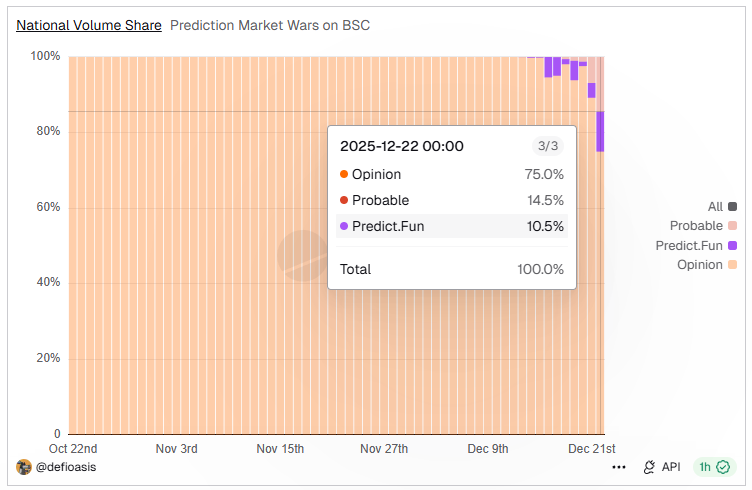
BNB Chain Ecosystem Prediction Market Share (December 22)
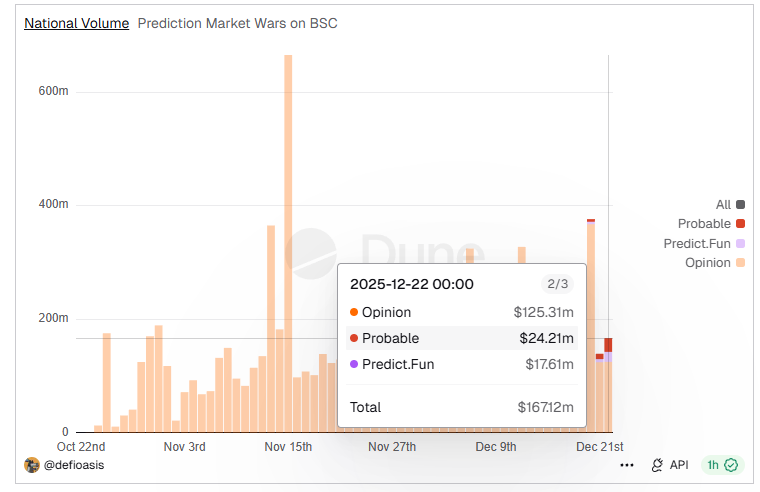
BNB Chain Ecosystem Prediction Market Trading Volume (December 22)

Next, Odaily Planet Daily will take you to understand the three prediction market platforms on BNB Chain that have received investment from YZi Labs: Opinion, predict.fun, and Probable.

Opinion: The Leader in BNB Chain's Prediction Market Ecosystem, Launched Christmas & New Year Points Activity Yesterday
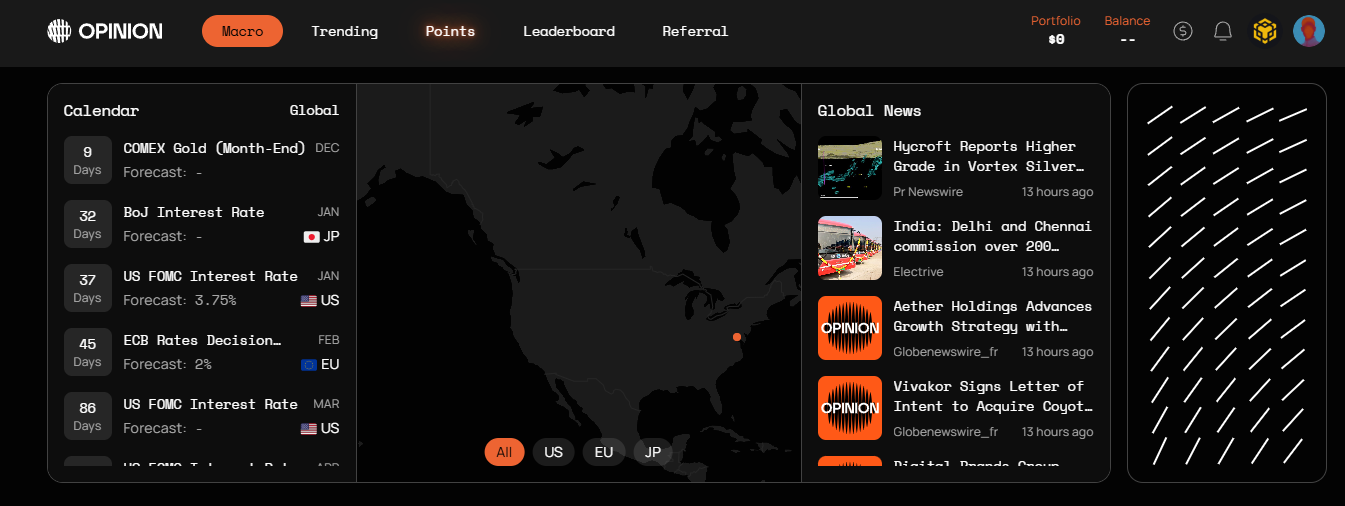
Opinion is the first prediction market platform on the BNB Chain ecosystem. According to ROOTDATA data, Opinion announced the completion of a $5 million seed round financing on March 18 this year. This round was led by YZi Labs, with participation from echo, Animoca Ventures, Manifold, Amber Group, and others. Additionally, Opinion was one of the 4 best-performing projects in the previous Binance Labs MVB program.

Points Rules

Opinion points are allocated on a weekly basis, with a total of 100,000 points rewarded per week. The rules are as follows:

1. Trading volume requirement: ≥ $200 per week (and a single order ≥ $10) to be counted for points.

2. Holding time: The larger the position and the longer the holding time → the higher the points.

3. Liquidity orders (limit orders): Limit order amount ≥ $10 to count for points; the longer the order is placed and the closer the price is to the best bid/ask → the more points; limit orders have 0 fees and add points weight, making them the most stable way to earn points (market orders charge about 2% fees).

4. Trading volume and fees: The higher the transaction volume and the more fees contributed, the more points earned.

Christmas & New Year Points Activity

Yesterday (December 22), Opinion announced on platform X the launch of the Christmas & New Year points activity. Specific details are as follows:

  • Activity reward: A total of 100,000 points;
  • Activity period: From December 22 to January 5, 2026, lasting two weeks;
  • Ways to earn points: Daily Warriors, 20,000 points total (trade > 3 times daily, and meet the requirement for > 10 days); Volume Kings: 20,000 points total (daily trading volume > $2,000, and meet the requirement for > 10 days); Binance Wallet Elite: 10,000 points total (accumulated trading volume during the activity > $2,000); Diamond Hands: 20,000 points total; Mystery Finale: 30,000 points total.

Additionally, some notes on the ways to earn points:

  • Diamond Hands reward: Allocated based on the time-weighted open positions of all users during the activity period, data comes from regular platform snapshots;
  • Daily Warriors and Volume Kings rewards: Wallets that meet the corresponding daily trading threshold for at least 10 days during the activity period will share the respective rewards;
  • Binance Wallet Elite reward: Users who complete a cumulative trading volume > $2,000 during the activity period via Binance Wallet will share the reward. This reward requires using a keyless address or a newly imported wallet; old wallets already registered with OPINION are not eligible.

predict.fun: Founder is NFT field renowned figure dingaling, First Week Points Activity Ends Tonight at 10 PM
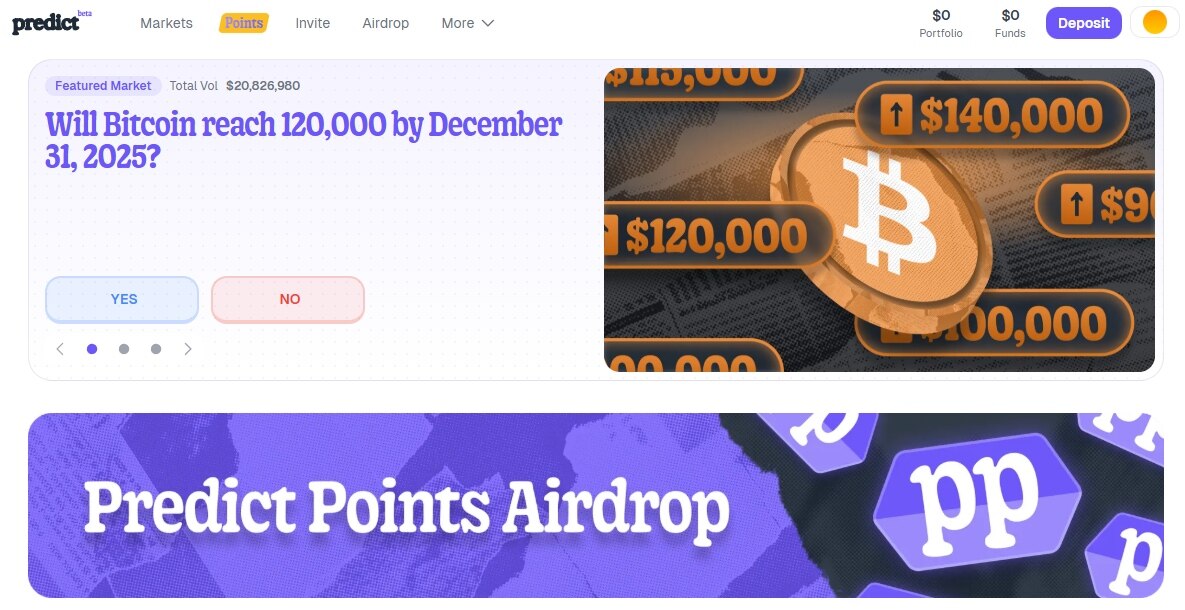
predict.fun is a prediction market platform launched on BNB Chain, founded by the previously well-known figure in the NFT field, dingaling. Unlike traditional prediction markets like Polymarket and Kalshi, predict.fun has implemented a key innovation: funds used by users to participate in predictions are no longer idle but can simultaneously generate additional returns during the prediction period.

On December 17, predict.fun's founder dingaling announced on platform X that the platform is officially open and has airdropped initial points to Meme traders on BNB Chain, Aster participants, and active users of various prediction markets. (For more interaction tutorials, read: Step-by-Step Guide to Participating in CZ-Supported predict.fun)

Today, predict.fun officially announced on platform X that the first week points activity will end at 10 PM Beijing time tonight. Prediction points rewards and other additional airdrop rewards will be credited to users' personal accounts in 3 days, and the leaderboard will also be updated. Additionally, the second week points activity will start immediately after the first week activity ends.

Probable: Prediction Market Incubated by PancakeSwap, Points System Coming Soon
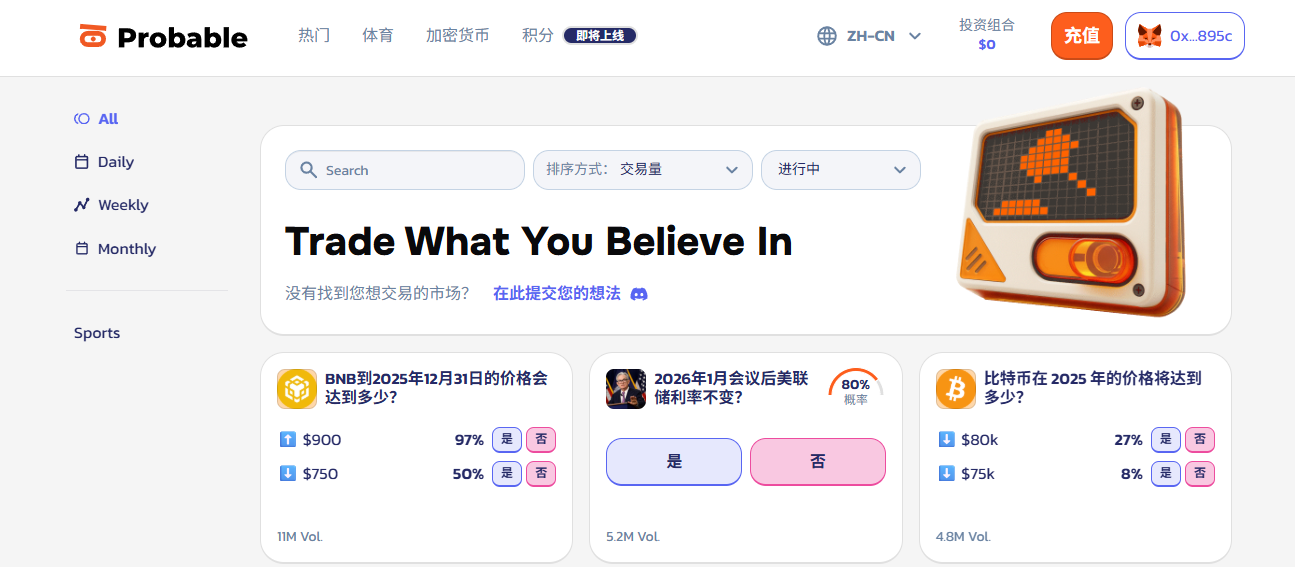
On December 16, PancakeSwap announced the launch of Probable, a fully on-chain prediction market platform incubated by them (platform language supports switching to Simplified Chinese). This project is jointly supported by PancakeSwap and YZi Labs and will be exclusively deployed on BNB Chain. PancakeSwap stated that Probable is an independent project, and its team will advance product development and ecosystem expansion with the support of PancakeSwap and YZi Labs.

According to the introduction, Probable is positioned as a user-centric on-chain prediction platform, featuring zero fees, fully on-chain settlement, and a simplified user experience. Initially, the platform will not charge prediction fees. Relying on BNB Chain's low-cost and high-performance infrastructure, it supports users to predict cryptocurrency trends, global events, sports events, and some regional characteristic markets.

At the mechanism level, Probable uses UMA's Optimistic Oracle as an event adjudication tool, achieving result confirmation through a dispute-based verification method to enhance the transparency and censorship resistance of the prediction market. Additionally, users can top up with any token, and the system will automatically exchange it for USDT on BNB Chain for participation in predictions, lowering the operational barrier.

Currently, Probable's points system has not yet been launched. According to official information, a new points system is coming soon. Points will be calculated based on users' trading volume, and the backend has already started counting and accumulating users' current trading volume.


Crypto di tendenza

Domande pertinenti

QWhich three prediction market platforms on BNB Chain are highlighted in the article as being backed by YZi Labs?

AThe three prediction market platforms on BNB Chain backed by YZi Labs are Opinion, predict.fun, and Probable.

QAccording to the Dune data from December 22nd, which BNB Chain prediction market had the highest trading volume and what was its market share?

AAccording to the Dune data from December 22nd, Opinion had the highest trading volume of $125 million, capturing a 75% market share.

QWhat is a key innovative feature of predict.fun that differentiates it from traditional prediction markets like Polymarket?

AA key innovative feature of predict.fun is that the funds users use to participate in predictions are not idle; they can simultaneously generate additional yield during the prediction period.

QWhat is the total amount of the seed round funding that Opinion completed, and who was the lead investor?

AOpinion completed a $5 million seed round funding, which was led by YZi Labs.

QWhat are two main technical features that Probable, incubated by PancakeSwap, promotes for its users?

AProbable promotes two main features: zero trading fees and a fully on-chain settlement process.

Letture associate

Two Legends Lost in Three Days: Is Google's AI Talent Dam Cracking?

In three days, Google lost two AI legends. On June 18, Noam Shazeer, co-author of the seminal "Attention is All You Need" paper and Gemini co-lead, left for OpenAI. Just 48 hours later, John Jumper, 2024 Nobel laureate and AlphaFold lead, departed DeepMind for Anthropic. This follows Andrej Karpathy joining Anthropic in May. These moves highlight a structural trend: top AI talent is concentrating at mission-driven, pre-IPO firms like OpenAI and Anthropic, while Google becomes a primary source. The exodus stems from a core mission mismatch. Google's ad-centric model often subordinates AI research to product and revenue goals, creating friction for pioneers like Shazeer, who returned in 2024 only to leave again. In contrast, OpenAI and Anthropic offer singular focus on pushing AI boundaries, whether towards AGI or safety-aligned models, which deeply appeals to top researchers like Jumper. Financial incentives amplify the pull. With both OpenAI and Anthropic nearing IPO, employees stand to gain immensely from equity, an upside Google's mature stock cannot match. Furthermore, the 2023 merger of Google Brain and DeepMind, intended to consolidate strength, has instead created cultural tension and slowed the path from research to product, as evidenced by Gemini's pace. This talent redistribution is reshaping the AI landscape. While Google retains vast data and compute resources, its true crisis is the quiet, continuous loss of the people who define the field's future. The real moat in AI is not infrastructure, but the concentration of brilliant minds—a battle Google is currently losing.

marsbit51 min fa

Two Legends Lost in Three Days: Is Google's AI Talent Dam Cracking?

marsbit51 min fa

Behind the AI Report Card, Lies a Chinese 'Exam Setter'

Beyond the familiar performance charts like MMLU-Pro and MMMU, which major AI models strive to ace, stands a key "examiner": Chinese-Canadian researcher Wenhu Chen. An assistant professor at the University of Waterloo and founder of TIGERLab, Chen addresses the crucial need for more rigorous AI evaluation. As models like GPT-4 began scoring near-perfect results on older benchmarks like MMLU, it became difficult to distinguish their true capabilities. In response, Chen introduced MMLU-Pro in 2024, featuring harder, more reasoning-focused questions with more answer choices, successfully reintroducing meaningful performance gaps. His work extends to multi-modal evaluation with MMMU and its enhanced version, MMMU-Pro. These benchmarks test a model's ability to understand and reason with complex information from images, charts, and text across diverse academic subjects, exposing the significant challenges even top models face in genuine comprehension. Chen's background in complex QA, table reasoning, and his experience at Google DeepMind on projects like Gemini inform his approach. He understands that effective benchmarks must anticipate how models might "cheat" by memorizing data or avoiding visual analysis. His lab also actively researches video understanding and generation models (e.g., UniVideo, Vamba), ensuring his evaluation work is grounded in practical model-building challenges. Now at Meta's Super Intelligence Lab, Chen continues his focus on multi-modal data and evaluation, representing the deep yet often unseen contributions of Chinese talent in shaping the fundamental tools of the AI industry.

marsbit1 h fa

Behind the AI Report Card, Lies a Chinese 'Exam Setter'

marsbit1 h fa

Alliance Co-founder's Letter to Entrepreneurs: Written at the Moment Cursor Sold for $600 Billion

Alliance Co-founder's Letter to Entrepreneurs: On Cursor's $60 Billion Sale Many aspiring founders see massive exits like Cursor's $60B sale and wonder why they can't achieve the same, often concluding opportunities are exhausted. But great companies aren't built in obvious, crowded spaces. Cursor, like Stripe, Figma, and Shopify before it, started with a non-consensus belief about the future. Before ChatGPT, they believed AI would transform knowledge work. They focused on a genuinely exciting domain, became their own customer, and obsessed over power users. Their journey involved years of "glass-chewing" effort before the market was ready. The pattern is consistent: identify a long-term technological shift, find a missed entry point, and execute for years before the trend becomes obvious. First-generation products (PayPal, Adobe, Amazon) prove a market exists. Second-generation winners (Stripe, Figma, Shopify) rebuild that market around new insights, technology, or changing customer behaviors. Founders must identify their phase in the cycle. Early entrants like Coinbase or Cursor focus on making new technology usable for power users. Later entrants find the "yin" to the established "yang"—the blind spots incumbents miss as they grow distant from individual users. The key is deep market immersion. Use every product in your space. Talk to users. Build an audience. Stop looking for ideas and start *seeing* them everywhere. Then, choose one. The idea must offer a 10x improvement or solve a "hair-on-fire" pain point—something severe enough that users are already crafting workarounds. When building, avoid feature bloat. Ask: why would someone switch? Great startups rarely force new behaviors; they improve familiar workflows with drastically lower friction (e.g., Cursor forked VS Code instead of creating a new editor). Distribution is the underestimated moat. Before product-market fit, achieve distribution-market fit. How do customers discover new tools? Founders like those at Airbnb, Stripe, and Cursor did unscalable, manual work to recruit early users. The final, unteachable ingredient is resilience. Cursor built for years pre-market, faced rejection, and persisted. So did Airbnb, Nvidia, and Rain (which launched post-FTX collapse). The lesson isn't that these founders were smarter, but that they stayed in the game long enough for their insights to compound. Framework: Spot technological cycles. Cultivate unique insight. Obsess over your market. Talk to customers. Find a hair-on-fire problem. Build the simplest wedge. Win your distribution channel. Above all, don't quit when it gets hard. Most people won't do these things consistently. The few who do build the next generation of great companies. Go build.

marsbit1 h fa

Alliance Co-founder's Letter to Entrepreneurs: Written at the Moment Cursor Sold for $600 Billion

marsbit1 h fa

Weekly Editor's Picks (0613-0619)

Weekly Editor's Picks (0613-0619): Market Insights & Analysis This weekly digest curates in-depth analysis often lost in the information flow, focusing on key insights across macro trends, investment, and technology. **Macro & Geopolitics:** With the Strait of Hormuz reopening and military conflict shifting to negotiation, markets are pivoting from "war shock" to "supply restoration." Trades include shorting crude risk premiums, longing airlines/tourism, Asian energy importers, and bond duration, while shorting inflation expectations. LNG, fertilizer, and chemical chains are also being repriced. **Investment & VC:** Ray Dalio advises against betting on concentrated AI giants dominating indices, advocating for diversified portfolios of high-quality, low-correlation assets instead. Analysis covers the 4-year crypto cycle, predicting the core surviving product by 2029 will be asset trading markets. Current BTC metrics suggest a potential bottoming zone, presenting a patient accumulation window. SpaceX's high-profile IPO at a $2.1T valuation faces scrutiny over fundamentals, with key watchpoints being its likely inclusion in the Nasdaq index and Q2 earnings. Concerns are raised about potential "gamma squeeze" and systemic risks if its narrative-driven valuation gets amplified by passive index funds. Robinhood (HOOD) is noted for breaking its high correlation with crypto, bolstered by its stock trading and new underwriting business. **Web3 & AI:** A warning highlights ~$1.8T in off-balance-sheet AI infrastructure commitments (purchase commitments, leases) as a potential systemic risk if AI monetization lags. AI models are being used for World Cup predictions, adding a new layer for betting markets. A cost breakdown of a $20 AI subscription reveals the supply chain from model companies to cloud, GPUs, and power. **Prediction Markets:** The emergence of prediction market "concept stocks" is noted, with Robinhood developing its own platform, Rothera, signaling a shift from market competition to a "channel war" for user access. **CeFi & DeFi:** The SpaceX IPO tested perpetual contract mechanisms for pre-IPO assets, highlighting challenges in handling corporate actions like stock splits on-chain. The de-pegging of STRC (Strategy's preferred share) to ~$89 reflects market concerns over MicroStrategy's capital structure and BTC-backed leverage model. BlackRock's covered-call Bitcoin ETF (BITA) offers yield but caps upside, appealing to yield-seeking institutions. **Ethereum:** An opinion piece argues Ethereum's core strength is its vast developer community and composability, solidifying its role as the default operating system for the financial internet. **Weekly Hot Topics:** Include the US-Iran deal reopening the Strait of Hormuz, Fed's hawkish hold, Anthropic restricting model access, SpaceX acquiring Cursor, and a humorous stock surge for "Liuliumei" due to its "LLM" ticker.

marsbit1 h fa

Weekly Editor's Picks (0613-0619)

marsbit1 h fa

Alliance's Co-Founder's Letter to Entrepreneurs: Written on the Occasion of Cursor's $60 Billion Sale

In this letter to entrepreneurs, Alliance reflects on the success of Cursor's $60 billion sale to Elon Musk, using it as a case study to counter the misconception that opportunities in crowded fields like AI or crypto are exhausted. The piece argues that great companies like Cursor, Stripe, Figma, and Shopify are not built by geniuses with perfect ideas, but by founders who start with a non-consensus belief about the future and build for years before that future becomes obvious to everyone. They identify long-term shifts, find overlooked entry points, and execute relentlessly. The framework for success involves: 1. **Identifying your place in the technology cycle**: Early-stage opportunities focus on making new tech usable for power users (e.g., Coinbase, Cursor). Later-stage opportunities involve finding the "yin" to an existing "yang"—the blind spots of first-generation players (e.g., Stripe vs. PayPal, Figma vs. Adobe). 2. **Cultivating unique insights**: Immerse yourself deeply in the market. Use every product, talk to users, and build an audience. Insights will emerge naturally from deep engagement. 3. **Finding a "hair-on-fire" problem**: Look for a 10x improvement or a severe, urgent pain point. The strongest signal is people already building clumsy workarounds. 4. **Building a focused MVP**: Don't just add features because you can. Ask why users would abandon their current tool for yours. The best startups rarely force new behaviors; they improve familiar workflows with drastically lower friction. 5. **Winning a distribution channel**: Distribution is often the moat. Before product-market fit, achieve channel-market fit. Find where your customers are and build an engine to reach them, even through unscalable, manual efforts initially. 6. **Persistence**: The final, unteachable ingredient is resilience. Success stories like Cursor, Airbnb, and Nvidia involved years of grinding, rejection, and perseverance when the path forward seemed unclear. The conclusion is that there is no secret. Most people fail to consistently execute these steps over the long term. The few who do build the companies that define the next era. The world is yours to create.

链捕手1 h fa

Alliance's Co-Founder's Letter to Entrepreneurs: Written on the Occasion of Cursor's $60 Billion Sale

链捕手1 h fa

Trading

Spot
Futures

Articoli Popolari

Come comprare HOT

Benvenuto in HTX.com! Abbiamo reso l'acquisto di Holo (HOT) semplice e conveniente. Segui la nostra guida passo passo per intraprendere il tuo viaggio nel mondo delle criptovalute.Step 1: Crea il tuo Account HTXUsa la tua email o numero di telefono per registrarti il tuo account gratuito su HTX. Vivi un'esperienza facile e sblocca tutte le funzionalità,Crea il mio accountStep 2: Vai in Acquista crypto e seleziona il tuo metodo di pagamentoCarta di credito/debito: utilizza la tua Visa o Mastercard per acquistare immediatamente HoloHOT.Bilancio: Usa i fondi dal bilancio del tuo account HTX per fare trading senza problemi.Terze parti: abbiamo aggiunto metodi di pagamento molto utilizzati come Google Pay e Apple Pay per maggiore comodità.P2P: Fai trading direttamente con altri utenti HTX.Over-the-Counter (OTC): Offriamo servizi su misura e tassi di cambio competitivi per i trader.Step 3: Conserva Holo (HOT)Dopo aver acquistato Holo (HOT), conserva nel tuo account HTX. In alternativa, puoi inviare tramite trasferimento blockchain o scambiare per altre criptovalute.Step 4: Scambia Holo (HOT)Scambia facilmente Holo (HOT) nel mercato spot di HTX. Accedi al tuo account, seleziona la tua coppia di trading, esegui le tue operazioni e monitora in tempo reale. Offriamo un'esperienza user-friendly sia per chi ha appena iniziato che per i trader più esperti.

98 Totale visualizzazioniPubblicato il 2024.12.11Aggiornato il 2026.06.02

Come comprare HOT

Cosa è HOLO

Comprendere HOLO: Il Futuro delle Applicazioni Decentralizzate Introduzione a HOLO, $holo Nel panorama in rapida evoluzione delle criptovalute e delle tecnologie decentralizzate, HOLO, noto anche come Holo, è emerso come un attore notevole. Questo progetto innovativo facilita lo sviluppo di applicazioni decentralizzate (DApps) attraverso la sua architettura sottostante conosciuta come Holochain. Con una visione di creare un ponte tra l'internet centralizzato che conosciamo oggi e l'ecosistema decentralizzato del futuro, HOLO mira a rendere le DApps accessibili all'utente comune senza gli ostacoli di installazioni complesse e competenze tecniche. Cos'è HOLO, $holo? Alla sua base, HOLO è una piattaforma distribuita progettata per ospitare DApps costruite su Holochain. A differenza delle tradizionali piattaforme blockchain, Holochain adotta un approccio unico consentendo a ciascuna applicazione di funzionare secondo un proprio insieme di regole. Il mandato di HOLO è connettere queste applicazioni Holochain (hApps) con gli utenti tramite tecnologie web familiari. L'obiettivo principale di HOLO è democratizzare l'accesso e l'uso delle DApps consentendo agli utenti di accedere a queste applicazioni direttamente attraverso i normali browser web. Questa accessibilità è fondamentale per ridurre le frizioni per gli utenti medi di internet, permettendo loro di utilizzare applicazioni di nuova generazione senza dover affrontare le complessità spesso associate alle criptovalute e all'uso delle DApp. Creatore di HOLO, $holo HOLO nasce dalla visione dei suoi creatori, Arthur Brock ed Eric Harris-Braun. Entrambi sviluppatori esperti e programmatori di contratti, hanno avviato il progetto nel dicembre 2016 come parte del MetaCurrency Project. Questa iniziativa era inizialmente focalizzata sullo sviluppo di strumenti e tecnologie mirati a promuovere un'economia peer-to-peer. I loro background nella programmazione e nelle iniziative imprenditoriali li hanno posizionati in modo unico per affrontare le sfide dello sviluppo e dell'hosting di applicazioni decentralizzate. Investitori di HOLO, $holo Sebbene i dettagli specifici riguardanti investitori individuali in HOLO non siano facilmente disponibili, è evidente che il progetto ha ricevuto un sostegno significativo e attenzione dalla comunità più ampia delle criptovalute. Il suo approccio innovativo all'hosting di applicazioni decentralizzate, insieme a una comunità di supporto, ha alimentato l'interesse e l'investimento nel progetto. Come funziona HOLO, $holo? HOLO opera creando un ampio ecosistema in cui gli host contribuiscono con spazio di archiviazione e potenza di elaborazione per le DApps basate su Holochain. Trasformando i loro dispositivi o anche hardware dedicato come HoloPorts in nodi di hosting, gli individui possono monetizzare efficacemente le risorse inutilizzate dei loro computer. I principali componenti funzionali di HOLO includono: Fornitore di Applicazioni: Queste entità acquistano crediti di hosting da HOLO, che vengono mantenuti in un conto di riserva. Questo meccanismo consente agli sviluppatori di DApp di garantire le risorse necessarie per eseguire le loro applicazioni. Host: Individui o organizzazioni che scelgono di ospitare DApps generano log di servizio firmati mentre rispondono alle richieste degli utenti. Questo processo garantisce che tutte le interazioni sulla rete siano tracciate e autenticate. Prova di Servizio: Un elemento cruciale dell'integrità operativa di HOLO, gli host presentano fatture ai fornitori di applicazioni, che poi convalidano il servizio fornito. Una volta convalidato, gli host ricevono compenso sotto forma di crediti di hosting. HoloFuel: Servendo come token nativo della rete Holo, HoloFuel è progettato per microtransazioni. Questo token facilita l'ampio throughput di transazioni necessario affinché la piattaforma supporti miliardi di transazioni simultanee senza problemi. La sinergia combinata di questi componenti garantisce un ambiente di hosting robusto e decentralizzato, spingendo l'utilità e la portata delle applicazioni Holochain. Cronologia di HOLO, $holo Il percorso di HOLO è stato segnato da diversi traguardi sin dalla sua nascita: Dicembre 2016: L'inizio di HOLO da parte di Arthur Brock ed Eric Harris-Braun come parte del MetaCurrency Project. 2018: L'emissione di un token ERC20, noto come HoloToken (HOT), ha servito come un “IOU” che è riscattabile per HoloFuel al lancio del progetto. Sviluppo Continuo: Avanzamenti, test e ottimizzazione continui della rete Holo e di HoloFuel, assicurando che il progetto rimanga all'avanguardia della tecnologia di hosting di applicazioni decentralizzate. Caratteristiche Uniche di HOLO, $holo HOLO si distingue nel campo affollato delle criptovalute e delle piattaforme decentralizzate grazie alle sue caratteristiche distintive e al framework innovativo su cui opera: Hosting Peer-to-Peer: HOLO apre la porta a chiunque per diventare un host per DApps semplicemente utilizzando i propri computer. Questa democratizzazione dell'hosting è simile a come piattaforme come Airbnb hanno interrotto l'industria alberghiera tradizionale dando potere agli individui di partecipare all'economia. Framework Holochain: Centrale alle innovazioni di HOLO è il framework Holochain stesso. Posizionato come una tecnologia di nuova generazione, Holochain vanta scalabilità senza pari, velocità di transazione rapide, eccezionale efficienza energetica e convenienza rispetto alle tecnologie blockchain convenzionali. HoloFuel per Microtransazioni: HoloFuel è meticolosamente progettato per accogliere microtransazioni, consentendo alla rete Holo di gestire efficientemente miliardi di transazioni contemporaneamente. Questa capacità è fondamentale per l'adozione mainstream, consentendo agli sviluppatori di creare applicazioni che siano economicamente sostenibili su larga scala. Conclusione HOLO rappresenta un significativo avanzamento nel panorama delle applicazioni decentralizzate e della tecnologia blockchain. Con la sua infrastruttura robusta, un approccio user-friendly e il framework innovativo Holochain, HOLO è pronto a svolgere un ruolo cruciale nel futuro del web. Se migliorerà le esperienze quotidiane su internet o ridefinirà il modo in cui sviluppatori e utenti interagiscono con le applicazioni digitali rimane da vedere, ma i suoi progressi finora meritano di essere seguiti mentre il mondo continua a muoversi verso un'economia digitale decentralizzata. Man mano che il progetto evolve, i suoi sviluppi in corso e il coinvolgimento della comunità saranno componenti cruciali del suo successo, potenzialmente stabilendo HOLO come una piattaforma mainstream per applicazioni decentralizzate. Con il crescente interesse attorno alle tecnologie decentralizzate, l'importanza e l'impatto di progetti come HOLO aumenteranno solo negli anni a venire.

101 Totale visualizzazioniPubblicato il 2024.12.26Aggiornato il 2024.12.26

Cosa è HOLO

Discussioni

Benvenuto nella Community HTX. Qui puoi rimanere informato sugli ultimi sviluppi della piattaforma e accedere ad approfondimenti esperti sul mercato. Le opinioni degli utenti sul prezzo di HOT HOT sono presentate come di seguito.

活动图片