Hoskinson Says Failed Wyoming Clinic Refocused Him On Cardano And Midnight

bitcoinistPubblicato 2026-05-28Pubblicato ultima volta 2026-05-28

Introduzione

Charles Hoskinson, founder of Cardano, announced the closure of a family-backed medical clinic in Gillette, Wyoming, citing unsustainable financial losses. The clinic, which served approximately 22,000 patients, was losing about $1.7 million per month due to structural issues in the U.S. healthcare system and insufficient local support. Hoskinson framed the shutdown as a strategic refocusing of his time and resources. He stated that his primary daily priorities are now driving adoption for Cardano's privacy-focused sidechain, Midnight, and returning Cardano to the top tier of cryptocurrencies. He emphasized that these are areas where he has direct expertise and agency, unlike the healthcare venture which he described as a costly diversion.

Charles Hoskinson said the closure of his family-backed Wyoming medical clinic has reinforced where his attention now belongs: Cardano, Midnight and the crypto ventures where he believes he has the most direct agency.

In a May 27 livestream, the Cardano founder gave an detailed account of why the Gillette, Wyoming clinic is being shut down, framing the decision as the result of structural losses, weak local support, difficult healthcare economics and a business model he said could not survive without subsidy or a private-equity-style operating approach.

Hoskinson said the project began in 2021 as a family effort involving his father and brother, both physicians, and was intended to build a “center of excellence” in an underserved rural market. The clinic eventually served about 22,000 patients, which he said amounted to roughly two-thirds of the town. But the economics moved in the wrong direction.

According to Hoskinson, the facility initially lost about $4 million per month before cost reductions brought losses down to roughly $1.7 million per month. He said even that reduced burn rate remained untenable, especially because reimbursements for primary care and mental health often failed to cover the clinic’s cost per appointment.

Related Reading: Hoskinson Reaffirms Cardano Focus After IO Treasury Proposals Pass

“The American health care system is broken,” Hoskinson said. “This was never a business. It was basically a charity.” He added that the clinic had become “an indispensable component of the public health of that county,” but said local and state stakeholders were unwilling to provide the kind of support needed to keep it operating.

Why This Matters For Cardano And Midnight

The most relevant part for crypto markets and Cardano observers came when Hoskinson connected the clinic’s failure to his own allocation of time. He said his strongest focus is no longer on running fee-for-service clinical operations, but on areas where he has expertise and influence.

“Every day I wake up, I say, ‘How do I get Midnight adopted? And how do I get Cardano back into the top 10, back into the top five?’” Hoskinson said. “These are the things that I’m primarily interested in. And these are the things that I have core expertise in and agency over changing.”

That line gives the livestream a different significance from a local business postmortem. Hoskinson has often operated across a wide portfolio of ventures, including blockchain, ranching, healthcare, regenerative medicine and policy interests. In this video, he described the clinic as a costly diversion that ultimately could not be reconciled with his main professional priorities.

He did not present the closure as a bankruptcy or liquidity problem. Hoskinson said he has “well more than enough money” to settle bills and close accounts, and that the facility will remain vacant for a time while conversations continue with other healthcare systems that may be able to use the building.

The explanation also included a broader critique of US healthcare incentives. Hoskinson argued that clinics in primary care are structurally disadvantaged by insurance reimbursements, Medicare and Medicaid rates, hospital billing advantages and a system that rewards procedures, cancer treatment and pharmaceuticals far more than routine care. He said the clinic faced a choice between dramatically increasing patient volume, relying more heavily on mid-level providers and reducing specialist capacity, or shutting down.

“We could have built it as a steel warehouse with crude fixtures. It would still lose money,” he said. “That’s just the reality of the matter. It had nothing to do with the capex. It had to do with the opex.”

For Cardano, the livestream is notable less for any specific roadmap update than for the signal it sends about Hoskinson’s bandwidth. He described Midnight adoption and Cardano’s return to the upper tier of crypto market rankings as daily priorities, while making clear that running a rural clinic is not a venture he expects to revisit soon.

At press time, ADA traded at $0.23.
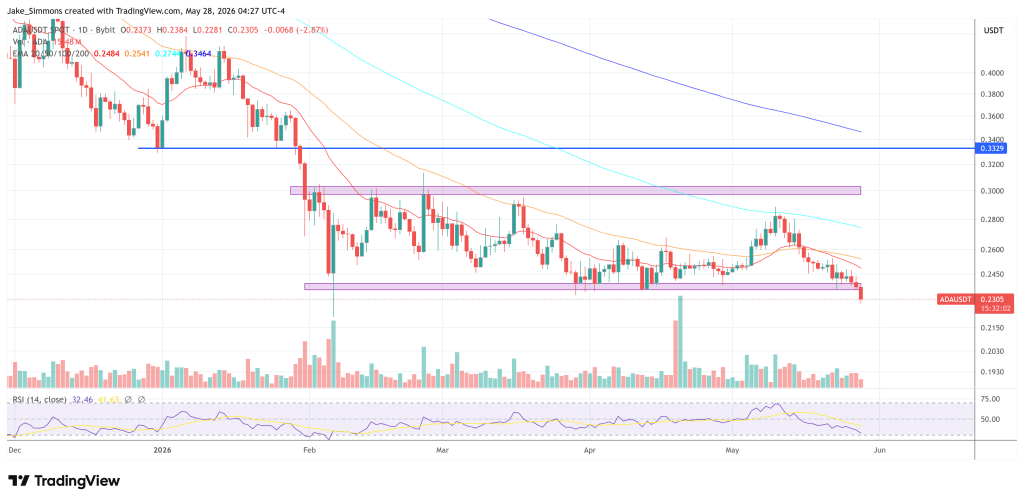
ADA drops below key support, 1-day chart | Source: ADAUSDT on TradingView.com

Domande pertinenti

QWhat is the primary reason Charles Hoskinson cited for closing the Wyoming medical clinic?

AHoskinson cited structural financial losses, weak local support, difficult healthcare economics, and an unsustainable business model that relied on subsidies or a private-equity-style approach.

QAccording to Hoskinson, what are his main daily professional priorities now?

AHis main daily priorities are focusing on getting Midnight adopted and getting Cardano back into the top 10, and ultimately the top 5, of the crypto market rankings.

QHow did Hoskinson characterize the clinic's role and its financial nature?

AHe characterized the clinic as an indispensable component of public health for the county, but stated it was never a true business and was essentially operating as a charity due to its financial losses.

QWhat broader issue in the US healthcare system did Hoskinson criticize in relation to the clinic's failure?

AHe criticized a system that structurally disadvantages primary care clinics through low insurance reimbursements, Medicare/Medicaid rates, and hospital billing advantages, while disproportionately rewarding procedures, cancer treatment, and pharmaceuticals over routine care.

QWhat does the clinic's closure signal for Hoskinson's involvement with Cardano?

AIt signals a refocusing of his time and bandwidth away from non-core ventures like healthcare and towards his crypto expertise, specifically on driving adoption for Midnight and improving Cardano's market position.

Letture associate

HYPE Spot ETF Continuously Accumulates 1% in 14 Days: Is the $75 New High Just the Starting Point?

Hyperliquid (HYPE) has surged to a new all-time high of $75 amid strong institutional and ETF-driven buying pressure. The article highlights several key bullish factors. First, the HYPE spot ETFs from 21Shares and Bitwise have seen 14 consecutive days of net inflows, totaling over $136 million and absorbing nearly 1% of HYPE's market cap—a faster initial pace than BTC or ETH ETFs. This ETF demand provides a solid price floor. Second, the protocol's own Assistance Fund (AF) mechanism, which uses 99% of fees to buy back and burn HYPE, has already removed over $1.1 billion worth of tokens, creating a dual support system alongside ETF inflows. This combined buying power is expected to counter potential selling pressure from upcoming team token unlocks. Institutionally, venture firm a16z is now considered one of the largest external holders of HYPE, with multiple addresses accumulating millions of tokens. Galaxy Digital is also actively buying. Analysts and firms like Bitwise and Grayscale are framing HYPE not as a mere meme coin but as a "second-generation" crypto with real value capture and infrastructure potential. Furthermore, Hyperliquid Strategies (PURR), a publicly traded company holding a large HYPE treasury, is set to join the Russell 3000 Index, potentially unlocking further passive investment flows. The ongoing feud between prominent backers like Arthur Hayes (pro-HYPE) and Kyle Samani (pro-SOL) underscores the intense market debate, with Hayes famously betting HYPE will outperform all top-ten crypto assets this year.

Odaily星球日报8 min fa

HYPE Spot ETF Continuously Accumulates 1% in 14 Days: Is the $75 New High Just the Starting Point?

Odaily星球日报8 min fa

ETH Bull and Bear Views Compilation: Can Ethereum's Value Flow Back to ETH?

Titled "ETH Bull and Bear Views: Can Ethereum's Value Flow Back to ETH?", this article synthesizes the current heated debate around Ethereum's native token, ETH, following Bankless co-founder David Hoffman's decision to sell his entire ETH holdings. The **bullish case**, represented by figures like Tom Lee (BitMine CEO) and Raoul Pal, argues that ETH's core thesis remains intact. They contend Ethereum is the essential, secure, and neutral foundational layer for future finance—encompassing stablecoins, RWA, DeFi, L2s, and Agentic AI. Bulls bet on ETH's long-term revaluation as institutional adoption of on-chain finance grows, with significant buying activity from entities like BitMine and Consensys cited as evidence. Conversely, the **bearish perspective**, led by Hoffman and analysts like Markus Thielen, questions ETH's value capture mechanism. They acknowledge Ethereum's network success but argue that the value created by L2s, DeFi, and applications does not sufficiently accrue to the ETH token itself. Bears point to ETH's prolonged underperformance versus the broader crypto market, lack of traditional cash flows, weakening "ultrasound money" narrative, and apparent institutional retreat (e.g., Harvard Management Company exiting its ETH ETF position) as key concerns. The debate highlights a pivotal shift: ETH is no longer just a community belief asset. The central question is whether ETH can transition from being a "**used infrastructure**" to a "**continuously bought and held core asset**" as more value enters the Ethereum ecosystem. The market is now critically examining the direct link between network growth and ETH's value.

marsbit55 min fa

ETH Bull and Bear Views Compilation: Can Ethereum's Value Flow Back to ETH?

marsbit55 min fa

Crypto is dead, Perps are forever

The crypto industry is shifting from a focus on creating native assets (like altcoins and protocol tokens) to becoming a "global asset pipeline." Native cryptocurrencies, except for Bitcoin, are seen as failing in their value storage and utility promises, with demand driven largely by speculation. Attention and liquidity are now moving toward real-world assets (RWAs) like U.S. stocks, bonds, gold, and oil traded on-chain via perpetual contracts (Perps). Stablecoins like USDT and USDC set the precedent, proving blockchain's core strength is efficient global settlement and transfer, not inventing new monetary systems. Meanwhile, assets like Ethereum and many DeFi tokens struggle as their narratives weaken against tangible traditional assets and the rapid real-world progress of AI. Perpetual contracts have emerged as a pivotal innovation. They simplify trading by offering pure price exposure to any asset, bypassing complexities of ownership, custody, and traditional market hours. Projects like Hyperliquid gained traction by combining CEX-like efficiency with on-chain transparency, capitalizing on post-FTX distrust, macroeconomic volatility, and the surge in demand for 24/7 stock trading. In conclusion, while the era of speculative native "crypto assets" may be over, perpetual contracts persist as the industry's most potent financial instrument—transforming all assets into globally accessible, constantly tradable instruments centered on price speculation.

marsbit1 h fa

Crypto is dead, Perps are forever

marsbit1 h fa

Tencent, Alibaba, ByteDance in a Battle for the Skill Store

Skill is becoming a key concept in the AI field, essentially serving as a structured "instruction manual" for AI Agents that specifies tool calls, decision logic, and output standards. This allows Agents to execute predefined tasks. As the number of Skills grows, distribution platforms have emerged. Major tech companies are swiftly entering this space. In March, Tencent, Alibaba, and ByteDance launched Skill stores within their respective Agent platforms. Subsequently, players like Zhipu AI, Meituan, and Xiaohongshu joined the fray. This competition for the "Skill store" is fundamentally a battle for the AI-era user entry point; whoever controls distribution controls the users. While ByteDance's Coze has experimented with paid Skills, most platforms offer them for free. The real value lies not in the stores themselves but in using them to attract and retain users within an ecosystem, driving revenue from services like cloud computing, model calls, or advertising. The landscape features three main player types: 1) **Internet giants** (e.g., Alibaba, ByteDance, Tencent, Meituan), leveraging Skills to drive traffic and monetize through their broader ecosystems (cloud services, transactions, ads). 2) **Large model companies** (e.g., Zhipu AI, Moonshot AI), using Skill stores to increase user engagement and monetize model API calls. 3) **Content platforms** (e.g., Xiaohongshu), treating Skills as a new content format to generate traffic and ad revenue. However, transforming Skill stores into a sustainable business faces significant hurdles. Key challenges include: the **difficulty in pricing Skills** due to inconsistent outputs across different models and contexts; **lack of cost transparency** (varying token consumption); **security risks** like Skill poisoning; and the **absence of standardized protocols** for development and evaluation. Unlike standardized mobile apps, Skills are often personalized workflows resistant to uniformity, which hinders the establishment of a reliable review and monetization system akin to the App Store. While there is genuine user demand for paid Skills—particularly in enterprise (e.g., contract review) and certain personal productivity scenarios—current platforms offer developers limited and unpredictable distribution. The future of Skill stores depends on overcoming these standardization, evaluation, and safety challenges to make acquiring a Skill as straightforward as downloading an app. For now, the stores function more as display shelves than robust marketplaces.

marsbit1 h fa

Tencent, Alibaba, ByteDance in a Battle for the Skill Store

marsbit1 h fa

Trading

Spot
Futures

Articoli Popolari

Come comprare ADA

Benvenuto in HTX.com! Abbiamo reso l'acquisto di Cardano (ADA) semplice e conveniente. Segui la nostra guida passo passo per intraprendere il tuo viaggio nel mondo delle criptovalute.Step 1: Crea il tuo Account HTXUsa la tua email o numero di telefono per registrarti il tuo account gratuito su HTX. Vivi un'esperienza facile e sblocca tutte le funzionalità,Crea il mio accountStep 2: Vai in Acquista crypto e seleziona il tuo metodo di pagamentoCarta di credito/debito: utilizza la tua Visa o Mastercard per acquistare immediatamente CardanoADA.Bilancio: Usa i fondi dal bilancio del tuo account HTX per fare trading senza problemi.Terze parti: abbiamo aggiunto metodi di pagamento molto utilizzati come Google Pay e Apple Pay per maggiore comodità.P2P: Fai trading direttamente con altri utenti HTX.Over-the-Counter (OTC): Offriamo servizi su misura e tassi di cambio competitivi per i trader.Step 3: Conserva Cardano (ADA)Dopo aver acquistato Cardano (ADA), conserva nel tuo account HTX. In alternativa, puoi inviare tramite trasferimento blockchain o scambiare per altre criptovalute.Step 4: Scambia Cardano (ADA)Scambia facilmente Cardano (ADA) nel mercato spot di HTX. Accedi al tuo account, seleziona la tua coppia di trading, esegui le tue operazioni e monitora in tempo reale. Offriamo un'esperienza user-friendly sia per chi ha appena iniziato che per i trader più esperti.

1.2k Totale visualizzazioniPubblicato il 2024.12.10Aggiornato il 2026.06.02

Come comprare ADA

Discussioni

Benvenuto nella Community HTX. Qui puoi rimanere informato sugli ultimi sviluppi della piattaforma e accedere ad approfondimenti esperti sul mercato. Le opinioni degli utenti sul prezzo di ADA ADA sono presentate come di seguito.

活动图片