Hoskinson Says Cardano Just Cleared A Major Binance Hurdle

bitcoinistPubblicato 2026-03-13Pubblicato ultima volta 2026-03-13

Introduzione

Charles Hoskinson, founder of Cardano, announced a major milestone for the ecosystem: the upcoming Binance spot listing of NIGHT, the native token of the privacy-focused sidechain Midnight. Hoskinson emphasized that this is the first Cardano-native asset to be listed on Binance, which he described as the world's largest altcoin exchange and the center of gravity for liquidity. He framed this development as a breakthrough that removes a significant structural barrier, opening the door for other Cardano assets to access top-tier global liquidity. Beyond market access, Hoskinson connected the listing to broader trends of chain abstraction and compliance, suggesting Midnight's technology could enable privacy-preserving tools essential for scaling tokenized real-world assets. He also presented this achievement as a direct rebuttal to critics who have questioned Cardano's ability to launch large-scale projects and remain relevant in the DeFi space.

Charles Hoskinson says the Cardano ecosystem has crossed a threshold it had struggled to reach for years: a Binance spot listing for a native asset. In a March 11 livestream, the Cardano founder described Binance’s announced support for Midnight’s token NIGHT as a milestone not just for that project, but for the broader effort to bring native assets into tier-one global liquidity.

NIGHT Gets Listed On Binance

Hoskinson framed the development around Midnight, the privacy-focused sidechain project tied to the Cardano ecosystem, whose token had already appeared on Binance Alpha. The bigger breakthrough, in his telling, is the move toward Binance spot. “Binance just tweeted today, Binance is excited to announce the Midnight Holder airdrop,” he said. “Plus, the token is going to be listed on Binance soon. So coming to Binance spot is NIGHT the first Cardano native asset to be listed on Binance. How about that?”

That distinction matters because Hoskinson cast Binance as the center of gravity for altcoin markets. He argued that getting a Cardano-native asset onto the exchange removes a structural barrier that had limited the ecosystem’s reach. “It’s a major milestone for the ecosystem. It’s opened the door for all other Cardano native assets,” he said. “This was a very high bar. It’s the largest market in the world... 80% of all altcoin trading is done here on Binance. It’s the market of markets, the granddaddy of them all.”

In Hoskinson’s telling, the significance goes beyond market access. He tied Midnight’s Binance arrival to a broader thesis around chain abstraction, account abstraction and compliance infrastructure, arguing that Midnight is meant to sit at the intersection of those trends as centralized and decentralized finance draw closer together.“

Traditional finance and DeFi are kind of coming together and Binance has always been on the forefront of that with BNB and what they’ve done with the Binance infrastructure,” he said. “When Midnight comes to this infrastructure and we can do things with this infrastructure, we can talk about reimagining the art of possible compliance and moving into the smart compliance world.”

He then pushed that argument further, saying privacy-preserving compliance tools could be essential if tokenized real-world assets are to scale. “That will open up $10 trillion of real world assets to enter the space above and beyond just making exchanges safer and more efficient,” Hoskinson said, pointing specifically to travel rule compliance and providing information “without revealing the underlying information.”

A rebuttal To Cardano Skeptics

The tone of the stream made clear that Hoskinson sees the Binance milestone as vindication after a long stretch of criticism around Cardano’s relevance in DeFi and its ability to launch large-scale products. He explicitly presented Midnight’s progress as a rebuttal to those narratives.

“There are some people who wrote off Cardano and they said, ‘Cardano can’t launch a billion-dollar project. Cardano can’t get tier one liquidity. Cardano’s days in the DeFi space are over. It’s not relevant anymore,’” he said. “And for us to be able to show them that they’re all wrong — you don’t get too many days like this.”

He compared the moment to earlier ecosystem inflection points, including Coinbase’s ADA listing in 2021 and the more recent arrival of USDCX, suggesting this latest move breaks another long-standing distribution bottleneck for Cardano-linked assets.

At press time, ADA traded at $0.2636.
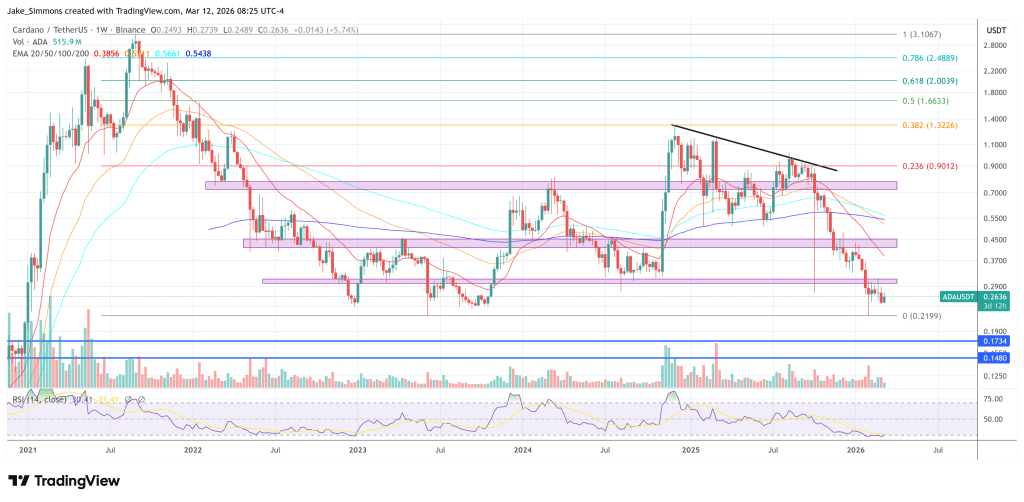
ADA hovers below key resistance, 1-week chart | Source: ADAUSDT on TradingView.com

Domande pertinenti

QWhat major milestone did Charles Hoskinson announce for the Cardano ecosystem regarding Binance?

ACharles Hoskinson announced that Midnight's token (NIGHT) will be listed on Binance spot, making it the first Cardano native asset to achieve a Binance spot listing.

QAccording to Hoskinson, why is Binance's role in altcoin trading significant for Cardano native assets?

AHoskinson stated that Binance is the largest market for altcoin trading, with 80% of all altcoin trading occurring there, making it a critical platform for liquidity and market access.

QHow does Hoskinson connect Midnight's Binance listing to broader trends in finance?

AHe links it to chain abstraction, account abstraction, and compliance infrastructure, suggesting Midnight sits at the intersection where traditional finance and DeFi are converging, enabling advanced privacy-preserving compliance tools.

QWhat does Hoskinson claim the Binance listing rebuts about Cardano?

AIt rebuts criticisms that Cardano cannot launch a billion-dollar project, secure tier-one liquidity, or remain relevant in the DeFi space, demonstrating the ecosystem's capability and growth.

QWhat potential does Hoskinson see for privacy-preserving compliance tools in tokenizing real-world assets?

AHe believes these tools could unlock $10 trillion in real-world assets by enabling compliance (like travel rule) without revealing underlying information, making exchanges safer and more efficient.

Letture associate

Who Funds the Agents?

**Summary: Who Funds AI Agents?** OpenAI recently shut down a feature allowing AI agents to shop for users, highlighting the challenge of creating a secure and regulated environment for agent-driven transactions. While payment infrastructure exists, a crucial governance layer—defining spending limits, fraud detection, tax handling, and return policies—is largely missing. The potential is enormous: AI agents already processed $73M across 176M transactions last year, with McKinsey forecasting this could grow to $3-5T in global consumer commerce by 2030. The core competition isn't just about processing payments, which can be very cheap (especially with crypto-based settlement), but about controlling the rules that govern agent spending. Key players like Stripe and Coinbase are racing to dominate this governance layer. Stripe's acquisition of wallet provider Privy allows it to set spending policies, identity checks, and human-in-the-loop approvals directly at the wallet level. Similarly, Coinbase's stack, including its x402 protocol and AgentKit, embeds governance rules. This vertical integration across settlement, wallet, and governance layers is becoming the dominant strategy. Control over the governance layer is where significant future value lies. If agents handle trillions in transactions, even a small fee for managing compliance, fraud prevention, and policy enforcement could generate billions in annual revenue. The companies that successfully integrate across the payment stack will capture value from idle agent balances, transaction fees, and governance services, positioning themselves as the foundational banks of the AI agent economy.

marsbit22 min fa

Who Funds the Agents?

marsbit22 min fa

A Nation Blocks Chips, a Giant Buys a Nuclear Power Plant: Why It's Time to Seriously Consider DeAI

**Title: Great Powers Blockade Chips, Giants Buy Nuclear Plants: Why It's Time to Seriously Consider DeAI** In May 2026, the US closed loopholes for Chinese firms to acquire advanced NVIDIA chips via overseas subsidiaries. That same month, Kenya halted a $1B geothermal data center project involving Microsoft, fearing its immense energy consumption. Meanwhile, Huawei announced mass production of its Ascend AI chip. These disparate events underscore a new reality: the competition for computing power ("compute") has escalated beyond the tech industry, becoming a geopolitical and infrastructural battleground. A new era of oligopoly is forming, with control over the AI stack—from GPU chips (NVIDIA) and cloud platforms (AWS, Azure, Google Cloud) to foundational models (OpenAI, Anthropic)—concentrating in a few Western "AI Octopus" corporations. This centralization creates systemic risks: pricing power and platform lock-in for users, infrastructure fragility, and a widening "compute divide" that threatens to marginalize nations without independent AI capacity. An "AI Iron Curtain" is deepening through export controls. In response, some nations like Saudi Arabia and the UAE are investing heavily to buy compute power, aiming to transition from oil to AI economies. The EU seeks to triple its compute capacity by 2030 to reduce dependency. However, the spending gap is vast, with four US tech giants alone planning ~$750B in AI capex for 2026. The race is increasingly constrained by energy, with AI tasks consuming up to 1000x more power than web searches, pushing firms to even acquire nuclear plants. This landscape is fueling interest in Decentralized AI (DeAI). It proposes a third way: using open protocols to coordinate a global network of idle GPUs, independent developers, and data centers, creating an AI infrastructure without a single controlling entity. Leveraging blockchain and cryptographic verification, DeAI aims to break market concentration, disperse energy demands, reduce geopolitical dependencies, and enhance transparency. While still nascent in performance and stability, DeAI's core promise is not immediate superiority but providing a crucial alternative architecture to resist monopoly, censorship, and centralized power. As specialized AI hardware costs fall and open-source models flourish, the window to build this foundation is open. The very existence of such competition serves as a vital check against the inevitable abuse of concentrated power.

marsbit1 h fa

A Nation Blocks Chips, a Giant Buys a Nuclear Power Plant: Why It's Time to Seriously Consider DeAI

marsbit1 h fa

Trading

Spot
Futures

Articoli Popolari

Come comprare ADA

Benvenuto in HTX.com! Abbiamo reso l'acquisto di Cardano (ADA) semplice e conveniente. Segui la nostra guida passo passo per intraprendere il tuo viaggio nel mondo delle criptovalute.Step 1: Crea il tuo Account HTXUsa la tua email o numero di telefono per registrarti il tuo account gratuito su HTX. Vivi un'esperienza facile e sblocca tutte le funzionalità,Crea il mio accountStep 2: Vai in Acquista crypto e seleziona il tuo metodo di pagamentoCarta di credito/debito: utilizza la tua Visa o Mastercard per acquistare immediatamente CardanoADA.Bilancio: Usa i fondi dal bilancio del tuo account HTX per fare trading senza problemi.Terze parti: abbiamo aggiunto metodi di pagamento molto utilizzati come Google Pay e Apple Pay per maggiore comodità.P2P: Fai trading direttamente con altri utenti HTX.Over-the-Counter (OTC): Offriamo servizi su misura e tassi di cambio competitivi per i trader.Step 3: Conserva Cardano (ADA)Dopo aver acquistato Cardano (ADA), conserva nel tuo account HTX. In alternativa, puoi inviare tramite trasferimento blockchain o scambiare per altre criptovalute.Step 4: Scambia Cardano (ADA)Scambia facilmente Cardano (ADA) nel mercato spot di HTX. Accedi al tuo account, seleziona la tua coppia di trading, esegui le tue operazioni e monitora in tempo reale. Offriamo un'esperienza user-friendly sia per chi ha appena iniziato che per i trader più esperti.

1.3k Totale visualizzazioniPubblicato il 2024.12.10Aggiornato il 2026.06.02

Come comprare ADA

Discussioni

Benvenuto nella Community HTX. Qui puoi rimanere informato sugli ultimi sviluppi della piattaforma e accedere ad approfondimenti esperti sul mercato. Le opinioni degli utenti sul prezzo di ADA ADA sono presentate come di seguito.

活动图片