Hong Kong Aims to Act as Global Connector Between Crypto and Traditional Finance

TheNewsCryptoPubblicato 2026-02-02Pubblicato ultima volta 2026-02-02

Introduzione

Hong Kong lawmaker Johnny Ng emphasizes that the city is positioning itself as a global connector between cryptocurrency and traditional finance, rather than competing directly with other nations. He argues that crypto is not a zero-sum game and should function as an interconnected global system. Hong Kong’s advantages include its common law system, English-language courts, and free capital flow, which help build a regulated and trusted crypto environment. The city also leverages the Greater Bay Area, collaborating with hubs like Shenzhen and Macau to combine fundraising and regulatory expertise with technological innovation. Recent efforts include inviting global crypto firms, such as Coinbase, to establish operations in Hong Kong and introducing clearer custody and OTC trading rules to better integrate crypto with institutional and corporate finance.

Johnny Ng, a Hong Kong lawmaker and a strong supporter of Web3 and digital assets, says that Hong Kong is not trying to “Beat” other countries in crypto; instead, it can act as a global connector between crypto markets and traditional finance across the U.S., Europe, and China.

Ng says that crypto should not be treated as the Zero sum game, meaning Crypto doesn’t belong to one country and is global, which works best when it is connected. He also stated that Hong Kong’s goal is to link East and West, Crypto startups and traditional banks, and innovation and regulations.

Why Hong Kong has a strong advantage

According to him, Hong Kong already has the strong advantages of a common law system that the global investors could understand and the English language court, trusted by the international businesses, with a free movement of money in and out of the city. This helps Hong Kong to build a crypto market that is regulated, safer, and accepted by the global financial institutions.

A key part of Hong Kong’s strategy involves the Greater Bay Area, which connects cities and Chinese hubs such as Shenzhen and Macau. Ng explained that Hong Kong helps to raise money and handle rules, whereas these main cities turn ideas into real products, which makes the region powerful.

Inviting the global crypto firms
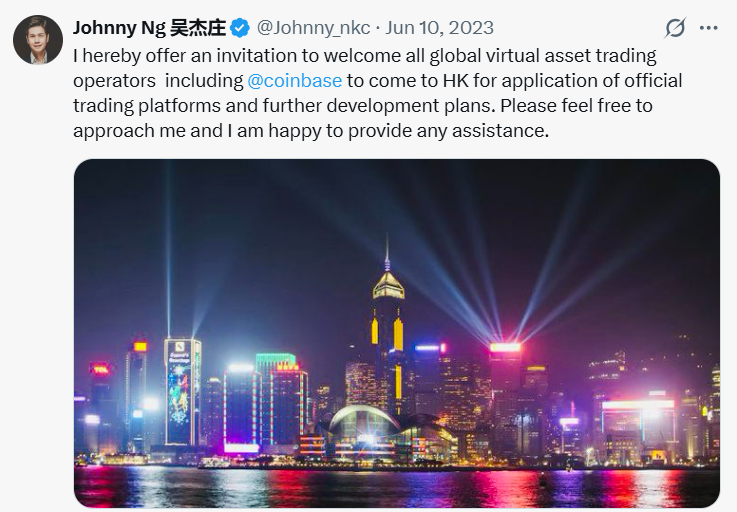
Ng pointed out that Vitalik Buterin spent a lot of time in Hong Kong during Ethereum’s early stages, which shows that the region has long supported blockchain innovations. In 2023, during the period of strict enforcement by the U.S. regulations, he invited the major crypto companies like Coinbase to operate in Hong Kong.

In 2026, Hong Kong plans to introduce clearer custody rules and regulate OTC crypto trading with larger trading limits for professional investors. Ng says that the next phase is about the infrastructure, and these steps aim to make crypto work smoothly with real businesses and large investors.

Highlighted Crypto News:

XRP Slides Below $1.60 Amid Broader Crypto Market Pullback

TagsBlockchainCryptoHongKong

Domande pertinenti

QWhat role does Hong Kong aim to play in the global crypto market according to Johnny Ng?

AHong Kong aims to act as a global connector between crypto markets and traditional finance, linking East and West, crypto startups and traditional banks, and innovation and regulations.

QWhat advantages does Hong Kong have in building a regulated crypto market?

AHong Kong has a common law system, English language courts trusted by international businesses, and free movement of money, which help build a regulated, safer crypto market accepted by global financial institutions.

QHow does the Greater Bay Area contribute to Hong Kong's crypto strategy?

AThe Greater Bay Area connects cities like Shenzhen and Macau, where Hong Kong handles fundraising and regulations while these cities turn ideas into real products, making the region powerful.

QWhat did Johnny Ng do in 2023 regarding global crypto companies?

AIn 2023, during strict U.S. regulations, Johnny Ng invited major crypto companies like Coinbase to operate in Hong Kong.

QWhat regulatory steps is Hong Kong planning for 2026 to support crypto integration?

AIn 2026, Hong Kong plans to introduce clearer custody rules and regulate OTC crypto trading with larger limits for professional investors to make crypto work smoothly with real businesses and large investors.

Letture associate

How Does Codex Use a Computer? Three Entry Points and Permission Boundaries

This article explains the three primary methods for Codex to interact with a computer, each with distinct use cases, permission boundaries, and trust levels. **1. Computer Use:** This offers the broadest access, allowing Codex to visually control and interact with the graphical user interface of authorized macOS/Windows apps, system settings, and even iOS simulators. It's ideal for tasks lacking APIs or structured tools, such as operating legacy software or multi-app workflows. However, it's the slowest method and has the widest permission scope, requiring careful supervision for sensitive actions. **2. Chrome Extension:** This grants Codex access to the user's logged-in Chrome browser state, including cookies, profiles, and open tabs. It's best for tasks requiring user identity across websites like Gmail, LinkedIn, Salesforce, or internal dashboards. Its key advantage is multi-tab control for complex workflows. While more powerful for browser-based tasks than Computer Use, it carries higher sensitivity as actions are performed under the user's identity. **3. In-App Browser:** This is a browser isolated within the Codex thread, separate from the user's personal browsing data. It excels in web development and debugging scenarios—previewing local servers, testing responsive layouts, or annotating designs directly on the page. Its isolation is a strength for development but a limitation for tasks requiring login sessions. The core principle is to choose the narrowest, safest, and most structured interface for the task. Use plugins or MCPs first, resort to visual control (Computer Use) only for GUI-dependent tasks, employ the Chrome extension for identity-reliant browser work, and prefer the In-App Browser for isolated development. **Appshots** are clarified as a fourth, complementary tool for *inputting* context—capturing a screenshot of a window to point Codex to something—rather than a method for Codex to *act*. Together, this layered approach highlights a key to AI agent productization: not granting unlimited permissions, but constraining them within clear boundaries for specific tasks while preserving user oversight.

marsbit49 min fa

How Does Codex Use a Computer? Three Entry Points and Permission Boundaries

marsbit49 min fa

The "Iron Rule" of Chip Equipment Is Being Broken

For years, the semiconductor equipment industry followed an unwritten "iron rule": suppliers offered steep discounts for new tool introductions (Design-in) and faced consistent price pressure during repeat orders, especially during market downturns. This long-standing buyer's market dynamic is now being upended. Recently, SK Hynix's primary equipment suppliers have reportedly requested a 3-4% price *increase*, a nearly unprecedented move. This shift is driven by a severe supply-demand imbalance fueled by the AI compute boom. Securing equipment has become an urgent arms race as chipmakers' expansion speed dictates their ability to fulfill massive AI chip orders. Key areas feeling the strain include: **TCB (Thermal Compression Bonding) Equipment:** Demand is exploding, driven by the simultaneous needs of HBM4 memory stacking, AI chip Chip-on-Substrate (C2S), and logic Chiplet Chip-on-Wafer (C2W) packaging. Players like Hanmi Semiconductor, Hanwha Semitech, and ASMPT are receiving major orders. While hybrid bonding is seen as the future, TCB remains the pragmatic choice for HBM4 mass production, with its lifecycle extended by relaxed specifications and ongoing technological upgrades. **Test Equipment Bottlenecks:** Ironically, AI-driven shortages are now crippling test equipment manufacturing. Critical components like FPGAs, Driver ICs, and CPUs face severe shortages and extended lead times (up to 52 weeks for FPGAs), as AI data center and server vendors prioritize supply. This creates a paradoxical cycle: AI chip shortages drive fab expansion, which requires more test equipment, whose production is delayed because its key parts are diverted to make AI chips. The industry is entering a broad, AI-powered upcycle. SEMI forecasts global semiconductor equipment sales to hit a record $156 billion by 2027, fueled by investment in advanced logic/foundry, HBM-driven DRAM, and advanced packaging (like CoWoS). Major players like TSMC, SK Hynix, and Micron are aggressively ramping capital expenditure. In conclusion, leading equipment vendors are no longer just selling tools; they are selling the critical capability to deliver AI-era capacity. Pricing power is shifting decisively to those with indispensable technology in key process nodes like advanced logic, HBM, and advanced packaging, rewriting the industry's traditional power structure.

marsbit1 h fa

The "Iron Rule" of Chip Equipment Is Being Broken

marsbit1 h fa

Trading

Spot
Futures
活动图片