Heavy Recommendation in Less Than a Month, Goldman Sachs Suggests "Going Short" on HALO Trade

marsbitPubblicato 2026-03-19Pubblicato ultima volta 2026-03-19

Introduzione

Goldman Sachs has executed a sharp reversal in its investment recommendation regarding the HALO (Heavy Assets, Low Obsolescence) trade within a month. After actively promoting the HALO narrative in late February, citing the AI-driven surge in capital expenditure from tech giants and structural tailwinds for physical assets, the bank now recommends shorting a specific basket of U.S. stocks, labeled GSXUHALT. This basket targets companies with high asset density but zero or negative earnings growth expectations, whose stock prices have rallied excessively alongside the broader HALO theme without fundamental support. Goldman's analysis indicates the market has been indiscriminately buying heavy-asset stocks, pushing some low-quality names to outperform higher-quality counterparts. The bank's data shows this basket peaked in late February and has begun to decline. The shift signals that the HALO trade's initial phase may be over, and internal differentiation is crucial. Goldman advises pairing this short position with thematic long opportunities, noting that the recent market pullback has created significant "buy-the-dip" potential in other sectors. The core message is that not all heavy-asset stocks are equal; investors must now distinguish between those with durable competitive advantages and those merely riding the trend.

Goldman Sachs executed a rare strategic about-face in less than a month—transitioning from actively pitching the HALO concept to investors to proactively shorting its "overheated" component stocks, reflecting concerns about the crowding in heavy-asset trades.

On Tuesday, Faris Mourad, head of Goldman's thematic trading team, introduced the short basket GSXUHALT in a latest report, specifically targeting U.S. companies that are asset-intensive but have zero or negative earnings growth expectations, yet whose stock prices have surged significantly with the HALO trend. Goldman believes the market's pursuit of heavy-asset stocks has become indiscriminate, with gains in some individual stocks severely disconnected from fundamentals.

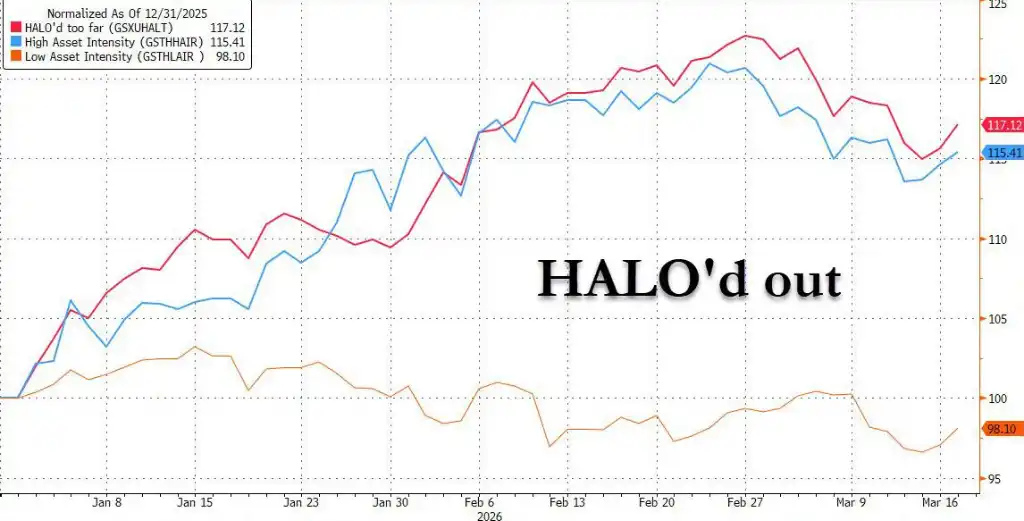
The immediate implication of this shift for the market is that the honeymoon period for the HALO trade may be over. Goldman data shows the GSXUHALT basket has begun to decline after peaking at the end of February, and the firm recommends investors pair this short position with their favored thematic long opportunities.
One Month Ago: Goldman Strongly Promoted HALO, Heavy-Asset Narrative Swept Wall Street

Going back to February 24th, Goldman Sachs Global Investment Research published a report titled "The HALO Effect: Heavy Assets, Low Obsolescence in the AI Era," joining major banks like JPMorgan in actively promoting the HALO concept—the combination of Heavy Assets and Low Obsolescence.

The logic at the time was clear and powerful: The rapid rise of AI is creating a dual impact on light-asset industries. On one hand, AI is disrupting profitability expectations in sectors like software and IT services, leading the market to reassess the terminal value of these industries; on the other hand, tech giants have embarked on an unprecedented capital expenditure cycle to maintain a competitive advantage in computing power—according to Goldman data, the top five U.S. tech giants are expected to have capital expenditures of approximately $1.5 trillion between 2023 and 2026, with spending in 2026 alone potentially exceeding $650 billion, surpassing their total pre-AI era spending.

Goldman's data at the time was equally impressive: Since 2025, its heavy-asset portfolio (GSSTCAPI) has cumulatively outperformed its light-asset portfolio (GSSTCAPL) by 35%. At the macro level, higher real interest rates, geopolitical fragmentation, and supply chain restructuring were seen as collective structural tailwinds for heavy-asset stocks.

About-Face: Indiscriminate Market Pursuit, Some Heavy-Asset Stock Gains Have Lost Fundamental Support

However, just one month later, Goldman's stance changed significantly.

Mourad pointed out in the latest report that the companies covered by the GSXUHALT basket are those that rose with the overall heavy-asset trend but themselves have no earnings growth expectations and returns that significantly lag behind high-quality HALO targets. In other words, the market, in chasing "AI-insulated" attributes, has indiscriminately poured funds into all heavy-asset stocks, no longer distinguishing between high and low quality.

Data confirms this judgment: The GSXUHALT basket's gains have actually surpassed those of the high-quality high asset intensity basket (GSTHHAIR), meaning low-return, no-growth heavy-asset stocks have instead beaten truly competitive peers. Meanwhile, the basket's stock price movement was still in sync with earnings expectations until late last year, after which a significant divergence appeared.

In screening for GSXUHALT components, Goldman selected companies from the highest asset-intensity industries in the Russell 1000 index, while剔除 all targets related to long-term trends like satellites, robotics, quantum computing, and AI, retaining only stocks with significant year-to-date gains but flat or downward revised earnings expectations. The basket's average asset intensity ratio is approximately 1.4.

Valuation Signal: Heavy-Asset Premium at Historically Medium-High Levels

Goldman's research last month already indicated that heavy-asset stocks are currently trading at a valuation premium relative to light-asset stocks. As of last month, the P/E premium for heavy-asset stocks was about 3%, sitting at the 62nd percentile over the past few decades. While still below historical peaks seen in 2004, 2012, and 2022, they are no longer cheap.
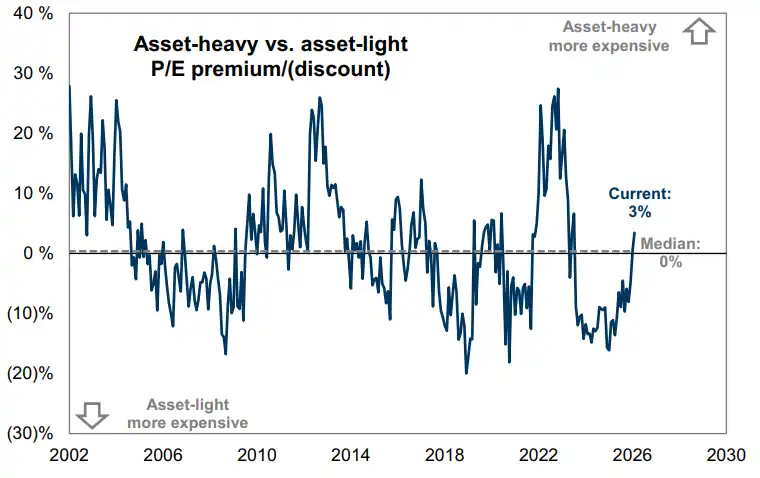
Since last November, Goldman's sector-neutral heavy-asset basket (GSTHHAIR) has cumulatively outperformed the light-asset basket (GSTHLAIR) by about 20%. In Goldman's view, the root of this strong performance by heavy assets lies in investors' strong demand for "AI-insulated" assets—namely, the search for physical asset-class stocks that are less susceptible to AI disruption and have underperformed for years.

Goldman recommends pairing the GSXUHALT short position with the firm's favored thematic long opportunities. The report notes that recent market adjustments have created the largest "buy the dip" opportunity in global equities since "Liberation Day," allowing investors to establish long exposure in directions supported by long-term trends while shorting heavy-asset stocks lacking fundamental support.

Behind this strategic shift is Goldman's clear judgment on the internal differentiation within the HALO trade: Not all heavy-asset stocks are worth holding. The time has come to distinguish between targets with true competitive moats and upward earnings momentum and those merely riding the coattails of the "heavy asset" label.


Domande pertinenti

QWhat is the HALO concept that Goldman Sachs initially promoted, and why did they recommend it?

AThe HALO concept, promoted by Goldman Sachs in late February, stands for 'Heavy Assets, Low Obsolescence.' It referred to companies with significant physical assets that are less likely to be disrupted by AI. Goldman recommended it because the rise of AI was seen as a threat to 'light asset' industries like software and IT services, while simultaneously driving an unprecedented capital expenditure cycle from major tech giants to maintain a competitive advantage in computing power.

QWhy did Goldman Sachs perform a strategic U-turn' and create the GSXUHALT basket?

AGoldman Sachs performed a strategic 'U-turn' and created the GSXUHALT basket because the market's pursuit of 'AI-insulated' assets had become indiscriminate. They observed that many heavy-asset stocks with zero or negative earnings growth expectations and low returns had seen their stock prices rise significantly alongside the broader HALO theme, becoming disconnected from their fundamentals.

QWhat specific criteria did Goldman Sachs use to select stocks for its GSXUHALT short basket?

AGoldman Sachs selected stocks for the GSXUHALT basket from the Russell 1000 index by focusing on companies in the highest asset-intensity sectors. They then剔除 (excluded) all companies related to long-term trends like satellites, robotics, quantum computing, and AI. Finally, they only kept stocks that had significant year-to-date price gains but had flat or downward revised earnings expectations. The basket's average asset intensity ratio is about 1.4.

QAccording to Goldman's data, what is the current valuation premium for heavy-asset stocks, and what does it indicate?

AAccording to Goldman Sachs's data from the previous month, heavy-asset stocks were trading at a price-to-earnings (P/E) premium of approximately 3% compared to light-asset stocks. This premium was at the 62nd percentile of its historical range over recent decades, indicating that while it is not at its historical peak, these stocks are no longer cheap and are valued at a medium-to-high level historically.

QWhat trading strategy does Goldman Sachs recommend alongside the GSXUHALT short position?

AGoldman Sachs recommends pairing the GSXUHALT short position with thematic long opportunities that they favor. They suggest that investors can short the heavy-asset stocks lacking fundamental support while simultaneously establishing long exposure in directions supported by long-term trends, taking advantage of what they see as the largest 'buy the dip' opportunity in global equities since 'Liberation Day'.

Letture associate

Bitcoin's 'Rally Ends,' Officially Entering the Later Stage of a Bear Market?

Bitcoin prices declined 13% this week, reversing the recent rebound and signaling a likely transition into the later stages of a bear market. Key on-chain metrics deteriorated, with the short-term holder cost basis falling below the Realized Price—a pattern last seen in early 2022, characteristic of bear market maturity. The rally to ~$82k proved to be a bear market bounce, as evidenced by the 90-day realized profit/loss ratio failing to sustain above the bullish threshold of 2. Daily realized losses surged to $1.35B, including significant selling from long-term holders who accumulated near cycle tops, indicating ongoing supply redistribution. Price was rejected almost precisely at the aggregate US spot ETF cost basis of ~$83k, turning that level into resistance and leaving the average ETF investor underwater again. Spot market selling pressure intensified, with the 7-day volume delta turning significantly negative to its weakest level since February. While a major long liquidation event cleared over $400M in leverage, spot demand has not yet stepped in to absorb the resulting supply. Options markets continue pricing in higher future volatility (elevated volatility risk premium) and maintain a skew toward put options, reflecting persistent demand for downside protection, though not yet panic. Overall, market structure remains fragile. Sustained recovery likely requires a reclaim of the ETF cost basis, a shift back to positive spot demand, and a slowdown in realized loss-taking. Until then, the market risks further downside or extended consolidation within the broader bear trend.

Foresight News1 h fa

Bitcoin's 'Rally Ends,' Officially Entering the Later Stage of a Bear Market?

Foresight News1 h fa

How Risky is the "Death Spiral" of MSTR and STRC?

Summary: This article explores the perceived "death spiral" risk between MicroStrategy (MSTR), its Bitcoin holdings, and its perpetual preferred stock (STRC), drawing comparisons to the LUNA-UST collapse. While both systems feature price anchors, high yields for holders, and potential feedback loops, their core mechanisms differ fundamentally. The MSTR-STRC structure relies on continuous financing to sustain its high dividend payouts, primarily through stock ATM offerings. A negative feedback cycle could occur: falling MSTR stock price makes raising equity capital harder, increasing pressure to sell Bitcoin, which undermines STRC confidence and further depresses MSTR. However, unlike LUNA-UST's automated, direct linkage, the MSTR-STRC loop is weaker and has brakes: STRC dividends can be deferred or rates lowered, and STRC holders have a $100/share liquidation preference in bankruptcy, providing a price floor. The company's sustainability hinges on its ability to continue financing. Its current ~$900 million USD reserves cover only about 6.3 months of its ~$1.71 billion annual interest/dividend burden. The next six months are critical, aligning with both the potential bottom in Bitcoin's four-year cycle and the depletion timeline of its reserves. While a LUNA-style catastrophic collapse is deemed highly unlikely due to structural differences, the key question is whether MicroStrategy can navigate this period through healthy deleveraging to restart its capital engine.

Foresight News1 h fa

How Risky is the "Death Spiral" of MSTR and STRC?

Foresight News1 h fa

Trading

Spot
Futures
活动图片




