This article is from:ACJ
Compiled|Odaily Planet Daily(@OdailyChina);Translator|Azuma(@azuma_eth)
Core Arguments
- Even as Robinhood's overall business hits record highs, its crypto business is in decline. In Q2 2026, Robinhood's crypto revenue fell 38% year-over-year to $100 million, accounting for only 8% of the company's total revenue; retail crypto trading volume fell 36% year-over-year, and the proportion of crypto assets in total customer Assets Under Custody (AUC) also dropped to a record low of just 7%.
- Robinhood Chain is one of the strongest Layer 2 (L2) network launch cases recently. The chain generated $3.6 million in Real Economic Value (REV) in July, accounting for 38% of all L2 network revenue tracked by growthepie, surpassing established networks including Polygon and Base.
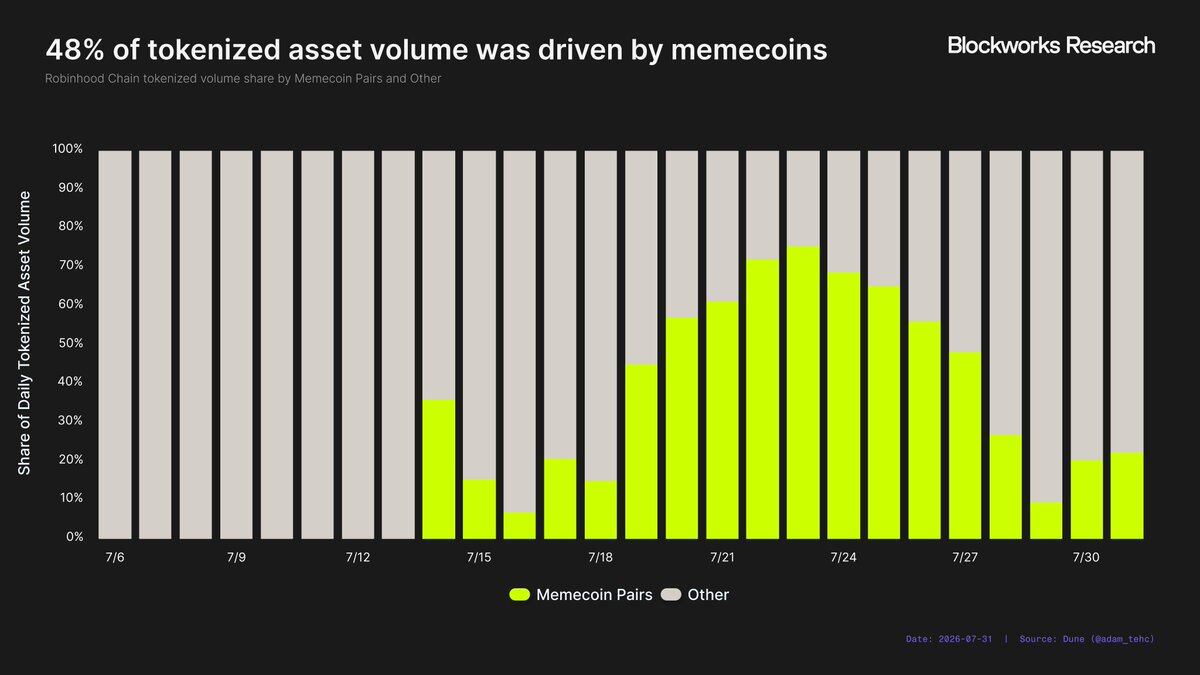
- What's driving early activity on Robinhood Chain is not Real World Assets (RWA), but Meme coins. In July, Meme coins accounted for 51% of Robinhood Chain's spot trading volume, while RWA accounted for only 5%. Furthermore, 48% of RWA trading volume came from liquidity pools composed of RWA and Meme coin pairs.
- Robinhood's clearest monetization opportunity lies not at the infrastructure layer, but at the application layer. Currently, the USDG stablecoin is already able to generate approximately $10.5 million in annualized interest income; the case of Morpho also demonstrates the value of Robinhood's primary app distribution capabilities. In contrast, Lighter's trading volume from the Robinhood Wallet integration accounted for only 0.2% of its total perpetual contract trading volume.
- Currently, Robinhood Chain cannot significantly impact Robinhood's profits. The combined annualized scale of known Robinhood Chain revenue sources is only about $54.8 million, equivalent to 14% of Robinhood's annualized crypto revenue. If Robinhood Chain is to become a significant business line, the company needs to scale USDG, commercialize main app traffic, or use the chain as an entry point for users into higher-value products.
Introduction: Robinhood's Crypto Business Is at a Crossroads
Perhaps no company better represents the trend of the rise of retail investors than Robinhood, which has become synonymous with retail investing, and its underlying business has thrived as a result.
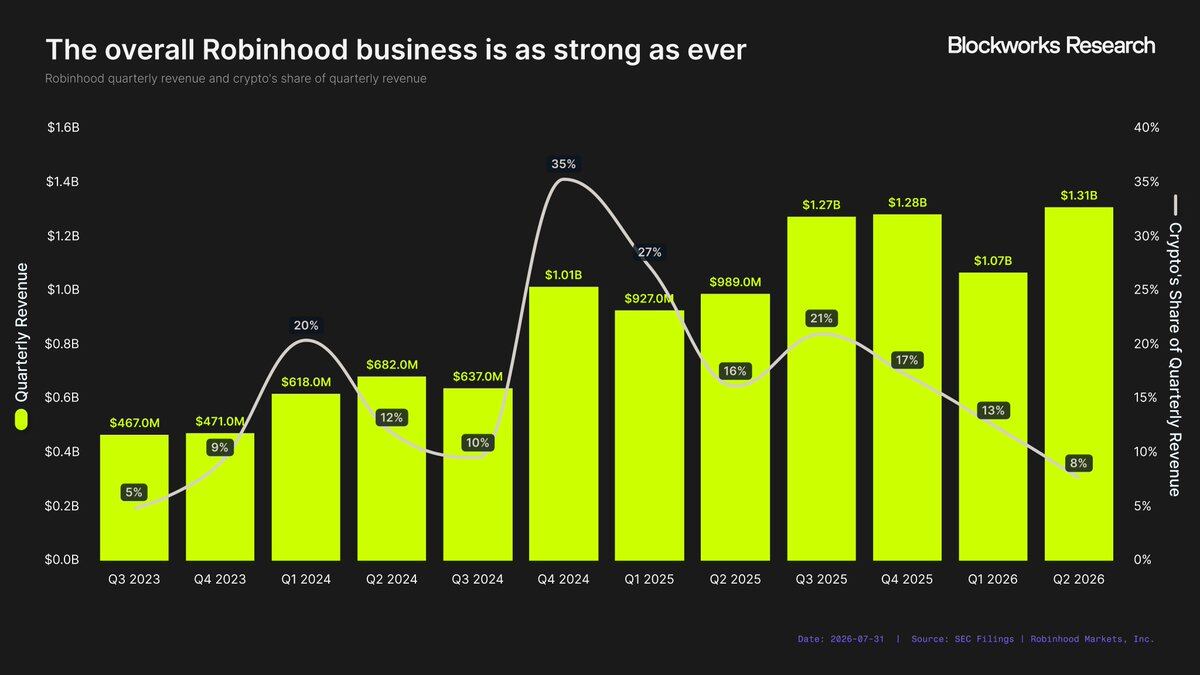
In Q2 2026, Robinhood's quarterly revenue reached $1.31 billion, a record high, up 32% year-over-year and 92% from Q2 2024. This growth came not only from its core stock and options trading business but also from an expanding product suite. Today, Robinhood boasts 13 business lines with annualized revenue exceeding $100 million. In fact, in Q2 2026, all of Robinhood's transaction-based revenue lines achieved double-digit year-over-year growth...
Except for one exception—the crypto business.
The crypto business, which once contributed over a third of Robinhood's revenue, has now shrunk to a nearly negligible part. In Q2 2026, only 8% of Robinhood's total revenue came from crypto, the lowest proportion since Q3 2023.
The importance of crypto in Robinhood's revenue mix has plummeted—even event contracts (i.e., prediction markets), launched just last year, generated more revenue than crypto in the second quarter:
- Event contract revenue: $156 million;
- Crypto business revenue: $100 million;
This weakness isn't only reflected in declining revenue share but also in Robinhood's core users losing interest in crypto assets. While this trend is not unique to Robinhood, the magnitude of the decline is still striking.
The most obvious indicator is trading activity. In Q2 2026, retail cryptocurrency trading volume on the Robinhood App was just $18.2 billion, down 36% year-over-year and the lowest quarterly level since Q3 2024.
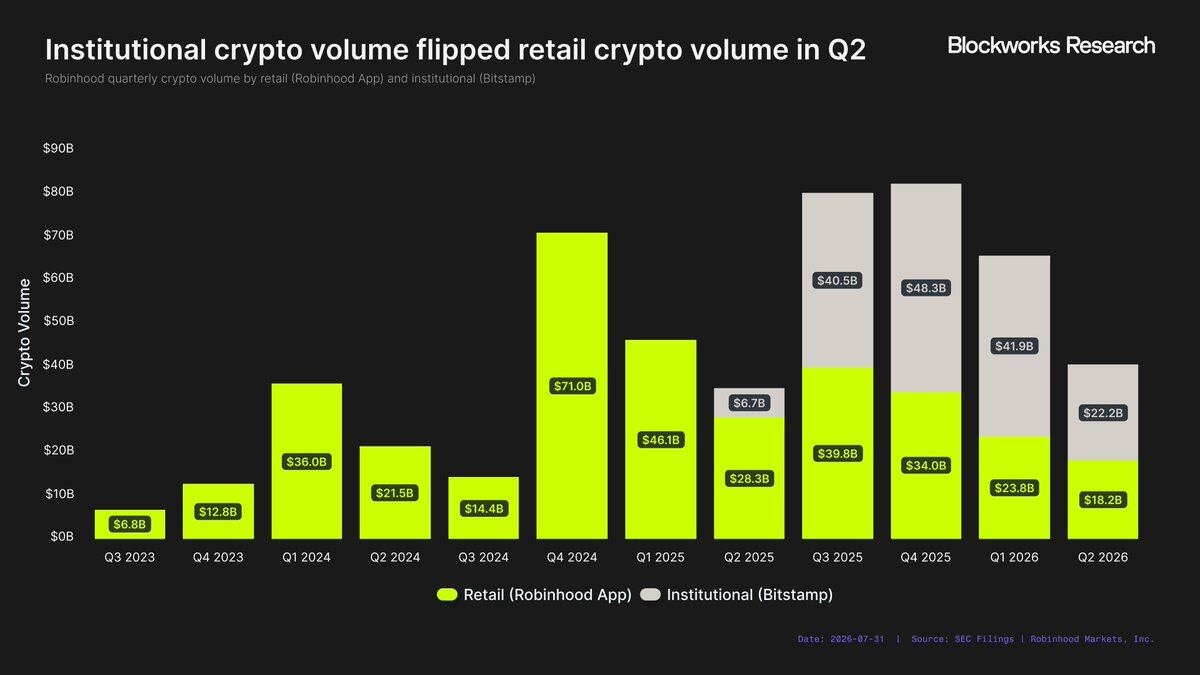
The decline was so significant that institutional trading volume on Bitstamp surpassed Robinhood's retail trading volume for the first time, even though institutional activity during this period wasn't particularly strong either—Bitstamp's Q2 trading volume was $22.2 billion, its second-lowest quarterly performance ever.
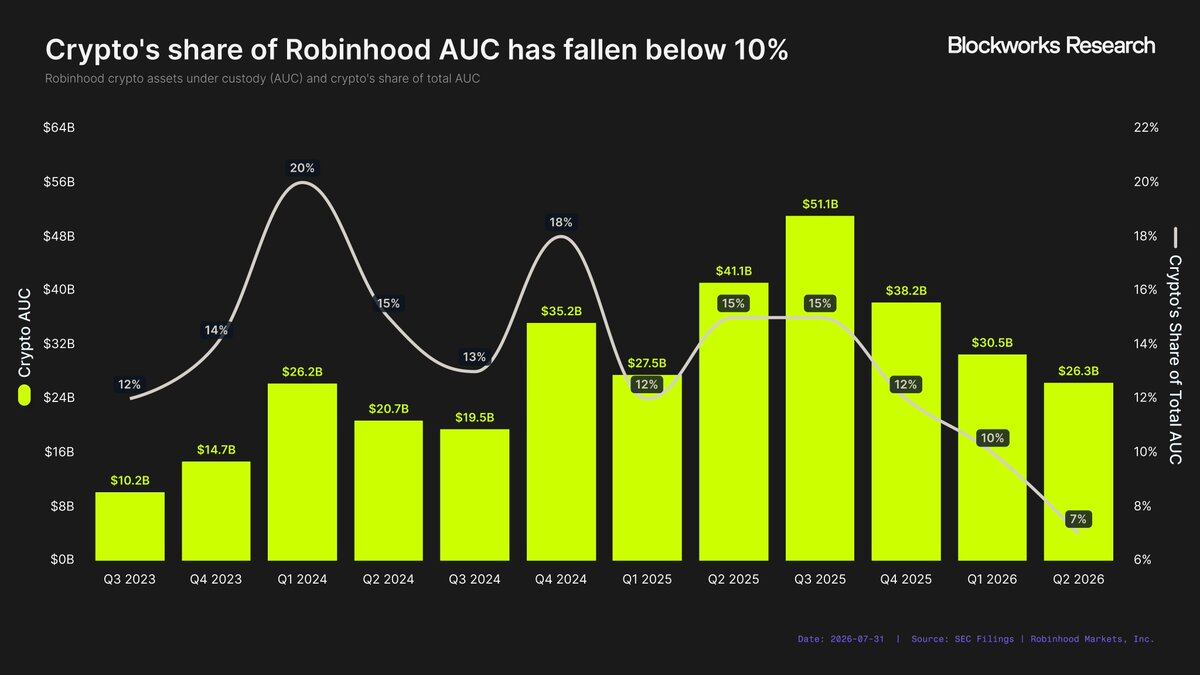
Trading volume isn't the only metric showing crypto's shrinking footprint. In Q1 2024, crypto Assets Under Custody (AUC) was $26.2 billion, accounting for 20% of Robinhood's total AUC. Over two years later, crypto AUC is essentially flat at $26.3 billion, but its share of total AUC is just 7%, the lowest quarterly share on record.
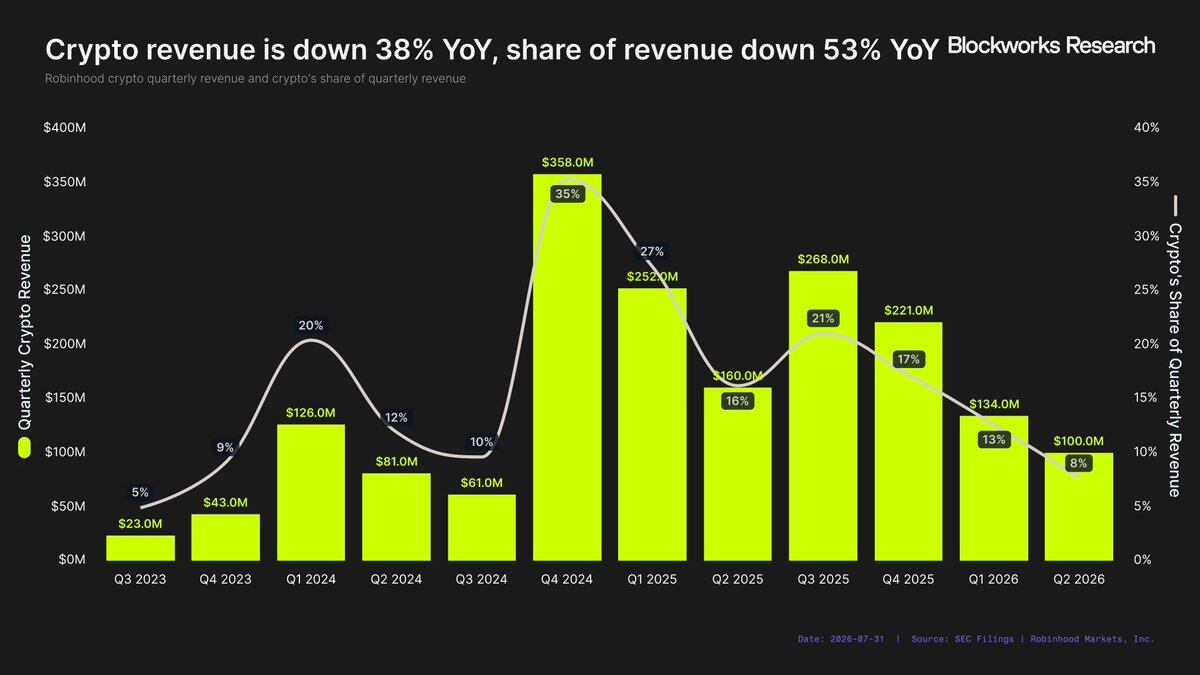
Against this backdrop, Robinhood's crypto revenue has been hit hard. Second-quarter crypto revenue fell 38% year-over-year, and its share of total revenue declined by 53 percentage points. In short, Robinhood overall is growing, but its crypto business is not.
Yet Robinhood isn't retreating from crypto. Instead, it has launched Robinhood Chain, its biggest crypto bet to date. Moving beyond near-total reliance on trading revenue, Robinhood is attempting to build a broader, more enduring crypto business. The key question is: Can Robinhood Chain make crypto a meaningful driver of growth for Robinhood again?
How Big is Robinhood Chain's Monetization Potential?
On July 1, 2026, Robinhood officially announced the launch of the Robinhood Chain mainnet at The World Is Flat event. This is Robinhood's self-developed Layer-2 (L2) blockchain, designed to power the company's growing on-chain ecosystem. Since launch, Robinhood Chain has become one of the fastest-starting blockchains in recent times.
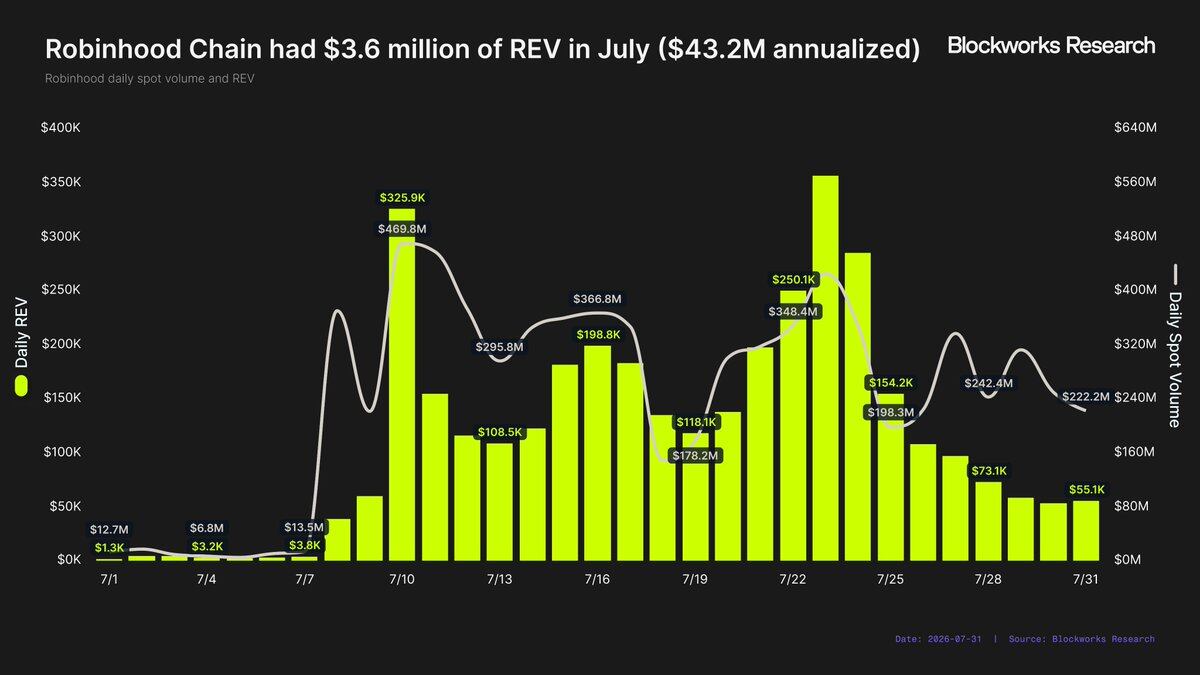
In its first month, Robinhood Chain generated $3.6 million in Real Economic Value (REV). While it's too early to tell if this level of activity is sustainable, a simple annualization of the first month's data suggests an annualized REV of around $43.2 million for Robinhood Chain.
This is a good start, but at this scale alone, it is far from enough to reverse the decline in Robinhood's crypto business revenue.
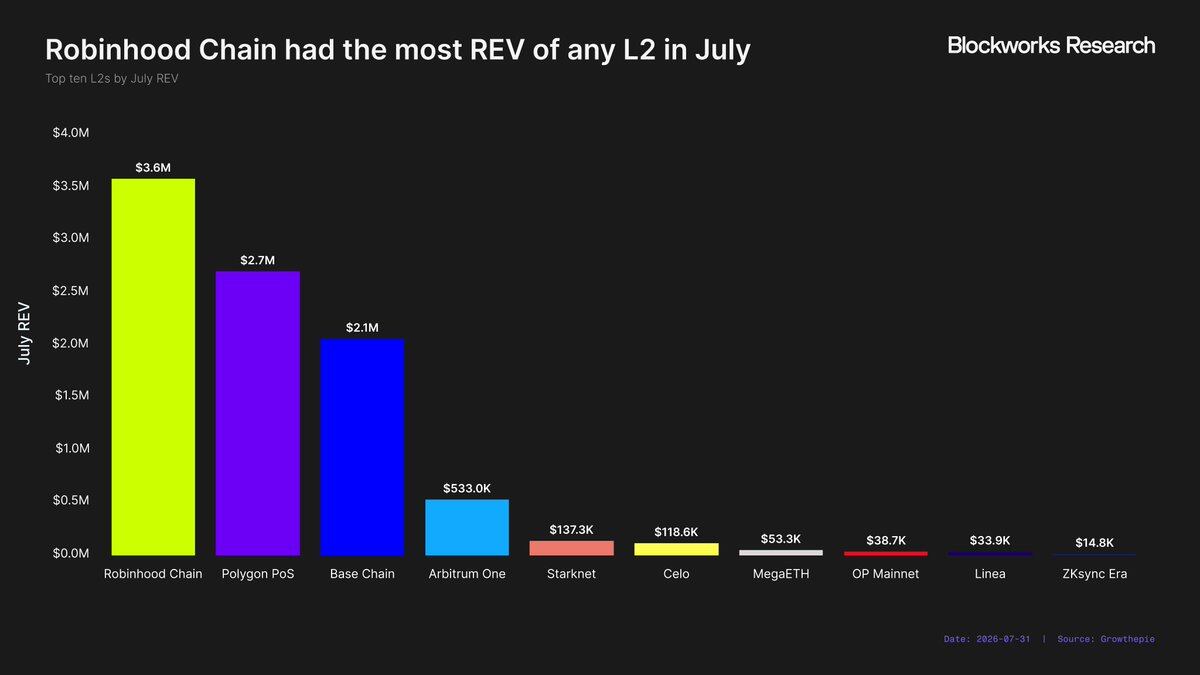
Even so, Robinhood Chain's launch performance remains impressive. In July, Robinhood Chain ranked first in revenue among all L2 networks, surpassing many mature networks that have been operational for years, such as Polygon ($2.7 million) and Base ($2.1 million).
According to data tracked by growthepie, Robinhood Chain currently accounts for 38% of all L2 network chain revenue. In other words, Robinhood Chain is already the L2 with the highest chain revenue, but 62% of the market share still belongs to other networks. Even if total L2 chain revenue stagnates, Robinhood Chain could still achieve significant growth by capturing a larger market share.
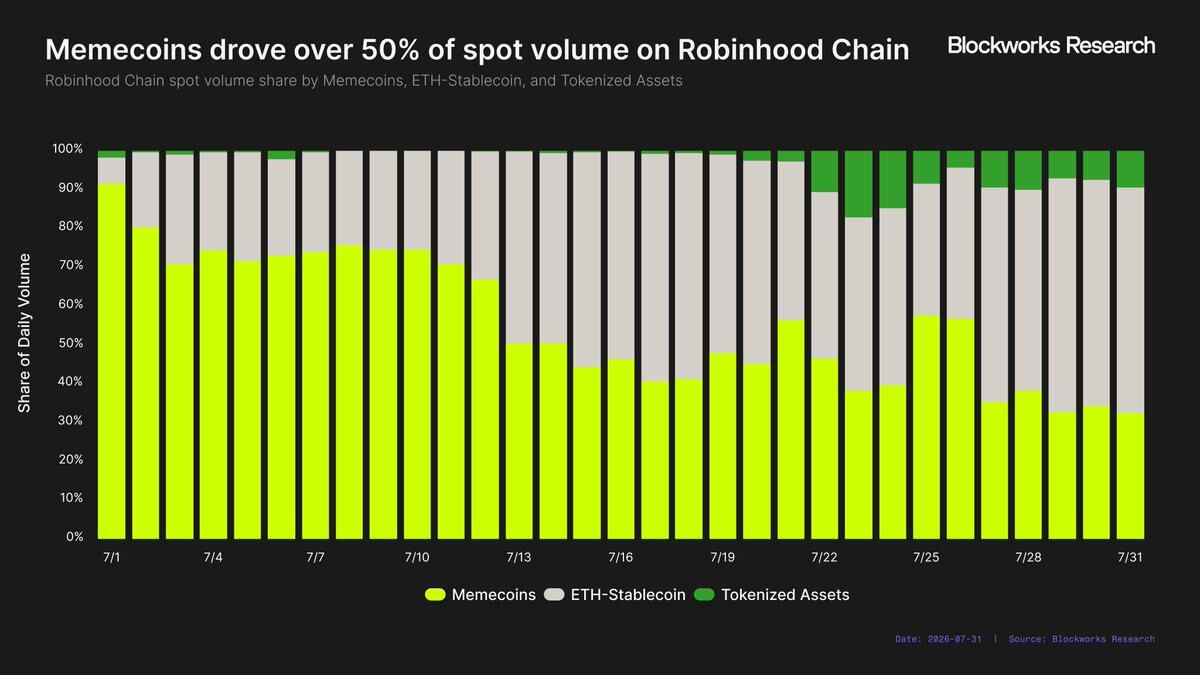
However, there is an important caveat to Robinhood Chain's early success: the majority of current activity is attributed to Meme coins, which have historically been one of the biggest drivers of blockchain REV. Robinhood seems to embrace this, with founder Vlad Tenev repeatedly expressing support for Memes.
Even so, the degree to which Meme coins are driving Robinhood Chain's activity is quite astonishing. The chain facilitated $6.93 billion in spot trading volume in July, of which $3.55 billion (51%) came from Meme coins. In contrast, RWA—the purported core use case for Robinhood Chain—accounted for only $313.2 million, or 5% of total trading volume.
Moreover, the direct share of Meme coins in Robinhood Chain's trading volume may still underestimate their real impact on network activity. Take RWA as an example. A strategy promoted by the Meme coin launch platform L()ng involves pairing Meme coins with tokenized stocks or ETFs in liquidity pools, thereby linking the Meme coin's price movement to the underlying RWA. If the underlying RWA rises, say by 5%, the Meme coin's price will also rise by 5% (assuming no buying or selling). Therefore, a significant portion of what appears to be RWA trading volume is actually driven by Meme coins as well. From July 6 to July 31, 48% of RWA trading volume occurred in liquidity pools pairing Meme coins with RWA.
While Meme coins can effectively drive chain revenue growth, historically they have rarely been a long-term, stable source of revenue. Meme coin activity is highly rotational; Ethereum, Avalanche, TRON, and Base have all experienced their speculative booms, but eventually, capital and users moved on to other networks. Whether Robinhood Chain will be able to retain this activity in the future remains uncertain. One month of data is not enough to prove whether Meme coins will be a sustainable REV source for Robinhood Chain, or if it is just another temporary stop in capital rotation before eventually flowing back to Solana.
From a broader perspective, REV from Robinhood Chain alone is unlikely to revive Robinhood's crypto business. From an industry-wide perspective, network revenue is in structural decline. First-generation smart contract platforms once earned substantial fee income from block space scarcity, but as block space becomes increasingly commoditized, it is becoming harder for new chains to generate significant revenue from the infrastructure itself.
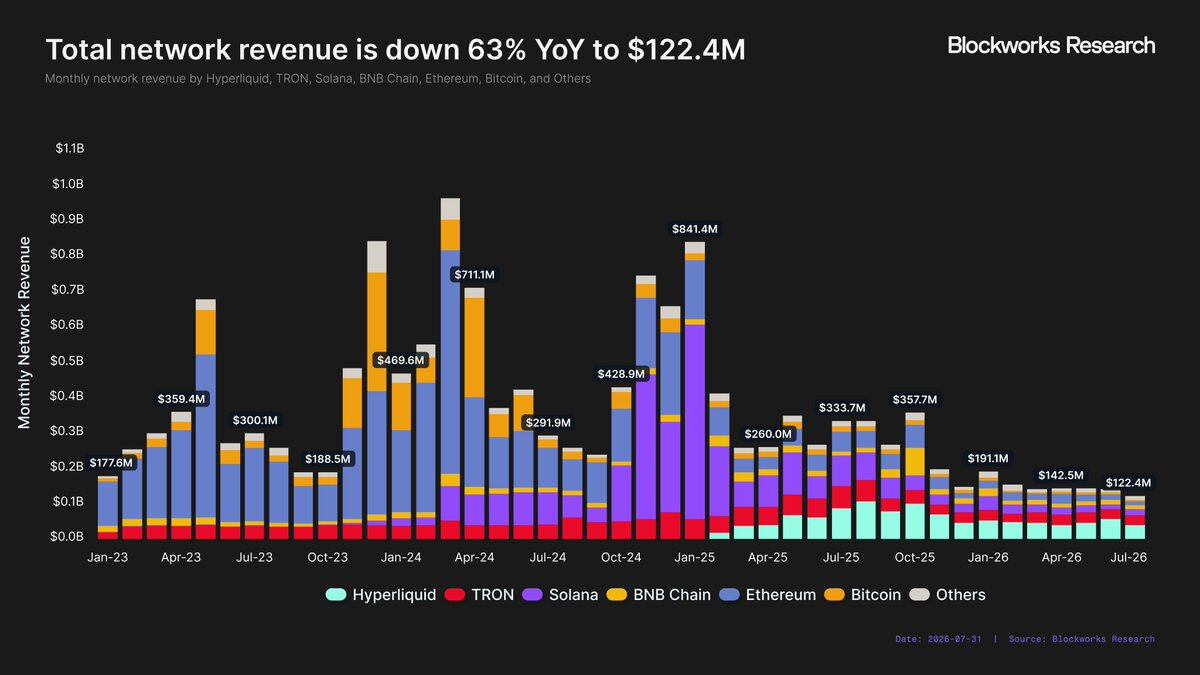
In July, blockchains tracked by Blockworks collectively generated $122.4 million in network revenue, the lowest monthly total in three and a half years. In comparison, network revenue in July 2025 was $333.7 million, down 63% year-over-year. This deterioration cannot be simply attributed to the market cycle. In July 2023, during the previous bear market, chains still generated $300.1 million in network revenue.
As mentioned earlier, Robinhood already has 13 business lines achieving at least $100 million in annualized revenue. Based on network revenue alone, it's hard to imagine Robinhood Chain joining this list. Even if Robinhood Chain continues to capture a larger share of L2 activity, its chain revenue will ultimately hit a market ceiling of around $100 million in annualized revenue.
Breaking through this ceiling requires Robinhood to onboard its existing user base onto the chain. However, since Robinhood's user base is primarily in the US, most cannot access Robinhood Chain through the Robinhood app under current regulations, a process that may take time.
If Robinhood hopes for Robinhood Chain to become the next $100 million business line in the near term, the company needs to move beyond the pure network revenue model.
Commercialization at the Application Layer
Value capture in the crypto industry is gradually shifting from the infrastructure layer to the application layer. Solana is a good example.
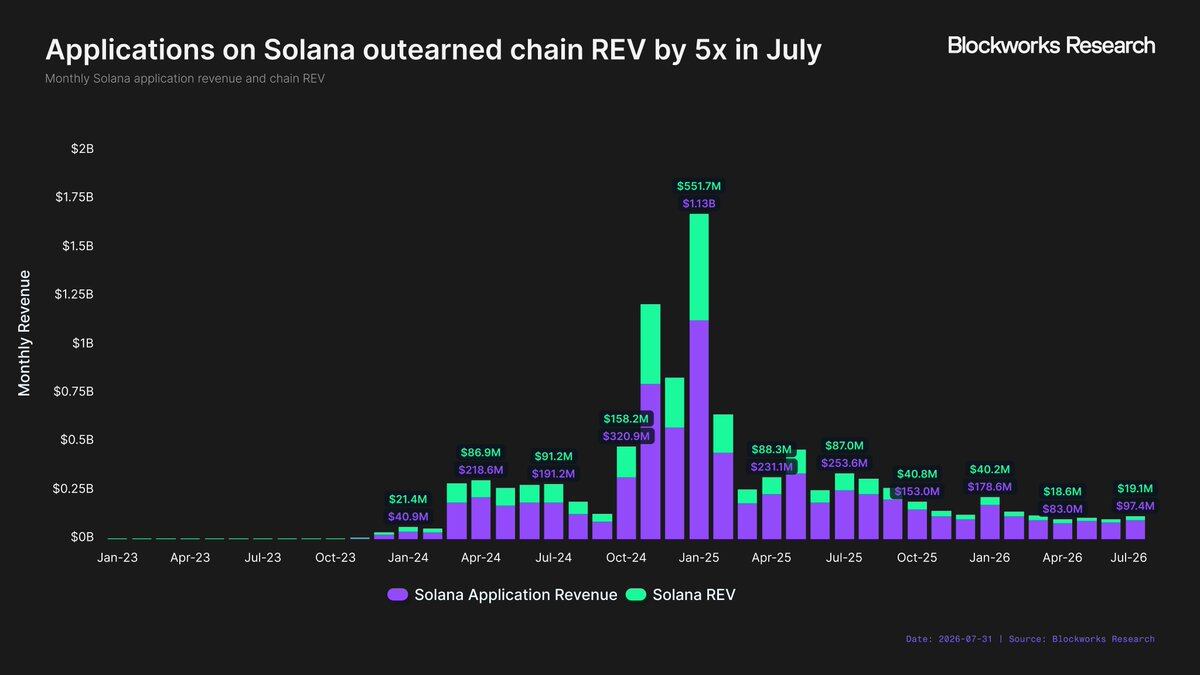
At the beginning of Solana's resurgence in January 2024, Solana applications generated $40.9 million in revenue, while the Solana network generated $21.4 million in REV, with application revenue being about 1.9 times network revenue. At Solana's bull market peak in January 2025, its application revenue reached $1.13 billion, while Solana REV was $551.7 million, maintaining a ratio of about 2 times. However, this gap has since widened further. In July 2026, for every $1 in revenue generated by Solana ecosystem applications, the network itself captured only about $0.20.
In other words, the application layer is capturing an increasing share of value, while the underlying blockchain is capturing a declining proportion. If Robinhood wants Robinhood Chain to become the next $100 million business line, it must participate directly in the commercialization of on-chain applications. While Robinhood has not officially announced this as a strategy, its early moves point in this direction.
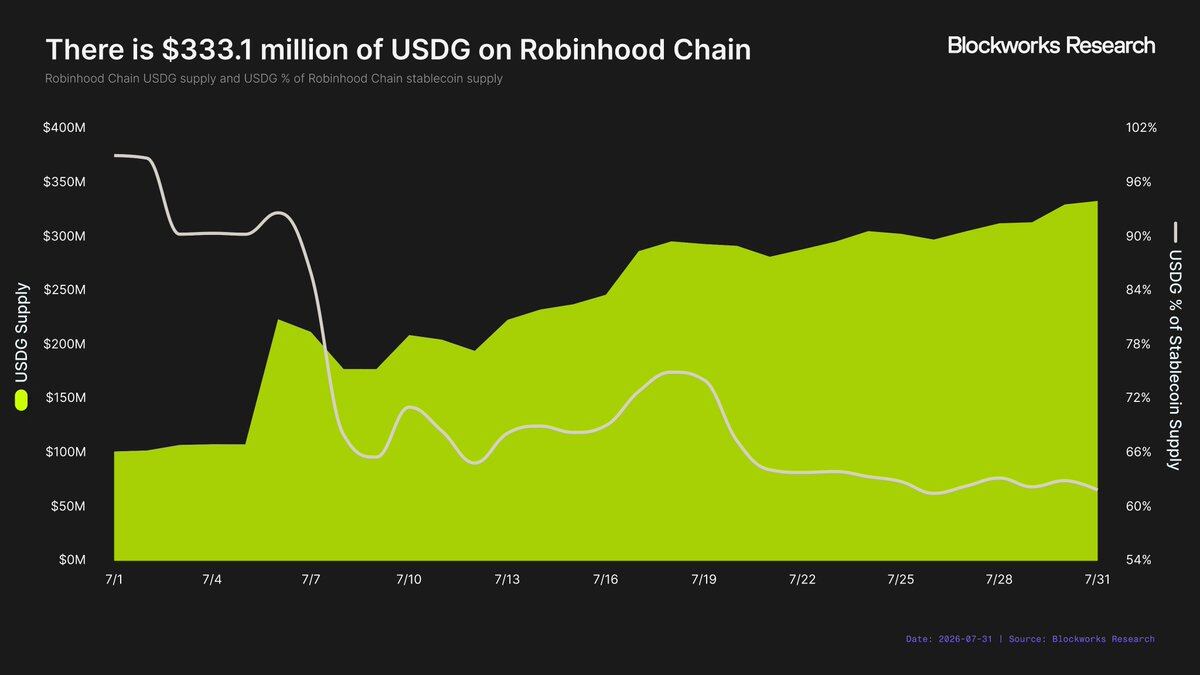
The most prominent case so far is Robinhood's stablecoin strategy. Unlike most blockchains that primarily rely on Circle's USDC or Tether's USDT, Robinhood has designated USDG as the native stablecoin for Robinhood Chain. This creates an additional revenue stream for Robinhood—interest income generated from the underlying reserve assets of USDG. As of the end of July, the market capitalization of USDG on Robinhood Chain was $333.1 million. Assuming an underlying reserve yield of 3.5% and that Robinhood retains 90% of the associated interest income, USDG would generate approximately $10.5 million in additional annualized revenue.
It shouldn't be difficult for Robinhood to further increase the supply of USDG, thereby creating a more substantial revenue stream. If USDG supply reaches $1 billion (a reasonable target, as 11 blockchains already have a stablecoin supply of at least $1 billion), it would generate $31.5 million in annualized revenue, nearly on par with Robinhood Chain's current chain revenue.
Robinhood Chain also appears to be expanding its application layer beyond stablecoins. Lighter launched a custom deployment of its Perp DEX on Robinhood Chain and will split trading fees 50/50 with Robinhood. As part of the partnership, Robinhood Wallet—a self-custody wallet separate from the main Robinhood app—will showcase Lighter's perpetual contracts directly within the app.
Additionally, it is rumored that Morpho also paid a fee to Robinhood for integration within the Robinhood app. If true, this would be a business model distinctly different from traditional blockchain ecosystems. In the past, blockchains typically paid incentives to attract application deployments, whereas Robinhood is trying the reverse: applications paying for access to Robinhood's user distribution channels.
How Much is Robinhood's Distribution Power Worth?
The viability of the entire application layer strategy ultimately depends on the value of Robinhood's distribution channels. If protocols are willing to pay to reach Robinhood users, then Robinhood can commercialize this traffic asset.
Based on current cases, protocols on Robinhood Chain can primarily gain users through two channels:
- The main Robinhood app, e.g., Morpho;
- The standalone Robinhood Wallet, e.g., Lighter.
While the distribution power of the main Robinhood app is well known, the value of distribution through Robinhood Wallet is far less clear.
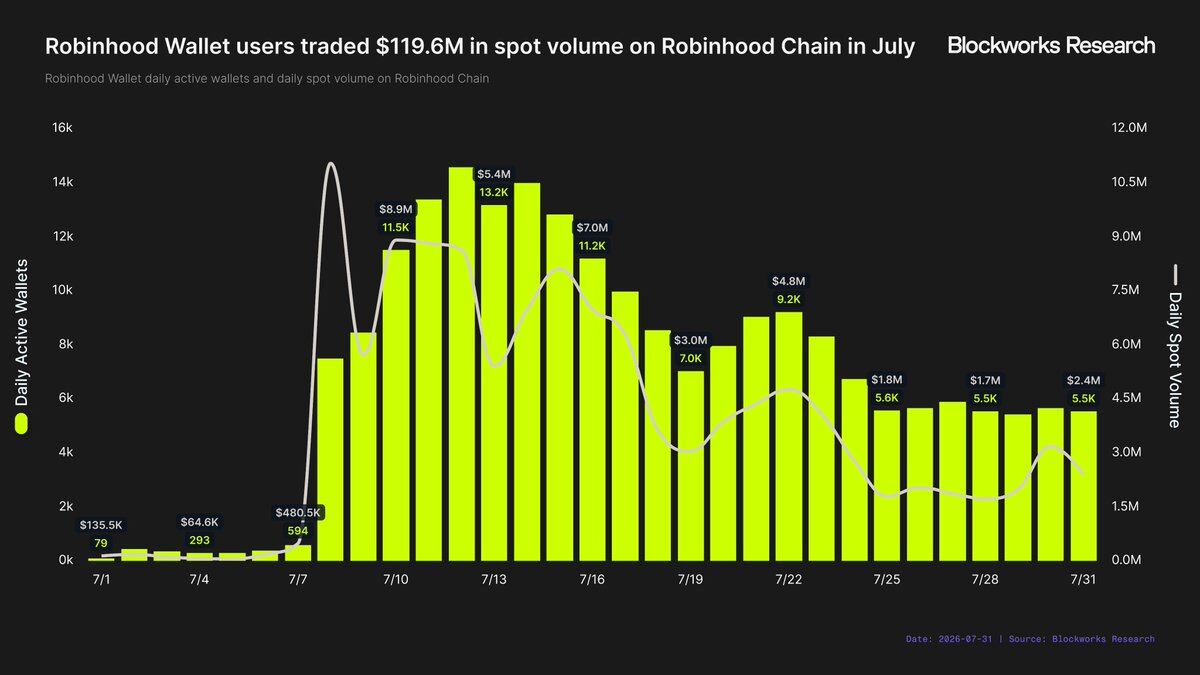
Looking solely at activity on Robinhood Chain, Robinhood Wallet users generated $119.6 million in trading volume in July. Daily volume peaked at $11 million on July 8 and declined to an average of $2.1 million per day in the final week of the month. The daily active wallet count for Robinhood Wallet in July was just under 7,000. This analysis does not apply Sybil attack filtering, so the actual number of unique users may be lower.
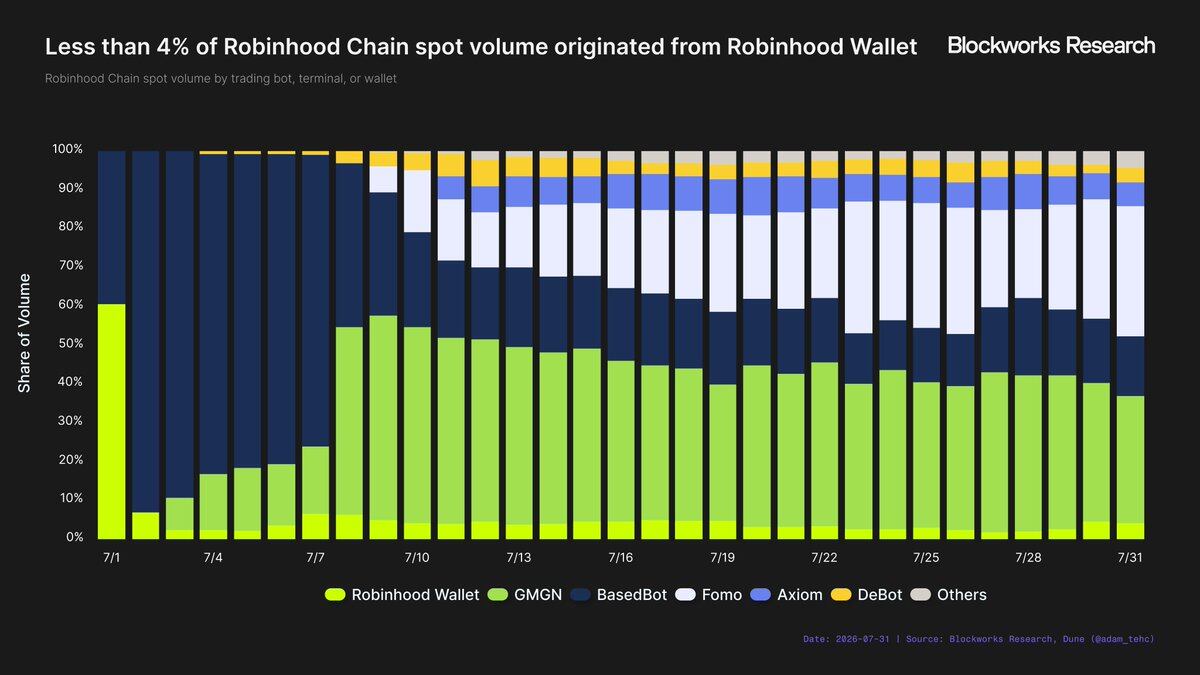
Compared to the broader wallet and trading app ecosystem on Robinhood Chain, Robinhood Wallet remains a relatively small player. The tracked wallets and trading apps collectively generated $3.08 billion in trading volume in July, of which Robinhood Wallet accounted for $119.6 million, representing less than 4% market share. However, trading volume for these apps is driven primarily by heavy users. Robinhood Wallet ranked fourth in terms of daily active wallets, despite ranking sixth in trading volume.
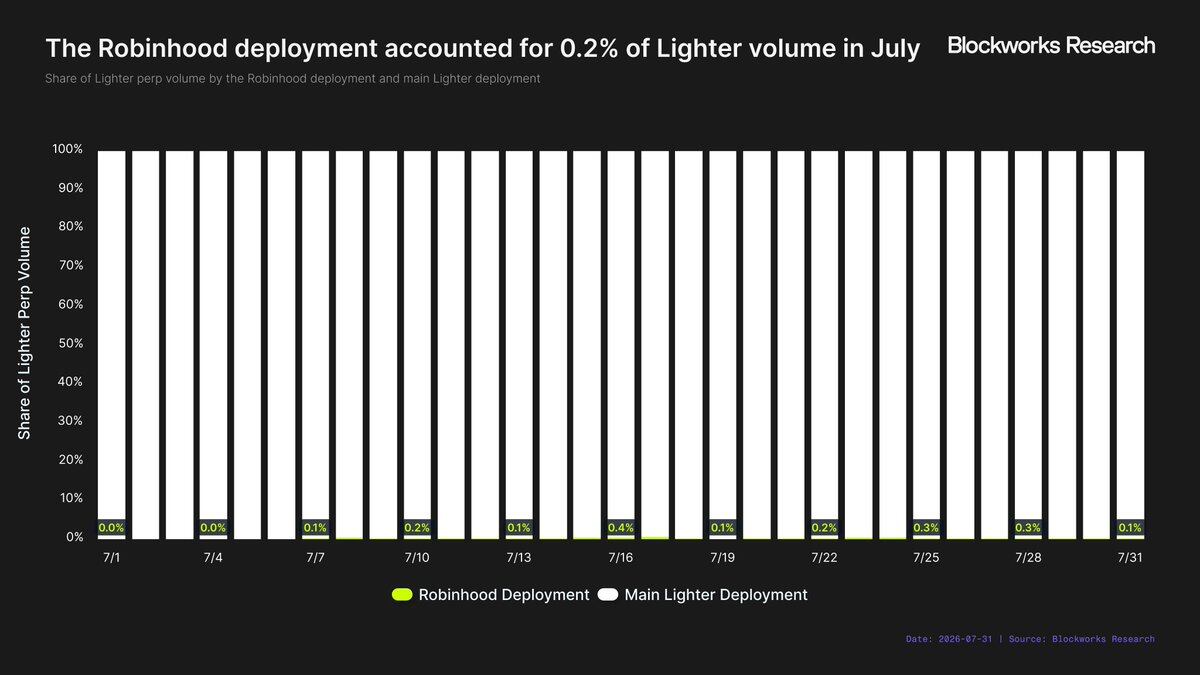
Lighter's integration further demonstrates the limited distribution value of Robinhood Wallet. Since integrating with Robinhood Wallet, Lighter's Robinhood deployment accounted for only 0.2% of its total perpetual contract trading volume. In July, this figure was $86.8 million, lower than the spot trading volume generated through Robinhood Wallet that month.
Perhaps more concerning is that Lighter is directly incentivizing perpetual contract trading through Robinhood Wallet, allocating 11 million LIT tokens for this purpose, currently worth about $25 million. Even the current limited volume is driven by incentives and might be lower without these rewards. For now, it's hard to draw conclusions about how much revenue Robinhood Wallet distribution alone can bring.
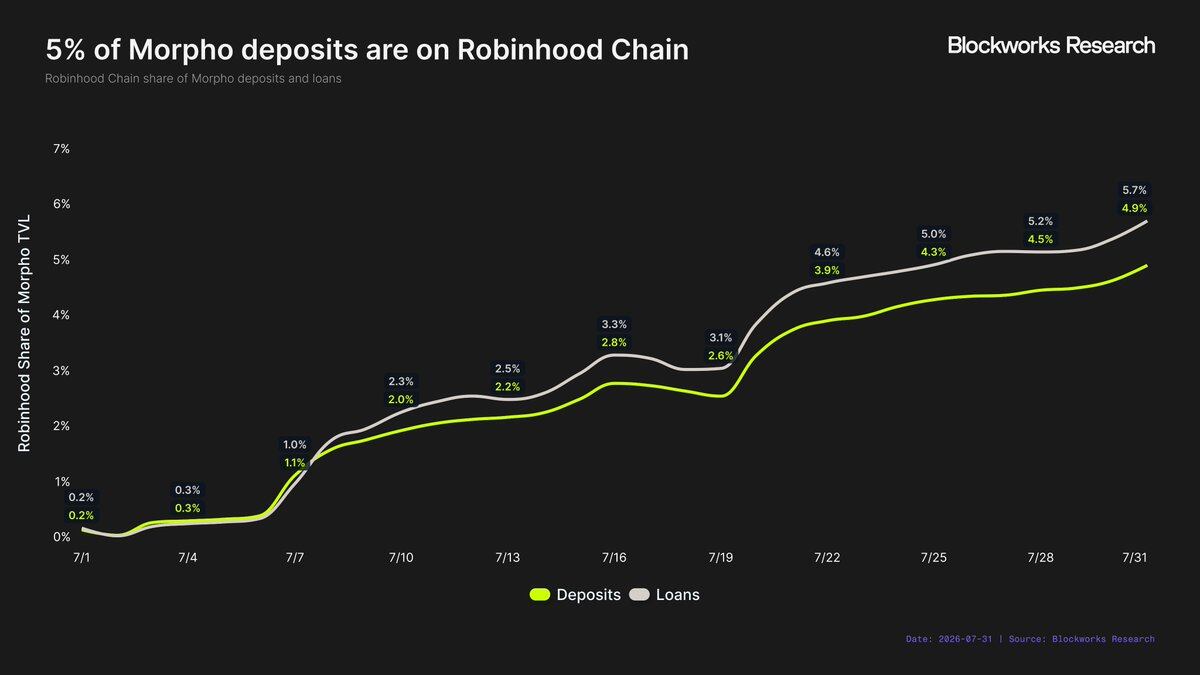
While the distribution value provided by Robinhood Wallet may be limited, the main Robinhood app is a different story. Morpho provides the clearest example, as Robinhood users can directly deposit stablecoins into Morpho through the main app to earn an incentivized 7% APY. As of the end of July, Morpho's deployment on Robinhood Chain accounted for 5% of Morpho's total deposits and nearly 6% of all loans. Just one month after launch, Robinhood Chain has already become Morpho's third-largest market by TVL.
It must be acknowledged that this TVL is also incentivized. Even so, the difference in distribution via the main Robinhood app versus Robinhood Wallet remains stark. While not a perfect like-for-like comparison, the share of Robinhood Chain market in Morpho's total deposits is 25 times greater than the share of Robinhood's deployment market in Lighter's total perpetual contract trading volume.
Therefore, the early conclusion regarding Robinhood's distribution value is split. For protocols that can secure direct integration into the main Robinhood app, the distribution value appears extremely high; but distribution solely through Robinhood Wallet is far less attractive. Unless Wallet integration serves as a stepping stone to ultimately reaching the main app, it's hard to understand why a protocol would sacrifice meaningful economic benefits for it.
Admittedly, this conclusion is based on only two early cases. Robinhood has not formally announced app-layer distribution deals as a broader strategy, nor is it clear to what extent the company intends to pursue such partnerships. But the difference observed so far is significant. The real value of Robinhood's distribution power doesn't come from "being associated with the Robinhood brand" or "deploying on Robinhood Chain," but from direct access to users within the main Robinhood app.
Can Robinhood Chain Revive the Crypto Business?
This report began with a core question—can Robinhood Chain make crypto a meaningful driver of growth for Robinhood again?
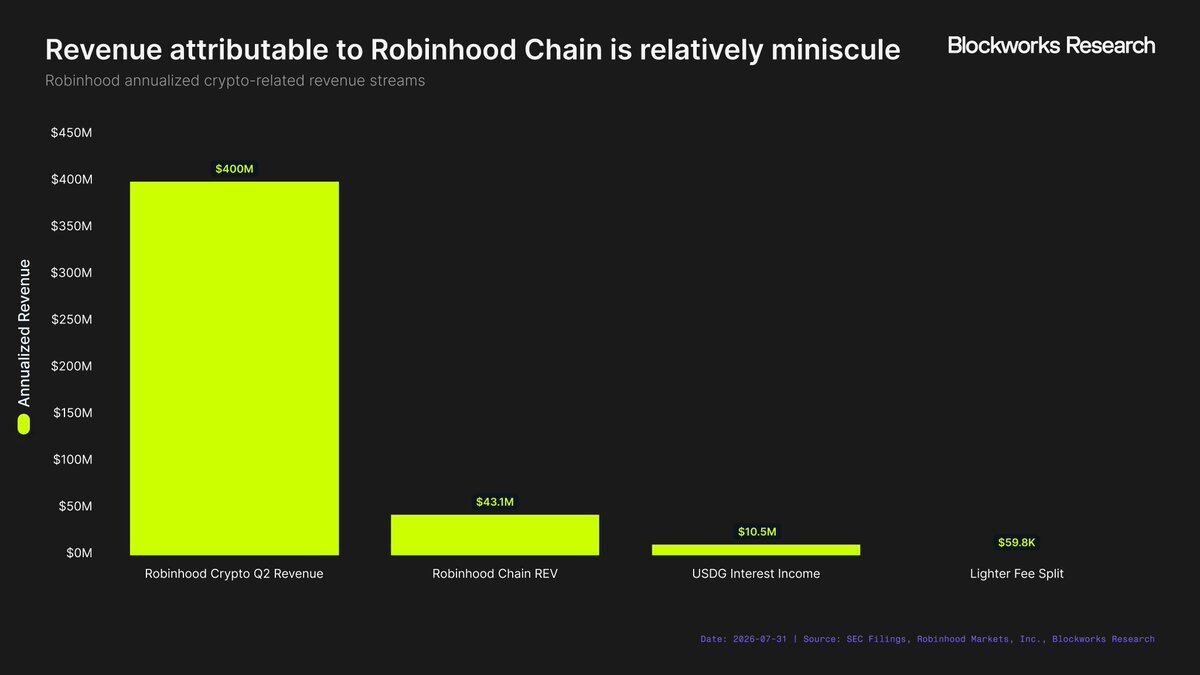
Early data paints a fairly clear picture. Robinhood Chain has achieved notable success as a blockchain but has yet to become a meaningful contributor to Robinhood's business. Robinhood's Q2 crypto revenue was $100 million, annualizing to about $400 million. In comparison, the known, quantifiable revenue streams associated with Robinhood Chain (chain REV, USDG interest income, Robinhood's share of Lighter fees) combined annualize to just $54.8 million, about 14% of Robinhood's annualized crypto revenue. Admittedly, this comparison merely annualizes Robinhood Chain's first-month data and should not be mistaken for its long-term revenue potential.
Frankly, relying solely on network revenue, Robinhood Chain will never have a material impact on Robinhood. Block space is too commoditized, and the entire L2 revenue market is too small. If Robinhood Chain is to make crypto a meaningful driver of growth for Robinhood again, the company needs to monetize the economic activity above the infrastructure layer.
Stablecoins provide the clearest path. Tether and Circle have already demonstrated how lucrative interest income from stablecoin reserves can be. At a 3.5% yield, every $1 billion in USDG supply would generate $35 million in annualized revenue for Robinhood (assuming it retains all associated interest income). Reaching $10 billion in supply would increase this figure to $350 million annually, nearly on par with Robinhood's current annualized crypto revenue. This won't happen overnight, but given the scale and size of Robinhood's business, achieving this isn't unimaginable.
Application distribution is another compelling opportunity. Robinhood possesses something almost every other blockchain lacks—direct access to a massive retail investor base. If on-chain protocols are willing to pay for access to these users, or share revenue with Robinhood, Robinhood can monetize its distribution power beyond just the fees generated by the chain itself. Early results indicate this strategy works when protocols are integrated into the main Robinhood app, although Robinhood Wallet distribution alone holds minimal value.
There's also the possibility that Robinhood doesn't view Robinhood Chain as a standalone profit-generating business. Instead, it might see the chain as a user onboarding and conversion channel. Robinhood Chain could act as a funnel, introducing users to tokenized assets before bringing them into the broader Robinhood ecosystem to trade stocks, options, crypto, and more. In this model, the chain's value may not be captured in network revenue but reflected in higher engagement and revenue across other areas of Robinhood's business.
For now, the answer to the question posed at the beginning of this report remains "no." Robinhood Chain has not yet become a meaningful driver of growth for Robinhood, and relying on network revenue alone will never get it there. For the answer to eventually become "yes," Robinhood needs to scale USDG or commercialize the user distribution power of the main Robinhood app. Otherwise, Robinhood Chain will likely have only indirect financial value, serving merely as a funnel for the high-value products that have already driven Robinhood's business.