Hageman video fuels Senate chatter as Lummis leaves Wyoming seat open

cointelegraphPubblicato 2025-12-23Pubblicato ultima volta 2025-12-23

Introduzione

Wyoming Representative Harriet Hageman has sparked speculation about a 2026 Senate run by posting a cryptic "Soon" video after Senator Cynthia Lummis announced she will not seek reelection. Lummis, a key crypto industry ally and co-sponsor of major digital asset legislation, is retiring, leaving a significant void for crypto advocacy in the Senate. Hageman, while aligned with broader conservative priorities, is now being encouraged by Wyoming's crypto community, including Custodia Bank founder Caitlin Long, to embrace this legacy. The race will test whether Wyoming continues its role as a central hub for crypto policy or shifts focus to other agenda items.

Wyoming Representative Harriet Hageman intensified chatter about a 2026 Senate run by posting a video days after Senator Cynthia Lummis announced she will not seek reelection.

​The five-second clip shows the congresswoman alongside a single-word caption: “Soon.” It breaks a months‐long lull on her account and bolsters speculation that she is eyeing Lummis’ open seat.

Wyoming’s Senate seat has been a reliable voice in advancing regulatory clarity for the crypto industry, from market structure bills and stablecoin regulation to banking access. Whoever replaces Lummis will help decide whether crypto keeps a dedicated champion in the Senate.

Hageman’s tweet has fueled speculation that she may target Wyoming’s open crypto-focused Senate seat. Source: Harriet Hageman

A crypto ally steps down

Lummis is expected to retire at the end of her term, removing one of the digital‐asset industry’s most outspoken allies from the Senate just as lawmakers edge toward potential votes on landmark market‐structure legislation.

​Lummis has built a national profile as a reliable pro‐crypto voice, embracing Bitcoin early and co‐sponsoring legislative efforts widely viewed to advance the blockchain industry, including the Responsible Financial Innovation Act and the ongoing US Clarity Act.

Her pending exit leaves the industry without a guaranteed champion in a chamber that has become increasingly central to decisions on trading‐platform oversight, stablecoin rules and banking access for crypto firms.

Related: Crypto community ‘very sorry’ over Senator Lummis’ reelection decision

​Hageman’s record and crypto’s hopes

As Wyoming’s at‐large House member, she has so far focused on broader conservative themes like parental rights in education, opposition to federal overreach and backing pro‐fossil fuel energy policies, while aligning herself with President Donald Trump. A Senate campaign would test how much she is willing to lean into Lummis’ crypto legacy alongside those priorities.

Wyoming’s crypto community is already nudging her in that direction. Caitlin Long, founder of Custodia Bank and a key architect of the state’s blockchain‐friendly laws, praised Hageman as “salt of the earth.” Long was reacting to news of Hageman’s expected entry in the race.
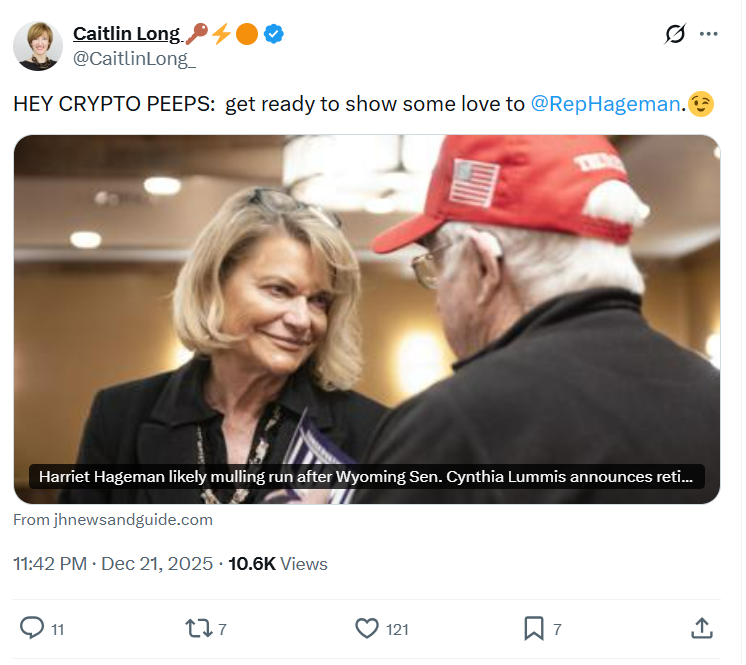
Introducing Harriet Hageman | Source: Caitlin Long

Related: Crypto among sectors ‘debanked’ by 9 major banks: US regulator

Long’s backing effectively introduces Hageman to crypto audiences as the preferred successor, even though the House member has not yet made digital assets a signature focus.

Wyoming’s 2026 Senate race is now poised to double as a test of whether the state wants to preserve its identity as home to the Senate’s most visible crypto advocate, or fold digital asset policy into a broader Trump‐era Republican agenda.


Domande pertinenti

QWhat action did Representative Harriet Hageman take that fueled speculation about a Senate run?

AShe posted a video with the caption 'Soon' on her social media account, breaking a months-long silence.

QWhy is Senator Cynthia Lummis's decision not to seek reelection significant for the crypto industry?

AShe is one of the digital asset industry's most outspoken allies, and her exit removes a guaranteed champion for crypto in the Senate.

QWhat major crypto legislation has Senator Lummis been involved in?

AShe co-sponsored the Responsible Financial Innovation Act and the ongoing US Clarity Act, which are widely viewed as advancing the blockchain industry.

QWho is Caitlin Long and what was her reaction to Hageman's potential Senate run?

ACaitlin Long is the founder of Custodia Bank and a key architect of Wyoming's blockchain-friendly laws. She praised Hageman as 'salt of the earth' and endorsed her as the preferred successor.

QWhat will the 2026 Wyoming Senate race test, according to the article?

AIt will test whether the state wants to preserve its identity as home to the Senate's most visible crypto advocate or fold digital asset policy into a broader Trump-era Republican agenda.

Letture associate

AI "Transfer Station" Earning Millions Monthly? Five Questions Uncover the Truth of Token Arbitrage

The article "AI 'Transfer Station' Earns Millions Monthly? Five Questions Uncover the Truth of Token Arbitrage" explores the emerging business of API token transfer stations, which profit from global AI service price disparities and access barriers. These intermediaries purchase low-cost tokens from overseas AI providers (e.g., OpenAI, Claude) through grey-market methods—such as exploiting enterprise credits, bulk accounts, or subscription benefits—and resell them to Chinese users at a markup. Key drivers include the high cost of using top AI models (e.g., Claude Code costs ~$5 per million tokens), the performance gap between domestic and foreign models, and mismatches between subscription and API pricing. However, the practice carries significant risks: upstream token sources may be unstable or illegal; user data passing through intermediaries can be harvested or injected with hidden prompts; and models might be downgraded without disclosure. The market is evolving, with some operators now exporting cheaper Chinese models (e.g., Qwen3.5 at ~$0.11 per million tokens) to overseas users, leveraging price gaps. Yet, sustainability is low due to compliance crackdowns, instability, and reputational risks. Users are advised to employ detection methods (e.g., prompt adherence tests) and avoid sensitive data usage. The authors caution that while transfer stations offer short-term arbitrage, they lack long-term reliability and security compared to official APIs.

marsbit29 min fa

AI "Transfer Station" Earning Millions Monthly? Five Questions Uncover the Truth of Token Arbitrage

marsbit29 min fa

The Cost of an 11.5% Annualized Return: Will MicroStrategy's STRC Face a Moment of Reckoning?

This article analyzes the potential risks associated with MicroStrategy's (MSTR) use of structured financial products like STRC to leverage its BTC exposure. While these tools have enabled impressive returns (e.g., 11.5% annualized) and fueled significant capital inflows ($13.5B outstanding), they also create substantial annual dividend obligations (~$400M). The author argues that this structure, while effective in a bull market, could become a liability if BTC price stagnates or declines. The core risk is a potential negative feedback loop: the growing dividend burden from continued STRC issuance may eventually outweigh the benefits of increased BTC holdings. To meet these obligations, MicroStrategy might need to use new issuance proceeds for dividends instead of buying more BTC, which could disappoint equity investors. If the market capitalization (mNAV) falls below the value of its BTC holdings, the company could be forced to sell BTC instead of issuing new shares, potentially triggering a panic. The author estimates a potential inflection point in 6 months, where annual dividend costs reach $3-4B. At that stage, CEO Michael Saylor might face a difficult choice: sell BTC to meet obligations or sacrifice the credibility of the preferred shares by halting dividends. The article concludes that this financial engineering, while powerful, could ultimately "backfire" on MicroStrategy if market conditions turn.

marsbit1 h fa

The Cost of an 11.5% Annualized Return: Will MicroStrategy's STRC Face a Moment of Reckoning?

marsbit1 h fa

Trading

Spot
Futures

Articoli Popolari

Come comprare OPEN

Benvenuto in HTX.com! Abbiamo reso l'acquisto di OpenLedger (OPEN) semplice e conveniente. Segui la nostra guida passo passo per intraprendere il tuo viaggio nel mondo delle criptovalute.Step 1: Crea il tuo Account HTXUsa la tua email o numero di telefono per registrarti il tuo account gratuito su HTX. Vivi un'esperienza facile e sblocca tutte le funzionalità,Crea il mio accountStep 2: Vai in Acquista crypto e seleziona il tuo metodo di pagamentoCarta di credito/debito: utilizza la tua Visa o Mastercard per acquistare immediatamente OpenLedgerOPEN.Bilancio: Usa i fondi dal bilancio del tuo account HTX per fare trading senza problemi.Terze parti: abbiamo aggiunto metodi di pagamento molto utilizzati come Google Pay e Apple Pay per maggiore comodità.P2P: Fai trading direttamente con altri utenti HTX.Over-the-Counter (OTC): Offriamo servizi su misura e tassi di cambio competitivi per i trader.Step 3: Conserva OpenLedger (OPEN)Dopo aver acquistato OpenLedger (OPEN), conserva nel tuo account HTX. In alternativa, puoi inviare tramite trasferimento blockchain o scambiare per altre criptovalute.Step 4: Scambia OpenLedger (OPEN)Scambia facilmente OpenLedger (OPEN) nel mercato spot di HTX. Accedi al tuo account, seleziona la tua coppia di trading, esegui le tue operazioni e monitora in tempo reale. Offriamo un'esperienza user-friendly sia per chi ha appena iniziato che per i trader più esperti.

130 Totale visualizzazioniPubblicato il 2024.12.12Aggiornato il 2026.04.23

Come comprare OPEN

Discussioni

Benvenuto nella Community HTX. Qui puoi rimanere informato sugli ultimi sviluppi della piattaforma e accedere ad approfondimenti esperti sul mercato. Le opinioni degli utenti sul prezzo di OPEN OPEN sono presentate come di seguito.

活动图片