GPT-5.6 Sol Suddenly Gets Dumber Overnight? Thinking Budget Slashed from 960 to 128, No More Fixed-Intelligence Models?

marsbitPubblicato 2026-07-15Pubblicato ultima volta 2026-07-15

Introduzione

The article discusses widespread user reports that OpenAI's GPT-5.6 Sol model, specifically its "Max" reasoning tier, has become less capable at complex, deep reasoning tasks. Users noted faster but shallower responses. Community investigation revealed an unpublicized internal parameter called "juice value," representing computational budget for reasoning. Observations indicated this value for the Max tier dropped dramatically from 960 to 128. In response, OpenAI's Thibault Sottiaux stated there was no intentional reduction in model capability ("nerf"). He explained the changes were part of an experiment to investigate unexpected high token usage following GPT-5.6's launch, which introduced features like longer reasoning and larger context windows. The experiment temporarily adjusted the "juice" parameter and rolled back the context window from 372k to 272k tokens to diagnose the usage spike. Sottiaux asserted these settings have been reverted and highlighted ongoing optimizations. The controversy highlights a tension between AI as a reliable, fixed-capability tool and its reality as a cloud service where providers can adjust performance parameters. The article argues that for AI to be trusted enterprise infrastructure, providers need clearer, transparent guarantees about the specific performance boundaries associated with service tiers.

Everyone online says GPT-5.6 Sol's Max tier has become dumber. OpenAI insists there's no nerf, just an "experiment." The knob turned during that experiment slashed the Max tier's budget from 960 down to 128, invisible to users.

Woke up to find GPT-5.6 Sol had become dumber!

A Japanese market research team, not long after starting work in the morning, discovered something off with their Codex Sol MAX. The team leader wrote a long post about the morning's ordeal and posted it on Reddit's r/codex.
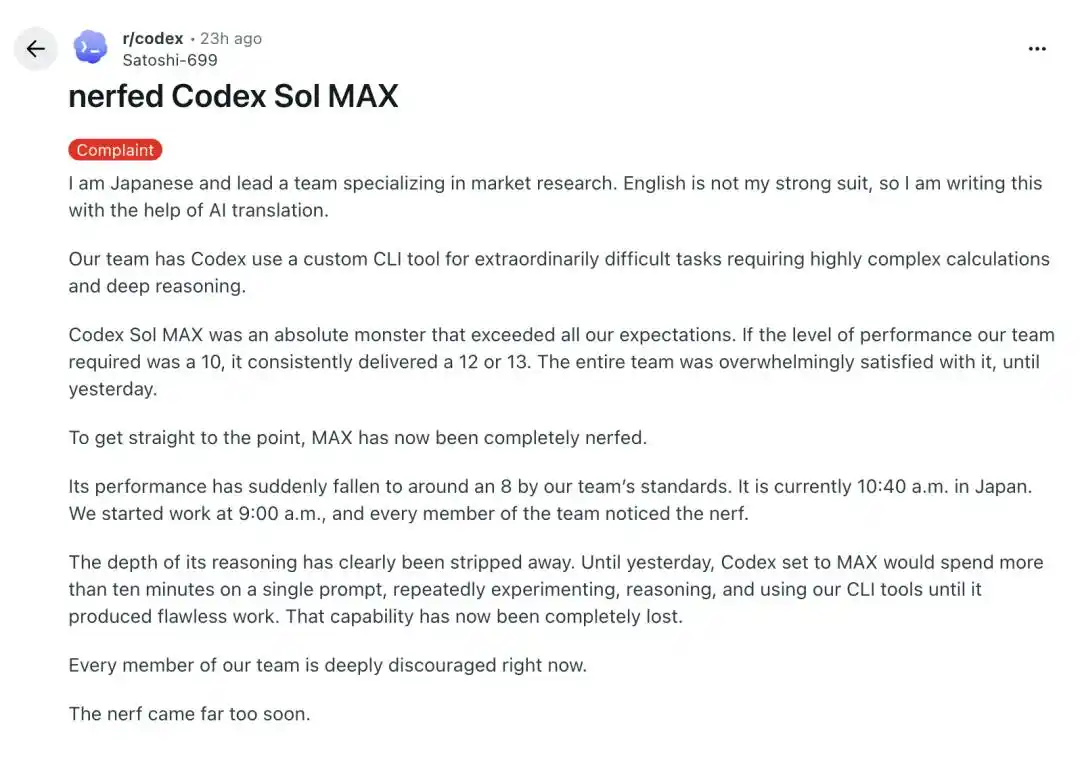
9 AM, the team started work as usual. By 10:40 AM, every single member had noticed the same thing.

They had Codex Sol MAX connected to a self-developed CLI tool, specifically for chewing through jobs requiring extremely complex calculations and deep reasoning.

Initially, Codex Sol MAX lived up to expectations, delivering 12 or 13 points out of a 10-point requirement. It was a "monster that far exceeded expectations," and "everyone was overwhelmingly satisfied with it."

But on this morning, that "monster's" performance suddenly slumped to 8 points.

The depth of reasoning had clearly been stripped away.

Before this, when faced with a prompt, Codex Sol MAX would take over ten minutes, repeatedly trying, reasoning, and calling their tools until the job was done flawlessly.

That capability had "completely vanished" on this very morning.

The Whole Internet Feels It's "Dumber"

The Japanese team's experience was just one example among many in the Codex community these past few days.

The complaints were highly consistent: the model indeed got faster, answers came more briskly, but it was unwilling to dig deep. That old drive to research first, then act, constantly revising itself, was gone.

A user on X summed up everyone's gut feeling:

Everyone's reasoning tier has been collectively downgraded by one level—if you used to run on Extra High, now you have to crank it to Max to get back the same level of effort.
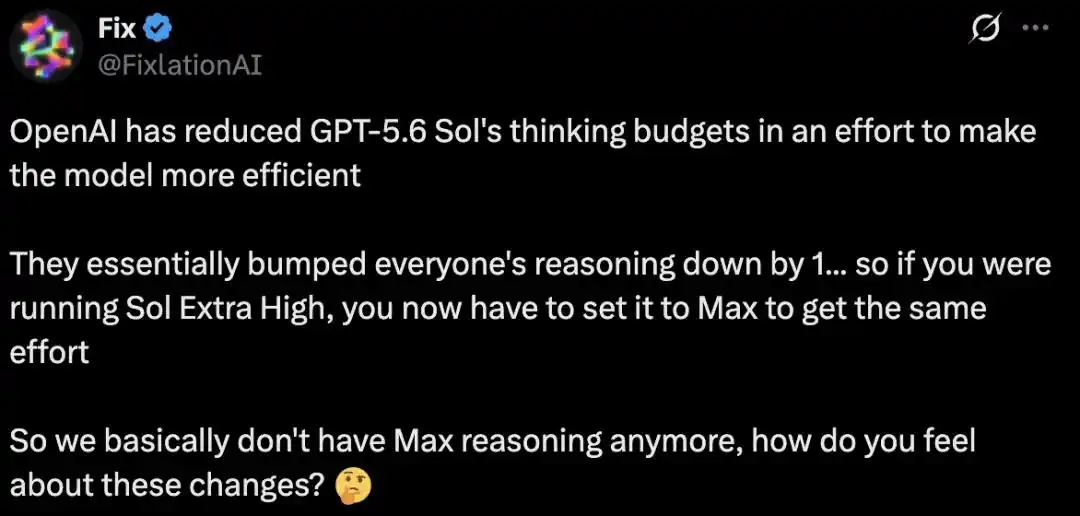
This kind of change is impossible for ordinary users to prove.

You can't see if the model weights were swapped, nor how much computing power the server allocated to you.

All you can perceive are four things: how fast it replies, how long it thinks, whether it reviews itself, and whether it calls upon other agents to help.

These are all indirect signals; none are written on a model card.

So, community users dug into it themselves and unearthed an internal parameter OpenAI never publicly disclosed: the juice value.

A Number Never Mentioned Officially

What OpenAI has publicly talked about are only the reasoning tiers.

At the GPT-5.6 launch on July 9th, the official line was the first-time introduction of max reasoning effort, "giving Sol the most ample time for deep reasoning." There's even an ultra tier above, which by default engages four agents to work in parallel.

In ChatGPT, these translate to those few options in the model selector: Medium, High, Extra High—all running Sol underneath, with the Pro tier running Sol Pro.

The juice value is the layer beneath these tiers: the internal reasoning compute budget. Users can't see it, and OpenAI has never published its values.

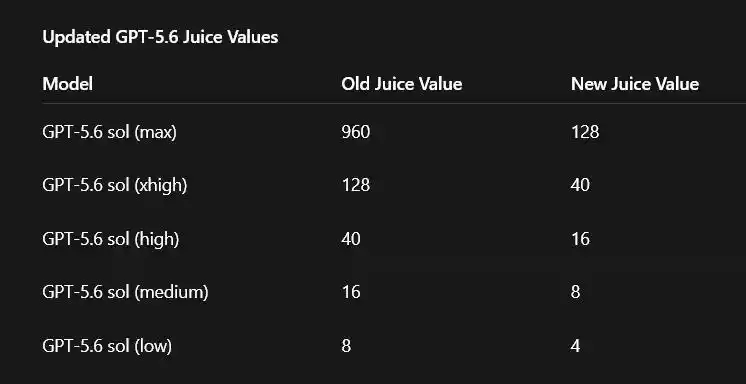
A community user, ns123abc, used a piece of hidden prompt text known as a "model fingerprint" to read a value from the system configuration: juice.

The community had previously observed that Sol's max tier corresponded to 960. This time, the screen showed 128—a drop of nearly 87%.
Almost simultaneously, another set of screenshots began circulating: the usable context for users in the Codex client had dropped from around 372k back to 272k.
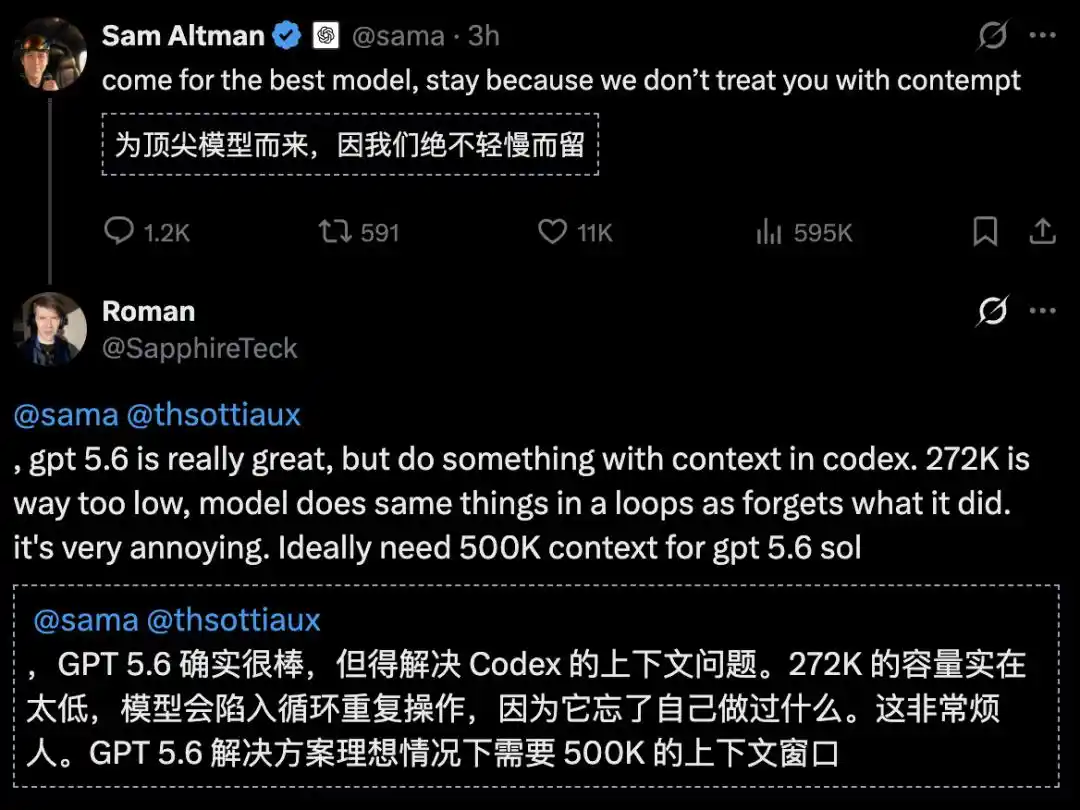
These two numbers quickly ignited the entire community.

Tibo: No Nerf, We're Investigating Usage

That same night, Tibo (Thibault Sottiaux), who leads Codex and ChatGPT Work at OpenAI, stepped up to speak.

Tibo posted an update on X, starting with: No nerf, only good things.
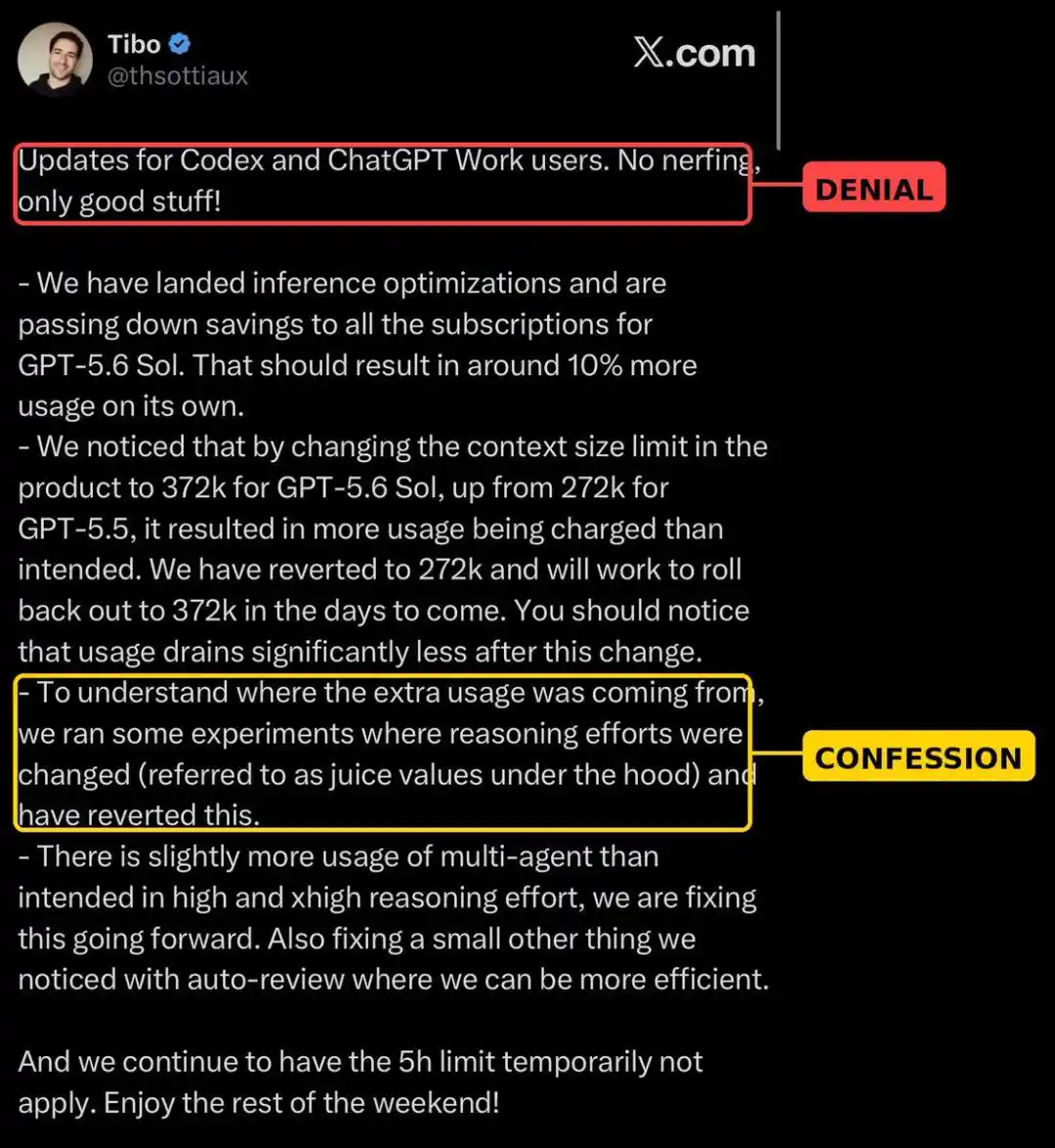
He then emphasized four points in one breath.

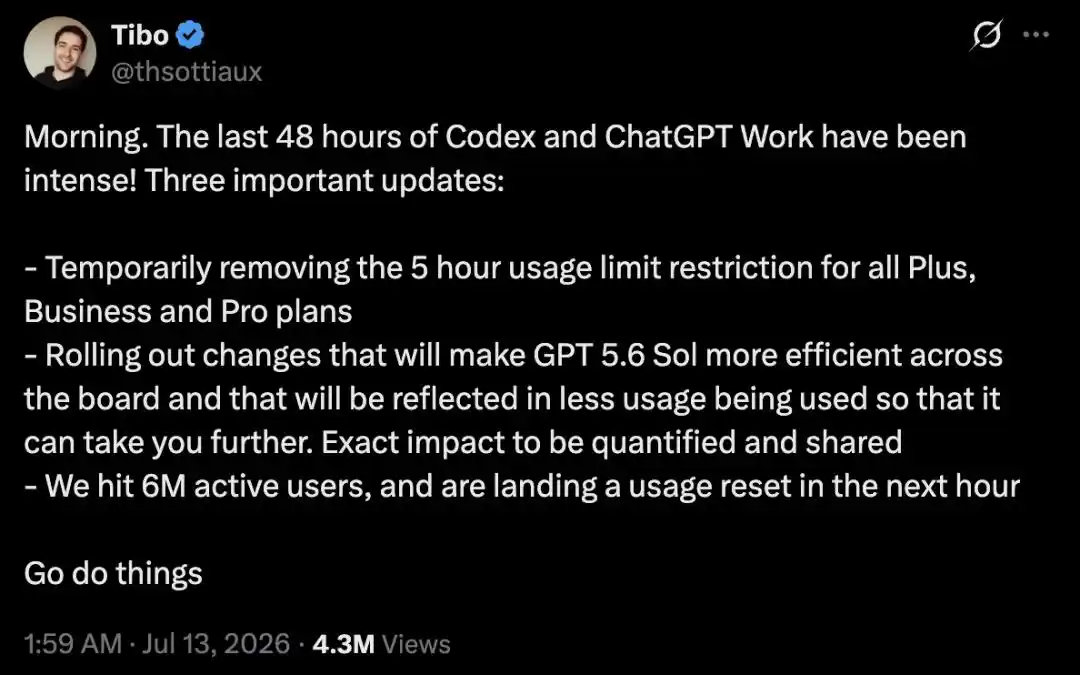
First, reasoning efficiency optimizations have already rolled out. The compute savings are being returned to all subscribers, which alone adds roughly 10% more usage.

Second, Sol's context window was raised from GPT-5.5's 272k to 372k, which resulted in higher-than-expected billing deductions. It has now been rolled back to 272k, with 372k being reintroduced in the coming days.

Third, to figure out where the extra usage was coming from, the team ran some experiments where they tweaked the reasoning effort—internally called "juice values."

This has now been reverted.

Fourth, the invocation of multi-agent for high and xhigh tiers was higher than expected, and there was waste on the auto-review side—both are being fixed.

Tibo's post essentially said: It's not a "nerf," it's "parameter tuning."

He didn't mention whether model weights were touched. But he did admit that the configurations users actually received had indeed been changed.

So what exactly is "juice"? Based on publicly available information, it appears closer to an internal system marker for reasoning resource allocation—roughly speaking, how much reasoning resource the system allows the model to invest in a single task.

While lowering the budget doesn't necessarily mean "the model weakened," it can quietly change many things:

How many paths can be explored in a long-horizon task, how many rounds of comparison between multiple solutions, whether code generation is actively tested after being produced, how many times it's willing to roll back after failure, and the "long-tail capabilities" in extremely difficult tasks that determine success or failure.

Ultimately, it represents how much thought the model is willing to put into a task.

To end this debate requires a strictly controlled experiment: the same model snapshot, the same batch of tasks, the same set of tool environments, changing only the juice variable.

See how much performance drops in complex coding, long-horizon agent tasks, mathematical reasoning, and error recovery.

This evidence remains absent to this day.

Every Token the Vendor Saves, the User Feels

Returning to the experiment Tibo mentioned. How did it come about?

After GPT-5.6 launched, demand surged immediately.

OpenAI temporarily lifted the five-hour usage limit window to handle the overwhelming volume of calls.
And GPT-5.6's most eye-catching new features—the longer thinking in max tier, ultra defaulting to four parallel agents, the larger context window—are precisely the token-hungry beasts.

The extra usage emerged exactly from here.

Hence, the experiment. To audit the bill, first lower the budget variable to see exactly where the usage goes—this makes perfect engineering sense.

But the problem lies exactly here: when the vendor saves tokens, users perceive it, most directly as the model "unwilling to think."

The variable that was adjusted happens to be the one users can feel.

AI Stops "Performing Miracles," Starts Punching the Clock

Over the past few years, large model companies have fostered a near-religious imagination.

People treated models like oracles, hoping they'd spit out an answer humans hadn't thought of in the dead of night, tolerating slowness, higher costs, occasional craziness.

But lab miracles can afford to ignore costs; once in production as industrial infrastructure, they cannot.

Thus, frontier models like Sol are transitioning from lab prophets who occasionally "perform miracles" into engines that keep running within daily workflows.

This resembles a process of intelligence domestication, and this controversy publicly exposed the process. Simultaneously, users' illusion of "fixed intelligence" is about to end.

Subscribing to a model is more like buying a light bulb: the model is fixed, but the brightness dial has always been in the platform's hands.

This might be the correct commercial choice, but it shouldn't forever remain in a black box.

If AI is truly to become enterprise infrastructure, vendors must provide boundaries more concrete than model names, letting users understand what exactly their paid "Max" tier guarantees.

Otherwise, it's just a price tag.

References:

https://x.com/thsottiaux/status/2076495156757577895

https://x.com/FixlationAI/status/2076469274441380349

https://www.reddit.com/r/codex/comments/1uuy5eq/nerfed_codex_sol_max/

This article is from the WeChat public account "新智元" (New AI Era), author: 元宇 (Yuan Yu)

Crypto di tendenza

Domande pertinenti

QWhat is the main change users noticed about GPT-5.6 Sol's performance according to the article?

AUsers noticed that GPT-5.6 Sol, particularly the Max tier, seemed to have become less capable at deep reasoning and complex problem-solving, delivering shallower answers more quickly instead of its previous thorough, iterative approach.

QWhat is the 'juice value' mentioned in the context of the controversy?

AThe 'juice value' is an internal, unpublicized OpenAI parameter representing the computational budget or reasoning effort allocated for a task. The community discovered its value for the Sol Max tier had reportedly dropped from 960 to 128.

QHow did OpenAI's Thibault Sottiaux (Tibo) explain the observed performance changes?

AThibault Sottiaux stated there was no 'nerf' (reduction in intelligence). He explained that the changes resulted from an experiment to investigate unexpected usage spikes after GPT-5.6's launch, during which the internal 'juice values' (reasoning effort) were temporarily adjusted. He asserted the settings had been reverted.

QWhat practical consequence did the temporary reduction in 'juice value' have for users?

AThe reduction in the internal reasoning budget meant the model spent less computational effort on tasks. Users perceived this as the model becoming 'lazy'—providing faster but shallower responses, exploring fewer solution paths, and performing less self-review and error recovery.

QWhat broader implication does the article suggest this incident has for AI as a service?

AThe incident reveals that a user's subscription buys a variable level of service, where key performance parameters like 'reasoning effort' are controlled by the provider and can be adjusted. The article argues that for AI to be trusted enterprise infrastructure, providers must offer clearer, more specific guarantees about what performance tiers actually entail, moving beyond just model names.

Letture associate

Hyperliquid Pre-IPO Contract Priced CXMT at $7.2, Foreign Capital Engaging with China's Storage Narrative via DeFi

Hyperliquid, a blockchain-based perpetual contracts platform, has launched a pre-IPO contract for Chinese memory chipmaker Changxin Technology (CXMT) ahead of its STAR Market debut. Priced at 7.2 USDC (approx. $7.2) per share, the contract implies a market cap of about $500 billion, exceeding the official IPO valuation of roughly $80 billion and sitting at the upper end of analyst estimates. This marks the first time such a crypto derivative has targeted a STAR Market listing. It provides global investors, particularly those unable to meet China's 500,000 yuan ($69,000) investment threshold for the STAR Market, a direct avenue to gain exposure to the "China storage substitution" narrative. The 24/7 tradable, leveraged contract also fills a gap for those seeking to hedge or speculate around the A-share listing, which operates under T+1 settlement and restricts short-selling. Changxin Technology, the world's fourth-largest DRAM supplier, is raising nearly $8 billion in one of Asia's largest IPOs this year, buoyed by a DRAM super-cycle and strategic shifts by major competitors. While the Hyperliquid contract offers a novel parallel pricing mechanism, the lack of direct arbitrage with the underlying A-shares may lead to persistent price divergence. Nevertheless, its emergence underscores significant international interest in China's key semiconductor players.

marsbit16 min fa

Hyperliquid Pre-IPO Contract Priced CXMT at $7.2, Foreign Capital Engaging with China's Storage Narrative via DeFi

marsbit16 min fa

The 'Great Divergence' of the Crypto Market in 2026: BTC Bear Market, but BlackRock, Franklin Templeton, and JPMorgan Are Simultaneously Doing One Thing

"2026 Crypto Market 'Great Divergence': BTC Bearish, But BlackRock, Franklin, JPMorgan Are Simultaneously Building Infrastructure." In July 2026, amidst BTC struggling at $62K, seven key events signal a profound shift: the 'Great Divergence' between price action and underlying infrastructure development. Franklin Templeton's CIO notes a "big disconnect" between price and fundamentals. Meanwhile, major institutions are advancing real-world blockchain adoption: BlackRock, Goldman Sachs, and JPMorgan join a UK government-backed tokenization taskforce targeting repo and gilts; Hyundai pilotes USDT for cross-border trade settlement; Bolivia considers integrating USDT into its national payment system; and Robinhood's new blockchain sees rapid adoption. This activity represents a quiet infrastructure bull market, driven by institutional strategy and long-term regulatory roadmaps, not short-term crypto price cycles. The core narrative is shifting from speculative price action to foundational utility. Infrastructure development—focused on upgrading traditional finance, enabling real-world payments, and tokenizing assets—is now decoupled from BTC's volatility. Historical parallels (e.g., dot-com bust/AWS birth, 2018 crypto winter/DeFi Summer) show that infrastructure built during downturns often becomes the next cycle's "toll booth." The critical question is no longer "Will BTC drop further?" but "Who will own the tolls when this new infrastructure is complete?" While BTC remains a key liquidity anchor, the valuation logic for crypto's real-world utility is increasingly separate from its most traded asset's price.

marsbit33 min fa

The 'Great Divergence' of the Crypto Market in 2026: BTC Bear Market, but BlackRock, Franklin Templeton, and JPMorgan Are Simultaneously Doing One Thing

marsbit33 min fa

Scaling Law a One-Size-Fits-All Solution? First Crystal Structure Manipulation Benchmark Shows Top Large Models Falling Short

Scaling Law Hits a Wall: New Benchmark Reveals AI's Struggles with Atomic-Level Material Manipulation A new benchmark called AtomWorld, developed by researchers, reveals a significant limitation in current large language models (LLMs). While powerful at understanding textual scientific knowledge, they perform poorly when tasked with physically manipulating atomic structures based on natural language instructions. The benchmark tests core atomic operations like replacing atoms, rotating structures, and expanding supercells. Results show that simply scaling up model size (Scaling Law) yields only modest and unstable improvements, particularly for tasks requiring strong 3D spatial reasoning and geometric planning. For instance, complex tasks like "rotating around a specific atom" see very low success rates even in top models like Claude Opus. This highlights a critical gap: textual knowledge does not automatically translate to reliable action in a physically constrained 3D space. The study argues that for AI in Science to progress, the focus must shift from just scaling language data (Language Scaling) to also scaling actionable capabilities (Action Scaling). This involves building training loops around "action-feedback-correction" cycles within simulated or real scientific environments. Ultimately, AtomWorld underscores that to become true lab assistants, AI models need to evolve beyond explaining knowledge to reliably executing precise, verifiable scientific actions.

marsbit46 min fa

Scaling Law a One-Size-Fits-All Solution? First Crystal Structure Manipulation Benchmark Shows Top Large Models Falling Short

marsbit46 min fa

Trading

Spot

Articoli Popolari

Cosa è SOLANA

HarryPotterWifHatMyroWynn10Inu,$solana: Un’Immersione nel Trendy Meme Coin Project Introduzione Nel panorama in continua evoluzione delle criptovalute, progetti innovativi emergono continuamente, catturando l'immaginazione di investitori ed appassionati. Uno di questi progetti è HarryPotterWifHatMyroWynn10Inu,$solana, una meme coin che ha iniziato a ritagliarsi una sua nicchia all'interno della comunità crypto. Questo articolo ha l'obiettivo di fornirti una panoramica completa del progetto, spiegandone lo scopo, l'architettura, il creatore, gli investitori e i traguardi significativi lungo il percorso. Cos'è HarryPotterWifHatMyroWynn10Inu,$solana? Panoramica HarryPotterWifHatMyroWynn10Inu,$solana è un progetto di meme coin strutturato sulla blockchain di Solana – una piattaforma rinomata per la sua scalabilità e velocità. Con l'intento di portare gioia e creatività nello spazio crypto, questo progetto non solo funge da token di scambio ma anche come catalizzatore per la generazione e la condivisione di contenuti meme. La comunità al suo interno è incoraggiata a partecipare attivamente, fornendo un ecosistema dinamico dove la creatività e la collaborazione prosperano. Obiettivi e Scopi Nella sua essenza, il progetto mira a favorire un ambiente dove gli appassionati di meme possano riunirsi, condividere e creare nuovi contenuti meme. Questo approccio narrativo infonde entusiasmo nella comunità, promuovendo il coinvolgimento e allo stesso tempo evidenziando le robuste funzionalità insite nella blockchain di Solana. Costruendo un progetto incentrato sulla comunità, HarryPotterWifHatMyroWynn10Inu,$solana desidera inoltre esplorare l'impatto sociale delle valute digitali come mezzo di espressione. Chi è il Creatore di HarryPotterWifHatMyroWynn10Inu,$solana? L'identità del creatore dietro HarryPotterWifHatMyroWynn10Inu,$solana rimane avvolta nel mistero. Il progetto è stato strutturato in modo tale che la proprietà sia stata rinunciata; pertanto, prospera come un'iniziativa guidata dalla comunità. Questa decentralizzazione promuove la trasparenza e la partecipazione democratica tra tutti i soggetti coinvolti. Tale approccio è sempre più popolare nel mondo delle meme coin, dove il coinvolgimento della comunità regna sovrano. Chi sono gli Investitori di HarryPotterWifHatMyroWynn10Inu,$solana? Attualmente, non ci sono informazioni pubblicamente disponibili riguardo agli specifici investitori o fondazioni che supportano HarryPotterWifHatMyroWynn10Inu,$solana. L'assenza di investitori noti sottolinea ulteriormente l'etica orientata alla comunità del progetto, che si mantiene indipendente dai tradizionali schemi finanziari. Questa indipendenza consente al progetto di sviluppare la propria identità libera da pressioni esterne, facendo affidamento invece sull'interesse collettivo della sua base utenti. Come Funziona HarryPotterWifHatMyroWynn10Inu,$solana? Modello Economico Il progetto impiega un modello economico unico che sostiene la sua funzionalità e il coinvolgimento degli utenti. Le transazioni all'interno di HarryPotterWifHatMyroWynn10Inu,$solana sono progettate per essere vantaggiose per tutte le parti coinvolte. Ogni operazione comporta una commissione, che viene successivamente redistribuita tra gli attuali possessori, aumentando al contempo il pool di liquidità. I componenti chiave di questo modello includono: Meccanismo di Riflesso: Una parte delle commissioni di transazione viene restituita ai possessori, promuovendo l'investimento a lungo termine nel token. Acquisizione di Pool di Liquidità: I fondi sono destinati a migliorare la liquidità, garantendo che le operazioni di acquisto e vendita possano essere eseguite senza intoppi. Meccanismi di Bruciatura: Una parte dei token potrebbe essere bruciata per creare scarsità, aumentando potenzialmente il valore man mano che la domanda cresce. Questo design incoraggia un ecosistema autosufficiente che prospera grazie alle interazioni e agli investimenti della comunità. Coinvolgimento della Comunità Nel cuore di HarryPotterWifHatMyroWynn10Inu,$solana c'è il valore attribuito al coinvolgimento della comunità. Permettendo agli utenti di partecipare allo sviluppo del progetto attraverso varie attività, come la creazione di meme e promozioni, il progetto favorisce un ecosistema vibrante dove la creatività può fiorire. Cronologia di HarryPotterWifHatMyroWynn10Inu,$solana La traiettoria di HarryPotterWifHatMyroWynn10Inu,$solana presenta diversi eventi degni di nota che hanno plasmato la sua posizione attuale nella comunità crypto: Creazione: La data specifica di creazione rimane non divulgata, ma l'ideazione del progetto è radicata nella cultura meme che permea l'era digitale. Passaggio alla Comunità: Dopo la rinuncia alla proprietà da parte del suo creatore, il progetto è passato a un modello guidato dalla comunità, permettendo a tutti i partecipanti di avere una parte nel suo successo. Audit e Collezione NFT: In un tentativo di aumentare la credibilità, il progetto ha completato un audit approfondito, lanciando simultaneamente una collezione NFT che serve a incarnare la sua etica centrata sui meme. Partnership e Sviluppo: Il progetto è attualmente impegnato a esplorare potenziali partnership con altri token e a organizzare lo sviluppo di un sito web unico e opzioni di merchandising basate sui suoi leggendari meme. Punti Chiave In sintesi, HarryPotterWifHatMyroWynn10Inu,$solana si presenta come un attore notevole nel settore delle meme coin delle criptovalute. Ecco alcuni dei punti salienti: Iniziativa Guidata dalla Comunità: Il progetto prospera come uno sforzo collaborativo, incoraggiando contributi attivi da parte dei membri della comunità mentre si distacca da pretese di proprietà. Modello Economico Innovativo: Utilizzando meccanismi di riflesso, acquisizione di liquidità e bruciatura, crea un ambiente finanziario robusto e coinvolgente per gli utenti. Coinvolgimento con NFT e Merchandising: Con il lancio di una collezione NFT, il progetto mira a approfondire il coinvolgimento all'interno della sua comunità, rafforzando il legame tra cultura meme e valuta digitale. Esplorazione di Partnership: L'iniziativa non è stagnante – lo sviluppo in corso e le potenziali partnership indicano un approccio lungimirante volto alla crescita sostenuta. Conclusione Mentre HarryPotterWifHatMyroWynn10Inu,$solana continua a guadagnare slancio all'interno del panorama delle criptovalute, la sua combinazione unica di coinvolgimento della comunità, strutture economiche innovative e integrazione della cultura meme delineano il suo potenziale percorso futuro. Anche con il mistero che circonda le sue origini e le affiliazioni degli investitori, il progetto cattura una storia intrigante che parla dell'essenza dell'innovazione decentralizzata. In un mondo dove le criptovalute sono spesso viste attraverso una lente puramente finanziaria, HarryPotterWifHatMyroWynn10Inu,$solana dimostra che il movimento crypto incorpora creatività, comunità e collaborazione. Che tu sia un investitore esperto o un neofita, il percorso che si sta sviluppando di questo progetto di meme coin rappresenta sicuramente uno studio di caso coinvolgente degno di attenzione.

482 Totale visualizzazioniPubblicato il 2024.04.04Aggiornato il 2024.12.03

Cosa è SOLANA

Cosa è SOLANA 2.0

BarbieCrashBandicootRFK777Inu, $SOLANA 2.0: Un Nuovo Giocatore nel Paesaggio Cripto Introduzione a BarbieCrashBandicootRFK777Inu, $SOLANA 2.0 Nel paesaggio in continua evoluzione delle criptovalute, nuovi entrant catturano costantemente l'attenzione di investitori ed entusiasti. Tra questi progetti emergenti c'è BarbieCrashBandicootRFK777Inu, rappresentato dal simbolo della criptovaluta $SOLANA 2.0. Questa iniziativa unica combina elementi di glamour, avventura e cultura meme, proponendosi di sfidare le aspettative in un'area estremamente competitiva. Con aspirazioni di crescita e innovazione, questo progetto cattura lo spirito di un underdog che lotta contro giganti affermati. Che cos'è BarbieCrashBandicootRFK777Inu, $SOLANA 2.0? Alla sua essenza, BarbieCrashBandicootRFK777Inu è un progetto di criptovaluta che trae ispirazione da varie riferimenti culturali iconici. Includendo l'eleganza e il fascino associati a Barbie, l'energia dinamica di Crash Bandicoot e la spinta instancabile rappresentata da RFK, il progetto mira a offrire un'esperienza multifattoriale nel mondo delle criptovalute. Il principale obiettivo del progetto BarbieCrashBandicootRFK777Inu è quello di unire questi elementi disparati in un ecosistema coeso che attragga un vasto pubblico. Abbracciando la fantasia della cultura meme, rimanendo però ancorato ai principi di decentralizzazione e empowerment finanziario, il progetto si è posizionato come un'opzione convincente sia per investitori esperti che per neofiti del mondo cripto. Chi è il Creatore di BarbieCrashBandicootRFK777Inu, $SOLANA 2.0? Nonostante l'interesse crescente per BarbieCrashBandicootRFK777Inu, le informazioni riguardanti il suo creatore rimangono per lo più sconosciute. L'anonimato del suo fondatore o team di sviluppo solleva interrogativi sulla struttura e governance del progetto. Nel mondo delle criptovalute, non è raro che i progetti operino senza creatori pubblici. Questa mancanza di informazioni potrebbe scoraggiare alcuni potenziali investitori, mentre altri potrebbero vederla come un'opportunità per abbracciare lo spirito di decentralizzazione che sottende molte iniziative nel campo delle criptovalute. Chi sono gli Investitori di BarbieCrashBandicootRFK777Inu, $SOLANA 2.0? Attualmente, ci sono poche informazioni disponibili riguardo ai fondamenti d'investimento o alle organizzazioni che supportano BarbieCrashBandicootRFK777Inu. La mancanza di un sostegno d'investimento dettagliato per il progetto evidenzia la natura indipendente di numerose criptovalute. In questo caso, resta da vedere se il finanziamento del progetto provenga da un supporto della comunità a livello locale o dal supporto di entità finanziarie più grandi. Come Funziona BarbieCrashBandicootRFK777Inu, $SOLANA 2.0? BarbieCrashBandicootRFK777Inu è progettato con una serie di funzionalità che contribuiscono alla sua unicità all'interno dello spazio cripto affollato. Sebbene i dettagli tecnici specifici rimangano segreti, si prevede che il progetto incorpori funzionalità volte a migliorare il coinvolgimento degli utenti e a promuovere la crescita della comunità. La combinazione di influenze variegate—dalla moda e avventura ai giochi—incoraggia un'atmosfera inclusiva che si rivolge a interessi diversi. Inoltre, i legami del progetto con l'ecosistema $SOLANA 2.0 suggeriscono potenziali vantaggi tecnologici. Questo potrebbe includere velocità di transazione innovative, scalabilità e costi contenuti, allineandosi con le capacità tecniche della blockchain di Solana. I fondatori del progetto sembrano voler sfruttare questa base tecnologica per creare un'esperienza comunitaria duratura e un'offerta di prodotto sostanziale. Timeline di BarbieCrashBandicootRFK777Inu, $SOLANA 2.0 Il percorso di BarbieCrashBandicootRFK777Inu contiene diverse tappe chiave, fornendo spunti sullo sviluppo del progetto fino ad ora: Concettualizzazione del Progetto: Sono emerse idee iniziali riguardo alla fusione di glamour, avventura e cultura meme, dando forma al concetto unico del progetto. Creazione del Token: È stato istituito il token simbolico $SOLANA 2.0, progettato per incarnare le aspirazioni del progetto e attrarre l'interesse di potenziali investitori. Sviluppo del Progetto: Attualmente, il progetto è in fase di ulteriore sviluppo, con un'enfasi sulla sfida ai player consolidati nel campo delle criptovalute e sulla fornitura di offerte innovative. Queste tappe riflettono la traiettoria di crescita del progetto, evidenziando il suo impegno a sviluppare un'esperienza pionieristica nel campo delle criptovalute. Punti Chiave su BarbieCrashBandicootRFK777Inu, $SOLANA 2.0 Concetto Unico: BarbieCrashBandicootRFK777Inu si distingue per la fusione di elementi di glamour, avventura e cultura meme in un unico progetto di criptovaluta. Spirito da Underdog: Il progetto abbraccia una persona underdog, mirante a sfidare progetti di criptovaluta consolidati e ritagliarsi una nicchia nell'industria. Fase di Sviluppo: Sono in corso sforzi di sviluppo attivi, con l'intenzione di fornire offerte fresche e innovative in linea con le aspettative della comunità e degli investitori. Conclusione BarbieCrashBandicootRFK777Inu, rappresentato dal simbolo $SOLANA 2.0, è un nuovo e interessante entrant nel mercato delle criptovalute. La sua combinazione unica di riferimenti culturali e visione ambiziosa potrebbe risuonare con coloro che cercano valori alternativi nei progetti cripto. Sebbene lo stato sconosciuto del suo creatore e degli investitori possa sollevare sopracciglia, l'enfasi del progetto su fascino e avventura presenta una narrativa affascinante che espande i confini di ciò che le criptovalute possono incarnare. Man mano che il progetto continua a svilupparsi, sarà interessante osservare la sua evoluzione all'interno del più ampio paesaggio cripto e come si posizioni tra i suoi concorrenti. Per coloro che vi sono coinvolti, BarbieCrashBandicootRFK777Inu potrebbe svelare esperienze sorprendenti che ridefiniscono l'interazione con gli asset digitali. Per ora, mentre il progetto avanza, il suo percorso rimane un promemoria che l'innovazione nel settore cripto non conosce limiti, offrendo tutto, dall'eccitazione e intrattenimento alla possibilità di empowerment finanziario.

187 Totale visualizzazioniPubblicato il 2024.04.05Aggiornato il 2024.12.03

Cosa è SOLANA 2.0

Come comprare SOL

Benvenuto in HTX.com! Abbiamo reso l'acquisto di Solana (SOL) semplice e conveniente. Segui la nostra guida passo passo per intraprendere il tuo viaggio nel mondo delle criptovalute.Step 1: Crea il tuo Account HTXUsa la tua email o numero di telefono per registrarti il tuo account gratuito su HTX. Vivi un'esperienza facile e sblocca tutte le funzionalità,Crea il mio accountStep 2: Vai in Acquista crypto e seleziona il tuo metodo di pagamentoCarta di credito/debito: utilizza la tua Visa o Mastercard per acquistare immediatamente SolanaSOL.Bilancio: Usa i fondi dal bilancio del tuo account HTX per fare trading senza problemi.Terze parti: abbiamo aggiunto metodi di pagamento molto utilizzati come Google Pay e Apple Pay per maggiore comodità.P2P: Fai trading direttamente con altri utenti HTX.Over-the-Counter (OTC): Offriamo servizi su misura e tassi di cambio competitivi per i trader.Step 3: Conserva Solana (SOL)Dopo aver acquistato Solana (SOL), conserva nel tuo account HTX. In alternativa, puoi inviare tramite trasferimento blockchain o scambiare per altre criptovalute.Step 4: Scambia Solana (SOL)Scambia facilmente Solana (SOL) nel mercato spot di HTX. Accedi al tuo account, seleziona la tua coppia di trading, esegui le tue operazioni e monitora in tempo reale. Offriamo un'esperienza user-friendly sia per chi ha appena iniziato che per i trader più esperti.

1.9k Totale visualizzazioniPubblicato il 2024.12.12Aggiornato il 2026.06.02

Come comprare SOL

Discussioni

Benvenuto nella Community HTX. Qui puoi rimanere informato sugli ultimi sviluppi della piattaforma e accedere ad approfondimenti esperti sul mercato. Le opinioni degli utenti sul prezzo di SOL SOL sono presentate come di seguito.

活动图片