Got Ripped Off by Polymarket, This Time the Bug is a "Time Warp"

Odaily星球日报Pubblicato 2026-03-09Pubblicato ultima volta 2026-03-09

Introduzione

Title: Polymarket's "Time Warp" Bug During Daylight Saving Transition Causes User Losses On March 8, 2024, Polymarket, a prediction market platform, encountered a significant timing error due to the transition from Eastern Standard Time (EST) to Eastern Daylight Time (EDT) in the US. This annual clock adjustment, which skips the hour from 2:00 AM to 3:00 AM, disrupted the platform's automated event creation and settlement system. The issue affected Polymarket's "Crypto Up or Down" hourly prediction markets for assets like BTC, ETH, SOL, and XRP. Events scheduled to run from 1:00 AM to 2:00 AM ET were impacted. Due to the time change, the platform's front-end and API incorrectly displayed the event duration as "March 8, 1-1 AM ET"—a logically impossible interval—instead of the correct "1:00 AM to 3:00 AM ET" (which still represents one actual hour). This bug caused substantial problems for automated trading systems that rely on precise timing data from the API. One user, "@richrichardoz," reported losses exceeding $100,000 because their trading bot malfunctioned upon receiving identical start and end times. The user and others have called for Polymarket to switch its time standard to UTC (Coordinated Universal Time) to avoid such issues and to compensate affected users. The incident highlights a critical design flaw in using local time (which is subject to bi-annual changes) instead of UTC, the global standard for financial systems. This ensures time remains consistent, mo...

Original | Odaily Planet Daily (@OdailyChina)

Author | Azuma (@azuma_eth)

In conventional understanding, time is linear, but the crypto world has its "exceptions".

Yesterday, Eastern Time (ET) completed the switch from standard time to daylight saving time as per convention (generally on the second Sunday of March at 2:00 AM), moving the clock forward by one hour, jumping directly from 2:00 AM on March 8 to 3:00 AM. The time didn't vanish into thin air; it's just that the Eastern Time zone switches between Eastern Standard Time (EST) and Eastern Daylight Time (EDT) based on custom, aiming to artificially adjust the time scale to make fuller use of daylight hours (and save electricity in the process).

For daily life, this switch doesn't cause much impact, but on the prediction market Polymarket, yesterday's time zone change directly sparked an unexpected controversy.

Polymarket Runs Into Timing Controversy

The controversy occurred in the "Crypto Up or Down" prediction events on Polymarket.

Polymarket offers cryptocurrency up/down prediction events with timeframes of year, month, week, day, 4 hours, 1 hour, 15 minutes, and 5 minutes, covering mainstream tokens like BTC, ETH, SOL, and XRP. These events are automatically created and settled based on Eastern Time and have become a significant source of trading volume on Polymarket.

At 1:00 AM on March 8 (still under Eastern Standard Time at that moment), Polymarket launched a new batch of 1-hour up/down prediction events for BTC, ETH, SOL, and XRP. The relevant links are as follows.

  • BTC (Final Result: Up): https://polymarket.com/event/bitcoin-up-or-down-march-8-1am-et
  • ETH (Final Result: Down): https://polymarket.com/event/ethereum-up-or-down-march-8-1am-et
  • SOL (Final Result: Down): https://polymarket.com/event/solana-up-or-down-march-8-1am-et
  • XRP (Final Result: Down): https://polymarket.com/event/xrp-up-or-down-march-8-1am-et

According to the event's resolution rules — comparing the opening price and closing price of the 1-hour candlestick on Binance USDT trading pairs, starting from the event's start time — the above four events have all been settled.

However, because the end time of this batch of events coincided with the daylight saving time switch, the moment Eastern Time reached 2:00 AM, it directly jumped to 3:00 AM (meaning the period from 2:00 AM to 3:00 AM was skipped), causing some timing confusion for this batch of events on the Polymarket platform itself.


As shown on Polymarket's frontend interface, perhaps because 2:00 AM did not exist in yesterday's Eastern Time reckoning, the time period currently displayed for this batch of events is "March 8, 1-1 AM ET" (i.e., March 8, 1:00 AM - 1:00 AM). Under normal timing conditions, such events should display a 1-hour time period (for example, the previous day's similar event was "March 7, 1-2 AM ET", i.e., 1:00 AM - 2:00 AM). If accounting for the daylight saving time switch, a more reasonable time period for this batch should be "March 8, 1-3 AM ET" (i.e., 1:00 AM - 3:00 AM, still essentially 1 hour).

So no matter how you look at it, the currently displayed "March 8, 1-1 AM ET" is very strange.

Chinese user "Xiao Z" (@richrichardoz) posted on X about this, stating that besides the frontend, Polymarket's API also returned the "1-1 AM ET" time period, causing automated programs relying on the API data to "all crash", estimating losses exceeding $100,000 because of this.
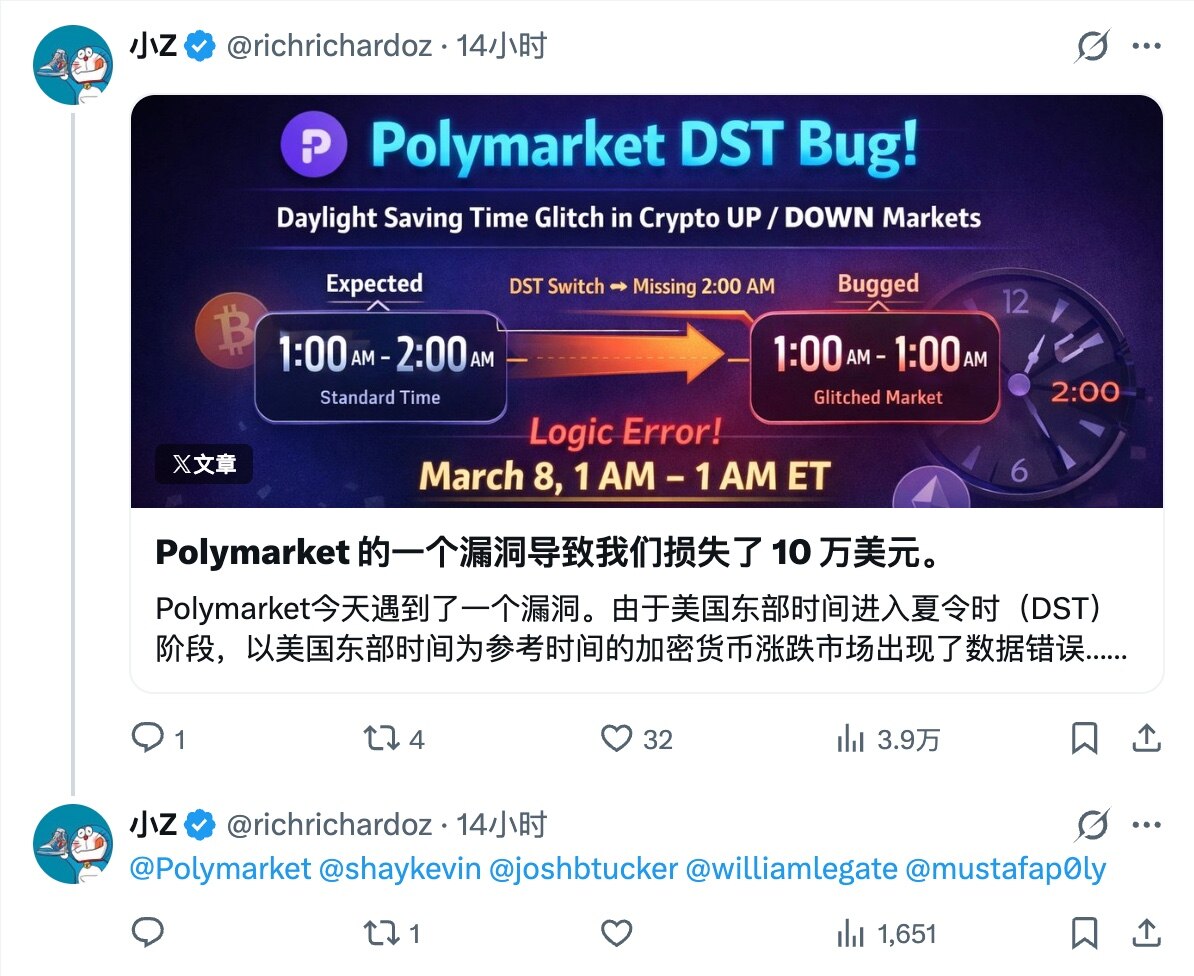
"Xiao Z" further explained that the start time and end time being exactly the same is a market state that is logically impossible. Many automated trading systems rely on the end time to determine the trading window; this error directly caused his program to lose a large sum of money. Therefore, he suggested that Polymarket change the time standard for related events to UTC time and compensate users affected by the data issue.
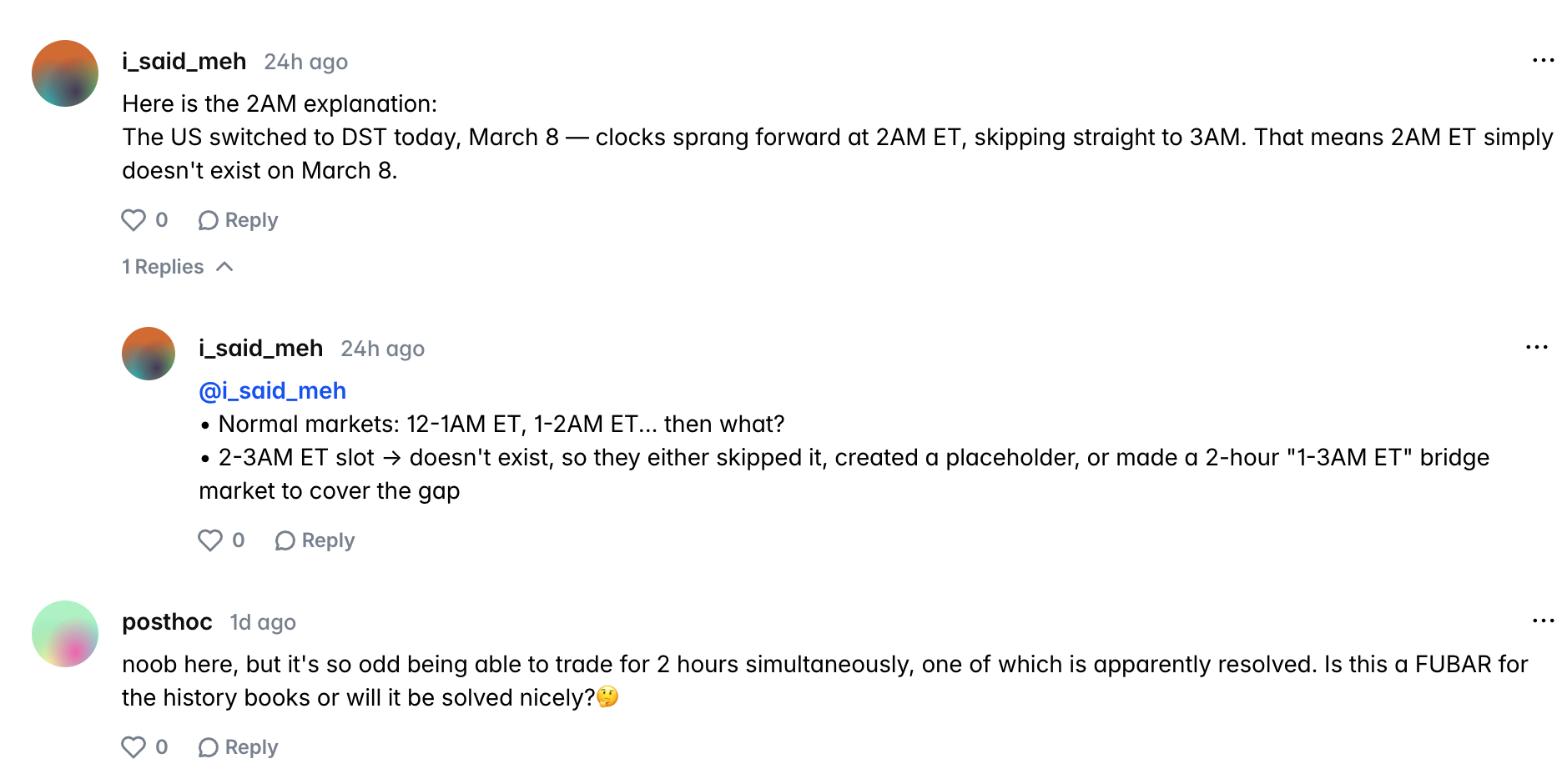
Besides this user, many external users have also left comments under the related events expressing confusion, but as of writing, Polymarket has not responded through official channels.

Time Standards in Traditional Financial Markets

Looking back at this controversy, although the scale of impact isn't huge, it exposed a fundamental design flaw in Polymarket's "Crypto Up or Down Market" events.

Influenced by historical customs, economic status, and industry practices, Eastern Time is still widely used across various industries. However, this is not very friendly to financial systems because Eastern Time switches between daylight saving time and standard time every year — artificially moving the clock forward or backward by one hour at specific times, resulting in "jumps" and "overlaps" in time respectively.

In modern financial systems, UTC time has long become the de facto universal standard. In the vast majority of financial infrastructure, internal systems typically use UTC timestamps as the sole standard time. Local times like Eastern Time are still used, but in terms of system logic, they often only exist in the presentation layer for users. This design is precisely to avoid the uncertainty of time systems, ensuring that time remains monotonic, unique, and globally consistent in financial transactions, settlements, and automated systems.

The key contradiction in Polymarket's controversy lies in the fact that the related events used Eastern Time as the timing standard but failed to fully consider the potential variable of the daylight saving time switch, ultimately causing confusion in the frontend and API data. Among the current user base of prediction markets, an increasing number of participants are trading via APIs and automated programs. Some minor issues that originally only affected frontend display can easily be amplified into real financial losses in automated systems.

Judging from the outcome, this controversy might not be considered a serious incident, and theoretically it could only happen at most twice a year, but what it reveals is a more serious design problem — as prediction markets gradually move towards becoming financial infrastructure, they must also adhere to the engineering standards used by financial infrastructure.


Domande pertinenti

QWhat was the specific bug that occurred on Polymarket related to time?

AThe bug was a 'time warp' caused by the switch from Eastern Standard Time (EST) to Eastern Daylight Time (EDT), where the hour from 2:00 AM to 3:00 AM was skipped. This led to a batch of 1-hour prediction events being incorrectly labeled with a time range of '1-1 AM ET' instead of the proper one-hour duration.

QWhich prediction markets on Polymarket were affected by this timing issue?

AThe affected markets were the 1-hour 'up or down' prediction events for Bitcoin (BTC), Ethereum (ETH), Solana (SOL), and XRP that started at 1:00 AM ET on March 8.

QWhat was the financial impact reported by user '@richrichardoz' due to this bug?

AUser '@richrichardoz' (also referred to as '小Z') reported that their automated trading systems, which relied on the API's end time data, malfunctioned due to the incorrect time data, resulting in estimated losses of over $100,000.

QWhat is the suggested solution to prevent such timing issues on Polymarket according to the article?

AThe article suggests that Polymarket should change the time standard for its events to UTC (Coordinated Universal Time) to avoid the complexities and inconsistencies of local time changes like daylight saving time.

QWhy does the article state that UTC time is the de facto standard in modern financial systems?

AUTC time is the standard because it provides a monotonic, unique, and globally consistent time reference. Financial infrastructure uses UTC internally to avoid the uncertainties caused by local time changes, such as daylight saving time transitions, which can disrupt trading, settlement, and automated systems.

Letture associate

In Conversation with Ray Dalio: We Are Currently in an AI Bubble, with 1% of My Portfolio in Bitcoin

Ray Dalio, founder of Bridgewater Associates, warns in an interview that the current AI boom shows classic bubble characteristics, which could lead to significant economic downturns as seen in past cycles like 1929 or 2000. He explains that speculative enthusiasm, fueled by debt and overvaluation, often precedes a crash when rising rates or taxation force asset sales, causing widespread losses and recession. Dalio also outlines his "Big Cycle" theory, describing an approximate 80-year pattern where widening wealth gaps, massive government deficits, and shifting geopolitical power (like China's rise) create internal conflict and global instability. He emphasizes that we are in a late-cycle, transitional phase where traditional powers like the US and UK face decline. For personal wealth protection, Dalio advises diversification beyond cash into assets like stocks, bonds, real estate, and particularly gold, which he prefers over Bitcoin. While he holds about 1% of his portfolio in Bitcoin as a non-printable hard asset, he views gold as more secure from technological or governmental threats. Regarding AI's impact, Dalio believes it will disproportionately benefit capital owners, worsening inequality by replacing both physical and cognitive labor. He suggests that human intuition and emotional intelligence, combined with AI, will be key for future workers. On taxation, Dalio argues that wealth taxes are impractical and risk triggering asset sell-offs, reducing productive investment. He points to the UK as a cautionary example of debt, low productivity, and political strife. Geopolitically, Dalio foresees a more regionalized world, with the US showing weakness in prolonged conflicts like with Iran, akin to past imperial declines. The ideal outcome, he suggests, is coexisting powerful blocs (e.g., Americas, China-Asia Pacific) without major war.

marsbit3 h fa

In Conversation with Ray Dalio: We Are Currently in an AI Bubble, with 1% of My Portfolio in Bitcoin

marsbit3 h fa

Daily 7.2 Trillion KRW: Foreign Capital's Record Net Buying on Friday! Wall Street Says Headwinds for Korean Stock Fund Flows Have Subsided

South Korean stock market sees a dramatic shift in fund flows. On July 31, foreign investors made a record net purchase of approximately KRW 7.2 trillion in KOSPI stocks, marking a fundamental reversal from the persistent large-scale net outflows seen in previous months. This contributed to a significant narrowing of foreign net selling in July to KRW 9.8 trillion, down sharply from KRW 48.4 trillion in June and KRW 44.5 trillion in May. Simultaneously, domestic institutional pressure eased. South Korean pension funds and asset managers turned to a net buying position in July, purchasing KRW 1.0 trillion worth of KOSPI shares, contrasting with net sales in May and June. Market volatility is expected to be dampened by new financial regulations. Effective July 31, the Financial Services Commission tightened access for retail investors to single-stock leveraged ETFs by raising the minimum cash deposit requirement. Trading volumes for these products subsequently dropped to about 50% of their monthly average. Citigroup Research maintains its year-end KOSPI target of 10,000 points. The firm cites several supportive factors: the substantial easing of headwinds from capital outflows, a robust fundamental outlook for the semiconductor sector, historically low market valuations, strong economic fundamentals, and the potential for policy support from financial authorities if needed.

marsbit3 h fa

Daily 7.2 Trillion KRW: Foreign Capital's Record Net Buying on Friday! Wall Street Says Headwinds for Korean Stock Fund Flows Have Subsided

marsbit3 h fa

Thanks to Dice Rolls, Bitcoin Keys Are Stored Offline, But Not Everyone Will Do It

The article discusses using dice rolls to generate secure Bitcoin wallet seeds, providing entropy independent of potentially flawed hardware random number generators. It explains that each fair dice roll offers about 2.585 bits of entropy, with around 50 rolls needed for a standard 12-word seed phrase and 99+ recommended for higher security. This method gained attention after a vulnerability was revealed in some Coldcard hardware wallets, where a faulty firmware RNG (dating back to 2021) compromised generated keys. The analysis notes that while a dice-generated main seed was safe from this specific flaw, other Coldcard functions (like creating paper wallets, backup keys, or passwords) could still be vulnerable if they used the defective RNG. The piece argues that while dice-based entropy is technically robust, the manual process is error-prone, tedious, and unrealistic for most new users, who might make mistakes in recording or inputting rolls. It concludes that while manual entropy generation should remain an option for advanced users, the long-term goal is to develop reliable, user-friendly hardware and software that securely generates randomness without requiring specialized knowledge. Coldcard users are advised to check their firmware version and replace any secondary secrets (like paper wallet keys) created with vulnerable devices, while also considering multi-signature setups with devices from different manufacturers for added security.

cryptonews.ru9 h fa

Thanks to Dice Rolls, Bitcoin Keys Are Stored Offline, But Not Everyone Will Do It

cryptonews.ru9 h fa

Trading

Spot
活动图片






