Author: ChandlerZ, Foresight News
On July 9, Bloomberg reported that Goldman Sachs had updated its internal personal trading policy, prohibiting employees from participating in event contracts involving specific companies (including whether Goldman Sachs itself would restructure or launch an acquisition in a certain quarter), election outcomes, financial market performance (including Bitcoin prices), macroeconomic data, geopolitical events (including ceasefire timelines in active conflicts), and regulatory outcomes of pending mergers and acquisitions. Sports and entertainment bets are still permitted.
Regarding penalty clauses, employees who violate the rules twice may face dismissal or account closure. If a trade is deemed improper, Goldman Sachs reserves the right to claw back profits exceeding $200 or direct that amount to charity. A Goldman Sachs spokesperson stated that the company does not comment on specific policy details, only noting that trading using material non-public information (MNPI) is prohibited in all markets where Goldman Sachs operates.
In January, Goldman Sachs CEO David Solomon publicly called prediction market platforms "very interesting" and revealed he had met with the heads of two leading platforms in the field. Six months later, his company closed this door for its employees.
According to a CNBC investigative report surveying 50 companies, strategies among Wall Street institutions vary significantly. Hedge funds Point72 Asset Management and Balyasny Asset Management have adopted more thorough measures than Goldman Sachs, outright banning all personal account prediction market trading activity without any category exemptions. JPMorgan Chase has only advised employees to "act cautiously" without issuing a formal ban. Bank of America is rolling out new trading restrictions to employees. Morgan Stanley has incorporated relevant clauses into its employee code of conduct.
Chrome Web Store Simultaneously Cuts Off Distribution Channels
The Google Chrome Web Store recently updated its developer program policy, set to take effect on August 1, 2026. This update explicitly lists prediction markets as a prohibited category, banning extensions that facilitate or support transactions involving real money for predicting outcomes.
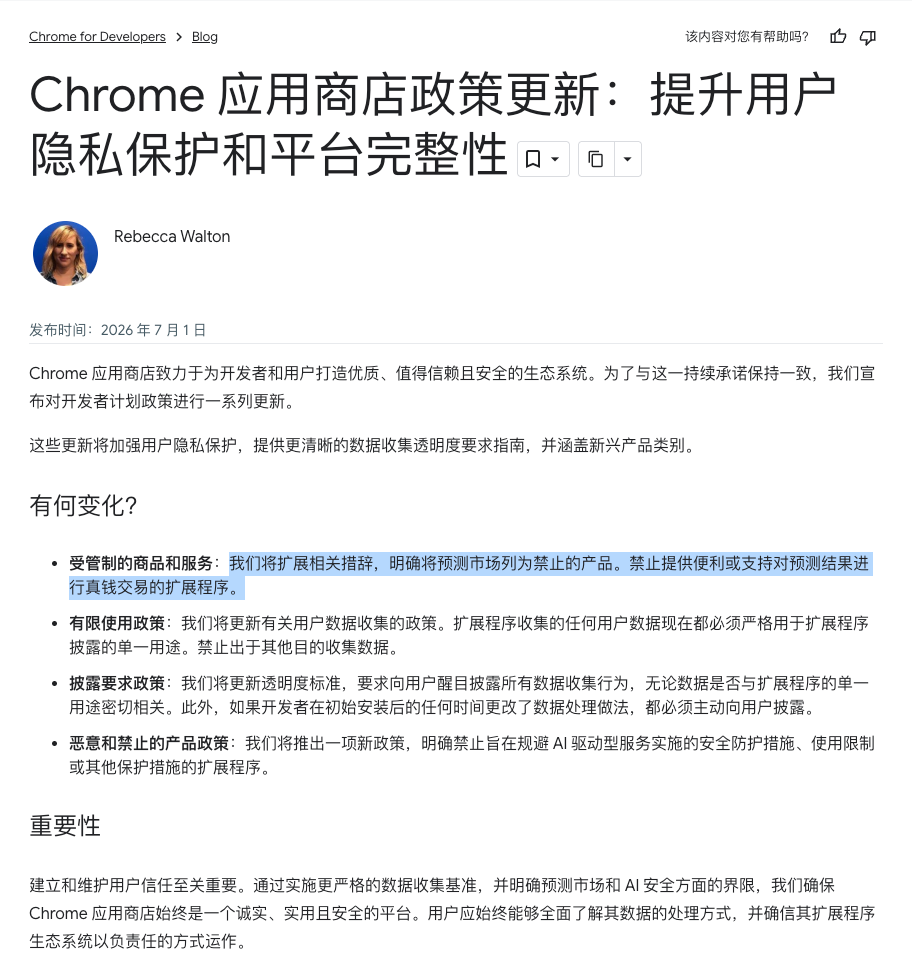
Additionally, the new policy requires that user data collected by extensions must be strictly used for a single disclosed purpose and prohibits repurposing it. It also adds a ban on extensions designed to circumvent security protections of AI-driven services. Google stated that it recommends developers promptly review the compliance of their existing extensions. After August 1, the Chrome Web Store may take enforcement action if extensions are found non-compliant with the policies.
Google's ban does not affect the prediction market platforms themselves; the web and mobile apps of Polymarket and Kalshi remain unaffected. However, Chrome extensions are one of the access points for some users to enter prediction markets, and blocking this channel sets up a barrier at the browser level. This policy adjustment also includes stricter transparency requirements for user data collection. Data collected by extensions can only be used for the declared purpose, and any changes in data handling must proactively notify users.
A Chain Reaction Triggered by a Google Employee
The direct trigger for Goldman Sachs' ban was an enforcement case in May of this year. The U.S. Commodity Futures Trading Commission (CFTC) announced that Google software engineer Michele Spagnuolo was alleged to have illegally profited $1.2 million by trading prediction contracts on Polymarket and was charged with fraud and money laundering. The involved contract was "Who will be the most searched person in 2025?". In the complaint, the CFTC seeks restitution, disgorgement, civil monetary penalties, trading and registration bans, and permanent injunctions against further violations of the Commodity Exchange Act and CFTC regulations. Yesterday, the U.S. Attorney's Office for the Southern District of New York announced criminal charges against Michele Spagnuolo in the same court.
Furthermore, according to The Wall Street Journal, Michele Spagnuolo used Google's "Year in Search" data, accessible to only a few employees, last year to place bets on the year's most popular searched persons on Polymarket, placing bets through an account named "AlphaRaccoon," involving 25 trades. He accurately bet that Kendrick Lamar and d4vd would rank in the top five.
This is the first insider trading case involving a private company in the history of prediction markets. Previous discussions of insider trading in prediction markets mainly focused on political events (like elections). The Spagnuolo case is the first to prove that corporate employees can use company insider information to profit on prediction markets.
For Wall Street institutions that handle large amounts of non-public financial information in their daily operations, such risks are particularly pronounced. If a trader, aware of upcoming earnings report data, merger plans, or regulatory decisions, places bets on related contracts on Polymarket or Kalshi, its nature is no different from insider trading in traditional securities markets. However, the current regulatory framework and identity verification mechanisms for prediction markets are far less mature than those for securities markets.
Financial Instrument or Casino
The actions by Goldman Sachs and Google come against a backdrop of prediction market industry facing pressure on multiple fronts. On June 26, the CFTC announced a broad investigation into Polymarket, involving allegations of fabricated trading videos, false winning records, and undisclosed paid promotions. On the same day, a consumer rights group sued Polymarket and its CEO and CMO in Washington, D.C. The CFTC has already filed federal lawsuits in 9 states, vying for jurisdiction over prediction markets, while 17 Democratic senators are attempting to block the CFTC from using federal funds to sue state governments.
Additionally, Argentina ordered a nationwide block on Polymarket in March this year, becoming one of over 30 countries globally imposing access restrictions on prediction markets. The ruling also forced Google and Apple to remove Polymarket's app from their respective app stores in Argentina.
According to Dune data, as of June 22, the monthly nominal trading volume of prediction markets reached a record high of $291.38 billion. Furthermore, Kalshi is seeking a new round of funding at a $40 billion valuation, and ICE, the parent company of the New York Stock Exchange, invested $2 billion in Polymarket. Capital continues to flow in.
Prediction markets still lack a widely accepted identity definition. U.S. CFTC Chairman Selig insists it is a federally regulated financial derivative, suing 9 states attempting to regulate prediction markets under gambling laws. Analysis by The Wall Street Journal shows that over 70% of accounts on Polymarket are in a loss-making position, with only 0.1% of accounts capturing 67% of all profits—figures that more closely resemble the distribution characteristics of a casino.
However, it's evident that restrictions are arriving simultaneously from multiple directions: federal-level enforcement investigations, political pressure from Congress, jurisdictional battles with state governments over gambling laws, internal compliance restrictions on Wall Street, and distribution channel blockades by tech platforms are all accelerating the encirclement of prediction markets.