Behind Robinhood's Launch of Its Own Chain, the Beautifully Packaged "Tokenized Stocks" Still Have No Equity Rights

marsbitPubblicato 2026-07-10Pubblicato ultima volta 2026-07-10

Introduzione

Robinhood has launched "Robinhood Chain," an Ethereum-based Layer 2 built with Arbitrum technology, and introduced "Stock Tokens." This article clarifies that these tokens are not actual on-chain equity. They are tokenized debt securities issued by Robinhood Assets Jersey Limited, offering economic exposure to reference stocks or ETFs but lacking direct ownership, voting rights, or other shareholder privileges. The legal structure is conservative, relying on traditional financial intermediaries, custody, KYC/AML controls, and specific jurisdiction rules, even though the tokens are transferable on-chain. The move is part of Robinhood's broader strategy to evolve from a retail brokerage into a global financial ecosystem, integrating services like banking, retirement, crypto, and DeFi. Robinhood Chain aims to provide a programmable settlement layer, making financial products more portable and accessible while masking underlying complexity. However, the "brokerage chain paradox" lies in balancing a simple user interface with the intricate, regulated reality of the wrapped assets. The success of this model depends on users and regulators accepting this structured approach without misunderstanding the tokens as direct stock ownership. Key components supporting this strategy include the Bitstamp acquisition (expanding institutional crypto capabilities), the Robinhood Wallet (bridging brokerage and self-custody), the Robinhood Earn program (integrating DeFi lending), and the Lighte...

Author: insights4vc

Compiled by: Deep Tide TechFlow

Deep Tide's Take: Robinhood has launched its own Layer 2 chain and "tokenized stocks," seemingly bringing stocks on-chain. However, what users actually get are packaged debt instruments—they hold neither voting rights nor true equity ownership. How far this packaging game can go depends on whether users, developers, and regulators can accept this contradiction of a "simple interface, complex underlying structure."

Robinhood's move is easily misinterpreted if one only looks at the surface. On the surface, the story is appealing: a major retail broker launches a public, Ethereum-compatible, Arbitrum-based Layer 2; it supports wallets, ETH gas fees, bridges, tokenized market exposure, and DeFi integration; it aims to make financial products cheaper, more portable, and more global. This is all largely true.

The real strategic questions lie beneath. Robinhood is building a permissionless financial chain, but the assets that make this chain strategically interesting are not truly permissionless financial objects. They are packaged claims on rights, still bound by law. The chain itself may be freely deployable. Tokens may be transferable between supporting wallets. But the economically meaningful instruments still rely on issuers, prospectuses, custodians, networks of authorized participants, sanctions and KYC controls, jurisdictional exclusions, oracle designs, and legal recourse that looks nothing like direct share ownership.

This is the broker-chain paradox. Robinhood's opportunity lies in hiding this complexity well enough that the products feel simple, global, and useful. Robinhood's risk is that users, developers, and regulators refuse to ignore the underlying complexity. If users think "tokenized stocks" are "stocks," the gap between language and legal reality becomes a product liability issue. If regulators believe the packaging is clear and fairly disclosed, the structure may expand. If they believe the packaging encourages misunderstanding, expansion may stall precisely where the story gets interesting.

Viewed this way, Robinhood Chain is neither a pure crypto experiment nor a simple extension of broker applications. It's an attempt to create a new layer in between: a consumer-facing financial stack whose interface feels intuitive, but whose underlying mechanisms are deeply structured, tightly controlled, and jurisdiction-specific. This is commercially rational. But also inherently fragile. If Robinhood cannot sustain the illusion of simplicity without overstating what users actually own, no part of the strategy will work.

Robinhood's Current Position and Super App Ambitions

Robinhood's launch of Robinhood Chain is not a defensive move. The company is acting from a position of unusual operational strength—for a broker that just a few years ago was viewed by many investors as a cyclical retail trading platform.

Robinhood (NASDAQ: HOOD) plans to release its Q2 2026 earnings after market close on Wednesday, July 29, 2026.

The revenue structure matters because it shows where the business actually monetizes today. In Q1 2026, options generated $260M in transaction revenue, stocks $82M, event contracts $104M, other transaction revenue $43M, and cryptocurrencies $134M. The standout growth line was event contracts, rising from $3M year-over-year to $104M, while crypto revenue fell from $252M to $134M. Therefore, the launch of Robinhood Chain coincides with a time when the company's earnings are still primarily driven by active retail trading, high-margin products, and balance sheet monetization, not by any existing on-chain business line.

This distinction is important for strategy and valuation. Robinhood Chain is not saving the business. It's trying to create a new interface on top of a business that is already functioning. This makes the move more credible because the company has room to experiment. It also makes the move easier to overhype because the existing earnings engine is still rooted in established broker economics.

The rest of the balance sheet and user engagement point in the same direction. Robinhood disclosed a $17B margin book, $16.7B in cash and deposits, $27.4B in retirement assets under custody, and $66B in crypto notional trading volume in Q1 2026, of which $42B came from Bitstamp and $24B from the Robinhood app. This last number is particularly relevant. Bitstamp already makes Robinhood's crypto footprint look more like infrastructure than an isolated retail trading feature.

From Broker App to Financial Super App

The strategic logic of Robinhood now appears more coherent than when the company first began adding disparate products around its core brokerage. In Q1 2026 and subsequent public materials, the company no longer just describes product expansion. It outlines a more complete operating model: brokerage, options, futures, event contracts, banking, Gold, retirement, crypto, wallet, private market access, AI tools, global licenses, tokenized assets, and DeFi-linked yields. Management's talk of building a "global financial ecosystem" is not just corporate speak. It's an attempt to explain how the layers fit together.

The broader stack now includes several parts that would seem incoherent in isolation. Robinhood Banking and higher cash engagement matter because they deepen deposit and balance relationships. Robinhood Gold matters because it increases subscription attach rates and supports premium packaging models. Retirement matters because it lengthens asset lifecycles and dampens pure trading cyclicality. Futures and event contracts matter because they increase engagement and monetization intensity. Crypto matters because it provides 24/7 markets, self-custody rails, and global funding flexibility. Bitstamp matters because it expands institutional and international reach. The wallet matters because it gives Robinhood a credible non-custodial interface. Robinhood Chain matters because it provides a programmable settlement layer where, in principle, all this financial activity can begin to converge.

The company's international direction reinforces the same point. Robinhood's expansion into Canada via WonderFi, its disclosed progress on Singapore regulation, and its description of UK crypto plans. The importance of these steps is not just new territory, but that they create a testing ground for products that don't fully fit within the US retail broker rulebook. Tokenized wrappers and wallet-native products are easier to introduce at the edges of the group than by turning the regulated core of the US app crypto-native overnight.

The strategic sentence is simple: Robinhood Chain matters because it may allow Robinhood to extend its consumer distribution advantage into programmable finance without having to turn its core US brokerage crypto-native overnight. That's why the chain should be read as infrastructure strategy, not launch hype.

What Exactly Is Robinhood Chain

Robinhood Chain's documentation describes it as an Arbitrum Layer 2 chain built on Ethereum, using Ethereum blobs for data availability and ETH as the native gas token. Robinhood Wallet natively supports it, and other EVM wallets can add it manually. Assets can be transferred on-chain using the canonical Arbitrum bridge or partner routing. Public materials also emphasize that the chain is open and permissionless, EVM-compatible, and designed for tokenized real-world assets.

Robinhood's July 2026 launch materials say the chain is built using the Arbitrum platform to "institutional standards" and name Uniswap as the day-one AMM, with Pleiades as a proprietary AMM/proprietary trading venue. Robinhood's technical documentation adds that Stock Tokens are standard ERC-20s, each with a Chainlink price feed, and corporate actions are reflected via on-chain multipliers rather than rebalancing balance changes.

However, public documentation is not equally complete on all infrastructure questions. We found clear docs on connectivity, gas, bridges, token formats, and oracle design, but fewer clear public explanations on sequencer decentralization, governance pathways, fault proof states, or the exact current production roles of each named infrastructure partner. This doesn't mean the system is weak; it means some institutional-grade diligence questions still require more disclosure than the public docs currently provide.

The main takeaway is straightforward. Robinhood Chain is real, but still early. It has infrastructure, partners, and live products attached to it. What it doesn't yet have is proof of sustained liquidity, broad developer adoption, seamless regulatory portability, or material revenue contribution. This distinction matters. A public mainnet and a few live products are enough to take the strategy seriously. They are not enough to prove it.

Stock Tokens and the Legal Reality of On-Chain Stocks

The most important sentence in this article is also the simplest: Robinhood's Stock Tokens should not be described as on-chain stocks. They are tokenized economic exposures to securities through legal wrappers.

Robinhood's on-chain Stock Tokens are described in public materials and prospectus filings as tokenized debt securities issued by Robinhood Assets Jersey Limited. They provide economic exposure to reference shares or ETFs, but users do not obtain direct legal ownership of the underlying securities, beneficial ownership of those shares, or ordinary shareholder rights like voting. The product documentation is clear on this point, and the prospectus framework is clearer than most marketing shorthand around "stock tokens" implies.

The early "Classic Stock Tokens" from Robinhood Europe were legally different again. Those products are described as derivative contracts between users and Robinhood Europe, UAB. They are not transferable to external wallets and can only be opened or closed via the Robinhood Europe platform. The legal boundaries there are even less ambiguous: customers are dealing with derivative exposures, not tokenized claims of holder rights.

The newer on-chain product is more aggressive on distribution but more conservative on legal architecture. That's precisely why it might work. Tokens can behave like crypto assets at the interface layer: on-chain transfer, held in compatible wallets, referenced in DeFi, and priced by oracles. But the underlying claim remains conservative: a Jersey-issued, prospectus-governed, collateralized, limited-recourse debt security referencing underlying shares. Robinhood isn't dismantling securities law. It's packaging around it.

The structure also relies on designated service providers and legal control points. The documents reviewed for the underlying research identify Robinhood Assets Jersey Limited as issuer and tokenizer, Bitstamp Global Ltd. as an authorized offeror in the reviewed terms, and Alpaca Securities LLC as custodian and broker for the reference series. These roles matter because tokenized exposure, aspiring to be globally portable, remains in practice knotted together by highly traditional financial plumbing.

Even the asset-backing story is more complex than the phrase suggests. Robinhood's materials state each token is 1:1 backed by underlying shares. The prospectus framework describes segregated accounts per series but also permits securities lending. During the life of a securities loan transaction, the issuer's economic exposure runs through collateral and contractual rights, not through untouched shares sitting statically in custody. This difference could matter in stress conditions. It introduces borrower, collateral, operational, and recovery-value risks that are alien to the simple intuition a retail user might derive from the product name.

Corporate actions and dividends are similarly indirect. Robinhood's materials explain dividends are handled through a multiplier mechanism adjusting token reference economics, not through direct shareholder distributions to users. The prospectus also flags withholding tax and Section 871(m) considerations for dividend equivalents. Again, this doesn't make the product defective. It makes the product structured. Users should buy this structure with their eyes open.

Transferability is real but not absolute. Robinhood says on-chain Stock Tokens can be held and transferred on supported blockchains and compatible wallets. At the same time, documentation allows for pausing, freezing, and restrictions under certain conditions, and purchase or redemption remains subject to KYC, AML, sanctions compliance, and jurisdictional exclusions. This is closer to a programmable, wrapped, conditional product than an unrestricted bearer instrument.

The business conclusion is straightforward. The product is aggressive on distribution but conservative on legal architecture. This combination is not a flaw. It's likely the only viable route to market. But it also means Stock Tokens should be evaluated as a legal and market structure experiment making economic exposure portable, not as an on-chain replacement for actual stock ownership.

Digital Assets as Infrastructure, Not Just Trading Revenue

Robinhood's digital assets strategy is now too broad to fit back into the old "crypto trading revenue" box. Crypto as a revenue line still matters, but its role as infrastructure is becoming more important. This shift is precisely where the deeper significance of Robinhood Chain lies.

Crypto trading revenue still matters, but it no longer tells the whole story. In Q1 2026, Robinhood generated $134M in crypto transaction revenue, a significant decline year-over-year, despite reaching $66B in crypto notional trading volume. Of that $66B notional volume, $42B came from Bitstamp and $24B from the Robinhood app. In other words, Robinhood's digital assets footprint has already outgrown its consumer crypto label.
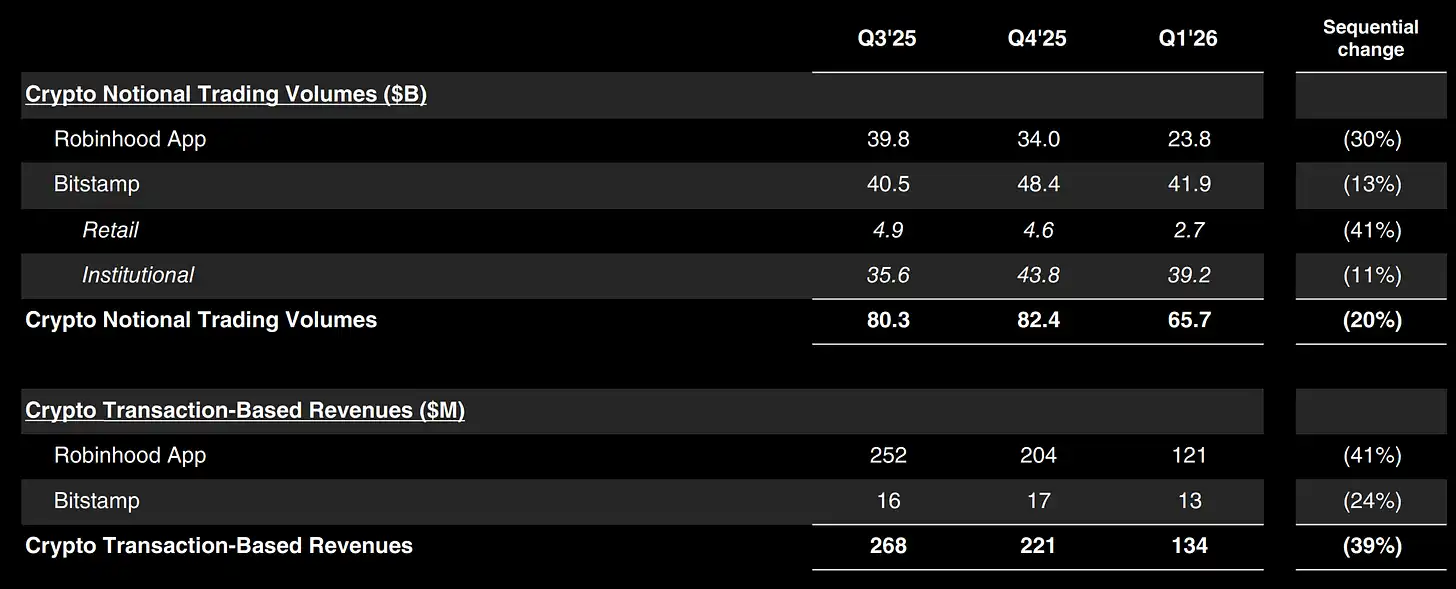
Bitstamp is central here. Robinhood completed its ~$200M cash acquisition of Bitstamp in June 2025, explicitly positioning the deal as gaining global exchange capabilities, institutional clients, white-label infrastructure, staking, institutional lending, and broader license coverage. In subsequent filings, Robinhood has already described Bitstamp as extending the institutional side of the business into services like on-exchange lending, OTC settlement, post-trade settlement, and institutional perps. A company doesn't talk this way if it still views crypto as an adjunct to its retail business.

Robinhood Earn makes the same point from the consumer side. Public materials describe a simple flow: users buy USDG on Robinhood Crypto, move it into a self-custody wallet, and then lend via Morpho. Robinhood carefully discloses that the wallet is non-custodial and withdrawal times depend on pool liquidity. The Morpho side describes Robinhood Earn as a progressive rollout to eligible US users. This is more than adding yield to cash balances; it's educating the Robinhood userbase that DeFi can live behind an interface without requiring crypto-native behavior from the customer.

The stablecoin angle matters because it could prove more durable than any single speculative trading cycle. If Robinhood can turn stablecoin balances into an invisible funding rail, it gains a portable, programmable financing layer for wallet-native activity, international flows, and future collateral use cases. In that model, stablecoins are not the product itself but the settlement medium underlying products. That's a strategically more important role.

Robinhood Wallet is the user-side bridge to this tech stack. Supporting materials show the wallet already spans multiple major blockchains and now includes Robinhood Chain itself. This matters because wallet strategy is where broker distribution and crypto infrastructure meet. Brokers can custody, wallets can compose. Robinhood increasingly wants to have both within the same customer relationship.

Why Lighter Matters

Lighter is one of the clearest examples of Robinhood's infrastructure positioning. Lighter gives Robinhood access to advanced on-chain trading design without having to build a crypto-native perpetual exchange from scratch. Public materials describe Lighter as a custom zero-knowledge rollup with order matching and clearing proofs, price-time priority execution, and an emergency exit design if certain operations aren't processed on time. Robinhood Wallet materials describe perpetual contracts within the wallet, including liquidation mechanics and funding rate dynamics, with the underlying decentralized protocol responsible for handling liquidations.
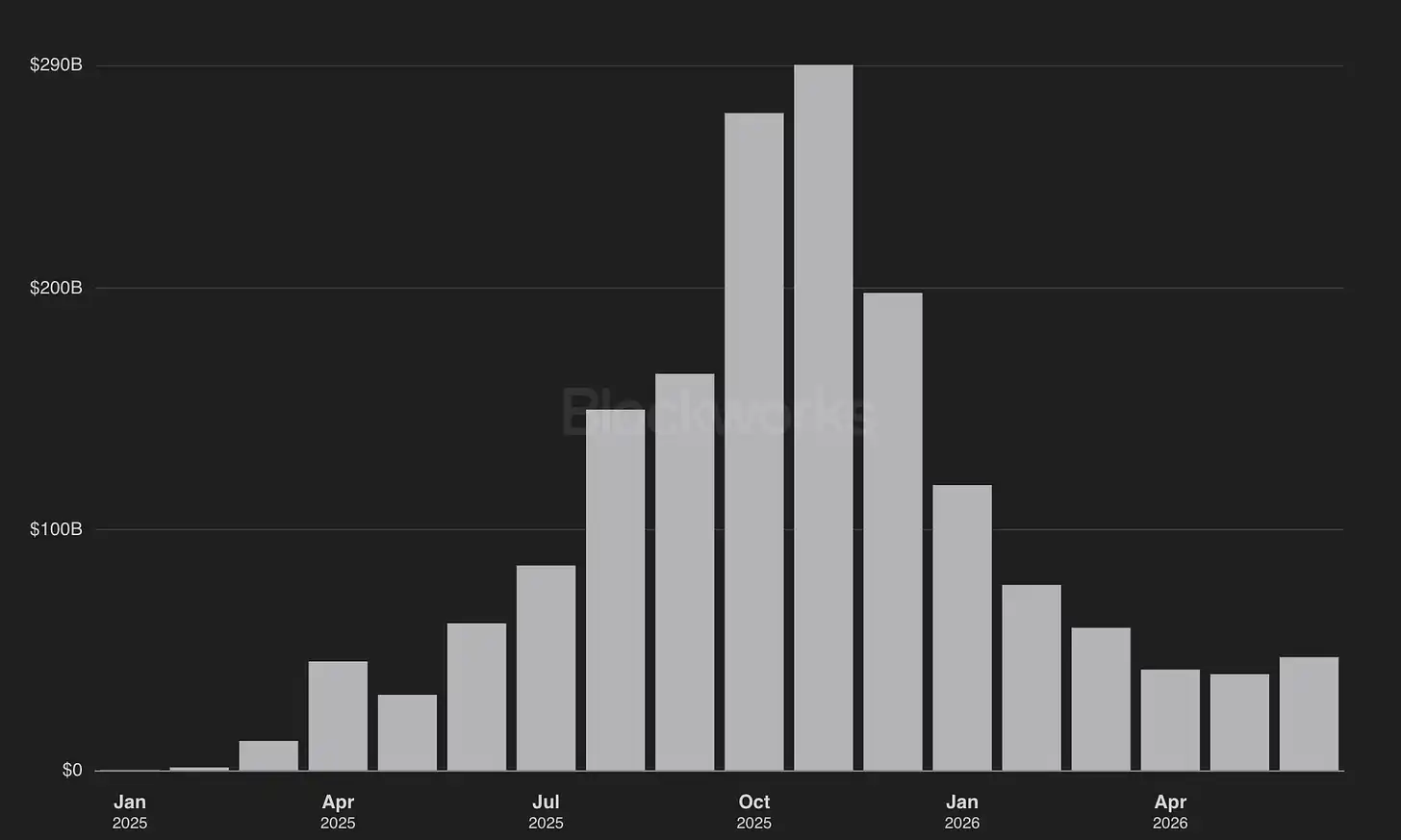
Perpetual contracts notional volume (Source: Blockworks)
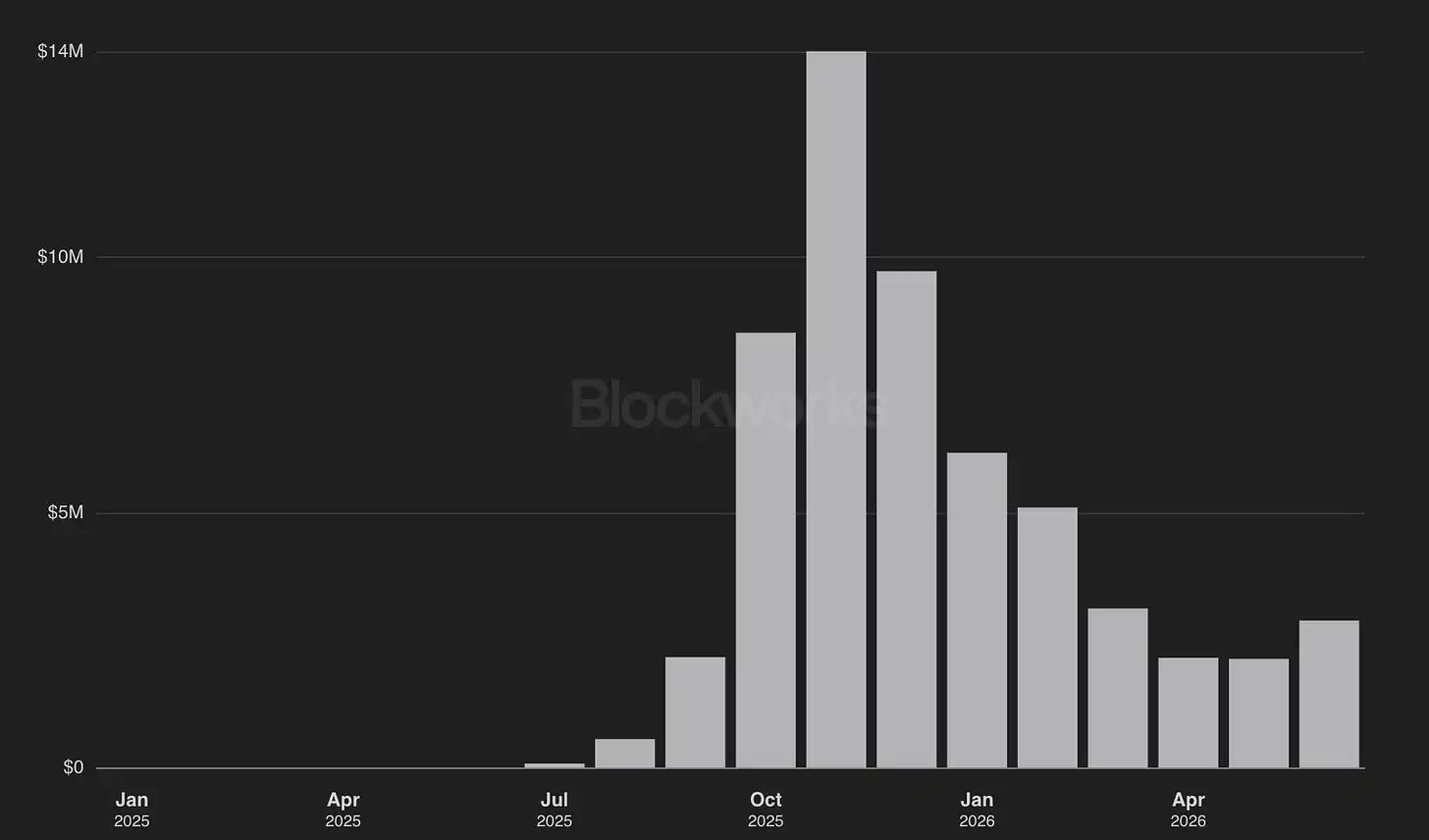
Revenue (Source: Blockworks)
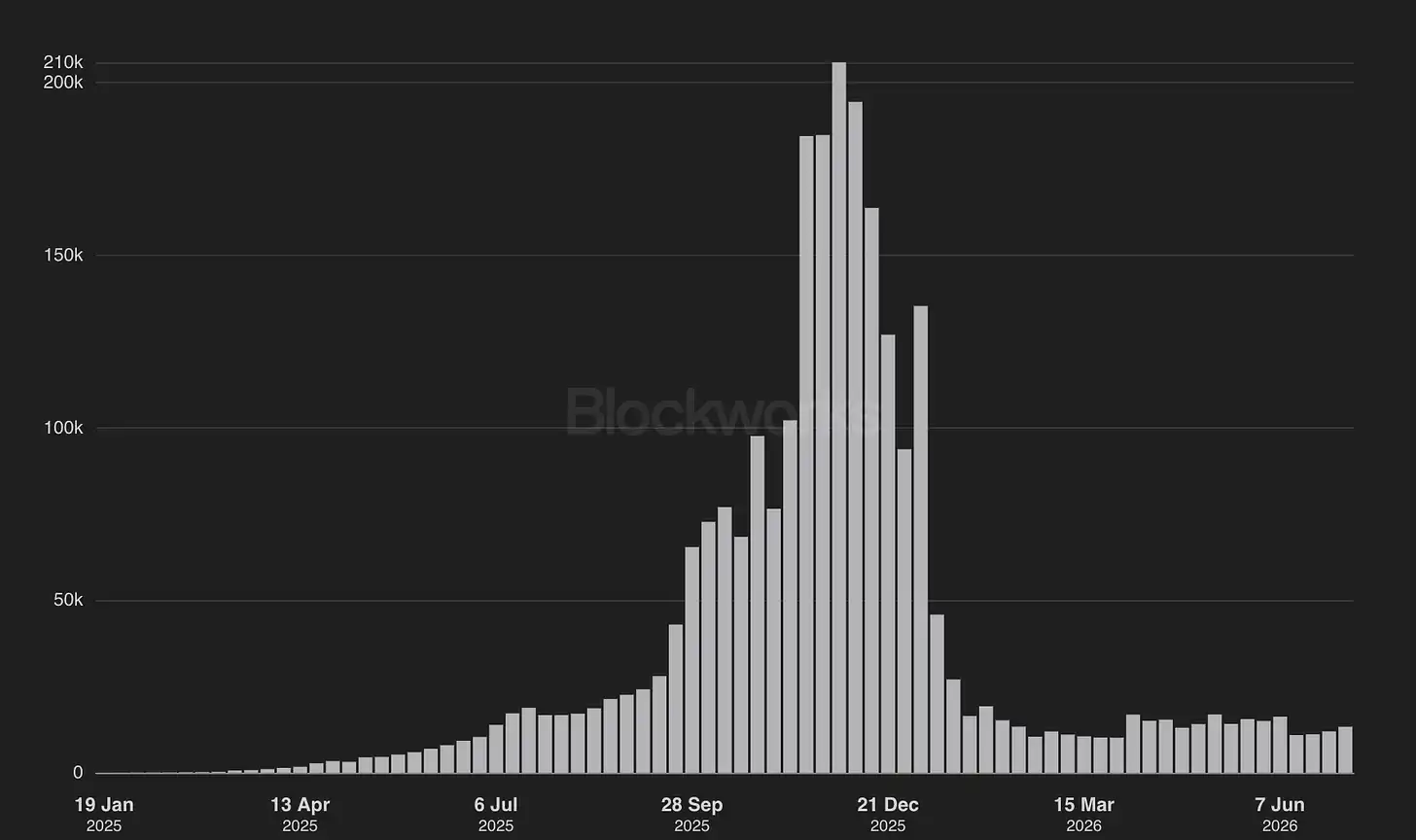
Traders (Source: Blockworks)

This is useful strategically in several ways. It expands the wallet's engagement surface. It lets Robinhood test high-frequency, high-engagement trading demand in a self-custody environment. It shortens time to market. It exposes Robinhood to the economic model and user behavior of global 24/7 trading without shifting the entire burden onto the regulated US broker architecture.

But Lighter also heightens the brand challenge. Perpetual contracts bring leverage, liquidation, incentive-sensitive liquidity, and retail loss risk closer to the Robinhood ecosystem. Lighter's own documentation explicitly states that RWA markets trade around the clock and use margin mechanisms. This may be commercially attractive, but it's also the kind of product layer that can bring political, regulatory, and reputational friction for a mass-market broker.

So the correct conclusion is narrower than markets might hope. Lighter is not proof that Robinhood can own a perpetuals economy like Hyperliquid, but rather proof that Robinhood can plug crypto-native trading infrastructure into its consumer wallet funnel. This makes strategic sense, but is not the same as owning the trading venue.

Risk Disclaimer:

insights4.vc and its newsletter provide research and information for educational purposes only and should not be considered professional advice of any kind. We do not advocate any investment actions, including buying, selling, or holding digital assets.

The content reflects the authors' opinions only and does not constitute financial advice. Please conduct your own due diligence before engaging with digital assets or related technologies, as they are high-risk and their value can fluctuate significantly.


Crypto di tendenza

Domande pertinenti

QAccording to the article, what is the core contradiction or paradox at the heart of Robinhood Chain's strategy?

AThe core paradox is that Robinhood is building a 'permissionless' financial chain, but the economically significant assets on it are not truly permissionless financial objects. They are legally constrained, packaged claims (like its tokenized stock exposure), relying on issuers, custodians, KYC controls, and specific jurisdictions. The opportunity lies in hiding this complexity to make the product feel simple and global, but the risk is that users, developers, or regulators might reject this illusion, creating product liability or regulatory roadblocks.

QWhat are Robinhood's 'Stock Tokens' legally, and what key shareholder rights do they NOT confer to the user?

ALegally, Robinhood's Stock Tokens are tokenized debt securities issued by Robinhood Assets Jersey Limited. They provide economic exposure to a reference stock or ETF but do NOT confer direct legal ownership of the underlying securities, beneficial ownership of the shares, or shareholder rights such as voting rights.

QHow does the article differentiate between Robinhood's role in cryptocurrency as a source of 'trading revenue' versus its role as 'infrastructure'?

AThe article states that while crypto trading revenue is still a significant line item (e.g., $134M in Q1 2026), its role is broadening beyond that. Cryptocurrency is increasingly becoming infrastructure for Robinhood. This is evidenced by the Bitstamp acquisition (providing global exchange capabilities and institutional services), the Robinhood Earn program (integrating DeFi lending behind a simple interface), and the strategic use of stablecoins as a portable, programmable settlement layer for future financial activities on platforms like Robinhood Chain.

QWhat is the strategic significance of the Lighter platform for Robinhood, according to the analysis?

ALighter provides Robinhood with access to advanced on-chain trading infrastructure (specifically for perpetual contracts) without having to build it from scratch. Strategically, it allows Robinhood to test high-engagement, 24/7 trading demand within a self-custody environment (like its Wallet), expand the utility of its wallet, and shorten product development time. It's a proof point that Robinhood can connect crypto-native trading infrastructure to its consumer distribution funnel, though it is distinct from owning the entire trading venue economy.

QWhy does the author argue that Robinhood Chain is launched from a position of 'operational strength' rather than as a defensive move?

AThe author points to Robinhood's current revenue structure, which is still primarily driven by traditional, high-margin brokerage activities like options and stocks, along with a growing events contracts business. The crypto revenue line, while significant, has declined. This means Robinhood Chain is not an attempt to 'save' a failing business but an attempt to create a new interface and infrastructure layer on top of an already functioning and profitable core brokerage business, giving the company credible room to experiment.

Letture associate

Strategy's Accounting Gimmick: The Cap on BTC Sales Far Exceeds $1.25 Billion

The article, originally from Bankless, discusses how MicroStrategy's (MSTR) recent Bitcoin (BTC) sales reveal a much larger potential selling capacity than the widely reported $1.25 billion "reserve-building" cap. On July 7, MicroStrategy disclosed a sale of 3,588 BTC (~$216M) to pay dividends for its STRAT (STRC) preferred shares and replenish its USD Reserve. Crucially, the company stated this sale did not count against its stated $1.25 billion "reserve-building capacity." The analysis explains that MicroStrategy's "BTC Monetization Plan," part of its broader "Digital Credit Capital Framework," actually outlines three main purposes for selling BTC, only one of which has the $1.25B cap: 1. **Building the USD Reserve** (capped at $1.25B). 2. **Covering preferred share/ debt costs** (replenishing the reserve after payments). 3. **Funding buybacks** (up to $10B for preferred shares and $10B for MSTR common stock). The key nuance is the accounting distinction between "building" the reserve (selling BTC before making payments) and "replenishing" it (selling BTC after using reserve funds for payments). While functionally the same—converting BTC to cash for obligations—only "building" counts against the publicized $1.25B limit. This means sales for "replenishing" and the $20B+ buyback pool allow for total potential sales exceeding $30B. The article frames this as part of MicroStrategy's shift from a simple "buy and hold" Bitcoin narrative to an "active capital management" model, where BTC becomes a balance-sheet tool to manage pressures between its common stock, preferred shares, dollar reserve, and Bitcoin holdings. This creates complex trade-offs and potential conflicts of interest. The conclusion warns investors that the $1.25B figure is not a total sales ceiling. Understanding terms like "build," "replenish," and "repurchase" in MicroStrategy's disclosures is now critical, as the company navigates a new, more complex role as an actively managed entity rather than a passive Bitcoin accumulator.

Odaily星球日报1 h fa

Strategy's Accounting Gimmick: The Cap on BTC Sales Far Exceeds $1.25 Billion

Odaily星球日报1 h fa

The Networking Game in Silicon Valley's Elite Circles: Those with Connections Get $50 Million, While the Truly Talented Can't Raise Money?

"Silicon Valley's Meritocracy to Relationship Game: How Networks Now Trump Talent." The article argues that Silicon Valley has shifted from a meritocracy to a "kingmaker" system where connections and background outweigh true ability. Key factors driving this change include: 1. **AI-Distorted Expectations:** Unprecedented growth curves (e.g., Anthropic) have led VCs to seek only "sure things" or pattern-match against past successes. 2. **Capital Concentration:** LP funds are concentrated in a few large, multi-stage funds, pushing VCs to overpay for hot deals to secure capital. 3. **VC Professionalization:** The industry has become a standardized career path, attracting conformist "NPCs" rather than independent thinkers. The long IPO timeline incentivizes safe, consensus bets for career advancement over risky, fund-returning outliers. This consensus capital fuels consensus founders. Startups are now a standard career option, with accelerators pressuring uniform ideas (e.g., 81% AI). Founders from elite schools (Stanford, OpenAI) easily raise millions based on pedigree, not proof. Large funds preemptively back "centrally cast" teams with $10-50M war chests to dominate categories, sidelining outsiders. The "kingmaker" strategy has downstream effects: it encourages aggressive, sometimes fraudulent, revenue reporting and allows founders to sell significant secondary shares early, attracting grifters. The author predicts a mean reversion. History shows the hottest trends rarely produce the most valuable companies. They advocate backing underestimated outsiders with "a chip on their shoulder" over anointed insiders, believing true meritocracy will ultimately win. "Those chasing the herd are set up for slaughter."

marsbit1 h fa

The Networking Game in Silicon Valley's Elite Circles: Those with Connections Get $50 Million, While the Truly Talented Can't Raise Money?

marsbit1 h fa

From 2 Million Monthly Active Users to Zero: Zapper's Demise in the "Maturation" of DeFi

From 2M MAU to Zero: The Demise of Zapper in a Maturing DeFi Landscape On July 8, 2026, Zapper co-founder Seb Audet announced the platform's full shutdown. Once a DeFi star with 2 million monthly active users, $13B in processed transactions, and $16.5M in funding, Zapper's journey ends. Born in 2020 from the merger of DeFiZap and DeFiSnap, Zapper rode the "DeFi Summer" wave. It became essential for users to track complex, multi-protocol yield farming positions across chains. At its peak, it supported 14 chains, 450+ protocols, and 7000+ tokens, with its signature "Zap" feature simplifying multi-step DeFi actions. However, sustainable revenue never materialized. Its primary model—taking small fees from DEX aggregation—faced fierce competition and squeezed margins. Meanwhile, maintaining its extensive, real-time data indexing system was costly. Crucially, the DeFi ecosystem matured, with activity and liquidity concentrating in fewer top protocols. The core demand for a complex, multi-protocol dashboard waned as user behavior simplified. Zapper attempted multiple pivots that failed to gain traction: an NFT-based points system (2021), a social app called Chainchat (2023), and plans for a ZAP token and open protocol (2024). These efforts reflected a persistent "blockchain-native" mindset focused on creating new C端 (consumer) needs rather than addressing existing pain points or bolstering its revenue-generating products. The article contrasts Zapper with DeBank, which successfully narrowed its asset-tracking focus while developing Rabby Wallet—a revenue-stabilizing, competitive product. Zapper's story serves as a cautionary tale for tooling projects: over-immersion in a purist vision, coupled with an inability to adapt business models to market shifts—like the consolidation of DeFi activity—can be fatal, even for once-dominant platforms.

marsbit2 h fa

From 2 Million Monthly Active Users to Zero: Zapper's Demise in the "Maturation" of DeFi

marsbit2 h fa

Trading

Spot

Articoli Popolari

Cosa è $S$

Comprendere SPERO: Una Panoramica Completa Introduzione a SPERO Mentre il panorama dell'innovazione continua a evolversi, l'emergere delle tecnologie web3 e dei progetti di criptovaluta gioca un ruolo fondamentale nel plasmare il futuro digitale. Un progetto che ha attirato l'attenzione in questo campo dinamico è SPERO, denotato come SPERO,$$s$. Questo articolo mira a raccogliere e presentare informazioni dettagliate su SPERO, per aiutare gli appassionati e gli investitori a comprendere le sue basi, obiettivi e innovazioni nei domini web3 e crypto. Che cos'è SPERO,$$s$? SPERO,$$s$ è un progetto unico all'interno dello spazio crypto che cerca di sfruttare i principi della decentralizzazione e della tecnologia blockchain per creare un ecosistema che promuove l'impegno, l'utilità e l'inclusione finanziaria. Il progetto è progettato per facilitare interazioni peer-to-peer in modi nuovi, fornendo agli utenti soluzioni e servizi finanziari innovativi. Al suo interno, SPERO,$$s$ mira a responsabilizzare gli individui fornendo strumenti e piattaforme che migliorano l'esperienza dell'utente nello spazio delle criptovalute. Questo include la possibilità di metodi di transazione più flessibili, la promozione di iniziative guidate dalla comunità e la creazione di percorsi per opportunità finanziarie attraverso applicazioni decentralizzate (dApps). La visione sottostante di SPERO,$$s$ ruota attorno all'inclusività, cercando di colmare le lacune all'interno della finanza tradizionale mentre sfrutta i vantaggi della tecnologia blockchain. Chi è il Creatore di SPERO,$$s$? L'identità del creatore di SPERO,$$s$ rimane piuttosto oscura, poiché ci sono risorse pubblicamente disponibili limitate che forniscono informazioni dettagliate sul suo fondatore o fondatori. Questa mancanza di trasparenza può derivare dall'impegno del progetto per la decentralizzazione—un ethos che molti progetti web3 condividono, dando priorità ai contributi collettivi rispetto al riconoscimento individuale. Centrando le discussioni attorno alla comunità e ai suoi obiettivi collettivi, SPERO,$$s$ incarna l'essenza dell'empowerment senza mettere in evidenza individui specifici. Pertanto, comprendere l'etica e la missione di SPERO rimane più importante che identificare un creatore singolo. Chi sono gli Investitori di SPERO,$$s$? SPERO,$$s$ è supportato da una varietà di investitori che vanno dai capitalisti di rischio agli investitori angelici dedicati a promuovere l'innovazione nel settore crypto. Il focus di questi investitori generalmente si allinea con la missione di SPERO—dando priorità a progetti che promettono avanzamenti tecnologici sociali, inclusività finanziaria e governance decentralizzata. Queste fondazioni di investitori sono tipicamente interessate a progetti che non solo offrono prodotti innovativi, ma contribuiscono anche positivamente alla comunità blockchain e ai suoi ecosistemi. Il supporto di questi investitori rafforza SPERO,$$s$ come un concorrente degno di nota nel dominio in rapida evoluzione dei progetti crypto. Come Funziona SPERO,$$s$? SPERO,$$s$ impiega un framework multifunzionale che lo distingue dai progetti di criptovaluta convenzionali. Ecco alcune delle caratteristiche chiave che sottolineano la sua unicità e innovazione: Governance Decentralizzata: SPERO,$$s$ integra modelli di governance decentralizzati, responsabilizzando gli utenti a partecipare attivamente ai processi decisionali riguardanti il futuro del progetto. Questo approccio favorisce un senso di proprietà e responsabilità tra i membri della comunità. Utilità del Token: SPERO,$$s$ utilizza il proprio token di criptovaluta, progettato per servire varie funzioni all'interno dell'ecosistema. Questi token abilitano transazioni, premi e la facilitazione dei servizi offerti sulla piattaforma, migliorando l'impegno e l'utilità complessivi. Architettura Stratificata: L'architettura tecnica di SPERO,$$s$ supporta la modularità e la scalabilità, consentendo un'integrazione fluida di funzionalità e applicazioni aggiuntive man mano che il progetto evolve. Questa adattabilità è fondamentale per mantenere la rilevanza nel panorama crypto in continua evoluzione. Coinvolgimento della Comunità: Il progetto enfatizza iniziative guidate dalla comunità, impiegando meccanismi che incentivano la collaborazione e il feedback. Nutrendo una comunità forte, SPERO,$$s$ può affrontare meglio le esigenze degli utenti e adattarsi alle tendenze di mercato. Focus sull'Inclusione: Offrendo basse commissioni di transazione e interfacce user-friendly, SPERO,$$s$ mira ad attrarre una base utenti diversificata, inclusi individui che potrebbero non aver precedentemente interagito nello spazio crypto. Questo impegno per l'inclusione si allinea con la sua missione generale di empowerment attraverso l'accessibilità. Cronologia di SPERO,$$s$ Comprendere la storia di un progetto fornisce preziose intuizioni sulla sua traiettoria di sviluppo e sui traguardi. Di seguito è riportata una cronologia suggerita che mappa eventi significativi nell'evoluzione di SPERO,$$s$: Fase di Concettualizzazione e Ideazione: Le idee iniziali che formano la base di SPERO,$$s$ sono state concepite, allineandosi strettamente con i principi di decentralizzazione e focus sulla comunità all'interno dell'industria blockchain. Lancio del Whitepaper del Progetto: Dopo la fase concettuale, è stato rilasciato un whitepaper completo che dettaglia la visione, gli obiettivi e l'infrastruttura tecnologica di SPERO,$$s$ per suscitare interesse e feedback dalla comunità. Costruzione della Comunità e Prime Interazioni: Sono stati effettuati sforzi attivi di outreach per costruire una comunità di early adopters e potenziali investitori, facilitando discussioni attorno agli obiettivi del progetto e ottenendo supporto. Evento di Generazione del Token: SPERO,$$s$ ha condotto un evento di generazione del token (TGE) per distribuire i propri token nativi ai primi sostenitori e stabilire una liquidità iniziale all'interno dell'ecosistema. Lancio della Prima dApp: La prima applicazione decentralizzata (dApp) associata a SPERO,$$s$ è stata attivata, consentendo agli utenti di interagire con le funzionalità principali della piattaforma. Sviluppo Continuo e Partnership: Aggiornamenti e miglioramenti continui alle offerte del progetto, inclusi partnership strategiche con altri attori nello spazio blockchain, hanno plasmato SPERO,$$s$ in un concorrente competitivo e in evoluzione nel mercato crypto. Conclusione SPERO,$$s$ rappresenta una testimonianza del potenziale del web3 e delle criptovalute di rivoluzionare i sistemi finanziari e responsabilizzare gli individui. Con un impegno per la governance decentralizzata, il coinvolgimento della comunità e funzionalità progettate in modo innovativo, apre la strada verso un panorama finanziario più inclusivo. Come per qualsiasi investimento nello spazio crypto in rapida evoluzione, si incoraggiano potenziali investitori e utenti a ricercare approfonditamente e a impegnarsi in modo riflessivo con gli sviluppi in corso all'interno di SPERO,$$s$. Il progetto mostra lo spirito innovativo dell'industria crypto, invitando a ulteriori esplorazioni delle sue innumerevoli possibilità. Mentre il percorso di SPERO,$$s$ è ancora in fase di sviluppo, i suoi principi fondamentali potrebbero effettivamente influenzare il futuro di come interagiamo con la tecnologia, la finanza e tra di noi in ecosistemi digitali interconnessi.

116 Totale visualizzazioniPubblicato il 2024.12.17Aggiornato il 2024.12.17

Cosa è $S$

Cosa è AGENT S

Agent S: Il Futuro dell'Interazione Autonoma in Web3 Introduzione Nel panorama in continua evoluzione di Web3 e criptovalute, le innovazioni stanno costantemente ridefinendo il modo in cui gli individui interagiscono con le piattaforme digitali. Uno di questi progetti pionieristici, Agent S, promette di rivoluzionare l'interazione uomo-computer attraverso il suo framework agentico aperto. Aprendo la strada a interazioni autonome, Agent S mira a semplificare compiti complessi, offrendo applicazioni trasformative nell'intelligenza artificiale (AI). Questa esplorazione dettagliata approfondirà le complessità del progetto, le sue caratteristiche uniche e le implicazioni per il dominio delle criptovalute. Cos'è Agent S? Agent S si presenta come un innovativo framework agentico aperto, progettato specificamente per affrontare tre sfide fondamentali nell'automazione dei compiti informatici: Acquisizione di Conoscenze Specifiche del Dominio: Il framework apprende in modo intelligente da varie fonti di conoscenza esterne ed esperienze interne. Questo approccio duale gli consente di costruire un ricco repository di conoscenze specifiche del dominio, migliorando le sue prestazioni nell'esecuzione dei compiti. Pianificazione su Lungo Orizzonte di Compiti: Agent S impiega una pianificazione gerarchica potenziata dall'esperienza, un approccio strategico che facilita la suddivisione e l'esecuzione efficiente di compiti complessi. Questa caratteristica migliora significativamente la sua capacità di gestire più sottocompiti in modo efficiente ed efficace. Gestione di Interfacce Dinamiche e Non Uniformi: Il progetto introduce l'Interfaccia Agente-Computer (ACI), una soluzione innovativa che migliora l'interazione tra agenti e utenti. Utilizzando Modelli Linguistici Multimodali di Grandi Dimensioni (MLLM), Agent S può navigare e manipolare senza sforzo diverse interfacce grafiche utente. Attraverso queste caratteristiche pionieristiche, Agent S fornisce un framework robusto che affronta le complessità coinvolte nell'automazione dell'interazione umana con le macchine, preparando il terreno per innumerevoli applicazioni nell'AI e oltre. Chi è il Creatore di Agent S? Sebbene il concetto di Agent S sia fondamentalmente innovativo, informazioni specifiche sul suo creatore rimangono elusive. Il creatore è attualmente sconosciuto, il che evidenzia sia la fase embrionale del progetto sia la scelta strategica di mantenere i membri fondatori sotto anonimato. Indipendentemente dall'anonimato, l'attenzione rimane sulle capacità e sul potenziale del framework. Chi sono gli Investitori di Agent S? Poiché Agent S è relativamente nuovo nell'ecosistema crittografico, informazioni dettagliate riguardanti i suoi investitori e sostenitori finanziari non sono documentate esplicitamente. La mancanza di approfondimenti pubblicamente disponibili sulle fondazioni di investimento o sulle organizzazioni che supportano il progetto solleva interrogativi sulla sua struttura di finanziamento e sulla roadmap di sviluppo. Comprendere il supporto è cruciale per valutare la sostenibilità del progetto e il suo potenziale impatto sul mercato. Come Funziona Agent S? Al centro di Agent S si trova una tecnologia all'avanguardia che gli consente di funzionare efficacemente in contesti diversi. Il suo modello operativo è costruito attorno a diverse caratteristiche chiave: Interazione Uomo-Computer Simile a Quella Umana: Il framework offre una pianificazione AI avanzata, cercando di rendere le interazioni con i computer più intuitive. Mimando il comportamento umano nell'esecuzione dei compiti, promette di elevare le esperienze degli utenti. Memoria Narrativa: Utilizzata per sfruttare esperienze di alto livello, Agent S utilizza la memoria narrativa per tenere traccia delle storie dei compiti, migliorando così i suoi processi decisionali. Memoria Episodica: Questa caratteristica fornisce agli utenti una guida passo-passo, consentendo al framework di offrire supporto contestuale mentre i compiti si sviluppano. Supporto per OpenACI: Con la capacità di funzionare localmente, Agent S consente agli utenti di mantenere il controllo sulle proprie interazioni e flussi di lavoro, allineandosi con l'etica decentralizzata di Web3. Facile Integrazione con API Esterne: La sua versatilità e compatibilità con varie piattaforme AI garantiscono che Agent S possa adattarsi senza problemi agli ecosistemi tecnologici esistenti, rendendolo una scelta attraente per sviluppatori e organizzazioni. Queste funzionalità contribuiscono collettivamente alla posizione unica di Agent S all'interno dello spazio crittografico, poiché automatizza compiti complessi e multi-fase con un intervento umano minimo. Man mano che il progetto evolve, le sue potenziali applicazioni in Web3 potrebbero ridefinire il modo in cui si svolgono le interazioni digitali. Cronologia di Agent S Lo sviluppo e le tappe di Agent S possono essere riassunti in una cronologia che evidenzia i suoi eventi significativi: 27 Settembre 2024: Il concetto di Agent S è stato lanciato in un documento di ricerca completo intitolato “Un Framework Agentico Aperto che Usa i Computer Come un Umano”, mostrando le basi per il progetto. 10 Ottobre 2024: Il documento di ricerca è stato reso pubblicamente disponibile su arXiv, offrendo un'esplorazione approfondita del framework e della sua valutazione delle prestazioni basata sul benchmark OSWorld. 12 Ottobre 2024: È stata rilasciata una presentazione video, fornendo un'idea visiva delle capacità e delle caratteristiche di Agent S, coinvolgendo ulteriormente potenziali utenti e investitori. Questi indicatori nella cronologia non solo illustrano i progressi di Agent S, ma indicano anche il suo impegno per la trasparenza e il coinvolgimento della comunità. Punti Chiave su Agent S Man mano che il framework Agent S continua a evolversi, diversi attributi chiave si distinguono, sottolineando la sua natura innovativa e il potenziale: Framework Innovativo: Progettato per fornire un uso intuitivo dei computer simile all'interazione umana, Agent S porta un approccio nuovo all'automazione dei compiti. Interazione Autonoma: La capacità di interagire autonomamente con i computer attraverso GUI segna un passo avanti verso soluzioni informatiche più intelligenti ed efficienti. Automazione di Compiti Complessi: Con la sua metodologia robusta, può automatizzare compiti complessi e multi-fase, rendendo i processi più veloci e meno soggetti a errori. Miglioramento Continuo: I meccanismi di apprendimento consentono ad Agent S di migliorare dalle esperienze passate, migliorando continuamente le sue prestazioni e la sua efficacia. Versatilità: La sua adattabilità attraverso diversi ambienti operativi come OSWorld e WindowsAgentArena garantisce che possa servire un'ampia gamma di applicazioni. Man mano che Agent S si posiziona nel panorama di Web3 e delle criptovalute, il suo potenziale per migliorare le capacità di interazione e automatizzare i processi segna un significativo avanzamento nelle tecnologie AI. Attraverso il suo framework innovativo, Agent S esemplifica il futuro delle interazioni digitali, promettendo un'esperienza più fluida ed efficiente per gli utenti in vari settori. Conclusione Agent S rappresenta un audace passo avanti nell'unione tra AI e Web3, con la capacità di ridefinire il modo in cui interagiamo con la tecnologia. Sebbene sia ancora nelle sue fasi iniziali, le possibilità per la sua applicazione sono vaste e coinvolgenti. Attraverso il suo framework completo che affronta sfide critiche, Agent S mira a portare le interazioni autonome al centro dell'esperienza digitale. Man mano che ci addentriamo nei regni delle criptovalute e della decentralizzazione, progetti come Agent S giocheranno senza dubbio un ruolo cruciale nel plasmare il futuro della tecnologia e della collaborazione uomo-computer.

569 Totale visualizzazioniPubblicato il 2025.01.14Aggiornato il 2025.01.14

Cosa è AGENT S

Come comprare S

Benvenuto in HTX.com! Abbiamo reso l'acquisto di Sonic (S) semplice e conveniente. Segui la nostra guida passo passo per intraprendere il tuo viaggio nel mondo delle criptovalute.Step 1: Crea il tuo Account HTXUsa la tua email o numero di telefono per registrarti il tuo account gratuito su HTX. Vivi un'esperienza facile e sblocca tutte le funzionalità,Crea il mio accountStep 2: Vai in Acquista crypto e seleziona il tuo metodo di pagamentoCarta di credito/debito: utilizza la tua Visa o Mastercard per acquistare immediatamente SonicS.Bilancio: Usa i fondi dal bilancio del tuo account HTX per fare trading senza problemi.Terze parti: abbiamo aggiunto metodi di pagamento molto utilizzati come Google Pay e Apple Pay per maggiore comodità.P2P: Fai trading direttamente con altri utenti HTX.Over-the-Counter (OTC): Offriamo servizi su misura e tassi di cambio competitivi per i trader.Step 3: Conserva Sonic (S)Dopo aver acquistato Sonic (S), conserva nel tuo account HTX. In alternativa, puoi inviare tramite trasferimento blockchain o scambiare per altre criptovalute.Step 4: Scambia Sonic (S)Scambia facilmente Sonic (S) nel mercato spot di HTX. Accedi al tuo account, seleziona la tua coppia di trading, esegui le tue operazioni e monitora in tempo reale. Offriamo un'esperienza user-friendly sia per chi ha appena iniziato che per i trader più esperti.

1.1k Totale visualizzazioniPubblicato il 2025.01.15Aggiornato il 2026.06.02

Come comprare S

Discussioni

Benvenuto nella Community HTX. Qui puoi rimanere informato sugli ultimi sviluppi della piattaforma e accedere ad approfondimenti esperti sul mercato. Le opinioni degli utenti sul prezzo di S S sono presentate come di seguito.

活动图片