Gold and Silver Plummet in Epic Crash! What Happened?

marsbitPubblicato 2026-01-31Pubblicato ultima volta 2026-01-31

Introduzione

Gold and silver experienced a historic plunge after reaching record highs, triggered by reports that former President Trump would nominate Kevin Warsh—a known hawk—as Federal Reserve Chair. This shift in Fed leadership expectations spurred a sharp dollar rally, dampening appeal for dollar-denominated metals. Spot gold fell over 13% intraday, its largest drop since the 1980s, while silver plummeted more than 35%, its worst decline on record. Industrial metals like copper also retreated. The sell-off exposed extreme market fragility, with overbought conditions, crowded long positions, and high leverage accelerating the decline. Technical indicators like gamma squeezes and RSI levels had previously signaled overheating. Despite the crash, both metals ended January with significant monthly gains. Mining stocks and ETFs suffered heavy losses. Analysts suggest the correction was overdue and may present buying opportunities, though volatility is expected to remain high.

Original Author: Wall Street Insights

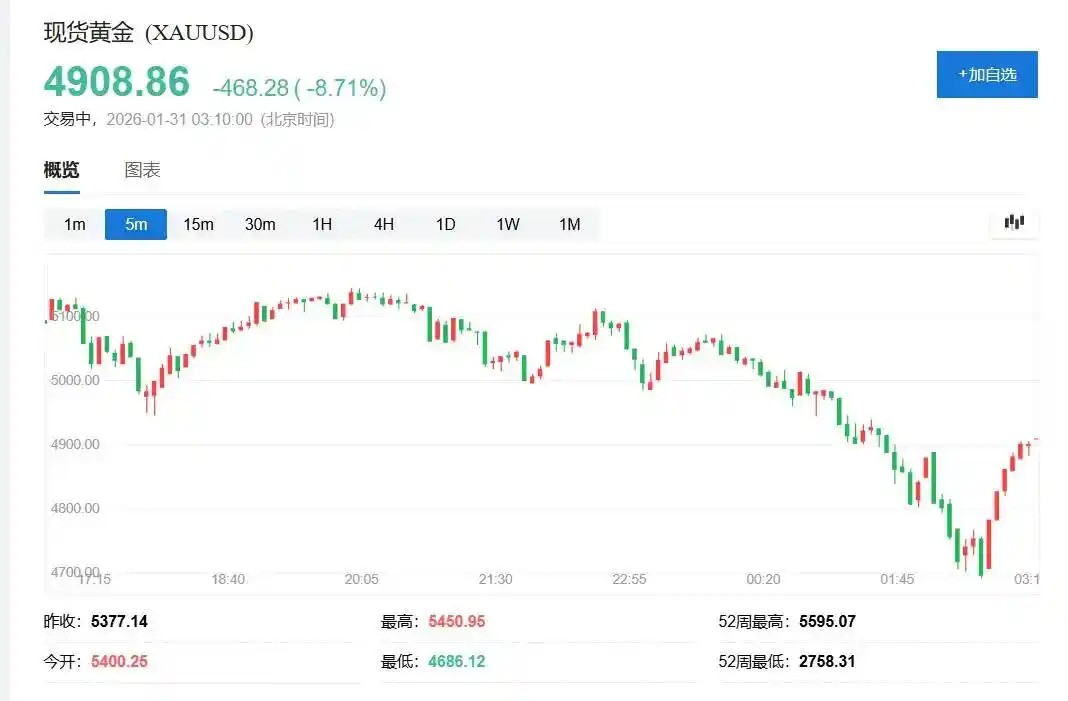
Gold and silver, which had both hit record intraday highs on Thursday, experienced a sharp decline. Gold turned lower early in the Asian session on Friday following news that Trump would nominate Warsh as Fed Chair, and had fallen below the $5,000/oz level during European trading. Losses accelerated during the US afternoon session, with spot gold at one point down nearly 13% intraday, its largest drop in over forty years since the early 1980s, exceeding the declines seen during the 2008 financial crisis.
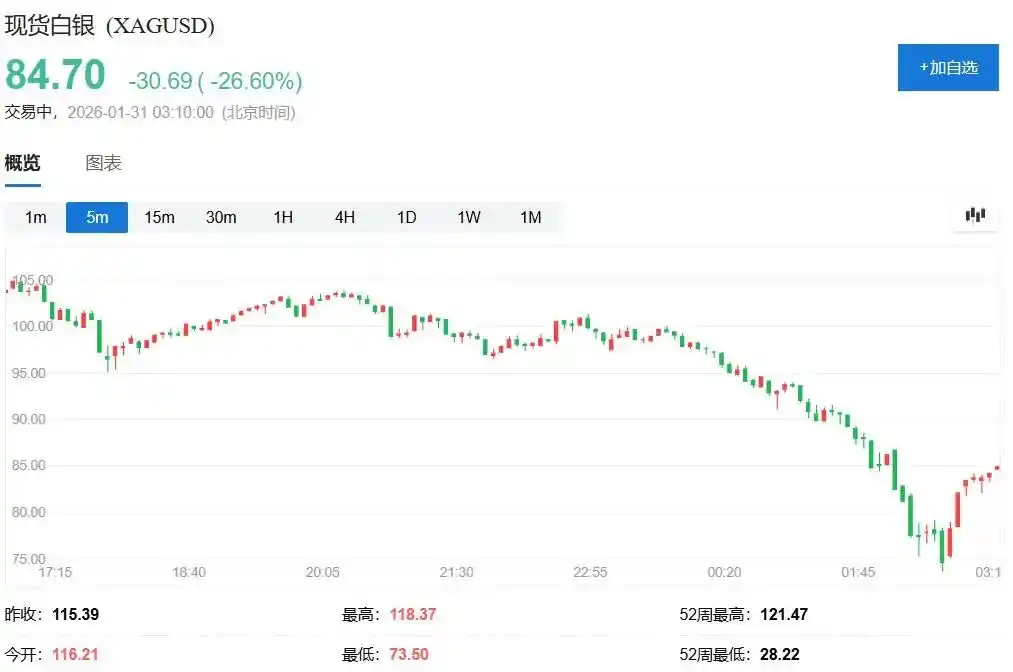
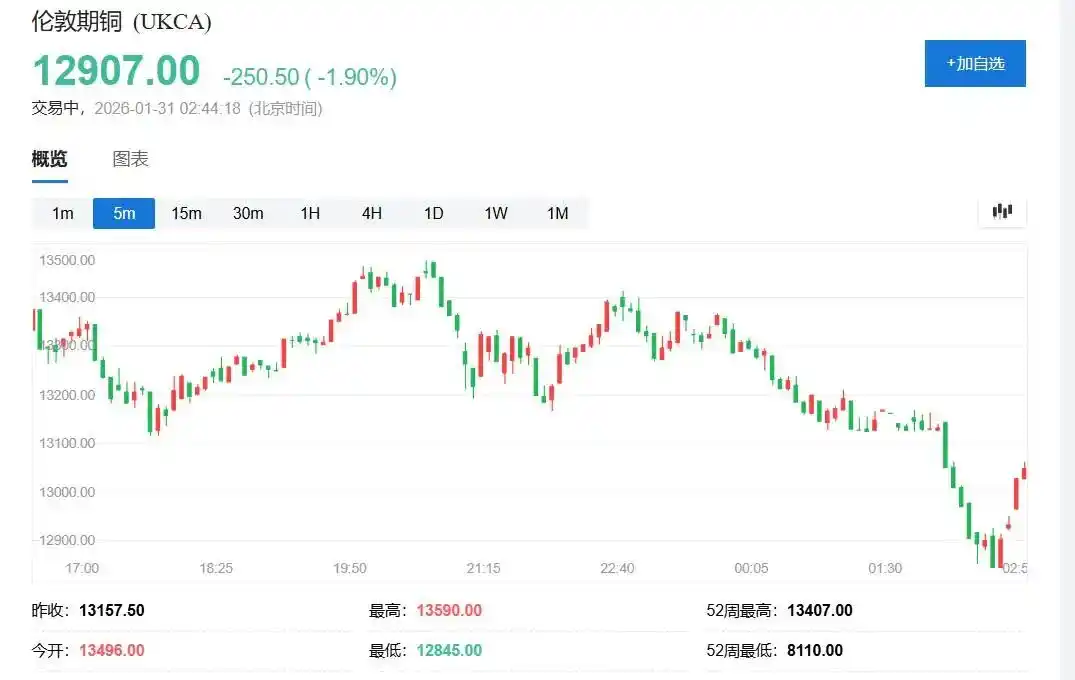
Silver, which broke above $120 for the first time ever on Thursday, fell below $100 during European trading on Friday and dropped below $80 during US session. Spot silver plummeted over 35% at one point, its largest recorded decline. This 'bloodbath' spread across the entire metals complex, with LME copper, which also hit a record high on Thursday, retreating nearly 6% at one point.
The market attributed the crash to a sharp shift in investor expectations regarding Fed policy.

Warsh has long been known for his hawkish stance, and although he recently publicly supported rate cuts to align with Trump, the market still believes he is unlikely to cut rates aggressively.

Commerzbank analyst Thu Lan Nguyen stated: "The market perceives Warsh as more hawkish than other candidates like Hassett." This expectation fueled a rebound in the US dollar, making dollar-denominated commodities less attractive to global buyers.

Warsh's nomination also alleviated market concerns about a loss of Fed independence.

Previously, investors flocked to precious metals for safety, partly due to fears of currency devaluation and concerns about Fed independence.

ING FX strategist Francesco Pesole said the choice of Warsh is "good news for the dollar, removing some concerns about a more dovish candidate."

The crash also exposed the extreme fragility of the precious metals market.

After the continuous surge in gold and silver prices recently, crowded long positions, record call option buying, and extreme leverage levels left the market in a state ripe for triggering a "gamma squeeze."

Pepperstone Senior Research Strategist Michael Brown stated: "The market was already very bubbly; it only took a small trigger to spark a move like this."

Historic Plunge for Gold and Silver

During the US afternoon session on Friday, the precious metals market staged a heart-stopping dive. The front-month NYMEX silver contract, after hitting a historic high of $121.785 on Thursday, fell below $80, touching $74 at one point, for an intraday drop of just over 35%. Spot silver fell below $74.60, down 35.5% on the day, its largest intraday decline on record.

Gold was also hit hard. NYMEX gold futures, which reached a historic high of $5,586.2 intraday on Thursday, fell to $4,714.5 during the US afternoon session on Friday, down nearly 12% on the day. Spot gold approached $4,670 during the US afternoon session, down over 12.7%.

By the close of COMEX floor trading, February gold futures settled down 11.37% at $4,713.9/oz, the largest single-day drop since January 22, 1980. February silver futures settled down 31.35% at $78.29/oz, the largest settlement decline since March 27, 1980.

Industrial metals were not spared. LME copper, which surged over 11% to a record high above $14,520 on Thursday, fell below $12,850 during Friday's session, down nearly 5.7% intraday, and settled about 3.4% lower at $13,158/ton. At the close, tin was down about 5.7%, while aluminum and nickel fell over 2%.
Fed Chair Pick Seen as Hawkish

The trigger for the market sell-off was the news of Warsh's nomination.

Reports emerged early in the Asian session on Friday that Trump would nominate Warsh as Fed Chair, and gold, which had set intraday record highs for nine consecutive sessions, immediately turned lower.

Before the US market open on Friday, Trump officially announced the nomination in a post on his social media platform, stating he has known Warsh for a long time, has no doubt he will rank among the great Fed Chairs, and might even be the best one.

Warsh was long known for his hawkish views but changed his tune last year, echoing Trump's calls for significant rate cuts, seen as key to his nomination.

Wall Street investors and strategists said Trump's choice of Warsh to lead the Fed is a relatively hawkish selection; he would likely resist balance sheet expansion, which would support the dollar and steepen the US Treasury yield curve.

Panmure Liberum analyst Tom Price said:

"The market sees Kevin Warsh as rational; he won't aggressively push for rate cuts. Those retail investors with various goals—like capital preservation—are taking profits."

Warsh's nomination fueled a major dollar rebound, with the currency posting its best single-day performance in six months since last July on Friday. The ICE US Dollar Index, which tracks the dollar against a basket of currencies, rose above 97.10 during the US afternoon session, up nearly 0.9% on the day. A stronger dollar makes dollar-denominated commodities less attractive to many global buyers and undermines theories that precious metals could replace the dollar as the global reserve currency.

Crowded Market Triggers "Stampede"

Although the Warsh nomination was the trigger for the sell-off, analysts widely believe technical factors amplified the decline.

Media reports suggest soaring prices and volatility had already put pressure on traders' risk models and balance sheets. A Goldman Sachs research note pointed out that the record wave of call option buying "mechanically reinforced the upward price momentum" because option sellers hedge their exposure by buying more futures.

Gold's decline may have been accelerated by a so-called "gamma squeeze." This refers to option dealers needing to buy more futures to keep their portfolios balanced when prices rise, and sell when prices fall.

For the SPDR Gold ETF, a large number of positions expiring on Friday were concentrated at $465 and $455, while a significant number of option positions on Comex for March and April were concentrated at $5300, $5200, and $5100.

Miller Tabak equity strategist Matt Maley said: "This is insane. Much of this is likely 'forced selling.' Silver has recently been the hottest asset for day traders and other short-term traders, so silver accumulated some leverage. With today's big drop, margin calls went out."

Pepperstone's Michael Brown noted, "Conditions in the metals market have been very bubbly for some time, and signs earlier this week suggested things were becoming completely disorderly." He stated that positioning in the gold and silver markets was "clearly extremely crowded on the long side, and volatility had increased to frankly absurd levels." In a market with such high volume and such stretched "leveraged longs," "it doesn't take much to trigger" a move like Friday's.

Brown said: "Simply put, everyone was rushing for the exit at the same time, forcing prices lower, which in turn triggered further forced selling," a reminder that "momentum works both ways."

Overseas-Chinese Banking Corp. strategist Christopher Wong said gold's move "validates the warning of 'fast up, fast down'." While the Warsh report was the trigger, he said a pullback was long overdue, "It's like one of those excuses the market was waiting for to unwind those parabolic moves."

Technical Indicators Had Warned Earlier

Before the crash, several technical indicators had flashed warning signals. The Relative Strength Index (RSI) had shown in recent weeks that gold and silver might be overbought and due for a pullback. Gold's RSI recently touched 90, its highest level for the precious metal in decades.

Heraeus Precious Metals trading head Dominik Sperzel said volatility was extremely extreme, and the psychological resistance levels of $5,000 and $100 were breached multiple times on Friday, "but we need to be prepared for the rollercoaster to continue."

Despite Friday's plunge, gold and silver still posted substantial gains for January. Based on the front-month contract settlement prices, NYMEX gold rose about 9% in January, and silver rose over 10%.

COMEX February gold futures gained 8.98% for January, the largest monthly gain in four months, marking six consecutive months of gains, the longest winning streak since October 2024. COMEX February silver futures gained 11.63% in January, rising for nine consecutive months, a record monthly winning streak. Over these nine months, they accumulated a gain of 140.66%, the largest nine-month gain since April 2011.

Commerzbank analysts wrote in a note on Friday that the extent of the pullback "suggests market participants were just waiting for an opportunity to take profits after the rapid price increases." The bank's head of commodity research, Thu Lan Nguyen, noted,

Although "the market perceives Warsh as more hawkish than other candidates like Hassett," "we still believe it is very likely that the Fed will yield to pressure to some extent and cut rates more than the market currently expects"

Mining Stocks Also Plunge

The precious metals crash dragged down shares of major mining companies. During Friday's session, US-listed gold mining giants Newmont (NEM), Barrick Gold (GOLD), and Agnico Eagle Mines (AEM) all fell over 10%, while Coeur Mining (CDE) dropped nearly 19% at one point.

Silver ETFs were hit even harder. During the session, ProShares Ultra Silver (AGQ) fell over 60% at one point, and iShares Silver Trust ETF (SLV) fell over 30% at one point, both funds recording their worst single-day performances on record. Gold ETFs also came under pressure.

Although mining stocks were battered on Friday, some analysts believe the pullback is healthy for the market. Amplify ETFs VP of Product Development Nate Miller said silver benefits from safe-haven and store-of-value demand, industrial demand, and global supply shortages, and some consolidation after such a sharp rally "is healthy and consistent with typical behavior in commodity markets following rapid price appreciation."

Zaner Metals VP and senior metals strategist Peter Grant said that while the rally did go too far too fast, it's not too late to buy metals. He called the drop below $100 an "opportunity," especially near the 20-day moving average around $93. However, "you have to be able to handle the volatility, which is likely to remain elevated."

Bloomberg Macro Strategist Simon White noted:

"The silver/gold (price) ratio had climbed almost as much as in the late 1970s, and today's dramatic move suggests this may mark a point of rejection. However, looking at gold and silver individually, they haven't yet fully matched the 1979 rally. It is too early to conclude whether silver relative to gold marks the end of the historic precious metals rally. Price is now becoming the main driver, with fundamentals temporarily taking a back seat."


Crypto di tendenza

Domande pertinenti

QWhat triggered the historic plunge in gold and silver prices?

AThe plunge was triggered by reports that former President Trump would nominate Kevin Warsh, known for his hawkish stance, as Federal Reserve Chair, leading to a shift in market expectations toward less aggressive interest rate cuts.

QHow much did silver prices drop during the sell-off?

ASilver prices plummeted by over 35% at one point, with spot silver falling below $74.60, marking the largest intraday decline on record.

QWhat technical factors amplified the decline in precious metals?

AThe decline was amplified by extreme leverage, crowded long positions, record call option purchases, and a 'squeeze' dynamic where forced selling accelerated the price drop.

QWhy was Kevin Warsh's nomination perceived as hawkish?

AWarsh was perceived as hawkish due to his historical stance against monetary easing, and although he recently supported rate cuts to align with Trump, markets believed he would resist aggressive easing policies.

QDid gold and silver still post monthly gains despite the crash?

AYes, gold futures rose about 9% in January, while silver futures gained over 11%, marking their sixth and ninth consecutive monthly gains, respectively.

Letture associate

Former CFTC Chairman, Circle President Tarbert: Preaching Long-Termism While Cashing Out $30 Million Himself

Former CFTC Chairman and Circle President Heath Tarbert has consistently advocated for a long-term vision in public, urging patience from investors as Circle’s stock price has fallen significantly from its peak. However, it has been revealed that since Circle’s IPO, Tarbert has continuously sold his CRCL shares through pre-arranged trading plans, cashing out approximately $30 million, without making any public market purchases. This contrast between his public messaging and personal actions has drawn criticism. Tarbert joined Circle in July 2023 as Chief Legal Officer, leveraging his regulatory experience to help guide the company through its IPO and expansion. Despite promoting stablecoins as long-term infrastructure, he established a 10b5-1 trading plan just before Circle went public, leading to substantial stock sales over the following year. In March 2026, he initiated another plan to sell more shares. His career trajectory highlights a pattern of moving between high-level regulatory roles and influential positions in the financial sector. After resigning as CFTC Chairman in early 2021, he joined Citadel Securities as Chief Legal Officer just 27 days later, during a period of intense regulatory scrutiny for the firm. He later joined Circle, aiding its efforts to navigate regulatory challenges for its public listing. While Tarbert's expertise in policy and compliance is valuable to companies like Circle, his actions—advocating long-term confidence while personally divesting—raise questions about the alignment between his public statements and his private financial decisions, leaving investors who followed his advice to bear the market risks.

marsbit8 min fa

Former CFTC Chairman, Circle President Tarbert: Preaching Long-Termism While Cashing Out $30 Million Himself

marsbit8 min fa

Gate Research Institute: The 'Wall Street-ization' Wave of Crypto Financial Products – Competition or Integration?

The article titled "Gate Research Institute: Are Crypto Financial Products Sparking a 'Wall Street' Wave—Competition or Convergence?" explores the evolving relationship between the crypto ecosystem and traditional finance (TradFi). The piece begins by reflecting on Bitcoin's original 2009 vision of decentralization, disintermediation, and moving away from banks. It then contrasts this with the 2024 landscape, where key crypto assets like Bitcoin are increasingly held through Wall Street products like ETFs issued by giants like BlackRock. The article questions whether this signifies that TradFi is systematically taking over the rights to issue, price, custody, and distribute crypto financial assets. The core argument is that this is not a zero-sum takeover but rather a bidirectional convergence where each side addresses the other's weaknesses. Crypto offers 24/7 global markets, programmable settlement, and open access but lacks compliant channels, institutional-grade custody, deep fiat liquidity, and mainstream distribution. TradFi possesses these but is constrained by legacy systems, limited operating hours, and slow settlement. Two primary convergence paths are highlighted: * **Path A (CEX to TradFi):** Exemplified by Gate, which has progressed from offering tokenized stocks and CFDs to providing direct, real stock trading (US, Hong Kong, South Korea) within its platform, using USDT. * **Path B (TradFi to Crypto):** Exemplified by Robinhood, which has integrated crypto trading, acquired exchanges like Bitstamp, and is moving traditional assets like stocks onto the blockchain via tokenization and its own Layer 2. Both paths are ultimately competing to become the next-generation, unified financial account—a "super account" where users can seamlessly trade cryptocurrencies, stocks, ETFs, RWA (Real World Assets), and tokenized treasury products in one interface. The growth of RWA and tokenized treasuries (e.g., BlackRock's BUIDL) is presented as the asset-layer fusion, providing stable, yield-bearing assets on-chain and acting as a bridge between the two worlds. In conclusion, the "Wall Street-ization" of crypto is framed as a mutual transformation. Decentralized ideals persist in the protocol layer, while at the application layer, a more efficient, global, and accessible unified capital market is emerging from this convergence. The future competition lies not between crypto exchanges and stockbrokers, but between platforms vying to offer the most comprehensive asset coverage, liquidity, and user experience within a single account.

marsbit12 min fa

Gate Research Institute: The 'Wall Street-ization' Wave of Crypto Financial Products – Competition or Integration?

marsbit12 min fa

Claude's Major New Feature: Screen Recording + Voice, Distilling Your Skills into AI Tasks in One Click

Claude has introduced a major new feature called "Record a Skill," available for Pro, Max, and Team users. This function, found in the Claude desktop app's CoWork menu, allows users to create reusable AI skills simply by recording their screen and providing voice narration while performing a task. Claude then automatically analyzes the recording and generates a functional Skill. A hands-on test confirmed the feature works seamlessly. Users start recording via the Skills manager, perform their workflow while verbally explaining the steps and logic, and avoid including sensitive information. After recording, Claude processes the content and creates the Skill, which can be saved and later invoked with a slash command (/). This eliminates the need for manual adjustments or writing complex instruction files. The innovation goes beyond mere efficiency. Previously, creating a Skill required writing a detailed SKILL.md file in Markdown—a significant barrier for non-technical users. "Record a Skill" bypasses this by directly capturing both actions and the implicit reasoning shared in the narration. This lowers the barrier to knowledge transfer and automation, addressing a core challenge in corporate knowledge management: the difficulty of getting experts to write and maintain documentation. However, the feature also highlights a shift in the nature of work. A case study from March 2026 showed a freelancer whose five-year client relationship was effectively replaced by a hand-coded Claude Skill automating their content workflow. With the even lower barrier of screen recording, the ability to distill personal expertise into automatable skills accelerates this trend. The "moat" for work is moving from simply knowing how to do a task to mastering tasks that are difficult or impossible to automate.

marsbit16 min fa

Claude's Major New Feature: Screen Recording + Voice, Distilling Your Skills into AI Tasks in One Click

marsbit16 min fa

Feeding AI "Noise" Can Also Boost Scores, This Work Enables Positive Transfer with Noise

Feeding "Noise" to AI Can Improve Performance: A Method Enables Positive Transfer from Noise This work, Semi-Supervised Noise Adaptation (SSNA), introduces a Noise Adaptation Framework (NAF) that challenges traditional transfer learning. Instead of requiring a labeled source domain of real data (e.g., images, text), NAF uses randomly generated Gaussian noise as the source. For a target task with C classes, it constructs C noise clusters by sampling from Gaussian distributions. Although this synthetic noise contains no semantic meaning, NAF trains it to form a discriminative class structure in a shared representation space—clustering same-class noise and separating different classes. The key is aligning this learned structure from the noise domain to the real, sparsely labeled target domain. A small number of target labels are still essential to establish the correspondence between noise clusters and actual classes. The training objective combines: 1) supervised loss on the few labeled target samples, 2) classification loss for the noise to build its structure, and 3) a distribution alignment loss (using Negative Domain Similarity) to minimize the gap between the noise and target domains in the shared space. Experiments show significant gains in few-label settings. With just 4 labels per class, NAF with a ResNet-18 backbone improves accuracy over a standard supervised baseline (ERM) by +12.35% on CIFAR-10, +7.61% on CIFAR-100, +4.38% on DTD-47, and +2.74% on Caltech-101. It also benefits fine-grained datasets and scales to ImageNet-1K (with 100 labels/class) and text classification (AG News). NAF can be integrated into existing semi-supervised methods like FixMatch for further gains. Ablation studies confirm the transferred benefit comes from the discriminative structure of the noise, not randomness itself. Collapsing all noise into a single point causes negative transfer, while increasing separation between noise cluster centers improves performance. The amount of noise per class is less critical once a basic structure forms. In conclusion, this work demonstrates that for positive transfer, the semantic content of source data may not be necessary. What can be effectively transferred is the *organizational structure* of categories within a representation space. This offers a promising alternative for scenarios where real source data is unavailable due to privacy, copyright, or procurement constraints.

marsbit18 min fa

Feeding AI "Noise" Can Also Boost Scores, This Work Enables Positive Transfer with Noise

marsbit18 min fa

Trading

Spot

Articoli Popolari

Come comprare EPIC

Benvenuto in HTX.com! Abbiamo reso l'acquisto di Epic Chain (EPIC) semplice e conveniente. Segui la nostra guida passo passo per intraprendere il tuo viaggio nel mondo delle criptovalute.Step 1: Crea il tuo Account HTXUsa la tua email o numero di telefono per registrarti il tuo account gratuito su HTX. Vivi un'esperienza facile e sblocca tutte le funzionalità,Crea il mio accountStep 2: Vai in Acquista crypto e seleziona il tuo metodo di pagamentoCarta di credito/debito: utilizza la tua Visa o Mastercard per acquistare immediatamente Epic ChainEPIC.Bilancio: Usa i fondi dal bilancio del tuo account HTX per fare trading senza problemi.Terze parti: abbiamo aggiunto metodi di pagamento molto utilizzati come Google Pay e Apple Pay per maggiore comodità.P2P: Fai trading direttamente con altri utenti HTX.Over-the-Counter (OTC): Offriamo servizi su misura e tassi di cambio competitivi per i trader.Step 3: Conserva Epic Chain (EPIC)Dopo aver acquistato Epic Chain (EPIC), conserva nel tuo account HTX. In alternativa, puoi inviare tramite trasferimento blockchain o scambiare per altre criptovalute.Step 4: Scambia Epic Chain (EPIC)Scambia facilmente Epic Chain (EPIC) nel mercato spot di HTX. Accedi al tuo account, seleziona la tua coppia di trading, esegui le tue operazioni e monitora in tempo reale. Offriamo un'esperienza user-friendly sia per chi ha appena iniziato che per i trader più esperti.

218 Totale visualizzazioniPubblicato il 2025.03.17Aggiornato il 2026.07.21

Come comprare EPIC

Discussioni

Benvenuto nella Community HTX. Qui puoi rimanere informato sugli ultimi sviluppi della piattaforma e accedere ad approfondimenti esperti sul mercato. Le opinioni degli utenti sul prezzo di EPIC EPIC sono presentate come di seguito.

活动图片