Global Wealth Report: US Produces 36 New Millionaires Daily, India Emerges as Fastest-Growing Dark Horse

marsbitPubblicato 2026-04-25Pubblicato ultima volta 2026-04-25

Introduzione

Knight Frank's "The Wealth Report 2026" highlights the rapid expansion of global private wealth. Between 2021 and 2026, the number of ultra-high-net-worth individuals (UHNWIs), those with over $30 million, increased by 162,191 to 713,626—averaging 89 new millionaires daily. The United States led this growth, contributing 41% of all new UHNWIs and increasing its global share from 33% to 35%. China remains the second-largest wealth hub, though its share declined from 18% to 17%. India emerged as a standout, with a 63% surge in UHNWIs. Regionally, North America dominates with 37% of UHNWIs, followed by Asia-Pacific (31%) and Europe (25%). The Middle East also saw significant growth. Future growth is expected from rapidly maturing economies like Indonesia, Saudi Arabia, and Poland.

Author: Knight Frank

Compiled by: Felix, PANews

Global private real estate advisory firm Knight Frank recently released the "2026 Wealth Report," highlighting the rapid expansion of global private wealth and dynamic changes in its geographical distribution. PANews has summarized the core content of the report.

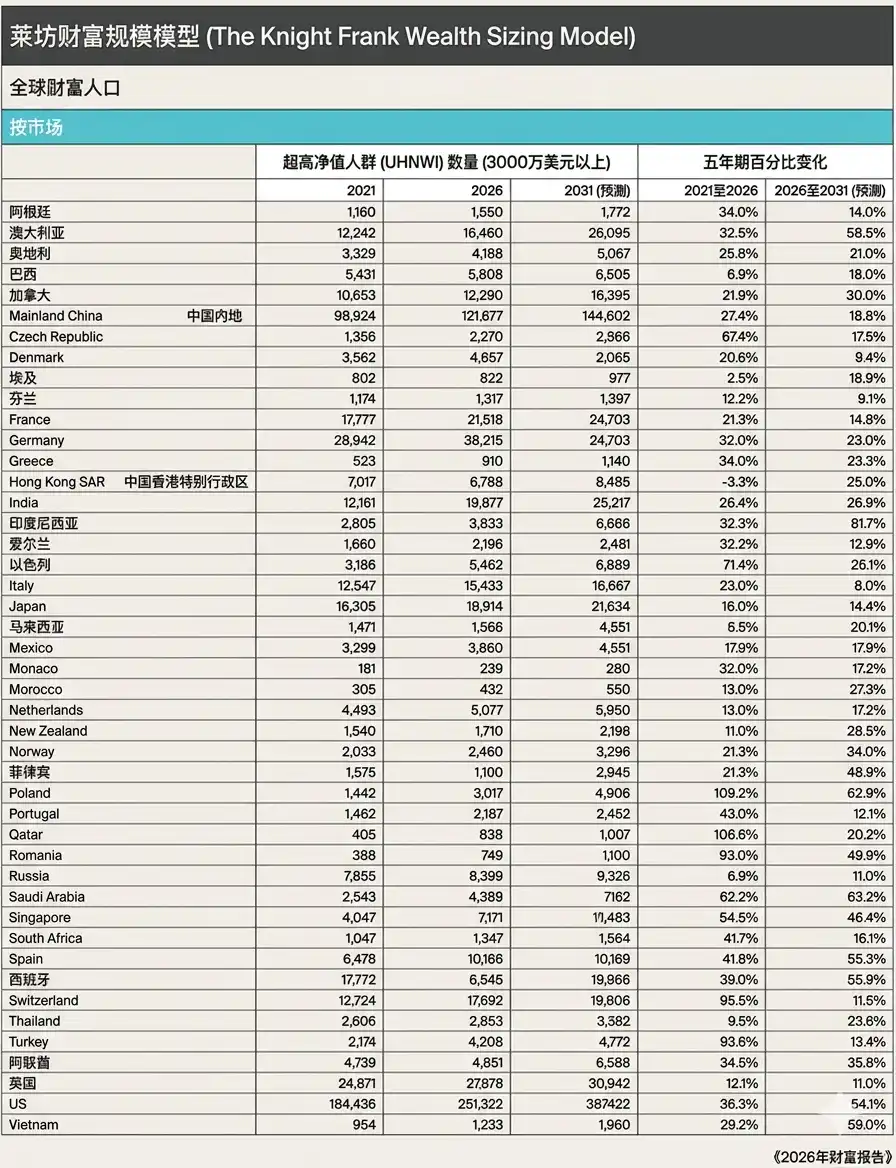
The report shows that between 2021 and 2026, the number of global ultra-high-net-worth individuals (with wealth exceeding $30 million) increased from 551,435 to 713,626, adding 162,191 new ultra-high-net-worth individuals over five years, or an average of 89 people per day breaking through the $30 million wealth threshold.

The United States led this wealth growth. During this period, 41% of all new ultra-high-net-worth individuals came from the U.S. The U.S. share of global ultra-high-net-worth individuals steadily increased from 33% in 2021 to 35% in 2026. By 2031, the U.S. is projected to account for 41% of the world's ultra-high-net-worth individuals.

China remains the world's second-largest wealth creation center, although its relative position is declining. China's share of global ultra-high-net-worth individuals fell from 18% in 2021 to 17% in 2026 and is expected to drop further to 15% by 2031. In fact, almost all countries are losing their global market share to accommodate the continued growth of U.S. wealth.

India is a counterexample. Between 2021 and 2026, its number of ultra-high-net-worth individuals (over $30 million) surged by 63%, from just over 12,000 to nearly 20,000. India's share of global ultra-high-net-worth individuals is only 2.8%, up from just over 2% five years ago. By 2031, the number of ultra-high-net-worth individuals in India is expected to increase from the current 19,877 to 25,217.

Australia holds a position in the global wealth landscape that far exceeds its size. Over the next five years, its number of ultra-high-net-worth individuals is expected to grow by nearly 60%, reaching 26,095, accounting for almost one-thousandth of its total population. Australia has a large number of billionaires, which is projected to grow by 77% between 2026 and 2031.
By region, the global wealth landscape is dominated by three major areas.

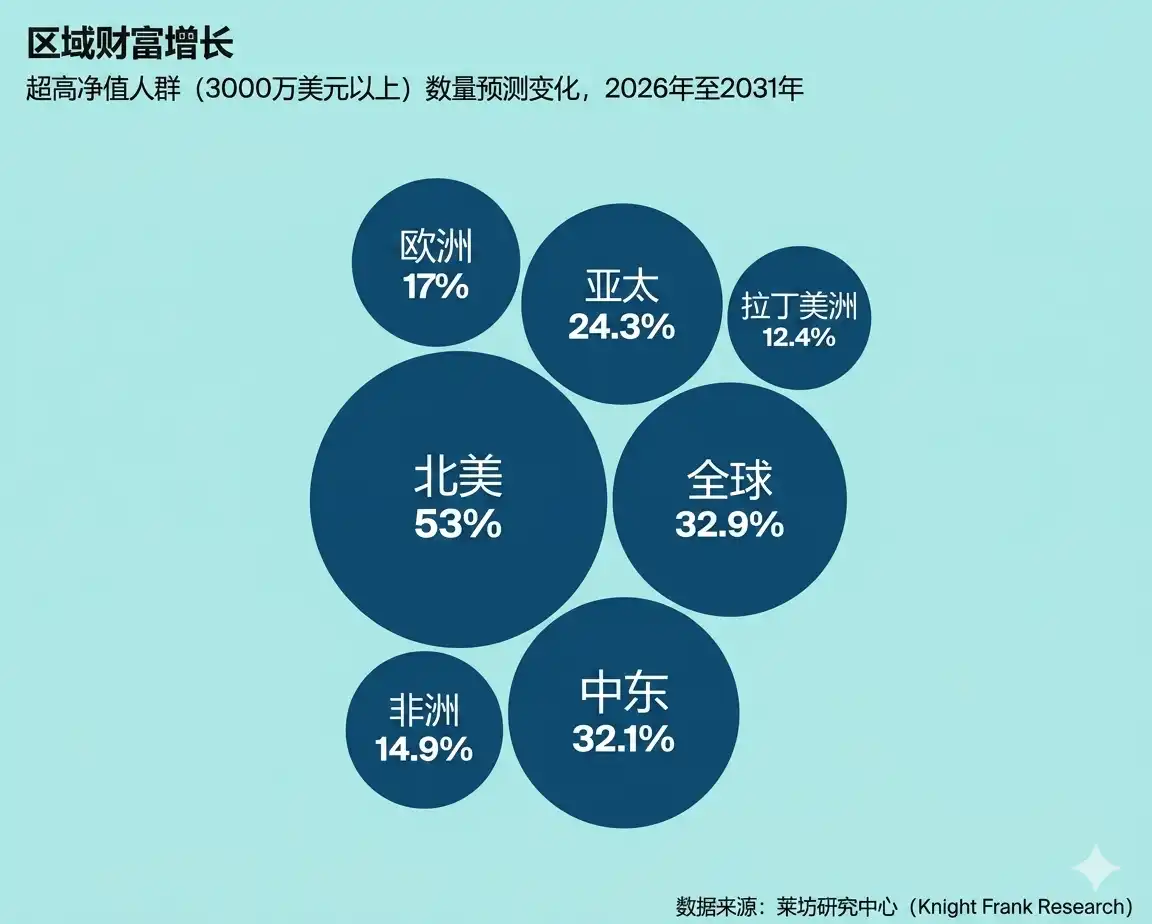
North America leads, accounting for 37% of global ultra-high-net-worth individuals in 2026. The Asia-Pacific region accounts for nearly 31% of ultra-high-net-worth individuals in 2026. Europe follows closely, with 183,953 super-rich, representing about a quarter of the global total. Beyond these regions, the Middle East stands out. Over the past five years, the Middle East's share of global millionaires increased from 2.4% to 3.1%.
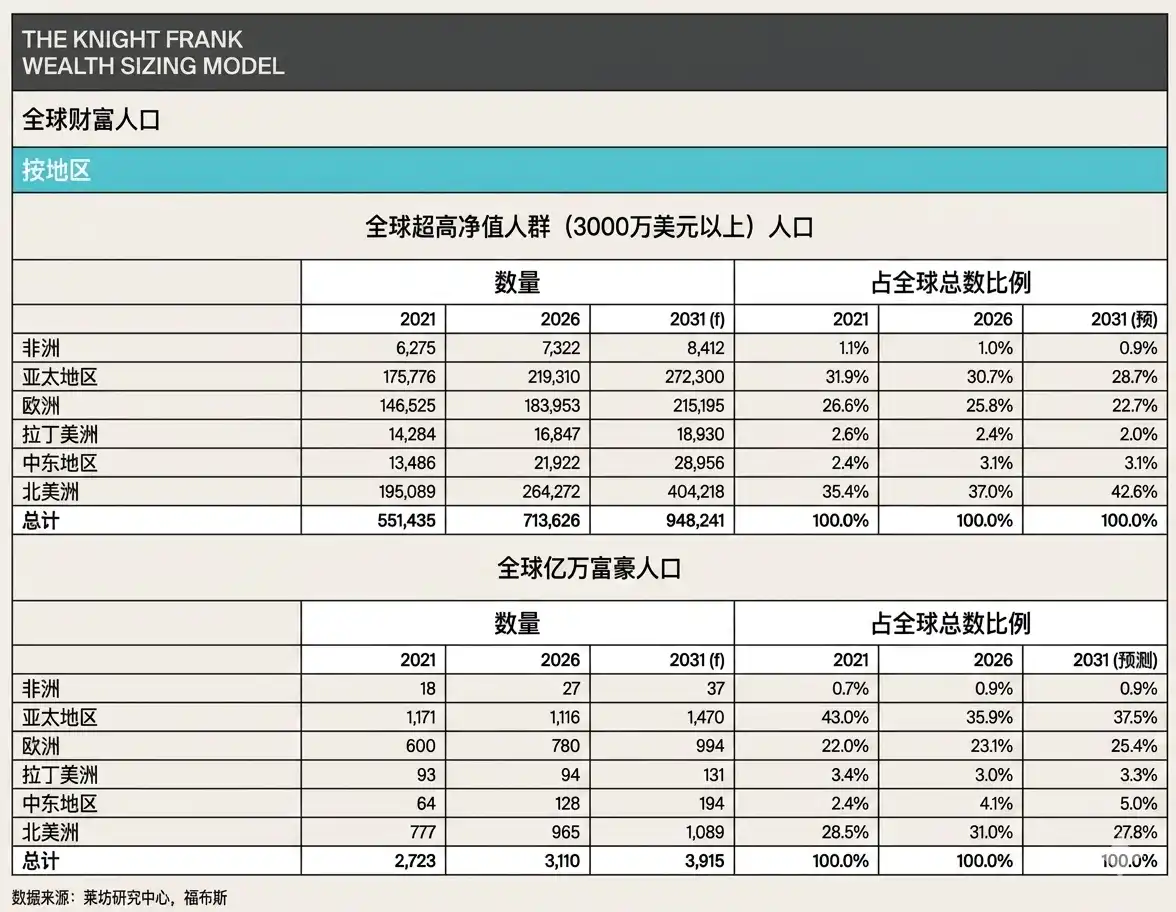
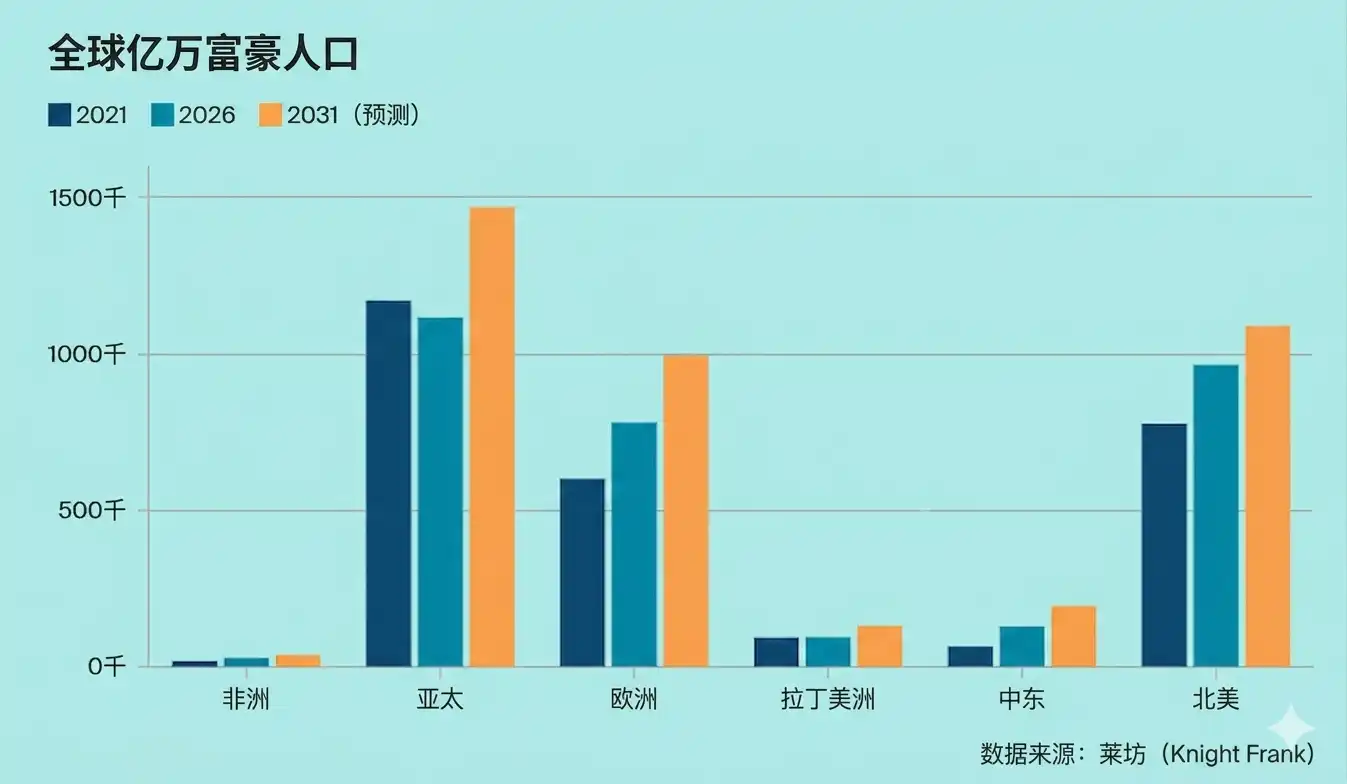
Additionally, the geographical distribution of the world's 3,110 billionaires is more dispersed than the broader ultra-high-net-worth individual group. The Asia-Pacific region has the most billionaires, with 1,116, followed by North America with 965. The Middle East accounts for just over 4% of the world's billionaires, significantly higher than its share of ultra-high-net-worth individuals.

Looking ahead, billionaire growth is expected to be highly geographically diverse. In percentage terms, Saudi Arabia is projected to lead, with its number of billionaires growing by 183%, followed by Poland (123%), Sweden (81%), and Australia (77%). This highlights the increasingly global trend of future billionaire growth.

Over the next five years, the growth of global ultra-high-net-worth individuals will not be led by traditional economies but by some rapidly maturing economies. Indonesia tops the list, with its number of ultra-high-net-worth individuals (over $30 million) expected to surge by 82% by 2031. It is followed by Saudi Arabia and Poland, both with growth rates exceeding 60%. Vietnam's nearly 60% growth highlights the rapid rise of emerging wealth centers in Southeast Asia.

Europe also shows strong performance, with Sweden, Romania, and Greece all achieving significant growth. Although wealth remains concentrated in a few global economic powerhouses, its geographical distribution is expanding.
Related reading: California to 'Harvest' 5% from Billionaires in One Go? Some Are Moving Overnight


Domande pertinenti

QAccording to Knight Frank's report, how many new ultra-high-net-worth individuals (UHNWIs) were added globally between 2021 and 2026, and what was the daily average?

ABetween 2021 and 2026, 162,191 new ultra-high-net-worth individuals (with wealth exceeding $30 million) were added globally, which is an average of 89 people per day.

QWhich country was the dominant force in global wealth creation, contributing the largest share of new UHNWIs, and what is its projected share by 2031?

AThe United States was the dominant force, contributing 41% of all new UHNWIs. Its share of the global UHNWI population is projected to rise to 41% by 2031.

QIndia is highlighted as a standout performer. What was the percentage growth of its UHNWI population from 2021 to 2026?

AIndia's ultra-high-net-worth individual population surged by 63% between 2021 and 2026.

QWhich three regions currently dominate the global wealth landscape in terms of UHNWI concentration, and what are their respective shares?

AThe three dominant regions are North America (37% of global UHNWIs in 2026), the Asia-Pacific region (nearly 31%), and Europe (about 25%).

QWhich country is expected to have the highest percentage growth in its billionaire population, according to the future projections in the report?

ASaudi Arabia is expected to lead in billionaire growth, with a projected increase of 183%.

Letture associate

Fei-Fei Li's Team Clarifies the Concept of 'World Models', Sora Merely a Renderer

"World Models" has become a widely used yet confusing term in AI. To address this, a team led by Fei-Fei Li and World Labs proposed a functional taxonomy based on the Partially Observable Markov Decision Process framework. This taxonomy categorizes systems called "world models" into three distinct projections: Renderers, Simulators, and Planners. Renderers, like OpenAI's Sora and other video generation models, focus on producing photorealistic visual outputs for human perception. They prioritize visual fidelity over physical accuracy. Simulators, such as NVIDIA Omniverse, aim to compute precise future environmental states for computational tasks like engineering analysis or digital twins. Planners, like Vision-Language-Action models, take in observations and goals to output executable actions for robots or agents. The article clarifies that most current "world models," including Sora, are primarily Renderers. They generate convincing visuals but lack the core ability to simulate state transitions based on actions, a key requirement for a true world model in classic reinforcement learning definitions. This conceptual confusion has practical implications, leading to potential misalignment in technology selection, investment, and public understanding of AI capabilities. Clear categorization is crucial. It helps enterprises avoid costly mistakes (e.g., using a renderer for robot training), allows investors to accurately assess markets, and enables researchers to build comparable benchmarks. While future systems may integrate these functions, recognizing current boundaries is essential for honest assessment and progress.

marsbit1 h fa

Fei-Fei Li's Team Clarifies the Concept of 'World Models', Sora Merely a Renderer

marsbit1 h fa

Trading

Spot
Futures
活动图片




