Global Top 10 Assets Reshuffle in 2025: Why Has Bitcoin Lost Its Shine?

marsbitPubblicato 2026-01-05Pubblicato ultima volta 2026-01-05

Introduzione

In 2025, global asset markets experienced significant shifts, with traditional hard assets like gold and silver dominating while Bitcoin underperformed. Gold surged over 65% to approximately $43,100 per ounce, reaching a theoretical market cap of $30 trillion, while silver rose 150% to $72, driven by geopolitical tensions, inflation, and industrial demand from AI and solar sectors. Major AI-related tech stocks like Nvidia and TSMC saw solid gains but entered a consolidation phase. Bitcoin, despite briefly hitting $126,000 mid-year, ended 2025 around $88,000 with an 8% annual loss—marking its first negative post-halving year. Key factors included macro liquidity tightening, increased correlation with equities, large-scale selling by long-term holders, excessive leverage unwinding ($30 billion in derivatives), and slowing institutional inflows, especially from ETFs in Q4. Looking ahead to 2026, analysts remain broadly optimistic. Institutions like J.P. Morgan, Standard Chartered, and Bernstein project targets between $140,000 and $170,000, citing potential ETF-driven demand, regulatory clarity, and macro improvements. However, skeptics like Bloomberg’s Mike McGlone warn of a possible drop to $50,000 or lower due to speculative risks. Overall, 2026 is seen as a potential rebound year for Bitcoin, contingent on macro conditions and institutional adoption.

Author:zhou, ChainCatcher

2025 was a year of dramatic divergence in the global asset markets.

Geopolitical conflicts, recurring inflation,AI technology breakthroughs, and massive central bank purchases drove a strong comeback for traditional hard assets, while cryptocurrencies came under pressure in the tug-of-war between institutional expectations and macroeconomic realities.

2025 Changes in the Global Top 10 Assets: Gold Dominates, Silver Rises, Bitcoin Rallies Then Falls

According to CompaniesMarketCap data, the ranking of the global top 10 assets in2025 showed profound structural adjustments. Gold led the pack with a theoretical market cap of approximately $30 trillion, while silver's market cap approached $4 trillion, securing a spot in the top three. Tech stocks occupied the middle of the rankings, while Bitcoin's market cap was around $1.8 trillion, slipping to eighth place.
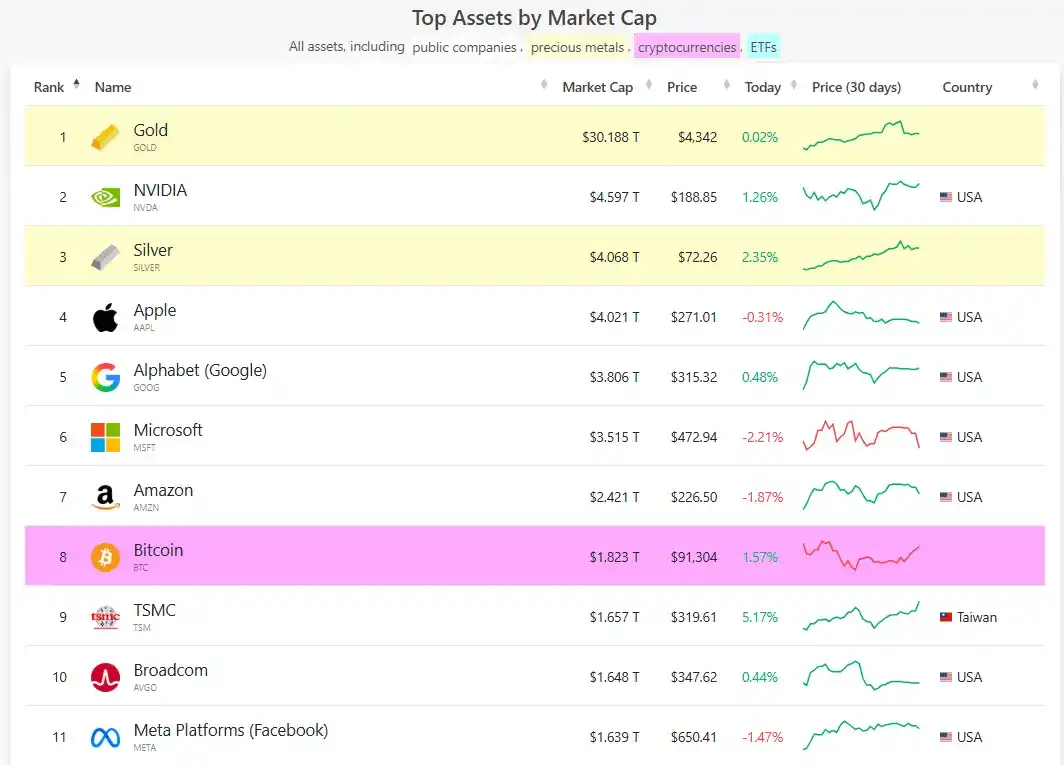

Hard Assets Gold and Silver Dominated the Year's Narrative

As the king of safe havens, the gold price soared from $2,630 at the beginning of the year to $4,310 by year-end, a gain of over65% , the largest in46 years. Driven by central bank purchases and geopolitical避险, its market cap nearly doubled and crushed the combined value of all listed companies. Silver became the year's biggest dark horse, its price surging from $29 at the start of the year to $72, a150% gain that far outpaced gold. Beyond its safe-haven属性, explosive growth in industrial demand from photovoltaics andAI computing power propelled silver from a peripheral asset强势into the global top three.

AI -Related Tech Stocks Were Strong But Entered a Digestion Phase

NVIDIA, as the chip leader, saw its market cap grow30% to $4.6 trillion, briefly surpassing the $5 trillion mark during the year. TSMC and Broadcom benefited from computing power demand, with their market caps both rising from $1 trillion to $1.6 trillion, gains of around60%. Although the AI sector overall hit record highs, the growth rate became more moderate, reflecting a more cautious market assessment of productivity realization.

Bitcoin Rallied Then Fell, Relatively Weak

Although Bitcoin briefly surged to $126,000 mid-year, with its market cap temporarily breaking into the global top five, a flash crash and volatility in the fourth quarter brought its year-end price back to around $88,000. With a negative return of approximately8% for the year, this marked the first time Bitcoin recorded a negative return in the year following a halving cycle.

Legacy Tech Giants Performed Steadily But Largely Lacked Explosiveness

Alphabet recorded a52% gain thanks to the integration of Gemini AI, its market cap rising to $3.8 trillion. The gains for Amazon, Microsoft, and Apple ranged between14% and33% . Although they maintained dominance in search, cloud computing, and consumer electronics, overall growth had significantly slowed.Meta saw its market cap increase to $1.67 trillion, driven by its Llama model and record engagement on its social platforms, fiercely competing with Broadcom for the tenth spot at year-end.

It is worth noting that in the 2025 asset ranking reshuffle, several traditional giants were squeezed out of the top ten. Among them, Eli Lilly, which had previously led due to the weight-loss drug boom, saw its gains slow due to the siphoning effect of the AI theme, falling to around 15th place. Additionally, companies like Tesla and Saudi Aramco were接近or briefly entered the top ten early in the year but fell to positions 15-20 by year-end, affected by intensified EV competition, oil price volatility, and the explosive growth of tech/precious metal assets. These changes highlight the structural shift of global capital towards AI computing infrastructure and hard asset避险demand.

Overall, the turning point in the global asset market in 2025 was the suppression of tech stocks by the market cap of hard assets. Tech stocks faced bubble concerns at historical highs, while Bitcoin experienced a shift from狂热to fatigue in its high-open, low-close performance, becoming a relative loser for the year.

Why Did Bitcoin Underperform? Narrative Shift from狂热to Fatigue

Bitcoin's performance in 2025 was typically characterized by a rise followed by a fall. At the beginning of the year, driven by pro-crypto policy expectations, massive institutionalETF inflows, and macro easing policies, its price started from the $90,000 level and reached a historical high of $126,000 in October, with its market cap briefly exceeding $2.4 trillion.

However, the situation changed急剧in the fourth quarter, with a severe flash crash pushing the price down to a low of $84,000. Bitcoin最终closed the year at around $88,000, recording a negative return of approximately8% . Compared to gold's70% and silver's over140% gains, Bitcoin's relative weakness reflected its vulnerability in a complex macro environment.

This performance was caused by multiple factors.

First, macro liquidity tightening and pressure from capital reallocation. The Fed's pace of interest rate cuts in the second half of the year fell short of expectations, coupled with the Bank of Japan maintaining its hiking stance, leading to tighter global liquidity. Capital was forced to withdraw from high-volatility assets and flow into safe-haven assets like gold and silver or productivity-oriented equity markets. Meanwhile, Bitcoin's correlation with US stocks surged from0.23 at the beginning of the year to over0.86 by year-end, gradually losing its appeal as an independent allocation asset.

Second, selling by long-term holders and leverage liquidation amplified market volatility. In 2025, the old whale group sold a record1.6 million Bitcoins, creating sustained selling pressure. The flash crash on October 10th wiped out months of gains in a very short time, triggering a chain reaction in the derivatives market.Matrixport pointed out that since the阶段性high in October 2025, nearly $30 billion in leverage corresponding to the open interest规模of BTC and ETH futures has been liquidated. Over-leveraging made it difficult for the market to quickly restore confidence after the暴跌.

Furthermore, the slowdown in institutional adoption progress further exacerbated the downward pressure. Although BitcoinETF maintained net inflows for the year, tens of billions of dollars were withdrawn in the fourth quarter. The strength of corporate acquisitions was also significantly limited. As the stock prices of some companies holding digital assets (DAT) fell, the market saw阶段性Bitcoin selling行为. The cooling of institutional sentiment directly suppressed market performance at year-end, preventing Bitcoin from continuing its past glory in 2025.

Bitcoin's Future?

Although Bitcoin recorded a negative return in 2025 and broke the traditional four-year cycle expectation, consensus at the institutional level remains optimistic. The market generally believes that this year's deep adjustment is paving the way for a more sustainable, institutionally-driven bull market in the future.

As 2026 arrives, with gradual improvement in global macro liquidity and further clarification of the regulatory environment, Bitcoin is expected to end the current period of震荡and return to a growth trajectory, potentially even challenging new historical levels.

According to summaries from various media, current public predictions show that analysts likeTom Lee, Standard Chartered, and Bernstein are generally bullish, but there are divergences.

Mainstream price targets mostly fall between $140,000 and $170,000, for example:

J.P. Morgan , based on a volatility-adjusted gold ratio model, calculated a theoretical fair value of approximately $170,000, believing Bitcoin still has significant upside potential.

Standard Chartered and Bernstein set their year-end 2026 targets at around $150,000, emphasizing structural support from ETF inflows, slowed corporate treasury adoption, and the long-term inflow of institutional capital will dominate the cycle.

Grayscale defines 2026 as the dawn of the institutional era, expecting Bitcoin to set new historical highs in the first half of the year, ending the traditional four-year cycle and shifting to a steady uptrend driven by sustained institutional demand.

Bitwise believes ETFs will absorb over 100% of the new supply, further strengthening price support, and predicts 2026 will belong to the bulls. Citi's baseline scenario is $143,000, with a bull scenario reaching $189,000.

Beyond these mainstream views, there are more激进perspectives. For example,Cardano founder Charles Hoskinson expects the Bitcoin price to reach $250,000, citing the powerful thrust from Bitcoin's fixed supply and growing institutional demand.

However, there are also significant bearish voices.Bloomberg Intelligence 's Mike McGlone is the most pessimistic, suggesting that in a deflationary macro environment, Bitcoin could fall back to $50,000 or even $10,000, particularly emphasizing the mean reversion risk faced by speculative assets.

Matrixport believes 2026 will be a year of high volatility rather than a smooth trend. Influenced by the Fed leadership transition, a疲软labor market, and election-year policy risks, the market will face密集risk event windows. The firm提醒investors to maintain flexibility and actively manage positions, precisely把握market exposure around key policy events.

Overall, although预测data shows significant divergence, mainstream institutions generally agree that 2026 will be a year of structural rebound for Bitcoin.ETF as a permanent demand engine, regulatory clarity, and accelerated corporate/institutional allocation will be the core catalysts. In the short term, the Bitcoin price may bottom out in the $80,000 to $100,000 range, but the probability of an upward breakout is significantly increasing as the macro environment turns and capital flows back.

Click to learn about open positions at ChainCatcher

Domande pertinenti

QWhat were the top three assets by market capitalization in 2025, according to the article?

AAccording to the article, the top three assets by market capitalization in 2025 were: 1. Gold (with a theoretical market cap of approximately $30 trillion), 2. Silver (approaching $4 trillion), and 3. Nvidia (with a market cap of $4.6 trillion).

QWhy did Bitcoin underperform in 2025, recording a negative return for the year?

ABitcoin underperformed due to several factors: a tightening of global macro liquidity leading to capital outflows from high-volatility assets, record selling by long-term holders ('whales') creating supply pressure, a flash crash in Q4 that triggered massive liquidations in the derivatives market, and a slowdown in institutional adoption with net outflows from Bitcoin ETFs in the fourth quarter.

QWhat was the primary reason for the massive surge in the price and market cap of silver in 2025?

AThe massive 150% surge in silver's price was driven not only by its safe-haven属性 but also by explosive growth in demand from the photovoltaic (solar) industry and AI computing power, which are industrial uses for the metal.

QWhat is the general consensus among major institutional analysts (like J.P. Morgan, Standard Chartered) regarding Bitcoin's price target for 2026?

AThe general consensus among major institutional analysts is optimistic, with mainstream price targets for the end of 2026 falling in the range of $140,000 to $170,000. They cite reasons such as continued ETF inflows, clearer regulations, and long-term institutional capital adoption as key catalysts.

QWhich analyst provided the most pessimistic outlook for Bitcoin in 2026, and what was their prediction?

AMike McGlone from Bloomberg Intelligence provided the most pessimistic outlook. He suggested that in a deflationary macro environment, Bitcoin could fall back to $50,000 or even $10,000, emphasizing the mean reversion risk for speculative assets.

Letture associate

Dialogue with ViaBTC CEO Yang Haipo: Is the Essence of Blockchain a Libertarian Experiment?

"ViaBTC CEO Yang Haipo: Blockchain as a Hardcore Libertarian Experiment" In a deep-dive interview, ViaBTC CEO Yang Haipo reframes the essence of blockchain, arguing it is not merely a new technology or infrastructure but a hardcore libertarian experiment. This experiment, born from the 2008 financial crisis and decades of cypherpunk ideology, tests a fundamental question: to what extent can freedom and self-organization exist without centralized trust? The discussion highlights the experiment's verified outcomes. On one hand, it has proven its core value of censorship resistance, providing critical financial lifelines for entities like WikiLeaks and individuals in hyperinflationary or sanctioned countries via tools like stablecoins. However, Yang points out a key paradox: the most successful product, USDT, is itself a centralized compromise, showing users prioritize a less-controlled pipeline over pure decentralization. On the other hand, the experiment has exposed the severe costs of this freedom—a "dark forest" without safeguards. Events like the collapses of LUNA, Celsius, and FTX, resulting in massive wealth destruction and prison sentences for founders, underscore the system's fragility and the inherent risks of an unregulated environment. Yang observes that despite decentralized protocols, human nature inevitably recreates centralized power structures, speculative frenzies, and narrative-driven cycles (from ICOs to Meme coins), where emotion and belonging often trump technological substance. Looking forward, he believes blockchain's future is significant but niche. Its real value lies in serving specific, real-world needs for financial sovereignty and bypassing traditional controls, not as a universal infrastructure replacing all centralized systems. For the average participant, Yang's crucial advice is to cultivate independent judgment. True freedom is not holding a crypto wallet, but possessing a mind resilient to groupthink and narrative hype in a high-risk, often irrational market.

marsbit9 min fa

Dialogue with ViaBTC CEO Yang Haipo: Is the Essence of Blockchain a Libertarian Experiment?

marsbit9 min fa

North Korean Hackers Loot $500 Million in a Single Month, Becoming the Top Threat to Crypto Security

North Korean hackers, particularly the notorious Lazarus Group and its subgroup TraderTraitor, have stolen over $500 million from cryptocurrency DeFi platforms in less than three weeks, bringing their total theft for the year to over $700 million. Recent major attacks on Drift Protocol and KelpDAO, resulting in losses of approximately $286 million and $290 million respectively, highlight a strategic shift: instead of targeting core smart contracts, attackers are now exploiting vulnerabilities in peripheral infrastructure. For instance, the KelpDAO attack involved compromising downstream RPC infrastructure used by LayerZero's decentralized validation network (DVN), allowing manipulation without breaching core cryptography. This sophisticated approach mirrors advanced corporate cyber-espionage. Additionally, North Korea has systematically infiltrated the global crypto workforce, with an estimated 100 operatives using fake identities to gain employment at blockchain companies, enabling long-term access to sensitive systems and facilitating large-scale thefts. According to Chainalysis, North Korean-linked hackers stole a record $2 billion in 2025, accounting for 60% of all global crypto theft that year. Their total historical crypto theft has reached $6.75 billion. Post-theft, they employ specialized money laundering methods, heavily relying on Chinese OTC brokers and cross-chain mixing services rather than standard decentralized exchanges. Security experts, while acknowledging the increased sophistication, emphasize that many attacks still exploit fundamental weaknesses like poor access controls and centralized operational risks. Strengthening private key management, limiting privileged access, and enhancing coordination among exchanges, analysts, and law enforcement immediately after an attack are critical to improving defense and fund recovery chances. The industry's challenge now extends beyond secure smart contracts to safeguarding operational security at the infrastructure level.

marsbit1 h fa

North Korean Hackers Loot $500 Million in a Single Month, Becoming the Top Threat to Crypto Security

marsbit1 h fa

Trading

Spot
Futures

Articoli Popolari

Cosa è BITCOIN

Comprendere HarryPotterObamaSonic10Inu (ERC-20) e la sua posizione nel mondo delle criptovalute Negli ultimi anni, il mercato delle criptovalute ha assistito a un aumento della popolarità delle meme coin, catturando l'interesse non solo dei trader, ma anche di coloro che cercano coinvolgimento comunitario e valore di intrattenimento. Tra questi token unici c'è HarryPotterObamaSonic10Inu (ERC-20), un progetto intrigante che mescola riferimenti culturali nel tessuto delle criptovalute. Questo articolo esplora gli aspetti chiave di HarryPotterObamaSonic10Inu, analizzando i suoi meccanismi, l'etica guidata dalla comunità e il suo coinvolgimento con il panorama crittografico più ampio. Che cos'è HarryPotterObamaSonic10Inu (ERC-20)? Come suggerisce il suo nome, HarryPotterObamaSonic10Inu è una meme coin costruita sulla blockchain di Ethereum, classificata secondo lo standard ERC-20. A differenza delle criptovalute tradizionali che possono enfatizzare l'utilità pratica o il potenziale investimento, questo token prospera grazie al valore di intrattenimento e alla forza della sua comunità. Il progetto mira a creare un ambiente in cui gli utenti coinvolti possono riunirsi, condividere idee e partecipare ad attività ispirate a diversi fenomeni culturali. Una caratteristica notevole di HarryPotterObamaSonic10Inu è la zero tassa sulle transazioni. Questo elemento allettante tende a incoraggiare il trading e il coinvolgimento della comunità, privo di costi aggiuntivi che possono scoraggiare i trader di piccole dimensioni. L'offerta totale della moneta è fissata a un miliardo di token, un numero che segna la sua intenzione di mantenere una circolazione sostanziale all'interno della comunità. Creatore di HarryPotterObamaSonic10Inu (ERC-20) Le origini di HarryPotterObamaSonic10Inu sono avvolte in un certo mistero; i dettagli sul creatore rimangono sconosciuti. Lo sviluppo di questo token non presenta un team identificabile o un piano esplicito, cosa non rara nel settore delle meme coin. Invece, il progetto è emerso organicamente, con il suo progresso fortemente dipendente dall'entusiasmo e dalla partecipazione della sua comunità. Investitori di HarryPotterObamaSonic10Inu (ERC-20) Per quanto riguarda investimenti esterni e finanziamenti, HarryPotterObamaSonic10Inu rimane ambiguo. Il token non elenca alcuna fondazione di investimento conosciuta o un sostegno organizzativo significativo. Invece, la linfa vitale del progetto è la sua comunità di base, che informa la sua crescita e sostenibilità attraverso azioni collettive e coinvolgimento nello spazio crittografico. Come funziona HarryPotterObamaSonic10Inu (ERC-20)? In quanto meme coin, HarryPotterObamaSonic10Inu opera principalmente al di fuori delle strutture tradizionali che governano spesso il valore degli asset. Ci sono diversi aspetti distintivi che definiscono il funzionamento del progetto: Transazioni senza tasse: Senza costi fiscali sulle transazioni, gli utenti possono comprare e vendere liberamente il token senza preoccuparsi di costi nascosti. Coinvolgimento della comunità: Il progetto prospera sull'interazione della comunità, sfruttando le piattaforme social per creare entusiasmo e facilitare il coinvolgimento. Discussioni, condivisione di contenuti e coinvolgimento sono elementi cruciali che aiutano ad espandere la sua portata e a favorire la lealtà tra i sostenitori. Nessuna utilità pratica: Va notato che HarryPotterObamaSonic10Inu non offre un'utilità concreta all'interno dell'ecosistema finanziario. Piuttosto, è classificato come un token principalmente per attività di intrattenimento e comunitarie. Riferimento culturale: Il token incorpora astutamente elementi della cultura pop per attirare interesse, collegandosi a appassionati di meme e seguaci delle criptovalute. HarryPotterObamaSonic10Inu esemplifica come le meme coin operino in modo diverso rispetto ai progetti di criptovalute più tradizionali, entrando nel mercato come costrutti sociali innovativi piuttosto che come asset utilitari. Cronologia di HarryPotterObamaSonic10Inu (ERC-20) La storia di HarryPotterObamaSonic10Inu è segnata da diversi traguardi notevoli: Creazione: Il token è emerso da un meme virale, catturando l'immaginazione di molti appassionati di criptovalute. Le date di creazione specifiche non sono disponibili, sottolineando la sua crescita organica. Inserimento negli scambi: HarryPotterObamaSonic10Inu ha fatto il suo ingresso in vari scambi, consentendo un accesso e un trading più facili da parte della comunità. Iniziative di coinvolgimento della comunità: Attività in corso volte a migliorare l'interazione della comunità, comprese gare, campagne sui social media e generazione di contenuti da parte di fan e sostenitori. Piani di espansione futura: La tabella di marcia del progetto include il lancio di una collezione NFT, merchandising e un sito di eCommerce relativo ai suoi temi culturali, coinvolgendo ulteriormente la comunità e cercando di aggiungere più dimensioni al suo ecosistema. Punti chiave su HarryPotterObamaSonic10Inu (ERC-20) Natura guidata dalla comunità: Il progetto dà priorità al contributo collettivo e alla creatività, garantendo che il coinvolgimento degli utenti sia al centro del suo sviluppo. Classificazione come meme coin: Rappresenta l'epitome delle criptovalute basate sull'intrattenimento, distinguendosi dai veicoli d'investimento tradizionali. Nessuna affiliazione diretta con Bitcoin: Nonostante la somiglianza nel nome del ticker, HarryPotterObamaSonic10Inu è distintivo e non ha alcuna relazione con Bitcoin o altre criptovalute consolidate. Focus sulla collaborazione: HarryPotterObamaSonic10Inu è progettato per creare uno spazio per la collaborazione e la condivisione di storie tra i suoi detentori, fornendo un canale per la creatività e il legame comunitario. Prospettive future: L'ambizione di espandersi oltre il suo presupposto iniziale verso NFT e merchandising delinea un percorso per il progetto per potenzialmente entrare in strade più mainstream all'interno della cultura digitale. Poiché le meme coin continuano a catturare l'immaginazione della comunità crittografica, HarryPotterObamaSonic10Inu (ERC-20) si distingue per i suoi legami culturali e il suo approccio centrato sulla comunità. Anche se potrebbe non adattarsi al modello tipico di un token orientato all'utilità, la sua essenza risiede nella gioia e nella camaraderia coltivate tra i suoi sostenitori, evidenziando la natura in evoluzione delle criptovalute in un'epoca sempre più digitale. Con la continuazione dello sviluppo del progetto, sarà importante osservare come le dinamiche della comunità influenzano la sua traiettoria nel panorama in continuo cambiamento della tecnologia blockchain.

1.2k Totale visualizzazioniPubblicato il 2024.04.01Aggiornato il 2024.12.03

Cosa è BITCOIN

Come comprare BTC

Benvenuto in HTX.com! Abbiamo reso l'acquisto di Bitcoin (BTC) semplice e conveniente. Segui la nostra guida passo passo per intraprendere il tuo viaggio nel mondo delle criptovalute.Step 1: Crea il tuo Account HTXUsa la tua email o numero di telefono per registrarti il tuo account gratuito su HTX. Vivi un'esperienza facile e sblocca tutte le funzionalità,Crea il mio accountStep 2: Vai in Acquista crypto e seleziona il tuo metodo di pagamentoCarta di credito/debito: utilizza la tua Visa o Mastercard per acquistare immediatamente BitcoinBTC.Bilancio: Usa i fondi dal bilancio del tuo account HTX per fare trading senza problemi.Terze parti: abbiamo aggiunto metodi di pagamento molto utilizzati come Google Pay e Apple Pay per maggiore comodità.P2P: Fai trading direttamente con altri utenti HTX.Over-the-Counter (OTC): Offriamo servizi su misura e tassi di cambio competitivi per i trader.Step 3: Conserva Bitcoin (BTC)Dopo aver acquistato Bitcoin (BTC), conserva nel tuo account HTX. In alternativa, puoi inviare tramite trasferimento blockchain o scambiare per altre criptovalute.Step 4: Scambia Bitcoin (BTC)Scambia facilmente Bitcoin (BTC) nel mercato spot di HTX. Accedi al tuo account, seleziona la tua coppia di trading, esegui le tue operazioni e monitora in tempo reale. Offriamo un'esperienza user-friendly sia per chi ha appena iniziato che per i trader più esperti.

3.6k Totale visualizzazioniPubblicato il 2024.12.12Aggiornato il 2025.03.21

Come comprare BTC

Cosa è $BITCOIN

ORO DIGITALE ($BITCOIN): Un'Analisi Completa Introduzione all'ORO DIGITALE ($BITCOIN) L'ORO DIGITALE ($BITCOIN) è un progetto basato su blockchain che opera sulla rete Solana, con l'obiettivo di combinare le caratteristiche dei metalli preziosi tradizionali con l'innovazione delle tecnologie decentralizzate. Sebbene condivida un nome con Bitcoin, spesso definito “oro digitale” a causa della sua percezione come riserva di valore, l'ORO DIGITALE è un token separato progettato per creare un ecosistema unico all'interno del panorama Web3. Il suo obiettivo è posizionarsi come un asset digitale alternativo valido, anche se i dettagli riguardanti le sue applicazioni e funzionalità sono ancora in fase di sviluppo. Cos'è l'ORO DIGITALE ($BITCOIN)? L'ORO DIGITALE ($BITCOIN) è un token di criptovaluta esplicitamente progettato per l'uso sulla blockchain di Solana. A differenza di Bitcoin, che fornisce un ruolo di stoccaggio di valore ampiamente riconosciuto, questo token sembra concentrarsi su applicazioni e caratteristiche più ampie. Aspetti notevoli includono: Infrastruttura Blockchain: Il token è costruito sulla blockchain di Solana, nota per la sua capacità di gestire transazioni ad alta velocità e a basso costo. Dinamiche di Offerta: L'ORO DIGITALE ha un'offerta massima fissata a 100 quadrilioni di token (100P $BITCOIN), sebbene i dettagli riguardanti la sua offerta circolante siano attualmente non divulgati. Utilità: Sebbene le funzionalità precise non siano esplicitamente delineate, ci sono indicazioni che il token potrebbe essere utilizzato per varie applicazioni, potenzialmente coinvolgendo applicazioni decentralizzate (dApp) o strategie di tokenizzazione degli asset. Chi è il Creatore dell'ORO DIGITALE ($BITCOIN)? Attualmente, l'identità dei creatori e del team di sviluppo dietro l'ORO DIGITALE ($BITCOIN) rimane sconosciuta. Questa situazione è tipica tra molti progetti innovativi nel settore blockchain, in particolare quelli allineati con la finanza decentralizzata e i fenomeni delle meme coin. Sebbene tale anonimato possa favorire una cultura guidata dalla comunità, intensifica le preoccupazioni riguardo alla governance e alla responsabilità. Chi sono gli Investitori dell'ORO DIGITALE ($BITCOIN)? Le informazioni disponibili indicano che l'ORO DIGITALE ($BITCOIN) non ha alcun sostenitore istituzionale noto o investimenti di venture capital prominenti. Il progetto sembra operare su un modello peer-to-peer incentrato sul supporto e sull'adozione della comunità piuttosto che su percorsi di finanziamento tradizionali. La sua attività e liquidità si trovano principalmente su exchange decentralizzati (DEX), come PumpSwap, piuttosto che su piattaforme di trading centralizzate consolidate, evidenziando ulteriormente il suo approccio di base. Come Funziona l'ORO DIGITALE ($BITCOIN) Le meccaniche operative dell'ORO DIGITALE ($BITCOIN) possono essere elaborate in base al suo design blockchain e alle caratteristiche della rete: Meccanismo di Consenso: Sfruttando il proof-of-history (PoH) unico di Solana combinato con un modello di proof-of-stake (PoS), il progetto garantisce una validazione efficiente delle transazioni contribuendo all'alta performance della rete. Tokenomics: Sebbene meccanismi deflazionistici specifici non siano stati dettagliati ampiamente, l'ampia offerta massima di token implica che potrebbe soddisfare microtransazioni o casi d'uso di nicchia che devono ancora essere definiti. Interoperabilità: Esiste il potenziale per l'integrazione con l'ecosistema più ampio di Solana, inclusi vari piattaforme di finanza decentralizzata (DeFi). Tuttavia, i dettagli riguardanti integrazioni specifiche rimangono non specificati. Cronologia degli Eventi Chiave Ecco una cronologia che evidenzia traguardi significativi riguardanti l'ORO DIGITALE ($BITCOIN): 2023: Il dispiegamento iniziale del token avviene sulla blockchain di Solana, contrassegnato dal suo indirizzo di contratto. 2024: L'ORO DIGITALE guadagna visibilità poiché diventa disponibile per il trading su exchange decentralizzati come PumpSwap, consentendo agli utenti di scambiarlo contro SOL. 2025: Il progetto assiste a un'attività di trading sporadica e a un potenziale interesse per impegni guidati dalla comunità, sebbene non siano state documentate partnership significative o avanzamenti tecnici fino ad ora. Analisi Critica Punti di Forza Scalabilità: L'infrastruttura sottostante di Solana supporta alti volumi di transazioni, il che potrebbe migliorare l'utilità di $BITCOIN in vari scenari di transazione. Accessibilità: Il potenziale basso prezzo di trading per token potrebbe attrarre investitori al dettaglio, facilitando una partecipazione più ampia grazie a opportunità di proprietà frazionata. Rischi Mancanza di Trasparenza: L'assenza di sostenitori, sviluppatori o di un processo di audit pubblicamente noti potrebbe generare scetticismo riguardo alla sostenibilità e all'affidabilità del progetto. Volatilità del Mercato: L'attività di trading è fortemente dipendente dal comportamento speculativo, il che può comportare una significativa volatilità dei prezzi e incertezze per gli investitori. Conclusione L'ORO DIGITALE ($BITCOIN) emerge come un progetto intrigante ma ambiguo all'interno dell'evolvente ecosistema di Solana. Sebbene tenti di sfruttare la narrativa dell'“oro digitale”, la sua partenza dal ruolo consolidato di Bitcoin come riserva di valore sottolinea la necessità di una chiara differenziazione della sua utilità e struttura di governance. L'accettazione e l'adozione future dipenderanno probabilmente dall'affrontare l'attuale opacità e dalla definizione più esplicita delle sue strategie operative ed economiche. Nota: Questo rapporto comprende informazioni sintetizzate disponibili a ottobre 2023, e potrebbero essersi verificati sviluppi oltre il periodo di ricerca.

99 Totale visualizzazioniPubblicato il 2025.05.13Aggiornato il 2025.05.13

Cosa è $BITCOIN

Discussioni

Benvenuto nella Community HTX. Qui puoi rimanere informato sugli ultimi sviluppi della piattaforma e accedere ad approfondimenti esperti sul mercato. Le opinioni degli utenti sul prezzo di BTC BTC sono presentate come di seguito.

活动图片














