Geopolitical Risks Persist, Bitcoin Becomes a Key Barometer?

marsbitPubblicato 2026-04-20Pubblicato ultima volta 2026-04-20

Introduzione

Amid escalating geopolitical tensions in the Middle East, particularly around Iran and the Strait of Hormuz, and a sudden injection of nearly $200 billion in liquidity by the Federal Reserve and the U.S. Treasury, financial markets are caught in a tug-of-war between liquidity-driven gains and risk-off sentiment. Bitcoin is emerging as a key indicator in this environment due to its high sensitivity to liquidity shifts. It has historically acted as a leading signal—declining ahead of equity downturns and recovering before broader markets. Currently, its ability to break above the $80,000–$85,000 resistance level will test whether recent liquidity injections can outweigh geopolitical uncertainties. Failure to do so may signal underlying weaknesses, potentially in private credit or fading liquidity impact. Other indicators show mixed signals: The CNN Fear & Greed Index reflects greed, volatility indices are relatively calm, and major equity indices like the S&P 500 and Nasdaq have hit new highs. However, the situation remains fragile, with Iran-related risks capable of swiftly reversing sentiment. The key question is whether liquidity or geopolitical risk will dominate market pricing in the near term.

Editor's Note: Just as the market regained upward momentum driven by liquidity, new uncertainties have begun to accumulate on the other end. The situation in Iran has reversed again, and the risks in the Strait of Hormuz are emerging, bringing geopolitical conflicts back to the core variable of asset pricing. Within just a few days, the market has shifted from the single logic of "fund-driven" to a dual game of "liquidity vs. risk events."

The current market is in a tug-of-war between "liquidity-driven gains" and "risk shocks from the escalation of the Iran situation." On one hand, the Federal Reserve and the U.S. Treasury injected nearly $200 billion in liquidity into the financial system in a short period, driving a rapid rebound in stocks and risk assets; on the other hand, geopolitical uncertainty, private credit risks, and overheated sentiment continue to make the market fragile.

In this structure, Bitcoin's role is beginning to change. Unlike traditional risk assets, it is more sensitive to changes in liquidity and often gives signals first when the funding environment shifts. Historical experience shows that whether it was the early decline in October 2025 or the率先 stabilization in this round of rebound, Bitcoin has, to some extent, played the role of a "leading indicator."

Therefore, the question is no longer just "will the market rise," but—as liquidity continues to be released and war risks resurface, which force will dominate pricing? If funds cannot continuously hedge external shocks, the current gains may only be a temporary mismatch; if liquidity persists, the market may continue to rise amid fluctuations.

What matters next is not a single variable, but their relative strength. And Bitcoin may once again be the asset that provides the earliest answer.

Below is the original text:

"Oh, think twice, 'cause it's another day for you and me in paradise." —Phil Collins

For traders and investors, Friday was an unusual trading day. But Monday is still some time away, and the market is already brewing new variables—as early as Saturday morning, reports indicated that Iran's stance on the Strait of Hormuz issue had reversed, which could once again trigger market turbulence.

Additionally, Friday's rebound has pushed market sentiment indicators (see below) to a relatively fragile level, making the market more prone to corrections. This has plunged the market into a "tug-of-war": on one side is the massive liquidity injection discussed below, and on the other is the uncertainty brought by the potential reversal of the Iran war situation.

What Just Happened?

The impact of liquidity on the market is facing a test—against the potential further escalation of Iran war volatility.

Q: What happens when approximately $200 billion floods into the financial system almost simultaneously?

A: Asset prices experience a sharp "melt-up."

Lately, I've been focusing on four factors collectively suppressing the stock market: the Iran war, the liquidity crunch in the financial system that has persisted since January this year, widespread market pessimism, and insufficient understanding of the true state of the private credit market.

But last week, these factors were almost "all overturned": the liquidity crunch reversed, the Iran situation seemed to ease, and market pessimism once again proved to be—as it often is—a leading indicator of a potential stock market rebound.

Are we out of the woods? No one can be sure, as the Iran situation is heating up again. Moreover, if investors re-enter "panic mode," liquidity could dry up again. And we still lack a clear understanding of what is happening in the private credit market.

For now, however, let's focus on a relatively observable variable: liquidity.

Dual "Liquidity Tsunamis"

If you're wondering where the money driving the stock market rally over the past two weeks came from—think again: the answer is the Federal Reserve and the U.S. Treasury. Around April 15, the two injected approximately $200 billion into the financial system combined, providing traders with a "Tax Day buffer."

First, the first "barrel"—the Federal Reserve.

On April 15, the Fed injected nearly $110 billion into the market through repo operations (via Treasury bonds and mortgage-backed securities). This alone is not insignificant, but more crucially, the Fed is still injecting about $40 billion per month into the market through its Reserve Management Purchase (RMP) program.

The real focus is on the second "barrel"—the U.S. Treasury.

Drawing on Garret Baldwin's analysis, the U.S. Treasury injected approximately $140 billion to $200 billion into the market during the same period. That is, roughly speaking, without any formal quantitative easing (QE) announcement, the Fed and the Treasury quietly injected close to $240 billion in liquidity into the market.

It's not hard to understand why the stock market experienced an explosive rally.

The More Subtle Part: The Treasury's Operations

How did the Treasury accomplish this "covert operation"?

The key lies in an account—the "U.S. Treasury General Account" (TGA) held at the Fed. When the balance of this account rises, it usually signals tightening liquidity; when the balance falls, it means liquidity is being released.

According to Garret's calculations, around Tax Day, the balance of this "checking account" of the U.S. government at the Fed dropped from about $837 billion to about $697 billion. And on April 15, it rose back to about $924 billion.

The key is that about $140 billion of this had already flowed into the banking system before Tax Day, meaning the financial system was actually in a "liquidity-abundant" state before April 15.

Even more interestingly, the U.S. National Financial Conditions Index (NFCI, tracked weekly in this report) reversed its previous tightening trend in the latest data (April 10).

We pointed out this change in the daily report of "Smart Money Passport": "The Fed injected about $10.5 billion into the financial system that day, while the NFCI index fell for the first time since January 23, 2026. The combination of these two signals may indicate that the Fed has adjusted its liquidity-tightening stance."

The biggest suspense now is: will liquidity take the lead, or will a new round of escalation in the Iran war once again become the core variable for the market.

Bitcoin Starts to "Act": Why It's a Barometer of Liquidity

Bitcoin's performance next is crucial.

Because compared to stocks, Bitcoin is more sensitive to liquidity. Therefore, its performance after recently breaking through $75,000, and whether it can challenge the $80,000–$85,000 range, deserves close attention.

From a technical perspective, the resistance in the $80,000–$85,000 range is not strong. The volume-by-price (VBP) distribution in this range is relatively thin, indicating that no effective support was formed during the previous decline. Therefore, under normal circumstances, this level should not pose strong resistance during a price recovery.

If the rally fails here, it implies two things: first, the market lacks confidence in this rebound; second, there may be issues with liquidity itself. More importantly, if Bitcoin cannot break through this key range, it may also mean that the "liquidity tsunami" created by the Fed and the Treasury is rapidly receding.

If $200 billion in bank reserves are digested by the market in just a few weeks, it would be a dangerous signal. This could mean that risks are accumulating in the private credit market or elsewhere.

Don't forget, Bitcoin's decline in October 2025 accurately predicted the stock market's troubles in 2026. At the same time, Bitcoin stabilized weeks before the stock market bottomed and rallied ahead of time when the Fed and the Treasury released liquidity.

Against the backdrop of the evolving Iran situation and unresolved global risks, any weakness in Bitcoin should not be ignored.
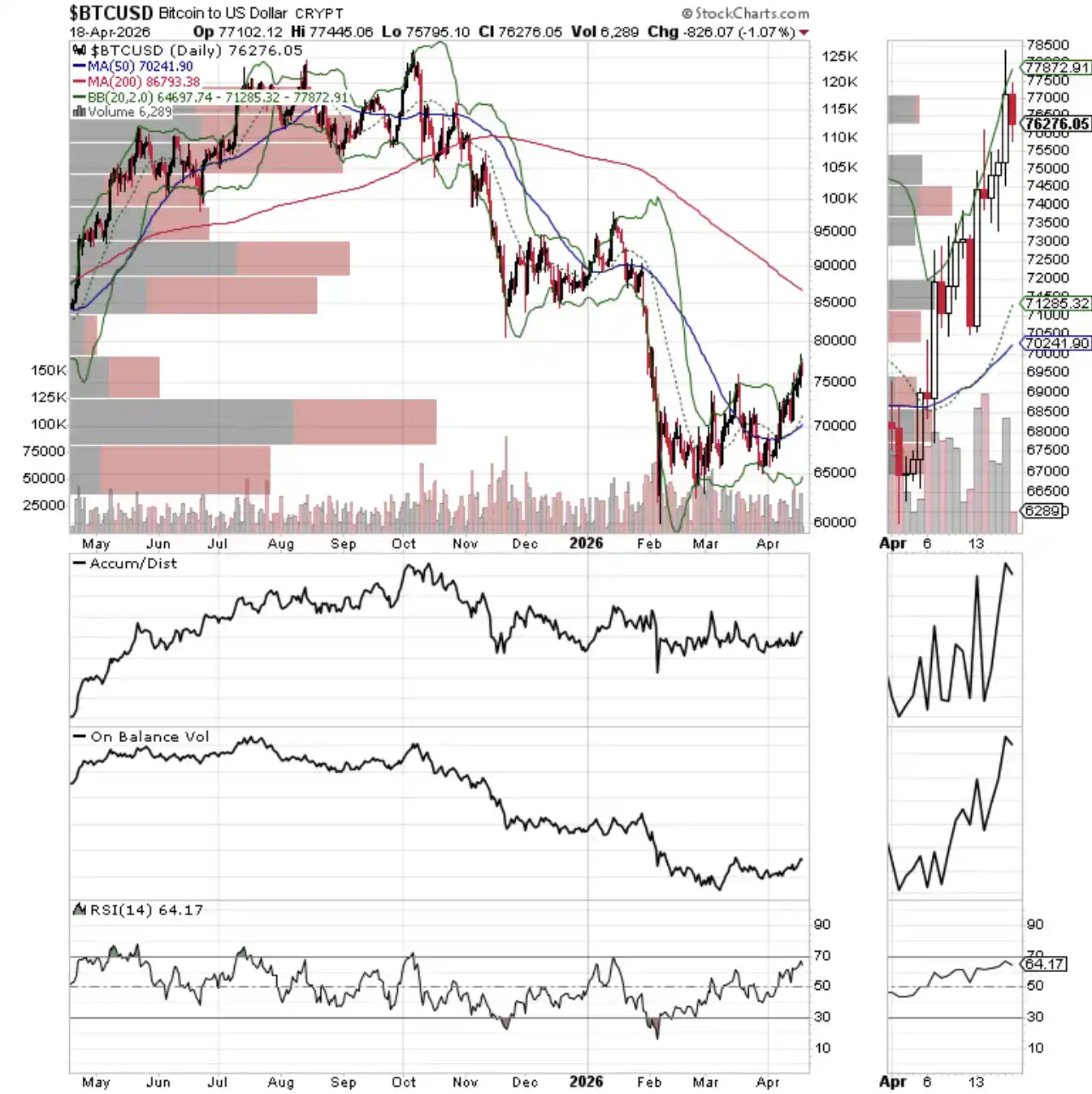
The $70,000–$75,000 range is a key support level.

Sentiment Summary: Market Suddenly Turns Fully Optimistic

The CNN Fear & Greed Index (GFI) closed at 68 on April 17, 2026, in the "Greed" zone.

CoinMarketCap's Crypto Fear & Greed Index was at 59 on Saturday morning, in the relatively high "Neutral" level.

The Chicago Board Options Exchange (CBOE) Total Put/Call Ratio was 0.65, with the index options P/C ratio closing at 0.82. The options market sentiment overall remains neutral, but as bullish sentiment heats up rapidly, it is gradually tilting towards the bearish area.

The CBOE Volatility Index (VIX) closed at 17.48, a relatively positive level. However, it could still rise back above 20 (often seen as the risk警戒线) in the short term.

It's worth noting that the VIX typically rises when traders heavily buy put options. Increased demand for puts forces market makers to hedge by selling stock index futures, thereby putting downward pressure on the market.

Conversely, when the VIX falls, it means reduced demand for puts, market sentiment turns optimistic, and more call buying often follows. This prompts market makers to buy stock index futures to hedge risks, increasing the probability of stock market gains.

Liquidity Watch

1. Bullish: Liquidity is easing

The National Financial Conditions Index (NFCI) released by the Federal Reserve, in its latest reading for March 27, 2026 (published April 10), was -0.47, down from the previous week's -0.44, indicating that financial conditions are easing and liquidity is improving.

A decline in NFCI is usually seen as a bullish signal, and a negative index means market liquidity is relatively abundant.

2. Bond yields retreat

U.S. Treasury yields fell in the latter part of the week, but could rise again depending on developments in Iran.
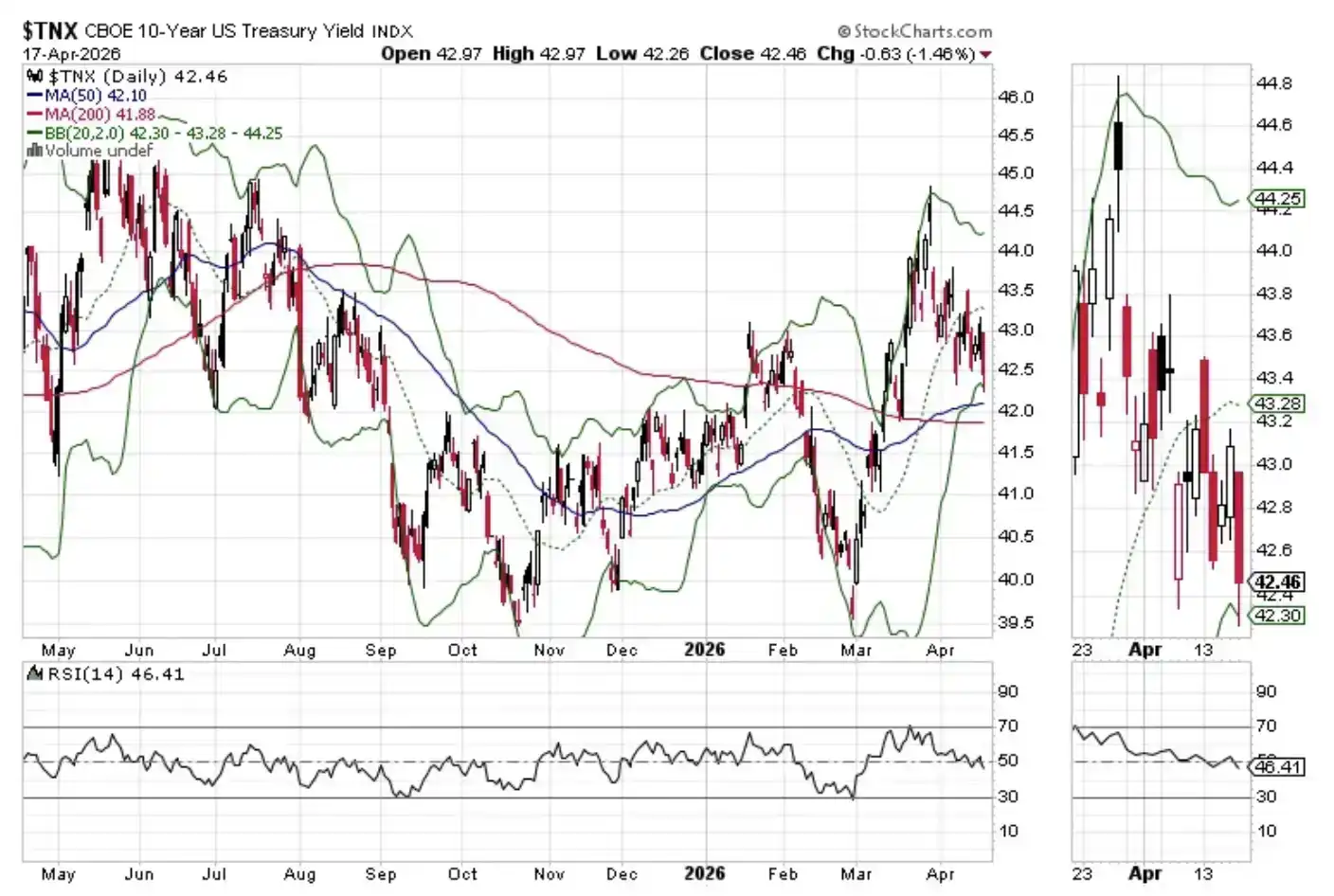
The U.S. 10-Year Treasury Yield closed the week below 4.3%, also falling below its 20-day moving average. A further break below the 200-day moving average would be seen as a bullish signal; conversely, a rise back above 4.5% could push yields back towards the highs near 4.6% seen in May 2025.

3. NYAD, SPX, and NDX all hit new highs simultaneously

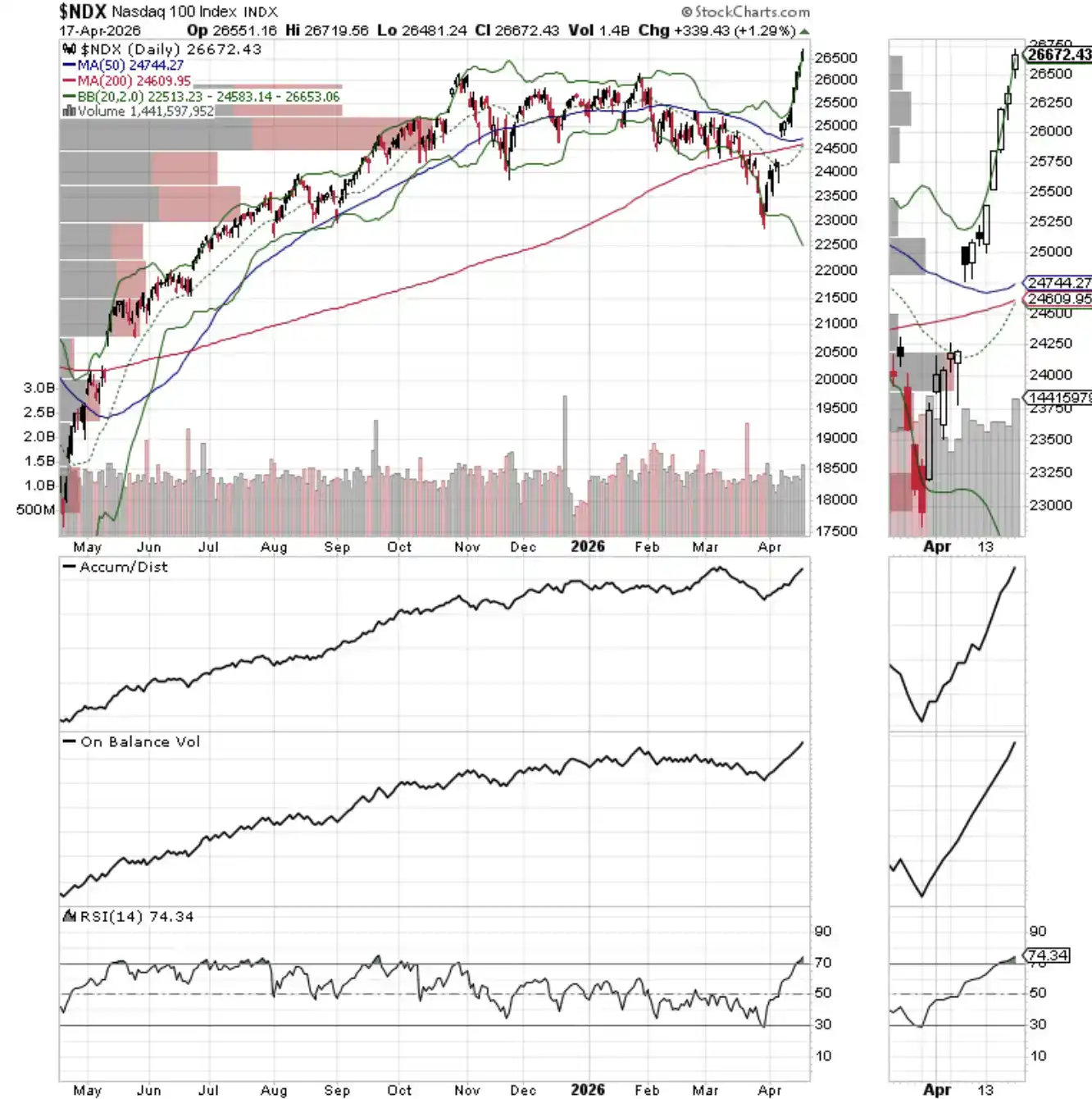
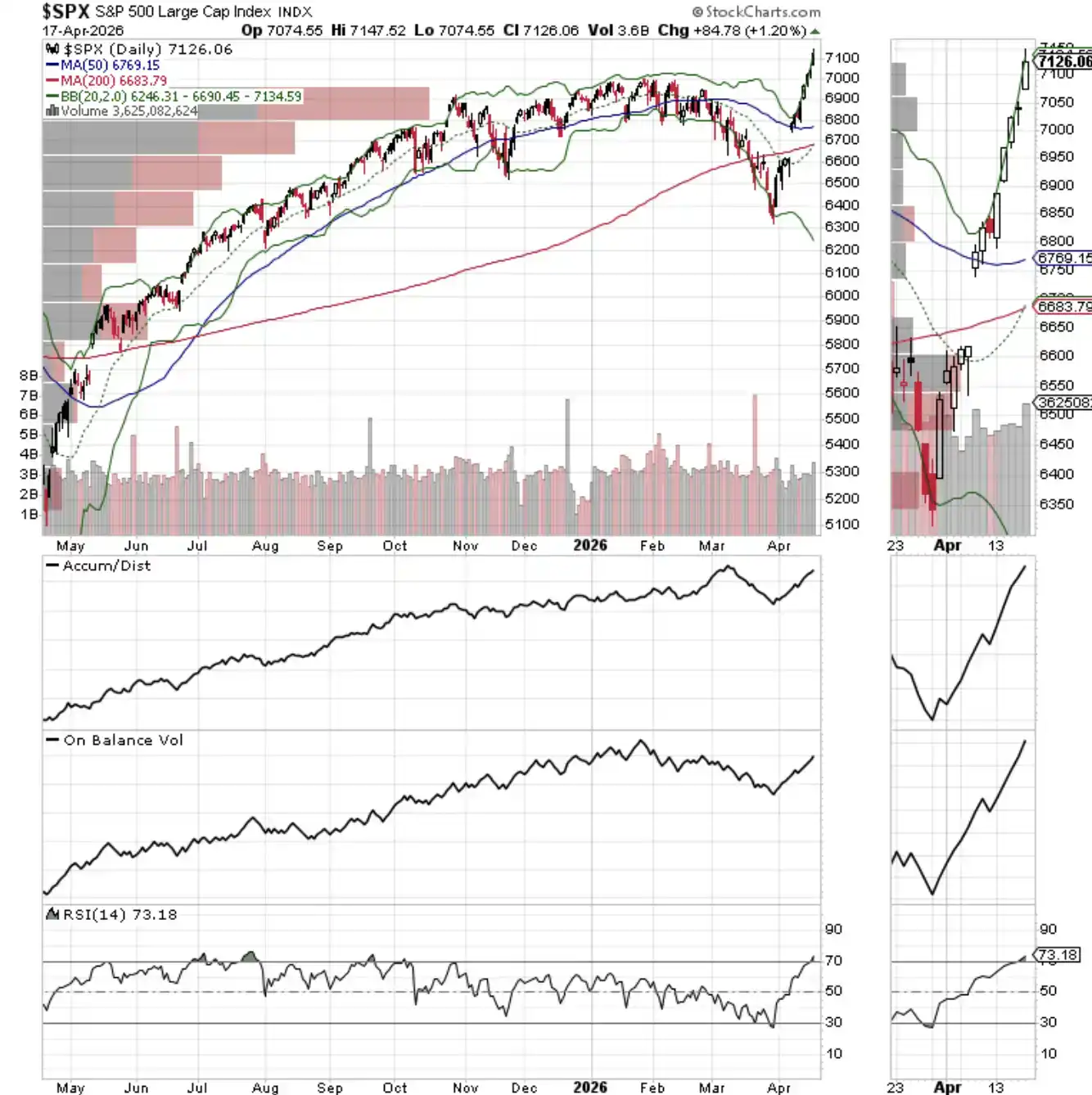
The NYSE Advance-Decline Line hit a new high, confirming the new highs in the S&P 500 Index and the NASDAQ-100 Index, forming a confirmation signal.

The current uptrend is validated—but only for now. A break below the 20-day or 50-day moving average could quickly change the market situation.

The NASDAQ-100 Index hit a new high last week, with 26,000 points now becoming a short-term support level.
The S&P 500 Index hit a new high last week and broke through the 7000 point mark. 7000 points has now become a short-term support level.
Domande pertinenti

QWhat is the main factor that has recently driven the sharp rise in stock and risk asset prices according to the article?

AThe main factor is the injection of nearly $200 billion in liquidity into the financial system by the Federal Reserve and the U.S. Treasury around April 15, which created a massive liquidity surge.

QWhy does the article suggest that Bitcoin is a key leading indicator for the market?

ABitcoin is more sensitive to liquidity changes than traditional risk assets. It often signals turning points in the funding environment first, as seen in its early decline in October 2025 and its率先企稳 (first to stabilize) in the current rebound.

QWhat is the 'TGA' (Treasury General Account) and how does its balance affect market liquidity?

AThe TGA is the U.S. Treasury's checking account at the Federal Reserve. When its balance decreases, it releases liquidity into the financial system; when its balance increases, it tightens liquidity.

QWhat key price level for Bitcoin does the article identify as a crucial test for market confidence and liquidity?

AThe $80,000–$85,000 range is identified as a crucial test. A failure to break through this level could indicate a lack of confidence in the rally or that the liquidity surge is fading.

QWhat new uncertainty has emerged that could challenge the market's liquidity-driven rally?

AThe uncertainty is a potential escalation in the Iran situation, specifically a reversal in Iran's stance on the Strait of Hormuz, which has reintroduced geopolitical risk as a core variable in asset pricing.

Letture associate

Has the 'Digital Gold' Narrative for BTC Failed?

**Title: Has the "Digital Gold" Narrative for Bitcoin Failed?** The article argues that Bitcoin's "digital gold" narrative remains valid despite a recent sharp price decline (from a peak near $126k in Oct 2025 to briefly under $61k in Feb 2026). It presents a long-term investment framework based on three core points: **1. Viewing Bitcoin as an Asset:** Bitcoin is presented as a superior potential store of value compared to gold. Key arguments are its absolute scarcity (21 million cap), superior portability, and transparent auditability via its public ledger. While acknowledging its current use in early, volatile stages (~3-4% global adoption), the author draws parallels to the early, disruptive phases of the internet and e-commerce. **2. Understanding the Recent Downturn:** The current ~50% correction is framed as a predictable, consensus-driven cycle following its post-halving peak (the 2024 halving preceded the Oct 2025 high). A crucial factor is a historic "changing of hands": the influx of new institutional buyers via ETFs allowed early, low-cost holders (miners, OG believers) to take profits. The author notes that while severe, Bitcoin's historical drawdowns (e.g., 93% in 2011, 77% in 2021-22) have been progressively smaller, suggesting maturing holder structure and decreasing volatility over time. **3. The Long-Term Perspective:** The long-term thesis hinges on Bitcoin capturing a portion of gold's market value. With Bitcoin's market cap at ~$1.4 trillion (at $70k) versus gold's ~$20 trillion, significant upside potential exists if the "digital gold" narrative is partially realized. However, the author strongly cautions that short-term risks remain, the bottom is unpredictable, and high volatility is inherent. The real risk is not Bitcoin failing but poor personal position management (over-leverage, wrong capital) and a lack of deep understanding, which can force investors out during severe downturns. The conclusion uses Amazon's 95% crash post-2000 dot-com bubble and subsequent 42x recovery as an analogy. The ultimate question is not if Bitcoin's price will rise, but if an investor's strategy and conviction can withstand the volatility to see the long-term play out. The recent divergence (gold up, Bitcoin down) is posed not as a narrative failure, but as potential evidence of this ongoing, painful transition from a speculative asset to a mainstream allocation.

marsbit9 h fa

Has the 'Digital Gold' Narrative for BTC Failed?

marsbit9 h fa

Has BTC's 'Digital Gold' Narrative Failed?

The article discusses Bitcoin's "digital gold" narrative, its recent price drop, and long-term outlook through the perspective of "Jason". It argues the narrative is not a failure but that Bitcoin represents a superior, new asset class due to its fixed supply (21 million), portability, and auditability. The piece compares its current ~3-4% global adoption rate to early internet/e-commerce, suggesting significant growth potential. Regarding the 2025-2026 price decline (from ~$126k to briefly under $61k), the author views it as a predictable, consensus-driven sell-off within Bitcoin's ~4-year cycle post-halving, exacerbated by a major "handover" from early, low-cost holders to new institutional buyers via ETFs. A key observation is that historical peak-to-trough drawdowns have lessened over time (e.g., 93% in 2011 to ~50% in 2026), indicating maturing volatility as holder structure changes. For the long term, the author uses a simple framework: Bitcoin's total market cap (~$1.4T at $70k) is only about 7% of gold's (~$20T). Even capturing 30-50% of gold's value would imply substantial upside. However, the article strongly cautions against viewing this as investment advice, emphasizing extreme volatility and the critical importance of risk management, position sizing, and deep fundamental understanding to survive severe drawdowns. It concludes by drawing a parallel to Amazon's 95% crash in 2000 and subsequent 42x recovery, stressing that the key is surviving market cycles to realize long-term potential.

链捕手10 h fa

Has BTC's 'Digital Gold' Narrative Failed?

链捕手10 h fa

From Code to Cognition: A Ten-Thousand-Word Guide to the Evolution of the Robot Brain

"From Code to Cognition: The Evolution of Robot Brains" The journey of robotic intelligence has shifted dramatically from manually coded systems to AI-driven brains. For decades, robots relied on layered software stacks—perception, state estimation, planning, control—each handcrafted. While predictable, they lacked adaptability. The 2010s saw deep learning revolutionize perception (e.g., object detection) and control (via reinforcement learning), but learned skills remained narrow. The arrival of Large Language Models (LLMs) marked a turning point. LLMs acted as high-level planners, interpreting natural language instructions and generating sequences of actions for traditional robotic systems to execute. However, true integration came with Visual-Language-Action (VLA) models, which fused vision, language, and motion prediction into a single network. Pioneered by models like RT-2 and open-source projects like OpenVLA, VLAs enable robots to reason and act directly from visual input and commands. The most advanced humanoid robots now employ a "dual-brain" architecture: a slow-thinking, large VLA (System 2) for reasoning and planning, and a fast-reacting, small network (System 1) for high-frequency motion control, sometimes with an even lower-level System 0 for balance. This split balances cognition with the physics of real-time movement. Computation is split between onboard hardware (e.g., NVIDIA Jetson) for safety-critical control loops and cloud/edge servers for non-critical tasks like learning and interfaces. A crucial driver is the open-source ecosystem—models like GR00T and OpenVLA allow startups to build upon pre-trained brains and fine-tune them with their own data, accelerating development. Despite progress, current systems struggle with recovery from errors, sample inefficiency, and long-horizon tasks. This has spurred the rise of **World Models**—neural networks that predict the consequences of actions. By simulating possible futures before acting (like NVIDIA Cosmos or Meta V-JEPA), robots can plan, recover, and generalize better. This represents the next frontier: shifting intelligence from learned reactions to an internal model of physics and cause-and-effect. The field is rapidly evolving. While not yet at its "ChatGPT moment," the convergence of cheaper hardware, scalable simulation, and world models points toward robots that are increasingly capable, adaptive, and useful. The question is shifting from "what can robots do?" to "what *should* they do?"

marsbit10 h fa

From Code to Cognition: A Ten-Thousand-Word Guide to the Evolution of the Robot Brain

marsbit10 h fa

Trading

Spot
Futures

Articoli Popolari

Cosa è BITCOIN

Comprendere HarryPotterObamaSonic10Inu (ERC-20) e la sua posizione nel mondo delle criptovalute Negli ultimi anni, il mercato delle criptovalute ha assistito a un aumento della popolarità delle meme coin, catturando l'interesse non solo dei trader, ma anche di coloro che cercano coinvolgimento comunitario e valore di intrattenimento. Tra questi token unici c'è HarryPotterObamaSonic10Inu (ERC-20), un progetto intrigante che mescola riferimenti culturali nel tessuto delle criptovalute. Questo articolo esplora gli aspetti chiave di HarryPotterObamaSonic10Inu, analizzando i suoi meccanismi, l'etica guidata dalla comunità e il suo coinvolgimento con il panorama crittografico più ampio. Che cos'è HarryPotterObamaSonic10Inu (ERC-20)? Come suggerisce il suo nome, HarryPotterObamaSonic10Inu è una meme coin costruita sulla blockchain di Ethereum, classificata secondo lo standard ERC-20. A differenza delle criptovalute tradizionali che possono enfatizzare l'utilità pratica o il potenziale investimento, questo token prospera grazie al valore di intrattenimento e alla forza della sua comunità. Il progetto mira a creare un ambiente in cui gli utenti coinvolti possono riunirsi, condividere idee e partecipare ad attività ispirate a diversi fenomeni culturali. Una caratteristica notevole di HarryPotterObamaSonic10Inu è la zero tassa sulle transazioni. Questo elemento allettante tende a incoraggiare il trading e il coinvolgimento della comunità, privo di costi aggiuntivi che possono scoraggiare i trader di piccole dimensioni. L'offerta totale della moneta è fissata a un miliardo di token, un numero che segna la sua intenzione di mantenere una circolazione sostanziale all'interno della comunità. Creatore di HarryPotterObamaSonic10Inu (ERC-20) Le origini di HarryPotterObamaSonic10Inu sono avvolte in un certo mistero; i dettagli sul creatore rimangono sconosciuti. Lo sviluppo di questo token non presenta un team identificabile o un piano esplicito, cosa non rara nel settore delle meme coin. Invece, il progetto è emerso organicamente, con il suo progresso fortemente dipendente dall'entusiasmo e dalla partecipazione della sua comunità. Investitori di HarryPotterObamaSonic10Inu (ERC-20) Per quanto riguarda investimenti esterni e finanziamenti, HarryPotterObamaSonic10Inu rimane ambiguo. Il token non elenca alcuna fondazione di investimento conosciuta o un sostegno organizzativo significativo. Invece, la linfa vitale del progetto è la sua comunità di base, che informa la sua crescita e sostenibilità attraverso azioni collettive e coinvolgimento nello spazio crittografico. Come funziona HarryPotterObamaSonic10Inu (ERC-20)? In quanto meme coin, HarryPotterObamaSonic10Inu opera principalmente al di fuori delle strutture tradizionali che governano spesso il valore degli asset. Ci sono diversi aspetti distintivi che definiscono il funzionamento del progetto: Transazioni senza tasse: Senza costi fiscali sulle transazioni, gli utenti possono comprare e vendere liberamente il token senza preoccuparsi di costi nascosti. Coinvolgimento della comunità: Il progetto prospera sull'interazione della comunità, sfruttando le piattaforme social per creare entusiasmo e facilitare il coinvolgimento. Discussioni, condivisione di contenuti e coinvolgimento sono elementi cruciali che aiutano ad espandere la sua portata e a favorire la lealtà tra i sostenitori. Nessuna utilità pratica: Va notato che HarryPotterObamaSonic10Inu non offre un'utilità concreta all'interno dell'ecosistema finanziario. Piuttosto, è classificato come un token principalmente per attività di intrattenimento e comunitarie. Riferimento culturale: Il token incorpora astutamente elementi della cultura pop per attirare interesse, collegandosi a appassionati di meme e seguaci delle criptovalute. HarryPotterObamaSonic10Inu esemplifica come le meme coin operino in modo diverso rispetto ai progetti di criptovalute più tradizionali, entrando nel mercato come costrutti sociali innovativi piuttosto che come asset utilitari. Cronologia di HarryPotterObamaSonic10Inu (ERC-20) La storia di HarryPotterObamaSonic10Inu è segnata da diversi traguardi notevoli: Creazione: Il token è emerso da un meme virale, catturando l'immaginazione di molti appassionati di criptovalute. Le date di creazione specifiche non sono disponibili, sottolineando la sua crescita organica. Inserimento negli scambi: HarryPotterObamaSonic10Inu ha fatto il suo ingresso in vari scambi, consentendo un accesso e un trading più facili da parte della comunità. Iniziative di coinvolgimento della comunità: Attività in corso volte a migliorare l'interazione della comunità, comprese gare, campagne sui social media e generazione di contenuti da parte di fan e sostenitori. Piani di espansione futura: La tabella di marcia del progetto include il lancio di una collezione NFT, merchandising e un sito di eCommerce relativo ai suoi temi culturali, coinvolgendo ulteriormente la comunità e cercando di aggiungere più dimensioni al suo ecosistema. Punti chiave su HarryPotterObamaSonic10Inu (ERC-20) Natura guidata dalla comunità: Il progetto dà priorità al contributo collettivo e alla creatività, garantendo che il coinvolgimento degli utenti sia al centro del suo sviluppo. Classificazione come meme coin: Rappresenta l'epitome delle criptovalute basate sull'intrattenimento, distinguendosi dai veicoli d'investimento tradizionali. Nessuna affiliazione diretta con Bitcoin: Nonostante la somiglianza nel nome del ticker, HarryPotterObamaSonic10Inu è distintivo e non ha alcuna relazione con Bitcoin o altre criptovalute consolidate. Focus sulla collaborazione: HarryPotterObamaSonic10Inu è progettato per creare uno spazio per la collaborazione e la condivisione di storie tra i suoi detentori, fornendo un canale per la creatività e il legame comunitario. Prospettive future: L'ambizione di espandersi oltre il suo presupposto iniziale verso NFT e merchandising delinea un percorso per il progetto per potenzialmente entrare in strade più mainstream all'interno della cultura digitale. Poiché le meme coin continuano a catturare l'immaginazione della comunità crittografica, HarryPotterObamaSonic10Inu (ERC-20) si distingue per i suoi legami culturali e il suo approccio centrato sulla comunità. Anche se potrebbe non adattarsi al modello tipico di un token orientato all'utilità, la sua essenza risiede nella gioia e nella camaraderia coltivate tra i suoi sostenitori, evidenziando la natura in evoluzione delle criptovalute in un'epoca sempre più digitale. Con la continuazione dello sviluppo del progetto, sarà importante osservare come le dinamiche della comunità influenzano la sua traiettoria nel panorama in continuo cambiamento della tecnologia blockchain.

1.6k Totale visualizzazioniPubblicato il 2024.04.01Aggiornato il 2024.12.03

Cosa è BITCOIN

Come comprare BTC

Benvenuto in HTX.com! Abbiamo reso l'acquisto di Bitcoin (BTC) semplice e conveniente. Segui la nostra guida passo passo per intraprendere il tuo viaggio nel mondo delle criptovalute.Step 1: Crea il tuo Account HTXUsa la tua email o numero di telefono per registrarti il tuo account gratuito su HTX. Vivi un'esperienza facile e sblocca tutte le funzionalità,Crea il mio accountStep 2: Vai in Acquista crypto e seleziona il tuo metodo di pagamentoCarta di credito/debito: utilizza la tua Visa o Mastercard per acquistare immediatamente BitcoinBTC.Bilancio: Usa i fondi dal bilancio del tuo account HTX per fare trading senza problemi.Terze parti: abbiamo aggiunto metodi di pagamento molto utilizzati come Google Pay e Apple Pay per maggiore comodità.P2P: Fai trading direttamente con altri utenti HTX.Over-the-Counter (OTC): Offriamo servizi su misura e tassi di cambio competitivi per i trader.Step 3: Conserva Bitcoin (BTC)Dopo aver acquistato Bitcoin (BTC), conserva nel tuo account HTX. In alternativa, puoi inviare tramite trasferimento blockchain o scambiare per altre criptovalute.Step 4: Scambia Bitcoin (BTC)Scambia facilmente Bitcoin (BTC) nel mercato spot di HTX. Accedi al tuo account, seleziona la tua coppia di trading, esegui le tue operazioni e monitora in tempo reale. Offriamo un'esperienza user-friendly sia per chi ha appena iniziato che per i trader più esperti.

4.0k Totale visualizzazioniPubblicato il 2024.12.12Aggiornato il 2026.06.02

Come comprare BTC

Cosa è $BITCOIN

ORO DIGITALE ($BITCOIN): Un'Analisi Completa Introduzione all'ORO DIGITALE ($BITCOIN) L'ORO DIGITALE ($BITCOIN) è un progetto basato su blockchain che opera sulla rete Solana, con l'obiettivo di combinare le caratteristiche dei metalli preziosi tradizionali con l'innovazione delle tecnologie decentralizzate. Sebbene condivida un nome con Bitcoin, spesso definito “oro digitale” a causa della sua percezione come riserva di valore, l'ORO DIGITALE è un token separato progettato per creare un ecosistema unico all'interno del panorama Web3. Il suo obiettivo è posizionarsi come un asset digitale alternativo valido, anche se i dettagli riguardanti le sue applicazioni e funzionalità sono ancora in fase di sviluppo. Cos'è l'ORO DIGITALE ($BITCOIN)? L'ORO DIGITALE ($BITCOIN) è un token di criptovaluta esplicitamente progettato per l'uso sulla blockchain di Solana. A differenza di Bitcoin, che fornisce un ruolo di stoccaggio di valore ampiamente riconosciuto, questo token sembra concentrarsi su applicazioni e caratteristiche più ampie. Aspetti notevoli includono: Infrastruttura Blockchain: Il token è costruito sulla blockchain di Solana, nota per la sua capacità di gestire transazioni ad alta velocità e a basso costo. Dinamiche di Offerta: L'ORO DIGITALE ha un'offerta massima fissata a 100 quadrilioni di token (100P $BITCOIN), sebbene i dettagli riguardanti la sua offerta circolante siano attualmente non divulgati. Utilità: Sebbene le funzionalità precise non siano esplicitamente delineate, ci sono indicazioni che il token potrebbe essere utilizzato per varie applicazioni, potenzialmente coinvolgendo applicazioni decentralizzate (dApp) o strategie di tokenizzazione degli asset. Chi è il Creatore dell'ORO DIGITALE ($BITCOIN)? Attualmente, l'identità dei creatori e del team di sviluppo dietro l'ORO DIGITALE ($BITCOIN) rimane sconosciuta. Questa situazione è tipica tra molti progetti innovativi nel settore blockchain, in particolare quelli allineati con la finanza decentralizzata e i fenomeni delle meme coin. Sebbene tale anonimato possa favorire una cultura guidata dalla comunità, intensifica le preoccupazioni riguardo alla governance e alla responsabilità. Chi sono gli Investitori dell'ORO DIGITALE ($BITCOIN)? Le informazioni disponibili indicano che l'ORO DIGITALE ($BITCOIN) non ha alcun sostenitore istituzionale noto o investimenti di venture capital prominenti. Il progetto sembra operare su un modello peer-to-peer incentrato sul supporto e sull'adozione della comunità piuttosto che su percorsi di finanziamento tradizionali. La sua attività e liquidità si trovano principalmente su exchange decentralizzati (DEX), come PumpSwap, piuttosto che su piattaforme di trading centralizzate consolidate, evidenziando ulteriormente il suo approccio di base. Come Funziona l'ORO DIGITALE ($BITCOIN) Le meccaniche operative dell'ORO DIGITALE ($BITCOIN) possono essere elaborate in base al suo design blockchain e alle caratteristiche della rete: Meccanismo di Consenso: Sfruttando il proof-of-history (PoH) unico di Solana combinato con un modello di proof-of-stake (PoS), il progetto garantisce una validazione efficiente delle transazioni contribuendo all'alta performance della rete. Tokenomics: Sebbene meccanismi deflazionistici specifici non siano stati dettagliati ampiamente, l'ampia offerta massima di token implica che potrebbe soddisfare microtransazioni o casi d'uso di nicchia che devono ancora essere definiti. Interoperabilità: Esiste il potenziale per l'integrazione con l'ecosistema più ampio di Solana, inclusi vari piattaforme di finanza decentralizzata (DeFi). Tuttavia, i dettagli riguardanti integrazioni specifiche rimangono non specificati. Cronologia degli Eventi Chiave Ecco una cronologia che evidenzia traguardi significativi riguardanti l'ORO DIGITALE ($BITCOIN): 2023: Il dispiegamento iniziale del token avviene sulla blockchain di Solana, contrassegnato dal suo indirizzo di contratto. 2024: L'ORO DIGITALE guadagna visibilità poiché diventa disponibile per il trading su exchange decentralizzati come PumpSwap, consentendo agli utenti di scambiarlo contro SOL. 2025: Il progetto assiste a un'attività di trading sporadica e a un potenziale interesse per impegni guidati dalla comunità, sebbene non siano state documentate partnership significative o avanzamenti tecnici fino ad ora. Analisi Critica Punti di Forza Scalabilità: L'infrastruttura sottostante di Solana supporta alti volumi di transazioni, il che potrebbe migliorare l'utilità di $BITCOIN in vari scenari di transazione. Accessibilità: Il potenziale basso prezzo di trading per token potrebbe attrarre investitori al dettaglio, facilitando una partecipazione più ampia grazie a opportunità di proprietà frazionata. Rischi Mancanza di Trasparenza: L'assenza di sostenitori, sviluppatori o di un processo di audit pubblicamente noti potrebbe generare scetticismo riguardo alla sostenibilità e all'affidabilità del progetto. Volatilità del Mercato: L'attività di trading è fortemente dipendente dal comportamento speculativo, il che può comportare una significativa volatilità dei prezzi e incertezze per gli investitori. Conclusione L'ORO DIGITALE ($BITCOIN) emerge come un progetto intrigante ma ambiguo all'interno dell'evolvente ecosistema di Solana. Sebbene tenti di sfruttare la narrativa dell'“oro digitale”, la sua partenza dal ruolo consolidato di Bitcoin come riserva di valore sottolinea la necessità di una chiara differenziazione della sua utilità e struttura di governance. L'accettazione e l'adozione future dipenderanno probabilmente dall'affrontare l'attuale opacità e dalla definizione più esplicita delle sue strategie operative ed economiche. Nota: Questo rapporto comprende informazioni sintetizzate disponibili a ottobre 2023, e potrebbero essersi verificati sviluppi oltre il periodo di ricerca.

99 Totale visualizzazioniPubblicato il 2025.05.13Aggiornato il 2025.05.13

Cosa è $BITCOIN

Discussioni

Benvenuto nella Community HTX. Qui puoi rimanere informato sugli ultimi sviluppi della piattaforma e accedere ad approfondimenti esperti sul mercato. Le opinioni degli utenti sul prezzo di BTC BTC sono presentate come di seguito.

活动图片