From Utopian Narratives to Financial Infrastructure: The 'Disenchantment' and Pivot of Crypto VC

marsbitPubblicato 2026-03-30Pubblicato ultima volta 2026-03-30

Introduzione

From Utopian Narratives to Financial Infrastructure: The Disenchantment and Pivot of Crypto VC The crypto industry, once championing "blockchain, not Bitcoin" and a broad Web3 vision, is now seeing venture capital flow overwhelmingly into pragmatic financial applications, particularly stablecoin payments. Following the decline of the Web3 and NFT boom in the early 2020s, investment has cooled for many sectors but surged for payment infrastructure. Key signals include Stripe's $1.1 billion acquisition of Bridge and Mastercard's $1.8 billion purchase of BVNK. Data from Architect Partners shows funding for crypto payment companies skyrocketed to $2.6 billion in 2025, exceeding the total of the previous three years combined. In contrast, funding for decentralized applications (DApps) and blockchain gaming has collapsed. The total private crypto funding reached $20.4 billion in 2025, still below the 2022 peak of $27.6 billion. Stablecoins, like USDT and USDC, are now seen as a breakthrough application, with their annual transaction volume soaring 72% to $33 trillion in 2025. Their core appeal is enabling efficient, real-time global value transfer, solving long-standing issues of cost and speed in cross-border payments. However, the industry faces significant challenges from established "gatekeepers" like Visa and Mastercard, which control terminal access. The piece also notes the declining market share of Binance and the emergence of new products like Franklin Templeton's toke...

Written by: Suvashree Ghosh, Matt Haldane

Compiled by: Saoirse, Foresight News

Not long ago, the crypto industry was chanting the slogan "blockchain, not Bitcoin," claiming that distributed ledger technology would go beyond financial applications and completely reshape the internet. However, recent financing trends indicate that in the real world, cash is still king.

Since the Web3 and NFT craze subsided in the early 2020s, investment enthusiasm in the crypto industry has noticeably cooled. But one niche has bucked the trend, attracting increasing venture capital—stablecoin payments.

Stripe's acquisition of Bridge for $1.1 billion last year was an early signal of traditional financial institutions beginning to lay out stablecoin payments. Since then, a batch of startups including ARQ, KAST, and RedotPay have successively secured new funding to build cross-border payment channels and stablecoin-based financial services. Mastercard's acquisition of BVNK for $1.8 billion last week further confirms the market's strong interest in this sector.

"Startups related to stablecoins are almost the hottest area for venture capital financing right now," said Rob Hadick, General Partner at Dragonfly Capital. "Stablecoins have broken away from the entire crypto industry to become one of the few truly breakthrough applications with widespread real-world adoption."

According to data from Architect Partners, which specializes in annual crypto financing reports, the total financing for crypto payment companies soared to $2.6 billion in 2025, exceeding the sum of the previous three years. Driven by Mastercard's acquisition of BVNK, this number is expected to continue climbing this year.
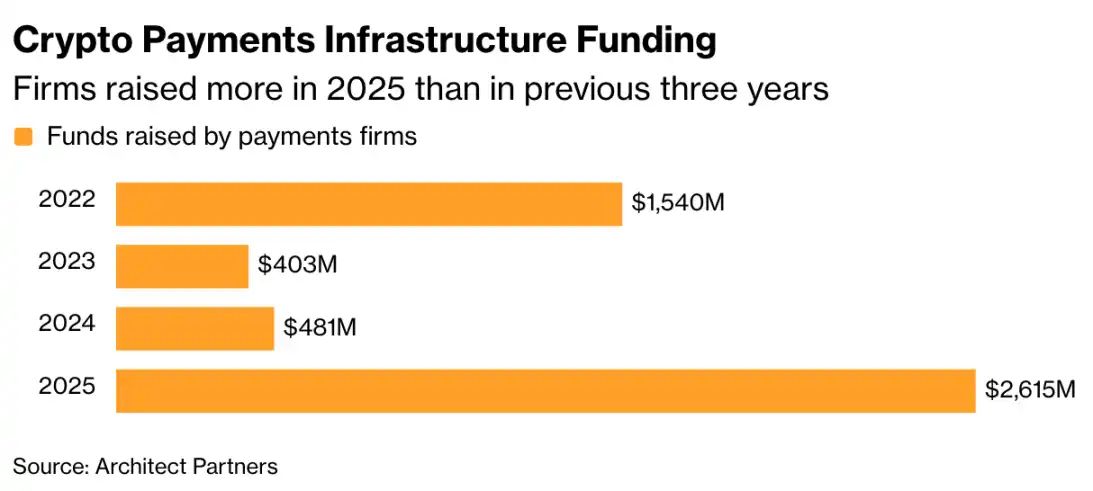
Crypto Payment Infrastructure Financing: 2025 company financing exceeded the sum of the previous three years

Meanwhile, overall private financing in the crypto industry increased from nearly $13 billion in 2024 to $20.4 billion in 2025, but still fell short of the 2022 peak of $27.6 billion.
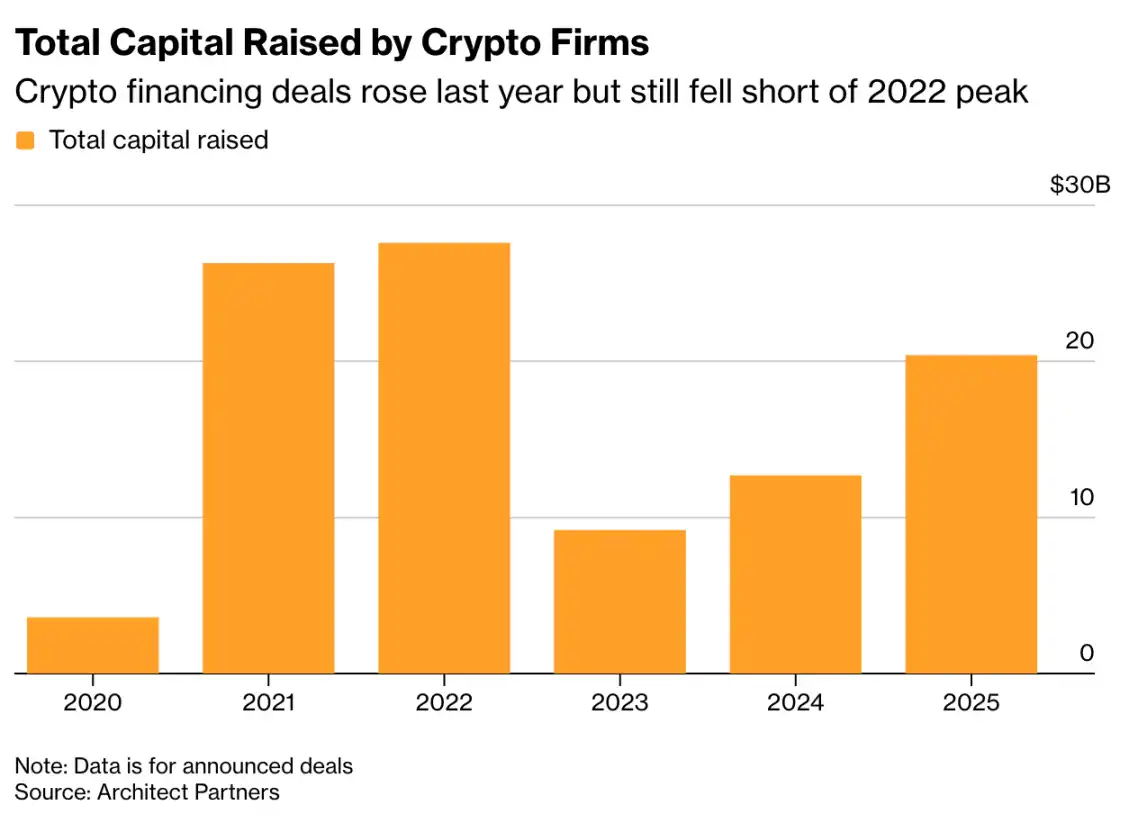
Total Financing for Cryptocurrency Companies: The number of crypto financing deals rose last year but still hasn't reached the 2022 peak

Currently, the two areas with the most concentrated private funding are "Investment & Trading Infrastructure" and "Brokers & Exchanges," both financial application businesses. Payment infrastructure firmly holds third place. In stark contrast, the blockchain gaming sector, which was once at the core of the Web3 and NFT frenzy, saw its financing drop from $3.76 billion in 2022 (about 14% of total financing) to the point where it was no longer listed as a separate category in 2025.

In fact, various types of decentralized applications (Web3 functional layer) collectively raised $5.2 billion in 2022; in the 2025 report, only the consumer DApp category remained, with financing of just $864 million.
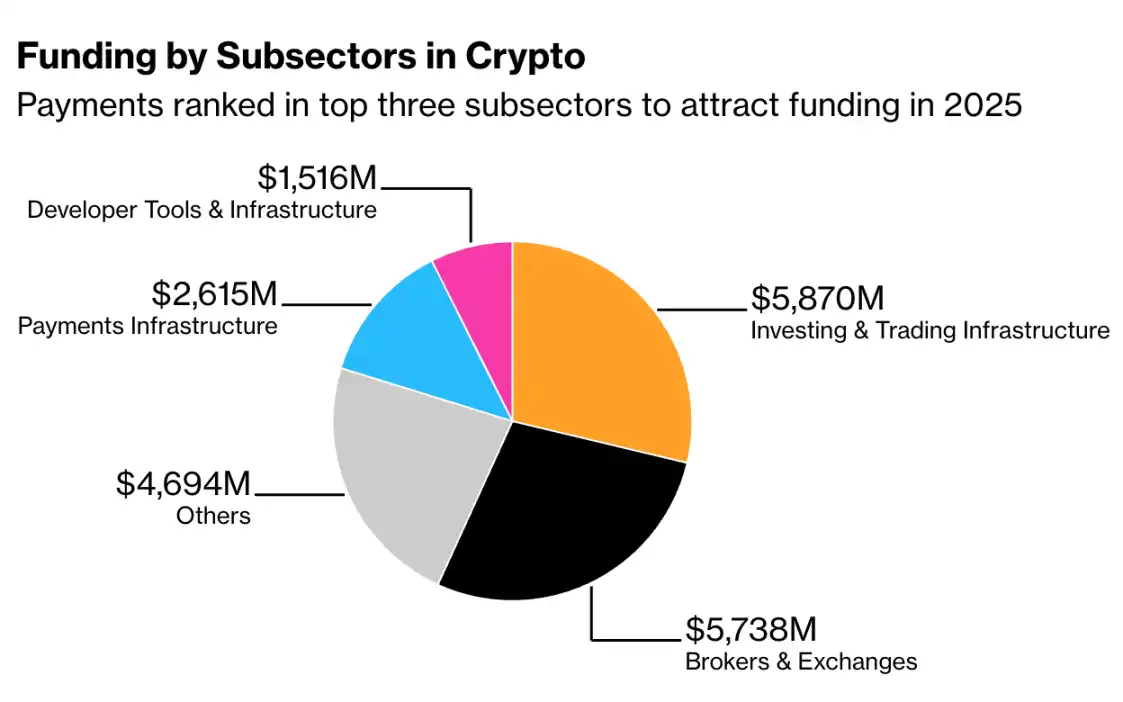
Financing by Cryptocurrency Subsector: Payments跻身 among the top three sub-sectors attracting financing in 2025

Stablecoins are building more robust financial infrastructure for blockchain. These tokens are typically pegged 1:1 to the US dollar, with their value tied to underlying assets. Driven by the Trump administration's pro-crypto policies, market enthusiasm for stablecoins reached unprecedented heights last year.

According to Artemis Analytics data, the total transaction volume of stablecoins surged 72% in 2025, reaching $33 trillion. The two largest stablecoins by size are currently Tether's USDT and Circle's USDC.

Circle's stock price recorded its largest-ever drop on Tuesday as investors assessed potential adjustments to U.S. stablecoin regulations and the impact of intensifying industry competition. But the core appeal of stablecoins remains clear: transferring funds as efficiently as possible.

Cross-border payments remain slow, costly, and capital-intensive. Despite years of fintech development, cross-border transfers still heavily rely on prefunded accounts in different jurisdictions.

"Stablecoins have completely changed this landscape," said Prajit Nanu, co-founder and CEO of cross-border payments company Nium. "They enable value to move globally in real-time without the same level of capital efficiency drain, which is why investors see them as the core infrastructure for the next generation of payments."

This industry still has powerful "gatekeepers." Large payment networks like Visa and Mastercard control access to payment terminals. Eric F. Risley, founder and managing partner of Architect Partners, wrote in the report that the channel distribution issue "is a major concern for every stablecoin and related payment company."
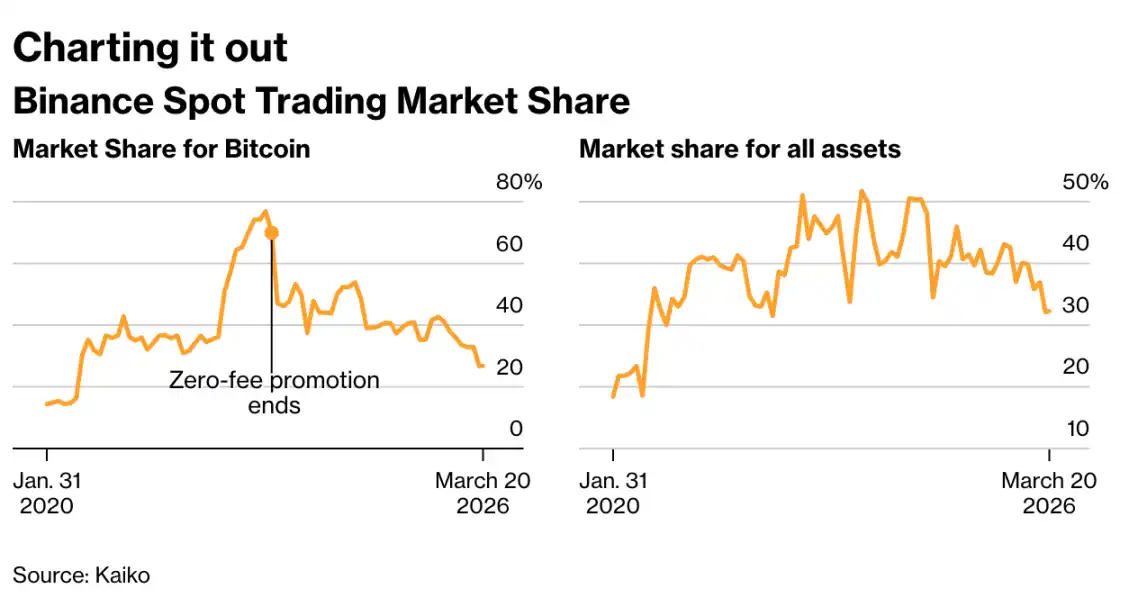
Binance Spot Trading Market Share Trend Chart

As of February this year, Binance's share of Bitcoin spot trading had fallen to 27% (this data varies slightly depending on the statistical method), and its share of all cryptocurrency trading fell from 52% to 32%. Its most profitable derivatives business also saw a significant decline, dropping to 34%.

Franklin Templeton partnered with Ondo Finance to launch an ETF tokenization product, tradable via crypto wallets 24/7, bypassing the broker accounts and limited trading hours that fund investments have relied on for decades.

Industry Voices

"The irony of holding this event in Las Vegas right now is just palpable," said Ben Johnson, Head of Client Solutions at Morningstar, stating bluntly that this industry has "completely crossed the line between investing and gambling, with no room for turning back."

ETFs, originally created to simplify investing, have now become a vehicle for the newest form of financial gambling in the U.S. Bloomberg Intelligence data shows that 36% of the 1,000 new funds launched last year were leveraged products or crypto-related funds.


Domande pertinenti

QWhat is the main shift in focus for crypto venture capital investments according to the article?

AThe main shift is from utopian narratives like Web3 and NFTs towards financial infrastructure, particularly stablecoin payments and related services.

QWhich specific area within crypto has seen as a 'breakthrough application' with real-world adoption?

AStablecoins are identified as a breakthrough application that has gained significant real-world adoption, especially in payment infrastructure.

QHow much did funding for crypto payment companies reach in 2025, and how does it compare to previous years?

AFunding for crypto payment companies reached $2.6 billion in 2025, which exceeded the total of the previous three years combined.

QWhat major acquisition is mentioned as a signal of traditional financial institutions' interest in stablecoin payments?

AMastercard's acquisition of BVNK for $1.8 billion is highlighted as a key signal of traditional financial institutions' growing interest in stablecoin payments.

QWhat problem do stablecoins primarily solve in the global financial system, as per the article?

AStablecoins solve the problem of slow, costly, and capital-intensive cross-border payments by enabling real-time global value transfer with greater efficiency.

Letture associate

Anthropic's IPO Launch: Commercial Miracle or Valuation Bubble?

Anthropic has confidentially filed for an IPO, led by Morgan Stanley and Goldman Sachs, potentially going public by October. Following its latest $650 billion funding round, its pre-IPO valuation stands at $965 billion, with projections reaching up to $2 trillion at listing, which would make it the highest-valued private company ever. The article, written by Fu Sheng, addresses skepticism that this represents an AI bubble akin to the 2000 dot-com crash. It argues the current situation differs fundamentally. Unlike the internet bubble era, which relied on speculative narratives with little revenue, Anthropic's valuation is backed by unprecedented, measurable financial performance. Key data points include: * **Revenue Growth:** ARR skyrocketed from $10 billion in early 2025 to $470 billion by May 2026, targeting $100 billion by year-end—a growth curve unmatched in business history. * **Profitability:** It achieved operating profitability in Q2 2026 with an estimated $5.6 billion profit. * **Efficiency:** With ~3,000 employees and ~$470 billion ARR, its revenue per employee exceeds $10 million. Products like Claude Code, launched less than a year ago, already generate $25 billion in annualized revenue. * **Enterprise Adoption:** It boasts a strong enterprise client base, with 8 of the Fortune 10 and over 1,000 large firms spending over $1 million annually on Claude. The valuation is framed using a traditional SaaS model (e.g., a 10x Price-to-Sales multiple on $100 billion revenue). The author contends the core question for analysts has shifted from "How big could this be?" to "How much is it earning and will earn next quarter?" The discussion extends beyond Anthropic to a broader paradigm shift: the transition from a "carbon-based" to a "silicon-based" economy. Companies are increasingly prioritizing investment in compute and AI capabilities over human resources, as these directly scale productivity and competitive advantage. Anthropic's IPO is thus positioned not just as a corporate milestone, but as a price anchor for this new economic era.

链捕手1 h fa

Anthropic's IPO Launch: Commercial Miracle or Valuation Bubble?

链捕手1 h fa

Near Returns to the AI Stage: Transformation into a Public Chain Due to 'Payroll Difficulties,' Agent and Privacy Emerge as New Growth Narratives

NEAR Returns to AI Origins: From Payroll Struggles to Blockchain, Now Focusing on AI Agents and Privacy NEAR Protocol's journey began not with grand blockchain ambitions, but from a practical hurdle: its AI startup founders, including Transformer paper co-author Illia Polosukhin, couldn't efficiently pay international developers in 2017. This led them to pivot and build a high-performance, scalable blockchain. After years navigating various crypto narratives like sharding and cross-chain interoperability, NEAR is now leveraging its AI roots to re-enter the AI arena. A key driver is its "NEAR Intents" layer, which abstracts complex cross-chain transactions. Users simply state their goal (e.g., swap BTC for ETH), and a solver network finds the optimal route. This system has processed over $20B in cross-chain volume, generating significant fee revenue. A major growth area is private transactions via "Confidential Intents/Swaps," which hide trade details until settlement to protect against MEV and front-running. Remarkably, private swaps recently accounted for over 40% of NEAR's transaction volume, highlighting strong demand but also potential regulatory scrutiny. With its AI-founder pedigree, NEAR is positioning itself at the intersection of blockchain, AI agents, and privacy, aiming to become infrastructure for the emerging agent economy while navigating the challenges of its rapid adoption.

marsbit4 h fa

Near Returns to the AI Stage: Transformation into a Public Chain Due to 'Payroll Difficulties,' Agent and Privacy Emerge as New Growth Narratives

marsbit4 h fa

From Ethereum to AI's 'CROPS': What Exactly is This Set of 'Slow Variables' That Vitalik Repeatedly Emphasizes?

In recent discussions, Vitalik Buterin has frequently emphasized the concept of "CROPS," a framework defining core values for Ethereum's development. CROPS stands for Censorship Resistance, Capture Resistance, Open Source, Privacy, and Security. Initially outlined in the Ethereum Foundation's "EF Mandate," it represents a commitment to user sovereignty, ensuring that the network resists external control, remains open, protects privacy, and prioritizes security. The relevance of CROPS extends beyond Ethereum's foundational principles, becoming crucial in the context of AI integration. As AI agents begin handling wallet operations and automated transactions, the risk increases that users may cede control over their digital assets, privacy, and intentions to centralized AI service providers. A "CROPS AI" would therefore emphasize local execution where possible, privacy-preserving remote model calls (e.g., using zero-knowledge proofs), and transparent, verifiable processes to maintain user agency. Vitalik highlights a significant convergence between "CROPS Ethereum access layer" and "CROPS AI." Both address the same fundamental challenge: how users can access powerful services—be it blockchain data via RPCs or AI models—without exposing sensitive information or relinquishing ultimate control. This intersection points toward a future digital entry point that is more private, secure, and user-controlled. Ultimately, CROPS is not merely an abstract ideal but a practical guidepost. It steers development—from protocol resilience and wallet design to AI agent safety—towards a future where users retain self-sovereignty even as digital systems grow more complex and powerful. In an era of accelerating AI adoption, these "slow variables" of censorship resistance, openness, privacy, and security may define Ethereum's enduring value.

marsbit4 h fa

From Ethereum to AI's 'CROPS': What Exactly is This Set of 'Slow Variables' That Vitalik Repeatedly Emphasizes?

marsbit4 h fa

Trading

Spot
Futures
活动图片




