From Shouting 150 Dollars to Liquidating HYPE in Just Three Days, How Much Credibility Does Arthur Hayes Have Left?

marsbitPubblicato 2026-06-09Pubblicato ultima volta 2026-06-09

Introduzione

How much of Arthur Hayes's market credibility remains? Recently, the "godfather of crypto perpetual swaps" and BitMEX co-founder has faced public criticism, including accusations from on-chain investigator ZachXBT about creating exit liquidity for his followers. Starting last week, Hayes executed multiple sudden sell-offs. He had repeatedly publicly predicted the HYPE token would reach $150. After a $100,000 bet defending Hyperliquid on June 1st, he announced just three days later that he had completely sold his HYPE and NEAR holdings, successfully exiting near the peak. He also sold ZEC and WLD. His sale of WLD appeared to be a classic "pump and dump" maneuver. On June 3rd, he publicly set a $10 target for WLD, causing its price to surge over 35%. By June 6th, he announced he had sold his WLD, citing "anomalous" SpaceX pre-IPO price action, which triggered a sharp price drop. On June 9th, Hayes published a lengthy article explaining his actions, citing factors like rising energy costs and a potential AI bubble burst. Consequently, his family office, Maelstrom, now holds positions in US energy producers and only core crypto assets BTC and ETH, having sold AI-related stocks and non-core cryptocurrencies. This pattern is not new. In 2025, he similarly touted HYPE before selling it at what turned out to be a cycle peak, only to repurchase it at the next cycle's low. Similar scenarios played out with tokens like ETHFI and ENA. Long-term observers have developed a strategy: i...

Original |Odaily Planet Daily(@OdailyChina)

Author |Golem(@web3_golem)
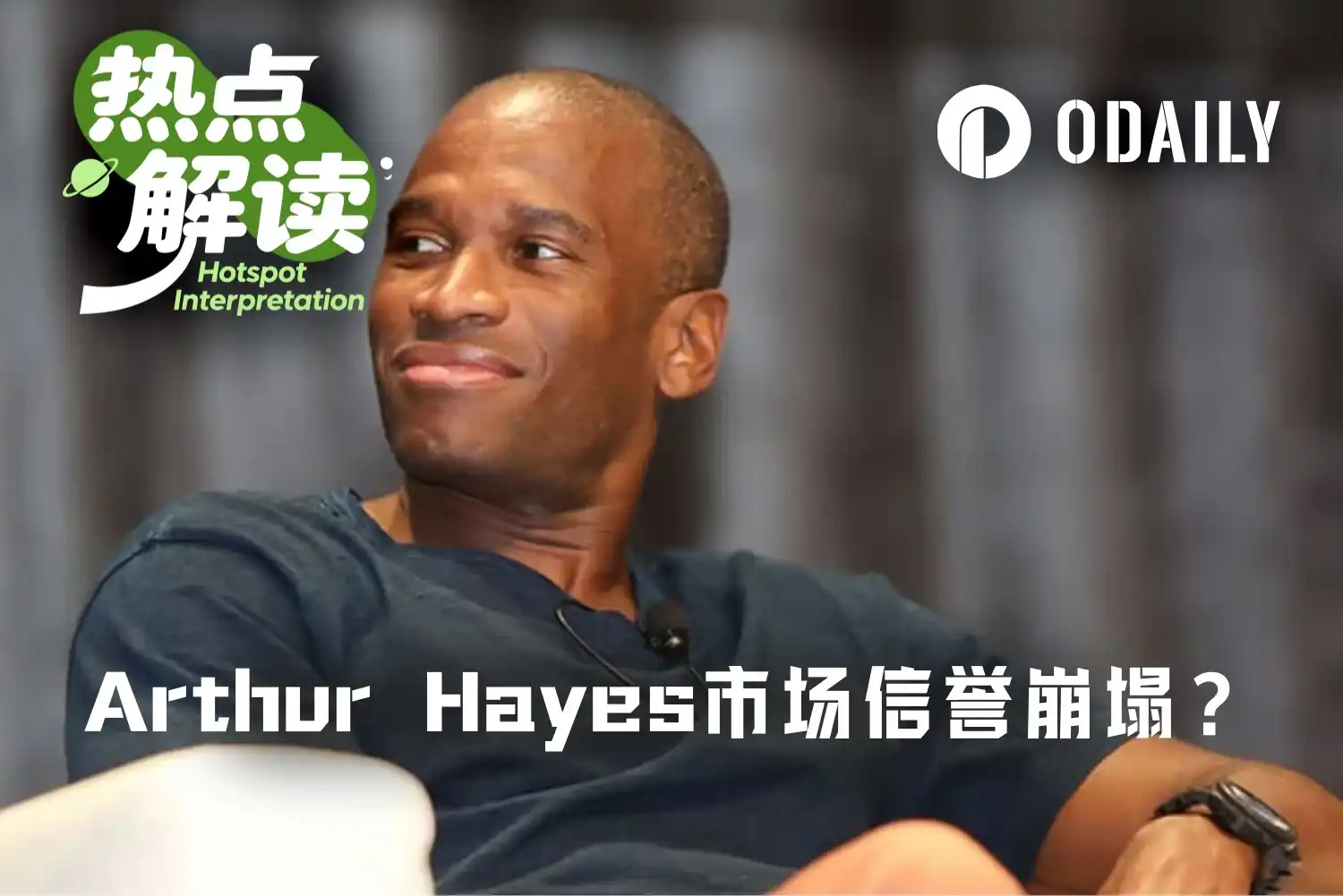
How much market credibility does Arthur Hayes have left? Recently, Arthur Hayes, the "Father of Crypto Perpetual Contracts" and co-founder of BitMEX, has faced public criticism, with on-chain detective ZachXBT also publicly questioning how much exit liquidity he has created using his followers.

Liquidated HYPE, NEAR, WLD

Starting last week, Arthur Hayes performed several unannounced selling operations to exit the top.

Arthur Hayes had repeatedly publicly stated that HYPE would rise to 150 dollars in this cycle. On June 1, Arthur Hayes was passionately criticizing and making a 100, 000 dollars bet with Kyle Samani, former co-founder of Multicoin Capital, for disparaging Hyperliquid. However, just 3 days later, Arthur Hayes announced he had completely liquidated his HYPE and NEAR holdings, with HYPE falling over 13.6% that day. His sell-off successfully exited at the top; HYPE hit a new high of 75.5 dollars on June 4 before falling continuously, currently trading around 62-64 dollars.

In addition to selling HYPE and NEAR, Arthur Hayes also liquidated ZEC and WLD. His liquidation of ZEC might be somewhat justified due to the Orchard Pool attack, but his selling of WLD resembled a classic "KOL cutting retail" operation: secretly accumulating, publicly shilling, and finally selling at a pumped price.

Because from publicly shilling WLD to liquidating WLD, Arthur Hayes only "acted" for 3 days. On June 3, the day before selling HYPE, Arthur Hayes publicly called for WLD to reach 10 dollars, suggesting WLD would become an alternative for investors who find it difficult to directly participate in SpaceX equity trading. After the news spread, WLD rose over 35% that day. But by June 6, Arthur Hayes changed his tune, stating he had sold all his WLD because SpaceX's pre-market price movement was "anomalous." This single, light explanation caused WLD to drop over 20% that day.

The difference between Arthur Hayes and "third-rate KOLs" is that he writes essays, often justifying his actions from the perspectives of macroeconomics and top-level design.

On June 9, Arthur Hayes published a lengthy essay, Reality Test (taking about 20 minutes to read fully), explaining his recent moves. He argued that three factors—rising energy costs due to restricted traffic in the Strait of Hormuz, the IPOs of the three major AI stocks (SpaceX, Anthropic, and OpenAI), and Trump turning against AI for mid-term elections—would burst the AI bubble.

Based on this, his family office Maelstrom holds significant positions in US-listed energy producers and has sold AI-related stocks and non-core crypto assets, holding only BTC and ETH.

Arthur Hayes' Words Shouldn't Be Heeded, But His Actions Must Be Watched

Arthur Hayes' articles are not only adept at using a large amount of economic data and charts to argue points but sometimes also overlay political and historical perspectives, leaving people dazzled. But when you take his words seriously and invest real money following his moves, he might announce the next day that he has liquidated and started talking down, seemingly forgetting what he said the day before, and your portfolio takes a simultaneous hit.

Such operations are common. As early as 2025, Arthur Hayes repeatedly played the "bullish one moment, liquidating the next" script. The most classic example remains HYPE. In August 2025, during a speech at WebX Japan, Arthur Hayes touted HYPE, claiming the token still had up to 126x upside potential (Odaily Note: price was 45.9 dollars that day), but just one month later, he announced he had sold all HYPE for millions in profit, citing the need to avoid token unlock risks.

This sale by Arthur Hayes was precisely at the peak of HYPE's last bull run, after which HYPE fell continuously. It wasn't until mid-January 2026 that Arthur Hayes started buying HYPE again on a large scale. Judging from the price action, his entry point was again the low point of this cycle's rally.

Similar examples include ETHFI and ENA, all involving public bullish statements, followed by unannounced sales, achieving precise exits at the top.(Related reading:You Ran Again First! A Review of Arthur Hayes' Exit Records)

Long-term followers of Arthur Hayes have summarized a methodology: Arthur Hayes' words shouldn't be listened to, but his actions must be closely watched. Follow his accumulation cautiously, but sell decisively when he does.

However, if Arthur Hayes continues such performances, especially cases like this WLD price manipulation, no matter how reasonable the excuses are disguised, his market credibility will be threatened. It's like a crypto version of "The Boy Who Cried Wolf." In the end, Arthur Hayes will inevitably face backlash.

One sentence in his latest published article is correct—"I am still an unabashed gambler," and gamblers generally don't end well.


Crypto di tendenza

Domande pertinenti

QWhat recent actions have led to Arthur Hayes' market credibility being questioned?

AArthur Hayes has faced criticism for abruptly selling off assets like HYPE, NEAR, and WLD after publicly endorsing them. For example, he sold HYPE days after predicting it would reach $150 and dumped WLD just three days after recommending it, actions that have drawn accusations of creating exit liquidity for his followers.

QHow did Arthur Hayes explain his sudden sale of AI-related crypto assets like WLD?

AIn his article 'Reality Test,' Hayes cited three main reasons: rising energy costs due to restricted traffic in the Strait of Hormuz, the potential IPO of major AI companies (SpaceX, Anthropic, OpenAI), and the possibility of Trump turning against AI for midterm elections. He claimed these factors could burst the AI bubble, prompting his family office to sell non-core crypto assets and hold only BTC and ETH.

QWhat is the 'methodology' some investors have developed regarding Arthur Hayes' market behavior?

ASome investors have concluded that 'Arthur Hayes' words cannot be trusted, but his actions must be closely watched.' They advise being cautious about following his buying moves but promptly selling when he does, as he has a history of publicly advocating for assets and then selling them at what often turns out to be a peak.

QWhat was a previous instance where Arthur Hayes exhibited similar 'pump and dump' behavior?

AA classic example is with HYPE in August 2025. Hayes publicly promoted HYPE at the Japan WebX conference, claiming it had 126x upside potential. Just one month later, he announced he had sold all his HYPE holdings, profiting millions, citing token unlock risks. This sale occurred near the peak of HYPE's price at that time.

QAccording to the article, what does Arthur Hayes call himself, and what warning is implied about such a label?

AIn his latest article, Arthur Hayes states, 'I am still an unapologetic gambler.' The article implies that such behavior is risky and warns that consistently acting like a gambler manipulating the market could lead to a loss of credibility and eventual backlash, similar to the 'boy who cried wolf' fable.

Letture associate

U.S. Tech Momentum Stocks Post Largest Single-Day Gain Ever, But Is the Plunge Over?

US tech momentum stocks staged a sharp rebound on Tuesday (July 21st). Morgan Stanley's TMT Momentum Factor surged over 12%, marking its largest single-day gain on record, exceeding even peaks from the 2000 dot-com bubble. Key momentum indices from Goldman Sachs also posted their strongest daily performances in years. The rally was led by semiconductors, with the Philadelphia Semiconductor Index jumping 4.6%. This rebound followed three consecutive down days and a cumulative 33% plunge in momentum stocks, one of the steepest drawdowns since the dot-com era. Analysts attribute the surge largely to a short squeeze. Heavy selling had pushed high-beta momentum stocks into deeply oversold territory, forcing many short sellers, particularly in Asia, to cover their positions, creating a self-reinforcing buying spiral. However, the rebound's internals appear weak. Trading volume was notably low, and advancing stocks still lagged decliners on the S&P 500, indicating a narrow, concentrated rally rather than broad market participation. Diverging views emerge on the outlook. BTIG warns the bounce has hit key resistance and recommends selling into strength, citing extreme volatility and historical parallels to past market tops. Conversely, Goldman Sachs and UBS believe the momentum unwind is nearing its end, suggesting it may be time to gradually add exposure, as positioning has been significantly reduced. They caution, however, that high volatility warrants a measured approach, potentially using defined-risk strategies. The upcoming earnings season, particularly reports from major tech firms like Alphabet, is seen as a critical test for the rally's sustainability. Simultaneously, bond markets flashed a warning, with yields rising partly due to spiking oil prices. Analysts note that if long-term Treasury yields break decisively higher, it could pose a significant headwind for equities, especially growth stocks.

marsbit5 min fa

U.S. Tech Momentum Stocks Post Largest Single-Day Gain Ever, But Is the Plunge Over?

marsbit5 min fa

U.S. Tech Momentum Stocks Record Largest Single-Day Gain Ever, but Has the Rout Ended?

U.S. tech momentum stocks staged a dramatic rebound on Tuesday, July 21st. Key momentum indices like the Morgan Stanley TMT Momentum Factor and Goldman Sachs' High Beta Momentum Long Index posted historic or near-historic single-day gains, fueled largely by semiconductor stocks. This sharp rally followed a severe three-day sell-off that saw momentum stocks plunge 33%, marking one of the steepest pullbacks since the dot-com bubble. Analysts attribute the bounce primarily to a short squeeze, as forced covering from over-leveraged traders, particularly in Asia, created a buying spiral. However, the rally's health is questioned due to weak market breadth—overall trading volume was low, and decliners outnumbered advancers in the S&P 500 despite the index's gain—suggesting a narrow, concentrated surge rather than broad recovery. Opinions on the sustainability diverge. BTIG strategists warn the rebound has hit key resistance levels, citing extreme volatility and historic stock dispersion as signs of an ongoing broader correction, and recommend selling into strength. Conversely, Goldman Sachs and UBS view the aggressive momentum unwinding as nearing its end, noting reduced positioning and a lack of new fundamental catalysts. They suggest the sell-off presents a selective opportunity to add exposure, albeit cautiously and gradually using defined-risk strategies. The immediate trajectory hinges on the ongoing earnings season, with market focus on Alphabet's capital expenditure guidance for AI investment clarity. Meanwhile, bond markets present a risk, with rising Treasury yields—potentially heading toward 5.5%—and widening credit spreads for mega-cap tech companies posing a threat to equity valuations. The combination of technical factors, earnings results, and macro conditions leaves the durability of the rebound in doubt.

链捕手7 min fa

U.S. Tech Momentum Stocks Record Largest Single-Day Gain Ever, but Has the Rout Ended?

链捕手7 min fa

Long-Divided Must Unite, Long-United Must Divide: When L1 Becomes Its Own Rollup, What Is Ethereum's Endgame?

"The Inevitable Cycle: When L1 Becomes Its Own Rollup – What is Ethereum's Endgame?" For years, the Ethereum community grappled with concerns that L2s were fragmenting the ecosystem and eroding L1's value. While L2s provided cheaper execution, they also splintered liquidity and the unified user experience of a single chain. This has prompted a fundamental reassessment of the relationship between L1 and L2. Ethereum's roadmap is evolving. The "Scale" initiative merges L1 and L2 expansion into a holistic framework. L1 itself is advancing with higher gas limits, statelessness, and zkEVM verification, no longer content to be just a low-throughput settlement layer. Consequently, the primary value proposition of L2s is shifting from merely providing cheap blockspace to offering L1 cannot easily provide: application-specific optimizations, privacy features, and flexible governance models. L2s are becoming a spectrum of execution environments with varying degrees of security inheritance from Ethereum. A critical challenge in this multi-chain future is interoperability. The vision is to make Ethereum "feel like one chain again." This relies on advancements in native account abstraction (like EIP-7702) and intent-based architectures (Open Intents Framework), where users declare desired outcomes, and solvers handle the complex cross-chain execution. Furthermore, shortening Ethereum's finality time from minutes to seconds is crucial, as it underpins trust between chains for bridges, stablecoins, and cross-chain applications. Perhaps the most provocative idea is that Ethereum L1 itself could become a form of "its own Rollup." As zkEVM and proof systems mature, high-performance nodes could execute transactions and generate validity proofs. Regular validators would then verify these proofs instead of re-executing all transactions. This blurs the traditional L1/L2 hierarchy, making "Rollup" more of a general execution-verification architecture. Native Rollup aims to integrate L2 validation more directly into the Ethereum protocol, allowing L2s to inherit L1's security more fully and move away from reliance on security councils. In the end, L2s are not destined to replace L1 or be made obsolete by it. The likely future is a unified system where diverse execution environments—each optimized for specific use cases like DeFi, gaming, or privacy—coexist. They will share a common foundation of security, liquidity, and verifiable state, seamlessly connected to restore a cohesive user experience. The next phase for Ethereum is not just about scaling through separation, but about intelligently reintegrating what was separated back into a coherent whole.

链捕手23 min fa

Long-Divided Must Unite, Long-United Must Divide: When L1 Becomes Its Own Rollup, What Is Ethereum's Endgame?

链捕手23 min fa

Agent Race Ends, Super Workbench Takes Over

The era of fragmented AI agents is ending. Over the past month, China's tech giants—Tencent, Alibaba, and ByteDance—have simultaneously shifted strategy: instead of launching new, standalone AI agents, they are consolidating their various agent projects into unified "super workbenches." Tencent integrated its QClaw teams into WorkBuddy, a strategic product hailed as a potential third flagship after QQ and WeChat. Alibaba is merging its QoderWork, Wukong, and MuleRun agents into a new "Qianwen Office" platform under DingTalk's leadership. ByteDance rebranded its TRAE SOLO coding agent to TRAE Work, signaling a broader focus on workflow collaboration. This convergence marks a pivotal industry consensus. The initial exploration phase, where companies rapidly built numerous overlapping agents for different scenarios, proved costly and inefficient. With open-source tools eroding technical barriers, competition has shifted from agent creation to resource consolidation and cost control. Historically, platform wars are won not by creating more products, but by simplifying them—as seen with browsers unifying web access and super-apps consolidating services. Now, the "super workbench" aims to become the unified AI entry point for work. This reflects a deeper market realization: the primary audience for AI is no longer just programmers (a market in the tens of millions) but all knowledge workers (a market of billions). The real opportunity lies in augmenting everyday tasks—managing emails, documents, data, and meetings—across the entire workday. The core battleground is becoming control over the primary AI entry point that employees use daily. Tencent's WorkBuddy leverages WeChat and Tencent Docs; Alibaba's Qianwen Office taps into DingTalk's organizational data; ByteDance's TRAE Work integrates with Feishu's workflows. Whoever owns this "super workbench" gains strategic control over orchestrating enterprise data and APIs. This shift is redefining enterprise software. Traditional SaaS applications, valued for their user interfaces, will recede into the background. Their core functionalities will be exposed as standardized "Skills" or APIs for the super workbench's agents to invoke. Software value will shift from selling user seats to charging based on API calls and outcomes delivered. The evolution of agents is moving through clear stages: first as novel standalone products, then as consolidated primary work entry points, and finally as pervasive, invisible capabilities embedded into the digital fabric. The recent moves by major tech firms signal the transition from the first stage into the second, accelerating toward the third. In the end, the most successful agent technology may become invisible—like electricity or the HTTP protocol—a fundamental, unnamed infrastructure powering work itself.

marsbit51 min fa

Agent Race Ends, Super Workbench Takes Over

marsbit51 min fa

Trading

Spot

Articoli Popolari

Come comprare HYPE

Benvenuto in HTX.com! Abbiamo reso l'acquisto di Hyperliquid (HYPE) semplice e conveniente. Segui la nostra guida passo passo per intraprendere il tuo viaggio nel mondo delle criptovalute.Step 1: Crea il tuo Account HTXUsa la tua email o numero di telefono per registrarti il tuo account gratuito su HTX. Vivi un'esperienza facile e sblocca tutte le funzionalità,Crea il mio accountStep 2: Vai in Acquista crypto e seleziona il tuo metodo di pagamentoCarta di credito/debito: utilizza la tua Visa o Mastercard per acquistare immediatamente HyperliquidHYPE.Bilancio: Usa i fondi dal bilancio del tuo account HTX per fare trading senza problemi.Terze parti: abbiamo aggiunto metodi di pagamento molto utilizzati come Google Pay e Apple Pay per maggiore comodità.P2P: Fai trading direttamente con altri utenti HTX.Over-the-Counter (OTC): Offriamo servizi su misura e tassi di cambio competitivi per i trader.Step 3: Conserva Hyperliquid (HYPE)Dopo aver acquistato Hyperliquid (HYPE), conserva nel tuo account HTX. In alternativa, puoi inviare tramite trasferimento blockchain o scambiare per altre criptovalute.Step 4: Scambia Hyperliquid (HYPE)Scambia facilmente Hyperliquid (HYPE) nel mercato spot di HTX. Accedi al tuo account, seleziona la tua coppia di trading, esegui le tue operazioni e monitora in tempo reale. Offriamo un'esperienza user-friendly sia per chi ha appena iniziato che per i trader più esperti.

330 Totale visualizzazioniPubblicato il 2024.12.11Aggiornato il 2026.06.02

Come comprare HYPE

Discussioni

Benvenuto nella Community HTX. Qui puoi rimanere informato sugli ultimi sviluppi della piattaforma e accedere ad approfondimenti esperti sul mercato. Le opinioni degli utenti sul prezzo di HYPE HYPE sono presentate come di seguito.

活动图片












