From "National Shrimp Farming" to the Intelligent Economy: The 2026 Hong Kong Web3 Carnival AI x Web3 Summit Agenda Unveiled!

marsbitPubblicato 2026-04-08Pubblicato ultima volta 2026-04-08

Introduzione

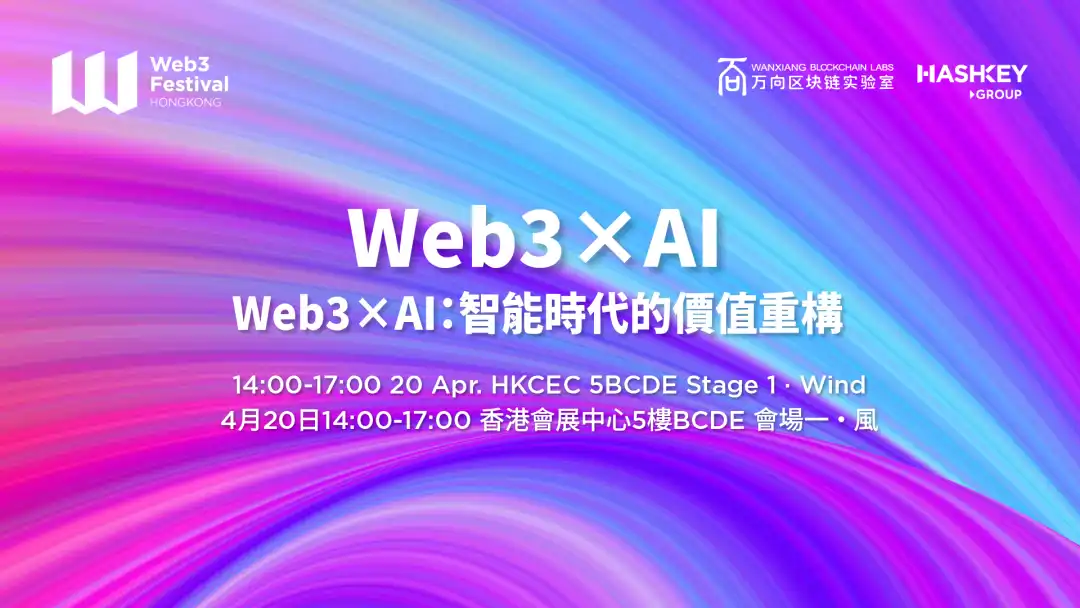
The 2026 Hong Kong Web3 Carnival will host a pivotal forum titled "Web3×AI: Value Reconstruction in the Intelligent Era" on the afternoon of April 20. This event brings together global pioneers in AI and Web3 to explore the deep integration of these transformative technologies. Discussions will cover topics ranging from Silicon Valley’s innovative uses of AI lobsters to practical implementation of AI and Web3 beyond the lab. Industry leaders from TON Foundation, Qtum, Cobo, MaxQuant, and Anoma will share insights on security, financial applications, and decentralized AI ecosystems. Key roundtables will address critical questions: Does AI truly need Web3? Experts will debate issues like data privacy, decentralized computing, and value attribution. Another session will focus on AI Agents and the future of human-computer interaction, examining how agentic AI could reshape industries by moving beyond traditional interfaces. This forum aims to cut through the hype and provide actionable insights into how AI and Web3 can move from technological overlap to symbiotic value creation.

The explosive popularity of OpenClaw has ignited a "national shrimp farming" trend. When the "intelligent emergence" of artificial intelligence meets the "trust machine" of Web3 head-on, what we are ushering in is far more than just a technological overlay—it is a profound revolution in value creation, distribution, and revaluation. When AI Agents make interfaces "disappear," what is the ultimate form of human-computer interaction? Does AI really need Web3?

On the afternoon of April 20th, Venue 1·Feng at the 2026 Hong Kong Web3 Carnival will host the "Web3 x AI: Value Reconstruction in the Intelligent Era" thematic forum. It will bring together pioneering forces from the global AI and Web3 fields, from the "lobster secrets" at the Silicon Valley frontier to the underlying logic of enterprise practice, from practical experience in security collaboration to future previews of human-machine symbiosis. It will provide in-depth analysis and forward-looking insights, exploring the new possibilities of Web3 and AI integration in the intelligent era.

Silicon Valley AI tech blogger Lang Hanwei will reveal what Silicon Valley is using lobsters for, decoding the wildest cutting-edge trends overseas from a unique tech blogger's perspective. John, Head of Asia-Pacific at TON Foundation, will share innovative explorations of TON ecosystem and AI collaboration. Qtum Co-founder Miguel Palencia will break down how to drive AI and Web3 from the "lab" to the "application field," building efficient and collaborative technical bridges for developers and enterprises.

Cobo Co-founder and CTO Changhao Jiang, based on practical experience, will thoroughly explain the collaboration between Web3 security and AI, safeguarding the steady progress of the integrated ecosystem. MaxQuant CEO Jeffery Zeng will focus on the innovative application of AI technology in asset analysis and risk control, showcasing the new value of finance and technology integration. Anoma Co-founder Adrian Brink will also explore the future blueprint of AI and Web3 symbiosis, leading the decentralized ecosystem to new intelligent heights.

In addition to keynote speeches that address core issues, high-quality roundtable discussions will bring together industry elites to discuss the central topics of current AI and Web3 integration.

On one side is AI's centralized reliance on data, computing power, and models; on the other is Web3's pursuit of decentralization, privacy, and rights confirmation. Are the two naturally complementary, or is it a "forced match"? Hosted by Gen Labs Limited CEO He Xiaoyang, alongside guests including Keywolf, Partner and Product Head of SlowMist, and Michael Yung, Strategic Advisor at Google Cloud, the roundtable discussion "Does AI Really Need Web3?" will take place. From data privacy and decentralized computing power to value rights, it will dissect the complementary space between AI and Web3, explore possible paths from "technological overlay" to "value symbiosis," and interpret the new changes in Web3 security in the AI era.

As AI Agents rapidly penetrate various industries, human-computer interaction is undergoing a revolution of "disappearing interfaces." From the "you-click, I-search" GUI, to the "you-say, I-do" conversational interface, and further to the "you-think, I-act" autonomous Agent, what exactly does the ultimate form of human-computer interaction look like? Guests including Zolo Xiong, Co-founder of Deep Chao TechFlow, KK, COO of Virtuals Protocol, Cindy Shi, CMO of Kite AI, and Bob, CEO of Questflow, will discuss topics such as the autonomy of AI Agents, user incentives, and experience. They will break down how AI Agents are breaking the boundaries of traditional human-computer interaction and reconstructing new paradigms for production, life, and industrial operations.

Value reconstruction in the intelligent era does not wait for bystanders; the best opportunities are always reserved for those who are present. This time, stand shoulder-to-shoulder with top global tech guests, penetrate the fog of technology, decode the core secrets of Web3 and AI integration, and jointly discover new possibilities for value in the intelligent era.


Domande pertinenti

QWhat is the main theme of the 'Web3×AI: Value Reconstruction in the Intelligent Era' forum at the 2026 Hong Kong Web3 Festival?

AThe forum focuses on the convergence of AI and Web3 technologies, exploring how their integration can revolutionize value creation, distribution, and re-evaluation, featuring discussions on AI agents, decentralized ecosystems, security, and practical applications.

QWhich speakers will discuss the practical implementation of AI and Web3 technologies moving from 'laboratory to application field'?

AMiguel Palencia, Co-founder of Qtum, will address how to drive AI and Web3 from the 'laboratory' to the 'application field,' building efficient technical bridges for developers and enterprises.

QWhat specific topic will Changhao Jiang, CTO of Cobo, cover regarding AI and Web3 integration?

AChanghao Jiang will share practical experiences on the synergy between Web3 security and AI, focusing on safeguarding the robust development of the integrated ecosystem.

QWhat is the central debate question in the roundtable discussion 'Does AI Really Need Web3?'

AThe roundtable debates whether AI's centralized reliance on data, computing power, and models is naturally complementary or fundamentally incompatible with Web3's pursuit of decentralization, privacy, and value attribution.

QHow will the panel on AI Agents address the evolution of human-computer interaction?

AThe panel, featuring experts like Zolo Xiong and KK, will discuss how AI Agents are transforming interaction from GUI to conversational interfaces and autonomous agents, breaking traditional boundaries and reshaping paradigms in production and daily life.

Letture associate

BIT Research: Liquidity is Disappearing, Will Bitcoin Replay the Bottoming Pattern of 2022?

The crypto market is currently in an adjustment phase driven by policy expectations and liquidity shifts. Despite a brief rebound fueled by geopolitical easing and SpaceX's strong IPO performance, unexpectedly hawkish signals from new Fed Chair Kevin Warsh have removed anticipated easing support. Concurrently, stablecoin liquidity is shrinking, with insufficient new capital inflows, pushing the market into a typically quiet summer period. Pricing lacks catalysts for a sustained rally. Daily trading volume has significantly contracted, stablecoin growth has slowed markedly, and the supportive effect of Strategy's (formerly MicroStrategy) STRC preferred stock-financed Bitcoin purchases is fading. Amid policy uncertainty, seasonal weakness, and liquidity contraction, Bitcoin faces near-term downward pressure. Warsh's hawkish pivot and refusal to provide a clear policy outlook have increased risk premiums, historically unfavorable for Bitcoin. Technically, the trend remains bearish below $73,700, with $62,446 as critical support. A break below could accelerate declines, though a prolonged consolidation phase, similar to 2022's bottoming process, is possible. Liquidity is a core constraint. Current daily volume is around $500 billion, roughly 25% of the peak during the July-Oct 2025 rally. The 12-month growth rates for USDT and USDC have fallen to ~20%, with 6-month growth near zero, indicating weak new inflows. Bitcoin ETF and Strategy-driven inflows have also weakened, with a 30-day rolling net outflow. With inflation at 4.2% above the Fed's target, combined hawkish policy, seasonal factors, and liquidity shortages challenge Bitcoin's ability to hold above $60,000. However, this adjustment phase may be forming a cyclical low this summer, potentially setting the stage for the next bull cycle.

marsbit18 min fa

BIT Research: Liquidity is Disappearing, Will Bitcoin Replay the Bottoming Pattern of 2022?

marsbit18 min fa

Who Makes the Best Use of Claude Code? The Answer Might Not Be Programmers

Claude Code Usage Report Summary (Based on ~400k sessions) Core Finding: In agentic programming with Claude Code, a clear division of labor has emerged: humans primarily decide *what* to build (planning decisions), while Claude decides *how* to build it (execution decisions). Key Insights: 1. **Effectiveness is not limited to programmers.** In code-generation tasks, success rates for users in non-technical fields (law, finance, management, research) are nearing those of software engineers. What matters most is the user's domain expertise and understanding of the problem to be solved. 2. **Domain expertise drives success and efficiency.** Sessions where users exhibited "expert" proficiency in the task's domain saw verified success rates double compared to "novice" sessions. Experts also delegated more work per instruction, with Claude executing more actions and producing more output. 3. **AI is amplifying, not replacing, domain knowledge.** Claude Code lowers the *implementation* barrier, not the *judgment* barrier. The value of knowing the "what" and "why" is increasing relative to just knowing the "how" to code. 4. **Usage is evolving.** Over a 7-month period (Oct '25 - Apr '26), the share of sessions for debugging halved, while use for software operations, data analysis, and non-code writing roughly doubled. The estimated economic value of typical tasks increased by ~25%. Conclusion: The data suggests coding agents are making programming background less critical for completing technical tasks. However, they reward and amplify deep domain understanding. The ability to successfully direct an AI agent stems more from mastery of a specific field than from coding skill itself. The primary gains come from being competent in a domain; deep specialization adds only marginal additional advantage. This may signal a shift where software creation becomes integrated into various professions.

marsbit53 min fa

Who Makes the Best Use of Claude Code? The Answer Might Not Be Programmers

marsbit53 min fa

Trading

Spot
Futures
活动图片