From Fragmented Components to the Super Layer

marsbitPubblicato 2026-01-27Pubblicato ultima volta 2026-01-27

Introduzione

In recent developments within the decentralized social space, Farcaster and Lens have both undergone significant strategic transitions, highlighting a broader shift toward platformization and operational specialization. Farcaster’s co-founder announced that Neynar, a major infrastructure provider and client, will acquire the protocol. This move reflects a growing consensus that long-term sustainability depends less on protocol-level iteration and more on professionalized infrastructure and execution. Neynar has abstracted away the complexity of running hubs and provides APIs that allow developers to focus on product development rather than protocol mechanics. Similarly, Lens announced that Mask Network will take over as the protocol’s next “steward,” shifting focus from infrastructure to consumer-facing products. Both Lens and Aave emphasized that the transition involves no change in ownership or governance—only a reallocation of responsibility toward productization and user experience. These cases illustrate that as protocols mature into platforms, the key challenge is no longer adding features, but clearly defining roles and optimizing the full operational stack—infrastructure, tooling, and distribution. The trend points toward the emergence of “super layers,” where tightly integrated technical and operational capabilities become essential to compete at scale. The movement signals that Web3 is entering an era of mature ecosystem competition, where independent teams and ...

Author: JayLovesPotato

Compiled by: Block unicorn

Over the past few days, a series of protocol announcements—along with Vitalik's comments—have reignited discussions in the decentralized social space. While these events may seem isolated, together they clearly indicate that the platformization of protocols is now advancing in a "strategic" manner.

1. The News and the Strategic Context Behind Them
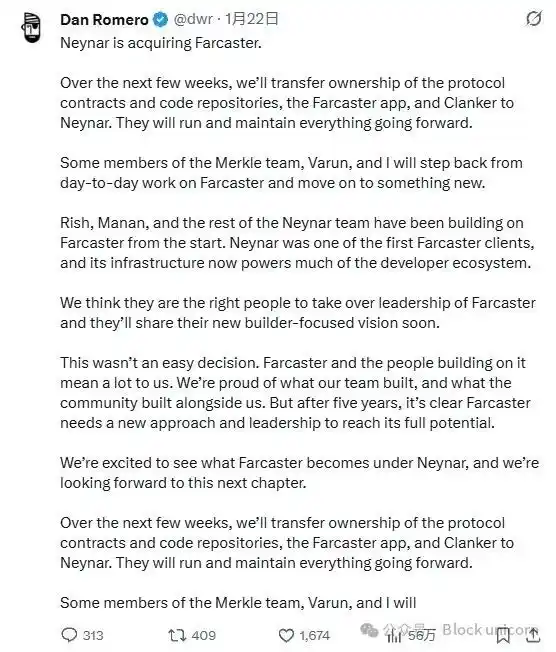
Last Wednesday, Dan Romero, co-founder of the decentralized social platform Farcaster, announced that Neynar, one of Farcaster's earliest and most influential clients, would acquire Farcaster. As part of this transition, ownership of the protocol contracts, core codebase, official applications, and (even) Clanker would be transferred in phases. Meanwhile, Romero noted that the founding team would step back from daily operations to focus on new projects.

Behind Farcaster's decision seems to be a growing internal consensus: the long-term sustainability of social protocols relies less on continuous iteration at the protocol design level and more on increasingly specialized infrastructure and operational execution capabilities at the current stage.

In practice, this means control naturally shifts to infrastructure providers who have successfully aggregated developer resources and traffic—Neynar has been emphasizing the cost and complexity of running Farcaster's hub servers since 2024, abstracting these challenges into APIs and infrastructure layers so developers can focus on product development rather than grappling with protocol internals.
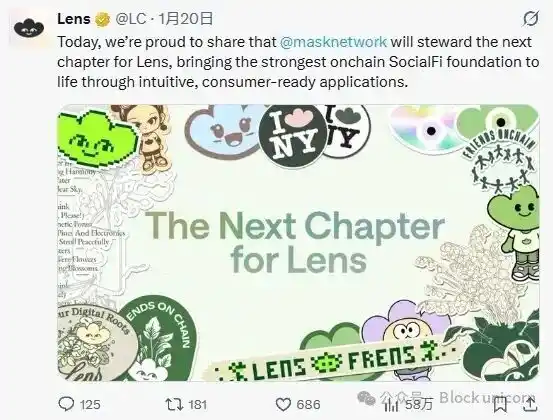
In contrast, Lens has adopted a more advanced—though conceptually aligned with Farcaster—approach. With a relatively richer set of tools, resources, and a mature user base, Lens has chosen to push further in the operational direction.

On January 20, 2026, Lens Labs officially announced that Mask Network would take on the role of "steward" for the next phase of Lens, shifting the project's focus from infrastructure building to consumer-facing products. Mask, for its part, stated that the move aims to translate the protocol's proven achievements into experiences accessible to the mass market.

Notably, both Lens and Aave specifically emphasized that this transition does not involve changes to ownership, financial structure, or governance. The focus is not on the acquisition itself but on a clear reallocation of responsibilities—specifically, who is responsible for turning the protocol into a product people use daily.

2. The Key to Platformization Lies in Clear Role Division

From a broader perspective, both cases point to the same conclusion: as protocols evolve into platforms, the key requirement is no longer adding more features but clearly dividing roles and responsibilities—i.e., how to efficiently optimize the complete operational stack required by a platform, including infrastructure resources, developer onboarding tools, distribution capabilities, and more.

Neynar's core value in the Farcaster ecosystem lies in standardizing social data and user behavior through APIs. Neynar enables developers to immediately start experimenting with products without dealing with the complexities of hub operations or the protocol level. Thus, this acquisition marks Neynar's entry into the next stage—enhancing Farcaster's development and operational layer by integrating the protocol itself.

Lens, though it followed a different path, ultimately landed in a similar framework. With Lens Chain and V3 already establishing the foundational architecture, the next challenge is no longer building more protocols but delivering consumer experiences that users truly engage with daily. The partnership with Mask Network is precisely aimed at bridging this gap.

3. The Battle of the Super Layers

In fact, the integration and consolidation of protocols are not new. Similar patterns have emerged in the Web2 and Web2.5 spaces since around 2025. Wallet providers, crypto payment companies, exchanges, and infrastructure providers are increasingly seeking to integrate adjacent services or make acquisitions to achieve vertical expansion and build so-called "super layers."

However, the most important aspect is not the range of functions these players are trying to bundle. Instead, the decisive shift lies in how they carefully design the integration—selecting the technology stack and operational platforms to integrate based on clearly defined target audiences.

The Neynar–Farcaster and Mask–Lens cases show that the Web3 ecosystem is also moving beyond the stage of loosely connected experimental protocols into an era of large-scale network ecosystems, where organization, operations, and technology are tightly interwoven. Even in the realm of building an open internet, Web3 product teams, long constrained by founder-centric, semi-closed structures, now face the reality of competition: independent team structures, clear division of responsibilities, and the ability to operate products long-term are no longer optional but essential.

Looking ahead, the market dynamics around building super layers (spanning both Web2 and Web3) are likely to become more strategic and more intense.

Crypto di tendenza

Domande pertinenti

QWhat is the strategic shift behind Farcaster's acquisition by Neynar?

AThe strategic shift is that the long-term sustainability of social protocols relies more on specialized infrastructure and operational execution rather than continuous iteration at the protocol design level. Control naturally transfers to infrastructure providers like Neynar, which abstracts away the complexity and cost of running hubs, allowing developers to focus on product development.

QHow does the Lens and Mask Network partnership differ from a traditional acquisition?

AThe partnership does not involve changes in ownership, financial structure, or governance. The focus is on a clear reallocation of responsibility—specifically, who is responsible for turning the protocol into a product that people use daily, rather than a merger or acquisition itself.

QWhat is the core value that Neynar provides to the Farcaster ecosystem?

ANeynar's core value lies in standardizing social data and user behavior through APIs, enabling developers to immediately start product experiments without dealing with the complexities of hub operations or the protocol layer.

QWhat broader trend do the Farcaster and Lens cases indicate about Web3 ecosystem evolution?

AThey indicate that the Web3 ecosystem is moving beyond loosely connected experimental protocols into an era of large-scale network ecosystems where organization, operations, and technology are tightly interwoven, with clear role divisions and long-term operational capabilities becoming essential.

QWhat is meant by the 'super layer' in the context of Web2 and Web3?

AThe 'super layer' refers to the trend where providers (like wallets, exchanges, infrastructure companies) integrate adjacent services or make acquisitions to achieve vertical expansion, building comprehensive platforms that bundle functionalities based on carefully selected tech and operational stacks for specific target audiences.

Letture associate

Uncertainty persists regarding cryptocurrency regulation, and there is a possibility of delay in passing the Clarity Act! Here are the details

The U.S. Senate's vote on the CLARITY Act, which aims to establish a legal framework for the crypto market, faces a potential delay. Priority on the Senate agenda is being given to a Russia sanctions bill and confirmations of federal officials, making a vote on the crypto bill after next week increasingly likely. Senate tradition of handling only one contentious bill at a time further complicates early consideration of the CLARITY Act. Key political disagreements persist, notably over provisions to restrict cryptocurrency trading by senior government officials and elected representatives, including potentially former President Donald Trump. A bipartisan consensus has not been reached. This uncertainty raises doubts about whether a vote can occur before the Senate's August recess. If disputes intensify, the bill's passage could be jeopardized not only for this year but potentially until 2026. Even if the Senate approves the bill, it would still require a revote in the House of Representatives and the President's signature to become law, potentially prolonging the establishment of a comprehensive regulatory framework long awaited by the crypto industry. The Clarity Act is considered crucial for clarifying which agencies will oversee digital assets, defining their legal status, and setting operational principles. Industry advocates argue its passage would boost institutional investor confidence and strengthen the U.S. position in the global digital asset market.

cryptonews.ru3 min fa

Uncertainty persists regarding cryptocurrency regulation, and there is a possibility of delay in passing the Clarity Act! Here are the details

cryptonews.ru3 min fa

SWIFT Shared Ledger Launches Live Pilot, How Will the 50-Year-Old Payment Network Reconstruct the Financial System?

SWIFT, a global financial messaging provider with a 50-year history, has launched a live pilot of a blockchain-based "shared ledger" in July 2026, involving 17 major banks. This marks a direct move by traditional finance to upgrade its core payment infrastructure using blockchain technology, transforming SWIFT's role from a messaging channel to a "value orchestration layer" for digital payments. The system is built on Hyperledger Besu (EVM-compatible) and integrates Chainlink's CCIP for cross-chain interoperability. It deepens the fusion of the ISO 20022 messaging standard with smart contracts to automate compliance (KYC/AML). The primary settlement medium in this network is "tokenized deposits"—digital representations of traditional bank deposits, not independent stablecoins—preserving the existing two-tier banking system. The move introduces "atomic settlement" (24/7, instant) but requires banks to adopt "pre-funding" models, increasing demands on liquidity management. It presents direct competitive pressure on native blockchain payment tokens (e.g., XRP) by offering an efficient, bank-backed alternative for cross-border settlement. Significant regulatory hurdles remain, including legal jurisdiction over cross-border digital assets, legal definitions of "settlement finality" for smart contracts, and balancing blockchain transparency with data privacy/localization laws. Technologies like zero-knowledge proofs may be needed to resolve privacy-compliance conflicts. Industry views are mixed: participating banks and SWIFT emphasize extending trusted, compliant finance into the digital realm with real-time efficiency, while crypto analysts warn of potential "liquidity backlash" as capital flows back to the traditional, now-tech-enhanced banking system. This pilot signifies that traditional finance and crypto are entering a phase of direct competition and fusion at the infrastructure level, likely leading to a future of interconnected, highly regulated financial networks rather than a fully decentralized system.

marsbit13 min fa

SWIFT Shared Ledger Launches Live Pilot, How Will the 50-Year-Old Payment Network Reconstruct the Financial System?

marsbit13 min fa

Trading

Spot

Articoli Popolari

Come comprare LAYER

Benvenuto in HTX.com! Abbiamo reso l'acquisto di Solayer (LAYER) semplice e conveniente. Segui la nostra guida passo passo per intraprendere il tuo viaggio nel mondo delle criptovalute.Step 1: Crea il tuo Account HTXUsa la tua email o numero di telefono per registrarti il tuo account gratuito su HTX. Vivi un'esperienza facile e sblocca tutte le funzionalità,Crea il mio accountStep 2: Vai in Acquista crypto e seleziona il tuo metodo di pagamentoCarta di credito/debito: utilizza la tua Visa o Mastercard per acquistare immediatamente SolayerLAYER.Bilancio: Usa i fondi dal bilancio del tuo account HTX per fare trading senza problemi.Terze parti: abbiamo aggiunto metodi di pagamento molto utilizzati come Google Pay e Apple Pay per maggiore comodità.P2P: Fai trading direttamente con altri utenti HTX.Over-the-Counter (OTC): Offriamo servizi su misura e tassi di cambio competitivi per i trader.Step 3: Conserva Solayer (LAYER)Dopo aver acquistato Solayer (LAYER), conserva nel tuo account HTX. In alternativa, puoi inviare tramite trasferimento blockchain o scambiare per altre criptovalute.Step 4: Scambia Solayer (LAYER)Scambia facilmente Solayer (LAYER) nel mercato spot di HTX. Accedi al tuo account, seleziona la tua coppia di trading, esegui le tue operazioni e monitora in tempo reale. Offriamo un'esperienza user-friendly sia per chi ha appena iniziato che per i trader più esperti.

331 Totale visualizzazioniPubblicato il 2025.02.11Aggiornato il 2026.06.02

Come comprare LAYER

Discussioni

Benvenuto nella Community HTX. Qui puoi rimanere informato sugli ultimi sviluppi della piattaforma e accedere ad approfondimenti esperti sul mercato. Le opinioni degli utenti sul prezzo di LAYER LAYER sono presentate come di seguito.

活动图片