From ETH to SOL: Why Will L1s Ultimately Lose to Bitcoin?

coinvoicePubblicato 2025-12-08Pubblicato ultima volta 2025-12-08

Introduzione

The article "From ETH to SOL: Why L1s Will Ultimately Lose to Bitcoin?" argues that Bitcoin (BTC) is increasingly dominating the "cryptomoney" narrative, leaving little room for other Layer-1 (L1) blockchains to compete for monetary premium. The core of the argument is that approximately 81% of the total crypto market cap is invested in assets viewed as money or potential money, with BTC alone accounting for 55%. While L1s like ETH, XRP, BNB, and SOL represent a significant portion of the remaining value, their valuations are not primarily driven by revenue or real economic activity. Data shows that L1 revenues have been declining annually, yet their price-to-earnings ratios have soared, suggesting their market caps are almost entirely propped up by speculation on future monetary premium, not fundamentals. The performance of L1s against BTC further supports this. Since December 2022, eight of the top ten L1s have underperformed BTC, with six lagging by over 40%. Solana (SOL) was a notable exception, outperforming BTC by 87%. However, this gain is put into perspective by its ecosystem's explosive growth: a ~3,000% increase in DeFi TVL, fees, and DEX volume. This indicates that an L1 must achieve astronomical, orders-of-magnitude growth to merely eke out a modest performance lead over BTC. The conclusion is that the trend of BTC consolidating monetary premium at the expense of L1s is irreversible. The narrative that an L1 could become "money" is losing credibility as investo...

Original Title:Can L1s Compete Against BTC as Cryptomoney?

Original Author: AvgJoesCrypto, Messari

Original Compilation: Dingdang, Odaily Planet Daily

Editor's Note: Recently, Haseeb Qureshi, a well-known partner at Dragonfly, published a lengthy article rejecting cynicism and embracing exponential thinking, unexpectedly bringing the community discussion back to the core issue: How much value do L1s really have left? The following content is excerpted from the upcoming "The Crypto Theses 2026" by @MessariCrypto, compiled by Odaily Planet Daily.

Cryptocurrency Drives the Entire Industry

It is crucial to refocus the discussion on "cryptocurrency" itself, as most capital in the crypto industry is ultimately seeking exposure to "monetized assets." The total market capitalization of the crypto market is currently $3.26 trillion, with BTC accounting for $1.80 trillion, or 55%. Of the remaining $1.45 trillion, approximately $0.83 trillion is concentrated in various L1 public chains. This means that about $2.63 trillion, or roughly 81% of the entire market's capital, is invested in assets that the market already views as money or believes may gain a monetary premium in the future.
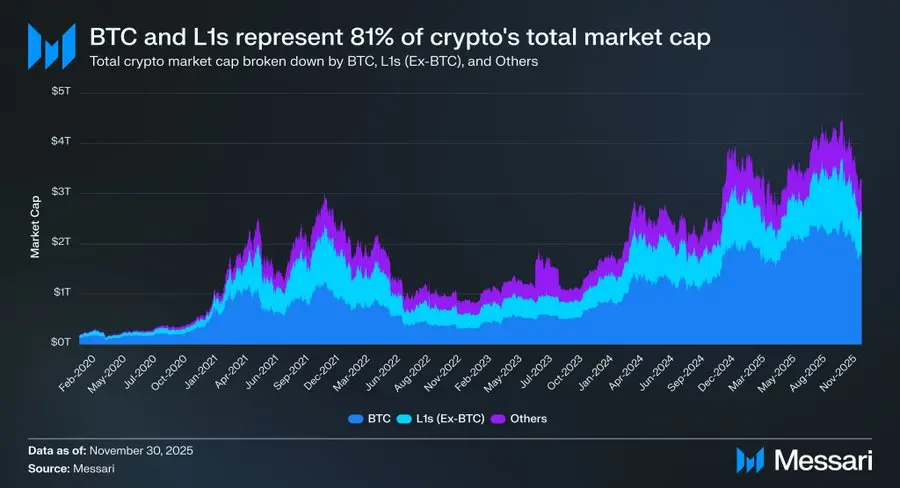
In this context, whether you are a trader, investor, capital manager, or developer, understanding how the market assigns or withdraws monetary premiums is essential. In the crypto industry, nothing drives valuation changes more than the market's willingness to view an asset as "money." Therefore, predicting which assets will gain monetary premiums in the future is arguably the most critical variable when building an investment portfolio.

So far, we have focused primarily on BTC, but it is also necessary to discuss those L1 assets among the remaining $0.83 trillion that "may or may not be money." As mentioned earlier, we expect BTC to continue capturing market share from gold and other non-sovereign stores of value in the coming years. But this raises a question: How much room is left for L1s? When the tide rises, will all boats (assets) rise (benefit)? Or will BTC, in its pursuit of gold, also absorb some of the monetary premium from L1 public chains?
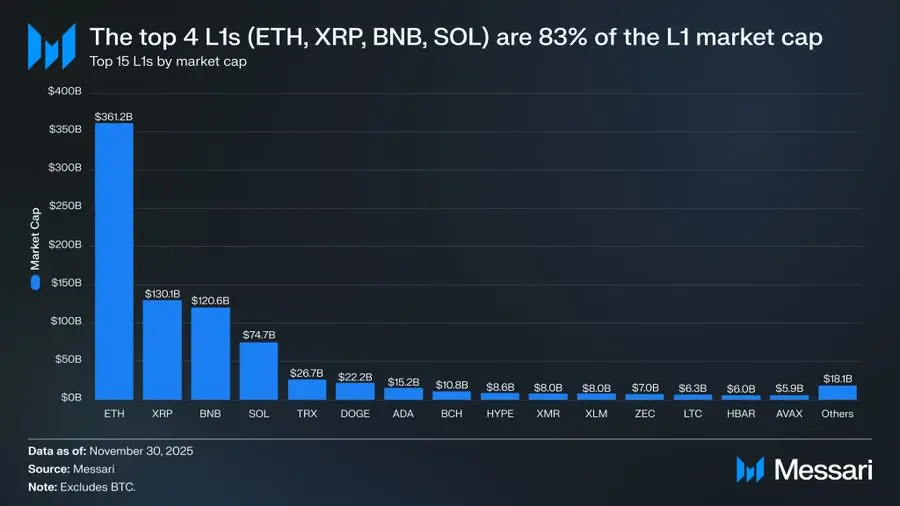
To answer these questions, we first need to look at the current valuation landscape of L1s. The top four L1s by market cap—ETH ($361.15 billion), XRP ($130.11 billion), BNB ($120.64 billion), and SOL ($74.68 billion)—have a combined market cap of $686.58 billion, accounting for 83% of the entire L1 sector. After these top four, there is a significant gap in market cap (e.g., TRX at $26.67 billion), but the tail end still holds considerable value. The total market cap of L1s outside the top 15 is still $18.06 billion, representing 2% of the total L1 market cap.

More importantly, L1 market cap is not equivalent to pure "monetary premium." There are three main valuation frameworks for L1s:

(i) Monetary Premium

(ii) Real Economic Value (REV)

(iii) Economic Security Demand

Therefore, a project's market cap is not solely determined by the market viewing it as money.

What Drives L1 Valuations Is Monetary Premium, Not Revenue

Despite the existence of multiple valuation frameworks, the market is increasingly inclined to evaluate L1s from the perspective of "monetary premium" rather than a "revenue-driven" angle. Over the past few years, the overall price-to-earnings (P/E) ratio for all L1s with a market cap exceeding $1 billion has generally remained between 150x and 200x. However, this aggregate data is misleading because it includes TRON and Hyperliquid. Over the past 30 days, TRX and HYPE contributed 70% of the revenue in this group but accounted for only 4% of the total market cap.
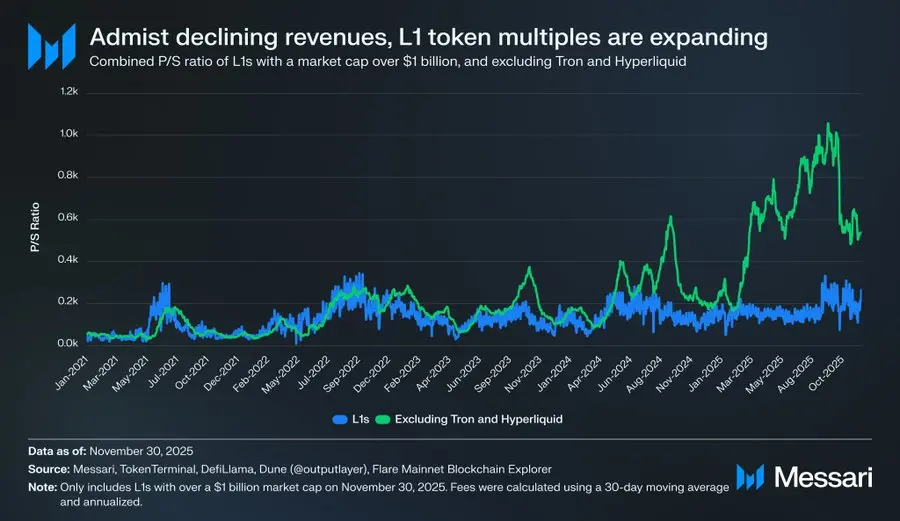
After removing these two outliers, the real story emerges. Despite continuously declining revenue, L1 valuations are rising. The adjusted P/E ratio shows a clear upward trend:

· November 30, 2021: 40x

· November 30, 2022: 212x

· November 30, 2023: 137x

· November 30, 2024: 205x

· November 30, 2025: 536x

If interpreted from an REV perspective, one might argue that the market is pricing in future revenue growth. However, this explanation does not hold, as revenue for the same group (still excluding TRON and Hyperliquid) has declined almost every year:

· 2021: $12.33 billion

· 2022: $4.89 billion (YoY -60%)

· 2023: $2.72 billion (YoY -44%)

· 2024: $3.55 billion (YoY +31%)

· 2025: Annualized $1.70 billion (YoY -52%)

In our view, the simplest and most straightforward explanation is: These valuations are primarily driven by monetary premium, not current or future revenue.

L1s Have Consistently Underperformed Bitcoin

If L1 valuations are primarily driven by the market's expectation of their monetary premium, the next question is: What shapes this expectation? A simple method is to compare their price performance with BTC's. If changes in monetary premium mainly reflect BTC's movements, these assets should perform similarly to BTC's "beta coefficient"; if the monetary premium comes from each L1's unique factors, their correlation with BTC should be weaker, and their performance should be more idiosyncratic.
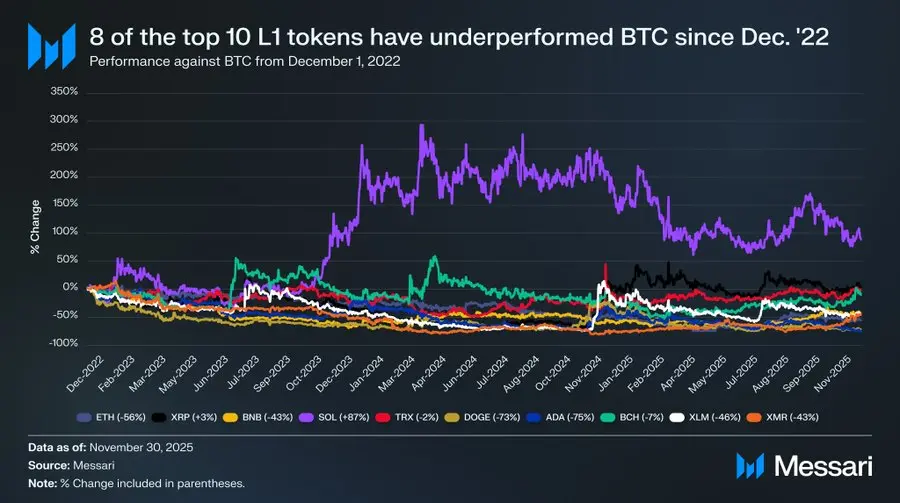
As representatives of L1s, we selected the top ten L1 tokens by market cap (excluding HYPE) and measured their performance relative to BTC since December 1, 2022. These ten assets represent about 94% of the L1 market cap, making them highly representative. During this period, eight assets underperformed BTC in absolute returns, with six lagging by more than 40%. Only two assets outperformed BTC: XRP and SOL. However, XRP's excess return was only 3%, and given its history of being driven by retail capital, we will not overinterpret this. The only asset with significant excess returns was SOL, which beat BTC by 87%.
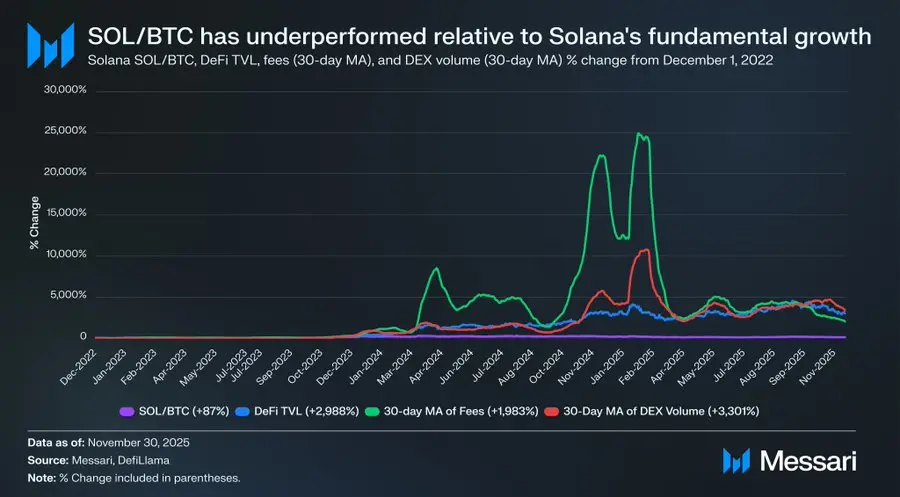
But upon closer examination, SOL's "outperformance" may not be as strong as it appears. During the same period that SOL outperformed BTC by 87%, Solana's fundamentals experienced exponential growth: DeFi TVL increased by 2,988%, fees grew by 1,983%, and DEX trading volume surged by 3,301%. By any reasonable measure, the Solana ecosystem expanded by 20 to 30 times since the end of 2022, yet SOL's price only outperformed BTC by 87%.

Please read that sentence again.

To achieve truly significant excess returns against BTC, an L1 doesn't need ecosystem growth of 200% or 300%—it needs growth of 2,000%-3,000% just to barely gain a few dozen percentage points of outperformance.

Combining the above, our judgment is: Although the market still prices L1s based on the expectation that they "may gain monetary premium in the future," confidence in these expectations is quietly waning. Meanwhile, the market's monetary premium for BTC as "cryptomoney" remains unshaken, and one could even argue that BTC's lead over various L1s is continuously widening.

Although cryptocurrency itself does not require fees or revenue to support its valuation, these metrics are crucial for L1s. Unlike BTC, the narrative for L1s depends on building an ecosystem (applications, users, throughput, economic activity, etc.) to support their token value. However, if an L1's ecosystem is showing annual declines (partly reflected in decreasing revenue and fees), it loses its only competitive advantage relative to BTC. Without real economic growth, its "cryptomoney" story becomes increasingly difficult for the market to accept.

Looking Ahead

Looking ahead, we do not believe this trend will reverse in 2026 or beyond. With few possible exceptions, we expect the L1 sector to continue losing market share, further squeezed by BTC. Since their valuations primarily rely on expectations of future monetary premium, as the market gradually concludes that BTC has the strongest claim to the "cryptomoney" narrative, L1 valuations will continue to contract. Although BTC will also face challenges in the coming years, these issues remain too distant and variable to provide effective support for the monetary premium of competing L1s.

For L1s, the bar for proving their value has been raised. Their narratives are no longer sufficiently attractive compared to BTC's, nor can they rely on market euphoria to support their valuations long-term. The era when the story of "we might become money in the future" could support trillion-dollar market caps is closing. Investors now have a decade of data proving that an L1's monetary premium can only be sustained when the ecosystem experiences extreme growth. Once growth stalls, L1s will consistently underperform BTC, and the monetary premium will dissipate.


Domande pertinenti

QWhat percentage of the total crypto market capitalization is currently held by assets that the market views as or expects to become monetized assets?

AApproximately 81% of the total market capitalization, or about $2.63 trillion, is held in assets the market views as money or expects to gain a monetary premium.

QAccording to the article, what are the three main valuation frameworks for Layer-1 (L1) blockchains?

AThe three main valuation frameworks for L1s are: (i) Monetary Premium, (ii) Real Economic Value (REV), and (iii) Economic Security Demand.

QWhat trend does the article identify regarding the price-to-earnings (P/E) ratios of major L1s when excluding outliers like TRON and Hyperliquid?

AThe article identifies a clear upward trend in the adjusted P/E ratios of major L1s, rising from 40x in November 2021 to 536x in November 2025, even as their revenues have been declining.

QWhich was the only major L1 asset that significantly outperformed Bitcoin (BTC) in terms of price performance from December 2022, and by what percentage?

ASolana (SOL) was the only major L1 that significantly outperformed Bitcoin, beating it by 87%.

QWhat is the article's primary conclusion about the future trend of L1 valuations relative to Bitcoin?

AThe article concludes that the trend of L1s losing market share to Bitcoin will not reverse; it expects the L1 sector to continue being squeezed by BTC as the market increasingly sees Bitcoin as having the strongest claim to the 'cryptomoney' narrative, causing L1 valuations to contract.

Letture associate

Anthropic Starts Poaching Scientists? $27K Weekly Onsite Stipend to Fix Claude's Expert-Level Errors

Anthropic has launched a new STEM Fellow program, offering $3,800 per week for a three-month, in-person residency in San Francisco. The role targets experts from science, technology, engineering, and mathematics (STEM) fields—machine learning experience is helpful but not required. Instead, Anthropic values scientific judgment and a willingness to learn quickly. Fellows will work with Claude models and internal tools under the guidance of an Anthropic researcher. Example projects include a materials scientist identifying errors in Claude’s reasoning or a climate scientist integrating atmospheric modeling software with Claude. The goal is to have experts "tell Claude where it's wrong" and improve its scientific capabilities. This initiative is part of Anthropic’s broader strategy to strengthen its scientific ecosystem, following earlier programs like the AI Safety Fellows and AI for Science programs. The company acknowledges that current AI models, while powerful, still produce high-confidence errors and lack end-to-end research autonomy. The program aims to embed domain expertise directly into model development, turning scientists into "high-level reviewers" for AI. Anthropic CEO Dario Amodei has previously emphasized AI’s potential to accelerate scientific breakthroughs, particularly in biology and healthcare. The company believes that the next phase of AI competition will depend not on scaling parameters, but on integrating human expertise to refine model accuracy and reliability.

marsbit32 min fa

Anthropic Starts Poaching Scientists? $27K Weekly Onsite Stipend to Fix Claude's Expert-Level Errors

marsbit32 min fa

On the Eve of X Money's Launch, Musk Dismantles the Referee First

"X Money Launches After Dismantling Regulator: Musk's 9-Day Power Play" In February 2025, a team from the "Department of Government Efficiency" (DOGE), led by Elon Musk, entered the Consumer Financial Protection Bureau (CFPB) headquarters. Shortly after, the CFPB was effectively dismantled—its funding frozen, activities suspended, and nearly 90% of staff laid off. This move came just nine days after X announced a partnership with Visa and as X Money prepared to launch. The article contrasts this with the decade-long regulatory battles faced by companies like Coinbase and PayPal. Coinbase spent over $75 million in political contributions and endured a major SEC lawsuit to operate legally. PayPal complied with strict state and federal rules for its stablecoin PYUSD, including 100% reserve requirements and monthly audits. However, Musk’s approach was different. After the CFPB introduced a rule placing large digital payment apps under federal oversight, Musk tweeted "Delete CFPB." Within months, the rule was revoked by Congress. Meanwhile, DOGE operatives gained "god-tier" access to CFPB databases, potentially obtaining sensitive competitive information from rivals like Apple, Google, and PayPal. The article also highlights a "suspicious exemption clause" in the GENIUS Act, which allows private companies like X to issue stablecoins with fewer restrictions. Senator Elizabeth Warren questioned whether Musk, who was a senior presidential advisor during the Act’s drafting, influenced this clause. X Money offers a 6% APY on deposits, despite FDIC warnings that stablecoin users are not insured. As X Money launches to 600 million monthly users, the article questions the fairness of a system where Musk can bypass regulations that others spent years and millions to comply with. The dismantling of the CFPB and the alleged regulatory advantages raise concerns about the future of equitable rule-making in the U.S. financial system.

marsbit40 min fa

On the Eve of X Money's Launch, Musk Dismantles the Referee First

marsbit40 min fa

Trading

Spot
Futures

Articoli Popolari

Cosa è BITCOIN

Comprendere HarryPotterObamaSonic10Inu (ERC-20) e la sua posizione nel mondo delle criptovalute Negli ultimi anni, il mercato delle criptovalute ha assistito a un aumento della popolarità delle meme coin, catturando l'interesse non solo dei trader, ma anche di coloro che cercano coinvolgimento comunitario e valore di intrattenimento. Tra questi token unici c'è HarryPotterObamaSonic10Inu (ERC-20), un progetto intrigante che mescola riferimenti culturali nel tessuto delle criptovalute. Questo articolo esplora gli aspetti chiave di HarryPotterObamaSonic10Inu, analizzando i suoi meccanismi, l'etica guidata dalla comunità e il suo coinvolgimento con il panorama crittografico più ampio. Che cos'è HarryPotterObamaSonic10Inu (ERC-20)? Come suggerisce il suo nome, HarryPotterObamaSonic10Inu è una meme coin costruita sulla blockchain di Ethereum, classificata secondo lo standard ERC-20. A differenza delle criptovalute tradizionali che possono enfatizzare l'utilità pratica o il potenziale investimento, questo token prospera grazie al valore di intrattenimento e alla forza della sua comunità. Il progetto mira a creare un ambiente in cui gli utenti coinvolti possono riunirsi, condividere idee e partecipare ad attività ispirate a diversi fenomeni culturali. Una caratteristica notevole di HarryPotterObamaSonic10Inu è la zero tassa sulle transazioni. Questo elemento allettante tende a incoraggiare il trading e il coinvolgimento della comunità, privo di costi aggiuntivi che possono scoraggiare i trader di piccole dimensioni. L'offerta totale della moneta è fissata a un miliardo di token, un numero che segna la sua intenzione di mantenere una circolazione sostanziale all'interno della comunità. Creatore di HarryPotterObamaSonic10Inu (ERC-20) Le origini di HarryPotterObamaSonic10Inu sono avvolte in un certo mistero; i dettagli sul creatore rimangono sconosciuti. Lo sviluppo di questo token non presenta un team identificabile o un piano esplicito, cosa non rara nel settore delle meme coin. Invece, il progetto è emerso organicamente, con il suo progresso fortemente dipendente dall'entusiasmo e dalla partecipazione della sua comunità. Investitori di HarryPotterObamaSonic10Inu (ERC-20) Per quanto riguarda investimenti esterni e finanziamenti, HarryPotterObamaSonic10Inu rimane ambiguo. Il token non elenca alcuna fondazione di investimento conosciuta o un sostegno organizzativo significativo. Invece, la linfa vitale del progetto è la sua comunità di base, che informa la sua crescita e sostenibilità attraverso azioni collettive e coinvolgimento nello spazio crittografico. Come funziona HarryPotterObamaSonic10Inu (ERC-20)? In quanto meme coin, HarryPotterObamaSonic10Inu opera principalmente al di fuori delle strutture tradizionali che governano spesso il valore degli asset. Ci sono diversi aspetti distintivi che definiscono il funzionamento del progetto: Transazioni senza tasse: Senza costi fiscali sulle transazioni, gli utenti possono comprare e vendere liberamente il token senza preoccuparsi di costi nascosti. Coinvolgimento della comunità: Il progetto prospera sull'interazione della comunità, sfruttando le piattaforme social per creare entusiasmo e facilitare il coinvolgimento. Discussioni, condivisione di contenuti e coinvolgimento sono elementi cruciali che aiutano ad espandere la sua portata e a favorire la lealtà tra i sostenitori. Nessuna utilità pratica: Va notato che HarryPotterObamaSonic10Inu non offre un'utilità concreta all'interno dell'ecosistema finanziario. Piuttosto, è classificato come un token principalmente per attività di intrattenimento e comunitarie. Riferimento culturale: Il token incorpora astutamente elementi della cultura pop per attirare interesse, collegandosi a appassionati di meme e seguaci delle criptovalute. HarryPotterObamaSonic10Inu esemplifica come le meme coin operino in modo diverso rispetto ai progetti di criptovalute più tradizionali, entrando nel mercato come costrutti sociali innovativi piuttosto che come asset utilitari. Cronologia di HarryPotterObamaSonic10Inu (ERC-20) La storia di HarryPotterObamaSonic10Inu è segnata da diversi traguardi notevoli: Creazione: Il token è emerso da un meme virale, catturando l'immaginazione di molti appassionati di criptovalute. Le date di creazione specifiche non sono disponibili, sottolineando la sua crescita organica. Inserimento negli scambi: HarryPotterObamaSonic10Inu ha fatto il suo ingresso in vari scambi, consentendo un accesso e un trading più facili da parte della comunità. Iniziative di coinvolgimento della comunità: Attività in corso volte a migliorare l'interazione della comunità, comprese gare, campagne sui social media e generazione di contenuti da parte di fan e sostenitori. Piani di espansione futura: La tabella di marcia del progetto include il lancio di una collezione NFT, merchandising e un sito di eCommerce relativo ai suoi temi culturali, coinvolgendo ulteriormente la comunità e cercando di aggiungere più dimensioni al suo ecosistema. Punti chiave su HarryPotterObamaSonic10Inu (ERC-20) Natura guidata dalla comunità: Il progetto dà priorità al contributo collettivo e alla creatività, garantendo che il coinvolgimento degli utenti sia al centro del suo sviluppo. Classificazione come meme coin: Rappresenta l'epitome delle criptovalute basate sull'intrattenimento, distinguendosi dai veicoli d'investimento tradizionali. Nessuna affiliazione diretta con Bitcoin: Nonostante la somiglianza nel nome del ticker, HarryPotterObamaSonic10Inu è distintivo e non ha alcuna relazione con Bitcoin o altre criptovalute consolidate. Focus sulla collaborazione: HarryPotterObamaSonic10Inu è progettato per creare uno spazio per la collaborazione e la condivisione di storie tra i suoi detentori, fornendo un canale per la creatività e il legame comunitario. Prospettive future: L'ambizione di espandersi oltre il suo presupposto iniziale verso NFT e merchandising delinea un percorso per il progetto per potenzialmente entrare in strade più mainstream all'interno della cultura digitale. Poiché le meme coin continuano a catturare l'immaginazione della comunità crittografica, HarryPotterObamaSonic10Inu (ERC-20) si distingue per i suoi legami culturali e il suo approccio centrato sulla comunità. Anche se potrebbe non adattarsi al modello tipico di un token orientato all'utilità, la sua essenza risiede nella gioia e nella camaraderia coltivate tra i suoi sostenitori, evidenziando la natura in evoluzione delle criptovalute in un'epoca sempre più digitale. Con la continuazione dello sviluppo del progetto, sarà importante osservare come le dinamiche della comunità influenzano la sua traiettoria nel panorama in continuo cambiamento della tecnologia blockchain.

1.1k Totale visualizzazioniPubblicato il 2024.04.01Aggiornato il 2024.12.03

Cosa è BITCOIN

Come comprare BTC

Benvenuto in HTX.com! Abbiamo reso l'acquisto di Bitcoin (BTC) semplice e conveniente. Segui la nostra guida passo passo per intraprendere il tuo viaggio nel mondo delle criptovalute.Step 1: Crea il tuo Account HTXUsa la tua email o numero di telefono per registrarti il tuo account gratuito su HTX. Vivi un'esperienza facile e sblocca tutte le funzionalità,Crea il mio accountStep 2: Vai in Acquista crypto e seleziona il tuo metodo di pagamentoCarta di credito/debito: utilizza la tua Visa o Mastercard per acquistare immediatamente BitcoinBTC.Bilancio: Usa i fondi dal bilancio del tuo account HTX per fare trading senza problemi.Terze parti: abbiamo aggiunto metodi di pagamento molto utilizzati come Google Pay e Apple Pay per maggiore comodità.P2P: Fai trading direttamente con altri utenti HTX.Over-the-Counter (OTC): Offriamo servizi su misura e tassi di cambio competitivi per i trader.Step 3: Conserva Bitcoin (BTC)Dopo aver acquistato Bitcoin (BTC), conserva nel tuo account HTX. In alternativa, puoi inviare tramite trasferimento blockchain o scambiare per altre criptovalute.Step 4: Scambia Bitcoin (BTC)Scambia facilmente Bitcoin (BTC) nel mercato spot di HTX. Accedi al tuo account, seleziona la tua coppia di trading, esegui le tue operazioni e monitora in tempo reale. Offriamo un'esperienza user-friendly sia per chi ha appena iniziato che per i trader più esperti.

3.6k Totale visualizzazioniPubblicato il 2024.12.12Aggiornato il 2025.03.21

Come comprare BTC

Cosa è $BITCOIN

ORO DIGITALE ($BITCOIN): Un'Analisi Completa Introduzione all'ORO DIGITALE ($BITCOIN) L'ORO DIGITALE ($BITCOIN) è un progetto basato su blockchain che opera sulla rete Solana, con l'obiettivo di combinare le caratteristiche dei metalli preziosi tradizionali con l'innovazione delle tecnologie decentralizzate. Sebbene condivida un nome con Bitcoin, spesso definito “oro digitale” a causa della sua percezione come riserva di valore, l'ORO DIGITALE è un token separato progettato per creare un ecosistema unico all'interno del panorama Web3. Il suo obiettivo è posizionarsi come un asset digitale alternativo valido, anche se i dettagli riguardanti le sue applicazioni e funzionalità sono ancora in fase di sviluppo. Cos'è l'ORO DIGITALE ($BITCOIN)? L'ORO DIGITALE ($BITCOIN) è un token di criptovaluta esplicitamente progettato per l'uso sulla blockchain di Solana. A differenza di Bitcoin, che fornisce un ruolo di stoccaggio di valore ampiamente riconosciuto, questo token sembra concentrarsi su applicazioni e caratteristiche più ampie. Aspetti notevoli includono: Infrastruttura Blockchain: Il token è costruito sulla blockchain di Solana, nota per la sua capacità di gestire transazioni ad alta velocità e a basso costo. Dinamiche di Offerta: L'ORO DIGITALE ha un'offerta massima fissata a 100 quadrilioni di token (100P $BITCOIN), sebbene i dettagli riguardanti la sua offerta circolante siano attualmente non divulgati. Utilità: Sebbene le funzionalità precise non siano esplicitamente delineate, ci sono indicazioni che il token potrebbe essere utilizzato per varie applicazioni, potenzialmente coinvolgendo applicazioni decentralizzate (dApp) o strategie di tokenizzazione degli asset. Chi è il Creatore dell'ORO DIGITALE ($BITCOIN)? Attualmente, l'identità dei creatori e del team di sviluppo dietro l'ORO DIGITALE ($BITCOIN) rimane sconosciuta. Questa situazione è tipica tra molti progetti innovativi nel settore blockchain, in particolare quelli allineati con la finanza decentralizzata e i fenomeni delle meme coin. Sebbene tale anonimato possa favorire una cultura guidata dalla comunità, intensifica le preoccupazioni riguardo alla governance e alla responsabilità. Chi sono gli Investitori dell'ORO DIGITALE ($BITCOIN)? Le informazioni disponibili indicano che l'ORO DIGITALE ($BITCOIN) non ha alcun sostenitore istituzionale noto o investimenti di venture capital prominenti. Il progetto sembra operare su un modello peer-to-peer incentrato sul supporto e sull'adozione della comunità piuttosto che su percorsi di finanziamento tradizionali. La sua attività e liquidità si trovano principalmente su exchange decentralizzati (DEX), come PumpSwap, piuttosto che su piattaforme di trading centralizzate consolidate, evidenziando ulteriormente il suo approccio di base. Come Funziona l'ORO DIGITALE ($BITCOIN) Le meccaniche operative dell'ORO DIGITALE ($BITCOIN) possono essere elaborate in base al suo design blockchain e alle caratteristiche della rete: Meccanismo di Consenso: Sfruttando il proof-of-history (PoH) unico di Solana combinato con un modello di proof-of-stake (PoS), il progetto garantisce una validazione efficiente delle transazioni contribuendo all'alta performance della rete. Tokenomics: Sebbene meccanismi deflazionistici specifici non siano stati dettagliati ampiamente, l'ampia offerta massima di token implica che potrebbe soddisfare microtransazioni o casi d'uso di nicchia che devono ancora essere definiti. Interoperabilità: Esiste il potenziale per l'integrazione con l'ecosistema più ampio di Solana, inclusi vari piattaforme di finanza decentralizzata (DeFi). Tuttavia, i dettagli riguardanti integrazioni specifiche rimangono non specificati. Cronologia degli Eventi Chiave Ecco una cronologia che evidenzia traguardi significativi riguardanti l'ORO DIGITALE ($BITCOIN): 2023: Il dispiegamento iniziale del token avviene sulla blockchain di Solana, contrassegnato dal suo indirizzo di contratto. 2024: L'ORO DIGITALE guadagna visibilità poiché diventa disponibile per il trading su exchange decentralizzati come PumpSwap, consentendo agli utenti di scambiarlo contro SOL. 2025: Il progetto assiste a un'attività di trading sporadica e a un potenziale interesse per impegni guidati dalla comunità, sebbene non siano state documentate partnership significative o avanzamenti tecnici fino ad ora. Analisi Critica Punti di Forza Scalabilità: L'infrastruttura sottostante di Solana supporta alti volumi di transazioni, il che potrebbe migliorare l'utilità di $BITCOIN in vari scenari di transazione. Accessibilità: Il potenziale basso prezzo di trading per token potrebbe attrarre investitori al dettaglio, facilitando una partecipazione più ampia grazie a opportunità di proprietà frazionata. Rischi Mancanza di Trasparenza: L'assenza di sostenitori, sviluppatori o di un processo di audit pubblicamente noti potrebbe generare scetticismo riguardo alla sostenibilità e all'affidabilità del progetto. Volatilità del Mercato: L'attività di trading è fortemente dipendente dal comportamento speculativo, il che può comportare una significativa volatilità dei prezzi e incertezze per gli investitori. Conclusione L'ORO DIGITALE ($BITCOIN) emerge come un progetto intrigante ma ambiguo all'interno dell'evolvente ecosistema di Solana. Sebbene tenti di sfruttare la narrativa dell'“oro digitale”, la sua partenza dal ruolo consolidato di Bitcoin come riserva di valore sottolinea la necessità di una chiara differenziazione della sua utilità e struttura di governance. L'accettazione e l'adozione future dipenderanno probabilmente dall'affrontare l'attuale opacità e dalla definizione più esplicita delle sue strategie operative ed economiche. Nota: Questo rapporto comprende informazioni sintetizzate disponibili a ottobre 2023, e potrebbero essersi verificati sviluppi oltre il periodo di ricerca.

99 Totale visualizzazioniPubblicato il 2025.05.13Aggiornato il 2025.05.13

Cosa è $BITCOIN

Discussioni

Benvenuto nella Community HTX. Qui puoi rimanere informato sugli ultimi sviluppi della piattaforma e accedere ad approfondimenti esperti sul mercato. Le opinioni degli utenti sul prezzo di BTC BTC sono presentate come di seguito.

活动图片