FRNT, the First State-Backed Stablecoin in the U.S.: Can It Save Wyoming from Energy Decline?

marsbitPubblicato 2026-01-09Pubblicato ultima volta 2026-01-09

Introduzione

Wyoming, the least populous U.S. state, has launched $FRNT, the first state government-backed dollar stablecoin, issued on Solana and six EVM-compatible chains. This move is a response to a deep fiscal crisis triggered by the decline of its coal industry, which once funded its tax-free status but has seen revenue halve since its peak. Facing an urgent need to diversify, Wyoming is leveraging its history of legislative innovation—like pioneering LLCs in 1977—to become a crypto hub. Previous steps included creating the SPDI banking license for crypto custodians and legalizing DAOs. The $FRNT stablecoin is 102% backed by U.S. Treasuries and cash, managed by Franklin Templeton, with interest funding public education. However, the state suffers from stark inequality. Wealthy enclaves like Jackson Hole contrast with widespread economic hardship, raising questions about who truly benefits from such financial innovations. While aiming to build a digital future from the ashes of coal, Wyoming’s experiment highlights the tension between technological ambition and social reality.

On the map of the United States, Wyoming is often an overlooked "Western asset."

When mentioned, most people's first thought is the erupting Old Faithful in Yellowstone National Park or the perpetual snow atop the Grand Teton peaks.

It is the least populous state in the U.S., with less than 600,000 people living across nearly 260,000 square kilometers—a number even smaller than the population of a distant suburban town in Shanghai.

In literary and cinematic memory, it is the cruel wilderness described by Annie Proulx as "unfixable, only endurable," the mountains that trapped the struggling cowboys in "Brokeback Mountain," and the blood-stained border town besieged by a blizzard in Quentin Tarantino's "The Hateful Eight."

It is contradictory and distinct: deeply conservative, it is the "deepest red" state in the U.S., with the Republican Party monopolizing power for forty years. In the 2024 U.S. election, over 70% of voters cast their ballots for Trump. Yet it has also been at the forefront of progress, becoming the "Equality State" as early as 1869 when it was the first to grant women the right to vote.

But Wyoming is by no means a financial desert. Every summer, the world's "most powerful" people gather here: at the serene Jackson Hole resort in Wyoming, the global central bank annual meeting hosted by the Federal Reserve Bank of Kansas City takes place. From Greenspan (the 13th Chair of the Federal Reserve) to Powell, every key turning point in global monetary policy has been set amidst these snow-capped meadows.

It is this aloof and unique "Western spirit" that once again thrust Wyoming into the spotlight in early 2026.
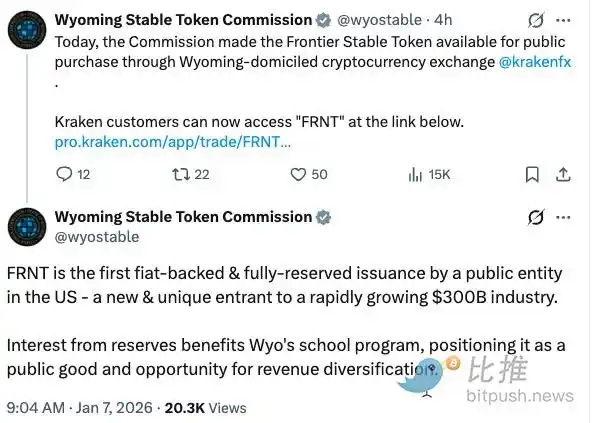
On January 7, local time, the state officially announced the launch of the $FRNT stablecoin, initially released on the Solana blockchain and supporting six EVM-compatible chains. This is the world's first dollar stablecoin backed by "state government credit."

Mining for Light: The Path to Regeneration in Energy Transition

Wyoming's radical move stems from a deep fiscal anxiety: the "underground wealth" that has sustained this land for a century is drying up.

As the energy heartland supplying 40% of the nation's coal, it once created the myth of a "tax-free paradise" through mineral resource taxes: residents pay no personal income tax, and businesses pay no corporate tax.

One key reason is that, thanks to the continuous export of resources from the Powder River Basin, this sparsely populated state generated astonishing wealth: its per capita GDP has long ranked among the top ten in the U.S., rivaling New York and California during peak energy years.

This prosperity once gave Wyoming the confidence to refuse to levy personal income tax, corporate tax, and estate tax. However, this is a fragile prosperity built on heavy industry.
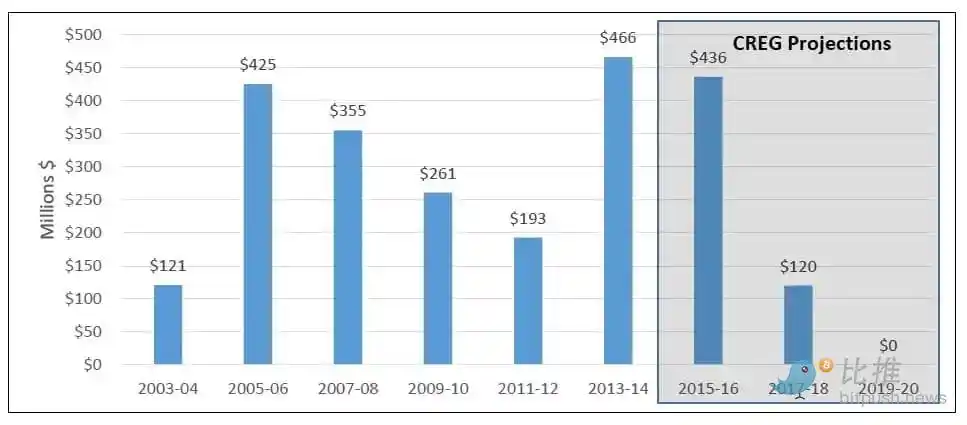
Since 2011, Wyoming's pillar industry began a decade-long "avalanche":

Ruthless market displacement: The rise of low-cost shale gas and renewable energy delivered a crushing blow to coal in terms of power generation costs.

Tightening environmental constraints: The advancement of federal carbon emission regulations (such as the Clean Power Plan) led to the closure of coal-fired power plants across the U.S.

A cliff-like fiscal gap: According to CREG official data cited by Wyoming Public Media, the state's coal resource tax plummeted from $290 million in 2011 to $170 million in 2022. In 2025, the state's coal production is expected to fall to the second-lowest point in history, only half of the peak in 2008. The "coal lease bonuses," once a significant source of school infrastructure funding, have even dropped to zero.
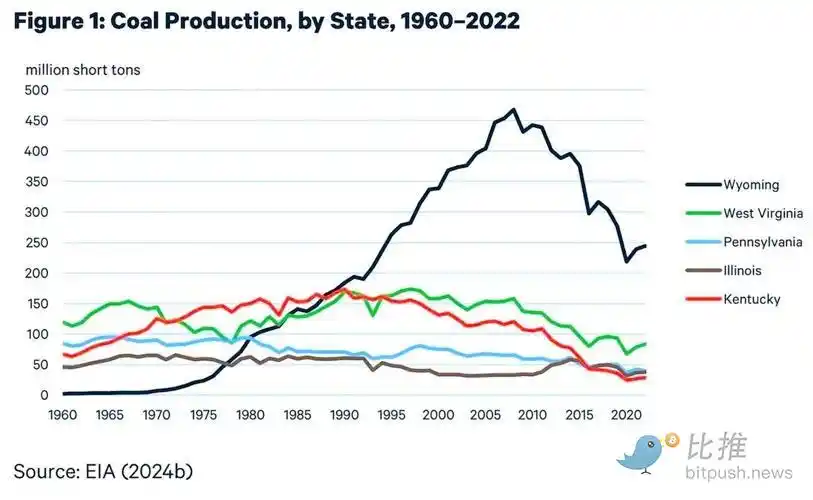
"If we don't shake things up, we'll be the next West Virginia (note: a traditional mining region in the U.S. that became one of the poorest states after the coal industry declined)."—This visceral fear has instilled a sense of urgency even in the most conservative cowboy politicians.

They realized that since they cannot change the trend of energy transition, they must leverage Wyoming's core asset—its extremely liberal business legislation.

In fact, Wyoming's innovative基因 has precedent. In 1977, it pioneered the LLC (Limited Liability Company), now the most popular business entity in the U.S.

Starting in 2018, to save itself, this deeply "red" conservative state was forced to embark on a long journey of institutional innovation in the crypto world.

In 2019, Wyoming passed House Bill 74 (HB 74), creating a new type of financial entity: the SPDI license (Special Purpose Depository Institution). This is not a traditional bank but an institution that "does not engage in lending and only handles custody and settlement."

In September 2020, the crypto exchange Kraken obtained the first SPDI license in the U.S., establishing Kraken Bank. This marked the first time crypto assets received "bank" status under state law.

In 2021, the state率先 passed the DAO Act, allowing code-controlled organizations to register as legal LLC entities.

As for the recently launched $FRNT, according to the Wyoming Stable Token Commission (WST) plan, the $FRNT stablecoin is over-collateralized by 102% in U.S. Treasuries and cash.

Reserve management is handled by the investment giant Franklin Templeton, which manages approximately $1.6 trillion in assets, while custody is provided by its affiliate, Fiduciary Trust Company International. Its core business logic is: the state government absorbs U.S. dollars, buys U.S. Treasuries, and the interest generated is directly allocated to the "School Foundation Fund" to support local public education.

Stablecoins: Who Actually Benefits?

Wyoming's leap actually marks the entry of the stablecoin赛道 into the second half: transitioning from a "credit game" of private companies to a "public good" at the government level.

In the past, discussions about stablecoins focused on the compliance risks of Tether or Circle; but in Wyoming's narrative, stablecoins are回归 to their essence—an extremely efficient, low-cost payment channel (settlement fees are typically below $0.01)—and they are beginning to take on public fiscal attributes.

However, this "digital highway" has encountered invisible barriers in the real world.
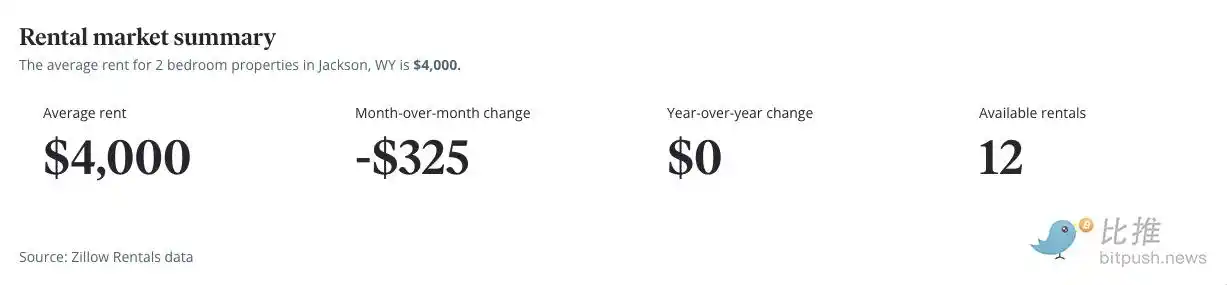
In Wyoming's Jackson Hole resort area, the monthly rent for an ordinary two-bedroom apartment has reached $4,000, 25% higher than in Los Angeles. Although the local per capita GDP ranks among the highest in the U.S., about 10% of residents still face food shortages. For blue-collar workers who catch the morning commute bus and rely on two or three jobs to make ends meet, "stablecoins" seem more like a distant technological concept.

This divide is not accidental but is meticulously designed and maintained. A state finance official admitted to prospect.org that through land acquisition and planning thresholds, the landscape here is shaped to be "poverty invisible."

Writer Annie Proulx once described the harshness of Wyoming's land; today, that harshness is folded by technology and capital into two layers of reality that do not penetrate each other.

On one side is the tax-avoidance utopia created by the wealthy in the mountains; on the other are the ordinary Americans who支撑这一切 but have nowhere to call home—their lives are quietly folded away in both reality and online narratives.

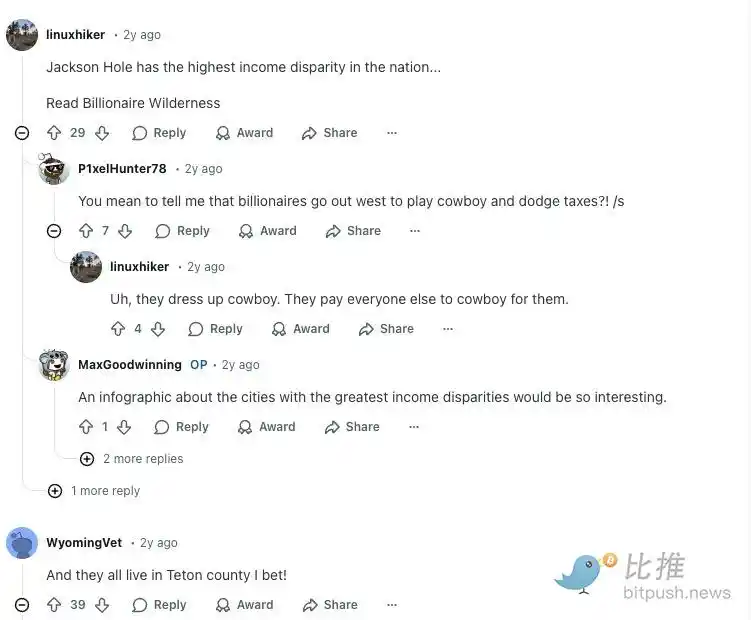
Looking through discussions about Wyoming on Reddit, complaints from locals are everywhere:
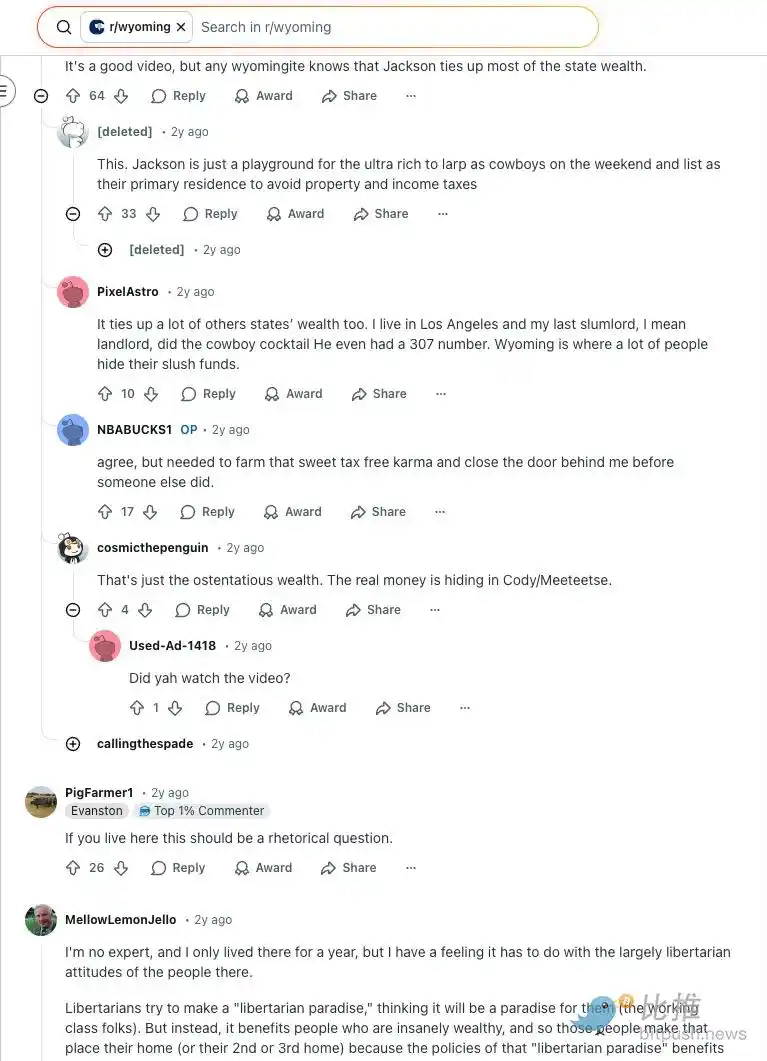
"Jackson is just a playground for super-rich people to play cowboy on weekends. They list it as their primary residence to escape property and income taxes."

"The people here are libertarians trying to create a 'libertarian paradise.' They think it will be a paradise for them (the working class). But in reality, it benefits the filthy rich, who make it their home (or second, third residence) because the policies of the 'libertarian paradise,' such as less regulation, lower taxes, etc., favor them."
Amid such撕裂, the state government is attempting to build digital-era fiscal autonomy on the ruins of the coal mining industry using laws and stablecoins. Data shows that Wyoming has 348 limited liability companies per thousand adults, surpassing Delaware to become the new institutional洼地 in the U.S.

But will this digital revenue flowing to the "Cowboy State" truly缝合 the cracks in this land?

Domande pertinenti

QWhat is the significance of Wyoming's $FRNT stablecoin in the context of U.S. state governments?

A$FRNT is the first U.S. dollar stablecoin to be backed by the full faith and credit of a state government, marking a significant shift from private company-issued stablecoins to a government-level public financial instrument.

QWhat major economic challenge is Wyoming facing that prompted the creation of $FRNT?

AWyoming is experiencing a severe decline in its coal industry, which has been its economic pillar, leading to a dramatic drop in coal severance tax revenue from $290 million in 2011 to $170 million in 2022, creating a pressing fiscal need for new revenue sources.

QHow does the $FRNT stablecoin mechanism generate revenue for the state of Wyoming?

AThe $FRNT stablecoin is over-collateralized by 102% with U.S. Treasuries and cash. The interest income generated from these reserve assets is directed into the state's School Foundation Fund to support public education.

QWhich companies are involved in the management and custody of the reserves for the $FRNT stablecoin?

AThe investment management giant Franklin Templeton, which oversees approximately $1.6 trillion in assets, manages the reserves, and its affiliate, Fiduciary Trust Company International, provides custody services.

QWhat previous legislative innovations has Wyoming pioneered, demonstrating its history of financial and business law experimentation?

AWyoming invented the Limited Liability Company (LLC) in 1977. More recently, it created the SPDI (Special Purpose Depository Institution) banking charter for crypto businesses in 2019 and passed the first DAO法案 (DAO Act) in 2021, allowing decentralized autonomous organizations to register as legal LLCs.

Letture associate

In Conversation with Ray Dalio: We Are Currently in an AI Bubble, with 1% of My Portfolio in Bitcoin

Ray Dalio, founder of Bridgewater Associates, warns in an interview that the current AI boom shows classic bubble characteristics, which could lead to significant economic downturns as seen in past cycles like 1929 or 2000. He explains that speculative enthusiasm, fueled by debt and overvaluation, often precedes a crash when rising rates or taxation force asset sales, causing widespread losses and recession. Dalio also outlines his "Big Cycle" theory, describing an approximate 80-year pattern where widening wealth gaps, massive government deficits, and shifting geopolitical power (like China's rise) create internal conflict and global instability. He emphasizes that we are in a late-cycle, transitional phase where traditional powers like the US and UK face decline. For personal wealth protection, Dalio advises diversification beyond cash into assets like stocks, bonds, real estate, and particularly gold, which he prefers over Bitcoin. While he holds about 1% of his portfolio in Bitcoin as a non-printable hard asset, he views gold as more secure from technological or governmental threats. Regarding AI's impact, Dalio believes it will disproportionately benefit capital owners, worsening inequality by replacing both physical and cognitive labor. He suggests that human intuition and emotional intelligence, combined with AI, will be key for future workers. On taxation, Dalio argues that wealth taxes are impractical and risk triggering asset sell-offs, reducing productive investment. He points to the UK as a cautionary example of debt, low productivity, and political strife. Geopolitically, Dalio foresees a more regionalized world, with the US showing weakness in prolonged conflicts like with Iran, akin to past imperial declines. The ideal outcome, he suggests, is coexisting powerful blocs (e.g., Americas, China-Asia Pacific) without major war.

marsbit2 h fa

In Conversation with Ray Dalio: We Are Currently in an AI Bubble, with 1% of My Portfolio in Bitcoin

marsbit2 h fa

Daily 7.2 Trillion KRW: Foreign Capital's Record Net Buying on Friday! Wall Street Says Headwinds for Korean Stock Fund Flows Have Subsided

South Korean stock market sees a dramatic shift in fund flows. On July 31, foreign investors made a record net purchase of approximately KRW 7.2 trillion in KOSPI stocks, marking a fundamental reversal from the persistent large-scale net outflows seen in previous months. This contributed to a significant narrowing of foreign net selling in July to KRW 9.8 trillion, down sharply from KRW 48.4 trillion in June and KRW 44.5 trillion in May. Simultaneously, domestic institutional pressure eased. South Korean pension funds and asset managers turned to a net buying position in July, purchasing KRW 1.0 trillion worth of KOSPI shares, contrasting with net sales in May and June. Market volatility is expected to be dampened by new financial regulations. Effective July 31, the Financial Services Commission tightened access for retail investors to single-stock leveraged ETFs by raising the minimum cash deposit requirement. Trading volumes for these products subsequently dropped to about 50% of their monthly average. Citigroup Research maintains its year-end KOSPI target of 10,000 points. The firm cites several supportive factors: the substantial easing of headwinds from capital outflows, a robust fundamental outlook for the semiconductor sector, historically low market valuations, strong economic fundamentals, and the potential for policy support from financial authorities if needed.

marsbit2 h fa

Daily 7.2 Trillion KRW: Foreign Capital's Record Net Buying on Friday! Wall Street Says Headwinds for Korean Stock Fund Flows Have Subsided

marsbit2 h fa

Thanks to Dice Rolls, Bitcoin Keys Are Stored Offline, But Not Everyone Will Do It

The article discusses using dice rolls to generate secure Bitcoin wallet seeds, providing entropy independent of potentially flawed hardware random number generators. It explains that each fair dice roll offers about 2.585 bits of entropy, with around 50 rolls needed for a standard 12-word seed phrase and 99+ recommended for higher security. This method gained attention after a vulnerability was revealed in some Coldcard hardware wallets, where a faulty firmware RNG (dating back to 2021) compromised generated keys. The analysis notes that while a dice-generated main seed was safe from this specific flaw, other Coldcard functions (like creating paper wallets, backup keys, or passwords) could still be vulnerable if they used the defective RNG. The piece argues that while dice-based entropy is technically robust, the manual process is error-prone, tedious, and unrealistic for most new users, who might make mistakes in recording or inputting rolls. It concludes that while manual entropy generation should remain an option for advanced users, the long-term goal is to develop reliable, user-friendly hardware and software that securely generates randomness without requiring specialized knowledge. Coldcard users are advised to check their firmware version and replace any secondary secrets (like paper wallet keys) created with vulnerable devices, while also considering multi-signature setups with devices from different manufacturers for added security.

cryptonews.ru8 h fa

Thanks to Dice Rolls, Bitcoin Keys Are Stored Offline, But Not Everyone Will Do It

cryptonews.ru8 h fa

Trading

Spot
活动图片





