Former New York Fed Expert: Powell May Announce $45 Billion Bond Purchase Plan

深潮Pubblicato 2025-12-08Pubblicato ultima volta 2025-12-08

Introduzione

Former New York Fed expert Mark Cabana predicts that, in addition to the widely anticipated 25 basis point rate cut, Fed Chair Powell will announce a $45 billion per month Treasury bill purchase program at the upcoming December FOMC meeting. This plan, set to begin in January 2026, aims to inject liquidity and prevent a further surge in repo market rates. Cabana warns that markets are underestimating the scale of the Fed's balance sheet actions, as money market rates indicate bank reserves are no longer "abundant." The move is seen as necessary to address liquidity shortages caused by previous quantitative tightening. UBS also forecasts a similar $40 billion monthly purchase program. The policy shift comes amid a critical leadership transition at the Fed, with Powell's term ending and expectations rising for Kevin Hassett to potentially succeed him.

Author: Zhang Yaqi

Source: Wall Street News

As the Federal Reserve's December 10th policy meeting approaches, the market is not only focused on the widely anticipated interest rate cut but also on a potential major balance sheet expansion plan, according to senior Wall Street strategists.

Recently, Mark Cabana, a former New York Fed repo expert and now a rates strategist at Bank of America, predicted that, in addition to the widely expected 25 basis point rate cut, Fed Chair Jerome Powell will announce a plan next Wednesday to purchase $45 billion per month in Treasury bills (T-bills). This bond-buying operation is set to be implemented in January 2026, aiming to inject liquidity into the system and prevent a further surge in repo market rates.

Cabana warned in a report that while the interest rate market has reacted tepidly to the rate cut, investors are generally "underestimating" the scale of the Fed's actions regarding its balance sheet. He pointed out that current money market rates indicate that reserves in the banking system are no longer "abundant," and the Fed must restart purchases of securities to fill the liquidity gap. Meanwhile, UBS's trading desk has made a similar prediction, expecting the Fed to begin purchasing about $40 billion in Treasury bills per month starting in early 2026 to maintain stability in the short-term interest rate market.
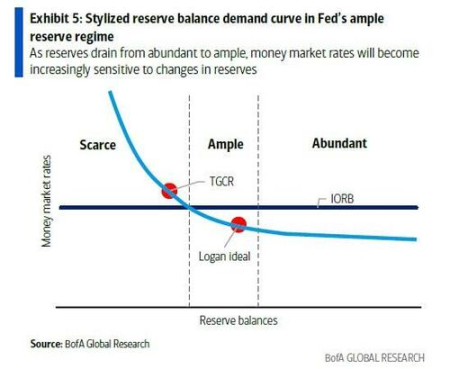
This potential policy adjustment comes at a critical time of impending leadership transition at the Fed. With Powell's term nearing its end and market expectations rising that Kevin Hassett might succeed him as Fed Chair, next week's meeting is not only about short-term liquidity but will also set the tone for the monetary policy path in the coming year.

Former New York Fed Expert Predicts: $45 Billion Monthly Purchases

Although market consensus is locked in on a 25 basis point rate cut next week, Mark Cabana believes the real variable lies in balance sheet policy. In his weekly report titled "Hasset-Backed Securities," he noted that the size of the RMP (Reserve Management Purchases) the Fed is likely to announce could be as high as $45 billion per month, a prediction that significantly exceeds current general market expectations.

Cabana detailed the composition of this figure: the Fed needs to purchase at least $20 billion monthly to cope with the natural growth of its liabilities, plus an additional $25 billion to reverse the reserve drain caused by previous "excessive quantitative tightening." He expects purchases of this magnitude to continue for at least 6 months. This announcement is expected to be included in the Fed's implementation note, with detailed operation sizes and frequency published on the New York Fed's website, focusing purchases on the Treasury bill market.

As previously reported by Wall Street News, since the balance sheet peaked at nearly $9 trillion in 2022, the Fed's quantitative tightening (QT) policy has reduced its size by approximately $2.4 trillion, effectively draining liquidity from the financial system. However, even with QT halted, signs of funding stress remain evident.

The clearest signals come from the repo market. As the short-term financing hub of the financial system, overnight reference rates in the repo market, such as the Secured Overnight Financing Rate (SOFR) and the Tri-Party General Collateral Rate (TGCR), have frequently and sharply breached the upper limit of the Fed's policy rate corridor in recent months. This indicates that reserve levels in the banking system are sliding from once "abundant" to "ample," with a risk of further moving towards "scarce." Given the systemic importance of the repo market, this situation is considered intolerable for the Fed in the long term, as it could weaken the transmission efficiency of monetary policy.

Against this backdrop, recent comments from Fed officials have also hinted at the urgency for action. New York Fed President John Williams stated that "we expect to reach ample reserve levels before long," while Dallas Fed President Lorie Logan noted that "I expect it will be appropriate to resume balance sheet growth before long." Cabana interprets "before long" as referring to the December FOMC meeting.

Auxiliary Tool Aimed at Smoothing Year-End Volatility

In addition to the long-term purchase plan, to address the impending year-end funding volatility, Bank of America also expects the Fed to announce term repo operations lasting 1-2 weeks. Cabana believes the pricing for these operations could be set at par with or 5 basis points above the Standing Repo Facility (SRF) rate, aiming to trim tail risks in the year-end funding market.

Regarding administered rates, although clients have inquired about the possibility of lowering the Interest on Reserve Balances (IORB), Cabana believes that simply cutting IORB "solves nothing," as banks generally prefer to hold higher cash buffers following the Silicon Valley Bank (SVB) collapse. He thinks it's more likely that the IORB and SRF rates could be cut synchronously by 5 basis points, but this is not the base case scenario.

Another important context for this meeting is the upcoming personnel changes at the Fed. The market currently views Kevin Hassett as a strong contender for the next Fed Chair. Cabana pointed out that once the new chair is confirmed, the market will price the medium-term policy path more based on guidance from the new appointee.
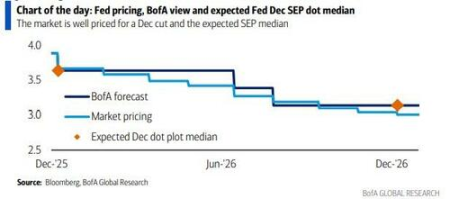
UBS also agrees with the view that balance sheet expansion is returning. UBS's sales and trading desk noted that by purchasing Treasury bills, the Fed can shorten the duration of its assets, thereby better matching the average duration of the Treasury market. Whether this operation is called RMP or quantitative easing (QE), its ultimate goal is clear: through direct liquidity injection, to ensure the financial market can maintain smooth operation during this critical period of political and economic transition.

Crypto di tendenza

Domande pertinenti

QWhat major policy action does former New York Fed expert Mark Cabana predict the Fed will announce, in addition to the widely expected rate cut?

AMark Cabana predicts that Fed Chair Powell will announce a plan to purchase $45 billion per month in Treasury bills (T-bills), set to be implemented in January 2026.

QWhat is the primary goal of the Fed's potential new Treasury bill purchase program according to the article?

AThe primary goal is to inject liquidity into the system to prevent a further surge in repo market rates and to address signs that bank reserves are no longer 'abundant'.

QWhat key signal from the repo market indicates that the banking system's reserve levels are becoming less ample?

AKey short-term funding rates like the Secured Overnight Financing Rate (SOFR) and the Tri-Party General Collateral Rate (TGCR) have frequently and sharply breached the upper limit of the Fed's policy rate corridor.

QWhat additional short-term tool does Bank of America expect the Fed to announce to handle year-end funding volatility?

ABank of America expects the Fed to announce term repo operations lasting 1-2 weeks, priced at or 5 basis points above the Standing Repo Facility (SRF) rate, to mitigate tail risks in the year-end funding market.

QHow does the article connect the Fed's potential policy actions to the upcoming leadership change?

AThe article states that the upcoming FOMC meeting is happening as Chair Powell's term nears its end, with expectations that Kevin Hassett may succeed him. The meeting's decisions will set the tone for monetary policy in the coming year, and the new Treasury purchases aim to ensure market stability during this period of political and economic transition.

Letture associate

Report Interpretation: J.P. Morgan Details Micron's Pre-Earnings Sentiment, Current Hardware Sector Dynamics

Morgan Stanley analyst Joshua Meyers' report (June 21, 2026) highlights key trends in the hardware and semiconductor sector ahead of Micron's earnings. The core takeaways are: 1. **Micron & Memory:** Memory remains a high-conviction long theme, driven by strong AI demand and rising ASPs. However, investor focus is shifting to the sustainability of Micron's >80% gross margins and the specifics of potential new long-term supply agreements (SCAs). 2. **Hardware Supply Chain:** AI-related demand for servers, networking, and storage remains robust, but company performance is diverging. Celestica (CLS) shows improved margin confidence, Western Digital and Seagate benefit from pricing, Fabrinet (FN) sees predictable AI optics growth, and Teradyne (TER) anticipates a new Google customer. 3. **AI Capex & WFE Forecasts:** JPMorgan increased its Wafer Fab Equipment (WFE) market growth forecasts to 28% in 2026 and 29% in 2027. AI infrastructure financing is evolving, with higher project-level debt reducing constraints on capex expansion. The report signals that while the AI-driven hardware cycle is strong, the market is entering a phase focused on execution verification (e.g., Micron's SCA details, Fabrinet's ramp with Amazon) and valuation sustainability. Key near-term signals include Micron's guidance, Arista Networks' outlook, and the pace of demand normalization post potential tariff-related pull-ins.

marsbit56 min fa

Report Interpretation: J.P. Morgan Details Micron's Pre-Earnings Sentiment, Current Hardware Sector Dynamics

marsbit56 min fa

Research Report Analysis: The Fed's New Chair's Debut – New Leader, But Same Script?

Report Analysis: Federal Reserve's New Chair Debut – A New Captain, But the Same Script? Morgan Stanley's chief global economist Seth B. Carpenter analyzes the first FOMC meeting under new Fed Chair Kevin Warsh in a June 21 report. Warsh deliberately avoided providing forward guidance on interest rates, aligning with his philosophy. However, market expectations for a rate hike this year were reinforced. Key signals lie elsewhere: inflation may fall more than expected, and quantitative tightening (QT) could be more aggressive than anticipated. The FOMC's "dot plot" suggests only one rate hike in 2026. Carpenter argues that if inflation undershoots forecasts, the logic for even a single hike weakens, especially as projections indicate potential rate cuts in 2027. On QT, Warsh's stance is clear. Carpenter notes that measures like halving the Treasury's account balance could shrink the Fed's balance sheet by around $500 billion with minimal market impact. Combined with adjustments to reserve interest and liquidity rules, the ultimate QT scale may exceed expectations, though its market effect might be less disruptive unless the Fed actively sells Mortgage-Backed Securities (MBS). While Warsh initiated a review of the Fed's policy framework, the 2% inflation target remains intact for now. The report concludes that the market may be overestimating the significance of reduced forward guidance and the near-term rate hike risk, while potentially underestimating the scope and manageable nature of the coming balance sheet reduction. The key debates will hinge on upcoming core PCE data, the specifics of the QT path, and the framework review's findings.

marsbit1 h fa

Research Report Analysis: The Fed's New Chair's Debut – New Leader, But Same Script?

marsbit1 h fa

Critical Game Week: BTC Retracement Confirmation vs. HYPE Support Battle | Guest Analysis

This weekly analysis outlines a critical juncture for BTC and HYPE markets, focusing on key price level confirmations. **BTC Analysis:** BTC is at a pivotal point after a five-wave rally from the June 5th low of $59,100. The price has broken below a short-term rising channel's lower boundary, with the current move seen as a pullback to test this breakdown. Failure to reclaim this level could lead to a retest of the $59,000-$60,000 support zone. The core scenario hinges on this channel retest outcome. * **Key Levels:** Resistance at $64,500-$65,000 (channel boundary) and $69,500-$70,500. Support at $59,000-$60,000 and $55,000. * **Strategy:** A core bearish stance is maintained (20% short from last week), with short-term plans for tactical trades. Three detailed contingency plans (A/B/C) are provided for short positions on resistance tests or breakdowns, emphasizing strict stop-loss discipline. **HYPE Analysis:** HYPE shows strong momentum but is currently in a corrective phase after hitting a new high of $76.94. The price is retesting the crucial $64-$66 support area. * **Key Levels:** Resistance near $77 and $80-$82. Support at $64-$66 and $52-$54. * **Strategy:** The short-term approach is "buy on dips, avoid chasing rallies." A long position is considered only if clear stabilization signals appear at the $64-$66 or deeper $52-$54 support zones, with tight risk controls. **General Risk Management:** A standardized trailing stop-loss protocol is emphasized: set initial stop, breakeven at +1% profit, then trail stops upward to lock in gains. *Disclaimer: All analysis is presented as a personal trading framework, not investment advice. Market conditions are complex and require dynamic adjustment.*

marsbit1 h fa

Critical Game Week: BTC Retracement Confirmation vs. HYPE Support Battle | Guest Analysis

marsbit1 h fa

Research Report Interpretation: Citi Attends AWS Summit, Bullish on Cloud Business Acceleration but Data Governance Remains Key Variable

Citi analyst Tyler Radke's team attended the AWS New York Summit (June 17-18), engaging with over 10 clients and partners. In a June 19 report, they highlighted the summit's focus on scaling agent AI for enterprise deployment. Citi maintains a "Buy" rating on Amazon, forecasting AWS revenue growth to accelerate to 37% in FY27 from 30% in FY26, noting this estimate may be conservative. Key takeaways: 1. **AWS Strategy Shift:** AWS is moving from proof-of-concepts to scalable deployment. New offerings like AWS Context (building enterprise knowledge graphs), Amazon Quick (cross-application AI assistant), and security tool Continuum address core enterprise pain points for AI adoption. 2. **Data Infrastructure Beneficiaries:** Data infrastructure companies like Snowflake, Elastic, Oracle, and ClickHouse are seen as direct beneficiaries of scaling AI workloads, as evidenced by strong growth and use cases presented. 3. **Critical Role of Data Governance:** As AI agents scale from hundreds to thousands, effective data governance becomes the key variable for deploying AI in core business processes. AWS Context represents AWS's strategic extension from providing compute/models to offering a data governance infrastructure layer. The report emphasizes that without solving data governance, AI will remain confined to pilot projects. The investment thesis focuses on AWS revenue acceleration and data infrastructure vendors' growth, while monitoring signals like AWS's quarterly revenue growth, Bedrock AgentCore task volume, and pricing impacts on companies like Elastic.

marsbit1 h fa

Research Report Interpretation: Citi Attends AWS Summit, Bullish on Cloud Business Acceleration but Data Governance Remains Key Variable

marsbit1 h fa

Trading

Spot
Futures

Articoli Popolari

Come comprare MAY

Benvenuto in HTX.com! Abbiamo reso l'acquisto di Mayflower (MAY) semplice e conveniente. Segui la nostra guida passo passo per intraprendere il tuo viaggio nel mondo delle criptovalute.Step 1: Crea il tuo Account HTXUsa la tua email o numero di telefono per registrarti il tuo account gratuito su HTX. Vivi un'esperienza facile e sblocca tutte le funzionalità,Crea il mio accountStep 2: Vai in Acquista crypto e seleziona il tuo metodo di pagamentoCarta di credito/debito: utilizza la tua Visa o Mastercard per acquistare immediatamente MayflowerMAY.Bilancio: Usa i fondi dal bilancio del tuo account HTX per fare trading senza problemi.Terze parti: abbiamo aggiunto metodi di pagamento molto utilizzati come Google Pay e Apple Pay per maggiore comodità.P2P: Fai trading direttamente con altri utenti HTX.Over-the-Counter (OTC): Offriamo servizi su misura e tassi di cambio competitivi per i trader.Step 3: Conserva Mayflower (MAY)Dopo aver acquistato Mayflower (MAY), conserva nel tuo account HTX. In alternativa, puoi inviare tramite trasferimento blockchain o scambiare per altre criptovalute.Step 4: Scambia Mayflower (MAY)Scambia facilmente Mayflower (MAY) nel mercato spot di HTX. Accedi al tuo account, seleziona la tua coppia di trading, esegui le tue operazioni e monitora in tempo reale. Offriamo un'esperienza user-friendly sia per chi ha appena iniziato che per i trader più esperti.

178 Totale visualizzazioniPubblicato il 2025.07.01Aggiornato il 2026.06.02

Come comprare MAY

Discussioni

Benvenuto nella Community HTX. Qui puoi rimanere informato sugli ultimi sviluppi della piattaforma e accedere ad approfondimenti esperti sul mercato. Le opinioni degli utenti sul prezzo di MAY MAY sono presentate come di seguito.

活动图片