Original | Odaily Planet Daily (@OdailyChina)
Author | Azuma (@azuma_eth)

On January 9, amidst a highly active cryptocurrency market, the venture capital giant Andreessen Horowitz (a16z) announced the completion of a new $15 billion fundraising round. This is the largest fundraising effort in the institution's history, accounting for over 18% of the total venture capital raised in the United States in 2025.
In the relatively short official announcement, a16z mentioned cryptocurrencies twice. The most critical statement, "Our mission is to ensure that the United States wins the technological competition of the next 100 years, which begins with winning the key architectures of the future—artificial intelligence and cryptocurrency technology," indicates that a16z, now well-supplied, will continue to actively invest in the cryptocurrency market.
Breakdown of Six Major Directions
According to a16z's plan, this batch of funds will be allocated to six major directions: the American Dynamism fund will receive $1.176 billion, the App fund $1.7 billion, the Bio + Health fund $700 million, the Infrastructure fund $1.7 billion, the Growth fund $6.75 billion, and the Other Venture Strategies fund $3 billion.
Although a16z did not explicitly designate a dedicated cryptocurrency fund in this fundraising, these six directions actually have significant overlap with the cryptocurrency space.
First is the American Dynamism fund. This is a direction with a clear "political" focus that a16z has been promoting in recent years. Its core goal is to use venture capital to rebuild America's "hard power" and national competitiveness. The fund will primarily invest in aerospace, defense, public safety, education, housing, supply chain, industry, and manufacturing—objectively speaking, this fund has little crossover with cryptocurrency.
Next is the App fund. This is one of a16z's most traditional and VC-centric funds. Its core goal is to focus on application-layer products that can be directly used by users. The fund will primarily invest in consumer internet products, AI applications, creator tools, social products, content services, games, fintech, and Web3 applications—this is also the direction where a16z's cryptocurrency narrative is most easily realized.
Then comes the Bio + Health fund. This is a long-term bet for a16z "beyond pure technology." Its core goal is to use software, data, and engineering thinking to transform the life sciences and healthcare systems. The fund's main investment areas include biotechnology, drug development platforms, gene editing, synthetic biology, medical data and AI diagnostics, and medical infrastructure software—this part has little direct overlap with cryptocurrency, but DeSci could be a potential intersection point.
The Infrastructure fund focuses on infrastructure. Its core goal is to provide an irreplaceable technical foundation for the next generation of applications and platforms. The fund's main investment areas are cloud computing and distributed systems, AI infrastructure, data platforms, developer tools, network protocols, and blockchain underlying protocols (L1, L2, other tools)—this is another core battlefield for a16z in the cryptocurrency space, besides the App fund.
The Growth fund primarily invests in Series C and later stages, as well as Pre-IPO stages. Its core goal is not to find new opportunities but to amplify returns by supporting proven winners. The fund mainly invests in mature tech companies, AI platforms, fintech unicorns, and mature Web3 infrastructure or applications—a16z's official website shows that Coinbase, Kalshi, etc., are explicitly categorized here.
The Other Venture Strategies fund is relatively special. It does not have a single theme but is more like a flexible "tactical capital pool," often used for special structured transactions, cross-fund collaborative investments, emerging field trials, secondary market opportunities, regional or thematic experimental funds, etc.—this fund has little direct crossover with cryptocurrency, but it cannot be ruled out that there may be temporary associations at special junctures, such as responsive moves during certain policy windows.
Looking at the six intended directions for this $15 billion, the App fund, Infrastructure fund, and Growth fund will be the main channels for a16z to inject capital into the primary cryptocurrency market. Among them, the App fund and Infrastructure fund will focus more on native application-layer and protocol-layer projects in the cryptocurrency market, respectively; while the Growth fund will tend to focus on platform services such as exchanges and prediction markets, and its investments will lean more towards leading players in the赛道 who have already shown an advantage.
2025: A Review of a16z's Investments
According to incomplete statistics from Odaily Planet Daily, a16z made a total of 31 investments in the broader cryptocurrency field over the past year, with two investments each in prediction market Kalshi, AI security company Doppel, privacy blockchain Seismic, etc.—especially Kalshi. a16z first co-led a $300 million Series D round for the company in October with Sequoia, at a valuation of $5 billion; then again in November, it participated in the company's $1 billion Series E round at a valuation of $11 billion—this was a16z's biggest bet in the cryptocurrency field last year.
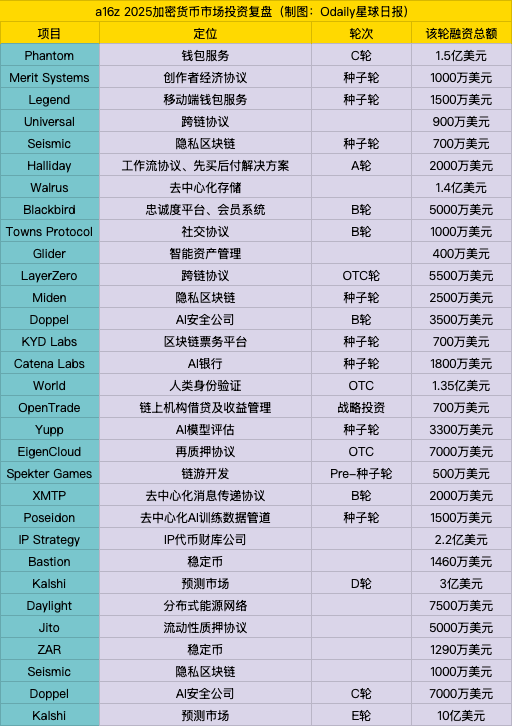
As can be seen from the statistics in the figure above, aside from the heavy bet on prediction markets, wallet services, privacy blockchains, stablecoins, and the intersection of AI and cryptocurrency were the focus of a16z's布局 in 2025. These sub-sectors can be classified into the blockchain underlying protocols and tools covered by the Infrastructure fund, and the fintech and AI applications covered by the App fund.
2026: a16z Made This Prediction
On New Year's Day 2026, a16z Crypto officially published a New Year's outlook article. In the article, a16z mentioned 17 potential developments they are excited about for 2026, which may contain clues to the institution's focus areas for future investments.
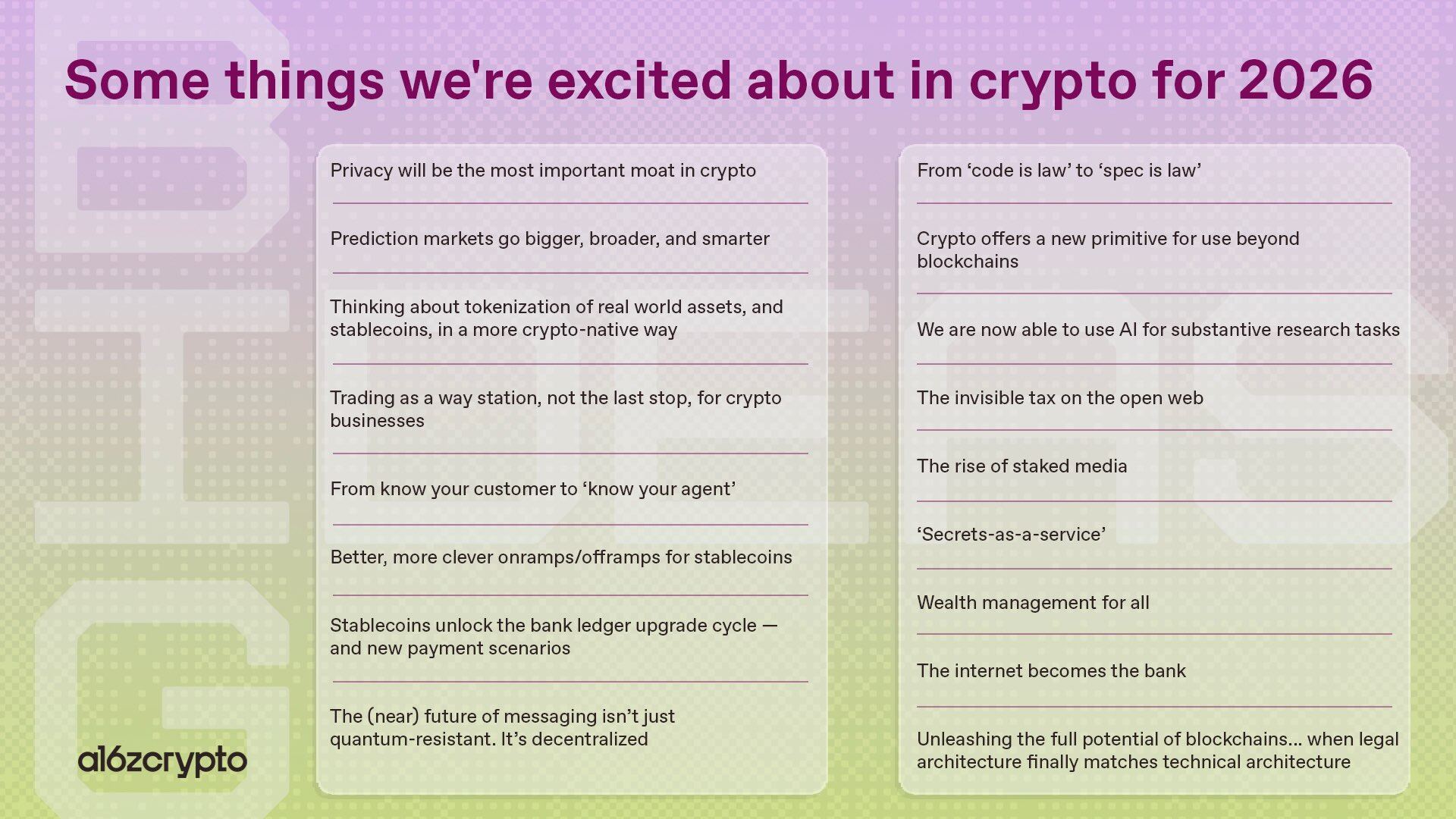
These 17 potential developments are:
- Privacy will become the most important moat in crypto;
- Prediction markets will become larger, broader, and smarter;
- Thinking more "crypto-natively" about real-world asset tokenization and stablecoins;
- Trading is just a waystation for crypto businesses, not the final destination;
- From "Know Your Customer" (KYC) to "Know Your Agent";
- Better, smarter on-ramps and off-ramps for stablecoins;
- Stablecoins will kick off a bank ledger upgrade cycle and spawn new payment scenarios;
- The future of instant messaging is not just quantum-resistant, but also decentralized;
- From "code is law" to "norms are law";
- Crypto is providing new kinds of foundational primitives usable beyond blockchains themselves;
- We can now use AI to perform substantive research tasks;
- The "invisible tax" of the open internet;
- The rise of Staked Media;
- "Secrets-as-a-Service";
- Wealth management for everyone;
- The internet is becoming the bank;
- When the legal framework finally matches the technical framework, the full potential of blockchains will be unleashed.
Among these 17 potential developments, some explicitly mention specific business models, including the sectors a16z has already heavily invested in, such as privacy, prediction markets, stablecoins, and AI. a16z also directly suggests optimization paths for these models, such as the need for smarter on-ramp and off-ramp solutions for stablecoins.
At the same time, another part of the potential developments belongs to imaginings of future states, such as the internet eventually becoming the bank. But exactly how these imaginings will be realized, a16z does not give clear answers—this question needs to be left to entrepreneurs who can bring innovative solutions. And they are precisely the targets that a16z's $15 billion most wants to find.






