Fed warns of ‘long, painful history’ – Why stablecoin oversight is urgent

ambcryptoPubblicato 2026-04-01Pubblicato ultima volta 2026-04-01

Introduzione

Federal Reserve Governor Michael Barr has called for strict stablecoin oversight, citing risks to financial stability and a surge in illicit use. Chainalysis data shows stablecoins now account for 84% of illegal crypto activity, up from 15% in 2020, often facilitating terrorism financing and sanctions evasion. Barr warned that unregulated private money historically caused bank runs, emphasizing the need for tight reserve asset controls, supervision, and liquidity requirements. While illicit activity remains below 1% of all crypto transactions, regulators are advancing the GENIUS Act, aiming for finalized rules by mid-2026. Meanwhile, non-USD stablecoins are growing rapidly, and Asian markets—which drive over 60% of global stablecoin activity—may restrict USD-based options, potentially reshaping the $315 billion market.

Michael Barr, a member of the Federal Reserve Board of Governors, has called for caution and strict stablecoin oversight.

During a recent discussion on stablecoin law, the GENIUS Act, Barr singled out major uses of the products, including crypto trading, cheaper remittances, and savings overseas.

However, he raised concerns about stablecoins’ facilitation of terrorist financing and risk to financial stability.

Well, Chainalysis data estimates that stablecoins now account for 84% of illicit crypto activity. This is a massive spike from only 15% in 2020. Hackers are now embracing stablecoins and P2P transactions to evade sanctions.

To curb this, Barr recommended,

Both regulatory and technological solutions will need to be deployed to limit these risks.

Despite the surge, the overall illicit activity only accounts for less than 1% of total crypto transactions.

On financial stability risk, Barr cited the ‘long and painful history’ of competing private money (bank notes) in the 1800s that led to bank runs and financial panics because they traded below par.

The cause? Low-quality reserve assets and weak safeguards. Barr added,

Tight control over reserve assets, coupled with supervision, capital and liquidity requirements, and other measures, could enhance the stability of stablecoins and make them more viable payment instruments.

This is part of the rulemaking process as regulators race to meet the July 2026 deadline for implementing the GENIUS Act. So far, the OCC and NCUA have issued proposed rules for the same. The Fed and other regulators are expected to follow suit and finalize guidelines by early Q3.

Stablecoins: USD-based vs. others

For issuers, the GENIUS Act offers clear rules. But for the U.S. government, it’s an increasingly important demand line for Treasury Bills to finance its debt.
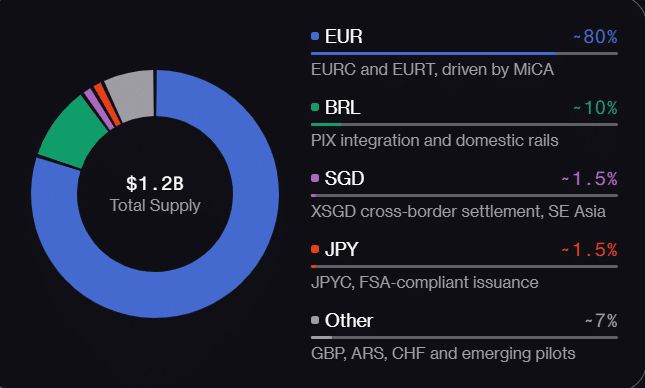
Source: Dune

Although USD-based versions (USDT, USDC) dominate the current $315 billion stablecoin market, non-USD alternatives have seen record growth. Since 2023, non-USD stablecoins have surged from $350 million to $1.2 billion. That’s a 3x expansion outpacing USD stablecoin growth, mostly dominated by Euro-based alternatives.

Beyond currency-based measures, Asia accounts for over 60% of global stablecoin activity, driven primarily by the Singapore–Japan–Hong Kong–China corridor. Interestingly, these jurisdictions are pushing for stablecoin rules that could restrict USD-based options. It’s unclear how these shifts will impact current stablecoin market dynamics in the upcoming months.


Final Summary

  • Fed’s Barr called for strong stablecoin oversight to avoid repeating the ‘painful’ bank runs of the 1800s due to private money.
  • The stablecoin market could be headed for major shifts as key global adoption jurisdictions mull restricting USD-based alternatives.


Domande pertinenti

QWhat are the main concerns raised by Michael Barr regarding stablecoins?

AMichael Barr raised concerns about stablecoins facilitating terrorist financing and posing risks to financial stability, citing their use in illicit activities and the historical precedent of private money causing bank runs and financial panics in the 1800s.

QWhat percentage of illicit crypto activity do stablecoins account for according to Chainalysis data?

AAccording to Chainalysis data, stablecoins now account for 84% of illicit crypto activity, a significant increase from 15% in 2020.

QWhat solutions did Michael Barr recommend to address the risks associated with stablecoins?

AMichael Barr recommended deploying both regulatory and technological solutions, including tight control over reserve assets, supervision, capital and liquidity requirements, and other measures to enhance the stability of stablecoins.

QHow has the non-USD stablecoin market grown since 2023?

ASince 2023, non-USD stablecoins have surged from $350 million to $1.2 billion, a 3x expansion that outpaced the growth of USD stablecoins, with Euro-based alternatives dominating this segment.

QWhich regions are driving global stablecoin activity, and what regulatory shifts are they considering?

AAsia accounts for over 60% of global stablecoin activity, primarily driven by the Singapore–Japan–Hong Kong–China corridor. These jurisdictions are considering stablecoin rules that could restrict USD-based options.

Letture associate

You Bet on the News, the Pros Read the Rules: The True Cognitive Gap in Losing Money on Polymarket

The article explains that the key to profiting on Polymarket, a prediction market platform, lies not just predicting real-world events correctly, but in meticulously understanding the specific rules that govern how each market will be resolved. It illustrates this with examples, such as a market on Venezuela's 2026 leader, where the official rules defining "officially holds" the office overruled the intuitive answer of who was in practical control. Other examples include debates over the definition of a "token" or what constitutes an "agreement." The core argument is that a "reality vs. rules" gap creates pricing discrepancies that savvy traders ("车头" or "whales") exploit. The platform has a formal dispute resolution process managed by UMA token holders to settle ambiguous outcomes. This process involves proposal submission, a challenge window, a discussion period, and a final vote. However, the article highlights a critical flaw in this system compared to a traditional court: the lack of separation between the arbiters (UMA voters) and the interested parties (traders with financial stakes in the outcome). This conflict of interest undermines the discussion phase, leads to herd mentality, and results in opaque final decisions without explanatory rulings. Consequently, the system lacks a body of precedent, making it difficult for users to learn from past disputes. The ultimate takeaway is that success on Polymarket requires a lawyer-like scrutiny of the rules to identify and capitalize on the cognitive gap between how events appear and how they are contractually defined for settlement.

marsbit23 min fa

You Bet on the News, the Pros Read the Rules: The True Cognitive Gap in Losing Money on Polymarket

marsbit23 min fa

Will the Fed Still Cut Interest Rates? Tonight's Data Is Crucial

The core debate surrounding the Federal Reserve's potential interest rate cuts is intensifying amid geopolitical conflict and rebounding inflation. The key question is whether high energy prices will cause persistent inflation or weaken consumer demand enough to force the Fed to cut rates. Citigroup presents a bullish case for cuts, arguing that oil supply disruptions from the Strait of Hormuz are temporary and will not lead to lasting inflationary pressure. They point to receding bond yields and oil prices as evidence the market is pricing in a short-lived shock. Citi's data also shows tightening financial conditions, a stabilizing labor market, and healthy tax returns, supporting their view that the path to lower rates remains open. Conversely, Deutsche Bank offers a starkly contrasting, more hawkish outlook. They argue the Fed's current policy is already neutral and expect rates to remain unchanged indefinitely. Their view is based on stalled disinflation progress and a shift toward more hawkish rhetoric from key Fed officials like Waller, who cited risks from prolonged Middle East conflict and tariffs. Other officials, including Williams and Hammack, signaled rates would likely stay on hold for a "considerable time." The market pricing has shifted dramatically, now forecasting zero cuts in 2026. The imminent release of the March retail sales "control group" data is highlighted as a critical test. This metric, which excludes gas station sales, will reveal if high gasoline prices are eroding consumer spending in other areas. A weak reading could support the case for imminent rate cuts, while a strong one would bolster the argument for the Fed to hold steady. This data is pivotal for determining the near-term policy path.

marsbit44 min fa

Will the Fed Still Cut Interest Rates? Tonight's Data Is Crucial

marsbit44 min fa

Trading

Spot
Futures
活动图片