February 2026 Crypto Market Recap: BTC's $60k Extreme Rebound, How Did the Market React on the US Military Airstrike Day?

marsbitPubblicato 2026-03-05Pubblicato ultima volta 2026-03-05

Introduzione

February 2026 Crypto Market Recap: BTC rebounded strongly from a critical $60K support level after a sharp drop from $70K, establishing a trading range between $60K–$70K for most of the month. Key events included a U.S. airstrike on Iran, which caused a brief dip to $62K before a recovery to $68K, and the death of Iran’s leader, interpreted as a market-positive signal. $ZRO surged around its LayerZero conference due to major partnership announcements but later gave back gains. AI-related tokens like $VVV performed well, while scam coins like $PIPPIN and $POWER saw manipulated pumps. The market exhibited bearish traits—short squeezes were common, and altcoin rallies were often brief. Uniswap spiked 40% on a BlackRock partnership announcement but quickly retraced. Other notable events included Base abandoning Optimism, hurting $OP, and strong performances from $MORPHO and $STABLE.

Author: CryptoNarratives (Viktor)

Compiled by: Deep Tide TechFlow

Deep Tide Guide: This monthly recap thoroughly breaks down the key movements in the February crypto market: BTC's extreme $60k rebound, the panic and rapid recovery on the day Iran was attacked, the pre- and post-ZRO conference expectation games, and the manipulative coins thriving in the bear market. Dense with information, it serves as excellent background material for understanding the current market structure.

Full Text Below:

BTC Timeline

Below is the main timeline for February:

Gold saw a significant pullback after reaching a peak in late January, falling from $5600 to $4400. The bottom was hit on February 2nd, followed by a rapid rebound to $5100 within two days. Silver also experienced a peak collapse, plummeting nearly 50% from $121 to $64 on February 6th.

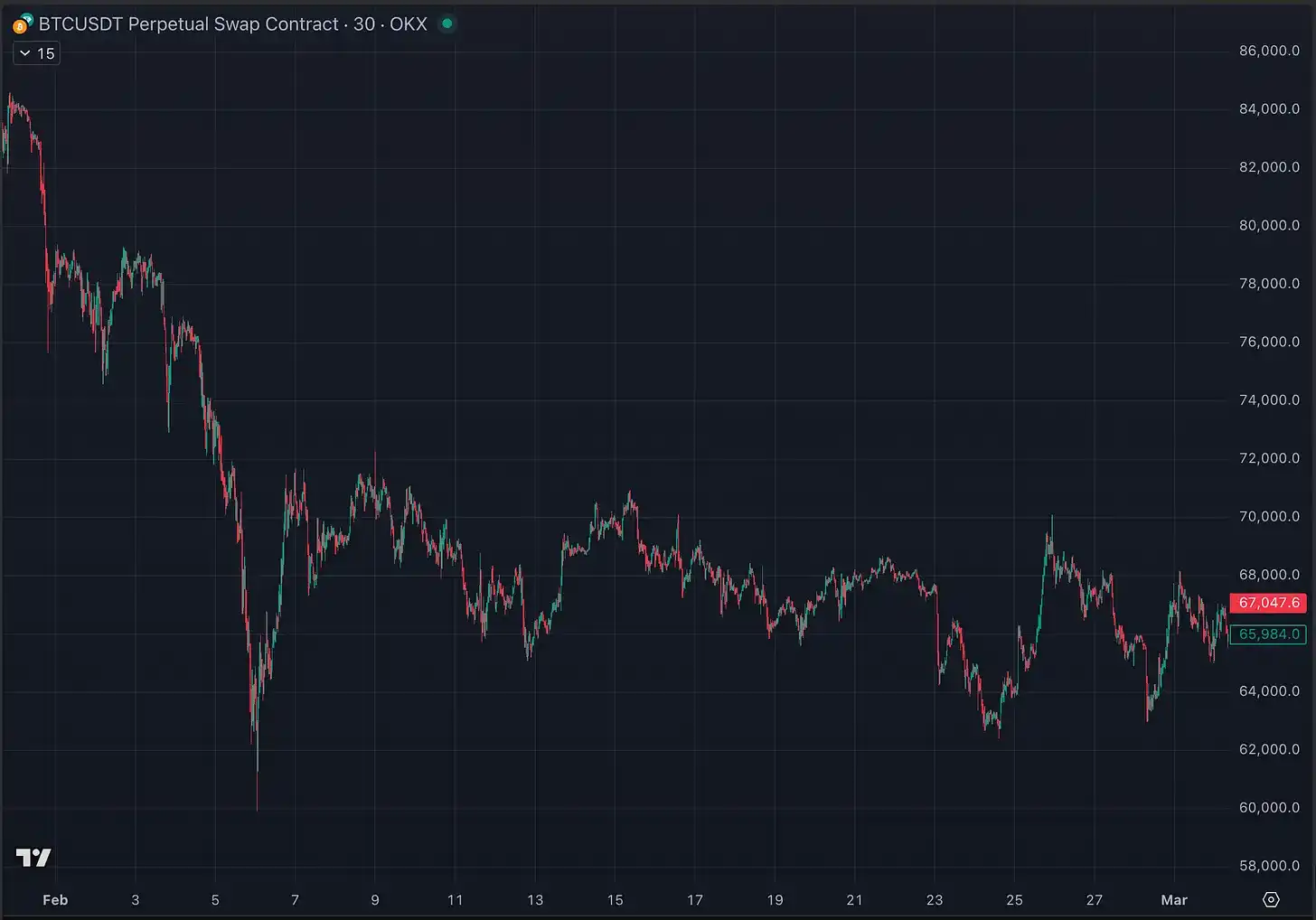
BTC started February on an extremely weak note. After hitting a high of $98k in January, it opened February at $78k, dropped to $70k within 4 days, and then experienced a single-day crash from $70k to $60k on February 5th.

BTC staged a strong rebound at the $60k level, recovering to nearly $72k in less than a day. This complete move defined the trading range for the entire subsequent month, largely fluctuating between $60k and $70k.

After the first week, BTC spent most of the month oscillating around $68k, with only two distinct periods of strength: February 13th-14th and February 25th. These periods each saw some stronger altcoin performances.

On February 27th, BTC dropped from $68k to $65k on rumors of an impending US airstrike on Iran. The attack was officially confirmed a day later. Upon the actual news landing, BTC fell further from $65k to $62k but was met with sustained buying pressure throughout the day, ultimately closing near $68k, which also marked the month's closing price. On the same day, the announcement of Khamenei's death was made, which the market generally interpreted as a bullish signal (as it suggested the US was unlikely to invest excessive resources in this conflict).
ZRO Conference

Almost the only significant narrative in the altcoin space in February was the LayerZero conference on February 10th. $ZRO had been strengthening consistently since the beginning of the year, primarily driven by anticipation for this event. I initially predicted this would be a typical 'sell the news' opportunity, but the reality was slightly different.

On the day, a video announcing the launch of their own blockchain was leaked early, triggering a sell-off and a roughly 20% drop within an hour, which also marked the day's low. Later that day, the official announcement was made – indeed, the launch of their own blockchain "Zero" – but it was accompanied by a slate of heavyweight partnership announcements, including Citadel Securities, Cathie Wood/ARK, DTCC, and ICE.
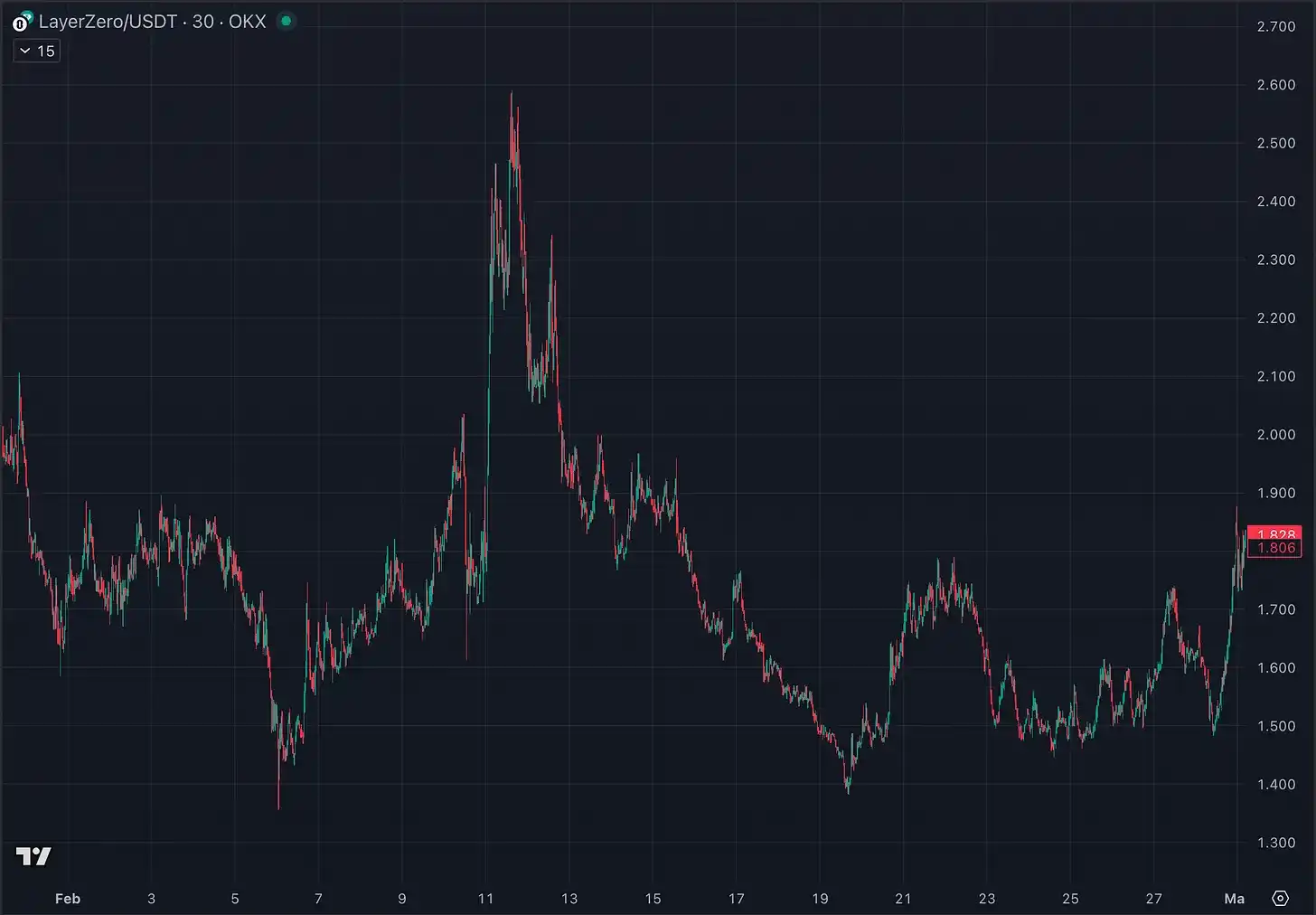
The result was a strong rally post-conference, with $ZRO gaining about 45% in 12 hours, catching many 'sell the news' traders off guard. But subsequently... all gains were erased, and the token slid all the way down to $1.5, a level that currently appears to be forming strong support.

VVV's Abnormal Strength

VVV was the best-performing "non-scam" token in February, rising from a bottom of $1.65 to $5.5 by month-end (with a further squeeze to $8 on March 2nd). One catalyst was its status as a legitimate project at the intersection of AI, privacy, and crypto, with a bottom valuation below $100M;另一方面, it also benefited from the tailwind of OpenClaw, as OpenClaw listed Venice as a recommended model supplier in its documentation until just yesterday.

(I'm inclined to think it peaked at the $8.4 squeeze in early March, but I could be wrong)
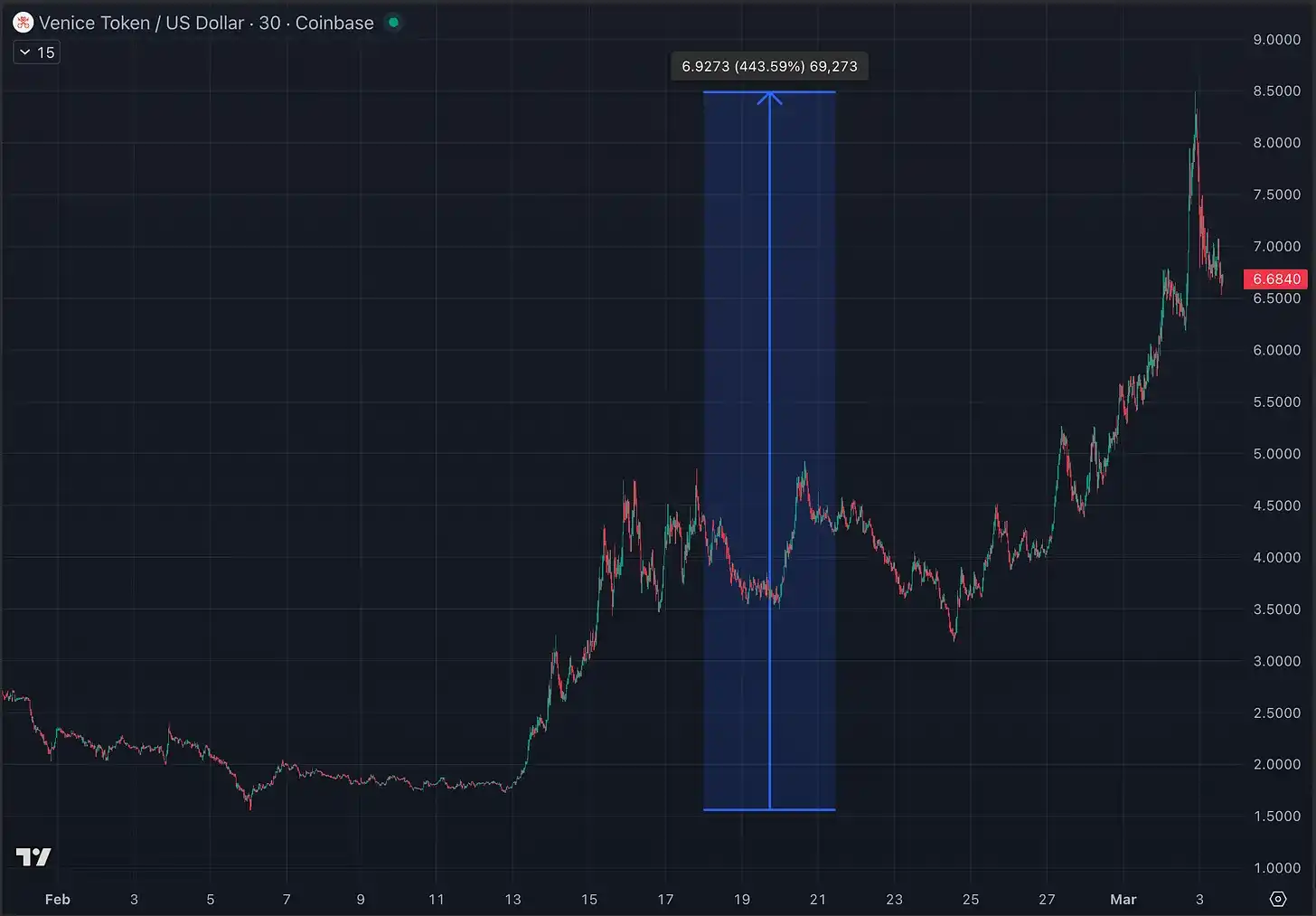
Other AI tokens briefly awakened late in February, with $SAHARA squeezing +70% in a single day and $GRASS gaining +70% over 4 days.

A Bountiful Month for Scam Coins: $PIPPIN, $SIREN, $POWER

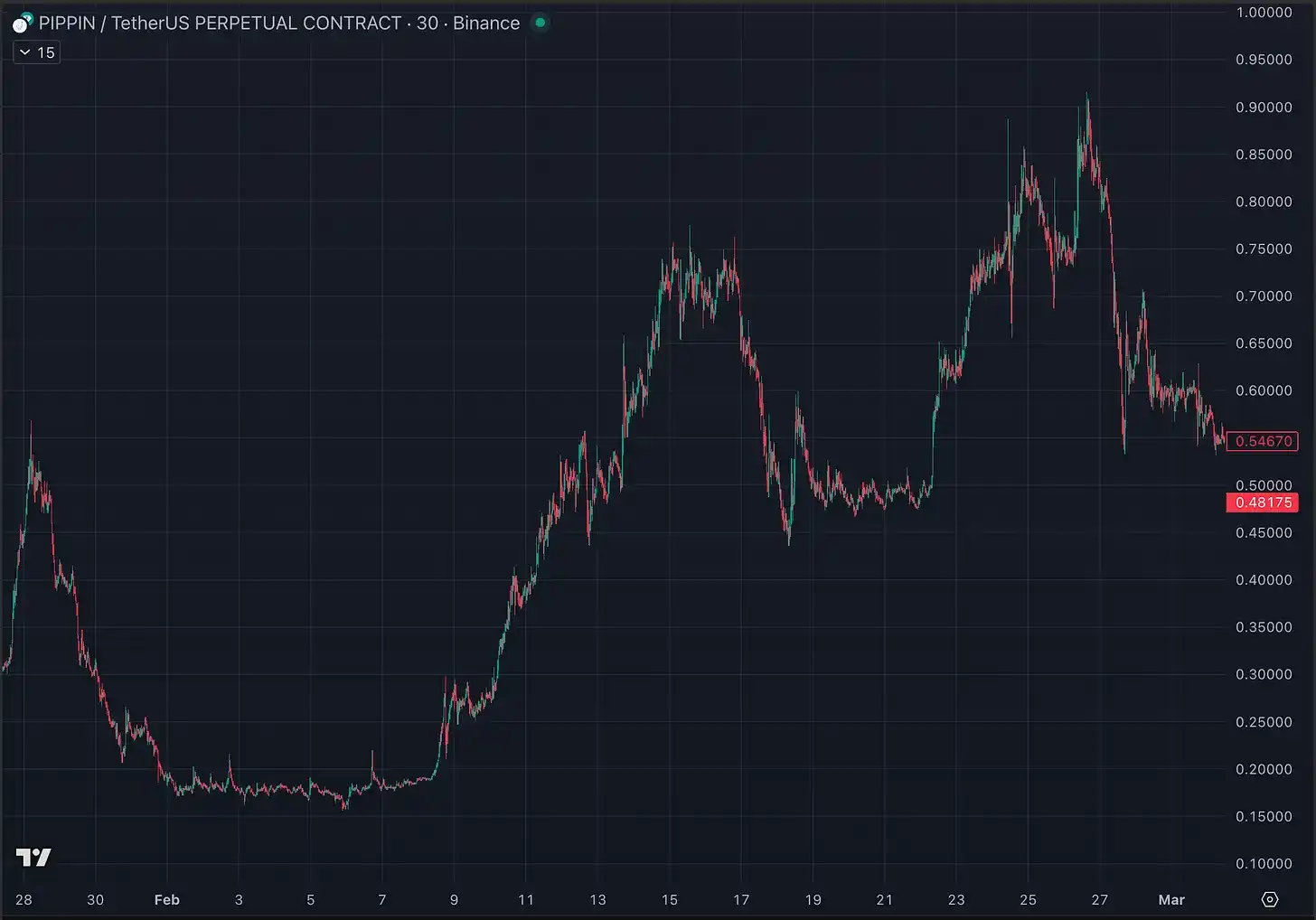
Bear markets seem to provide excellent breeding ground for scam coins. In February, the veteran AI Meme coin $PIPPIN made a comeback – its supply is completely locked by a single entity, and its price action is典型的 of manipulation. $PIPPIN started the month steadily at a $180M market cap, having already experienced a 70% crash over the previous 4 days. It began a strong rally from February 8th, rising +315% in 7 days to set a new high of $750M market cap, then pulled back to $500M before surging again to a new high of $900M. Strangely, its funding rate is no longer negative, making it a relatively less risky (though still risky) short target for a scam coin. Even so, I wouldn't be surprised to see it break the $1bn market cap.
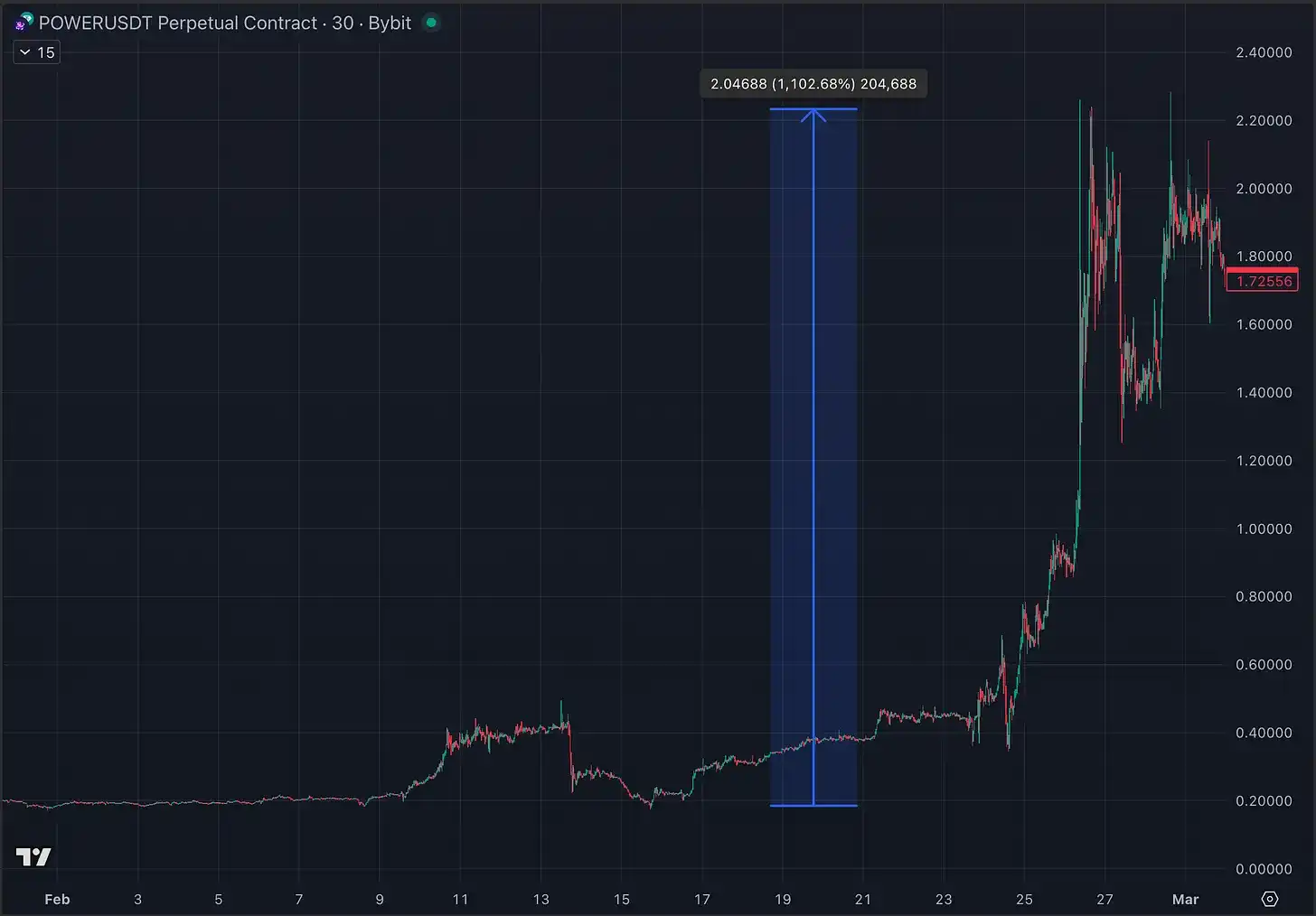
$POWER was one of the new manipulative plays emerging in February, with a 12x move from bottom to top, squeezing to a $2.3bn FDV, with extremely negative funding rates. Be very cautious shorting this.
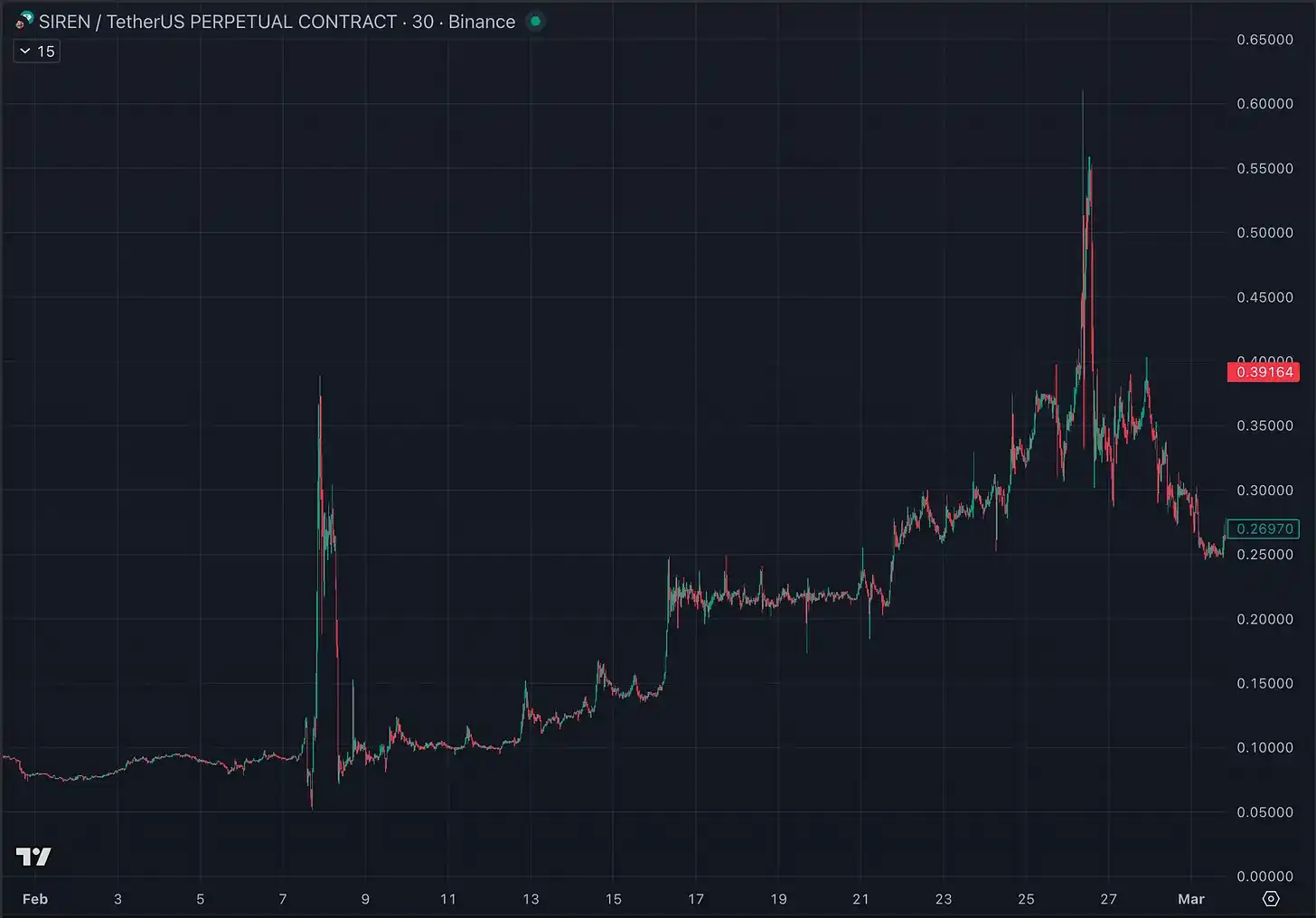
Another notable move was $SIREN, this BSC scam meme coin executed a pump and dump on February 8th – running from $100M market cap to $400M and back to $100M – then spent the rest of February slowly climbing to new highs, eventually executing a major squeeze at a $600M market cap.
It's also worth mentioning $BULLA, which did a 13x run in late January, then crashed 95% in a single day on February 1st, falling from $450M FDV to $25M FDV. $ARC also experienced an 80% collapse after rising from $40M to $130M.

Bear Market Characteristics

We are in a bear market environment: most bullish moves in altcoins are short squeezes that are quickly given back. Here are tokens that exhibited this behavior in February: ZK ZIL LA NIL SONIC DYM ME MOVE 0G INIT RPL ESP AZTEC BIO AGLD SAHARA. These moves typically involve +50% to +100% gains within a single day, accompanied by negative funding rates (making it difficult for shorts), followed by weakness over subsequent days.

Aside from post-crash bounces, altcoins only had two brief periods of strength. The first was February 13th-15th, led by Meme coins (USELESS+50%, PEPE+35%) and AI tokens ($TAO+35%, $VVV+150%, VIRTUAL+25%). The second occurred on February 25th, was extremely brief, and was purely a short squeeze on "dead" large-cap coins, which gained +25% to +30% that day (DOT NEAR UNI APT FIL TIA......).

$HYPE & Perp DEX Sector

$HYPE ended January strongly, rallying from $22 to $34 in a day, and this strength carried over into early February. It reached $38 on February 3rd and was one of the strongest tokens on February 5th, the day of the market-wide crash and liquidation cascade. Its strength was notable – on February 6th it nearly touched $37, as if the market crash never happened for HYPE – but this also marked its top relative to the altcoin market. It slightly underperformed the altcoin market over the next 20 days, pulling back to $26.
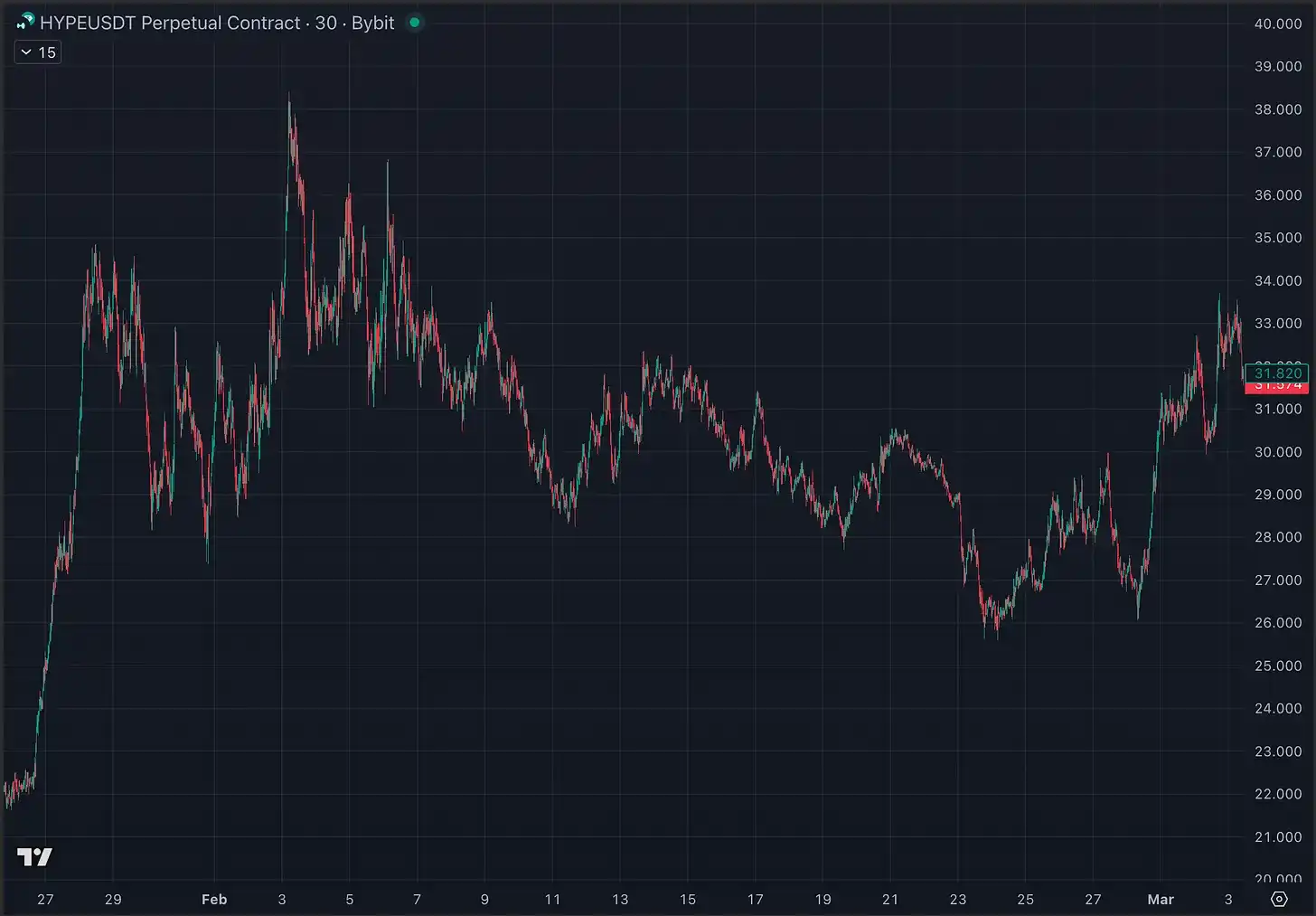
One reason for $HYPE's strength in early February was significant buying by Multicoin over several days, and HSI/PURR (HYPE's DAT) were also accumulating steadily.

In the Perp DEX sector, $LIT continued to show extreme weakness in February, finding support around $1.3, which has been tested four or five times.

$ASTER saw a strong bounce after the February 5th crash, rising from a low near $0.4 to $0.7, then strangely consolidated sideways around $0.7 for the remainder of February. It has a bullish catalyst: the launch of its own L1/blockchain in March.

Uniswap x BlackRock

On February 11th, Uniswap announced a partnership with BlackRock to provide liquidity for the latter's BUIDL product, simultaneously announcing BlackRock's direct investment in $UNI tokens (amount undisclosed). The market reaction was extremely strong, with $UNI gaining +40% in 10 minutes – quite remarkable for a token with an FDV over $30 billion. But the gains were completely erased over the next 10 hours, a classic bear market pump and dump.

Aave went through a period of controversy in February. On February 20th, BGD Labs announced its withdrawal from the Aave DAO due to disagreements over the V4 strategy, causing $AAVE to drop 8%. At the end of the month, Marc Zeller, a well-known figure in the Aave ecosystem, published a critique of Aave Labs, characterizing it as effectively an value extraction vehicle, leading to further token weakness.

Particularly unfavorable for Aave is that its main competitor, $MORPHO, has performed strongly in 2026, gaining nearly +75% in February. The FDV of the two tokens is now roughly equal, around $2bn each.

Other Important Events in February

On February 18th, Base announced it would transition from the Optimism tech stack to building its own. This was devastating for $OP, which fell 40% over 4 days. $ARB was also dragged down by correlation, now with an FDV of "only" $1bn, down 96% from its ATH ($OP is down 97%).

On February 11th, $BERA experienced a very strong short squeeze, gaining +160% in 8 hours, with a extreme discrepancy between spot and futures prices (a 15% gap). This is a weirdly trading token, mostly significantly underperforming the market but occasionally experiencing very strong random squeezes, having already seen a 2x move over 5 days last month.

On February 18th, $WLFI suddenly rose +30% for no apparent reason, simultaneously with open interest (OI) increasing by nearly $100M – this likely means a single entity pulled the price by going long $100M worth of $WLFI. The price then topped out here, has fallen about 20% from the high, and there has been no news since. This entity's move was quite strange, and I expect $WLFI to go much lower in the coming months.

At the end of February 2026, the bankruptcy estate of Terraform Labs sued Jane Street in Manhattan federal court, accusing it of using non-public information during the May 2022 Terra collapse to trade ahead of key UST liquidity events. $LUNC gained +35% in the days following the news.

$ZEC is still digesting its Q4 2025 rally, generally underperforming, but also occasionally seeing powerful squeezes, like the +45% on February 13th-14th. I think it's quite possible it falls to $150 or even $100 in the coming months.

$HNT had a strong 2x move in February. Is this a dead cat bounce for an asset suffering from excessive dilution, or has this DePIN token finally become cheap enough to be a worthwhile buy?

Like last month, $STABLE continued to trade as if its supply is locked, rising +144% from a local bottom of $1.6bn FDV to set a new high near $4bn FDV. DegenSpartan also endorsed it in an article, and given DegenSpartan's rare public commentary lately, this endorsement is quite bullish.

$BCH is a strange token. It consistently rose relative to BTC (outperforming by 40%) for 22-day stretch, then suddenly reversed, giving back all its excess returns in less than a week. Many became bullish on BCH due to the "quantum-resistant" narrative and its overall strength since early 2025, but it now looks like an entity holding a large amount of BCH decided to exit, continuously TWAP selling.

Robinhood listed two altcoins in February: $SNX (February 19th) and $CC. $CC barely reacted, but $SNX gained +42% over several days as a result. Upbit listings remain a very strong catalyst for tokens; $AZTEC (+70%), $ESP (+100%), and $SKR (+40%) all experienced this, with extremely negative funding rates within hours of listing. $BIRB also saw a 2x move after listing on Bithumb on February 3rd.

Two notable TGEs in February were $AZTEC and $ESP (Espresso). Both traded at relatively low valuations (FDV both below $500M, whereas这类 projects easily reached $1bn+ FDV a few months ago), indicating that altcoin premiums are slowly being repriced downward. However, $ESP had a stronger performance, with a +280% move from its late February low to high.

Polymarket announced a partnership with Kaito to launch an attention market. $KAITO rose +13% in 3 minutes after the news, then gave back all gains within an hour.


Domande pertinenti

QWhat was the key price range for BTC in February 2026, and what event caused a sharp drop to $60k?

ABTC's price range for most of 2026 was between $60k and $70k. A sharp drop to $60k occurred on February 5th, falling from $70k in a single day.

QHow did the market react to the US airstrike on Iran and the subsequent announcement of Khamenei's death at the end of February?

ABTC initially dropped from $68k to $65k on rumors of the airstrike, then fell further to $62k when the attack was confirmed. However, it was met with strong buying pressure and closed the day near $68k. The announcement of Khamenei's death was interpreted as a bullish signal, as it suggested the US would not heavily invest in further conflict.

QWhat was the market's reaction to the LayerZero (ZRO) conference on February 10th, and what significant partnerships were announced?

AThe market reaction was complex. A leaked video caused a 20% sell-off, but the official announcement of its own 'Zero' blockchain, along with major partnerships including Citadel Securities, Cathie Wood/ARK, DTCC, and ICE, led to a 45% pump in the following 12 hours. However, these gains were later completely erased.

QWhich 'scam coins' or heavily manipulated tokens were highlighted as having significant price action in February?

AThe article highlighted $PIPPIN, $SIREN, and $POWER as notable manipulated 'scam coins'. $PIPPIN saw a 315% pump, $SIREN had a major pump and dump, and $POWER saw a 12x increase from its bottom.

QAccording to the article, what are the characteristics of the altcoin market in this bearish environment?

AThe bear market is characterized by short-lived altcoin squeezes that quickly give up their gains. These pumps, often +50% to +100% in a single day, are typically followed by weakness over subsequent days. Most altcoin strength was limited to two brief periods: February 13-15 and February 25.

Letture associate

Trading

Spot
Futures

Articoli Popolari

Cosa è BITCOIN

Comprendere HarryPotterObamaSonic10Inu (ERC-20) e la sua posizione nel mondo delle criptovalute Negli ultimi anni, il mercato delle criptovalute ha assistito a un aumento della popolarità delle meme coin, catturando l'interesse non solo dei trader, ma anche di coloro che cercano coinvolgimento comunitario e valore di intrattenimento. Tra questi token unici c'è HarryPotterObamaSonic10Inu (ERC-20), un progetto intrigante che mescola riferimenti culturali nel tessuto delle criptovalute. Questo articolo esplora gli aspetti chiave di HarryPotterObamaSonic10Inu, analizzando i suoi meccanismi, l'etica guidata dalla comunità e il suo coinvolgimento con il panorama crittografico più ampio. Che cos'è HarryPotterObamaSonic10Inu (ERC-20)? Come suggerisce il suo nome, HarryPotterObamaSonic10Inu è una meme coin costruita sulla blockchain di Ethereum, classificata secondo lo standard ERC-20. A differenza delle criptovalute tradizionali che possono enfatizzare l'utilità pratica o il potenziale investimento, questo token prospera grazie al valore di intrattenimento e alla forza della sua comunità. Il progetto mira a creare un ambiente in cui gli utenti coinvolti possono riunirsi, condividere idee e partecipare ad attività ispirate a diversi fenomeni culturali. Una caratteristica notevole di HarryPotterObamaSonic10Inu è la zero tassa sulle transazioni. Questo elemento allettante tende a incoraggiare il trading e il coinvolgimento della comunità, privo di costi aggiuntivi che possono scoraggiare i trader di piccole dimensioni. L'offerta totale della moneta è fissata a un miliardo di token, un numero che segna la sua intenzione di mantenere una circolazione sostanziale all'interno della comunità. Creatore di HarryPotterObamaSonic10Inu (ERC-20) Le origini di HarryPotterObamaSonic10Inu sono avvolte in un certo mistero; i dettagli sul creatore rimangono sconosciuti. Lo sviluppo di questo token non presenta un team identificabile o un piano esplicito, cosa non rara nel settore delle meme coin. Invece, il progetto è emerso organicamente, con il suo progresso fortemente dipendente dall'entusiasmo e dalla partecipazione della sua comunità. Investitori di HarryPotterObamaSonic10Inu (ERC-20) Per quanto riguarda investimenti esterni e finanziamenti, HarryPotterObamaSonic10Inu rimane ambiguo. Il token non elenca alcuna fondazione di investimento conosciuta o un sostegno organizzativo significativo. Invece, la linfa vitale del progetto è la sua comunità di base, che informa la sua crescita e sostenibilità attraverso azioni collettive e coinvolgimento nello spazio crittografico. Come funziona HarryPotterObamaSonic10Inu (ERC-20)? In quanto meme coin, HarryPotterObamaSonic10Inu opera principalmente al di fuori delle strutture tradizionali che governano spesso il valore degli asset. Ci sono diversi aspetti distintivi che definiscono il funzionamento del progetto: Transazioni senza tasse: Senza costi fiscali sulle transazioni, gli utenti possono comprare e vendere liberamente il token senza preoccuparsi di costi nascosti. Coinvolgimento della comunità: Il progetto prospera sull'interazione della comunità, sfruttando le piattaforme social per creare entusiasmo e facilitare il coinvolgimento. Discussioni, condivisione di contenuti e coinvolgimento sono elementi cruciali che aiutano ad espandere la sua portata e a favorire la lealtà tra i sostenitori. Nessuna utilità pratica: Va notato che HarryPotterObamaSonic10Inu non offre un'utilità concreta all'interno dell'ecosistema finanziario. Piuttosto, è classificato come un token principalmente per attività di intrattenimento e comunitarie. Riferimento culturale: Il token incorpora astutamente elementi della cultura pop per attirare interesse, collegandosi a appassionati di meme e seguaci delle criptovalute. HarryPotterObamaSonic10Inu esemplifica come le meme coin operino in modo diverso rispetto ai progetti di criptovalute più tradizionali, entrando nel mercato come costrutti sociali innovativi piuttosto che come asset utilitari. Cronologia di HarryPotterObamaSonic10Inu (ERC-20) La storia di HarryPotterObamaSonic10Inu è segnata da diversi traguardi notevoli: Creazione: Il token è emerso da un meme virale, catturando l'immaginazione di molti appassionati di criptovalute. Le date di creazione specifiche non sono disponibili, sottolineando la sua crescita organica. Inserimento negli scambi: HarryPotterObamaSonic10Inu ha fatto il suo ingresso in vari scambi, consentendo un accesso e un trading più facili da parte della comunità. Iniziative di coinvolgimento della comunità: Attività in corso volte a migliorare l'interazione della comunità, comprese gare, campagne sui social media e generazione di contenuti da parte di fan e sostenitori. Piani di espansione futura: La tabella di marcia del progetto include il lancio di una collezione NFT, merchandising e un sito di eCommerce relativo ai suoi temi culturali, coinvolgendo ulteriormente la comunità e cercando di aggiungere più dimensioni al suo ecosistema. Punti chiave su HarryPotterObamaSonic10Inu (ERC-20) Natura guidata dalla comunità: Il progetto dà priorità al contributo collettivo e alla creatività, garantendo che il coinvolgimento degli utenti sia al centro del suo sviluppo. Classificazione come meme coin: Rappresenta l'epitome delle criptovalute basate sull'intrattenimento, distinguendosi dai veicoli d'investimento tradizionali. Nessuna affiliazione diretta con Bitcoin: Nonostante la somiglianza nel nome del ticker, HarryPotterObamaSonic10Inu è distintivo e non ha alcuna relazione con Bitcoin o altre criptovalute consolidate. Focus sulla collaborazione: HarryPotterObamaSonic10Inu è progettato per creare uno spazio per la collaborazione e la condivisione di storie tra i suoi detentori, fornendo un canale per la creatività e il legame comunitario. Prospettive future: L'ambizione di espandersi oltre il suo presupposto iniziale verso NFT e merchandising delinea un percorso per il progetto per potenzialmente entrare in strade più mainstream all'interno della cultura digitale. Poiché le meme coin continuano a catturare l'immaginazione della comunità crittografica, HarryPotterObamaSonic10Inu (ERC-20) si distingue per i suoi legami culturali e il suo approccio centrato sulla comunità. Anche se potrebbe non adattarsi al modello tipico di un token orientato all'utilità, la sua essenza risiede nella gioia e nella camaraderia coltivate tra i suoi sostenitori, evidenziando la natura in evoluzione delle criptovalute in un'epoca sempre più digitale. Con la continuazione dello sviluppo del progetto, sarà importante osservare come le dinamiche della comunità influenzano la sua traiettoria nel panorama in continuo cambiamento della tecnologia blockchain.

1.2k Totale visualizzazioniPubblicato il 2024.04.01Aggiornato il 2024.12.03

Cosa è BITCOIN

Come comprare BTC

Benvenuto in HTX.com! Abbiamo reso l'acquisto di Bitcoin (BTC) semplice e conveniente. Segui la nostra guida passo passo per intraprendere il tuo viaggio nel mondo delle criptovalute.Step 1: Crea il tuo Account HTXUsa la tua email o numero di telefono per registrarti il tuo account gratuito su HTX. Vivi un'esperienza facile e sblocca tutte le funzionalità,Crea il mio accountStep 2: Vai in Acquista crypto e seleziona il tuo metodo di pagamentoCarta di credito/debito: utilizza la tua Visa o Mastercard per acquistare immediatamente BitcoinBTC.Bilancio: Usa i fondi dal bilancio del tuo account HTX per fare trading senza problemi.Terze parti: abbiamo aggiunto metodi di pagamento molto utilizzati come Google Pay e Apple Pay per maggiore comodità.P2P: Fai trading direttamente con altri utenti HTX.Over-the-Counter (OTC): Offriamo servizi su misura e tassi di cambio competitivi per i trader.Step 3: Conserva Bitcoin (BTC)Dopo aver acquistato Bitcoin (BTC), conserva nel tuo account HTX. In alternativa, puoi inviare tramite trasferimento blockchain o scambiare per altre criptovalute.Step 4: Scambia Bitcoin (BTC)Scambia facilmente Bitcoin (BTC) nel mercato spot di HTX. Accedi al tuo account, seleziona la tua coppia di trading, esegui le tue operazioni e monitora in tempo reale. Offriamo un'esperienza user-friendly sia per chi ha appena iniziato che per i trader più esperti.

3.6k Totale visualizzazioniPubblicato il 2024.12.12Aggiornato il 2025.03.21

Come comprare BTC

Cosa è $BITCOIN

ORO DIGITALE ($BITCOIN): Un'Analisi Completa Introduzione all'ORO DIGITALE ($BITCOIN) L'ORO DIGITALE ($BITCOIN) è un progetto basato su blockchain che opera sulla rete Solana, con l'obiettivo di combinare le caratteristiche dei metalli preziosi tradizionali con l'innovazione delle tecnologie decentralizzate. Sebbene condivida un nome con Bitcoin, spesso definito “oro digitale” a causa della sua percezione come riserva di valore, l'ORO DIGITALE è un token separato progettato per creare un ecosistema unico all'interno del panorama Web3. Il suo obiettivo è posizionarsi come un asset digitale alternativo valido, anche se i dettagli riguardanti le sue applicazioni e funzionalità sono ancora in fase di sviluppo. Cos'è l'ORO DIGITALE ($BITCOIN)? L'ORO DIGITALE ($BITCOIN) è un token di criptovaluta esplicitamente progettato per l'uso sulla blockchain di Solana. A differenza di Bitcoin, che fornisce un ruolo di stoccaggio di valore ampiamente riconosciuto, questo token sembra concentrarsi su applicazioni e caratteristiche più ampie. Aspetti notevoli includono: Infrastruttura Blockchain: Il token è costruito sulla blockchain di Solana, nota per la sua capacità di gestire transazioni ad alta velocità e a basso costo. Dinamiche di Offerta: L'ORO DIGITALE ha un'offerta massima fissata a 100 quadrilioni di token (100P $BITCOIN), sebbene i dettagli riguardanti la sua offerta circolante siano attualmente non divulgati. Utilità: Sebbene le funzionalità precise non siano esplicitamente delineate, ci sono indicazioni che il token potrebbe essere utilizzato per varie applicazioni, potenzialmente coinvolgendo applicazioni decentralizzate (dApp) o strategie di tokenizzazione degli asset. Chi è il Creatore dell'ORO DIGITALE ($BITCOIN)? Attualmente, l'identità dei creatori e del team di sviluppo dietro l'ORO DIGITALE ($BITCOIN) rimane sconosciuta. Questa situazione è tipica tra molti progetti innovativi nel settore blockchain, in particolare quelli allineati con la finanza decentralizzata e i fenomeni delle meme coin. Sebbene tale anonimato possa favorire una cultura guidata dalla comunità, intensifica le preoccupazioni riguardo alla governance e alla responsabilità. Chi sono gli Investitori dell'ORO DIGITALE ($BITCOIN)? Le informazioni disponibili indicano che l'ORO DIGITALE ($BITCOIN) non ha alcun sostenitore istituzionale noto o investimenti di venture capital prominenti. Il progetto sembra operare su un modello peer-to-peer incentrato sul supporto e sull'adozione della comunità piuttosto che su percorsi di finanziamento tradizionali. La sua attività e liquidità si trovano principalmente su exchange decentralizzati (DEX), come PumpSwap, piuttosto che su piattaforme di trading centralizzate consolidate, evidenziando ulteriormente il suo approccio di base. Come Funziona l'ORO DIGITALE ($BITCOIN) Le meccaniche operative dell'ORO DIGITALE ($BITCOIN) possono essere elaborate in base al suo design blockchain e alle caratteristiche della rete: Meccanismo di Consenso: Sfruttando il proof-of-history (PoH) unico di Solana combinato con un modello di proof-of-stake (PoS), il progetto garantisce una validazione efficiente delle transazioni contribuendo all'alta performance della rete. Tokenomics: Sebbene meccanismi deflazionistici specifici non siano stati dettagliati ampiamente, l'ampia offerta massima di token implica che potrebbe soddisfare microtransazioni o casi d'uso di nicchia che devono ancora essere definiti. Interoperabilità: Esiste il potenziale per l'integrazione con l'ecosistema più ampio di Solana, inclusi vari piattaforme di finanza decentralizzata (DeFi). Tuttavia, i dettagli riguardanti integrazioni specifiche rimangono non specificati. Cronologia degli Eventi Chiave Ecco una cronologia che evidenzia traguardi significativi riguardanti l'ORO DIGITALE ($BITCOIN): 2023: Il dispiegamento iniziale del token avviene sulla blockchain di Solana, contrassegnato dal suo indirizzo di contratto. 2024: L'ORO DIGITALE guadagna visibilità poiché diventa disponibile per il trading su exchange decentralizzati come PumpSwap, consentendo agli utenti di scambiarlo contro SOL. 2025: Il progetto assiste a un'attività di trading sporadica e a un potenziale interesse per impegni guidati dalla comunità, sebbene non siano state documentate partnership significative o avanzamenti tecnici fino ad ora. Analisi Critica Punti di Forza Scalabilità: L'infrastruttura sottostante di Solana supporta alti volumi di transazioni, il che potrebbe migliorare l'utilità di $BITCOIN in vari scenari di transazione. Accessibilità: Il potenziale basso prezzo di trading per token potrebbe attrarre investitori al dettaglio, facilitando una partecipazione più ampia grazie a opportunità di proprietà frazionata. Rischi Mancanza di Trasparenza: L'assenza di sostenitori, sviluppatori o di un processo di audit pubblicamente noti potrebbe generare scetticismo riguardo alla sostenibilità e all'affidabilità del progetto. Volatilità del Mercato: L'attività di trading è fortemente dipendente dal comportamento speculativo, il che può comportare una significativa volatilità dei prezzi e incertezze per gli investitori. Conclusione L'ORO DIGITALE ($BITCOIN) emerge come un progetto intrigante ma ambiguo all'interno dell'evolvente ecosistema di Solana. Sebbene tenti di sfruttare la narrativa dell'“oro digitale”, la sua partenza dal ruolo consolidato di Bitcoin come riserva di valore sottolinea la necessità di una chiara differenziazione della sua utilità e struttura di governance. L'accettazione e l'adozione future dipenderanno probabilmente dall'affrontare l'attuale opacità e dalla definizione più esplicita delle sue strategie operative ed economiche. Nota: Questo rapporto comprende informazioni sintetizzate disponibili a ottobre 2023, e potrebbero essersi verificati sviluppi oltre il periodo di ricerca.

99 Totale visualizzazioniPubblicato il 2025.05.13Aggiornato il 2025.05.13

Cosa è $BITCOIN

Discussioni

Benvenuto nella Community HTX. Qui puoi rimanere informato sugli ultimi sviluppi della piattaforma e accedere ad approfondimenti esperti sul mercato. Le opinioni degli utenti sul prezzo di BTC BTC sono presentate come di seguito.

活动图片













